Compound Determiners: every single, each and every, such

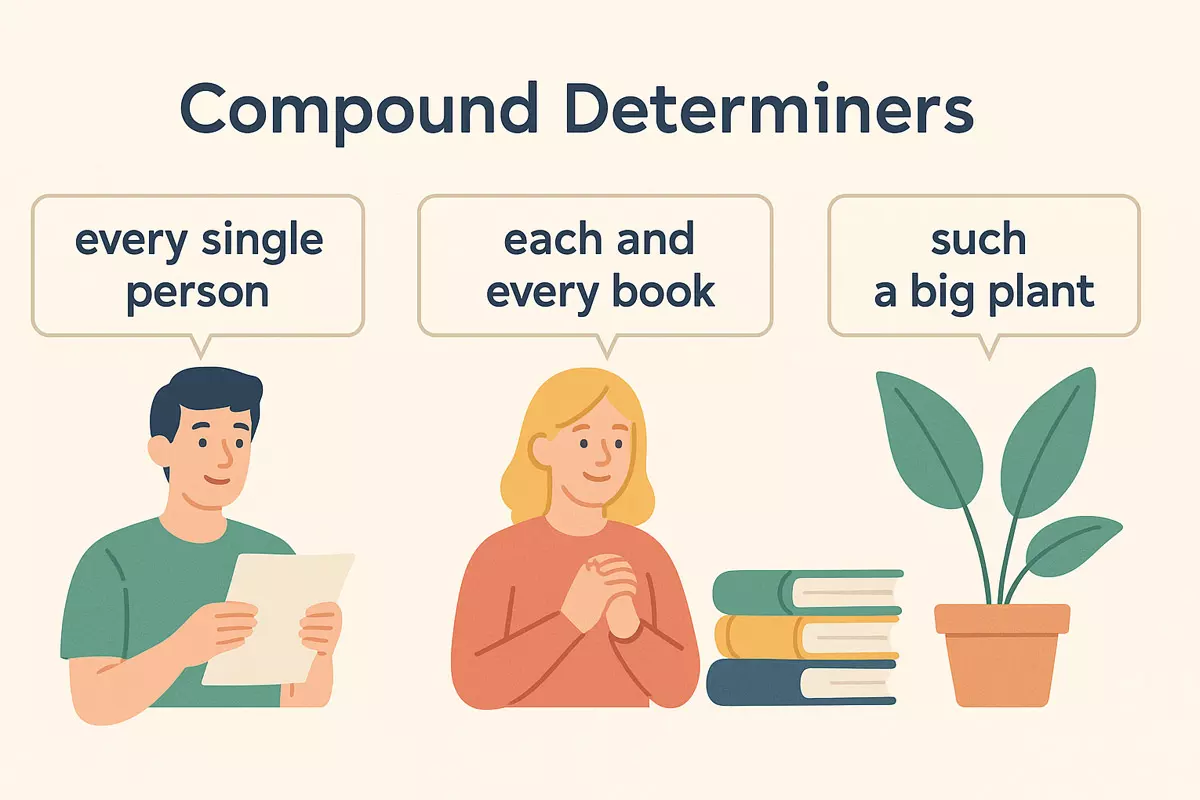 This article explains what compound determiners are, why we use them, and how phrases like every single and each and every add emphasis. It covers usage, tone, common mistakes, and includes practice with sentence rewriting.
- What compound determiners are and why speakers use them
- Using every single to add emphasis and emotion
- Using each and every together for strong generalizations
- Using such before nouns and adjective+noun phrases
- Register and tone: how compound determiners sound in speech
- Common mistakes and overuse of emphatic determiners
- Practice: rewrite neutral sentences using compound determiners
Have you ever noticed how phrases such as every single or each and every add extra emphasis to what you are saying? These expressions are known as compound determiners, and they play a key role in making your statements in English more forceful and clear. By combining words for emphasis, compound determiners help speakers highlight the importance or inclusiveness of what they are talking about, making their message more precise and impactful in everyday communication.
What compound determiners are and why speakers use them
Compound determiners are expressions made up of two or more words that work together in front of a noun to clarify or intensify meaning. Unlike simple determiners (like "every" or "each"), compound forms such as "every single," "each and every," or "such a" add emphasis, specificity, or emotional color to what’s being described. These combinations are especially common in spoken English, where speakers want to stress their point or make a statement sound more personal or dramatic.
How compound determiners work
These multi-word determiners function as a single grammatical unit. They are typically used before singular countable nouns or uncountable nouns, depending on the phrase. For example:
- Every single day felt longer than the last.
- Each and every student must submit their project.
- I’ve never seen such chaos.
By combining words, speakers express a stronger sense of totality or uniqueness. The meaning often goes beyond what a single determiner would convey.
Reasons for using compound determiners
Speakers choose these forms for several reasons:
- To intensify or add emotional force (e.g., "every single time" sounds more emphatic than just "every time").
- To draw attention to the completeness or inclusiveness of a group ("each and every member").
- To clarify or highlight a specific quality ("such an amazing performance").
- To sound more conversational or persuasive.
- To avoid ambiguity, especially in instructions or rules.
Typical patterns and examples
Here are some common compound determiner constructions:
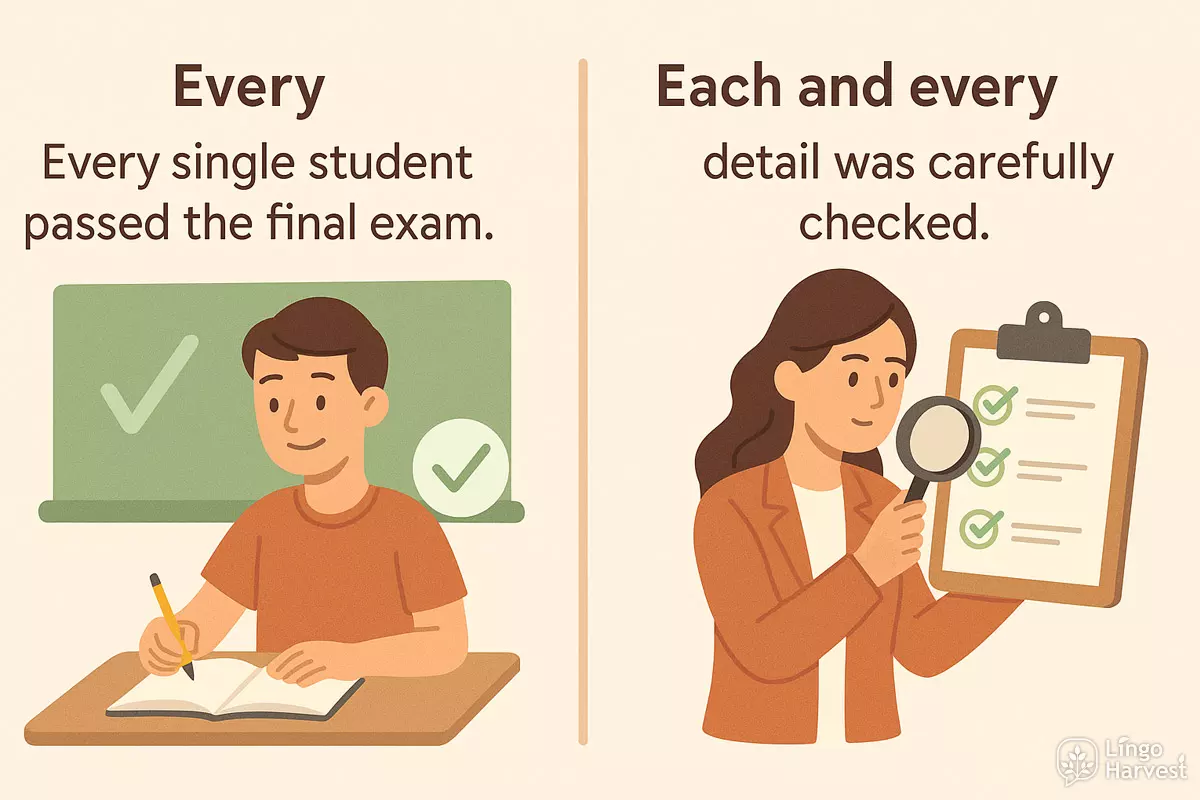
- every single → Every single student passed the final exam.
- each and every → Each and every detail was carefully checked.
- such a / such an → It was such a difficult task that everyone struggled.
- all and sundry → The news spread quickly among all and sundry.
- any and all → He refused to take any and all responsibility.
- no single → No single explanation can fully describe the event.
- so much (as) → She didn’t so much as look at the document.
- this very → This very moment will change everything.
- those particular → Those particular rules must be followed strictly.
- what little → He shared what little food he had.
- what few → What few chances she had, she used wisely.
- certain specific → There are certain specific conditions we must meet.
- these same → These same problems appeared last year.
- that exact → I remember that exact moment clearly.
- one and only → She is the one and only person I trust.
- the very → That was the very reason he left.
- the entire → The entire team worked late.
- some particular → She showed interest in some particular solution.
These expressions are flexible and can be adapted to fit different contexts, from formal writing to everyday conversation.
Comparing compound determiners to simple determiners
Compound determiners are chosen when the speaker wants to go beyond the basic meaning. For instance, "every" on its own is neutral, but "every single" adds a sense of insistence. Similarly, "such" often adds a dramatic or evaluative tone that "a" or "an" lacks.
Summary
In essence, these multi-word determiners allow speakers to fine-tune their meaning, add emotion, and ensure their message is received as intended. Whether to stress importance, include everyone, or highlight a striking characteristic, compound determiners are a useful tool for nuanced expression in English.
Using every single to add emphasis and emotion
The phrase every single is a powerful tool in English for stressing how comprehensive or exhaustive something is. Unlike the simple determiner every, adding single highlights that no exceptions are allowed, and it often adds an emotional or dramatic tone to the statement. People use this expression in both spoken and written English to underline frustration, admiration, or the totality of an experience.
How does “every single” differ from “every”?
While every already refers to all members of a group, every single intensifies this by focusing attention on each item individually. It suggests a personal investment or strong feeling about the group or situation. This can make your language more persuasive or expressive, especially when you want your listener to feel the impact.
- “I read every single book on the list.” (Not just most of them—absolutely all.)
- “She answered every single question correctly.” (Impressive, no mistakes at all.)
- “Every single time I try, something goes wrong.” (Expresses frustration or annoyance.)
- “He thanked every single person who helped.” (Shows thorough gratitude.)
- “Every single day, she calls her mother.” (Emphasizes consistency and care.)
- “They checked every single detail.” (No aspect was ignored.)
- “Every single child in the class got a gift.” (No one was left out.)
- “I remember every single word you said.” (Suggests emotional memory.)
- “Every single page of the report was perfect.” (Highlights thoroughness.)
- “We visited every single store in the mall.” (Shows effort and exhaustion.)
- “Every single mistake taught me something.” (Even the smallest ones mattered.)
- “She noticed every single change.” (Very observant.)
- “Every single meal was delicious.” (No exceptions.)
- “He lost every single match that season.” (Stresses disappointment or bad luck.)
- “Every single student passed the test.” (Emphasizes a positive outcome.)
When to use “every single” for effect
Reserve this phrase for situations where you want to highlight the totality or emotional weight of your statement. It fits well in storytelling, complaints, compliments, and when discussing habits or routines. Overusing it can reduce its impact, so choose moments where you really want listeners to pay attention.
Using each and every together for strong generalizations
When you combine "each" and "every," the result is an emphatic phrase that highlights a sweeping generalization. This construction, often seen as "each and every," stresses that no single member of a group is exempt from the statement. It's commonly used in both spoken and written English to leave no doubt that all individual cases are covered, emphasizing both the individuality and totality.
Why do speakers use "each and every"?
Pairing these determiners creates a stronger, more forceful statement than using "each" or "every" alone. It’s a favorite in formal contexts, motivational speech, rules, instructions, and when expressing total inclusion. The phrase can add emotional weight or seriousness, making it clear that the statement applies universally.
Contexts and examples
You'll often find "each and every" in:
- Motivational or disciplinary statements
- Legal or official documents
- Instructions or warnings
- Emphatic apologies or thanks
Here are some expanded examples of how "each and every" is used:
- Each and every student must submit their assignment by Friday.
- The coach thanked each and every player for their hard work.
- You must check each and every detail before signing the contract.
- I appreciate each and every one of you.
- Security checks each and every bag at the entrance.
- Parents are responsible for each and every child in their care.
- He apologized to each and every guest for the inconvenience.
- The company values each and every customer.
- Please read each and every instruction carefully.
- The law applies to each and every citizen.
- We monitor each and every transaction closely.
- She greeted each and every visitor personally.
- They inspected each and every room in the building.
- He addressed each and every complaint seriously.
- We celebrate each and every victory, big or small.
When not to use "each and every"
While this phrase is powerful, it can sound repetitive or overly formal in casual conversation. Use it for emphasis, not routine situations. For simple, everyday contexts, "each" or "every" alone usually suffices.
Comparing "each," "every," and "each and every"
The nuance and strength of meaning differ between these forms. Observe how emphasis changes:
| Form | Usage Example |
|---|---|
| Each | Each employee must sign in upon arrival. (focus on individuals) |
| Every | Every employee must sign in upon arrival. (focus on the group as a whole) |
| Each and every | Each and every employee must sign in upon arrival. (emphasizes total inclusion, no exceptions) |
Summary
In summary, "each and every" is a powerful tool to underline that a statement applies without exception. Use it to reinforce rules, express gratitude, or stress thoroughness—just be mindful of tone and context to avoid sounding excessive.
Using such before nouns and adjective+noun phrases
When we use such in English, it acts as an intensifier that emphasizes the quality or extent of a noun or an adjective+noun combination. This word is always placed before the noun or the entire adjective+noun phrase it modifies. The structure helps to highlight surprise, admiration, or strong feelings about the noun being described. Such + noun:
- such luck → He had such luck that he won twice in one week.
- such noise → There was such noise in the street that I couldn’t sleep.
- such confusion → The instructions caused such confusion among the students.
- such weather → We stayed inside because of such weather.
- such patience → She showed such patience with the children.
Such + adjective + noun:

- such a beautiful view → We stopped to admire such a beautiful view.
- such an interesting book → I couldn’t stop reading such an interesting book.
- such complicated instructions → He was confused by such complicated instructions.
- such a long journey → We were exhausted after such a long journey.
- such terrible news → She was shocked by such terrible news.
- such a nice surprise → It was such a nice surprise to see you.
- such excellent results → The team achieved such excellent results.
- such a boring movie → We left early because it was such a boring movie.
- such fantastic food → We enjoyed such fantastic food at the festival.
- such a difficult question → The exam included such a difficult question.
Grammar patterns and article use
The use of such with singular countable nouns generally requires an article between such and the noun (usually a or an). For uncountable nouns or plural nouns, no article is used.
- Such a clever idea → That was such a clever idea that everyone agreed immediately.
- Such an unusual experience → It was such an unusual experience that I still think about it today.
- Such delicious food → We were served such delicious food at the wedding.
- Such wonderful people → They are such wonderful people that everyone loves them.
Common mistakes
Learners often confuse so and such. Remember: use so before adjectives or adverbs alone (e.g. so big, so quickly), but use such before a noun or an adjective+noun group (e.g. such a big house).
| Correct Usage | Incorrect Usage |
|---|---|
| such a good idea | so a good idea ❌ |
| such terrible weather | so terrible weather ❌ |
| such an expensive car | so an expensive car ❌ |
| so expensive | such expensive ❌ |
Overall, such is a useful word for highlighting qualities and making your descriptions more vivid. Remember the correct word order and article use to sound natural in English.
Register and tone: how compound determiners sound in speech
How you use phrases like "every single," "each and every," or "such" can shape the impression your speech gives. These compound determiners aren't just about meaning—they also affect the formality, emphasis, and emotional undertone of what you're saying.
Formality and Context
Compound determiners often push language toward a more emphatic or expressive register. For example, "every single" adds intensity compared to a plain "every." Similarly, "each and every" sounds more formal and deliberate, often used in speeches, warnings, or official statements. "Such" is flexible—it can sound formal ("Such behavior is unacceptable") or very casual ("I've never seen such a mess!"), depending on delivery.
Emphasis and Emotional Nuance
These phrases are powerful tools for adding emphasis. "Every single" can express frustration or admiration: "I've told you every single time." "Each and every" underlines thoroughness or inclusivity: "We appreciate each and every one of you." "Such" highlights degree or quality: "Such a beautiful day!"
Typical Speech Patterns and Effects
- Every single: used for strong emphasis, often in complaints or praise.
- Each and every: formal, draws attention to completeness or inclusion.
- Such: modifies nouns for intensity, can be positive or negative in tone.
Comparing Tone and Register
| Compound determiner | Typical register & tone | Example in speech |
|---|---|---|
| every single | Informal, emphatic, personal | "You forgot every single time." |
| each and every | Formal, inclusive, thorough | "We value each and every employee." |
| such | Neutral to formal, expressive | "Such kindness is rare." |
When to Use for Best Effect
Choosing between these depends on your goals:
- Use every single to stress frequency or totality, often in a personal or emotional context.
- Pick each and every for formal occasions, speeches, or when you want to convey seriousness and inclusivity.
- Select such for highlighting qualities or degrees, adaptable to both casual and formal speech.
Being mindful of how these compound determiners affect tone can help you sound more natural and precise, whether you're making a point, offering praise, or expressing frustration.
Common mistakes and overuse of emphatic determiners
Learners often struggle with emphatic compound determiners like every single, each and every, and such. Their power lies in emphasis, but careless use can lead to awkwardness, redundancy, or even confusion. It's helpful to know not just how to use them, but where mistakes most often happen.
Redundancy and unnecessary repetition
One frequent issue is doubling up on emphasis where it isn't needed. For example, using both each and every and every single together in the same sentence can sound clumsy:
- ❌ Incorrect: She checked each and every single room in the building.
- ✅ Better: She checked every single room in the building.
- ✅ Also fine: She checked each and every room in the building.
Inappropriate emphasis
Emphatic determiners should be reserved for situations that truly require strong emphasis. Overusing them in neutral or factual contexts can make your writing or speech seem exaggerated or unnatural.
- ❌ Too much: I drink every single cup of coffee at work.
- ✅ Natural: I drink coffee at work.
- ✅ Emphatic (but justified): I drank every single cup of coffee because I needed to stay awake.
Confusing such with other determiners
Another pitfall is using such incorrectly, especially when combining it with articles or adjectives. Remember, such usually precedes an article and an adjective:
- ❌ Incorrect: She is such intelligent.
- ✅ Correct: She is such an intelligent person.
- ✅ Also correct: It was such a surprise!
Summary of typical misuse patterns
The table below outlines common mistakes and improved alternatives when using these compound determiners.
| Troublesome Example | Improved Usage |
|---|---|
| Each and every single day I go jogging. | Every single day I go jogging. |
| She has such beautiful. | She has such beautiful eyes. |
| I read every single and each of the books. | I read each and every one of the books. |
| He made such a big mess every single time. | He made a big mess every single time. |
| He called each and every single one of his friends. | He called each one of his friends. |
Quick checklist for correct usage
- Use every single or each and every for strong emphasis, but not both together.
- Reserve these phrases for situations that truly require emphasis.
- With such, include an article and an adjective before the noun when appropriate.
- Avoid repeating the same idea with different emphatic determiners in one sentence.
- Check if a simple determiner (like every or each) is sufficient for your meaning.
By being mindful of these pitfalls, your use of emphatic determiners will sound more natural and effective.
Practice: rewrite neutral sentences using compound determiners
Transforming simple sentences into ones with compound determiners like "every single," "each and every," or "such" can add emphasis, highlight individuality, or make your statements more expressive. In this section, you'll get hands-on with these constructions by rewriting neutral statements.
Instructions
Below are basic sentences. Your task: rewrite them using one of the following compound determiners:
- every single
- each and every
- such
Choose the most natural option for each. Don’t just mechanically replace words—think about which determiner best fits the meaning and tone.
Sentences to Rewrite
- All students must submit their assignments on time.
- He gave her a gift she had never seen before.
- They checked all the doors before leaving.
- She enjoys reading books of this kind.
- Everyone in the team worked hard.
- I don’t want to repeat this mistake again.
- All the cookies were eaten by the children.
- This is a problem we have faced before.
- People need to respect the rules.
- He apologized for his behavior.
- I have visited all the museums in the city.
- They want to avoid problems like these in the future.
Tips for Using Compound Determiners
- Every single adds emphasis to the totality or completeness of the group.
- Each and every stresses both the individuality and the completeness.
- Such is used to intensify or qualify a noun, often to express surprise or strong feeling.
Model Transformations
| Neutral Sentence | With Compound Determiner |
|---|---|
| All the students passed the exam. | Every single student passed the exam. |
| She faced challenges in her work. | She faced such challenges in her work. |
| Everyone made an effort. | Each and every person made an effort. |
| He has never seen a mistake like this. | He has never seen such a mistake. |
Show answers
- Every single student must submit their assignments on time.
- He gave her such a gift she had never seen before.
- They checked each and every door before leaving.
- She enjoys reading such books.
- Each and every member of the team worked hard.
- I don’t want to repeat such a mistake again.
- Every single cookie was eaten by the children.
- This is such a problem we have faced before.
- Each and every person needs to respect the rules.
- He apologized for such behavior.
- I have visited every single museum in the city.
- They want to avoid such problems in the future.