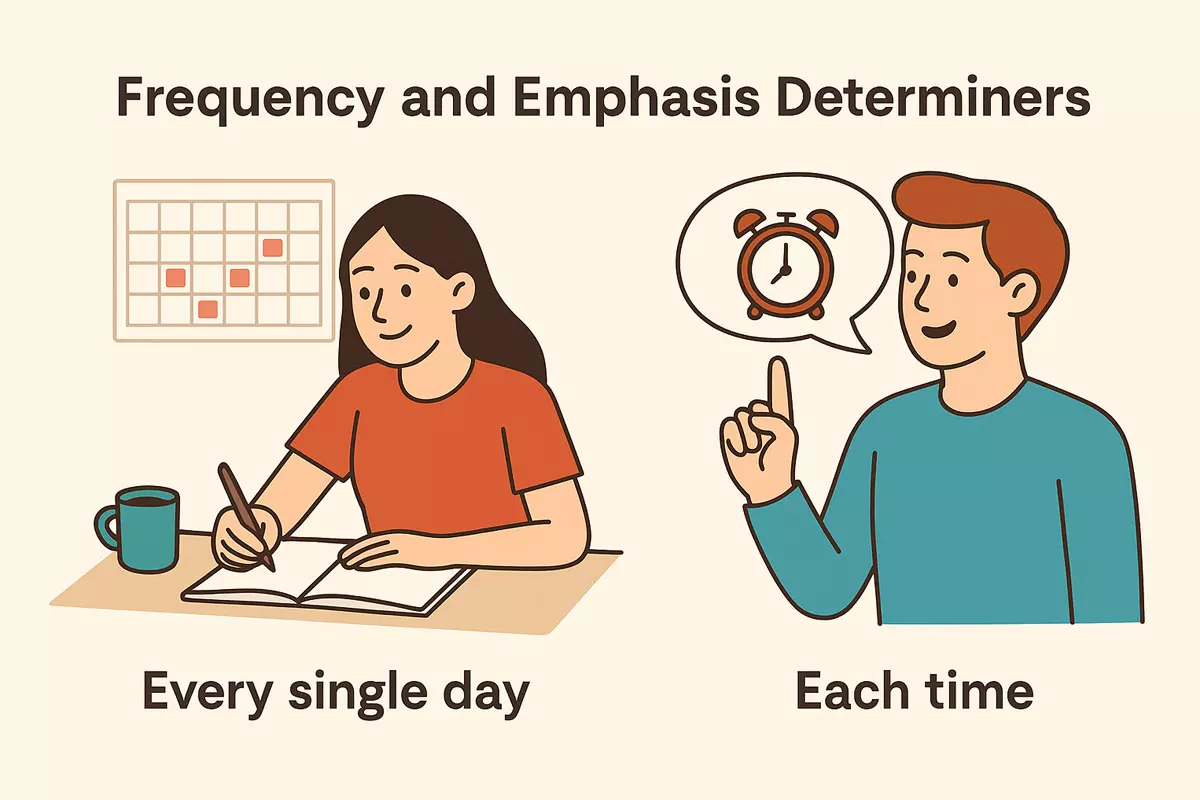
Frequency and Emphasis Determiners: every single day, each time

 Here we how determiners in English convey frequency and intensity, contrasts neutral and emphatic forms such as every and every single, examines their effects in speech and writing, and provides practice in adjusting sentence emphasis.
- How determiners express frequency and intensity
- Using every and each for repeated events
- Strengthening meaning with every single and similar forms
- Contrast between neutral and emphatic expression
- Stylistic effect in storytelling and conversation
- Examples from spoken and written English
- Practice: adjust sentences to increase or decrease emphasis
In everyday conversations, we use certain words and phrases to emphasize how often or how strongly something occurs, allowing us to express habits and underline significance. By choosing terms such as always, never, frequently, or rarely, we subtly convey the frequency of actions or events, while words like crucial, essential, or vital help us stress their importance. This careful selection of language not only clarifies our meaning but also shapes how our listeners perceive the message, making our communication more effective and nuanced.
How determiners express frequency and intensity
When we want to talk about how often something happens or how strongly we feel about it, certain determiners play a key role. Words like “every single day” and “each time” don’t just tell us about occurrence—they also add emphasis, highlighting the regularity or importance of the event. These expressions often combine a basic determiner (“every,” “each”) with an intensifier (“single”) to make the statement stronger or more precise.
Expressing Regularity and Emphasis
Phrases such as “every single day” go beyond the neutral “every day.” By adding “single,” the speaker stresses that no days are missed, and the action is unwavering. This intensification can convey commitment, annoyance, or simply a high degree of regularity. Similarly, “each and every time” makes an action feel exhaustive and leaves no exceptions.
- Every single day – stresses absolute daily repetition
- Each and every time – emphasizes that something happens on all occasions, without exception
- Every last one – intensifies the idea of completeness
- Each individual case – highlights separateness and focus on every item
- Every single person – underlines that no one is left out
- Each and every morning – draws attention to repetition and routine
- Every single effort – focuses on the intensity of attempts
- Each time without fail – suggests consistency and reliability
- Every single moment – expresses that something is true at all times
- Each and every opportunity – stresses thoroughness in taking chances
- Every last detail – intensifies attention to all aspects
- Each individual attempt – emphasizes separate, repeated tries
- Every single night – underlines nightly occurrence
- Each time, without exception – no exceptions allowed
- Every single question – stresses that all questions are included
Comparing Neutral and Emphatic Forms

You can see how adding intensifiers or pairing determiners with extra words changes the tone and meaning:
| Neutral Form | Emphatic/Intensive Form |
|---|---|
| every day | every single day |
| each time | each and every time |
| everyone | every single person |
| every effort | every single effort |
| each case | each individual case |
Why Use These Forms?
Using intensified determiners helps speakers show just how often or how strongly something happens. The choice between “every day” and “every single day” can communicate greater frustration, pride, or urgency. These structures are common in both spoken and written English when the speaker wants to leave no doubt about the frequency or intensity of an action or feeling.
Using every and each for repeated events
When talking about things that happen again and again, English speakers often choose between “every” and “each.” Both words can describe repeated actions or regular occurrences, but they have subtle differences in meaning and usage. Understanding how to use these determiners correctly will help you sound more natural and precise.
General Usage and Nuances
“Every” is used to refer to all members of a group as a whole, especially when talking about regular intervals or repeated events. “Each,” on the other hand, emphasizes individuals one by one, often drawing attention to the uniqueness or separateness of every instance. For example:
- We have a meeting every Monday. (regular, as a group)
- Each student gets a turn to speak. (focus on individuals)
Patterns with Time Expressions
“Every” is typically used with time words to describe frequency. “Each” can also be used, though it often adds a sense of individual attention or emphasis.
- Every morning, I drink coffee.
- Each morning, I check my email.
- Every single day, she calls her mother. (extra emphasis)
- Each time you visit, bring your badge.
- Every week, there’s a new episode.
- Each year, the festival grows bigger.
- Every five minutes, the alarm rings.
- Each time I see him, he’s smiling.
- Every summer, we travel abroad.
- Each birthday feels special.
Emphasis and Special Forms
Adding “single” after “every” (as in “every single day”) gives extra force, stressing that no days are missed or skipped. This construction is common in spoken English to show strong feelings or importance. “Each and every” is another phrase used to underline thoroughness or completeness, though it’s more formal or emphatic.
- She checks on her plants every single morning. (strong emphasis)
- Each and every time I ask, he helps me. (very thorough)
Quick Comparison
| Usage | Example |
|---|---|
| Regular intervals (group focus) | Every Saturday, they play soccer. |
| Emphasis on individuals | Each player wears a different jersey. |
| Strong emphasis (no exceptions) | Every single moment counts. |
| Individual repeated actions | Each time the phone rings, I worry. |
Summary Tips
- Use “every” for regular, group, or routine events.
- Choose “each” to highlight separate, individual acts or occasions.
- Add “single” for extra emphasis: “every single day.”
- “Each time” stresses individual repetition or reaction.
By learning these distinctions, you’ll better express how often things happen and how much they matter.
Strengthening meaning with every single and similar forms
Using phrases like "every single day" or "each and every time" adds extra emphasis to frequency determiners, making statements more forceful or emotionally charged. These intensified forms highlight the speaker’s attitude, often conveying frustration, amazement, or insistence. Instead of simply stating regularity, they underline the idea that not a single exception exists.
How intensified determiners work
Adding words such as “single,” “last,” or “little” to common determiners strengthens the sense of totality. For example, "every single mistake" stresses that not one mistake is overlooked. These forms are common in both spoken and written English when speakers want to stress how often or how thoroughly something happens.
- every single day → I practice English every single day.
- each and every time → Each and every time she calls, I answer.
- every last detail → He checked every last detail before submitting the report.
- every little thing → She worries about every little thing.
- every single person → Every single person in the room agreed.
- each individual moment → I tried to enjoy each individual moment of the trip.
- every single one → I read every single one of his messages.
- every single time → Every single time it rains, the road floods.
- every single reason → She had every single reason to refuse.
- each separate case → Each separate case must be reviewed carefully.
- every single opportunity → He takes every single opportunity to learn.
- every possible chance → She gave him every possible chance to explain.
- every little bit → Every little bit of help makes a difference.
- every single step → Follow every single step of the instructions.
- every last second → He used every last second to finish the test.
- every single instance → The rule applies in every single instance.
- every single example → We analyzed every single example in the book.
- each and every one → Each and every one of the tickets was sold.
Comparing emphasis: standard vs. strengthened forms
The difference between a basic determiner and its strengthened variant can change the tone of a sentence. Notice how the meaning shifts in these pairs:
- every day vs. every single day
- each time vs. each and every time
- every mistake vs. every single mistake
- every detail vs. every last detail
The second option in each pair adds weight and emotional color to the sentence, making the frequency or thoroughness more vivid for the listener or reader.
Where and why we use these forms
Speakers turn to these reinforced determiners when they want to:
- Express strong feelings (e.g., annoyance, admiration, insistence)
- Clarify there are no exceptions
- Make statements more persuasive or memorable
- Emphasize thoroughness or completeness
In summary, these intensified expressions are a natural way to boost the impact of frequency and emphasis determiners, making communication more expressive and precise.
Contrast between neutral and emphatic expression
Choosing between neutral and emphatic determiners can subtly shift the tone and intent of a sentence. While neutral frequency words like "every day" or "each time" simply state regularity or repetition, their emphatic counterparts—"every single day," "each and every time"—add weight and emotional coloring. This extra emphasis may signal frustration, admiration, or a desire to stress the importance or constancy of an action.
How emphasis changes meaning
Regular expressions of frequency sound factual and objective. When someone says, "I go for a walk every day," they’re just stating a routine. However, adding emphasis, as in "I go for a walk every single day," suggests determination, annoyance, or amazement, depending on context. Emphatic forms often appear in spoken English to underline a point or react to disbelief.
Common patterns: neutral vs. emphatic
- every day → every single day
- each time → each and every time
- every morning → every single morning
- every week → every single week
- each attempt → each and every attempt
- every meeting → every single meeting
- each year → each and every year
- every chance → every single chance
- each call → each and every call
- every lesson → every single lesson
Usage notes and nuance
Emphatic forms are best reserved for situations where you want to draw attention to consistency, effort, or exasperation. Overusing them can sound unnatural or overly dramatic. For written contexts, especially formal writing, neutral forms are more common. In conversations, speakers may switch to emphatic phrases to reinforce their message or respond to skepticism.
| Neutral Expression | Emphatic Expression | Typical Effect or Connotation |
|---|---|---|
| every day | every single day | Highlights regularity, can imply frustration or dedication |
| each time | each and every time | Emphasizes repetition, often for insistence or emphasis |
| every meeting | every single meeting | Stresses totality, sometimes used to complain or stress effort |
| each attempt | each and every attempt | Underscores thoroughness, determination, or exasperation |
| every morning | every single morning | Can show routine or amplify emotional response |
Using stronger determiners can add color and intent to your language, but matching the degree of emphasis to the context is key for clarity and natural expression.
Stylistic effect in storytelling and conversation
The use of emphatic determiners like "every single day" or "each time" can subtly shift the tone and emotional impact of spoken and written narratives. Rather than simply stating frequency, these expressions highlight emotional resonance, frustration, routine, or even affection. Choosing a more emphatic phrase often signals the speaker’s attitude or underlines the significance of repeated actions.
Heightening emotional impact
Writers and speakers turn to these intensifiers to make experiences more vivid for listeners or readers. For example, "every single day" conveys more persistence or weariness than the plain "every day," while "each and every time" signals exasperation or thoroughness. This choice can reveal character traits, set the mood, or add a layer of irony.

- "Every single day, she waited by the window."
- "He forgets his keys each and every time."
- "Every single time I call, you’re busy."
- "Each time the phone rang, her heart raced."
- "Every single moment counts."
- "He checks his email every single hour."
- "Each and every one of you matters."
- "Every single mistake taught me something."
- "Each time I visit, it feels different."
- "Every single page of this book is a treasure."
Conversation: signaling attitude and connection
In dialogue, frequency and emphasis determiners can signal impatience, affection, or even sarcasm, depending on context and delivery. For instance, "every single time you do this..." may convey annoyance, while "each and every day I love you more" expresses devotion.
Comparison of effect
The following table shows how subtle changes in phrasing affect tone and intensity:
| Standard Phrase | Emphatic/Stylistic Variant |
|---|---|
| every day | every single day |
| each time | each and every time |
| every mistake | every single mistake |
| each of you | each and every one of you |
| every hour | every single hour |
Nuances in storytelling
Choosing between neutral and emphatic forms allows storytellers to control pacing and focus. Using these determiners sparingly can make key moments stand out, whereas overuse risks diluting their impact. In summary, such phrases are valuable tools for conveying emotional nuance, shaping the listener's perception, and enhancing the rhythm of both spoken and written language.
Examples from spoken and written English
Everyday language makes frequent use of determiners like every single day and each time to highlight regularity or intensity. These phrases appear in both casual speech and formal writing, often to add emphasis or to clarify the frequency of an action.
Common usage patterns
- She calls her mother every single day without fail.
- He checks his email each time he sits at his desk.
- I remind myself every single day to stay positive.
- Each time I visit, the garden looks different.
- They practice the piano every single day before dinner.
- Each time you make the same mistake, you learn something new.
- We go for a walk every single day, rain or shine.
- Each time the bell rings, the class begins.
- He writes in his journal every single day.
- Each time she hears that song, she smiles.
- Our dog needs to be fed every single day at the same time.
- Each time I try to call, the line is busy.
Spoken versus written emphasis
In conversation, people often use these phrases for extra impact. Adding "single" in every single day stresses the unbroken routine, while each time draws attention to repeated, distinct events. In writing, these determiners can give clarity or underline the importance of consistency and repetition.
Comparing "every single day" and "each time"
| Expression | Typical Context | Example Sentence |
|---|---|---|
| every single day | Ongoing, daily routines or habits | She exercises every single day. |
| each time | Repeated, separate occasions | Each time he calls, I get nervous. |
| every single day | Emphasizing no exceptions | He takes his medication every single day. |
| each time | Highlighting repeated reactions or outcomes | Each time it rains, the roof leaks. |
Writers and speakers choose between these expressions based on whether they want to stress continuous frequency or focus on individual repeated moments. Both play a key role in adding nuance and emphasis to descriptions of habitual actions or recurring events.
Practice: adjust sentences to increase or decrease emphasis
Understanding how to modify the intensity of a statement is a valuable skill, especially when working with frequency and emphasis determiners like “every single day” or “each time.” Let’s look at ways to make sentences stronger or more neutral, and then try some hands-on tasks to practice these adjustments.
Ways to Increase or Decrease Emphasis
To express something with more intensity, you can add words such as every single, each and every, or absolutely every. To tone it down, use basic determiners like every, each, or even sometimes for much less frequency.
- Every single day – adds strong emphasis (suggests without exception)
- Every day – neutral (just regular frequency)
- Each time – neutral (for every occurrence)
- Each and every time – more emphatic (no exceptions at all)
- Sometimes – much less frequent, reduces emphasis
- Almost every time – strong but allows for rare exceptions
- Occasionally – emphasizes rarity
- Once in a while – very rare, minimal emphasis
- Always – extreme emphasis on frequency
- Rarely – minimal emphasis, nearly never
Comparing Sentences: More vs. Less Emphasis
| Low/Neutral Emphasis | High Emphasis |
|---|---|
| I go for a walk every day. | I go for a walk every single day. |
| She checks her email each time she arrives. | She checks her email each and every time she arrives. |
| They visit us occasionally. | They visit us absolutely every time they’re in town. |
| He calls sometimes. | He calls every single time he has news. |
| I rarely eat dessert. | I eat dessert every single day. |
Try It Yourself: Adjust the Emphasis
Rewrite the following sentences to make them either more emphatic or less emphatic, as indicated.
- Make the sentence stronger: “I finish my homework every day.”
- Make the sentence weaker: “She calls me every single day.”
- Make the sentence stronger: “They clean the office each time.”
- Make the sentence less strong: “He complains each and every time.”
- Make the sentence stronger: “I see him sometimes at the gym.”
- Make the sentence weaker: “We meet every single weekend.”
- Make the sentence stronger: “She checks her email every morning.”
- Make the sentence less strong: “They argue every single evening.”
- Make the sentence stronger: “He practices piano every week.”
- Make the sentence weaker: “I think about this problem every single time.”
Show answers
- I finish my homework every single day.
- She calls me every day (or sometimes).
- They clean the office each and every time.
- He complains each time (or sometimes).
- I see him almost every single time at the gym.
- We meet every weekend (or sometimes).
- She checks her email every single morning.
- They argue every evening (or sometimes).
- He practices piano every single week.
- I think about this problem every time (or quite often).
Tips for Adjusting Emphasis
To intensify your point, add words like single, each and every, or absolutely. To soften, use words like sometimes, rarely, or simply remove intensifiers. Consider the effect you want your sentence to have and choose your determiner accordingly.