Interrogative Determiners: what, which, whose in Questions

 Here we what interrogative determiners are, how to use what, which, and whose in questions, their correct order, and common mistakes. It also provides practical exercises for forming questions about people, objects, and choices.
- What interrogative determiners are and how they work
- Difference between what and which in questions
- Using whose to ask about possession politely
- Question word order with what, which, and whose
- Everyday question examples with objects, people, and choices
- Common mistakes with interrogative determiners
- Practice: rewrite statements as questions using what, which, or whose
In English, we use specific words to ask about details, choices, or relationships, helping us gather information and clarify ownership or characteristics. Words like who, what, where, when, why, and which are essential for forming questions that target specific information, such as identifying people, objects, places, reasons, or options. Additionally, words like whose help us determine possession or ownership in a conversation. Understanding how to use these question words allows us to communicate more effectively and obtain the details we need in various situations.
What interrogative determiners are and how they work
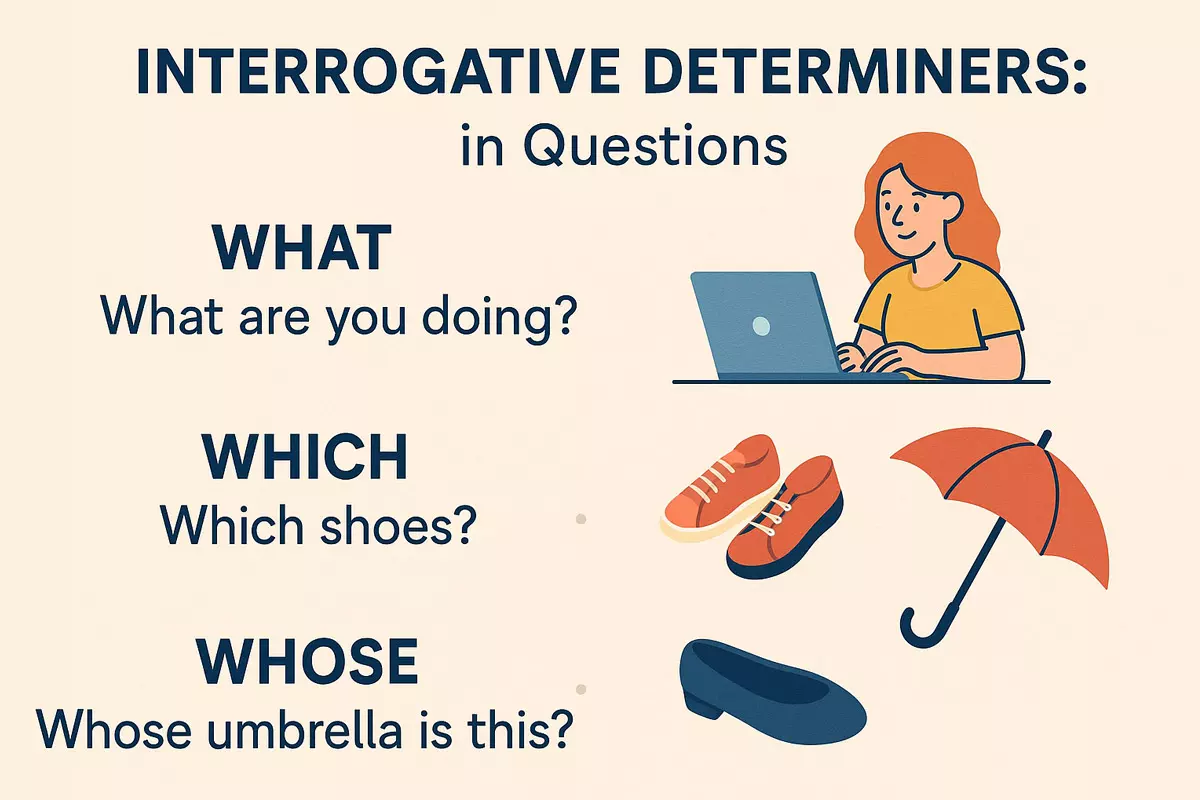
Interrogative determiners are words that introduce questions and directly modify nouns. In English, the most common examples are what, which, and whose. These words help us ask for specific information about people or things by attaching to a noun in a question, rather than standing alone. For example, compare “What is your name?” (pronoun) with “What color is your car?” (determiner).
How interrogative determiners function in questions
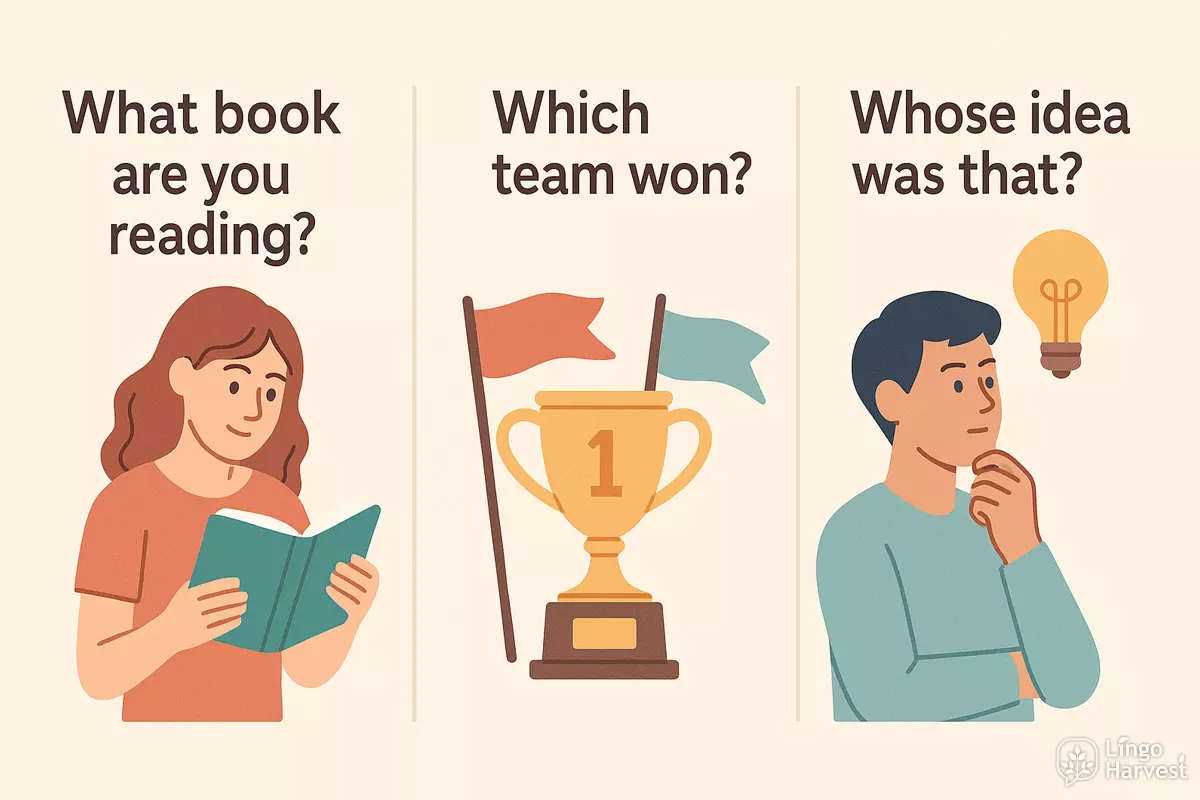
These determiners always come at the beginning of a noun phrase and signal that the speaker is requesting more details about a particular item, group, or ownership. They do not stand alone; instead, they are always attached to a noun:
- What book are you reading?
- Which team won?
- Whose idea was that?
Key points about usage
- They must be followed by a noun: “Which movie,” not just “Which?”
- They are different from interrogative pronouns, which can stand alone (“What happened?”).
- They can be used in both direct and indirect questions.
- They help clarify exactly what information is being requested.
Examples comparing the main forms
Here’s how the three main interrogative determiners differ in use:
| Determiner | Example Question | Typical Use |
|---|---|---|
| What | What book did you buy? | Asks for information about an unspecified item or kind |
| Which | Which movie do you prefer? | Asks for a choice from a known or limited set |
| Whose | Whose jacket is this? | Asks about ownership or association |
More examples in context
- What day is your appointment?
- Which route should we take?
- Whose keys are on the table?
- What time does the train leave?
- Which flavor do you want?
- Whose phone keeps ringing?
- What size do you wear?
- Which book belongs to Anna?
- Whose turn is it?
- What kind of music do you like?
- Which color do you prefer?
- Whose idea was this project?
In summary, interrogative determiners make it possible to ask detailed questions by specifying the noun they refer to. They help keep questions clear and direct, ensuring that the listener knows exactly what information is being requested.
Difference between what and which in questions
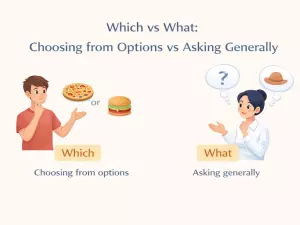
When forming questions in English, “what” and “which” both help identify or specify things, but they are used in different contexts. “What” is generally open-ended and used when there is a broad or unlimited set of possible answers. In contrast, “which” is more selective, used when choosing from a defined or limited group.
General Usage
“What” is ideal when the speaker does not know the range of possible responses. For example, “What color do you like?” could mean any color in existence. On the other hand, “which” is appropriate when the options are already known or visible: “Which color do you prefer—red or blue?” Here, the choice is restricted.
Key Differences at a Glance
| Usage | Example Question | Typical Context | Implied Choice |
|---|---|---|---|
| What | What book are you reading? | Open set of possibilities | Any book |
| Which | Which book did you choose from the shelf? | Limited, known options | Specific books on the shelf |
Practical Examples
- What movie do you want to watch? (any movie)
- Which movie should we watch tonight—Inception or Interstellar? (choices given)
- What food do you like? (all foods possible)
- Which food would you like from the menu? (items listed)
- What language do you speak? (open to all languages)
- Which language did you use in your last email? (specific, known choices)
- What subject interests you most? (no restriction)
- Which subject did you choose for your project? (selection from set)
- What song is playing? (any song)
- Which song did you add to the playlist? (from playlist options)
- What city would you like to visit? (unlimited cities)
- Which city did you visit last summer? (from a group discussed earlier)
Common Pitfalls
It is easy to confuse these determiners, especially in casual speech. Remember: use “what” when you are not limiting responses, and “which” when the listener is choosing from a set. For instance, “Which animal do you like?” only makes sense if the animals have been specified before.
Summary
In summary, “what” is broad and non-restrictive, while “which” signals a defined set. Using them correctly helps questions sound natural and precise.
Using whose to ask about possession politely
When you want to inquire about ownership in English, "whose" is the go-to interrogative determiner. This word helps you ask about who something belongs to without sounding rude or blunt. Instead of directly asking "Is this your pen?" you can use "Whose pen is this?" to keep the question neutral and polite, making it especially useful in formal settings or when you don't want to assume ownership.
How "whose" works in questions
"Whose" is always followed by a noun, indicating the object you are asking about. The structure is simple: Whose + noun + verb…? This pattern allows you to focus on the item and its possible owner, rather than the person directly.
- Whose coat is on the chair?
- Whose idea was it to go hiking?
- Whose phone keeps ringing?
- Whose keys did I find in the kitchen?
- Whose turn is it to present?
- Whose car is blocking the driveway?
- Whose advice should we follow?
- Whose shoes are these by the door?
- Whose handwriting is on the board?
- Whose responsibility is it to lock the office?
- Whose lunch is in the fridge?
- Whose team won the match?
- Whose books are on my desk?
- Whose appointment is scheduled at 3 PM?
- Whose laptop was left behind?
- Whose suggestion did the manager choose?
- Whose umbrella did you borrow?
- Whose dog is barking outside?
- Whose project are we reviewing?
- Whose jacket did you take by mistake?
Politeness and indirectness
Choosing "whose" over a more direct form softens your question. It avoids assumptions and lets people respond without feeling accused or singled out. For example, in a group setting, "Whose bag is this?" is more considerate than asking, "Is this your bag?"
Responding to "whose" questions
When answering, people usually reply with a possessive pronoun or a name:
- It's mine.
- That's John's.
- Those are hers.
This approach keeps the conversation smooth and courteous, especially in shared or public spaces.
Question word order with what, which, and whose
English questions that begin with what, which, or whose follow a specific word order, especially when these words are used as determiners before nouns. Understanding this order helps you form clear and natural questions in conversation and writing. When these interrogative determiners start a question, the typical order is:
- Interrogative determiner (what, which, or whose)
- Noun
- Auxiliary verb (if needed)
- Subject (if not already included)
- Main verb
- Other sentence elements (object, place, time, etc.)
Examples of word order in questions
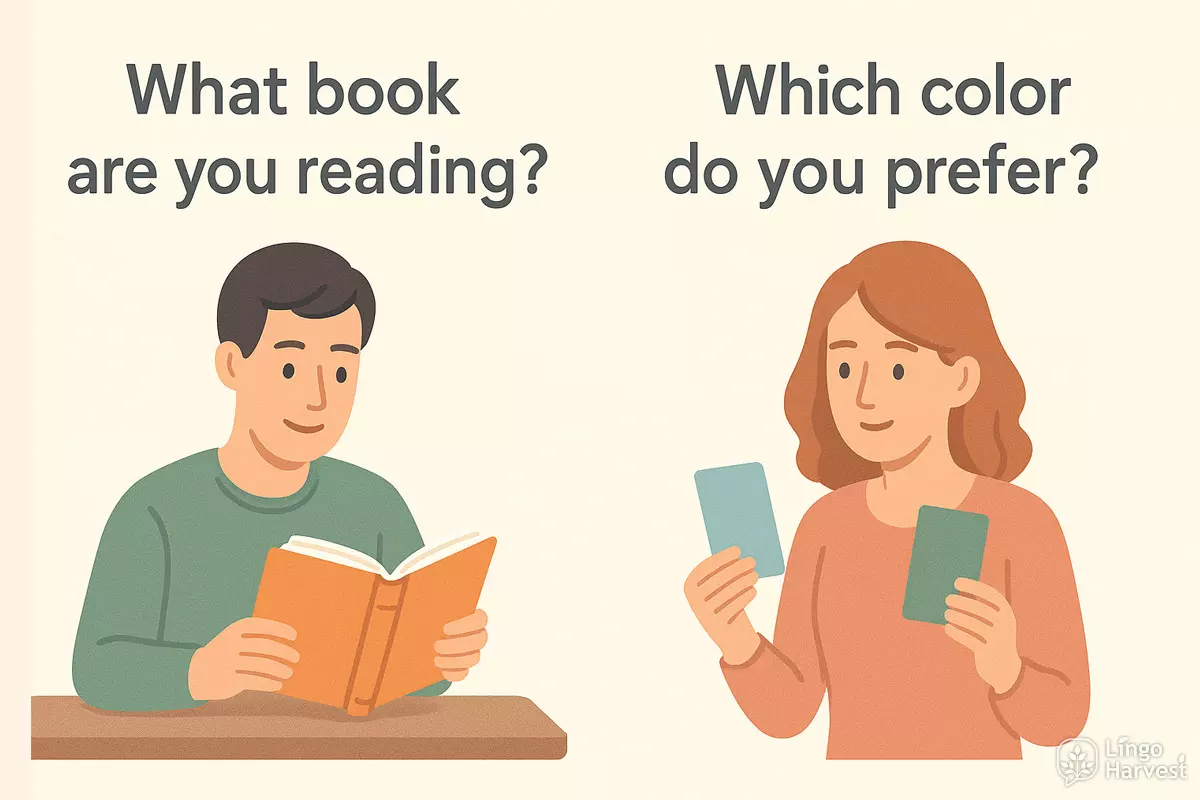
Here are some common patterns you’ll encounter:
- What book are you reading?
- Which color do you prefer?
- Whose jacket is this?
- What movies has she seen?
- Which train leaves next?
- Whose keys did you find?
- What time does the meeting start?
- Which team won the match?
- Whose phone keeps ringing?
- What languages do you speak?
- Which shoes should I wear?
- Whose idea was it?
- What subject do you like most?
- Which bus goes to the center?
- Whose turn is it now?
Direct vs. indirect questions
When these determiners are used in indirect questions, the word order changes. In indirect questions, the subject comes before the verb, just as in statements. For example:
- Can you tell me which book you are reading?
- I wonder whose car that is.
- Do you know what time the train leaves?
Summary table: Word order in questions vs. statements
| Question | Statement/Indirect Question |
|---|---|
| What book are you reading? | You are reading a book. / I wonder what book you are reading. |
| Which team won? | The team won. / Tell me which team won. |
| Whose bag is this? | This is someone’s bag. / Do you know whose bag this is? |
| What color do you like? | You like a color. / Please say what color you like. |
Remember: in direct questions, the auxiliary verb usually comes before the subject, but in indirect questions or statements, the subject comes before the verb. This distinction is key to asking and understanding questions naturally in English.
Everyday question examples with objects, people, and choices
When using interrogative determiners like what, which, and whose, questions often revolve around tangible items, selecting from options, or identifying people in daily situations. These words help specify the subject of the question, making conversations clearer and more focused.
Questions about objects
People frequently ask about things they see, need, or want to know more about. Here are practical examples:
- What book are you reading?
- Which shirt do you prefer for the interview?
- Whose phone is ringing?
- What color is your new car?
- Which keys are mine?
Questions involving people
Identifying or asking about individuals is common, especially in group settings or when something belongs to someone. Consider these examples:
- Which student won the prize?
- Whose idea was this?
- What teacher do you have for math?
- Which friend is coming to dinner?
- Whose jacket is this on the chair?
Questions about choices and preferences
Daily life often involves making selections. Interrogative determiners clarify which option is being discussed:
- Which movie should we watch tonight?
- What dessert would you like?
- Which route is faster?
- What time works for you?
- Which seat do you want?
Comparing what, which, and whose in context
Below is a table showing how these words function in similar questions, highlighting their differences when asking about objects, people, or choices.
| Question Word | Example in Context |
|---|---|
| What | What bag did you buy? (open, any bag) |
| Which | Which bag did you buy? (from a known set of bags) |
| Whose | Whose bag is this? (asking about ownership) |
| Which (person) | Which colleague called? (choosing from a group) |
| What (person) | What teacher is on duty? (type or identity of person) |
| Whose (person) | Whose friend is waiting outside? (ownership of the friend) |
These examples demonstrate the flexibility and precision of interrogative determiners in everyday English. By choosing the right word, you can ask more effective questions about items, people, and available options.
Common mistakes with interrogative determiners
Learners often run into trouble when using “what,” “which,” and “whose” in questions, especially when deciding which one is appropriate or how to structure the sentence. Misunderstandings can lead to awkward or confusing questions.
Mixing up “what” and “which”
Choosing between “what” and “which” depends on how specific the options are. “What” is used for open choices, while “which” is for a limited set. Confusing the two is common, especially in everyday conversation.
- Incorrect: What color do you prefer: red or blue?
- Correct: Which color do you prefer: red or blue?
- Incorrect: Which animal lives in the jungle?
- Correct: What animal lives in the jungle?
Omitting the noun after the determiner
Interrogative determiners need to be followed by a noun. Using them alone can make your question incomplete or unclear.
- Incorrect: Which do you want?
- Correct: Which book do you want?
- Incorrect: Whose is this?
- Correct: Whose pen is this?
Confusing “whose” with “who’s”
“Whose” shows possession, while “who’s” is a contraction for “who is” or “who has.” Mixing these up leads to both grammatical and meaning errors.
- Incorrect: Who’s bag is this?
- Correct: Whose bag is this?
Word order errors
Placing the interrogative determiner incorrectly in the sentence can confuse the listener or reader. The determiner should come before the noun it modifies.
- Incorrect: Book which do you want?
- Correct: Which book do you want?
- Incorrect: Pen whose is this?
- Correct: Whose pen is this?
Forgetting subject-verb agreement
Even when the question starts with an interrogative determiner, the verb must agree with the subject.
- Incorrect: Which fruits is on the table?
- Correct: Which fruits are on the table?
Summary of typical errors
Below is a quick reference highlighting frequent pitfalls and their corrections:
| Mistake | Correction |
|---|---|
| What color do you prefer: red or blue? | Which color do you prefer: red or blue? |
| Which animal lives in the jungle? | What animal lives in the jungle? |
| Which do you want? | Which book do you want? |
| Who’s bag is this? | Whose bag is this? |
| Book which do you want? | Which book do you want? |
| Which fruits is on the table? | Which fruits are on the table? |
Paying attention to these details makes your questions clearer and helps you avoid common pitfalls when using interrogative words as determiners.
Practice: rewrite statements as questions using what, which, or whose
Turning statements into questions with interrogative determiners helps learners grasp their correct usage in real contexts. Below, you'll find a variety of statements. Your task is to transform each into a question, choosing between what, which, or whose as appropriate.
Instructions
Read each statement and convert it into a question, using one of the interrogative determiners. Think about the context: use what for general options, which for limited choices, and whose to ask about possession.
Rewrite These Statements
- This is her umbrella.
- You prefer the red shirt.
- This book belongs to John.
- You want to eat for lunch.
- The bag is on the table.
- You finished the assignment.
- The keys are on the counter.
- He won the competition.
- You need help with this problem.
- They chose the blue car.
- That is Sarah's notebook.
- He will attend the meeting.
- She likes the chocolate cake.
- The phone is ringing.
- This jacket is Mark's.
Show answers
- Whose umbrella is this?
- Which shirt do you prefer?
- Whose book is this?
- What do you want to eat for lunch?
- Which bag is on the table?
- Who finished the assignment? (Note: "Who" is correct, but for practice: Which student finished the assignment?)
- Which keys are on the counter?
- Who won the competition? (Or: Which team/person won the competition?)
- What do you need help with?
- Which car did they choose?
- Whose notebook is that?
- Who will attend the meeting? (Or: Which person will attend the meeting?)
- Which cake does she like?
- Which phone is ringing?
- Whose jacket is this?
Quick Reference: Choosing the Right Interrogative Determiner
| Determiner | When to Use | Example Question |
|---|---|---|
| What | For general items or when the options are not limited. | What book are you reading? |
| Which | When choosing from a known, limited set of options. | Which color do you prefer? |
| Whose | To ask about ownership or possession. | Whose keys are these? |
Practicing with real sentences helps you internalize the patterns for forming questions with what, which, and whose. Review the answers and think about why each determiner fits the context.