Which vs What: Choosing from Options vs Asking Generally

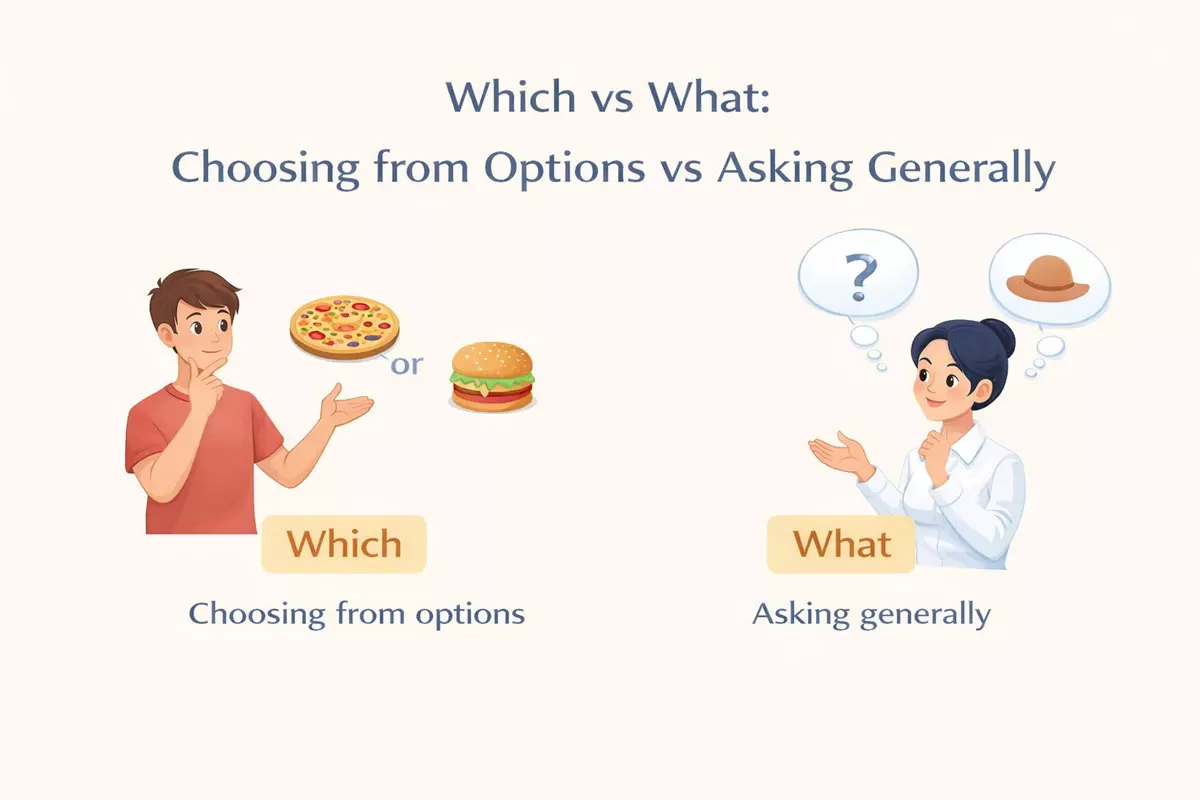 The article explains the key difference between which and what, discusses closed and open choice questions, and shows how to use each with or without nouns. It also covers implied options, usage in speech and writing, common mistakes, and context-based practice.
- Core meaning difference between which and what
- Closed choice vs open choice questions
- Which/what with nouns and without nouns
- Implied options in context
- Spoken preferences vs written clarity
- Common learner confusion patterns
- Meaning changes caused by word choice
- Practice: select which or what by context
When choosing between words like "which" and "what" to ask about options, subtle differences can influence how your question is understood. Using "which" suggests you are selecting from a specific, limited set, while "what" is more open-ended and implies a broader or undefined range of possibilities. Being aware of these nuances allows you to communicate your intent more precisely and avoid confusion, ensuring your questions are clear and appropriate for the context in which you are asking.
Core meaning difference between which and what
When choosing between “which” and “what,” the essential distinction comes down to the type of choice involved. “Which” is used when the options are limited or known; “what” is for open choices, where the set may be unknown or unlimited. This difference affects how questions and statements are framed, especially in English conversation and writing.
Defining the Scope of Choice
- Which refers to a selection from a specific, defined group. For example: “Which color do you prefer—red or blue?” Here, the options are clear.
- What is used when the possibilities are more open-ended. For example: “What color do you like?” In this case, any color in existence could be the answer.
How Context Determines the Word
Context is key. If both the speaker and listener are aware of the possible options, “which” fits best. If the possibilities haven’t been narrowed down, “what” is the natural choice. Consider these examples:
- “Which movie did you watch?” (You both know the list of movies.)
- “What movie did you watch?” (Any movie could be the answer.)
Comparison Table: “Which” vs “What” in Use
| Question | Underlying Meaning |
|---|---|
| Which book do you want? | Choose from a specific set of books. |
| What book do you want? | Any book is possible; no set list. |
| Which subjects do you enjoy? | There’s a known or limited list (e.g., school subjects). |
| What subjects do you enjoy? | Potentially any subjects, not a fixed group. |
| Which route should we take? | Several specific routes are being considered. |
| What route should we take? | No particular routes have been named yet. |
Quick Reference: When to Use Each
- Use which when the options are clear, known, or presented to the listener.
- Use what when asking about anything possible, or when no options have been given.
Additional Examples
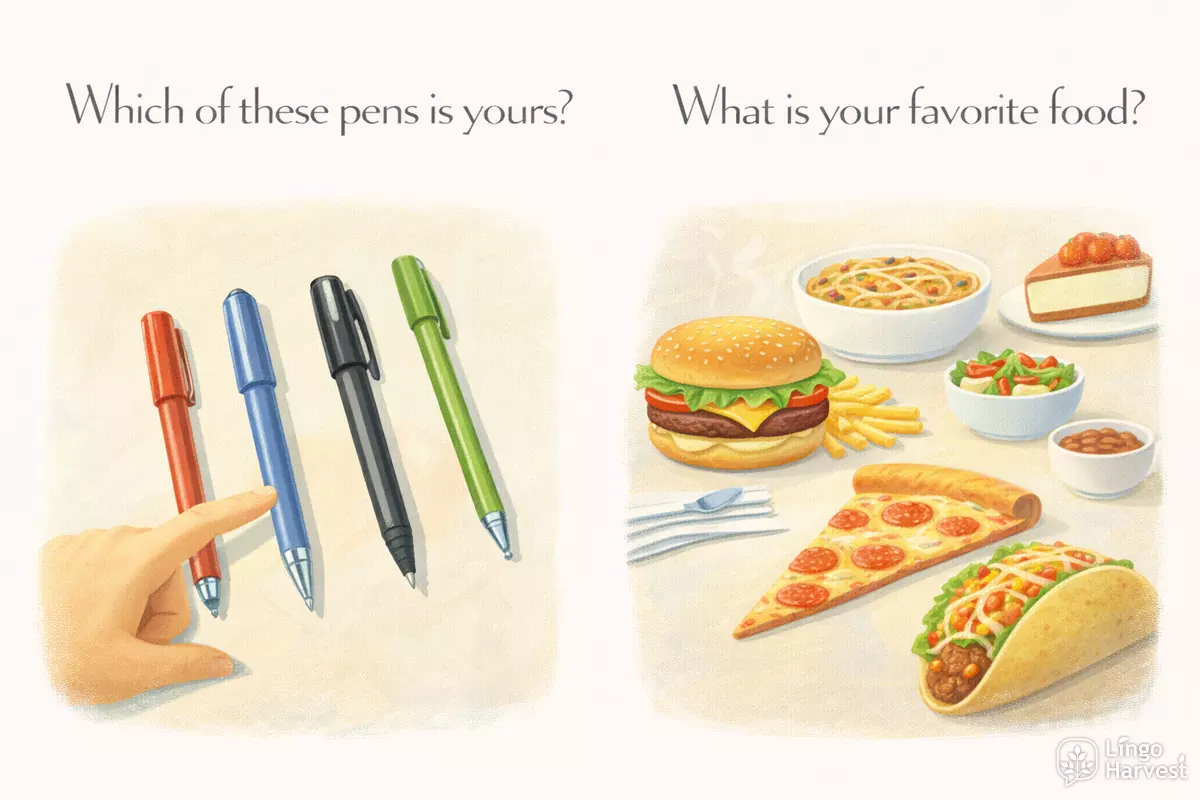
- Which of these pens is yours? (Refers to specific pens)
- What is your favorite food? (Any food is possible)
- Which team won the game? (Refers to teams in a particular game)
- What happened at the meeting? (Any event could be the answer)
- Which seat do you want? (From available seats)
- What do you want for your birthday? (No limits on suggestions)
- Which of our projects should be prioritized? (Known projects)
- What projects interest you? (Any potential project)
- Which one is correct? (From a set of choices)
- What is correct? (Open to any answer)
In short, “which” zooms in on defined options, while “what” opens the floor to unlimited possibilities. Picking the right word helps clarify your question and makes communication more precise.
Closed choice vs open choice questions
When asking about options, the structure of your question can guide the listener toward a limited set of answers or leave the field wide open. This difference shapes whether you select “which” or “what” in English. Understanding the distinction helps you ask clearer, more effective questions in both casual and formal settings.
Defining the two types
A closed choice question restricts possible answers to a defined list or set. These questions often expect the responder to choose from specific alternatives provided by the speaker or implied by the context. By contrast, an open choice question allows for any answer within a broader category, not limited by a preset list.
How “which” and “what” fit in
Generally, “which” is used when the options are limited or known, while “what” is used when the options are unlimited or unspecified. The difference is subtle but important for clarity.
| Closed Choice (“Which”) | Open Choice (“What”) |
|---|---|
| Which book do you want to borrow? (from a visible pile) |
What book do you want to borrow? (any book in existence) |
| Which color do you prefer, red or blue? | What color do you like best? |
| Which train are you taking? | What transportation are you using? |
| Which dessert would you like: cake, pie, or ice cream? | What dessert do you want? |
| Which student answered correctly? | What student inspired you? |
Recognizing limited vs unlimited sets
A helpful way to decide is to ask yourself: Is there a finite, identifiable group to choose from? If yes, “which” is likely best. If the possibilities are endless or unknown, “what” is usually the right fit.
- “Which” for choosing among visible, mentioned, or previously discussed items.
- “What” for requesting information from an open field of possibilities.
Common examples
- Which seat is yours? (from available seats in the room)
- What music do you enjoy? (any genre or artist)
- Which route will you take? (from a few mapped options)
- What hobbies do you have? (any activity)
- Which language are you studying? (from a list of offered courses)
- What language do they speak there? (any language possible)
- Which movie did you see last night? (from current cinema listings)
- What movie would you recommend? (no limit)
- Which phone is yours? (from several on the table)
- What phone do you want to buy? (any make or model)
In summary, the way you frame your query—whether narrowing down options or leaving them open—determines your choice between “which” and “what.” Recognizing this subtlety leads to more precise and natural communication.
Which/what with nouns and without nouns
Understanding how "which" and "what" interact with nouns—and when they can stand alone—is essential for clear, natural English. Both words can be used directly before a noun or on their own, but the choice depends on context and the type of information the speaker wants.
With Nouns: Asking About Specific or General Options
When "which" or "what" comes before a noun, the meaning can change subtly. Generally, "which" suggests a limited set of known options, while "what" is broader or more open-ended.
- Which book do you want to read? (You and the listener know the books available.)
- What movie did you see? (Any movie is possible; no set list.)
- Which color do you prefer? (The colors are probably visible or previously discussed.)
- What language do you speak? (Open to any language.)
- Which train goes to Oxford? (Refers to a timetable or known schedule.)
- What food do you like? (No options specified.)
- Which team won the match? (From the teams that played.)
- What job do you want? (Any job, not a set list.)
- Which street is your house on? (Limited to known streets nearby.)
- What animal is your favorite? (All animals possible.)
Without Nouns: Pronoun Use
Both "which" and "what" can stand alone as pronouns, especially when the noun is clear from context or mentioned earlier. This often happens in follow-up questions or when the options are visually present.
- Which do you prefer? (Refers to options already discussed or visible.)
- What did you say? (General—no specific options implied.)
- Which is yours? (You can see the items.)
- What happened? (Open-ended; anything could have occurred.)
Comparison Table: Usage Patterns
| Form | Typical Context | Example | Implied Range |
|---|---|---|---|
| Which + noun | Known, limited choices | Which seat is free? | Specific set (e.g., seats in the room) |
| What + noun | Open or unknown set | What subject do you like? | Any possible subject |
| Which (no noun) | Refers to visible/mentioned options | Which is yours? | Choices are clear |
| What (no noun) | General or unspecified context | What happened? | Anything possible |
Key Points to Remember
- Use "which" when choices are limited or clear to both speaker and listener. ✅
- Choose "what" for open, undefined possibilities or when no set list is implied. ✅
- Both can stand alone as pronouns if the noun is obvious from context.
- Context—what you and your listener know—guides the choice more than strict grammar rules.
Grasping these patterns helps you ask clearer, more precise questions in English, whether you use the words with nouns or on their own.
Implied options in context
When choosing between "which" and "what," the number and clarity of options—whether stated or assumed—play a crucial role. In real conversations, people often leave options unstated, relying on context or shared understanding. This means that the choice of "which" or "what" isn’t just about grammar, but about how many alternatives are implied, and how specific the speaker wants to be.
Recognizing hidden choices
Speakers frequently refer to options that aren’t explicitly listed. For example, if someone asks, "Which do you prefer?" while pointing at two desserts, the available items are obvious from the situation, even if not named. On the other hand, "What do you want?" leaves the field open—there may be many possibilities, not all of them visible or previously mentioned.
How context shapes interpretation
The surrounding conversation, shared experiences, or even gestures can indicate the range of options. Sometimes, a questioner expects the listener to infer the set of choices from context alone. This is especially true in everyday exchanges, where brevity and efficiency are valued.
- Browsing a menu: "Which would you like?" (menu items are the implied options)
- Shopping for clothes: "Which size fits you?" (sizes are known but not listed)
- At a buffet: "What will you try?" (unrestricted, all food is possible)
- During a quiz: "Which is the capital of France?" (choices may be visible or assumed)
- Making plans: "What should we do tonight?" (limitless activities)
- Choosing transportation: "Which bus goes downtown?" (specific set of buses)
- Deciding on a movie: "What are you in the mood for?" (open-ended)
- In a classroom: "Which answer is correct?" (finite set of responses)
- Ordering coffee: "What'll it be?" (any drink is an option)
- Comparing options: "Which one is yours?" (small, defined group)
- Discussing books: "Which did you read?" (subset from a known list)
- Suggesting food: "What sounds good for lunch?" (endless choices)
Contrast: specific vs. open-ended choices
| Prompt | Implied Range of Options |
|---|---|
| "Which color do you want?" | Limited set (e.g., red, blue, green) |
| "What color do you want?" | Any possible color, no boundaries |
| "Which movie should we watch?" | Specific list (perhaps just what's showing) |
| "What movie do you like?" | Any movie, no list implied |
Understanding the subtle cues that signal whether options are limited or open-ended helps clarify why "which" and "what" are used differently. Often, the speaker's intent and the listener's awareness of the situation fill in the blanks, making the right choice feel natural—even when the alternatives are never stated aloud.
Spoken preferences vs written clarity
Everyday conversation tends to favor simplicity and speed, which affects how people choose between “which” and “what.” Spoken language often prioritizes ease and flow over precision, leading to more flexible or even interchangeable use of these words. In contrast, written English—especially in formal or academic contexts—demands greater accuracy. The difference between these two modes often reveals itself in subtle but important ways.
Typical usage in speech
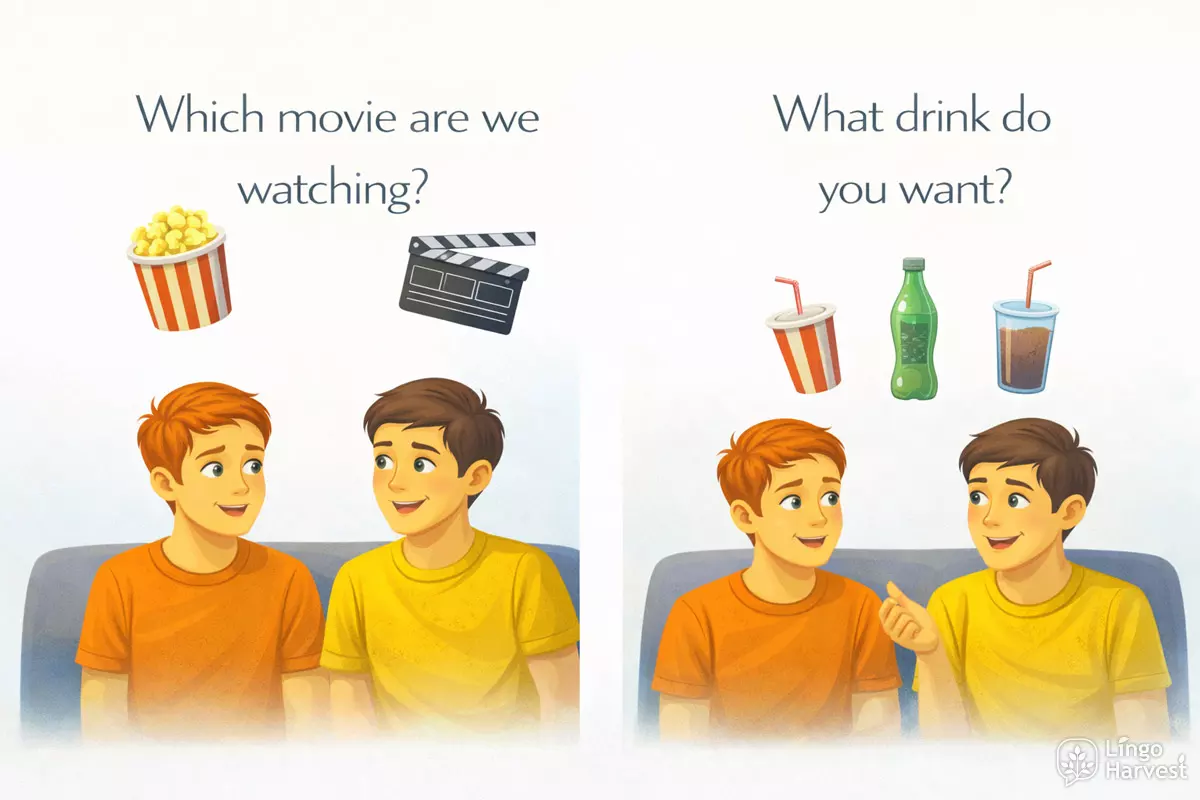
When people speak, their choices are influenced by context cues and shared understanding. Native speakers might say “What book do you want?” or “Which book do you want?” almost interchangeably if the context is clear. In conversation, tone, gestures, and situation fill in the gaps, so the distinction between a defined set (which) and an open set (what) is less strictly maintained.
- “What movie are we watching?” (no set list in mind)
- “Which movie are we watching?” (referring to a shortlist or options just mentioned)
- “What drink do you want?”
- “Which drink do you want?” (perhaps pointing at a menu)
- “What color do you like?”
- “Which color do you like?” (when showing color swatches)
- “What route should we take?”
- “Which route should we take—the highway or the back roads?”
- “What questions do you have?” (open-ended)
- “Which questions do you have from the list?” (specific set)
Written forms: clarity and precision
In writing, especially where ambiguity can lead to misunderstanding, the distinction becomes more important. Editors and teachers often point out that “which” should be used when the options are limited and defined, while “what” suits broader or undefined choices. This helps readers interpret intent without needing additional context.
| Spoken Example | Written Equivalent |
|---|---|
| What do you want for dinner? | Which of these dishes would you like for dinner? |
| What song should we play? | Which song from the playlist should we play? |
| What time works for you? | Which of the available times suits you? |
| What job are you applying for? | Which of the listed positions are you applying for? |
| What bus do you take? | Which bus on this schedule do you take? |
Why the difference matters
This contrast can impact both comprehension and tone. In speech, flexibility rarely causes confusion, but in writing—especially in instructions, contracts, or academic work—using the wrong form can make your meaning unclear or even misleading. Knowing when to use each term helps both writers and speakers be understood, whether the audience listens or reads.
Common learner confusion patterns
Many English learners find it tricky to decide when to use "which" or "what" in questions, especially because both words ask for information but in slightly different ways. The confusion often arises from subtle differences in meaning, context, and expectations about the answer.
Typical mix-ups and learner errors
- Using "which" when there is no clear set of options (e.g., Which food do you like? when no choices are given).
- Choosing "what" even when a list or limited group is obvious (e.g., What color do you want—red or blue?).
- Assuming "which" always sounds more formal or polite, regardless of context.
- Switching "which" and "what" randomly in similar question types, causing awkwardness or misunderstanding.
- Overusing "what" because it feels more general and easier to remember.
- Believing "which" can only be used for physical objects, not ideas or actions.
- Confusing the use in indirect questions (e.g., Can you tell me what/which bus goes downtown?).
- Thinking "which" is not used in open-ended questions.
- Failing to notice that "what" is preferred for jobs, time, and descriptions (What time… What kind… What job…).
- Not recognizing when a context has already limited the options, making "which" more natural.
Contextual confusion: the role of choices
The main difference often comes down to whether a specific set of choices is present or implied. When there is a defined group, "which" is usually preferred. If the options are completely open or unknown, "what" is the go-to word. Learners sometimes overlook these cues in conversation or written text.
| Situation | Natural Question |
|---|---|
| Unlimited options | What music do you like? |
| Specific set of options | Which seat is yours? (when seats are visible) |
| Job or description | What does she do? |
| Choosing from a menu | Which dessert would you like? |
| Unclear context | What/Which bus goes to the city center? |
Practical tips for learners
- Look for clues: If the choices are visible or previously mentioned, "which" is likely right.
- Use "what" when no limits are set, or when asking about type, kind, or job.
- Remember that both can sometimes work, but the nuance may change the listener’s expectation.
- Practice by noticing real-life examples in conversations, menus, and forms.
- Don’t stress over minor mistakes; context often makes your meaning clear.
Understanding the subtle distinction between these question words comes with exposure and practice. Paying attention to context and listening to native speakers can help clarify which word is most appropriate.
Meaning changes caused by word choice
Choosing between "which" and "what" can subtly—but importantly—alter both the intent and the clarity of a question or statement. The two words might seem interchangeable at first glance, but their usage signals how many options the speaker assumes, and whether those options are known or unknown to the listener. Understanding these distinctions helps avoid confusion and ensures that your questions are interpreted as you intend.
How "Which" and "What" Guide Interpretation
When "which" is used, it usually implies a limited set of options. This word suggests that the answer must come from a specific, perhaps previously mentioned, group. In contrast, "what" signals openness—there may be countless possibilities, or the set of options has not been defined. This difference affects the way listeners process the question and even the kind of answers they provide.
| Question | Implied Meaning |
|---|---|
| Which book do you want? | There is a known, limited selection of books to choose from. |
| What book do you want? | No set list; any book in existence could be chosen. |
| Which color do you prefer? | You are expected to pick from a specific palette of colors. |
| What color do you prefer? | Your answer can be any color, not limited by a list. |
Common Patterns and Their Effects
- Using "which" often makes questions more precise, limiting the answer space.
- "What" is favored when the speaker does not know the possible answers, or when the category is very broad.
- Switching from "what" to "which" can make a question feel more pointed or restrictive.
- In surveys or forms, "which" is used when options are listed, while "what" is for open-ended responses.
- "Which" can sound more formal or careful, especially in academic or technical contexts.
- "What" works naturally in casual conversation, especially for unknowns.
- Ambiguity arises if the set of choices is unclear; listeners might wonder why "which" is used without a visible list.
- Answerers might hesitate if "what" is used where a set is implied, expecting more guidance.
- In English learning, this distinction often causes confusion, especially in translation or test settings.
- Context sometimes overrides these rules, so native speakers occasionally use "which" and "what" interchangeably, but subtle meaning shifts remain.
Paying attention to these small differences in wording leads to clearer communication. The choice between these words not only reflects what the speaker knows, but also shapes the listener's expectations and responses.
Practice: select which or what by context
Choosing between which and what depends on the level of specificity and the set of options implied by the question. Let's explore how context determines the correct choice with practical examples and focused activities.
Quick Reference: Contexts for "which" and "what"
| Context | Preferred Question Word |
|---|---|
| Specific, known options (limited set) | which |
| General inquiry, open or unlimited choices | what |
| Requesting identification from a group | which |
| Asking about type, kind, or nature | what |
Task 1: Choose the Correct Word
Decide whether which or what is appropriate for each sentence below. Consider if the context implies a defined set or an open question.
- _____ color do you prefer for the logo: red, blue, or green?
- _____ time is the meeting?
- _____ of these books have you read?
- _____ would you like for dinner?
- _____ subjects do you enjoy most at school?
- _____ movie are we going to watch from the list?
- _____ is your favorite hobby?
- _____ route should we take—Main Street or the highway?
- _____ did you say your name was?
- _____ countries have you visited?
Show answers
- Which
- What
- Which
- What
- What
- Which
- What
- Which
- What
- What
Task 2: Spot the Difference
Read each pair of questions and decide why one uses which and the other uses what. Notice how the context shifts the meaning.
- Which dessert would you like—cake or ice cream? / What dessert would you like?
- Which train goes to the city center? / What goes to the city center?
- Which phone did you buy? / What did you buy?
- Which languages do you speak? / What languages are taught at this school?
- Which jacket should I wear—the black one or the blue one? / What should I wear?
- Which of these documents do you need—the invoice or the receipt? / What do you need?
- Which route is faster—Route A or Route B? / What is the fastest way to get there?
- Which meeting are you joining—the morning one or the afternoon one? / What are you doing today?
- Which seat do you prefer—window or aisle? / What kind of seat do you prefer?
- Which button should I press—Start or Reset? / What should I do next?
Show answers
- Which is for a limited set (cake or ice cream); what is open to any option.
- Which selects among known trains; what is open-ended (could be train, bus, taxi, etc.).
- Which asks about a specific choice among phones; what asks generally about the purchase.
- Which implies a selection from a known group; what asks about the range offered.
- Which selects between two jackets; what asks generally about clothing choices.
- Which selects from specific documents; what asks generally what is needed.
- Which compares two named routes; what asks generally for the best method.
- Which selects between known meetings; what asks generally about plans.
- Which selects between seat options; what asks generally about preferences.
- Which chooses between two buttons; what asks generally what action to take.
Tips for Deciding
- Use which when the choices are clear, limited, or previously mentioned.
- Use what for open questions, types, or when the options aren't defined.
- If you can list all possible answers, which is likely correct.
Practice with real questions in daily life—notice if you’re referring to a set or asking openly. Over time, choosing the right form will become second nature.