Negative Determiners: no, none, neither, few, little

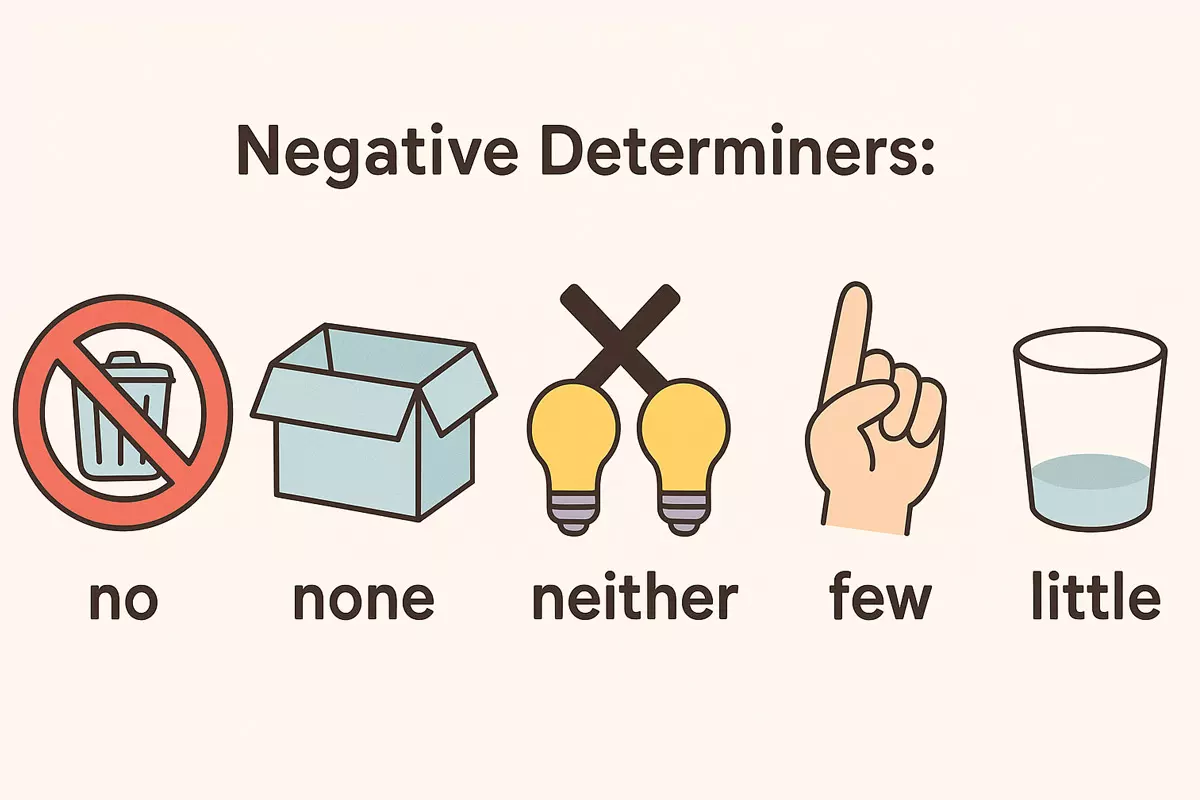 Here we what negative determiners are, explains the differences between no, none, neither, few, and little, shows how they affect sentence meaning, and gives tips on avoiding double negatives. It also provides practice choosing the correct determiner.
- What negative determiners are in simple terms
- Difference between no and none in basic sentences
- Using neither to talk about two negative options
- Few vs a few and little vs a little for quantity
- How negative determiners change the meaning of a sentence
- Avoiding double negatives with determiners
- Practice: choose the correct negative determiner in context
Expressing absence or scarcity in English relies on selecting appropriate words to modify nouns, particularly determiners that indicate lack. Using words like no, few, little, or none helps clarify meaning and ensures that listeners or readers understand when something is missing or present in only small amounts. Mastering these expressions is useful for both written and spoken English, as it allows for more precise communication and helps avoid misunderstandings in everyday situations.
What negative determiners are in simple terms
Negative determiners are special words used to show the absence or lack of something in a sentence. They help us make it clear that we are talking about “none,” “not any,” or “very little” of whatever noun comes after. In English, words like no, none, neither, few, and little serve this purpose. These words are placed before nouns (or sometimes stand on their own) to express negativity or zero quantity.
How negative determiners work
Negative determiners are used to block or limit the presence of people, things, or amounts. They change the meaning of a sentence from positive to negative by making it clear that something is missing or not included. For example:
- No students were late. (Zero students were late.)
- None of the apples are fresh. (Not a single apple is fresh.)
- Neither answer is correct. (Zero of the two answers are correct.)
- Few people understood the joke. (Only a small number did.)
- Little water is left. (A very small amount remains.)
Key points about negative determiners
- They come before nouns or noun phrases (e.g., no money, few options).
- They are used to show zero, not any, or hardly any quantity.
- Some, like none or neither, can stand alone and do not need a noun after them.
- They are different from negative pronouns or adverbs, which play other roles in a sentence.
Common negative determiners and their usage
Here are some typical examples of negative determiners and how they’re used:
- No: before singular or plural nouns (No cars, No milk)
- None: replaces a noun or noun phrase (How many tickets are left? None.)
- Neither: used for two items, meaning not one or the other (Neither shirt fits me.)
- Few: before plural countable nouns, meaning not many (Few chances remain.)
- Little: before uncountable nouns, meaning not much (Little hope was left.)
Examples in sentences
- No dogs barked during the night.
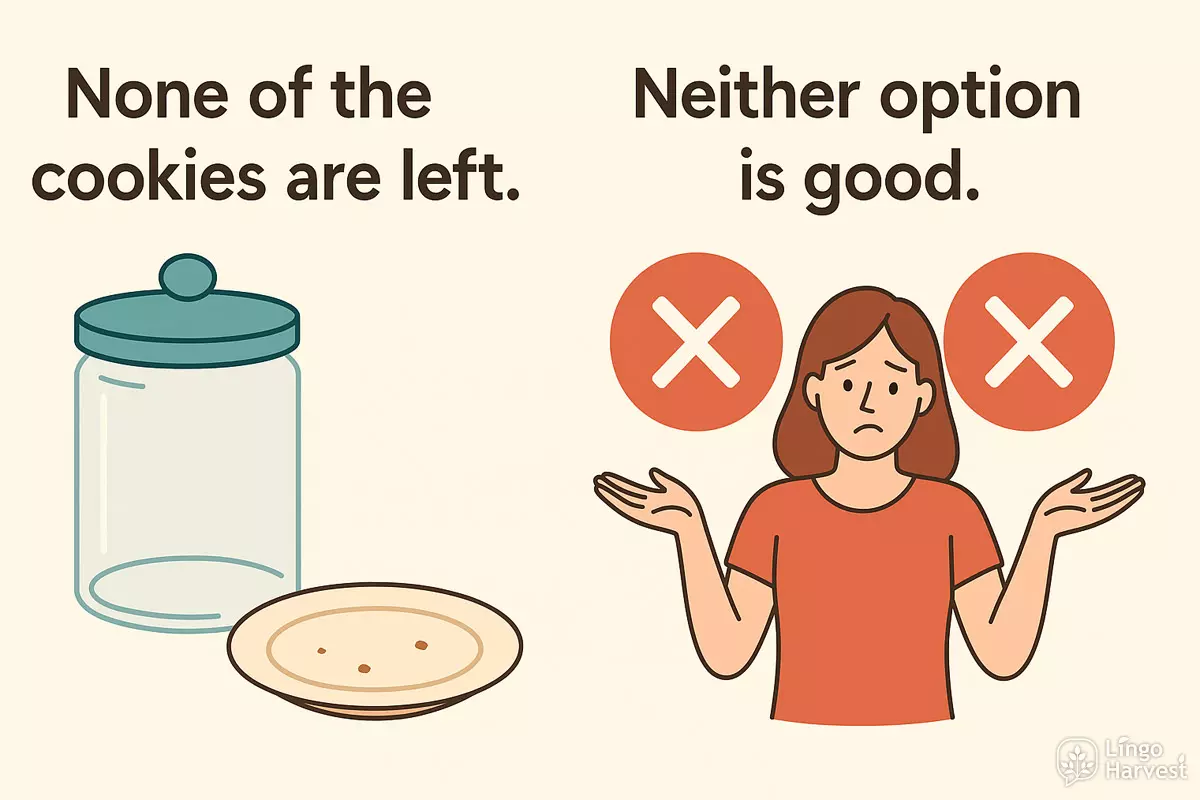
- None of the cookies are left.
- Neither option is good.
- Few people survived the storm.
- Little time remains before the deadline.
- No information was given.
- None agreed with the proposal.
- Neither of the roads is open.
- Few answers were correct.
- Little interest was shown.
- No one called me today.
- None is available at the moment.
- Neither boy wanted to leave.
- Few tickets are left.
- Little energy remained after the run.
In summary
Negative determiners are a simple way to make it clear that something is missing, lacking, or not present in a group or amount. They are easy to spot because they always express some kind of negative quantity or exclusion.
Difference between no and none in basic sentences
Understanding how to use "no" and "none" correctly helps make your English sound natural. Both words are used to express negation, but their placement and function in a sentence are not the same. Let's break down how each works in everyday language.
How "no" is used
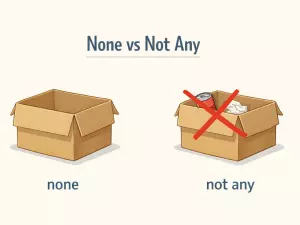
"No" acts as a negative determiner before a noun. It replaces articles like "a," "an," or "the" and means "not any." For example: "There is no milk in the fridge." Here, "no" comes right before the noun it modifies.
How "none" is used
"None" is a pronoun and stands alone, replacing a noun to show that nothing of that kind exists. For instance: "How many cookies are left? None." You don’t need to add a noun after "none"—it's understood from context.
| Pattern | Example with "no" | Example with "none" |
|---|---|---|
| Before a noun | No students arrived on time. | ❌ None students arrived on time. |
| As a pronoun (no noun after) | ❌ I have no. | I have none. |
| Answering a question | ❌ How many apples? No. | How many apples? None. |
| With "of" + noun/pronoun | ❌ No of them came. | None of them came. |
Quick rules to remember
- Use "no" before a noun: "No cars are allowed here."
- Use "none" without a noun: "How many cars are there? None."
- "None of" can be followed by a noun or pronoun: "None of the answers are correct."
- Do not use "none" directly before a noun: ❌ "None people came."
Examples for practice
- No money was found in the wallet.
- None was found in the wallet.
- No dogs are allowed in this park.
- None of the dogs are allowed inside.
- No reason was given for the delay.
- None of the reasons made sense.
- No calls have been received today.
- None came from your number.
- No one knows the answer.
- None of us knows the answer.
- No evidence supports the claim.
- None supports the claim.
- No students passed the test.
- None of the students passed.
Knowing when to use "no" or "none" depends on whether you need a determiner before a noun or a pronoun to stand alone. Practice with these patterns to master negative determiners in simple English sentences.
Using neither to talk about two negative options
When you want to express that two alternatives are both not true, not chosen, or not possible, "neither" is the word you need. "Neither" allows you to make it clear that none of the two options applies. This is especially useful in statements and responses where you want to reject both possibilities at once, rather than repeating yourself.
How "neither" works in sentences
"Neither" is used with two items, actions, or choices. You can use it as a determiner before a noun, as a pronoun, or in combination with "nor" to join two negative elements. Here are some ways to use it:
- Neither answer was correct.
- I like neither tea nor coffee.
- Neither of the doors is open.
- Neither my brother nor my sister can swim.
- She could neither sing nor dance at the audition.
- Neither option suits our needs.
- Neither of them has arrived.
- Neither candidate impressed the panel.
- Neither side agreed to compromise.
- Neither of us wanted dessert.
- Neither statement is true.
- He neither called nor texted.
- Neither film was interesting.
- Neither of the solutions worked.
- Neither suggestion was helpful.
Common patterns with "neither"
There are a few patterns you’ll see with this word:
- Neither + singular noun: Neither plan is realistic.
- Neither of + plural noun/pronoun: Neither of the answers was correct.
- Neither…nor…: Neither the manager nor the assistant was available.
- Neither + verb (short answer): "I don't like sushi." – "Neither do I."
Key points
- "Neither" always refers to two, not more.
- Verb agreement: After "neither," the verb is usually singular ("Neither option is good").
- Use "neither...nor..." to connect two negative alternatives.
- For more than two, use "none" instead of "neither."
By choosing "neither," you can efficiently express that both available choices are excluded or not valid, making your negative statements precise and clear.
Few vs a few and little vs a little for quantity
Understanding how to use "few" and "a few" (for countable nouns), and "little" and "a little" (for uncountable nouns), can make your English sound more precise. The difference often comes down to whether you want to emphasize scarcity or simply indicate a small amount.
Countable nouns: "few" vs "a few"
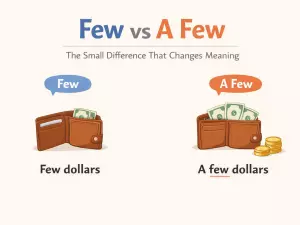
"Few" (without "a") highlights that the number is very small—almost none—often with a negative feeling. "A few" suggests there are some, and it's often more positive.
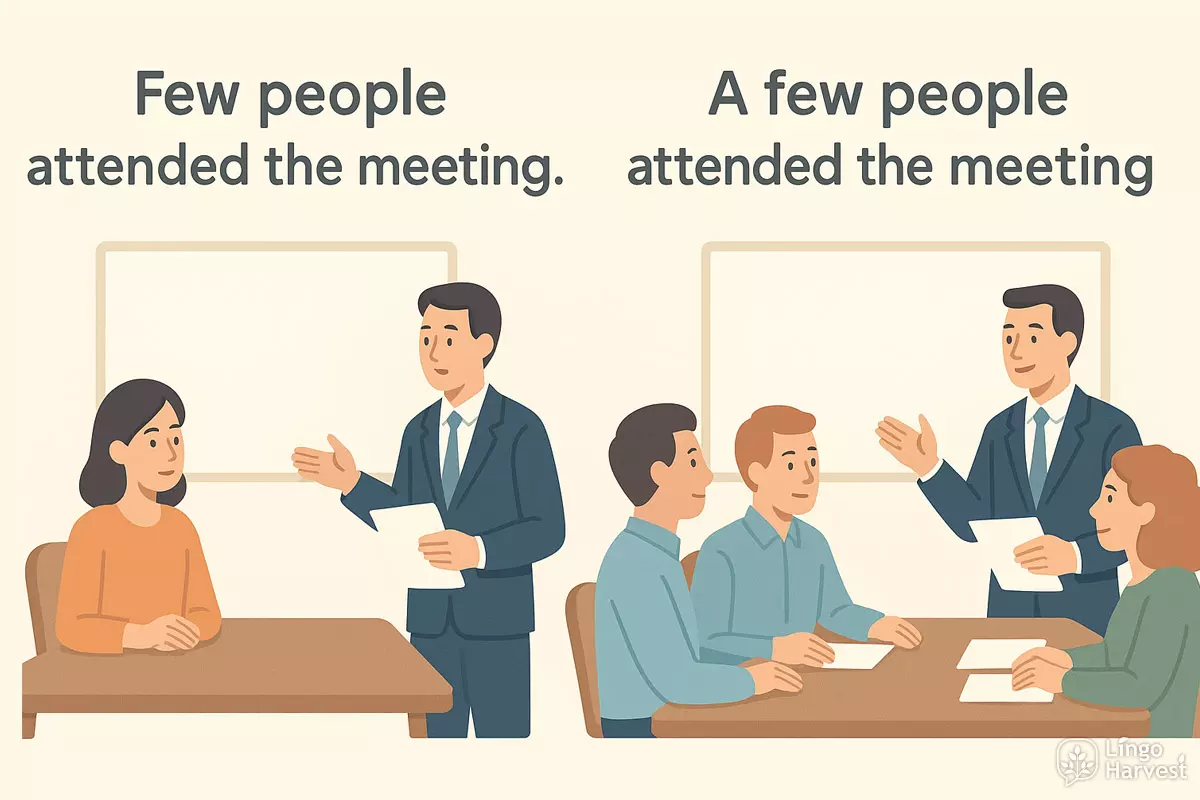
- Few people attended the meeting. (Almost no one was there.)
- A few people attended the meeting. (Some people were there.)
- Few students passed the test. (Not many succeeded.)
- A few students passed the test. (At least some did well.)
- Few cars are parked outside. (Hardly any.)
- A few cars are parked outside. (Several, but not many.)
Uncountable nouns: "little" vs "a little"
With things you can't count (like water, time, or money), "little" and "a little" work in the same way. "Little" means hardly any, while "a little" means there is some, even if not much.
- Little time remains. (Almost none.)
- A little time remains. (Some is left.)
- Little hope is left. (Nearly hopeless.)
- A little hope is left. (There’s still some chance.)
- Little information was given. (Very minimal details.)
- A little information was given. (Some details, at least.)
Quick Reference: Key Differences
| Expression | Meaning/Usage |
|---|---|
| Few (countable) | Very small number, almost none (negative) |
| A few (countable) | Some, but not many (positive or neutral) |
| Little (uncountable) | Very small amount, hardly any (negative) |
| A little (uncountable) | Some, even if not much (positive or neutral) |
Tips for choosing the right form
- Use "few" and "a few" with things you can count: books, friends, apples.
- Use "little" and "a little" with things you can’t count: sugar, patience, advice.
- Adding "a" usually makes the meaning more positive.
- If you want to stress a lack or insufficiency, use "few" or "little" without "a".
- For more formal or written English, these distinctions are important for clarity.
Choosing between these forms helps express exactly how much—or how little—of something there is, and whether that amount is sufficient or disappointingly small.
How negative determiners change the meaning of a sentence
Negative determiners like no, none, neither, few, and little are crucial for expressing absence, rejection, or limitation within statements. By placing these words before nouns or noun phrases, speakers can shift a sentence’s meaning from positive or neutral to negative or restrictive. Understanding how these determiners work helps you avoid misunderstandings and communicate your intended message more precisely.
Impact on sentence meaning
When you use a negative determiner, you often indicate that something does not exist, is not chosen, or is present only in a very small amount. This can affect the tone, implication, and even the grammatical structure of a sentence. For example:
- No students passed the test. (Not a single student passed.)
- Few people attended the meeting. (Only a small number attended.)
- Neither answer is correct. (Both options are wrong.)
- Little progress was made. (Almost no progress.)
- There is none left. (Zero quantity remains.)
These determiners can replace or modify articles and quantifiers, changing the focus from what exists to what is lacking or absent.
Common patterns and their effects
The placement and choice of a negative determiner can alter not just the meaning, but also the emphasis of a statement. Here are some typical patterns:
- No + noun: indicates total absence (e.g., No solution was found.)
- None (pronoun): stands alone as a subject or object (e.g., None of the cookies are left.)
- Neither + singular noun: used for two alternatives (e.g., Neither option works.)
- Few + plural noun: stresses scarcity, but not zero (e.g., Few customers complained.)
- Little + uncountable noun: emphasizes a very small amount (e.g., Little time remains.)
Subtle differences: “few” vs. “a few”, “little” vs. “a little”
Adding or omitting “a” changes the nuance:
- Few friends (almost none, negative)
- A few friends (some, positive/neutral)
- Little hope (almost none, negative)
- A little hope (some, positive/neutral)
Comparison of negative determiners in sentence context
| Determiner | Effect in a sentence |
|---|---|
| No | Denies the existence of any quantity: No dogs are allowed. |
| None | Substitutes for “not any”: None of the answers were correct. |
| Neither | Excludes both options in a pair: Neither book belongs to me. |
| Few / Little | Indicates an insufficient or very small amount: Few people noticed. / Little water was left. |
Key points to remember
- Negative determiners restrict or deny the existence or quantity of something.
- Choosing the right determiner changes the nuance from total absence (no, none) to partial or limited presence (few, little).
- Word order and context are important; using the wrong determiner can lead to confusion.
By mastering these determiners, you can make your English clearer and more precise, especially when you need to express limits, absence, or rejection.
Avoiding double negatives with determiners
When using negative determiners like no, none, neither, few, and little, it’s important to avoid combining them with other negative words in the same clause. This combination often leads to double negatives, which can cause confusion or make your sentences grammatically incorrect in standard English.
What is a double negative?
A double negative happens when two negative forms appear together in a sentence, unintentionally reversing or weakening the intended meaning. In English, this is usually considered nonstandard, except in some dialects or for stylistic effect.
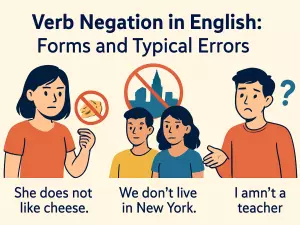
- Incorrect: I don’t have no money. ❌
- Correct: I don’t have any money. ✅
- Incorrect: She hasn’t got none of the answers. ❌
- Correct: She hasn’t got any of the answers. ✅
Common pitfalls with negative determiners
Negative determiners can replace other negatives in a sentence, so adding extra negatives is unnecessary and confusing. Here are some frequent mistakes and their correct forms:
- We didn’t see no birds. ❌ → We didn’t see any birds. ✅
- He has no time to relax. ✅ (correct on its own)
- There are few options left. ✅
- We don’t have none left. ❌ → We don’t have any left. ✅
- She doesn’t know neither answer. ❌ → She knows neither answer. ✅
- They have little interest in sports. ✅
- I can’t find none of my keys. ❌ → I can’t find any of my keys. ✅
- We haven’t done no homework. ❌ → We haven’t done any homework. ✅
- There isn’t no milk left. ❌ → There isn’t any milk left. ✅
- He didn’t invite neither of us. ❌ → He invited neither of us. ✅
Quick reference: correct vs. incorrect patterns
| Incorrect (Double Negative) | Correct (Standard English) |
|---|---|
| I don’t have no friends. | I don’t have any friends. OR I have no friends. |
| She hasn’t got none left. | She hasn’t got any left. OR She has none left. |
| We didn’t see neither option. | We didn’t see either option. OR We saw neither option. |
| He can’t do nothing about it. | He can’t do anything about it. OR He can do nothing about it. |
| They haven’t bought no tickets. | They haven’t bought any tickets. OR They have bought no tickets. |
Tips for using negative determiners
- Use only one negative word per clause for clarity.
- If you use a negative determiner (like no or none), avoid adding negative verbs (like don’t, hasn’t).
- When in doubt, replace extra negatives with positive forms like any or either.
- Remember that few and little are already negative in meaning; don’t combine them with additional negatives.
Using these guidelines helps keep your meaning clear and your grammar correct, especially when working with negative determiners in English sentences.
Practice: choose the correct negative determiner in context
Understanding when to use "no," "none," "neither," "few," and "little" can be tricky, especially since they all express negative ideas but function differently in sentences. Below, you’ll find a variety of exercises and examples to help you practice selecting the right word for each situation. Read the sentences carefully and fill in the blanks with the most appropriate negative determiner.
Fill in the blanks
Choose the correct word—no, none, neither, few, or little—for each sentence below.
- ________ of the two answers is correct.
- There is ________ milk left in the fridge.
- ________ students came to the early morning class.
- I have ________ idea what you mean.
- She has ________ friends in this city.
- ________ of the cakes was eaten at the party.
- ________ of my friends like horror movies.
- There are ________ apples on the table.
- ________ of the candidates was suitable for the job.
- We have ________ time to finish the project.
- ________ of them wanted to leave early.
- He has ________ money left after shopping.
- ________ of the children knew the answer.
- ________ of these pens works.
- ________ of the information is useful.
Show answers
- Neither
- Little
- Few
- No
- Few
- None
- None
- No
- Neither
- Little
- None
- Little
- None
- None
- None
Common mistakes: which negative determiner fits?
Some negative determiners are used with countable nouns, and others with uncountable nouns. Review these sentences and decide which form is correct.
- She has ________ patience for long meetings. (few/little)
- We saw ________ people at the station. (few/little)
- ________ of the solutions is practical. (neither/none)
- There is ________ hope of success. (few/little)
- He showed ________ interest in the proposal. (few/little)
- They had ________ friends in the city. (few/little)
- ________ of the candidates were suitable. (neither/none)
- We have very ________ time to finish this. (few/little)
- ________ of the two cars is affordable. (neither/none)
- The team made ________ mistakes during the match. (few/little)
Show answers
- little
- few
- neither
- little
- little
- few
- none
- little
- neither
- few
Quick reference: when to use each word
| Word | Usage & Typical Context |
|---|---|
| No | Used before a noun to mean “not any” (e.g., “No cars are allowed here.”) |
| None | Stands alone, replaces a noun to mean “not any” (e.g., “How many cookies? None.”) |
| Neither | Used with two items to mean “not one or the other” (e.g., “Neither answer is correct.”) |
| Few / Little | “Few” for countable nouns, “little” for uncountable; both mean “not many/much” (e.g., “Few people,” “Little time”) |
Practice regularly and pay close attention to whether the noun is countable or uncountable, and whether you’re talking about two items or more. This will help you master these negative forms in everyday writing and speech.