Few vs A Few: The Small Difference That Changes Meaning

 The article explains the core difference between few and a few, focusing on their negative or positive attitudes toward quantity. It covers usage with countable nouns, common mistakes, sentence patterns, contextual shifts, clear examples, and practice.
- Core meaning difference between few and a few
- Negative vs positive attitude toward quantity
- Use with countable nouns only
- Typical sentence patterns and position
- Contextual meaning shifts in real usage
- Common learner misunderstandings
- Examples showing contrast clearly
- Practice: choosing few or a few correctly
A single word can dramatically change the meaning of a sentence, particularly when using terms that appear almost identical. For example, the difference between “few” and “a few” may seem minor, but each conveys a distinct message. While “few” often suggests a scarcity or lack, “a few” implies there is at least some quantity present. Being aware of such subtle contrasts is crucial for clear and effective communication, as even small differences in wording can significantly influence how your message is understood.
Core meaning difference between few and a few
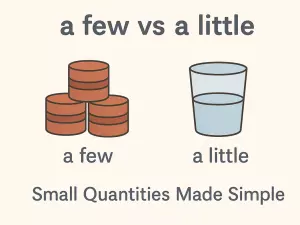
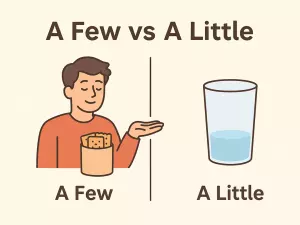
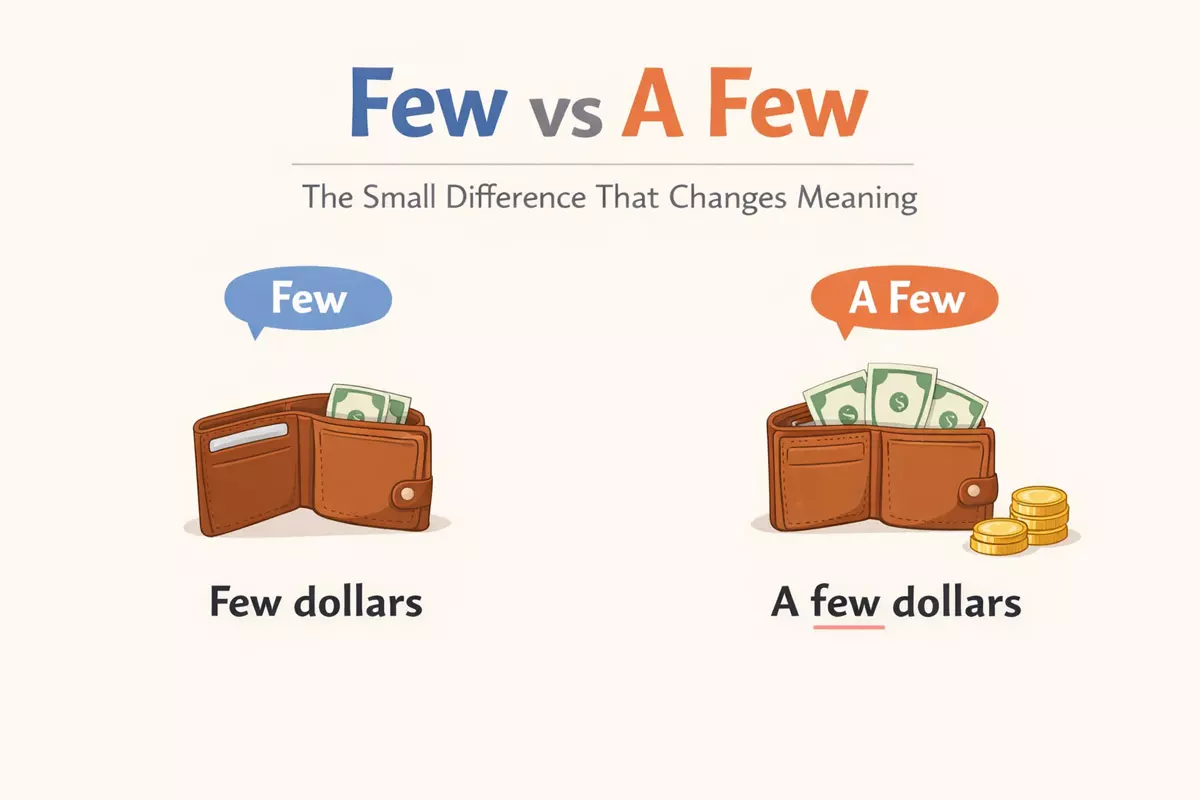
The distinction between "few" and "a few" seems minor, but it actually changes the feeling and implication of a sentence. Both refer to a small number, but their tone is quite different. "Few" highlights scarcity or insufficiency, while "a few" suggests that, although the number is small, it is still enough for some purpose.
How "few" and "a few" influence meaning
If you use "few" by itself, it often carries a negative or limiting nuance. It implies that not enough of something exists. In contrast, "a few" is more optimistic, indicating that there is at least a small, usable quantity. This subtle shift can completely change the impression you give.
- Few people attended the meeting. (Almost no one came; disappointing turnout.)
- A few people attended the meeting. (Some people came; not many, but enough.)
Examples in context

Here are more examples to highlight the shift in meaning:
- There are few cookies left. (Nearly gone; not enough for everyone.)
- There are a few cookies left. (Enough for a snack; some remain.)
- She has few friends in the city. (She is likely lonely.)
- She has a few friends in the city. (She knows some people; not alone.)
- We have few options. (Almost none; limited choices.)
- We have a few options. (Some possibilities to consider.)
- He made few mistakes. (Nearly perfect performance.)
- He made a few mistakes. (Some errors, but not many.)
- I have few regrets. (Almost none; generally satisfied.)
- I have a few regrets. (Some, but not overwhelmed by them.)
- There are few buses on Sundays. (Inconveniently rare.)
- There are a few buses on Sundays. (You can travel, though options are limited.)
Quick comparison
| Expression | Implication |
|---|---|
| Few | Not enough; almost none; negative or limiting |
| A few | Some; enough to be useful or positive |
In summary, "few" often stresses a lack, while "a few" points to a small but sufficient quantity. Choosing between them shapes whether your message feels pessimistic or more hopeful.
Negative vs positive attitude toward quantity
The subtle contrast between “few” and “a few” often reflects the speaker’s outlook on the amount being discussed. “Few” suggests disappointment or insufficiency, while “a few” implies a more optimistic view, hinting that the small number is still useful or welcome. This distinction can influence the tone of a sentence, changing how information is perceived by the listener or reader.
How “few” and “a few” shape meaning
When someone uses “few,” they often focus on the scarcity or lack of something. In contrast, “a few” highlights that, although the quantity isn’t large, it’s enough for some purpose. This isn’t just a grammatical detail—it’s a matter of perspective.
| Expression | Implication |
|---|---|
| Few people attended the meeting. | Negative: Not enough people; turnout was disappointing. |
| A few people attended the meeting. | Positive: Some people came; better than none. |
| Few cookies are left. | Negative: Almost gone; barely any remain. |
| A few cookies are left. | Positive: There are still some; you can have one. |
| Few problems were found. | Positive: Hardly any issues; things went well. |
| A few problems were found. | Neutral/Negative: Some issues; not perfect, but manageable. |
Common situations and their connotations
- “Few opportunities” → There’s almost nothing available (discouraging).
- “A few opportunities” → There are some options (encouraging).
- “Few friends” → Suggests loneliness or isolation.
- “A few friends” → Implies companionship, even if not many.
- “Few resources” → Indicates a shortage or lack.
- “A few resources” → Suggests at least something is available.
- “Few answers” → Not enough information; possibly a problem.
- “A few answers” → Some information; helpful in context.
- “Few minutes left” → Out of time; urgency.
- “A few minutes left” → Still some time remains.
- “Few changes” → Almost no adjustments; could be good or bad depending on context.
- “A few changes” → Some updates; progress or improvement possible.
In summary, whether you use “few” or “a few” can subtly shift the mood of your sentence. “Few” often carries a sense of limitation or lack, while “a few” points to possibility, sufficiency, or even gratitude that there is something rather than nothing.
Use with countable nouns only
When choosing between "few" and "a few," it's important to remember that both are used with nouns you can count. These words never pair with mass nouns like "water" or "information." Instead, they fit naturally with items or concepts that can be separated into individual units, such as "books," "apples," or "ideas." If you try to use them with something uncountable, the sentence won't make sense.
What are countable nouns?
Countable nouns are things you can number: one car, two cars; one friend, three friends. They typically have both singular and plural forms. This is why "few" and "a few" work with them—they give you information about a small number of separate items.
- chairs → There are a few chairs in the room.
- coins → He found a few coins in his pocket.
- students → Several students asked questions.
- countries → She has visited many countries.
- mistakes → We made a few mistakes.
- pencils → I need two pencils.
- emails → She received many emails today.
- jobs → There are a few jobs available.
- ideas → He shared some interesting ideas.
- questions → The teacher answered several questions.
- tickets → I bought two tickets.
- friends → She has many friends.
- cars → There are three cars outside.
- books → I read a few books last month.
- dogs → Two dogs are playing in the yard.
- problems → We solved a few problems.
- days → The trip lasted five days.
- answers → He gave the correct answers.
Non-examples: Uncountable nouns
Uncountable nouns refer to substances, abstract ideas, or mass concepts that cannot be counted as individual units. Because of this, they cannot be used with few or a few, which are reserved for countable nouns. Instead, uncountable nouns typically combine with little, a little, much, or some.
Compare the incorrect and correct forms below:
- milk
❌ few milk
✅ a little milk / some milk - money
❌ a few money
✅ a little money / much money (questions & negatives) - information
❌ few informations
✅ some information / a little information - furniture
❌ a few furnitures
✅ some furniture / a piece of furniture - sand
❌ few sand
✅ a little sand - music
❌ few music
✅ some music / a little music - homework
❌ a few homework
✅ a little homework / much homework - advice
❌ few advices
✅ some advice / a piece of advice - luggage
❌ a few luggages
✅ some luggage / a piece of luggage - equipment
❌ few equipments
✅ some equipment / a piece of equipment
Key takeaway:
Use few / a few only with things you can count individually. If the noun describes a mass, substance, or abstract concept, switch to little / a little or use a partitive structure (a piece of, a bit of, an item of).
Typical sentence patterns
Here are some sample sentences that show the correct use of "few" and "a few" with countable nouns:
- I have a few ideas for the project.
- She made few mistakes on the test.
- We saw a few birds in the garden.
- There are few tickets left for the concert.
| Correct Usage | Incorrect Usage |
|---|---|
| a few apples | a few rice |
| few chairs | few water |
| a few questions | a few information |
| few cars | few music |
To sum up, "few" and "a few" are always paired with nouns that can be counted. If you're unsure, check if the noun has a plural form or can be used with numbers. This simple rule helps you avoid common mistakes and makes your English sound more natural.
Typical sentence patterns and position
When deciding whether to use "few" or "a few," it helps to notice where these phrases typically appear in sentences and which grammatical structures they fit. Both are quantifiers used before plural countable nouns, but their meaning and impact can shift depending on context and placement.
Common sentence structures
You’ll most often find "few" and "a few" used like this:
- Directly before a plural countable noun: "Few people attended." / "A few cookies are left."
- After verbs such as "have," "see," or "find": "We have few options." / "She found a few coins."
- With adjectives for emphasis: "Very few students passed." / "Only a few guests remained."
Position in negative and positive statements
- "Few" often emphasizes scarcity or insufficiency, giving a negative sense: "Few solutions are available."
- "A few" suggests a small but sufficient number, often positive: "A few friends came to help."
Typical placement in questions and answers
- Questions: "Do you have a few minutes?" / "Are there few reasons for concern?"
- Short responses: "Yes, a few." / "No, few."
Expanded examples of "few" and "a few" in context
Both few and a few are grammatically correct. The difference lies in meaning, not correctness. Few emphasizes scarcity or insufficiency, while a few suggests a small but sufficient amount.
- Few people know the answer. → almost no one knows it
- A few people know the answer. → some people do know it
- We have few supplies left. → not enough; this is a problem
- We have a few supplies left. → enough for now
- Few countries agreed. → nearly none agreed
- A few countries agreed. → some countries agreed
- Few opportunities exist. → opportunities are very limited
- A few opportunities exist. → some options are available
- There are few apples in the basket. → the basket is almost empty
- There are a few apples in the basket. → enough for a snack
Summary: pattern comparison
| Pattern | Example |
|---|---|
| Subject + "few"/"a few" + plural noun + verb | "Few options exist." / "A few options exist." |
| "Have"/"has" + "few"/"a few" + plural noun | "She has few friends." / "She has a few friends." |
| "There are" + "few"/"a few" + plural noun | "There are few choices." / "There are a few choices." |
| Adjective + "few"/"a few" + plural noun | "Very few people attended." / "Only a few people attended." |
In summary, "few" and "a few" usually come before plural countable nouns and can follow verbs or be used with adjectives. The small addition of "a" changes the sense from almost none (negative) to some (positive), so recognizing their position and structure is key for clear communication.
Contextual meaning shifts in real usage
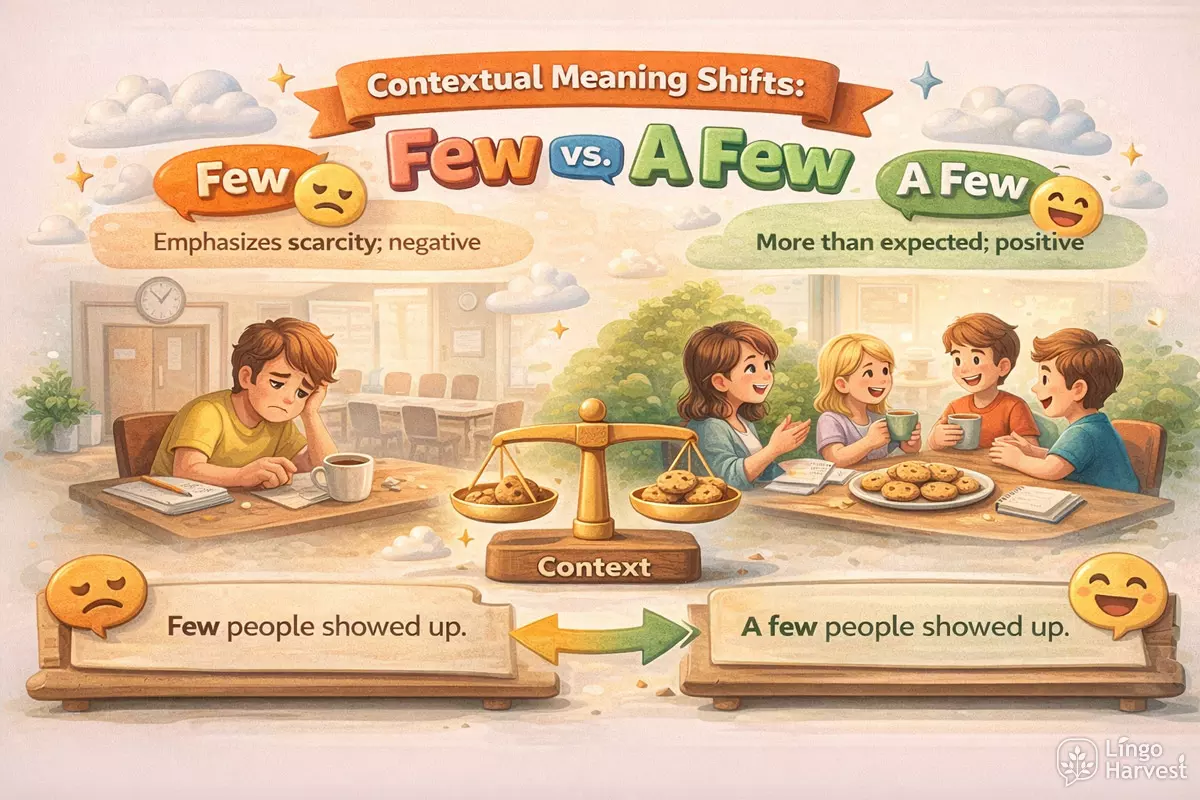
The distinction between few and a few often hinges on subtle cues in conversation and writing. While both refer to a small quantity, their emotional undertones and implications can shift dramatically depending on context. Recognizing these differences helps avoid misunderstandings, especially in situations where tone or intent matters.
Interpreting nuance in everyday situations
The phrase few usually emphasizes scarcity or insufficiency, which can sound negative or disappointing. In contrast, a few often suggests that, despite being small, the number or amount is still significant or useful—implying some positivity or at least adequacy. The choice between them can affect how a message is received, especially in spoken English.
- Few people attended the meeting. (Implies a disappointing turnout.)
- A few people attended the meeting. (Suggests some people did come, so the event wasn’t empty.)
- We have few options left. (Almost none, a negative outlook.)
- We have a few options left. (Still some choices remain.)
- There are few cookies on the plate. (Nearly gone, maybe not enough for everyone.)
- There are a few cookies on the plate. (Enough for a small group, or at least something.)
- She has few friends in town. (She is likely lonely.)
- She has a few friends in town. (She isn’t alone, even if her circle is small.)
- Few students passed the test. (Most failed, negative result.)
- A few students passed the test. (Some succeeded, despite difficulty.)
- Few opportunities arise in this field. (Rare, almost none.)
- A few opportunities arise in this field. (Occasional chances exist.)
- He gave few details about his trip. (Almost nothing shared.)
- He gave a few details about his trip. (Some information provided.)
- Few solutions are practical. (Most are not useful.)
- A few solutions are practical. (At least some can work.)
Impact on listener expectations
How you choose between these expressions can set expectations or influence reactions. For example, telling a friend that “few people enjoyed the movie” signals disappointment, while “a few people enjoyed the movie” softens the message, hinting at at least some positive feedback.
Quick reference: contrast in real-world scenarios
| Expression | Likely Meaning |
|---|---|
| Few chances left | Almost none remain; urgency or scarcity |
| A few chances left | Several remain; some hope or possibility |
| Few mistakes were made | Very rare errors; a generally positive result |
| A few mistakes were made | Some errors occurred; not perfect but not disastrous |
| Few customers complained | Almost no complaints; generally satisfied customers |
| A few customers complained | Some complaints; not widespread, but present |
Understanding these subtle shifts helps make your communication clearer and more precise, especially when expressing amounts, feelings, or evaluations in both formal and informal contexts.
Common learner misunderstandings
Many English learners find it tricky to know when to use few and a few. The similarity in their form can hide the important difference in meaning. One often signals something positive, while the other can sound negative or disappointing. This subtlety often leads to confusion, especially when interpreting or producing sentences in real-life contexts.
Mixing up positive and negative meanings
A frequent source of error is assuming that both expressions mean “some, but not many.” In fact, few usually suggests almost none, which can sound discouraging. In contrast, a few means a small number, but at least some — often a reassuring or positive nuance. Learners may unintentionally give the wrong impression in conversation by switching them.
Examples of common mistakes
- Saying “I have few friends here” (implies you are lonely or have almost no friends) instead of “I have a few friends here” (suggests you do have some friends).
- Using “a few problems” when you mean there are barely any problems, rather than “few problems.”
- Misunderstanding native speakers who use “few” in a sentence and missing the negative tone.
- Assuming both forms can be used interchangeably in formal writing.
- Forgetting that both are used only with countable nouns (e.g., “a few apples,” not “a few milk”).
- Confusing “few”/“a few” with “little”/“a little,” which are for uncountable nouns.
- Adding “of” after “few” or “a few” incorrectly (e.g., “a few of apples”).
- Trying to use “few” or “a few” with plural uncountable nouns (“a few informations”).
- Thinking “a few” always means “three” or a specific number.
- Not noticing that “few” can be used for emphasis or formality in certain contexts.
Contrast at a glance
| Expression | Typical Meaning | Example Sentence | Implication |
|---|---|---|---|
| few | almost none | Few students passed the test. | ❌ Negative (most did not succeed) |
| a few | some, but not many | A few students passed the test. | ✅ Positive (at least some did well) |
| few friends | very small or unsatisfactory number | He has few friends in the city. | ❌ Suggests loneliness |
| a few friends | a small, but sufficient number | He has a few friends in the city. | ✅ Suggests company/support |
Tips to avoid mistakes
- Remember: “few” = almost none (negative); “a few” = some (positive).
- Use these only with countable nouns (books, people, ideas).
- Listen for the tone or mood of the sentence to help choose the correct form.
- Practice with real sentences and pay attention to native usage.
Examples showing contrast clearly
Understanding the subtle distinction between "few" and "a few" is easiest when you see them used in context. Both phrases refer to a small number, but the feeling they convey is quite different. "Few" tends to have a negative or limiting sense, suggesting not enough, while "a few" is more positive, indicating some or enough for a purpose. Below, you'll find real examples that highlight this difference in meaning.
Typical usage in sentences
- Few people attended the meeting. (Almost nobody came; disappointing turnout)
- A few people attended the meeting. (Some people came; not many, but enough for discussion)
- Few students passed the exam. (Most failed; negative result)
- A few students passed the exam. (Some succeeded; at least there were some passes)
- Few options remain. (Hardly any choices left; situation is limiting)
- A few options remain. (There are still some choices; it's not hopeless)
- Few friends called me on my birthday. (Almost no one remembered; disappointment)
- A few friends called me on my birthday. (Some remembered; a positive note)
- Few buses run after midnight. (Almost none; hard to get home late)
- A few buses run after midnight. (There are some buses; possible to travel late)
- Few errors were found in the report. (Very close to perfect; almost no mistakes)
- A few errors were found in the report. (Some mistakes; not too bad, but needs fixing)
- Few visitors come here in winter. (The place is nearly empty)
- A few visitors come here in winter. (Some people still visit; not totally deserted)
- Few opportunities like this arise. (Rare chance; almost never happens)
- A few opportunities like this arise. (Occasionally possible; not common, but not unique)
Direct comparison table
| With "Few" | With "A Few" |
|---|---|
| Few seats were available. Almost none left; likely not enough. |
A few seats were available. Some left; enough for some people. |
| Few solutions exist for this issue. Very limited options; hard to solve. |
A few solutions exist for this issue. There are some possible ways; not hopeless. |
| Few customers visited today. Almost no business; negative news. |
A few customers visited today. Some business; not busy, but not empty. |
| Few books on the shelf are new. Most are old; almost no new ones. |
A few books on the shelf are new. There are some new ones; positive note. |
Summary of the difference
In short, "few" emphasizes scarcity or insufficiency, while "a few" suggests that, although the number is small, it is sufficient or at least not zero. Choosing the right phrase can completely change the tone of your sentence, especially when you want to express either disappointment or a small but positive outcome.
Practice: choosing few or a few correctly
Grasping the subtle difference between "few" and "a few" is important in order to express quantity and attitude accurately. The following exercises and examples will help reinforce when to use each expression, based on whether you want to emphasize scarcity or simply indicate a small number. Notice how context can affect the meaning and tone of a sentence.
Fill in the blank: "few" or "a few"?
Choose the correct option for each sentence below. Think about whether the sentence is expressing a negative idea (almost none, not enough) or a neutral/positive idea (some, enough for the purpose).
- There are ________ cookies left, so we can share them.
- Unfortunately, ________ people attended the meeting, so we had to cancel it.
- I have ________ friends in this city, and they help me feel at home.
- He has ________ opportunities to travel, which makes him disappointed.
- We have ________ minutes before the movie starts; let's get snacks.
- She made ________ mistakes on the test, so her score was high.
- ________ students understood the instructions, so the teacher explained again.
- Can you lend me ________ dollars until tomorrow?
- There are ________ reasons to believe his story.
- Only ________ guests RSVP’d, so the party was quiet.
Show answers
- a few
- few
- a few
- few
- a few
- a few
- few
- a few
- few
- few
Quick comparison: how "few" and "a few" change meaning
Compare these pairs. Notice how the choice affects the meaning. In each case, "few" emphasizes a lack, and "a few" highlights that there are some (even if not many).
| With "few" | With "a few" |
|---|---|
| Few people know the answer. (Almost no one knows.) |
A few people know the answer. (Some people know.) |
| Few cars were on the road. (Almost empty streets.) |
A few cars were on the road. (Some traffic, but not much.) |
| Few students passed the exam. (Most failed.) |
A few students passed the exam. (Some succeeded.) |
| Few solutions exist for this problem. (Hard to solve.) |
A few solutions exist for this problem. (There are options.) |
| Few eggs are left in the fridge. (Almost none remain.) |
A few eggs are left in the fridge. (Enough for a recipe.) |
| Few tourists visit in winter. (Winter is very quiet.) |
A few tourists visit in winter. (Some do come.) |
| Few signs of progress were seen. (Almost no progress.) |
A few signs of progress were seen. (Some progress is visible.) |
| Few knew about the event. (It was mostly unknown.) |
A few knew about the event. (A small group was informed.) |
| Few options are available. (Very limited choices.) |
A few options are available. (Some choices exist.) |
| Few details were provided. (Not enough information.) |
A few details were provided. (Some information given.) |
Tips for deciding which to use
- "Few" suggests a negative tone—almost none, insufficient, or disappointing.
- "A few" suggests a neutral or positive tone—some exist, enough for the purpose.
- Think about what you want to communicate: lack or presence?
- Read the sentence aloud; does it sound like a complaint (few) or a reassurance (a few)?
- Context matters: "few" often fits with negative results or missed expectations, while "a few" fits with opportunities or small achievements.
Test yourself: choose the correct expression
Decide if each sentence needs "few" or "a few".
- ______ books on this topic have been published.
- We only have ________ days left before the deadline.
- There are ________ chances of rain today.
- She has ________ relatives in this city.
- ______ students understood the explanation.
- We made ________ mistakes during the test.
- ______ companies showed interest in the proposal.
- He has ________ friends he can rely on.
- ______ opportunities remain at this stage.
- There are ________ tickets still available.
Show answers
- Few books on this topic have been published.
- A few days left before the deadline.
- Few chances of rain today.
- A few relatives in this city.
- Few students understood the explanation.
- A few mistakes during the test.
- Few companies showed interest in the proposal.
- A few friends he can rely on.
- Few opportunities remain at this stage.
- A few tickets still available.
Regular practice with real-life examples will help you build confidence in choosing between these expressions. Pay attention to the message you want to convey: is it a lack, or simply a small but sufficient amount?