Determiners for Uncountable Nouns: much, little, a bit of

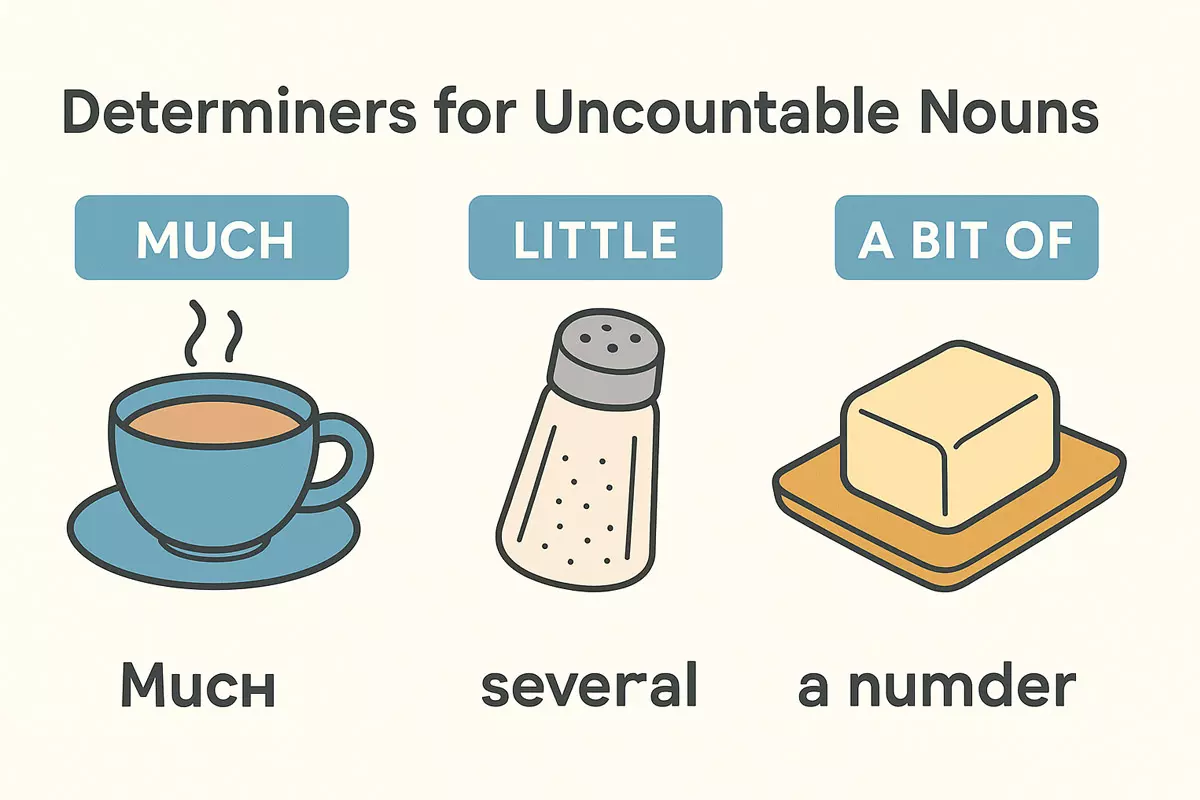 Here we how to recognize uncountable nouns, gives examples for food, materials, and ideas, explains using much, little, and a bit of, highlights mistakes with many, offers useful phrases, and provides practice with determiners.
- What uncountable nouns are and how to recognize them
- Typical uncountable nouns for food, materials, and ideas
- Using much and little with uncountable nouns
- Using a bit of and a little bit of in everyday English
- Common mistakes: using many with uncountable nouns
- Useful phrases with uncountable nouns in daily conversations
- Practice: complete sentences with correct determiners for uncountables
Navigating English grammar can be challenging, particularly when expressing quantities of uncountable nouns such as water, information, or advice. To communicate clearly and accurately, it is important to know which words are appropriate for these situations. Terms like much, a little, some, and a great deal of are commonly used to indicate amounts of things that cannot be counted individually. Mastering these expressions helps ensure your meaning is understood and your language sounds natural in both spoken and written English.
What uncountable nouns are and how to recognize them
Uncountable nouns, sometimes called mass nouns, refer to substances, concepts, or collective categories that cannot be separated into individual elements and counted directly. Instead of using numbers, we describe their quantity with words like much, little, or a bit of. These nouns represent things that are seen as a whole or a mass, rather than as individual units.
Key characteristics of uncountable nouns
- They do not have a plural form. For example, we say water, not waters (unless talking about different types or bodies of water).
- They are usually paired with singular verbs: Milk is good for you.
- They cannot be used with numbers directly: ❌ two breads, ✅ two loaves of bread.
- To specify quantity, we use measurement words like some, a little, a piece of, a bottle of, etc.
Common types and examples
Many uncountable nouns fall into certain categories. Here are some of the most frequent types, along with sample words:
- Substances and materials: water, air, rice, oil, gold, sand, bread, sugar, coffee, milk
- Abstract concepts: advice, information, knowledge, progress, time, luck, happiness, education, news, research
- Activities and fields: work, travel, homework, music, traffic
- Natural phenomena: weather, rain, sunshine, thunder
How to tell if a noun is uncountable
Recognizing uncountable nouns can be tricky, but there are signs to look for:
- Ask yourself: Can I put a number in front of this word without changing its form? If not, it’s probably uncountable.
- If the noun refers to something you can’t separate into exact units (like sand or information), it’s likely a mass noun.
- Check if it needs a “container” or “measure word” (like a piece of advice, a bottle of water) to specify quantity.
- Notice if it usually appears without “a” or “an”: we say advice, not an advice.
Uncountable vs. Countable: Quick Comparison
| Uncountable Noun | Countable Equivalent or Example |
|---|---|
| bread | a loaf of bread, two loaves |
| information | a fact, two details |
| water | a glass of water, three bottles |
| advice | a suggestion, two tips |
| rice | a grain of rice, several bowls |
| music | a song, many tracks |
| furniture | a chair, two tables |
| news | a report, several articles |
Understanding which nouns are uncountable helps you use determiners correctly and avoid common mistakes in English. When in doubt, check if the noun fits the patterns above or look for common measurement phrases that typically accompany mass nouns.
Typical uncountable nouns for food, materials, and ideas
When talking about substances, concepts, or categories that cannot be easily counted, English uses uncountable nouns. These words represent items or ideas that are seen as wholes or masses rather than individual units. Recognizing them is essential for choosing the correct determiners like much, little, or a bit of.
Uncountable nouns related to food
Many food and drink items fall into this group because they are usually measured rather than counted. Here are some common examples:
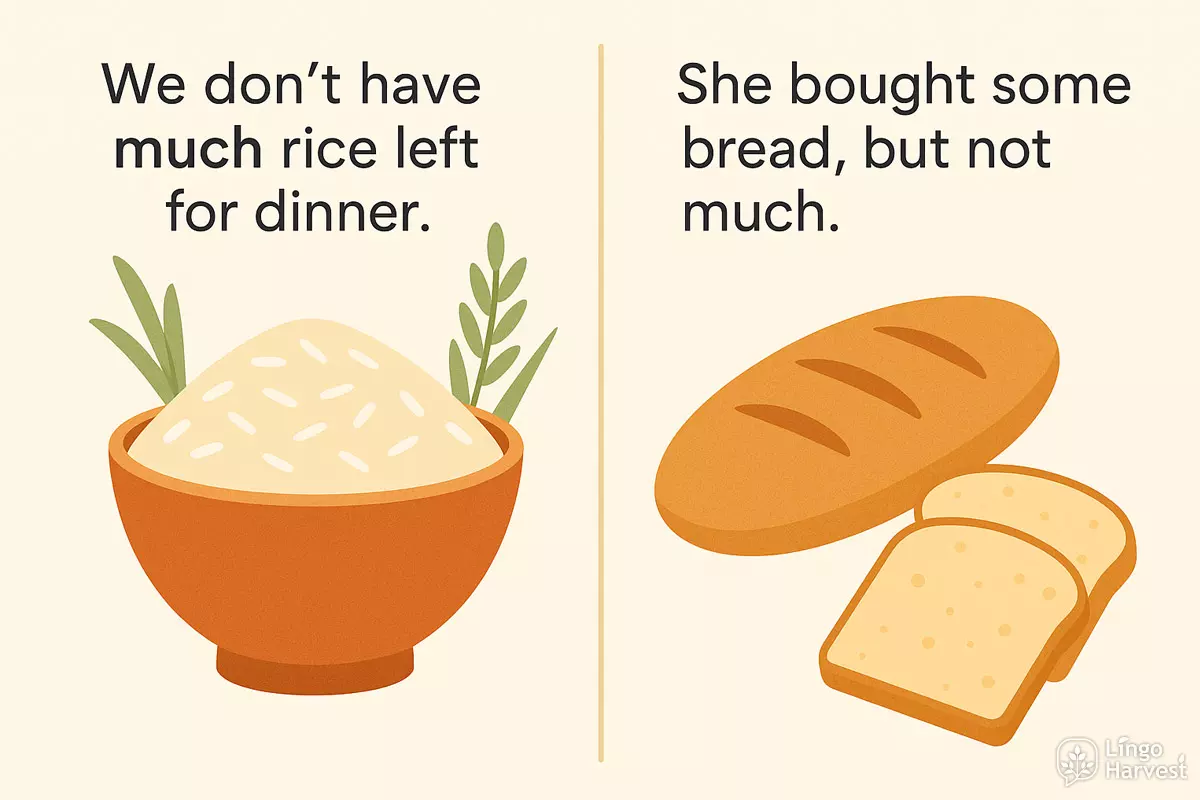
- rice → We don’t have much rice left for dinner.
- bread → She bought some bread, but not much.
- cheese → There is little cheese in the fridge.
- butter → We need more butter; there isn’t much left.
- meat → He eats very little meat these days.
- water → You should drink plenty of water, not just a little.
- milk → There isn’t much milk in the bottle.
- coffee → She drinks very little coffee in the morning.
- tea → We have much tea stored in the cupboard.
- salt → Add a little salt to the soup.
- sugar → He uses very little sugar in his tea.
- honey → There isn’t much honey left in the jar.
- flour → We have little flour, so we can’t bake bread.
- oil → Add a little oil to the pan before cooking.
Materials and substances
Materials are almost always uncountable since they refer to undivided substances. For example:
- wood → The table is made of wood, so we don’t need much to repair it.
- glass → The vase is fragile because it’s made of glass.
- paper → We don’t have much paper left in the printer.
- plastic → This bottle is made of plastic, not metal.
- cotton → These shirts use very little cotton compared to jeans.
- iron → The gate is made of iron and needs little maintenance.
- gold → She owns very little gold jewelry.
- silver → There isn’t much silver in this old coin.
- sand → The construction needs a lot of sand, not just a little.
- cement → We need more cement; there’s little left in the bag.
- steel → This bridge uses large amounts of steel.
Abstract ideas and concepts
Many words for feelings, qualities, or activities are also uncountable. These nouns express things you cannot touch or separate into individual items:
- information → She didn’t give me much information about the project.
- advice → He gave me a little advice before the interview.
- news → There isn’t much news about the situation yet.
- knowledge → She has a great deal of knowledge in chemistry.
- progress → We made little progress this week.
- research → The team has done a lot of research on the topic.
- music → He listens to music every evening, but not much today.
- furniture → They bought some new furniture for the living room.
- luggage → She traveled with very little luggage.
- education → Many people believe education requires a lot of effort.
- work → He has too much work to finish today.
- traffic → There was little traffic this morning.
- weather → The weather doesn’t give us much sunshine in winter.
- fun → We had so much fun at the party.
- luck → He didn’t have much luck in the competition.
Quick comparison: countable vs. uncountable
To help clarify, here’s a table showing common mistakes with countable and uncountable food and material nouns:
| Correct Uncountable Use | Incorrect Countable Use |
|---|---|
| some bread | ❌ a bread, breads |
| much information | ❌ many informations |
| a bit of advice | ❌ an advice, advices |
| little rice | ❌ a rice, rices |
| less water | ❌ fewer waters |
By understanding which nouns are uncountable, you can avoid common mistakes and use determiners like much, little, or a bit of naturally in your sentences. This awareness is especially useful when describing foods, materials, and abstract ideas in everyday English.
Using much and little with uncountable nouns
When talking about quantities of things we cannot count individually—like water, information, or money—English uses specific words to show amount. Two of the most common are much and little. These words help us describe large or small quantities of uncountable nouns in both questions and statements.
How to use "much"
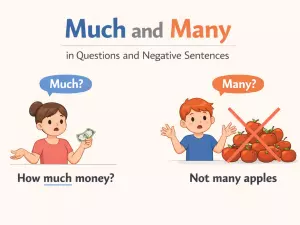
Much is mainly used in questions and negative sentences. It refers to a large quantity, but because we can't count the items, we don't use a plural form. For example, we say "much sugar" instead of "many sugars."
- Is there much milk left in the fridge?
- We don’t have much time before the meeting.
- How much information did you find?
- There isn’t much rain in this region.
- Do you need much help with your work?
How to use "little"
Little is used to indicate a small amount of something uncountable. It can sound rather limited or negative, implying that the amount is not enough. In contrast, "a little" suggests a small but sufficient quantity.
- There is little hope of success.
- They have little patience for delays.
- She has little experience in this area.
- We saw little improvement after the changes.
- He brought little water for the hike.
Comparison: "much" vs "little"
| "Much" | "Little" |
|---|---|
| Shows a large quantity Do you have much time? |
Shows a small quantity There is little time left. |
| Common in questions/negatives We don’t have much information. |
Often negative or insufficient Little progress was made. |
| Not used in positive statements unless formal Much work remains. |
"A little" means some (but not much) We have a little money left. |
| Used with uncountable nouns much advice, much knowledge |
Used with uncountable nouns little advice, little knowledge |
Common uncountable nouns with "much" and "little"
Here are some typical nouns that fit with these determiners:
- water → We don’t have much water left.
- money → He has very little money to spend.
- time → There isn’t much time before the deadline.
- information → We received little information about the event.
- advice → She gave me some advice, but not much.
- work → He has so much work to finish today.
- equipment → They have little equipment for the project.
- bread → There isn’t much bread in the kitchen.
- furniture → The apartment has very little furniture.
- news → There wasn’t much news this morning.
- music → She has little music downloaded on her phone.
- progress → We made little progress last week.
- patience → He has very little patience with delays.
- experience → I didn’t have much experience at the time.
- energy → She has little energy after work.
- traffic → There wasn’t much traffic today.
- luggage → We brought very little luggage on the trip.
- knowledge → He has little knowledge of chemistry.
- research → They have done much research on the topic.
- bread → We have little bread left for breakfast.
To sum up, "much" and "little" help us express how large or small an amount of something uncountable is, shaping the tone and meaning of our statements.
Using a bit of and a little bit of in everyday English
In spoken and written English, expressions like a bit of and a little bit of help speakers sound more natural and less formal when talking about small amounts. These phrases are especially common with uncountable nouns such as time, money, water, and advice. Both forms suggest a small quantity, but adding little can make the amount sound even smaller or more informal.
Common contexts and usage patterns
People often use these expressions to soften statements, make polite requests, or describe quantities in a friendly way. Here are some typical situations:
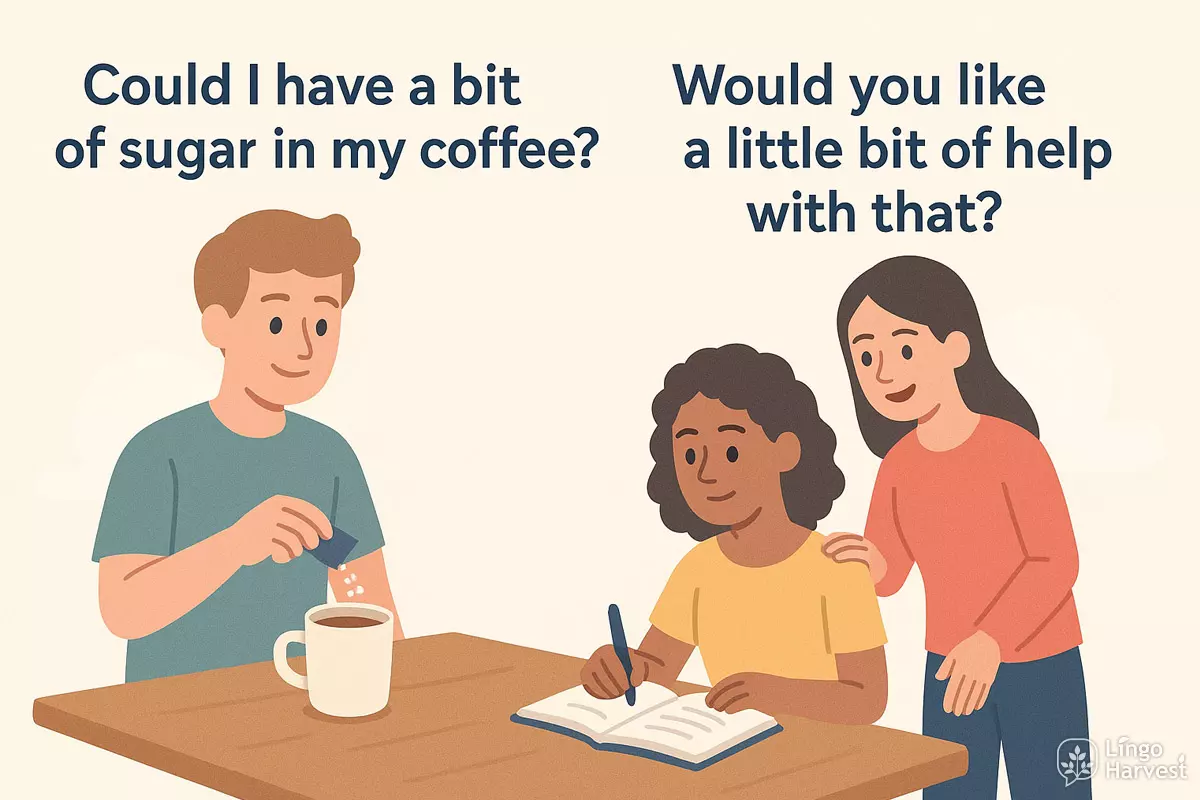
- Requesting: "Could I have a bit of sugar in my coffee?"
- Offering: "Would you like a little bit of help with that?"
- Describing: "There’s a bit of noise coming from outside."
- Explaining: "I need a little bit of time to finish."
- Suggesting: "Let’s add a bit of salt to the soup."
- Apologizing: "Sorry, I made a little bit of a mess."
- Sharing feelings: "I’m feeling a bit of stress today."
- Talking about changes: "There’s been a little bit of improvement."
- Describing taste: "The cake needs a bit of sweetness."
- Making comparisons: "She has a little bit of experience, but not much."
Subtle differences and emphasis
While a bit of and a little bit of are often interchangeable, the longer version can sound even more informal or emphasize the smallness of the amount. For example, "I need a little bit of help" sounds slightly gentler than "I need a bit of help." In some cases, using a little bit of adds friendliness or softens requests.
| Expression | Example Sentence |
|---|---|
| a bit of | Can you give me a bit of advice? |
| a little bit of | There’s a little bit of milk left in the fridge. |
| a bit of | He showed a bit of interest in the project. |
| a little bit of | I’d like a little bit of peace and quiet. |
In summary, using these phrases adds variety and nuance to English conversations. They are particularly useful for sounding natural, polite, or non-committal when talking about small quantities of uncountable things.
Common mistakes: using many with uncountable nouns
Learners of English often confuse countable and uncountable nouns, especially when choosing quantifiers. One frequent error is pairing "many" with nouns that cannot be counted individually. This typically happens because "many" feels natural for expressing quantity, but it is only correct with countable items (like "books," "apples," or "chairs"). Uncountable nouns—such as "water," "information," or "music"—require different determiners.
Why "many" is incorrect with uncountable nouns
Uncountable nouns refer to substances, concepts, or masses that we do not separate into individual elements. Since they represent a whole or a collective idea, "much" is used instead of "many" to indicate quantity. For example, we say "much advice" and not "many advice." Using "many" with these nouns sounds unnatural and may confuse listeners.
Frequent errors and correct alternatives
Below are some common mistakes and how to fix them. Notice how "much," "a little," or "a bit of" properly match uncountable nouns:
- ❌ Do you have many money? → ✅ Do you have much money?
- ❌ There isn’t many information available. → ✅ There isn’t much information available.
- ❌ How many rice do we need? → ✅ How much rice do we need?
- ❌ She doesn’t have many furniture. → ✅ She doesn’t have much furniture.
- ❌ We saw many snow last winter. → ✅ We saw much snow last winter.
- ❌ There isn’t many traffic today. → ✅ There isn’t much traffic today.
- ❌ He didn’t eat many bread. → ✅ He didn’t eat much bread.
- ❌ I don’t have many homework. → ✅ I don’t have much homework.
- ❌ Many knowledge is needed for this job. → ✅ Much knowledge is needed for this job.
- ❌ There isn’t many equipment in the gym. → ✅ There isn’t much equipment in the gym.
- ❌ How many milk do you want? → ✅ How much milk do you want?
- ❌ She doesn’t have many patience. → ✅ She doesn’t have much patience.
- ❌ Many sugar is unhealthy. → ✅ Much sugar is unhealthy.
Tip: When to use "many" and "much"
A simple way to remember: use "many" with things you can count one by one (like "books"), and "much" with things you can measure but not count individually (like "water"). If you’re unsure, try to use "a lot of"—it works with both countable and uncountable nouns in informal contexts.
Summary of correct usage
Understanding the difference between countable and uncountable nouns helps you avoid mistakes with quantifiers. Always check if a noun is uncountable before using "many"—if it is, switch to "much," "a little," or "a bit of" for correct and natural English.
Useful phrases with uncountable nouns in daily conversations
When speaking English, uncountable nouns come up often, especially when talking about things like advice, information, or money. Using the right determiners helps your speech sound more natural and clear. Below are some everyday expressions and sentence patterns that show how "much," "little," and "a bit of" are used with these nouns.
Common expressions using "much," "little," and "a bit of"
- Do you have much time to talk?
- There's little hope of finishing today.
- I need a bit of help with this.
- How much money do we need?
- She gave me a bit of advice.
- There isn’t much information available.
- Can I get a bit of water?
- We have little patience left.
- Is there much traffic today?
- He showed little interest in the topic.
- I’d like a bit of sugar in my tea.
- There’s not much furniture in the room.
- She has little experience in this area.
- Could you add a bit of salt?
- They have much respect for their teacher.
- We need a bit of time to decide.
- He gave little thought to the consequences.
- Is there much work left to do?
- Let’s take a bit of rest before continuing.
- There’s little room for error.
Patterns for polite requests and offers
When making requests or offers, using "a bit of" often sounds softer and more natural. For example:
- Would you like a bit of cake?
- Could I have a bit of quiet, please?
- Can you give me a bit of advice?
Comparing determiners with uncountable nouns
Sometimes it's helpful to see how these determiners can change the meaning or tone. Here is a quick comparison:
| Phrase with "much" | Alternative with "little" or "a bit of" |
|---|---|
| Do you have much time? | Do you have a bit of time? |
| There isn’t much hope. | There’s little hope. |
| How much information do we need? | Could you give me a bit of information? |
| Is there much sugar left? | Can I have a bit of sugar? |
These examples and structures will help you sound more fluent and polite when discussing topics involving uncountable nouns in English. Try using different determiners to adjust your tone or clarify your meaning in everyday conversations.
Practice: complete sentences with correct determiners for uncountables
Understanding how to use determiners like much, little, and a bit of with uncountable nouns is essential for clear communication. Below, you’ll find exercises designed to help you choose the right word in context. These activities focus on common situations where these determiners appear, encouraging both recognition and correct use.
Choose the correct determiner
Read each sentence and select the most suitable option: much, little, or a bit of.
- There isn’t ________ water left in the bottle.
- I have ________ patience for rude people.
- Could you give me ________ advice about my project?
- He added ________ sugar to his coffee, not too much.
- We don’t have ________ time to finish the assignment.
- She put ________ effort into her homework and it showed.
- Is there ________ information about the new policy?
- The soup needs ________ salt, just a pinch.
- There was ________ noise in the library; it was very quiet.
- I only need ________ help with this task, not a lot.
Show answers
- much
- little
- a bit of
- a bit of
- much
- little
- much
- a bit of
- little
- a bit of
Fill in the blanks with appropriate determiners
Use much, little, or a bit of to complete each sentence meaningfully.
- He hasn’t shown ________ interest in sports lately.
- Could I have ________ milk in my tea?
- There’s very ________ hope of finding the lost keys.
- We need ________ more information before making a decision.
- She had ________ energy left after the long trip.
- There isn’t ________ traffic on Sundays.
- We have ________ time to finish the report.
- He showed ________ patience with the children.
- Do you have ________ experience in this field?
- There was so ________ noise that no one could concentrate.
Show answers
- much
- a bit of / some
- little
- much
- little
- much
- little
- much
- much
- much
Quick review: When to use each determiner
- Much – for large amounts, usually in negative or question forms (e.g., “Do you have much experience?”).
- Little – for small amounts, often with a negative meaning (e.g., “There is little hope”).
- A bit of – for a small, unspecified amount, often informal (e.g., “Can I have a bit of cheese?”).
Practice choosing the right determiner helps you sound more natural and precise when talking about uncountable quantities in English.