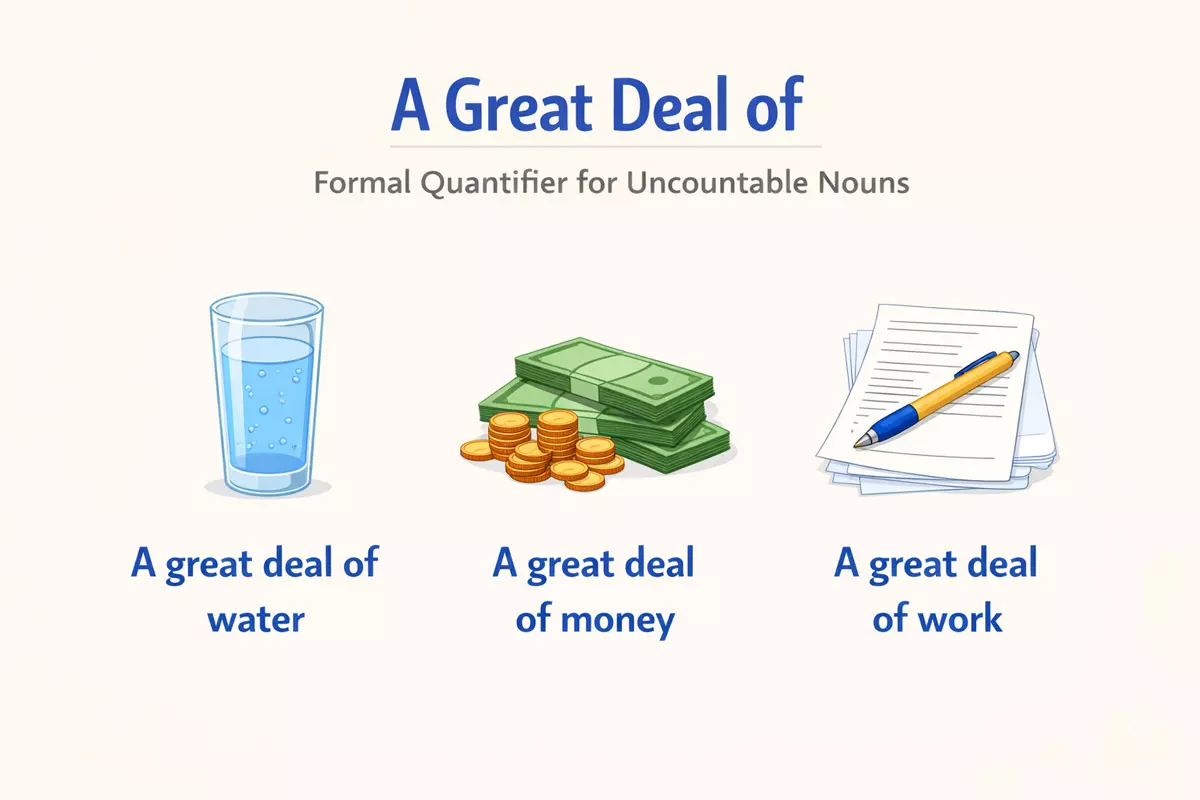
A Great Deal of: Formal Quantifier for Uncountable Nouns

 Here we the meaning and intensity of 'a great deal of,' its restriction to uncountable nouns, tone, formality, typical contexts, correct grammar, comparison with similar quantifiers, common mistakes, usage examples, and practice tips.
- Meaning and strength of the expression
- Why it is limited to uncountable nouns
- Tone and level of formality
- Common contexts where it sounds natural
- Sentence position and grammatical patterns
- Comparison with similar formal quantifiers
- Typical learner mistakes and misuse
- Examples in formal and informational writing
- Practice: choosing a great deal of correctly
When talking about things that cannot be counted individually, such as water or information, it is essential to use language that accurately reflects their uncountable nature. This means choosing words and phrases that convey the idea of a large amount without implying a specific number. Expressing these concepts clearly not only improves the precision of your communication but also helps others understand your message more effectively, especially when discussing abstract or limitless quantities.
Meaning and strength of the expression
When using "a great deal of" with uncountable nouns, the phrase acts as a formal quantifier indicating a large or significant amount. This expression emphasizes quantity, but it does so in a measured, somewhat formal way—more reserved than emphatic terms like "a ton of" or "loads of." It's commonly found in both spoken and written English, particularly in academic, professional, and polite contexts.
Nuances of Use
"A great deal of" is typically applied to uncountable (mass) nouns, such as "information," "work," or "patience." It does not specify an exact amount, but it suggests that the quantity is notably high. Compared to similar expressions, it sits between neutral and emphatic; it is stronger than "some" or "a bit of," but less exaggerated than "a huge amount of."
- a great deal of patience — Teaching young children requires a great deal of patience.
- a great deal of effort — The project took a great deal of effort to complete.
- a great deal of knowledge — This role demands a great deal of knowledge in the field.
- a great deal of time — Writing the report took a great deal of time.
- a great deal of support — She received a great deal of support from her family.
- a great deal of research — The study involved a great deal of research.
- a great deal of interest — The announcement generated a great deal of interest.
- a great deal of money — They invested a great deal of money in the startup.
- a great deal of attention — The issue requires a great deal of attention.
- a great deal of damage — The storm caused a great deal of damage.
- a great deal of progress — He has made a great deal of progress this year.
- a great deal of stress — The job comes with a great deal of stress.
- a great deal of confusion — The sudden change created a great deal of confusion.
- a great deal of experience — She brings a great deal of experience to the team.
- a great deal of responsibility — The position carries a great deal of responsibility.
Comparative Strength
The strength of this quantifier varies depending on context and alternatives. For example, "a great deal of" is more formal and slightly less forceful than "a lot of," but stronger than "some." It is rarely used with countable nouns, especially in modern English.
| Quantifier | Relative Strength/Usage |
|---|---|
| a bit of | → Small amount, understated |
| some | → Moderate, unspecified amount |
| a great deal of | → Large, formal, polite |
| a lot of | → Large, informal, common |
| a huge amount of | → Very large, emphatic |
Register and Tone
Choosing "a great deal of" adds a touch of formality or politeness to your statement. It is well-suited for academic writing, business communication, and situations where a neutral or respectful tone is desired. In casual speech, speakers might prefer "a lot of" or "lots of" instead.
Why it is limited to uncountable nouns
The phrase “a great deal of” is used with mass nouns—words that represent substances or concepts that cannot be counted individually. This is because “a great deal of” refers to an amount or quantity, not a discrete number of items. For instance, you might say “a great deal of information,” but not “a great deal of apples.” The construction focuses on things that are measured in bulk or by degree, not by distinct units.
How Uncountable Nouns Differ from Countable Nouns
Uncountable nouns represent things like liquids, concepts, or materials that cannot be separated into individual elements. These include words like “water,” “advice,” and “furniture.” In contrast, countable nouns refer to items you can count separately, such as “books,” “cars,” or “ideas.” Since “a great deal of” measures a general quantity rather than a specific count, it fits naturally with uncountable terms.
Common Uncountable Nouns Used with "A Great Deal Of"

- Information — The report contains a great deal of information.
- Advice — She gave me a great deal of advice before the interview.
- Furniture — They bought a great deal of furniture for the new office.
- Water — The plant needs a great deal of water in summer.
- Time — Fixing the issue took a great deal of time.
- Patience — Dealing with customers requires a great deal of patience.
- Money — The project cost a great deal of money.
- Progress — The team has made a great deal of progress.
- Effort — Learning a new language takes a great deal of effort.
- Support — She received a great deal of support from her colleagues.
- Attention — The matter deserves a great deal of attention.
- Work — Completing the renovation involved a great deal of work.
- Experience — He has a great deal of experience in management.
- Energy — The children have a great deal of energy.
- Knowledge — This position requires a great deal of knowledge.
- Luck — Winning the competition took a great deal of luck.
- Traffic — There is a great deal of traffic during rush hour.
- Interest — The announcement generated a great deal of interest.
Why “A Great Deal Of” Doesn’t Work with Countable Nouns
Trying to use this phrase with countable nouns sounds unnatural and is considered incorrect in standard English. For countable nouns, expressions such as “a large number of” or “many” are preferred. The difference comes down to whether you are describing a measurable quantity (uncountable) or a specific number (countable).
| Expression | Correct Usage |
|---|---|
| A great deal of | A great deal of patience ✅ A great deal of money ✅ A great deal of books ❌ |
| A large number of | A large number of books ✅ A large number of ideas ✅ A large number of water ❌ |
In summary, “a great deal of” is naturally matched to nouns that represent an indefinite mass or abstract concept. This limitation ensures clarity and correctness in both formal and informal writing.
Tone and level of formality
When it comes to expressing quantity with uncountable nouns, “a great deal of” stands out as a formal and somewhat elevated alternative to more neutral phrases like “a lot of” or “lots of.” This expression is commonly found in academic writing, business correspondence, and situations where a polished or respectful tone is preferred. Using it in conversation can make statements sound more serious or careful, especially when compared to informal choices.
Writers and speakers often select “a great deal of” when they want to convey care, precision, or distance. In less formal communications, simpler alternatives are usually chosen for brevity and ease. Understanding the nuances of this phrase can help you match your language to the context—choosing formality when it’s required, and avoiding awkwardness in casual exchanges.
Contexts Where “A Great Deal Of” Is Appropriate
- Academic essays and research papers
- Formal letters or official reports
- Professional presentations or meetings
- News articles and journalistic writing
- Polite or diplomatic conversation
- Describing abstract concepts (e.g., “a great deal of uncertainty”)
- Discussing emotions or qualities in a refined way
- Legal documents or contracts
- Serious discussions (e.g., “a great deal of responsibility”)
- Historical or analytical texts
Comparison With Alternative Expressions
To highlight differences in tone and register, here’s a comparison of several common quantifiers for uncountable nouns:
| Expression | Formality Level | Typical Contexts |
|---|---|---|
| A great deal of | Formal | Academic, professional, official |
| A lot of | Neutral / Informal | Everyday speech, informal writing |
| Lots of | Informal | Casual conversation |
| Plenty of | Neutral | General, sometimes informal |
| Much | Formal (affirmative), Neutral (negative/interrogative) | Written English, questions, negatives |
Tips for Choosing the Right Register
- Use “a great deal of” when you want to sound precise, respectful, or official.
- Switch to “a lot of” or “lots of” if the setting is relaxed or conversational.
- Remember that overusing formal quantifiers can seem stiff or distant in friendly contexts.
- Match your language to your audience—consider their expectations and the situation.
- Reserve “a great deal of” for writing or speech that benefits from a measured, thoughtful tone.
Choosing between these expressions not only affects clarity but also the impression you make. “A great deal of” lends gravity and nuance, while simpler phrases keep things light and accessible. Tailoring your quantifier to the moment makes your English sound natural and appropriate.
Common contexts where it sounds natural
The phrase a great deal of is typically reserved for situations where a formal, somewhat elevated tone is needed, particularly when discussing large, often abstract quantities that can’t be counted individually. This expression is especially common in academic, professional, and written English, rather than in informal conversation. It tends to appear with uncountable nouns—those that represent substances, concepts, or collective qualities.
Typical scenarios for use
- Academic writing (e.g., research papers, essays)
- Formal reports or business documents
- Describing abstract concepts (e.g., knowledge, patience)
- Talking about emotions or qualities (e.g., enthusiasm, courage)
- Discussing resources or materials (e.g., information, water)
- Expressing the extent of effort or work (e.g., effort, work)
- Reporting on progress or change (e.g., progress, development)
- Referring to influence or impact (e.g., influence, importance)
- Describing time spent or needed (e.g., time, preparation)
- Summarizing research or findings (e.g., evidence, support)
- Discussing financial matters in a general sense (e.g., money, funding)
- Explaining health or medical data (e.g., stress, pain)
Alternative expressions and register
While a great deal of is a polished choice for uncountable nouns, it has equivalents that are more casual or suited to spoken English, like a lot of or lots of. The table below highlights how the level of formality and context can influence your choice.
| Expression | Typical Context | Example |
|---|---|---|
| A great deal of | Formal, academic, written | A great deal of evidence supports this theory. |
| A lot of | Neutral, everyday speech | There’s a lot of water on the floor. |
| Lots of | Informal, spoken | She has lots of energy today. |
| Much | Formal negative/interrogative | There isn’t much information available. |
Examples with uncountable nouns
- He devoted a great deal of attention to the details.
- The project required a great deal of patience.
- There is a great deal of uncertainty in the results.
- We received a great deal of support from the community.
- Her research provided a great deal of insight.
- The new policy created a great deal of confusion.
- This process requires a great deal of skill.
- He invested a great deal of time in his studies.
- The discussion generated a great deal of interest.
- The experiment involved a great deal of risk.
In summary, this formal quantifier fits best in writing or speech that needs precision, respectability, or an academic tone, especially with nouns that can’t be counted individually. It’s rarely used for everyday, casual conversations, where simpler alternatives usually sound more natural.
Sentence position and grammatical patterns
Understanding how “a great deal of” fits into English sentences helps ensure clarity and correctness, especially when dealing with uncountable nouns. This formal quantifier generally functions as a noun modifier, specifying a large quantity. Its placement and grammatical behavior are consistent, but some nuances are worth noting.
Typical placement in sentences

“A great deal of” is usually positioned directly before an uncountable noun. It acts as a quantifier phrase and always precedes the noun it modifies. The entire phrase (“a great deal of”) is treated as a single unit, so it should not be separated or rearranged.
- A great deal of information was provided at the meeting.
- She demonstrated a great deal of patience.
- The project required a great deal of effort.
Verb agreement
When using this quantifier, verb agreement depends on the noun that follows. Since “a great deal of” is used with uncountable nouns (which are grammatically singular), the verb should also be singular.
- A great deal of money is needed for the renovation. ✅
- A great deal of advice has been given. ✅
- A great deal of equipment was purchased. ✅
Common grammatical patterns
The phrase is rarely used at the end of a sentence. It most often appears at the beginning or in the middle, serving as the subject or as part of the object.
| Pattern | Example |
|---|---|
| Subject position | A great deal of research is required. |
| Object position | The committee discussed a great deal of evidence. |
| With adjectives | She showed a great deal of remarkable skill. |
| After prepositions | We succeeded because of a great deal of preparation. |
| With possessives | His work involves a great deal of responsibility. |
Negative, interrogative, and comparative forms
This quantifier can appear in negative and question forms, but some alternatives may sound more natural in casual speech. In formal contexts, it remains standard.
- Negative: There isn’t a great deal of hope left.
- Question: Did you receive a great deal of feedback?
- Comparative: This process requires an even greater deal of attention.
Summary of usage
To use “a great deal of” correctly:
- Always pair it with uncountable nouns.
- Follow it with a singular verb.
- Place the phrase immediately before the noun.
- Avoid splitting the phrase or using it with countable nouns.
- Use it in both affirmative and negative sentences, as well as questions.
By following these patterns, you can communicate large quantities in a polished, formal style.
Comparison with similar formal quantifiers
The phrase a great deal of is just one of several formal quantifiers used with uncountable nouns in English. To understand its unique role, it helps to look at how it functions alongside other expressions that indicate large or vague amounts in formal or semi-formal contexts. While all these quantifiers serve to modify uncountable nouns, their tone, frequency, and register can differ significantly.
Common alternatives and their nuances
- A lot of — More neutral and common in both spoken and written English, but less formal than a great deal of.
- Much — Used mainly in questions and negatives in everyday English; more formal in affirmative sentences.
- A large amount of — Similar in formality to a great deal of, but slightly more precise and less idiomatic.
- Plenty of — Conveys sufficiency rather than emphasis on quantity; more informal.
- A good deal of — Close in meaning, but slightly less formal; often interchangeable in some contexts.
- Lots of — Very informal, rarely used in academic or professional writing.
- A considerable amount of — Emphasizes the significance or impact of the quantity, often used in research or reports.
- An abundance of — Suggests more than enough, sometimes with a positive connotation.
- A quantity of — Neutral, less common, and often used in technical contexts.
- A wealth of — Implies richness or diversity rather than sheer volume; often metaphorical.
Register and usage differences
Register plays a key role in which quantifier is appropriate. For example, a great deal of is favored in formal writing, academic reports, and polite conversation, whereas a lot of or lots of are more suited to casual speech. The choice can affect not only the tone but also the perceived precision and professionalism of the sentence.
| Quantifier | Formality & Typical Context | Example |
|---|---|---|
| A great deal of | Formal; academic, business, polite speech | A great deal of research has been conducted. |
| A lot of | Neutral; general spoken/written English | A lot of information is available online. |
| Much | Formal (affirmative); common in negatives/questions | Much progress has been made. |
| A large amount of | Formal; precise, technical, or scientific writing | A large amount of data was collected. |
| A good deal of | Semi-formal; less formal than a great deal of | A good deal of time was spent on revisions. |
| Plenty of | Informal; casual conversation | There’s plenty of space in the room. |
In summary, while a great deal of shares similarities with several other quantifiers for uncountable nouns, its level of formality and idiomatic tone make it particularly useful in settings where a polished and professional impression is important. Understanding these subtle distinctions can help you select the most effective quantifier for your communication goals.
Typical learner mistakes and misuse
Learners often face challenges when using "a great deal of" as a quantifier for uncountable nouns. These issues usually stem from confusion between countable and uncountable nouns, as well as mixing up similar quantifying phrases. Understanding where "a great deal of" is appropriate can help avoid awkward or incorrect sentences.
Common errors with "a great deal of"
Many English learners mistakenly use this phrase with countable nouns or in informal contexts where a simpler word would suffice. Here are some of the most frequent missteps:
- Using "a great deal of" with countable nouns: Incorrect: "A great deal of apples were sold." ❌
- Confusing it with "a lot of," which works for both countable and uncountable nouns: Incorrect: "A great deal of chairs."
- Omitting "of" after "a great deal": Incorrect: "A great deal money."
- Placing "a great deal of" before adjectives: Incorrect: "A great deal of expensive equipment."
- Using it in informal speech where it sounds overly formal or stilted.
- Applying "a great deal of" to abstract ideas that are not typically quantified: Incorrect: "A great deal of happinesses."
- Incorrect verb agreement: Incorrect: "A great deal of water are needed."
- Redundant use with other quantifiers: Incorrect: "A great deal of much information."
- Trying to make it plural: Incorrect: "Great deals of advice."
- Using it with negative forms improperly: Incorrect: "Not a great deal of people."
Comparison with Similar Quantifiers
Learners sometimes substitute or confuse "a great deal of" with other quantifiers. The table below highlights typical confusion points and clarifies correct usage.
| Phrase | Example (Correct Use) |
|---|---|
| A great deal of | She has a great deal of experience. ✅ |
| A lot of | They have a lot of books. ✅ |
| Much | There isn’t much time left. ✅ |
| Many | Many students attended. ✅ |
How to avoid these pitfalls
To prevent mistakes, remember that "a great deal of" is reserved for uncountable nouns, such as information, water, time, or patience. If you’re unsure, try replacing it with "much" or "a lot of" to check if the sentence still sounds right. Avoid using this phrase with plural countable nouns, and don’t double up on quantifiers. By being mindful of these common errors and practicing with a variety of uncountable nouns, your use of formal quantifiers like "a great deal of" will become more natural and precise.
Examples in formal and informational writing
Writers often use “a great deal of” to refer to large quantities of uncountable nouns, especially in academic, technical, or professional texts. This phrase lends a formal tone and is commonly preferred over more conversational alternatives like “lots of” or “plenty of.” Below, you’ll find typical contexts and sentences where this quantifier enhances clarity and precision.
Common contexts for “a great deal of”
- Scientific reporting (e.g., discussing data, research findings, or evidence)
- Business and economics (e.g., referencing resources, information, or funding)
- Academic essays (e.g., analyzing literature, presenting arguments)
- Official communications (e.g., policies, formal requests)
- Technical documentation (e.g., describing effort, attention, or support)
Sample sentences using “a great deal of”
- The experiment required a great deal of precision.
- She has invested a great deal of time in developing this project.
- A great deal of research supports this conclusion.
- The proposal received a great deal of attention from the committee.
- There is a great deal of interest in renewable energy sources.
- The company devoted a great deal of effort to improving customer satisfaction.
- This policy change has generated a great deal of discussion among stakeholders.
- A great deal of information is available on this topic.
- We encountered a great deal of resistance during the initial phase.
- Her work demonstrates a great deal of creativity.
Comparing “a great deal of” with other quantifiers
| Expression | Typical Use |
|---|---|
| a great deal of | Formal, uncountable nouns (e.g., “a great deal of patience”) |
| a lot of | Informal, both countable and uncountable nouns (e.g., “a lot of information”) |
| much | Formal/neutral, usually negative/interrogative (e.g., “not much evidence”) |
| plenty of | Informal/positive, both noun types (e.g., “plenty of support”) |
Choosing “a great deal of” helps maintain a polished, objective tone, especially when discussing abstract concepts or large amounts of something that cannot be counted individually. This makes it a staple in formal documents, academic papers, and professional communication.
Practice: choosing a great deal of correctly
Understanding when to use "a great deal of" is essential for clear and accurate English, especially with uncountable nouns. This section provides practical exercises and guidance to help you confidently select this formal quantifier in appropriate contexts.
Common Contexts for "a great deal of"
The phrase is typically used to express large amounts with uncountable nouns such as information, effort, or patience. It is more formal than alternatives like "lots of" or "plenty of." Review the examples below to see how this quantifier fits different scenarios:
- a great deal of information — The guide includes a great deal of information for beginners.
- a great deal of research — The article is based on a great deal of research.
- a great deal of time — Preparing for the exam takes a great deal of time.
- a great deal of effort — Finishing the project required a great deal of effort.
- a great deal of patience — Raising a puppy takes a great deal of patience.
- a great deal of energy — The kids have a great deal of energy after school.
- a great deal of money — They spent a great deal of money on repairs.
- a great deal of support — She received a great deal of support from her team.
- a great deal of progress — He has made a great deal of progress this month.
- a great deal of attention — This issue needs a great deal of attention.
- a great deal of advice — I got a great deal of advice from my mentor.
- a great deal of experience — She has a great deal of experience in sales.
- a great deal of trouble — The storm caused a great deal of trouble for drivers.
- a great deal of noise — The construction made a great deal of noise all day.
- a great deal of enthusiasm — The crowd showed a great deal of enthusiasm.
- a great deal of knowledge — The course provides a great deal of knowledge about finance.
- a great deal of damage — The fire did a great deal of damage to the building.
- a great deal of concern — The decision raised a great deal of concern.
- a great deal of interest — The lecture sparked a great deal of interest.
- a great deal of confusion — The new rules created a great deal of confusion.
Comparing Quantifiers: When to Use "a great deal of"
The following table highlights differences between "a great deal of," "much," and "a lot of" in formal writing with uncountable nouns.
| Quantifier | Example with Uncountable Noun | Formality |
|---|---|---|
| a great deal of | a great deal of patience is needed | Formal |
| much | much patience is needed | Neutral/Formal (often negative or questions) |
| a lot of | a lot of patience is needed | Informal/Neutral |
| plenty of | plenty of patience is needed | Informal |
Choose the Correct Quantifier
Try selecting the most appropriate quantifier for each sentence. Focus on context, formality, and whether the noun is countable or uncountable.
- She has ______ experience in this field.
- There isn't ______ water left in the bottle.
- We received ______ feedback after the event.
- He has ______ patience with children.
- They invested ______ time in the project.
- The job requires ______ responsibility.
- She showed ______ interest in the proposal.
- The repair caused ______ damage to the building.
- Learning a new skill takes ______ effort.
- The discussion generated ______ confusion.
Show answers
- a great deal of
- much
- a great deal of / a lot of
- a great deal of
- a great deal of
- a great deal of
- a great deal of
- a great deal of
- a great deal of
- a great deal of
Spot the Error
Identify if "a great deal of" is used correctly. If not, suggest a better choice.
- A great deal of books were donated to the library.
- A great deal of advice was given during the meeting.
- A great deal of people attended the conference.
- She put a great deal of effort into her studies.
- A great deal of chairs were moved into the hall.
- The charity raised a great deal of money in one day.
- A great deal of questions were asked after the lecture.
- They spent a great deal of time preparing the presentation.
- A great deal of students have signed up for the course.
- The accident caused a great deal of damage to the building.
Show answers
- ❌ Incorrect – use "a large number of books" (books = countable)
- ✅ Correct
- ❌ Incorrect – use "a large number of people" (people = countable)
- ✅ Correct
- ❌ Incorrect – use "a large number of chairs" (chairs = countable)
- ✅ Correct
- ❌ Incorrect – use "a large number of questions" (questions = countable)
- ✅ Correct
- ❌ Incorrect – use "a large number of students" (students = countable)
- ✅ Correct
Summary Tips
- Use "a great deal of" with uncountable nouns in formal contexts.
- For countable nouns, choose alternatives like "a large number of."
- Match the quantifier to the tone and purpose of your writing.