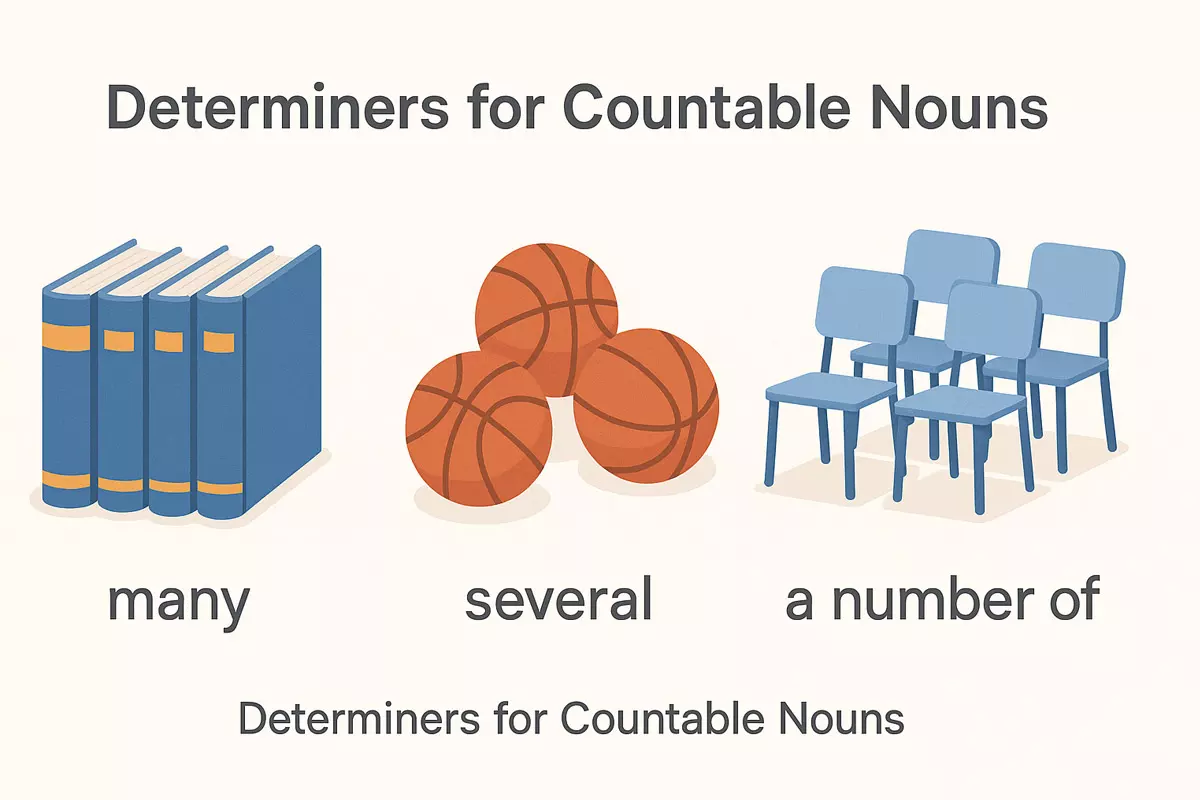
Determiners for Countable Nouns: many, several, a number of

 The article explains countable nouns and their role with determiners, covers the use of many, several, a number of, a lot of, and clarifies few vs a few. It also addresses mixing noun types, typical learner errors, and provides practice exercises.
- What countable nouns are and why they matter for determiners
- Using many and several with plural countable nouns
- Phrases with a number of and a lot of
- Difference between few and a few with countable nouns
- Mixing countable and uncountable nouns in the same sentence
- Typical errors learners make with countable determiners
- Practice: choose the correct determiner for countable nouns
Selecting appropriate words to describe quantities helps your English sound both precise and natural. For example, using terms like handful, multitude, or portion allows you to express different amounts of countable items more accurately. Understanding these expressions not only improves your communication skills but also ensures that your meaning is clear to listeners. By expanding your vocabulary related to quantity, you can describe situations more effectively and avoid misunderstandings in everyday conversations.
What countable nouns are and why they matter for determiners
Countable nouns are words that refer to things you can count individually—items that have both singular and plural forms. For instance, you can have one apple, three chairs, or several ideas. Because these nouns can be separated and tallied, they require specific determiners to show quantity, such as "many," "several," or "a number of." The choice of determiner affects both the grammar and meaning of your sentences.
How to recognize countable nouns
Identifying whether a noun is countable is crucial for using the correct quantifiers. Here are some key features:
- They have a plural form (e.g., books, cars, cats).
- You can use numbers directly before them (e.g., two pens, five students).
- They work with "a" or "an" in the singular (e.g., a friend, an apple).
- They accept quantifiers like "many," "few," "a number of," and "several."
Uncountable nouns, by contrast, refer to substances or concepts that cannot be counted individually (like water, information, or advice) and require different determiners.
Why determiners are important for countable nouns
Using the right determiner with a countable noun makes your meaning clear and grammatically correct. For example, saying "many bottles" or "several reasons" communicates a specific idea about quantity. The wrong choice can confuse your listener or reader.

Here are common determiners used with countable nouns:
- many — Many students joined the workshop.
- several — Several options are available.
- a number of — A number of books are missing.
- few — Few people understood the instructions.
- a few — A few friends came to visit.
- each — Each student received a certificate.
- every — Every seat in the hall was taken.
- both — Both answers are correct.
- either — You can choose either option.
- neither — Neither solution worked.
- these — These shoes are too big.
- those — Those bags belong to Kate.
- some — Would you like some water?
- any — Do you have any questions?
Examples: Determiners in context
Let’s look at how these quantifiers work with countable nouns:
- There are many chairs in the room.
- We invited several friends to dinner.
- A number of mistakes were found in the report.
- Only a few students passed the exam.
- Each answer was checked twice.
- Both solutions are correct.
Understanding which nouns are countable and selecting the right determiner helps you form natural, precise sentences in English.
Using many and several with plural countable nouns
Both many and several are commonly used to describe quantities with nouns that can be counted and have a plural form. These determiners help specify that the noun refers to more than one item, but they convey slightly different ideas regarding quantity and emphasis.
How "many" and "several" function
The word many often emphasizes a large number or asks about quantity, especially in questions and negative statements. Several suggests more than two but not a large number, and it is less precise than "many." Both are used before a plural noun without “the” or “a.”
- There are many books on the shelf. (A large number)
- She visited several countries last year. (More than two, but not a huge number)
- How many apples do you need?
- We don’t have many chairs left.
- He has several friends in the city.
- Not many people attended the meeting.
- They brought several gifts.
- Are there many options to choose from?
- Several students missed the class.
- We didn’t see many cars on the road.
- Several attempts were made before succeeding.
Comparing "many" and "several"
It’s important to note the difference in meaning and usage. While both are for plural nouns, "many" can refer to any large number, but "several" always means more than two, yet not as numerous as "many." The table below summarizes their typical use and nuance.
| Determiner | Typical Meaning | Example | Common Contexts |
|---|---|---|---|
| many | A large number (not specific) | There are many students here. | Questions, negatives, emphasis on quantity |
| several | More than two, but not a large number | She has several bags. | General statements, no strong emphasis |
Key points to remember
- Both "many" and "several" are only for countable nouns in plural form.
- They are never used with uncountable nouns (❌ many water, ❌ several information).
- Use "many" for large or unspecified numbers, and "several" for a limited but plural amount.
- Neither word requires an article (❌ the many, ❌ the several in this context).
Choosing between "many" and "several" depends on how large the group is and the speaker’s intention. Use these words to clarify amounts in everyday conversation and writing.
Phrases with a number of and a lot of
When discussing countable nouns, expressions like a number of and a lot of are commonly used to indicate quantity in an indefinite, but usually large, sense. These phrases help speakers talk about groups of things or people without needing to specify an exact amount. Both can be used in affirmative sentences and often replace more formal quantifiers such as many.
Usage and Meaning
- A number of suggests several or quite a few, but not a precise count. It is always followed by a plural countable noun.
- A lot of is more informal and emphasizes a large quantity. It can modify both countable and uncountable nouns, but here we focus on countable cases.
Examples in Sentences
- A number of students were absent today.
- A lot of books are available in the library.
- A number of people disagree with the proposal.
- A lot of ideas were shared during the meeting.
- A number of errors need to be corrected.
- A lot of tourists visit this city every year.
- A number of options are open to us.
- A lot of emails arrive each morning.
- A number of volunteers have signed up.
- A lot of shops close early on Sundays.
- A number of reasons explain the delay.
- A lot of questions remain unanswered.
- A number of factors influence the result.
- A lot of children enjoy the playground.
- A number of flights have been cancelled.
- A lot of animals live in this forest.
Comparing "a number of" and "a lot of"
| Phrase | Typical Use | Example |
|---|---|---|
| A number of | Moderate to large, but not huge; more formal | A number of students passed the test. |
| A lot of | Large quantity; informal, conversational | A lot of people enjoyed the concert. |
Grammar Notes
- Both phrases require plural verb forms: A number of students are…, A lot of books have…
- They can be replaced by many in most contexts, but with subtle differences in tone.
- In negative or interrogative sentences, many is more common: “Are there many problems?” rather than “Are there a lot of problems?”
These expressions are essential for fluent, natural speech and writing, especially when you want to avoid sounding repetitive or overly precise. Use them to add variety and flexibility to your sentences about countable nouns.
Difference between few and a few with countable nouns
Understanding when to use few versus a few can make your English sound more precise and natural, especially with countable nouns. Both phrases mean a small number, but there’s a key difference in the feeling they convey. Few often has a negative tone, suggesting that the number is not enough or less than expected. On the other hand, a few is more positive, simply indicating some, without implying that it’s insufficient.
How do “few” and “a few” change the meaning?
While both are used before plural countable nouns, the choice between them affects the overall message. Here’s how:
- Few = hardly any, not enough, almost none
- A few = some, a small number (but enough)
Examples with common countable nouns
- Few students passed the exam. ❌ (Very small number, not enough)
- A few students passed the exam. ✅ (Some did, so it’s not all bad)
- Few apples are left in the basket. (Almost none remain)
- A few apples are left in the basket. (Some are still there)
- Few people attended the meeting. (Disappointingly low turnout)
- A few people attended the meeting. (At least some came)
- Few cars were on the street. (Almost empty)
- A few cars were on the street. (Not many, but present)
- Few books are available in this library. (Scarcity)
- A few books are available in this library. (There are some to choose from)
Summary of usage
- Use few if you want to stress the lack or insufficiency.
- Use a few if you simply mean a small number, but not zero.
Choosing between these two expressions lets you express either disappointment or a neutral/positive idea of quantity with countable nouns.
Mixing countable and uncountable nouns in the same sentence
When constructing sentences, it's common to encounter situations where both countable and uncountable nouns appear together. This can be tricky, especially when selecting the correct determiners such as many, several, or a number of, which are suitable only for countable nouns. Uncountable nouns, on the other hand, require different determiners like much, a little, or some. Understanding how to combine these noun types smoothly is essential for clear and accurate communication.
How to Coordinate Determiners with Mixed Nouns
When both noun types are in the same sentence, make sure each noun is paired with the appropriate determiner. Avoid using quantifiers like many or several with uncountable nouns. For example, you might say, “She brought many books and some water,” not “many books and water.”
Common Patterns for Combining Countable and Uncountable Nouns

Writers often join these nouns using conjunctions, especially when listing items. Here are some effective patterns:
- Several chairs and a little patience are needed for the meeting.
- We saw a number of paintings and some impressive artwork at the gallery.
- Many questions and much confusion arose during the discussion.
- She has several ideas and a lot of experience in this field.
- They offered many suggestions and some advice on the project.
- A number of apples and some juice were on the table.
- There are many options and little time left to choose.
- We need several volunteers and a bit of support.
- Several bags and some luggage were missing.
- He brought many tools and plenty of equipment.
- A number of emails and some feedback arrived this morning.
- She owns many books and a great deal of knowledge.
- They found several errors and a lot of confusion in the report.
- There were many dishes and much food at the party.
- He made a number of calls and some progress today.
Tips for Smooth Coordination
- Always match the quantifier to the noun type: use many, several, a number of for things you can count; use some, much, a little for mass nouns.
- When listing, keep the sentence balanced by pairing determiners with their correct nouns.
- If using a single determiner for both nouns, ensure both are the same type (both countable or both uncountable).
Quick Reference: Determiners for Mixed Nouns
| Countable Noun Example | Uncountable Noun Example |
|---|---|
| many books | much information |
| several chairs | a little patience |
| a number of questions | some advice |
| many options | little time |
| several errors | a lot of confusion |
By keeping these distinctions in mind, you can confidently construct sentences that combine both types of nouns, ensuring each is paired with the correct determiner for natural, grammatically correct English.
Typical errors learners make with countable determiners
Understanding how to use determiners such as many, several, and a number of with countable nouns can be tricky for English learners. These words help specify quantity, but each has its own nuances and restrictions. Below, you’ll find common mistakes and misconceptions that often arise, along with clear examples and advice for avoiding confusion.
Mixing up determiners with uncountable nouns
A frequent problem is using countable noun determiners with uncountable nouns. For example, saying “many information” instead of “much information.” This happens because learners may not always recognize which nouns are countable.
- ❌ Incorrect: I have many homework.
- ✅ Correct: I have much homework.
- ❌ Incorrect: She gave me several advice.
- ✅ Correct: She gave me some advice.
Confusing "many", "several", and "a number of"
Each determiner indicates a different quantity or emphasis. Learners sometimes use them interchangeably, leading to awkward or unclear sentences. Here’s a structured comparison:
| Determiner | Typical Use & Meaning | Example | Common Error |
|---|---|---|---|
| many | Large quantity, often in questions/negatives or formal writing | We don’t have many chairs. | Using with small numbers (e.g. “many books” for just 2-3) |
| several | More than two but not a large number | She visited several countries last year. | Using for a large group (e.g. “several students” for 50+) |
| a number of | Some, but not specific; often interchangeable with “some” | A number of people were late. | Confusing word order (“number a of” or “a numbers of”) |
Omitting the determiner or using the wrong article
Sometimes, students leave out these words entirely or add unnecessary articles, which makes the sentence sound unnatural.
- ❌ Incorrect: I saw cats in the street. (when you mean “many” or “several”)
- ✅ Correct: I saw several cats in the street.
- ❌ Incorrect: She has a several friends.
- ✅ Correct: She has several friends.
Word order and agreement errors
Learners may put the quantifier in the wrong place or forget that the noun must be plural after these determiners.
- ❌ Incorrect: Many student is here.
- ✅ Correct: Many students are here.
- ❌ Incorrect: Several of book are interesting.
- ✅ Correct: Several books are interesting.
Summary list: Frequent mistakes with countable determiners
- Using “many” with uncountable nouns
- Applying “several” or “a number of” to singular nouns
- Confusing the quantity each determiner expresses
- Omitting the determiner where needed for clarity
- Wrong word order (e.g., “a several” or “number a of”)
- Forgetting to use the plural form of the noun
- Mixing up “some” (for both countable and uncountable) with “several”
- Trying to use “much” with countable nouns
- Using multiple determiners together incorrectly (“many several books”)
- Overusing “many” in positive sentences where “a lot of” is more natural
Paying attention to these patterns will help you sound more natural and precise when talking about quantity with countable nouns.
Practice: choose the correct determiner for countable nouns
When learning to use determiners such as "many," "several," and "a number of," it helps to see them in realistic contexts. Each of these words is used with countable nouns, but they express slightly different ideas about quantity or emphasis. Below you'll find interactive exercises and example sentences to help you master the correct choice.
Complete the sentences: Select the best determiner
Choose from: many, several, a number of.
- ________ students participated in the competition last week.
- There are ________ reasons why this method works better.
- We saw ________ birds in the park this morning.
- ________ people have visited this museum over the years.
- She asked ________ questions during the presentation.
- ________ books on the shelf belong to the library.
- We still have ________ tasks to finish before lunch.
- ________ visitors arrived earlier than expected.
- They found ________ errors in the report.
- ________ students in this group need extra help.
Show answers
- Many students participated in the competition last week.
- Several reasons why this method works better.
- A number of birds in the park this morning.
- Many people have visited this museum over the years.
- Several questions during the presentation.
- A number of books on the shelf belong to the library.
- A few tasks to finish before lunch.
- Several visitors arrived earlier than expected.
- A number of errors in the report.
- Many students in this group need extra help.
Usage reminders: How do these determiners differ?
- Many – emphasizes a large quantity; suitable for both positive and negative statements.
- Several – means "more than two, but not a lot"; suggests a moderate amount, often 3–7.
- A number of – similar to "some" or "several," but usually implies more than "several," though less precise than "many."
Practice: Identify the correct determiner in context
Read each sentence and choose which word best fits the meaning.
- ________ attempts were made to solve the problem, but it remains unsolved.
- After the meeting, ________ employees stayed to ask questions.
- There are ________ ways to reach the city center from here.
- ________ tourists visit this site every summer.
- We discovered ________ issues during the inspection.
- ________ candidates applied for the position this year.
- She received ________ invitations to the event.
- They offered ________ solutions to improve the system.
- ________ members of the team disagreed with the proposal.
- The project failed because ________ resources were available.
Show answers
- Several attempts were made to solve the problem, but it remains unsolved.
- A number of employees stayed to ask questions.
- Many ways to reach the city center from here.
- Many tourists visit this site every summer.
- Several issues were discovered during the inspection.
- Many candidates applied for the position this year.
- A few invitations to the event.
- Several solutions to improve the system.
- Several members of the team disagreed with the proposal.
- Few resources were available.
Quick reference: Examples in daily language
- Many cars were parked outside the stadium.
- Several friends helped me move last weekend.
- A number of emails arrived overnight.
- Many shops are closed on Sundays.
- Several children played in the garden.
- A number of opportunities are available for volunteers.
- Many movies are released each year.
- Several options are on the table.
- A number of questions remain unanswered.
- Many teachers recommend this book.
Practicing with varied examples will help you feel more confident choosing the right determiner for countable nouns in any context.