Determiners with Possessive ’s: John’s car, the teacher’s notes

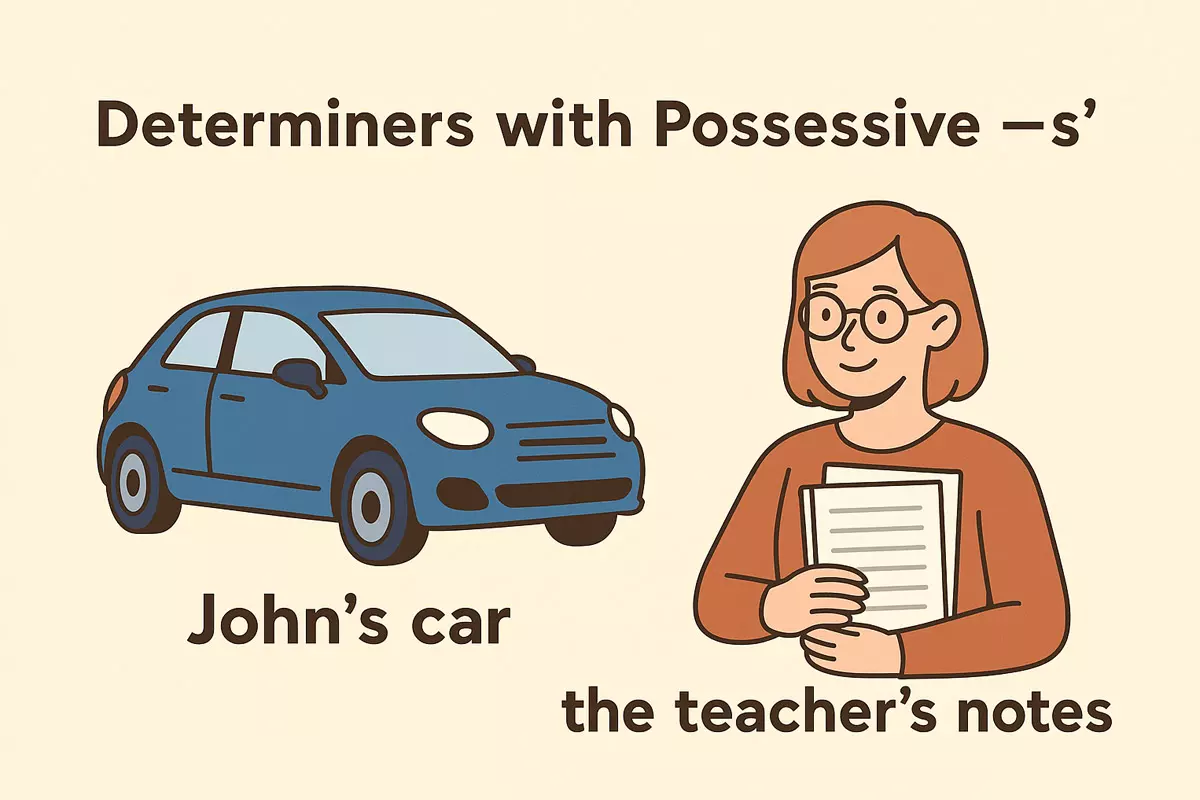 Here we how possessive ’s functions as a determiner in English, forming it with singular and plural nouns, word order differences, special cases like children’s and names ending in s, common mistakes with its and it’s, and practice rewriting phrases.
- How possessive ’s works as a determiner in English
- Forming possessive ’s with singular and plural nouns
- Differences between John’s car and the car of John
- Word order with possessive ’s and noun phrases
- Special cases: children’s, people’s, names ending in s
- Confusing possessive ’s with its and it’s
- Practice: rewrite phrases using possessive ’s correctly
English indicates ownership or belonging in several ways, such as using possessive nouns and pronouns. For instance, to show that a bicycle belongs to Mark, we say Mark’s bicycle, while to refer to lessons prepared by our instructor, we might say our instructor’s lessons. Additionally, possessive pronouns like my, your, his, her, its, our, and their are used before nouns to show possession, as in my book or their house. These forms help clarify relationships between people and things, making our language more precise and personal.
How possessive ’s works as a determiner in English
In English, the possessive ’s attaches to a noun to indicate ownership or association, and it also acts as a determiner. This means it tells us whose item, idea, or quality we are talking about—similar to words like my, your, or their. For example, in “Sarah’s book,” the phrase clearly shows the book belongs to Sarah. The possessive form appears before the noun it modifies and replaces the need for another determiner like the or a.
Where ’s fits in the noun phrase
When using this construction, the noun with ’s comes at the start of the noun phrase, directly before what is owned or related. You would not say “the Sarah’s book” or “a John’s car”—the possessive already determines which item you mean. This is why “the teacher’s notes” is correct, but “the the teacher’s notes” is not.
Common patterns and examples
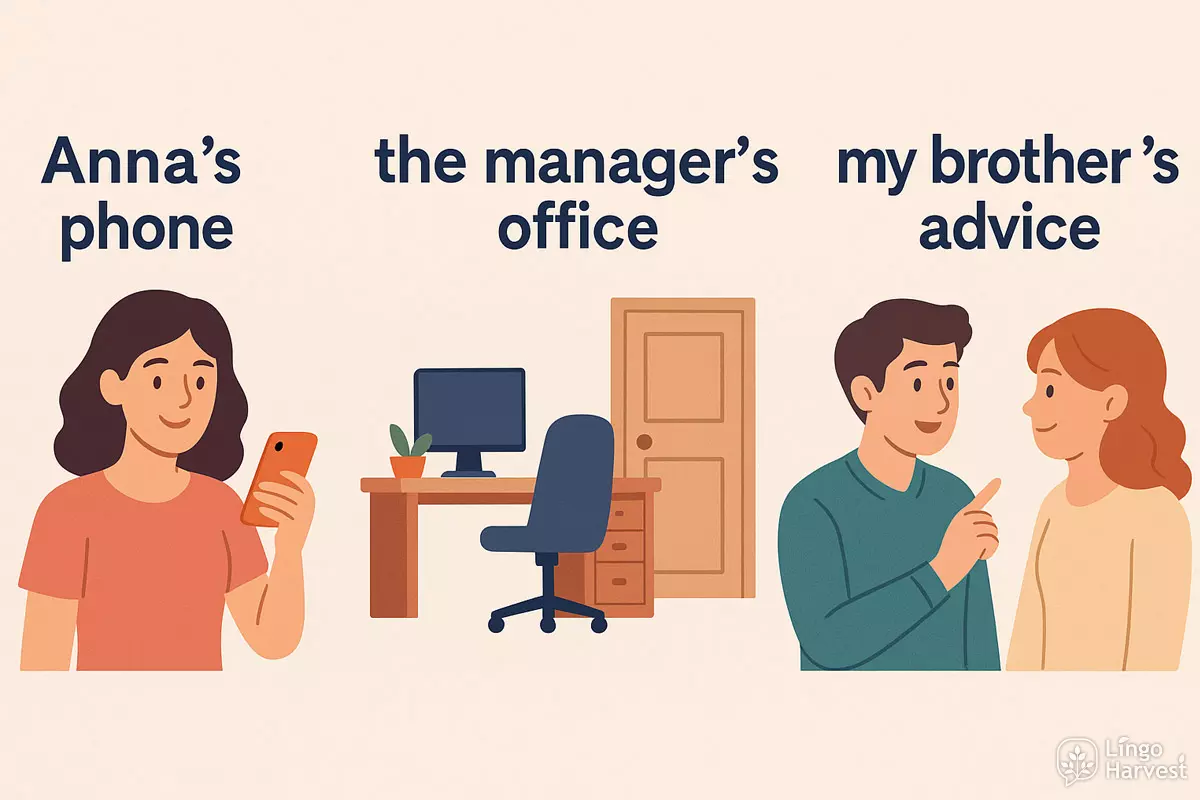
Here are several examples showing how possessive ’s works as a determiner in different contexts:
- Anna’s phone
- the manager’s office
- my brother’s advice
- the company’s policy
- John’s car
- the cat’s tail
- yesterday’s news
- the children’s toys
- the teacher’s notes
- the city’s mayor
- our neighbor’s garden
- the dog’s owner
- the president’s speech
- last week’s meeting
- the author’s signature
How possessive determiners compare to other determiners
Possessives act in place of articles and demonstrate a clear relationship between the owner and what is owned. Here’s a comparison of how possessive ’s, possessive pronouns, and articles function in similar sentences:
| With Possessive ’s | With Possessive Pronoun | With Article |
|---|---|---|
| Lisa’s bag is blue. | Her bag is blue. | The bag is blue. |
| The doctor’s office opens at 9. | His office opens at 9. | An office opens at 9. |
| Our neighbor’s garden is beautiful. | Their garden is beautiful. | A garden is beautiful. |
| Yesterday’s news was surprising. | Its news was surprising. | The news was surprising. |
Key points to remember
- The possessive ’s always comes before the noun it modifies.
- It replaces other determiners; do not use an article together with possessive ’s.
- Use ’s for singular and irregular plural nouns; use just the apostrophe (’) for regular plural nouns ending in s (e.g., “the students’ projects”).
- This form is common in both spoken and written English, especially when the owner is a person, animal, or organization.
Understanding how to use the possessive form as a determiner helps make your English more precise and natural, especially when talking about relationships or ownership.
Forming possessive ’s with singular and plural nouns
Understanding how to create possessive forms in English helps clarify ownership or association. The possessive ’s is added to nouns to show that something belongs to someone or something else, but the placement and form can change depending on whether the noun is singular or plural.
Singular nouns
For most singular nouns, simply add ’s to the end:
- the cat’s whiskers
- my friend’s advice
- the company’s policy
- the city’s mayor
- the girl’s bicycle
If the singular noun already ends with -s, both ’s and just ’ are sometimes accepted (with ’s preferred in modern usage):
- James’s book (also James’ book)
- the boss’s office
Plural nouns
For regular plural nouns ending in -s, add only an apostrophe after the final s:
- the teachers’ lounge
- the dogs’ owner
- the students’ projects
- the families’ cars
Irregular plural nouns that do not end in -s form the possessive with ’s:
- the children’s playground
- the men’s department
- the women’s team
- the mice’s tails
Summary of possessive forms
| Type of noun | How to form possessive | Example |
|---|---|---|
| Singular noun | Add ’s | the neighbor’s garden |
| Singular noun ending in -s | Add ’s (or just ’) | Chris’s laptop / Chris’ laptop |
| Regular plural ending in -s | Add only ’ | the players’ locker room |
| Irregular plural (not ending in -s) | Add ’s | the children’s books |
Quick tips
- Don’t use possessive ’s with pronouns (use possessive pronouns instead: his, her, their, etc.).
- For compound nouns, add ’s to the end: my brother-in-law’s car.
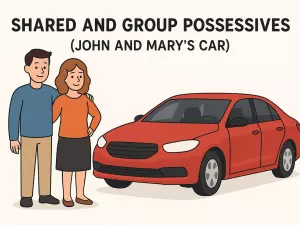
- When showing joint possession, add ’s to the final noun: Sam and Lisa’s house.
With these patterns, you can express possession accurately for both single and plural forms, making your meaning clear in everyday English.
Differences between John’s car and the car of John
When expressing possession in English, both "John’s car" and "the car of John" refer to the same basic idea: a car that belongs to John. However, these two constructions differ in terms of style, frequency, and nuance. Understanding when and why to use each form helps your English sound more natural and precise.
Naturalness and Frequency in Modern English
The possessive ’s form ("John’s car") is by far the more common and natural-sounding way to show ownership, especially in spoken language and informal writing. The "of" construction ("the car of John") is rare with personal names and often sounds awkward or overly formal. Native speakers almost always prefer the possessive ’s in everyday conversation.
Context and Usage Preferences
- Possessive ’s: Used with people, animals, organizations, and sometimes time expressions. Example: Mary’s book, the cat’s tail, the company’s policy, yesterday’s news.
- Of-construction: More common with inanimate objects, longer noun phrases, or when the possessor is an abstract noun. Example: the roof of the house, the end of the story, the color of the sky.
- With personal names, "the car of John" is highly unusual and would typically be replaced by "John’s car."
Style and Tone
The "of" structure can be used for emphasis or stylistic effect in literary or poetic contexts, but in everyday English it’s mostly reserved for inanimate or abstract relationships. Using "the car of John" might sound unnecessarily formal or non-native.
Summary Table: Comparison of Forms
| Form | Typical Usage | Naturalness | Example |
|---|---|---|---|
| Possessive ’s | People, animals, organizations, time | Very common, natural | John’s car |
| Of-construction | Inanimate objects, abstract nouns | Common with objects, rare with names | The roof of the house |
| Of-construction (with names) | Personal names | Unusual, formal, awkward | The car of John |
Additional Examples
Here are more examples illustrating the difference:
- Sarah’s phone → The phone of Sarah (awkward)
- The teacher’s notes → The notes of the teacher (acceptable for emphasis or clarity)
- The city’s center → The center of the city (both are common, but "of" is preferred)
- My brother’s advice → The advice of my brother (formal)
- The company’s logo → The logo of the company
- The children’s playground → The playground of the children (less natural)
- Yesterday’s meeting → The meeting of yesterday (rare, poetic)
- The dog’s collar → The collar of the dog
- London’s museums → The museums of London
- The heart’s desire → The desire of the heart
In summary, the possessive ’s structure is the default and most idiomatic choice for showing possession with names and living things, while the "of" construction is reserved for certain contexts, mostly involving objects or formality. Choosing the appropriate form helps your English sound both correct and natural.
Word order with possessive ’s and noun phrases
When using possessive ’s in English, the structure consistently places the possessive marker immediately after the possessor, followed by the thing that is owned. This creates a clear relationship between the owner and the item. The possessor can be a single noun, a noun phrase, or even a more complex group.
Basic word order
The standard order is: Possessor + ’s + Possession. For example:
- John’s car
- the teacher’s notes
- my brother’s guitar
- the dog’s collar
- Sarah’s idea
Using noun phrases as possessors
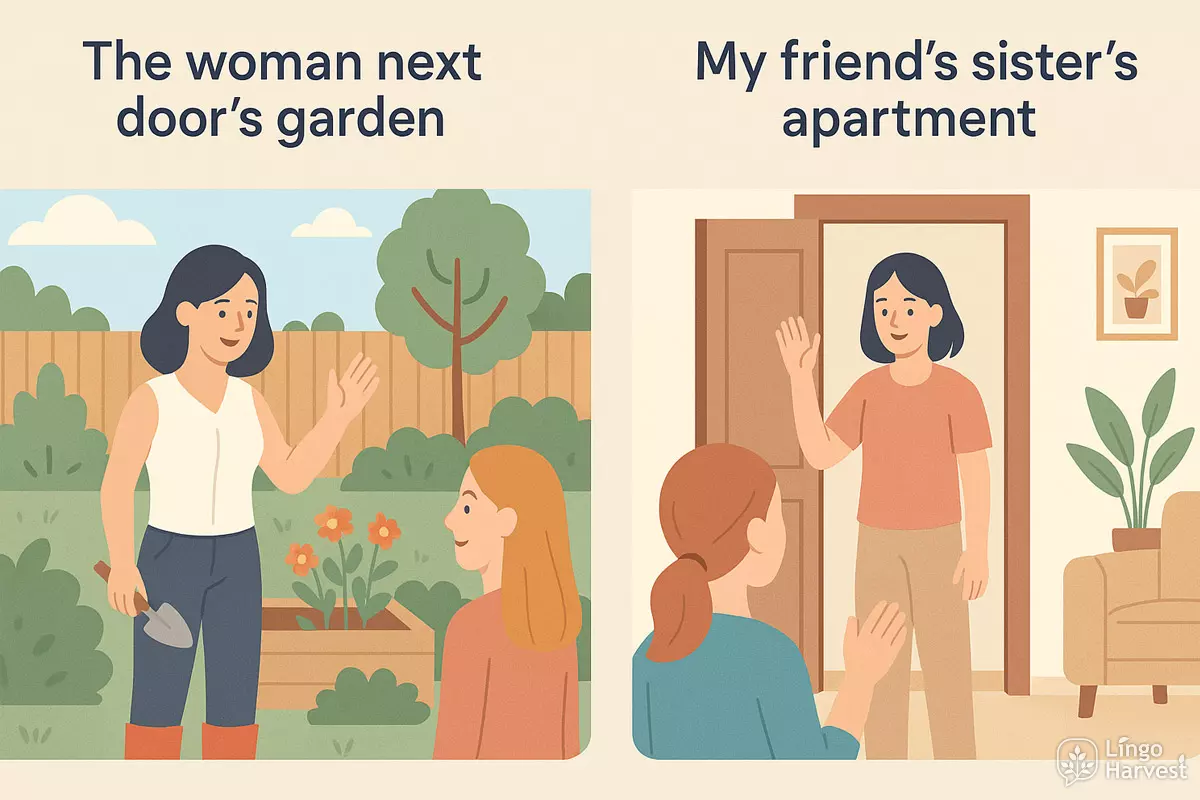
When the possessor is a noun phrase (including determiners or adjectives), the ’s attaches to the end of the entire phrase, not just the noun itself. This keeps the ownership clear and prevents confusion.
- the woman next door’s garden
- my friend’s sister’s apartment
- the boy in the red shirt’s backpack
- the president of the club’s decision
- someone else’s phone
Comparing possessive ’s and "of"-phrases
In English, both possessive ’s and "of" can show ownership, but their word order is different. ’s is more common with people and animals, while "of" is preferred with things or abstract ideas. Here’s a comparison:
| Possessive ’s | "Of"-Phrase |
|---|---|
| the manager’s office | the office of the manager |
| my uncle’s advice | the advice of my uncle |
| the cat’s tail | the tail of the cat |
| the company’s policy | the policy of the company |
| the children’s toys | the toys of the children |
| the city’s history | the history of the city |
Common patterns and tips
- When a possessive phrase is long or complex, it can sound awkward; consider using "of" for clarity.
- Do not use both ’s and "of" together (❌ the car’s of John).
- For plural nouns ending in -s, add only an apostrophe (the teachers’ room).
- With compound nouns, add ’s to the end (my mother-in-law’s recipe).
- Double possessives can occur: a friend of my father’s.
Understanding the correct arrangement of possessive forms and noun phrases helps you express ownership precisely and naturally in English. Pay attention to the position of ’s, and choose between ’s and "of" depending on the context and the type of nouns involved.
Special cases: children’s, people’s, names ending in s
Understanding how to use possessive ’s with certain words can be tricky, especially when dealing with irregular plurals and names that already end with “s.” Let’s look at these three common problem areas and clarify the patterns.
Irregular plurals: children’s, people’s, men’s, women’s
Some plural nouns don’t end in “s” (like “children,” “people,” “men,” and “women”). For these, the possessive is formed by simply adding ’s:
- children’s books (books that belong to the children)
- people’s opinions (opinions held by people)
- men’s shoes (shoes for men)
- women’s restroom (restroom for women)
- mice’s tails (tails of the mice)
- geese’s wings (wings of the geese)
- oxen’s strength (strength of the oxen)
- cattle’s feed (feed for the cattle)
- deer’s tracks (tracks of the deer; “deer” is both singular and plural)
- children’s playground (playground for children)
These forms are standard and do not use just an apostrophe.
Regular plurals ending in “s”
For regular plural nouns, only an apostrophe is added:
- teachers’ lounge (lounge for teachers)
- students’ projects (projects belonging to students)
- parents’ meeting (meeting for parents)
- dogs’ owner (owner of the dogs)
This pattern distinguishes regular from irregular plurals.
Names ending in “s”
Possessives for names ending with “s” can be confusing, but here are the main approaches:
- James’s car (preferred in American English, but “James’ car” is also correct, especially in British English)
- Chris’s book or Chris’ book (both are found; the choice may depend on style guides)
- Charles’s house or Charles’ house (either form is accepted)
- Jess’s bag or Jess’ bag
- Lucas’s phone or Lucas’ phone
- Ross’s hat or Ross’ hat
- Thomas’s idea or Thomas’ idea
- Lois’s dress or Lois’ dress
- Francis’s notes or Francis’ notes
The pronunciation is usually /ɪz/ regardless of spelling, but written forms may vary based on personal or editorial preference.
Summary Table: Possessive Forms
| Type | Example | Possessive Form | Note |
|---|---|---|---|
| Irregular plural (no “s” ending) | children | children’s | Add ’s |
| Regular plural (ends in “s”) | teachers | teachers’ | Add only apostrophe |
| Name ending in “s” | James | James’s or James’ | Both forms accepted |
| Singular noun | cat | cat’s | Add ’s |
It’s important to follow these conventions for clarity and consistency. If in doubt, check your style guide or consider the preferred usage in your region.
Confusing possessive ’s with its and it’s
Mixing up the possessive ’s and the words “its” and “it’s” is one of the most common issues for both native speakers and learners of English. The problem usually comes from the similar spelling but very different meanings: the possessive form with an apostrophe (’s) shows ownership, while “its” and “it’s” are not related to that use.
Understanding the Difference
Possessive ’s is used to show that something belongs to someone or something, for example, “John’s car” or “the teacher’s notes.” In contrast, “its” is a possessive adjective meaning “belonging to it,” and “it’s” is the contraction for “it is” or “it has.” While they may look similar, their functions in sentences are completely different.
Common Mistakes and How to Avoid Them
It’s easy to accidentally use the wrong form, especially in writing. Here are some examples to clarify:
- John’s book (the book of John) ✅
- The cat chased its tail (the tail of the cat) ✅
- It’s raining outside (it is raining) ✅
- The company increased it’s profits ❌ (should be its profits)
- My friend lost it’s wallet ❌ (should be his/her/its wallet)
- The teacher’s desk is near the window ✅
- Every dog has its own bed ✅
- It’s been a long day (it has been) ✅
- That car lost it’s wheel ❌ (should be its wheel)
- The school’s playground is new ✅
- The phone lost its signal ✅
- It’s time to go home (it is time) ✅
- That bird is building its nest ✅
- The city’s lights are bright ✅
- Make sure your essay has its title on the first page ✅
Quick Reference
Here’s a simple way to check which form to use: if you can replace the word with “it is” or “it has,” use “it’s.” If you mean “belonging to it,” use “its.” For ownership by a person or animal, use the possessive ’s.
| Form | Meaning / Use | Example |
|---|---|---|
| Possessive ’s | Shows ownership (for people, animals, organizations) | the teacher’s notes |
| its | Possessive adjective (belonging to it) | The cat licked its paw. |
| it’s | Contraction of “it is” or “it has” | It’s raining. / It’s been a while. |
Summary
Remember: use possessive ’s for people and animals, “its” for things that belong to “it,” and “it’s” only where “it is” or “it has” makes sense. Double-checking can help you avoid these easy-to-make mistakes and make your writing clearer.
Practice: rewrite phrases using possessive ’s correctly
To master possessive ’s, it’s useful to transform basic noun phrases into their correct possessive forms. This helps clarify ownership and makes sentences more natural in English. Below you’ll find a set of practice items where you can rewrite phrases, replacing longer structures with the concise possessive ’s construction.
Rewrite the following phrases
Turn each phrase below into a form using the possessive ’s. For example: the bag of Anna → Anna’s bag.
- the shoes of the teacher
- the brother of John
- the color of the car
- the house of my parents
- the name of the school
- the toys of the children
- the decision of the manager
- the cover of the book
- the birthday of my friend
- the opinion of the expert
- the tail of the dog
- the uniform of the team
- the price of the ticket
- the advice of the doctor
- the window of the kitchen
Show answers
- the teacher’s shoes
- John’s brother
- the car’s color
- my parents’ house
- the school’s name
- the children’s toys
- the manager’s decision
- the book’s cover
- my friend’s birthday
- the expert’s opinion
- the dog’s tail
- the team’s uniform
- the ticket’s price
- the doctor’s advice
- the kitchen’s window
Common mistakes to avoid
Pay attention to where to place the apostrophe, especially with plural nouns or names ending in s. Here are some reminders:
- For regular plural nouns ending in s, place the apostrophe after the s: the teachers’ lounge.
- For irregular plurals, add ’s: the children’s playground.
- Don’t use possessive ’s with inanimate objects unless it’s a common expression (like the car’s engine).
More practice: converting between forms
Try changing these possessive forms back to the “of” structure:
- Sarah’s idea
- The students’ project
- The city’s park
- The doctor’s office
- The teacher’s explanation
- The company’s policy
- The children’s toys
- The team’s victory
- The country’s economy
- The manager’s decision
Show answers
- the idea of Sarah
- the project of the students
- the park of the city
- the office of the doctor
- the explanation of the teacher
- the policy of the company
- the toys of the children
- the victory of the team
- the economy of the country
- the decision of the manager
Practicing these transformations will help you use possessive ’s more naturally in your writing and speaking.