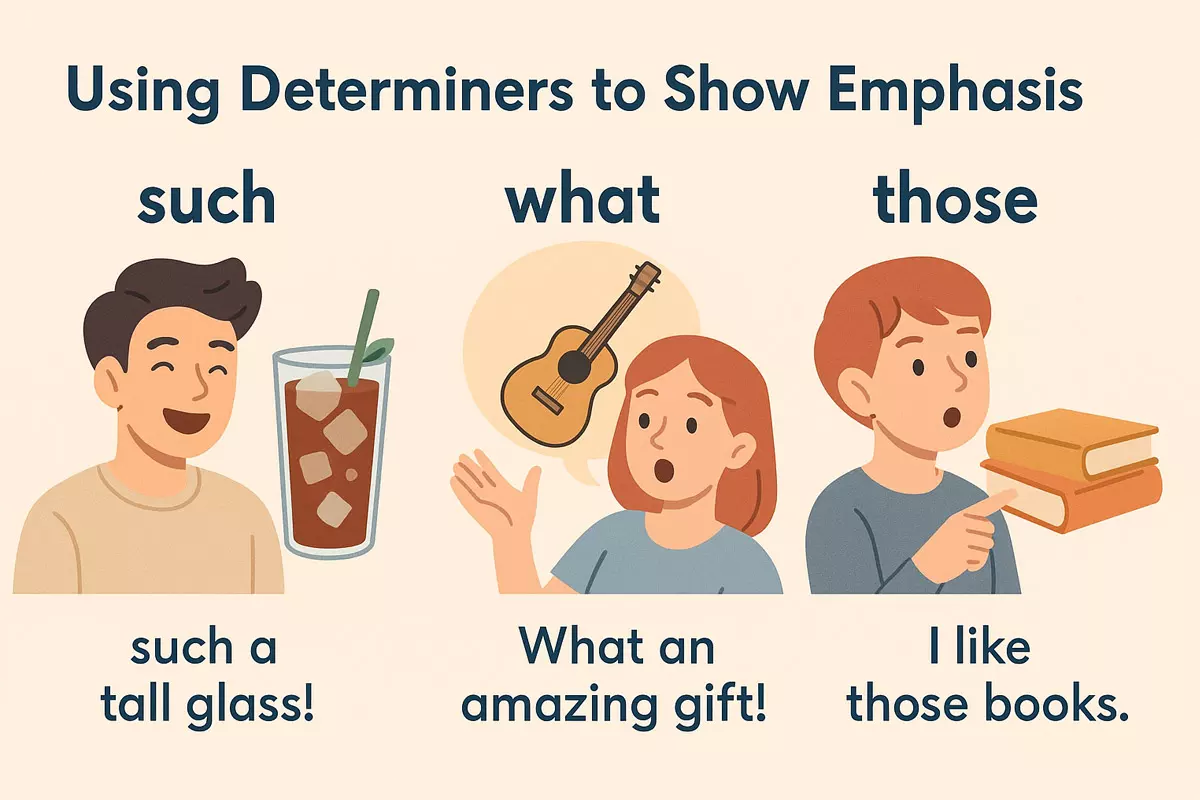
Using Determiners to Show Emphasis: such, what, those

 Here we how to express emphasis in English using such, what, and those, explains the difference between neutral and emphatic determiners, discusses intonation and punctuation in emphatic structures, and includes practice transforming sentences.
- What emphasis means and why we use it in English
- Using such before nouns to express strong feeling
- Using what in exclamations with nouns and noun phrases
- Using those to point and comment on people or things
- Differences between neutral and emphatic determiner use
- Intonation and punctuation in emphatic structures
- Practice: transform neutral sentences into emphatic ones
Selecting precise words to highlight specific details can significantly enhance your writing. Words such as such, what, and those are particularly useful for emphasizing certain people, objects, or situations, allowing you to draw attention where it matters most. By using these terms thoughtfully, you can clarify your message and ensure your key points are noticed by your readers, making your writing more impactful and engaging overall.
What emphasis means and why we use it in English
Emphasis in English is about drawing special attention to a particular idea, word, or part of a sentence. We use it to highlight what’s most important, to express surprise or strong feelings, or simply to make our communication clearer. Emphasis can help listeners or readers understand exactly what stands out in your message, whether you’re amazed by something, want to show contrast, or wish to clarify a point.
How we create emphasis in English
There are many ways to stress something in English. Sometimes we change our tone or stress words when speaking. In writing, we might rearrange the sentence or use specific words and structures. Determiners like such, what, and those are especially useful for making certain details stand out.
- Such: Used before adjectives and nouns to intensify their meaning (e.g., such a beautiful day).
- What: Often used in exclamations to show surprise or strong emotion (e.g., What a mess!).
- Those: Can point to particular people or things to single them out (e.g., Those shoes are amazing).
- Word order: Bringing key information to the front of a sentence (e.g., Never have I seen...).
- Repetition: Repeating words or phrases for effect.
- Intonation: Raising your voice or pausing for effect (mainly in speech).
- Contrast: Using words like but, however, or yet to highlight differences.
- Modifiers: Adding adjectives, adverbs, or intensifiers (e.g., really, so, incredibly).
- Tag questions: Inviting agreement or surprise (e.g., It’s cold today, isn’t it?).
- Exclamation marks: Punctuation to show strong feeling (in writing).
Why do we highlight ideas or details?
Using emphasis isn’t just about style—it shapes how your message is understood. For example, when you want someone to notice how unusual a situation is, you might say, Such chaos! Or, if you want to praise, What a performance! Emphasis helps express emotion, clarify meaning, and keep your listener or reader engaged.
Common situations where emphasis is helpful
- Expressing surprise or disbelief
- Giving compliments or criticism
- Describing something unusual or extreme
- Clarifying or correcting information
- Making comparisons
- Persuading or encouraging someone
- Directing attention to a specific object or detail
- Showing contrast between ideas or events
- Reacting emotionally in conversations
- Making stories or anecdotes more vivid
In short, emphasizing helps us communicate more vividly and precisely, letting others know exactly what matters most in our message.
Using such before nouns to express strong feeling
When you want to show a strong reaction to something, "such" is often placed before a noun or a noun phrase. This helps to emphasize your impression, whether it's surprise, admiration, disappointment, or any other intense emotion. The structure usually follows this pattern: such + (adjective) + noun.
Common Patterns and Examples
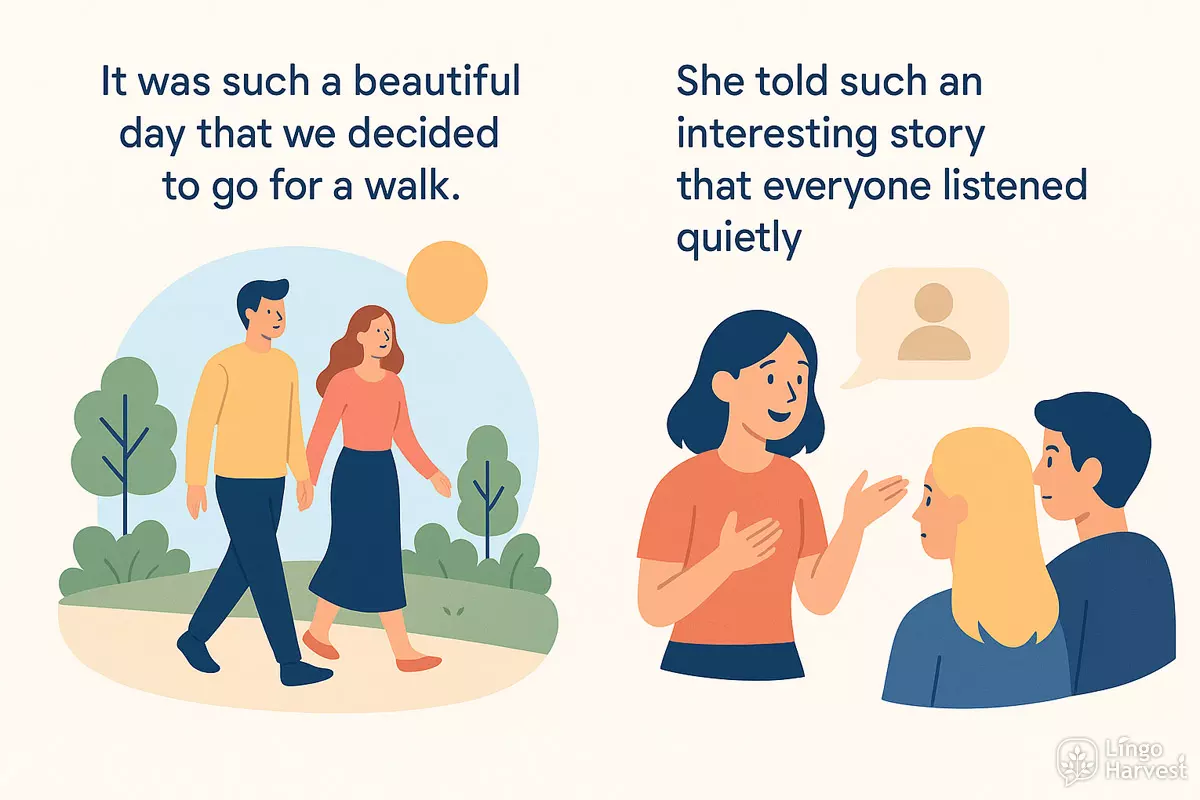
- such a beautiful day → It was such a beautiful day that we decided to go for a walk.
- such an interesting story → She told such an interesting story that everyone listened quietly.
- such terrible weather → We had such terrible weather yesterday that all flights were delayed.
- such a mess → The kitchen was in such a mess that we didn’t know where to start.
- such kind people → They are such kind people that you always feel welcome.
- such a loud noise → There was such a loud noise that the whole building shook.
- such delicious food → They served such delicious food that we ordered more.
- such a strange feeling → I had such a strange feeling that something was wrong.
- such good luck → You had such good luck finding that apartment.
- such an amazing opportunity → It was such an amazing opportunity that she couldn’t refuse.
- such a difficult question → He asked such a difficult question that no one could answer.
- such wonderful news → That is such wonderful news! Congratulations!
- such a big surprise → It was such a big surprise that I couldn’t speak.
- such poor timing → It was such poor timing that the whole plan failed.
- such a silly mistake → She made such a silly mistake that the teacher laughed.
- such excitement → There was such excitement in the room before the show started.
- such a relief → Finishing the exam was such a relief for everyone.
- such strong coffee → This is such strong coffee that I can’t drink it.
How it Works in Sentences
Placing "such" before nouns (with or without adjectives) draws attention to how remarkable, unusual, or notable something is. Compare these examples:
- It was a party. → It was such a party!
- They are friends. → They are such good friends!
- The movie was boring. → It was such a boring movie.
When to Use "such" Instead of "so"
"So" is used with adjectives and adverbs (e.g., "so tall," "so quickly"), but "such" comes before a noun or a noun phrase. Here’s a comparison for clarity:
| With "such" | With "so" |
|---|---|
| such a nice person | so nice |
| such terrible weather | so terrible |
| such an expensive car | so expensive |
| such a boring film | so boring |
| such a big surprise | so big |
Key Points to Remember
- Use "such" before a noun or noun phrase, often with an adjective.
- "Such" helps make your emotional reaction clear and vivid.
- Don't use "such" directly before just an adjective or adverb; in those cases, use "so".
- Both positive and negative feelings are commonly expressed with "such".
By choosing this construction, you add color and strength to your descriptions, making your language more expressive and engaging.
Using what in exclamations with nouns and noun phrases
When you want to express surprise, admiration, or strong feeling about a person, thing, or situation, the word what is often placed at the beginning of an exclamatory sentence. This construction is especially common with nouns and noun phrases, and it helps highlight how remarkable or unexpected something is.
Typical Patterns
The structure usually follows these patterns:
- What + (a/an) + adjective + noun!
- What + noun (phrase)!
Notice that "what" comes before the noun or noun phrase, and if the noun is countable and singular, you'll often need "a" or "an." For plural or uncountable nouns, you omit the article.
Examples of Exclamatory Sentences with What
Here are several ways to use this structure to convey strong emotion or emphasis:
- What a beautiful day!
- What amazing news!
- What a mess!
- What clever children!
- What luck!
- What a surprise!
- What terrible weather!
- What an idea!
- What determination!
- What a performance!
- What an adventure!
- What noisy neighbors!
- What a pity!
- What a waste!
- What energy!
- What a difference!
- What a story!
- What courage!
Common Mistakes to Avoid
- ❌ What beautiful the day! → What a beautiful day!
- ❌ What an amazing! → What amazing news! (needs a noun)
- ❌ What a children! → What clever children! (no article for plural)
Notes on Usage
This exclamatory form is mostly used in spoken or informal written English. It's not used to ask questions, even though the word "what" is also a question word. The noun or noun phrase immediately follows "what," and adjectives can be included for extra emphasis. This pattern is a natural way to show emotion and make your English sound more expressive and authentic.
Using those to point and comment on people or things
When we want to refer to specific people or objects, especially at a distance or to distinguish them from others, "those" comes in handy. It is the plural form of "that" and is often used to indicate particular items or individuals, sometimes with a comment or opinion attached. This makes "those" useful not just for identification, but also for expressing attitude or drawing attention.
Pointing out with "those"
You can use "those" to physically or figuratively point to a group:
- Those books on the shelf are mine.
- Could you pass me those keys?
- Those people over there look familiar.
In each case, "those" singles out which books, keys, or people are meant—often ones further away or not immediately at hand.
Making comments or judgments
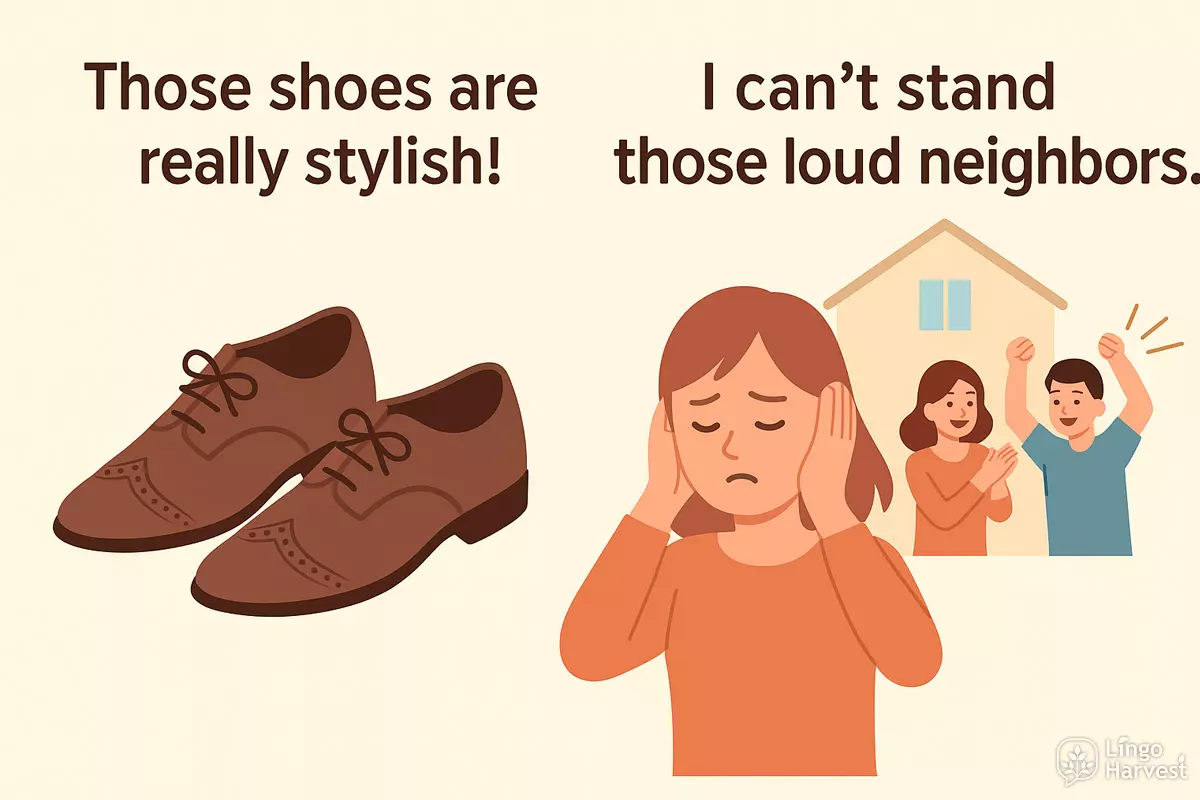
"Those" is also useful for making comments about a group, sometimes showing positive or negative feelings. See how it works in these examples:
- Those shoes are really stylish!
- I can't stand those loud neighbors.
- Those jokes were hilarious.
- Those days were tough, but we made it through.
- Did you see those incredible paintings at the gallery?
- Those rules don’t make any sense.
- Those students always help out after class.
- Why are those reports always late?
- Those memories will stay with me forever.
- I remember those nights when we used to talk for hours.
Comparing "those" with other determiners
Unlike "these," which refers to things close by, "those" is for things further away or more detached—either physically or emotionally. For example:
- These cookies (on the plate in front of you)
- Those cookies (on the counter across the room)
This distinction also works for time or experience: "these days" (recent, current) vs. "those days" (in the past).
Patterns for using "those" in comments
You’ll often find "those" followed by a noun and a descriptive phrase or adjective:
- Those old friends always know how to cheer me up.
- Those annoying ads keep popping up.
- Those delicious cakes were gone in minutes.
- Those unexpected guests made the party more fun.
By using "those" in this way, you can draw attention, express opinions, or simply clarify which people or things you mean, making your message more specific and expressive.
Differences between neutral and emphatic determiner use
Understanding how determiners like "such," "what," and "those" can add emphasis is key to expressing stronger feelings, opinions, or reactions in English. Neutral determiners simply identify or specify nouns without adding any emotional tone. In contrast, emphatic determiners highlight surprise, admiration, or intensity. This shift in meaning affects how the listener interprets the speaker’s intent.
Neutral determiners: straightforward and factual
Neutral determiners are used to provide basic information about a noun—quantity, possession, or specificity—without coloring the sentence with emotion. They include words like "the," "a," "some," "this," "my," "their," and "these." For example:
- She bought those apples.
- Can I have some water?
- This book is new.
These uses simply identify or count; there is no extra emphasis or surprise implied.
Emphatic determiners: adding emotion or surprise
Emphatic determiners, on the other hand, inject emotion, intensity, or a sense of drama. Common examples include "such," "what," and "those" (when used with a particular tone). These words can transform a regular statement into an exclamation or a comment full of feeling.
- Such a beautiful day! (strong admiration)
- What a mess you’ve made! (surprise or frustration)
- Those shoes! (often expressing amazement or disapproval, depending on context and intonation)
- What fantastic news!
- Such kindness is rare.
- Those people! (can imply annoyance, disbelief, or praise based on delivery)
- What an incredible performance!
- Such a waste of time!
- Those ideas are brilliant! (emphatic praise)
- What a surprise!
Comparing neutral and emphatic uses
The table below shows how the meaning and tone shift when moving from neutral to emphatic determiners in similar contexts:
| Neutral Use | Emphatic Use |
|---|---|
| She wore those shoes. (just identifying the shoes) | Those shoes! (expressing surprise or admiration) |
| This is a big problem. (objective description) | What a big problem! (emphasizing the seriousness) |
| It was a cold day. (neutral fact) | Such a cold day! (surprise or complaint) |
| I met some interesting people. (simple statement) | What interesting people I met! (enthusiasm or amazement) |
Key takeaways
Choosing between neutral and emphatic determiners depends on the speaker’s intention. If you wish to simply refer to things or people, stick to neutral forms. To highlight your feelings—whether excitement, shock, or disappointment—use emphatic forms like "such," "what," or an expressive "those." This choice can subtly but powerfully change the tone of your communication.
Intonation and punctuation in emphatic structures
When using emphatic expressions like "such," "what," and "those," spoken intonation and written punctuation both play crucial roles in communicating emphasis. In conversation, speakers often raise their pitch, slow down, or stress particular words within emphatic phrases. In writing, specific punctuation—especially exclamation marks and commas—helps convey the intended force or surprise.
Intonation patterns in speech
Emphasis in speech is often marked by a change in pitch and stress. With structures like "What a day!" or "Such a mess!", the voice typically rises on the key word and sometimes falls sharply at the end. This vocal pattern signals strong feelings such as surprise, admiration, or disapproval. Consider these common features:
- Rising intonation on the emphasized word ("What a performance!")
- Pausing before or after the emphasized element ("Those, I will never forget.")
- Slowed delivery for dramatic effect ("Such... a beautiful view!")
- Stronger volume or stress on determiners and adjectives ("What an incredible story!")
Punctuation choices in writing
Writers use punctuation to reflect the emphasis that intonation provides in speech. Exclamation marks are especially common, but commas and even dashes play a role. Here's how punctuation can affect the tone and clarity of emphatic sentences:
- Exclamation marks signal strong emotion or surprise ("What a surprise!")
- Commas can indicate a pause for emphasis ("Such a mess, everywhere.")
- Dashes add dramatic breaks ("Those—those were the days!")
- Periods can soften the emphasis but still convey intensity ("What a day.")
Comparison: Intonation and punctuation in parallel examples
| Spoken Intonation | Written Punctuation |
|---|---|
| Rising pitch on "such" ("Such a view!") | Exclamation mark: "Such a view!" |
| Pause after "what" ("What... a mess.") | Ellipsis, period: "What... a mess." |
| Strong stress on "those" ("Those were the days!") | Exclamation mark: "Those were the days!" |
| Falling intonation at the end ("What a party.") | Period: "What a party." |
| Emphatic pause before noun ("Such, talent!") | Comma: "Such, talent!" |
Examples of emphatic structures with intonation and punctuation cues
- What a performance! (surprise, admiration)
- Such a lovely evening. (gentle emphasis)
- Those were the days! (nostalgia)
- What an idea! (astonishment)
- Such chaos! (disapproval or amazement)
- Those, I remember well. (pause for effect)
- What a disaster! (shock)
- Such dedication! (praise)
- What a view. (soft, reflective)
- Those shoes—wow! (surprise, admiration)
- What a story! (enthusiasm)
- Such nonsense! (dismissal)
- Those, of all things! (disbelief)
- What a relief! (sudden emotional shift)
- Such luck! (envy or amazement)
- What patience. (admiration, with understated tone)
- Those were the moments. (reflective emphasis)
- Such, courage! (pause for dramatic effect)
Understanding how intonation and punctuation work together with determiners like "such," "what," and "those" allows for richer, more expressive communication—both in speech and writing.
Practice: transform neutral sentences into emphatic ones
Turning ordinary statements into emphatic ones adds color and emotion to your communication. In English, determiners like such, what, and those help highlight feelings, opinions, or surprise. Let’s explore how to rephrase neutral sentences to sound more expressive.
Transforming with “such”, “what”, and “those”
The words such and what are especially useful for intensifying your sentences, while those can highlight a particular group or category. Consider how these determiners change the tone:
- “She has a nice voice.” → “She has such a nice voice!”
- “It was a strange idea.” → “What a strange idea!”
- “These days are hard.” → “Those were hard days.”
Practice: Change these neutral sentences
Try to rewrite each statement so it sounds more emphatic using such, what, or those.
- The movie was boring.
- He is a talented musician.
- They made a big mistake.
- This is a delicious cake.
- She wore a beautiful dress.
- It was an incredible journey.
- We had a fun time.
- He told an interesting story.
- I met a friendly dog.
- These winters were cold.
Show answers
- What a boring movie!
- He is such a talented musician!
- What a big mistake they made!
- This is such a delicious cake!
- She wore such a beautiful dress!
- What an incredible journey it was!
- We had such a fun time!
- He told such an interesting story!
- I met such a friendly dog!
- Those were cold winters.
Common Patterns for Emphasis
Notice these typical structures when using these determiners for emphasis:
- such + (adjective) + noun: “such a lovely view”
- what + (a/an) + (adjective) + noun: “What a mess!”
- those + noun (usually plural or referring to past): “Those were the days!”
Quick Reference: Neutral vs. Emphatic Sentences
| Neutral Sentence | Emphatic Sentence |
|---|---|
| The weather was bad. | What bad weather! |
| He gave a helpful answer. | Such a helpful answer he gave! |
| They were difficult times. | Those were difficult times. |
| She made a quick decision. | What a quick decision she made! |
| I saw an amazing performance. | Such an amazing performance! |
| These lessons were useful. | Those were useful lessons. |
Experiment with these patterns in your own writing or speech to make your language more vivid and memorable.