Using other and another: clear rules and common errors

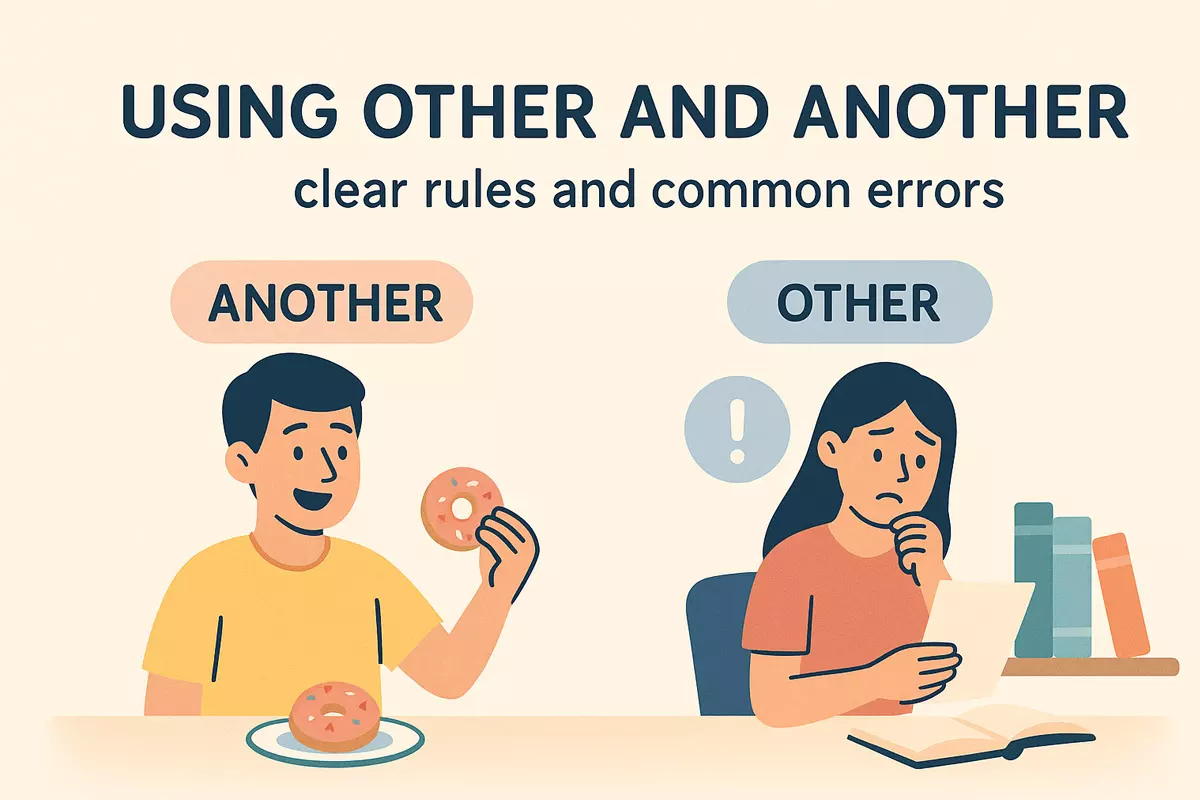 The article explains the difference between other and another, details their correct use with singular, plural, and uncountable nouns, covers phrases like the other and each other, gives common mistakes, real-life examples, and practice exercises.
- Basic difference between other and another
- Using another with singular countable nouns
- Using other with plural nouns and uncountables
- Phrases like the other, the others, and each other
- Typical learner mistakes with other and another
- Everyday examples for choices, options, and items
- Practice: choose other or another in short dialogues
Selecting the correct word between "other" and "another" can be more challenging than it seems, even for those who speak English fluently. "Another" is typically used when referring to one more item or person of the same kind, while "other" is used to distinguish between different items or people. For example, you might say, "I would like another cup of coffee," when you want one more, but "I would like the other cup of coffee," when referring to a different cup. Mastering these subtle differences improves clarity and precision in your writing.
Basic difference between other and another
Understanding how to use other and another correctly is vital for clear communication in English. Both words help us refer to additional or alternative people or things, but they are used in different contexts. The distinction primarily comes down to whether you are talking about singular or plural nouns, and whether you mean “one more” or “different/additional” in a broader sense.
When to use another
Another is used exclusively with singular, countable nouns. It means “one more” or “an additional one of the same type.” For example, if you have finished your coffee and want more, you might say, “Can I have another cup?” Here, you are requesting one more cup.
- Would you like another piece of cake?
- I need another minute to finish.
- He bought another car last week.
- Let’s try another approach.
- She wants another chance.
When to use other
Other can refer to both singular and plural nouns, but it is more flexible than another. It is used to talk about something different or additional, not necessarily just “one more.” When paired with a plural noun, it simply means “additional” or “different ones.” It can also be used with uncountable nouns.
- Do you have other questions?
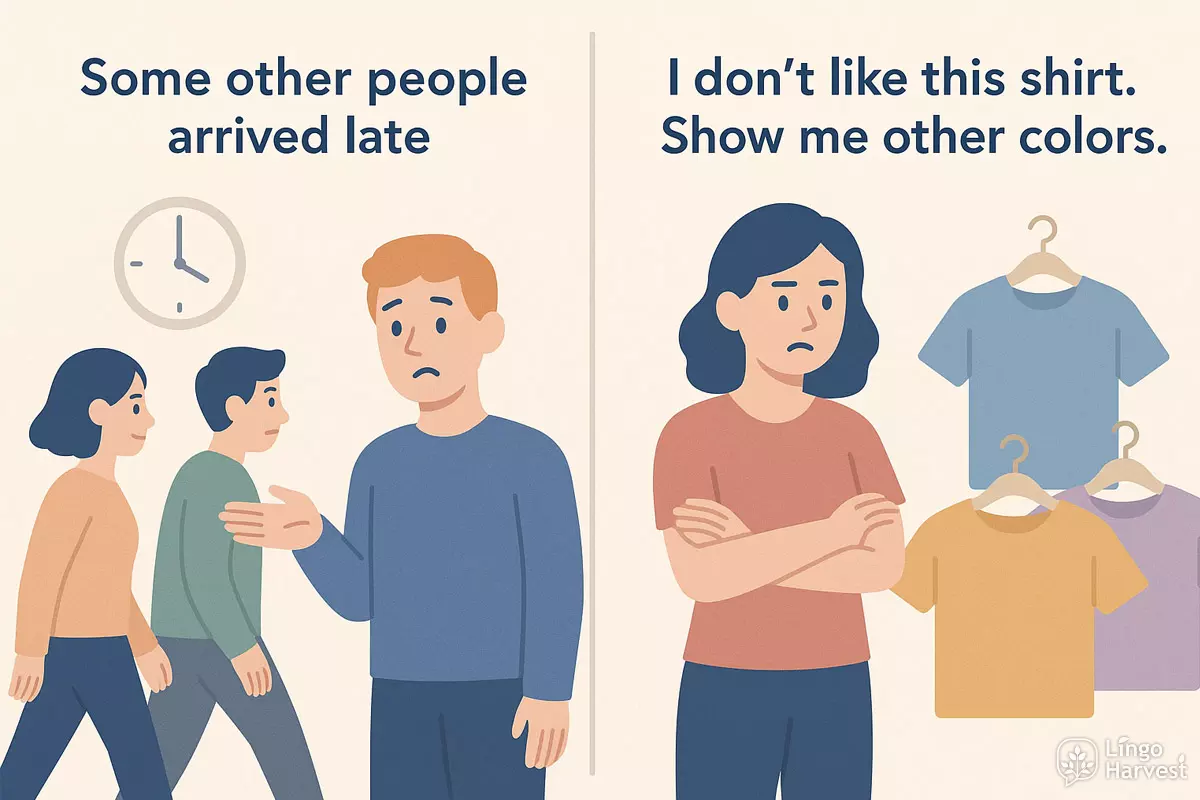
- Some other people arrived late.
- I don’t like this shirt. Show me other colors.
- We’ll need other information for the report.
- Is there any other way?
Summary: Key distinctions
| Word | Usage & Example |
|---|---|
| another | Used before singular, countable nouns to mean “one more” or “an additional one”. Example: another apple, another idea |
| other | Used before plural nouns or uncountable nouns to mean “additional” or “different”. Example: other books, other information |
In daily English, mixing up these words is a common mistake. Remember: if you’re talking about a single, countable item and mean “one more,” use another. For plural or uncountable nouns, or when you mean “different,” other is the right choice.
Using another with singular countable nouns
The word another is specifically used when talking about an additional, different, or extra item, but only with singular, countable nouns. This means you use it when you want one more of something you can count individually, such as "book," "cup," or "idea." Remember, another is never used with plural nouns or uncountable nouns.
How and when to use "another"
You add another before a singular, countable noun when you want to refer to one more of that noun, usually of the same type. It can also mean "a different one" or "an additional one." For instance, if you finish your coffee and want one more, you say, "Can I have another cup?" not "Can I have other cup?"
- I'd like another slice of cake. ✅
- She bought another dress for the party. ✅
- He needs another pen to finish the exam. ✅
- Is there another seat available?
- They want another chance to try.
- The teacher gave him another question.
- Let’s wait for another bus.
- May I have another piece?
- She found another solution.
- We’ll need another room for the guests.
- Could you pass me another fork?
- He ordered another pizza.
- Can I see another example?
- She asked for another chance.
- Let’s try another approach.
Common mistakes to avoid
- Incorrect: I want another apples. ❌
- Correct: I want another apple. ✅
- Incorrect: She needs another information. ❌
- Correct: She needs more information. ✅
When you want to refer to more than one item, use other with plural countable nouns (other books) or uncountable nouns (other advice). For a single, countable thing, always choose another.
Quick reference
| Expression | Is it correct? | Explanation |
|---|---|---|
| another chair | ✅ | Singular, countable noun |
| another chairs | ❌ | Plural noun; use "other chairs" |
| another idea | ✅ | Singular, countable noun |
| another advice | ❌ | Uncountable noun; use "other advice" |
| another question | ✅ | Singular, countable noun |
| another questions | ❌ | Plural noun; use "other questions" |
In summary, another is your go-to word when you need to add or refer to one more single, countable item. Double-check that the noun is singular and countable to avoid common errors.
Using other with plural nouns and uncountables
When you want to refer to additional or different items in a group, “other” is the word you need for both plural countable nouns and uncountable nouns. This is different from “another,” which is used only with singular countables. The structure and meaning shift slightly depending on whether you’re talking about things you can count or things you can’t.
“Other” with plural countable nouns
Use “other” before plural nouns to mention additional people or things of the same kind. It can mean “more” or “different” items in a group, and is often paired with “the,” “some,” or “any,” but not always.
- Do you have other books I can borrow?
- Some other students arrived late.
- I don’t like these shoes. Do you have other styles?
- Several other options are available.
- Let’s invite other friends to the party.
- Are there any other questions?
- We saw other animals at the zoo.
- The other people left early.
- She has other responsibilities at work.
- Many other countries use this system.
“Other” with uncountable nouns
For things you cannot count individually (like “water,” “information,” or “money”), “other” is also correct. Here, it refers to a different type or additional amount of the uncountable thing.
- Do you have other information about the event?
- We need other evidence to solve the case.
- She prefers other music (not this style).
- Is there other furniture in the office?
- I’ll bring other equipment tomorrow.
- They offered other support during the project.
- This soup needs other seasoning.
- We should consider other feedback as well.
- He has other experience in the field.
- Ask if they have other advice.
Common mistakes to avoid
- ❌ Incorrect: Do you have another books?
✅ Correct: Do you have other books? - ❌ Incorrect: She needs another information.
✅ Correct: She needs other information.
Quick comparison: “other” vs. “another”
| Form | Example Usage |
|---|---|
| other + plural countable noun | Other ideas, other people, other questions |
| other + uncountable noun | Other information, other advice, other equipment |
| another + singular countable noun | Another book, another student, another option |
| other (pronoun) | Some students arrived late; others left early. |
Understanding this pattern will help you use “other” naturally with both groups and mass nouns, and avoid the most frequent errors.
Phrases like the other, the others, and each other
Many English learners find it tricky to use expressions such as “the other,” “the others,” and “each other” correctly. These phrases look similar but serve different purposes in sentences. Understanding their distinct meanings will help you avoid common mistakes and communicate more clearly.
“The other” vs. “the others”
“The other” refers to the remaining item or person in a group of two. In contrast, “the others” points to all remaining people or things in a group of three or more. For example:
- We have two pens. One is blue; the other is black.
- Five students are here. Three are ready; the others are still waiting.
Notice how “the other” singles out just one, while “the others” covers all the rest.
Using “each other” and “one another”
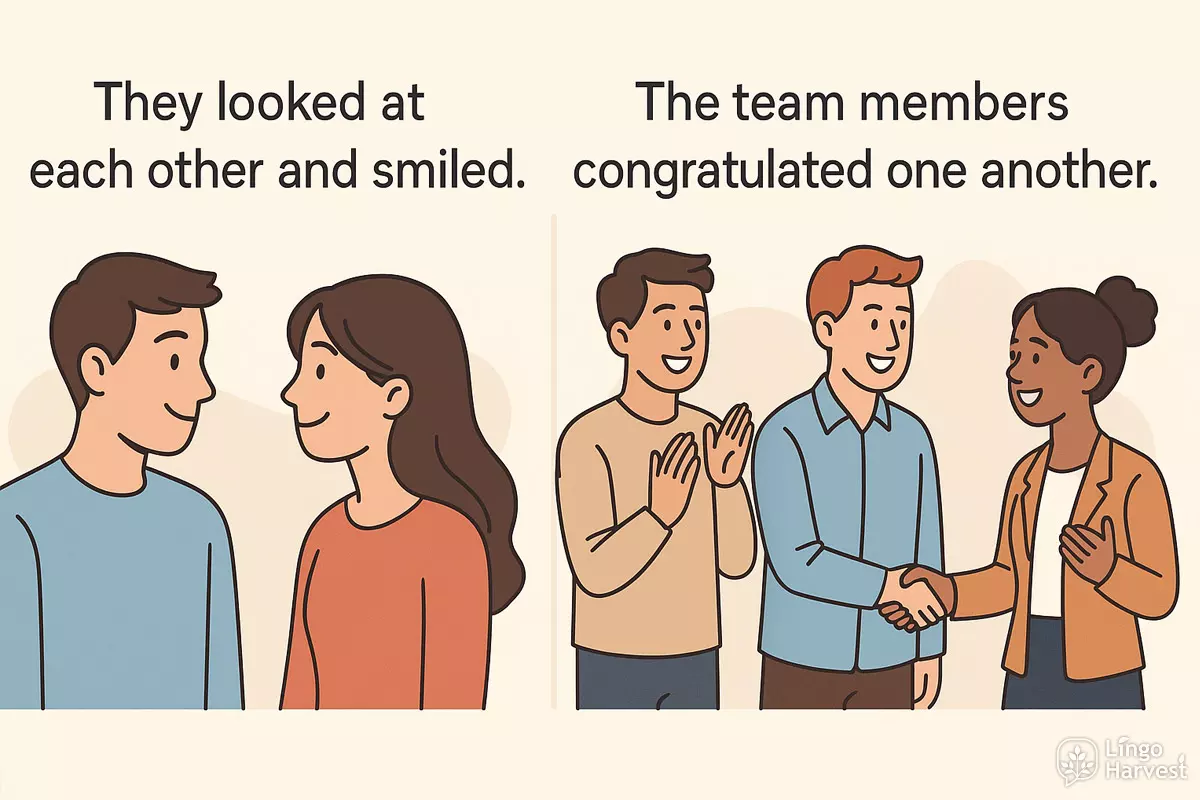
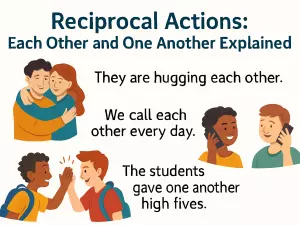
Both “each other” and “one another” describe reciprocal actions, meaning two or more people are doing the same thing to one another. While “each other” is most common for two people, and “one another” for groups, in modern English they’re often used interchangeably:
- They looked at each other and smiled.
- The team members congratulated one another.
Quick comparison: “other” phrases in action
It’s easy to mix up these expressions, especially with similar words like “another.” Here’s a quick guide to clarify their use:
| Phrase | Usage Example |
|---|---|
| the other | We have two options; I prefer the other. |
| the others | Some people arrived early; the others came later. |
| each other | They help each other with homework. |
| one another | The neighbors greeted one another warmly. |
| another | Would you like another cup of tea? |
Common mistakes to watch for
- Don’t use “the other” when you mean more than one person or thing—use “the others.”
- Avoid saying “each others” or “one anothers”—these forms do not exist in standard English.
- Remember, “another” is not the same as “the other.” “Another” means an additional one, not the remaining one.
Mastering these expressions will help you sound more natural and precise, especially in conversations about groups or pairs. Practice by paying attention to context and the number of items or people involved.
Typical learner mistakes with other and another
Learners of English often get confused when choosing between “other” and “another,” especially when dealing with countable and uncountable nouns. This confusion can lead to errors in both writing and speaking, making sentences sound unnatural or even unclear.
Mixing up “other” and “another”
One frequent issue is using “another” with plural nouns, or using “other” where “another” is needed. “Another” should only be used with singular, countable nouns, while “other” can be used with both singular and plural nouns, and with uncountable nouns. For example, “another apples” is incorrect, while “other apples” is correct.
Incorrect article usage
Learners sometimes forget to use the article “an” before “another,” or add unnecessary articles before “other.” This is especially common in phrases like “an other book” (incorrect; should be “another book”) or “the another idea” (incorrect; should be “another idea”).
Common error patterns
- Using “another” with plurals: “Can I have another cookies?” ❌ Instead, say: “Can I have another cookie?” or “Can I have other cookies?”
- Using “other” with singular countables without an article: “Give me other pen.” ❌ Instead, say: “Give me another pen.” or “Give me the other pen.”
- Adding “the” before “another”: “The another chance” ❌ Instead, just use: “Another chance”
- Omitting “the” before “other” with singular nouns: “I want other dress.” ❌ Correct: “I want the other dress.”
- Using “another” with uncountables: “Can I have another information?” ❌ Correct: “Can I have more information?” or “Other information”
- Repeating “other” unnecessarily: “Do you have other another idea?” ❌
- Confusion in negative sentences: “I don’t want another ones.” ❌ Instead: “I don’t want other ones.”
- Using “others” as an adjective: “I have others books.” ❌ Instead: “I have other books.”
- Using “other” where “another one” is needed: “I need other.” ❌ Instead: “I need another one.”
- Forgetting plural with “others”: “I like others.” (when meaning “other people”) ✅
Comparison of correct and incorrect usage
| Incorrect Example | Correct Example |
|---|---|
| Can I have another apples? | Can I have other apples? |
| I want other pen. | I want another pen. |
| The another idea is better. | Another idea is better. |
| There are many another options. | There are many other options. |
| She has another informations. | She has other information. |
Summary tips
To avoid these mistakes, always check if the noun is singular, plural, or uncountable, and choose “another” or “other” accordingly. Pay attention to the use of articles and remember: “another” = “an + other” for one more of the same kind, while “other” is more flexible and often refers to something different or additional in both singular and plural forms. Practicing with these patterns can help you use both words confidently and correctly.
Everyday examples for choices, options, and items
Understanding how to use other and another correctly can make daily conversations much clearer, especially when discussing choices or alternatives. These words help us refer to different things, additional items, or alternative options. Below are practical scenarios and sample sentences showing how these terms function in real life.
Ordering food or drinks
- Can I have another cup of tea? (one more, additional)
- Would you like another slice of pizza?
- Do you want to try another flavor?
- I’ll take the other sandwich. (the second of two)
Shopping and making selections
- I don’t like this shirt. Do you have it in another color?
- This bag is too small. Show me other styles, please.
- I bought one, but I need another.
- Some shoes are black; others are brown.
Comparing and contrasting items
- This phone is expensive, but the other one is affordable.
- One student passed; the others failed.
- Some people prefer coffee; others like tea.
- We have three options. Let’s look at the other two.
Requests and offers
- Could I see another example?
- He wants another chance.
- Let’s meet on another day.
- Is there another way to solve this?
Summary table: Everyday usage patterns
| Situation | Sample sentence |
|---|---|
| Choosing between two items | I’ll take the other seat. |
| Asking for more of something | Could I have another cookie? |
| Referring to additional options | Do you have other suggestions? |
| Describing groups or categories | Some people like cats; others prefer dogs. |
In each scenario, the choice of word depends on whether you mean an additional one, a different one, or the remaining ones in a group. Paying attention to context helps you avoid common mistakes and sound more natural in everyday English.
Practice: choose other or another in short dialogues
Understanding how to use "other" and "another" can be challenging, especially in everyday conversations. The best way to master these words is to see them in action. Below, you'll find a series of short dialogues where you need to decide which word fits best. Each example mimics real-life exchanges, helping you get comfortable with making the right choice.
Fill in the blank: dialogues
Read each dialogue and decide whether "other" or "another" is correct in the blank space.
- Waiter: Would you like ______ cup of coffee?
Customer: Yes, please! - Student 1: I can’t find my pen. Do you have ______ I can borrow?
Student 2: Sure, here you go. - Mother: You’ve already had one cookie. You can’t have ______.
Child: But I’m still hungry! - Manager: We should try a different approach. Let’s discuss ______ options.
Team member: Good idea. - Friend A: I lost my keys.
Friend B: Maybe they’re in your ______ bag. - Receptionist: The doctor is busy. Please wait in the ______ room.
Patient: Thank you. - Teacher: If you finish early, you can try ______ exercise.
Student: Okay! - Person 1: I’d like ______ slice of cake, please.
Person 2: Coming right up! - Boss: This report isn’t correct. Ask ______ colleague to check it.
Employee: Will do. - Customer: Do you have this shirt in ______ color?
Shop assistant: Yes, we do.
Common patterns in dialogues
Here are typical ways these words appear in conversation:
- Requesting more of the same: “Can I have another?”
- Referring to a different item: “Let’s try the other one.”
- Offering alternatives: “Would you like another drink?”
- Pointing out a different person or thing: “Ask the other teacher.”
- Talking about different options: “We need to find other solutions.”
- Asking for an additional item: “Could I get another napkin?”
- Comparing two items: “This one is cheaper than the other.”
- Directing someone: “Go to the other room.”
- Replacing something: “Do you have another charger?”
- Describing alternatives: “There are other ways to do this.”
Show answers
- another
- another
- another
- other
- other
- other
- another
- another
- other
- another