Reciprocal Pronouns in Formal and Academic Writing

 Here we how reciprocal pronouns like each other and one another function in academic writing, clarifies their modern usage, formality, and ambiguity, highlights common learner mistakes, and provides examples and revision practice for formal style.
- What reciprocal pronouns express in writing
- Each other vs one another in modern usage
- Formality and stylistic expectations
- Reciprocal pronouns in academic arguments
- Avoiding ambiguity in formal texts
- Common learner overgeneralizations
- Examples from formal writing
- Practice: revise sentences for formal style
Expressing mutual actions or shared relationships is vital in academic and professional communication, as it allows for clear and precise articulation of collaborative efforts or reciprocal interactions. Mastery of this grammatical aspect not only improves the accuracy of your writing but also ensures that your intended meaning is effectively conveyed to your audience. By using appropriate language to describe mutual relationships, you contribute to a more professional tone and facilitate better understanding in scholarly discussions and documentation.
What reciprocal pronouns express in writing
Reciprocal pronouns are used to indicate mutual actions or relationships between two or more entities. In academic and formal contexts, these pronouns clarify that the action or feeling is shared among participants, which helps prevent ambiguity and ensures precision. By using forms like each other and one another, writers efficiently convey complex interactions without lengthy explanations.
Clarifying Mutual Relationships
Writers employ reciprocal pronouns to highlight that subjects are both acting and receiving the action. This is especially helpful in research papers, scientific reports, or analyses where a clear representation of relationships is crucial. For example, in a discussion about collaboration, stating that “the teams supported each other” instantly communicates mutual assistance.
Common Functions in Academic Texts
- Expressing shared actions (e.g., “The participants greeted one another.”)
- Describing exchanges of ideas or information
- Indicating reciprocal feelings (e.g., “They respected each other’s opinions.”)
- Clarifying group dynamics or partnerships
- Summarizing results involving mutual influence or cooperation
- Reporting on studies involving two-way interactions
- Highlighting feedback loops or cycles in processes
- Emphasizing collective responsibility or contribution
- Describing conflict or competition between groups
- Noting shared benefits or consequences
Comparing Usage: Each Other vs. One Another
Both each other and one another serve to express mutual relationships, but some writers choose between them based on the number of entities involved or formality. Here’s a quick comparison:
| Pronoun | Typical Usage |
|---|---|
| each other | Traditionally for two entities; common in both formal and informal writing |
| one another | Traditionally for more than two entities; slightly more formal |
Precision and Conciseness
Using reciprocal pronouns helps writers avoid wordiness. Instead of repeating the same action for each participant, a single phrase succinctly shows that the action is mutual. This is valued in scholarly writing, where clarity and brevity are essential.
Examples of Reciprocal Pronouns in Context
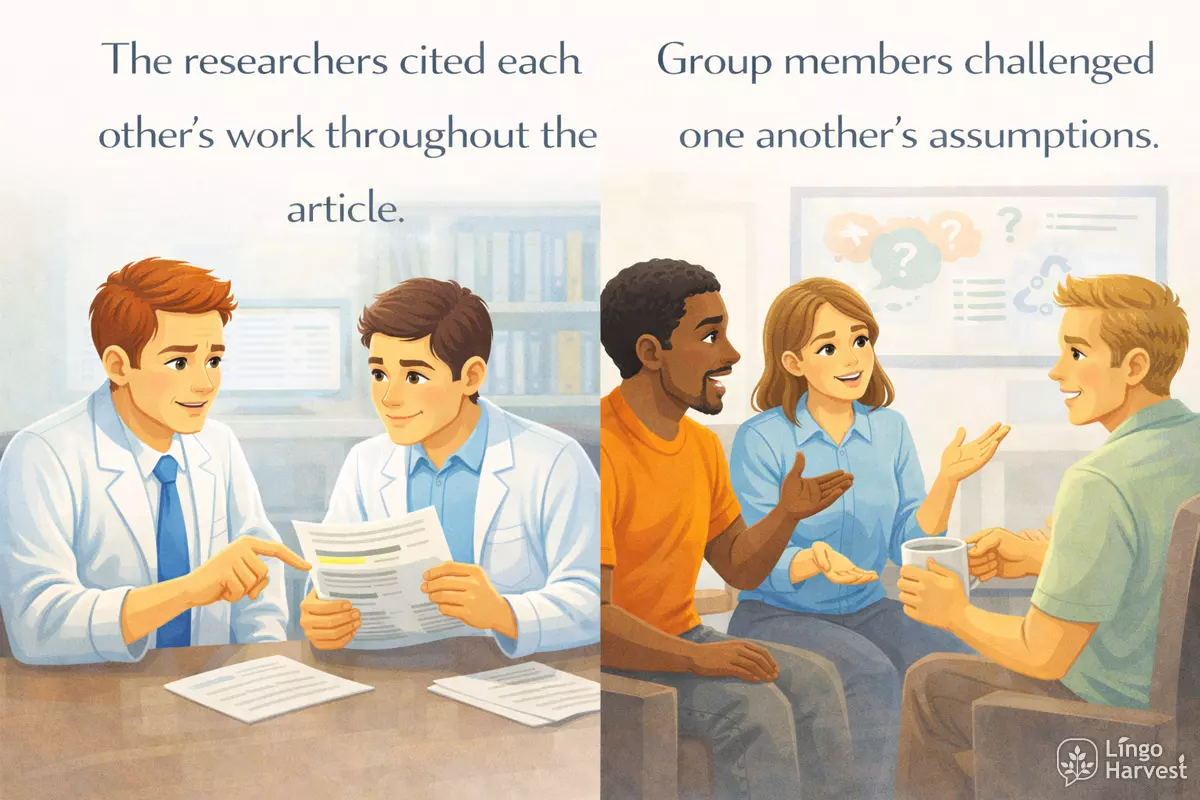
- “The researchers cited each other’s work throughout the article.”
- “Group members challenged one another’s assumptions.”
- “Departments communicate with each other to coordinate schedules.”
- “The nations promised to support one another in times of crisis.”
- “Peers reviewed each other’s proposals before submission.”
- “The authors referenced one another’s findings.”
- “Students encouraged each other during the project.”
- “Committees held each other accountable.”
- “The teams competed against one another for the prize.”
- “Colleagues shared resources with each other.”
Ultimately, reciprocal pronouns serve as a tool for expressing shared actions or feelings in a way that is both precise and efficient—qualities that are especially valued in formal and academic writing.
Each other vs one another in modern usage
Writers often wonder whether there is a meaningful difference between each other and one another in current academic and formal contexts. Traditionally, some guides suggested each other for two people and one another for more than two, but modern usage does not strictly enforce this distinction. In most contemporary writing—including university essays, research papers, and professional correspondence—these reciprocal pronouns are functionally interchangeable, and the older rule is rarely observed outside of prescriptive grammar discussions.
Traditional distinction vs contemporary practice
While some style guides and older grammar textbooks state that each other should refer exclusively to pairs and one another to groups of three or more, evidence from academic publications and major style manuals shows that this distinction is largely ignored in practice. Most native speakers and writers do not make a conscious choice based on group size, and both forms are accepted in formal writing.
| Expression | Typical Context | Example Sentence |
|---|---|---|
| each other | Pairs or groups (informal and formal) | The two students helped each other with their assignments. |
| one another | Pairs or groups (more formal, sometimes for groups of 3+) | The committee members consulted one another before making a decision. |
Usage patterns and flexibility
- Both forms are accepted in scholarly and scientific writing.
- Writers may choose one another for a slightly more formal tone, but it is not required.
- Some academic publications use each other exclusively, even for large groups.
- Standardized tests and formal style guides (such as APA, MLA, and Chicago) do not penalize the use of either form in any group size.
- In edited prose, consistency within a document is more important than strict adherence to outdated rules.
Common usage examples
- The researchers shared their findings with each other.
- Colleagues often review one another’s manuscripts.
- Participants were instructed to listen to each other’s feedback.
- The team members supported one another during the project.
- Students exchanged ideas with each other during discussions.
- Board members questioned one another about the proposal.
- The twins always look out for each other.
- Neighbors greeted one another warmly at the event.
- Friends congratulated each other on their achievements.
- Scientists referenced one another’s work in the journal article.
In summary, you can use each other and one another interchangeably in most academic and formal writing today. If your institution or publisher has a specific preference, follow their guidelines; otherwise, prioritize clarity and consistency. Both phrases express mutual actions or feelings and are fully accepted in modern usage.
Formality and stylistic expectations
In academic and professional contexts, reciprocal pronouns like each other and one another are typically used to express mutual relationships with precision and clarity. Writers are expected to use these forms correctly to communicate shared actions or feelings between two or more parties. Misuse or overuse can undermine the credibility of formal writing, so understanding distinctions and stylistic conventions is essential.
Appropriate contexts for reciprocal pronouns
- Describing interactions in research findings (e.g., "Participants helped each other complete the task.")
- Summarizing collaborative processes in reports or case studies
- Explaining mutual responsibilities or behaviors in legal or policy documents
- Discussing relationships between groups in literature reviews or theoretical frameworks
Common stylistic guidelines
Writers should avoid redundancy, such as pairing reciprocal pronouns with phrases that already imply mutuality. Additionally, it is preferable to use each other for interactions between two entities and one another for groups of three or more, although this distinction is becoming less rigid in modern usage. Consistency and clarity are more important than strict adherence to outdated rules.
| Form | Typical Use in Formal Writing | Example |
|---|---|---|
| each other | Mutual actions between two parties | The two researchers consulted each other before publishing. |
| one another | Mutual actions among three or more parties | The committee members supported one another throughout the project. |
| each other's | Possessive for two parties | The colleagues respected each other's opinions. |
| one another's | Possessive for groups | The students read one another's essays. |
Points to remember
- Do not use reciprocal pronouns with singular nouns (❌ "Each person greeted each other").
- Avoid unnecessary repetition (❌ "They cooperated with each other together").
- Maintain agreement in number: ensure the pronoun matches the number of entities described.
- Opt for clear, concise phrasing—especially in complex or technical documents.
- Use possessive forms for shared attributes or items (e.g., "respect one another's boundaries").
Ultimately, selecting and applying reciprocal pronouns accurately helps maintain a professional tone and fosters clear communication in scholarly writing.
Reciprocal pronouns in academic arguments
Writers in scholarly contexts often use reciprocal pronouns to clarify interactions, relationships, or mutual actions among subjects. These pronouns—most notably “each other” and “one another”—help avoid ambiguity when describing complex processes or when illustrating how participants in a study respond or relate within a group setting. Their effective use can make arguments more precise and nuanced, especially when discussing collaborative efforts, comparisons, or cause-and-effect relationships.
Functions in formal analysis
Reciprocal pronouns serve several purposes in academic writing. They:
- Express mutual actions or feelings between two or more entities.
- Clarify group dynamics in research findings or sociological studies.
- Help streamline sentences by replacing repetitive subject-object structures.
- Support arguments about interdependence or reciprocal influence among variables.
- Facilitate concise descriptions of experimental interactions or feedback loops.
Common patterns and examples
Academic writers tend to use these pronouns in arguments that analyze cooperation, compare perspectives, or explain reciprocal effects. Here are typical patterns and example sentences:
- The researchers consulted each other throughout the experiment.
- Group members relied on one another to interpret the data.
- The two theories inform each other in the latest literature.
- Participants exchanged feedback with one another during the workshop.
- Departments collaborate with each other to achieve interdisciplinary goals.
- Students evaluated one another’s presentations using a rubric.
- Authors built on each other’s findings to advance the field.
- Countries influence one another’s policies over time.
- Cells communicate with each other via chemical signals.
- Models complement one another in explaining the phenomenon.
- Communities depend on each other for resources.
- Variables interact with one another in the regression analysis.
- Scholars critique each other’s methodologies.
- Languages borrow from one another as they evolve.
Choosing between “each other” and “one another”
Though used interchangeably in most modern academic settings, some writers distinguish between these two pronouns. Traditionally, “each other” refers to two entities, while “one another” is reserved for more than two. However, this distinction is rarely enforced in formal publications today.
| Pronoun | Typical Use |
|---|---|
| each other | Interactions between two participants or groups |
| one another | Interactions among three or more participants or groups |
Precision and clarity in argumentation
Using reciprocal pronouns strengthens the clarity of academic arguments by making group relationships explicit. They help prevent confusion, especially in discussions involving multiple actors or variables. Careful usage ensures that the intended mutuality is clear, supporting rigorous and transparent scholarly communication.
Avoiding ambiguity in formal texts
Clarity is essential in academic and professional contexts, especially when using reciprocal pronouns like each other and one another. These pronouns can sometimes lead to uncertainty, particularly if their antecedents are not clear or if sentence structure is complex. Writers should ensure that their use of reciprocal forms leaves no doubt about who is involved in the relationship or action described.
Common sources of ambiguity
- Unclear antecedents: When it is not obvious which nouns the reciprocal pronoun refers to, the meaning of the sentence can be lost.
- Complex sentences: Lengthy or nested clauses may obscure the relationship between participants.
- Inconsistent number: Using a reciprocal pronoun with a singular or mismatched noun can confuse readers about the intended meaning.
- Overuse within a paragraph: Repeating reciprocal structures without clear reference may result in confusion.
Strategies for precision
Writers can apply several techniques to make their use of reciprocal pronouns precise and unambiguous:
- Clarify the antecedents immediately before the reciprocal pronoun.
- Use parallel and consistent sentence structures.
- Revise lengthy sentences to separate distinct actions or relationships.
- Restate the participants if there is any chance of confusion.
- Choose between each other and one another based on the number of parties, if needed for extra clarity (though modern usage is flexible).
Illustrative examples

Compare the following sentences to see how ambiguity can arise and how it can be resolved:
| Ambiguous Example | Clear Revision |
|---|---|
| The students and the teachers greeted each other. | The students greeted the teachers, and the teachers greeted the students. |
| Researchers and assistants shared their findings with one another. | The researchers shared their findings with the assistants, and vice versa. |
| Participants discussed their results with each other and the organizers. | Participants discussed their results with the organizers and with one another. |
| Both teams congratulated each other after the presentation. | Each team congratulated the other after the presentation. |
Key reminders for academic writing
- Always double-check that reciprocal pronouns refer unambiguously to the intended subjects.
- When in doubt, rephrase the sentence for greater transparency.
- Avoid stacking multiple reciprocal pronouns in a single clause.
- Maintain consistency in reference throughout a section or document.
By applying these practices, writers can minimize confusion and ensure that their formal texts are both precise and professional.
Common learner overgeneralizations
Learners often encounter pitfalls when using reciprocal pronouns, especially in formal or academic contexts. These mistakes can stem from confusion about the precise function and limitations of "each other" and "one another." Misunderstandings frequently lead to non-standard usage or awkward phrasing, which can make writing appear less polished.
Frequent Patterns and Errors
Many students assume that reciprocal pronouns are interchangeable with reflexive pronouns, or that they can be used in any context involving more than one person or group. Here are some typical missteps:
- Using "each other" or "one another" with a singular subject (e.g., He gave each other a book ❌).
- Choosing "each other" for groups larger than two, when some style guides prefer "one another" (though in modern English, this distinction is fading).
- Adding unnecessary possessive forms: each other'sselves ❌.
- Confusing reciprocal with reflexive pronouns: They looked at themselves vs. They looked at each other.
- Omitting needed prepositions: They talked each other instead of They talked to each other.
- Redundant phrasing: They helped each other mutually (the word "mutually" is redundant).
- Placing the pronoun incorrectly in the sentence, causing ambiguity.
- Using reciprocal pronouns with inanimate objects, which is rarely appropriate in formal writing.
- Attempting to form plural or possessive forms incorrectly: each others' opinions instead of the correct each other's opinions.
- Applying reciprocal pronouns to actions that do not logically require reciprocity, such as They arrived each other ❌.
- Using "each another" as a mistaken blend (not standard).
- Repetition: They helped one another each other ❌.
- Forgetting subject-verb agreement: Each other are happy ❌.
Comparing Reciprocal and Reflexive Pronouns
Learners often confuse the two types, but their functions are distinct. The table below highlights key differences:
| Reciprocal Pronouns | Reflexive Pronouns |
|---|---|
| Refer to actions done mutually (e.g., They respect each other) | Refer to actions done to oneself (e.g., She prepared herself) |
| Used only with plural subjects | Used with both singular and plural subjects |
| Never used as possessives except with “’s” (e.g., each other's books) | Can be used as possessives (her own book) |
| Not typically used for inanimate objects | Can be used for inanimate objects in some contexts (The doors closed themselves) |
Summary
Awareness of these recurring missteps helps writers refine their academic style and avoid common errors. Careful attention to subject-verb agreement, context, and the distinction between pronoun types contributes to more precise and formal expression.
Examples from formal writing
Academic and professional texts often rely on reciprocal pronouns to express mutual relationships or shared actions between subjects with precision and clarity. In scholarly writing, these constructions help avoid ambiguity, ensure conciseness, and maintain a formal tone. Below, you’ll find common patterns and sample sentences demonstrating how these pronouns function in such contexts.
Common usage patterns
Writers frequently employ reciprocal pronouns like "each other" and "one another" to indicate actions or feelings shared by two or more entities. These phrases typically appear after plural subjects and are often used to stress collaboration, comparison, or interaction.
- The two theories complement each other in explaining the observed phenomenon.
- The committee members consulted one another before reaching a consensus.
- Researchers referenced each other’s findings to support their arguments.
- The authors critiqued one another’s methodologies in the published debate.
- The different departments rely on each other for critical resources.
- The studies corroborate one another in their conclusions.
- Participants were instructed to review each other’s work for accuracy.
- The collaborating institutions supported one another throughout the project.
- Members of the peer review panel evaluated each other’s submissions objectively.
- These two models inform each other within the broader theoretical framework.
- Departments communicate with one another to streamline the process.
- The scholars acknowledged each other’s contributions in the preface.
Comparing reciprocal pronouns in scholarly contexts
The table below illustrates how "each other" and "one another" are typically used in formal writing, along with example sentences and notes on preferred contexts.
| Reciprocal Pronoun | Example Sentence | Typical Context |
|---|---|---|
| each other | The two researchers challenged each other’s assumptions. | Between two entities |
| one another | Departments coordinate with one another during the review process. | Among three or more entities |
| each other’s | Students critiqued each other’s presentations in class. | Possessive form (mutual ownership) |
| one another’s | Colleagues respected one another’s perspectives. | Possessive form (multiple parties) |
Nuances in academic writing
In scholarly prose, the choice between "each other" and "one another" is sometimes dictated by tradition or the number of parties involved, though the distinction is often blurred in modern usage. Regardless, these pronouns help streamline sentences and avoid repetition. For example, instead of saying "The two departments reviewed the work of the other department," it is more concise to write, "The two departments reviewed each other’s work." This approach is especially valued in disciplines that prioritize clarity and brevity.
Practice: revise sentences for formal style
Rewriting sentences to fit formal or academic contexts often requires more than simply swapping out words. When working with reciprocal pronouns such as "each other" and "one another," it's important to maintain clarity, avoid ambiguity, and ensure the tone matches scholarly expectations. Below, you'll find targeted practice activities and guidance to help you refine sentences that use reciprocal pronouns, making them suitable for formal writing.
Common Informal Patterns and Their Formal Alternatives
Writers sometimes use reciprocal pronouns in casual ways, which may not be appropriate for research papers, reports, or academic essays. Consider these typical informal sentences and their improved formal versions:
- They talked to each other about the project. → The participants discussed the project with one another.
- We helped each other finish the assignment. → The group members assisted one another in completing the assignment.
- Students shared notes with each other. → The students exchanged notes among themselves.
- People at the conference met each other. → Attendees at the conference became acquainted with one another.
- They smiled at each other. → The individuals exchanged smiles.
- The teams competed against each other. → The teams competed against one another.
- We gave each other feedback. → Feedback was exchanged among the group members.
- They sent messages to each other. → Messages were sent between the participants.
- The colleagues supported each other. → The colleagues provided mutual support.
- The researchers relied on each other. → The researchers relied on one another for expertise.
Quick Reference: Informal vs. Formal Use of Reciprocal Pronouns
Below is a comparison of informal and formal versions of sentences using reciprocal pronouns. This table serves as a helpful reference when revising your own writing.
| Informal Sentence | Formal Revision |
|---|---|
| They emailed each other about the deadline. | The participants corresponded regarding the deadline. |
| The students helped each other with the experiment. | The students assisted one another during the experiment. |
| We shared our ideas with each other. | Ideas were exchanged among the group members. |
| The authors reviewed each other's work. | The authors engaged in a mutual review of their work. |
| The teams congratulated each other after the match. | The teams offered mutual congratulations following the match. |
| They criticized each other during the debate. | The participants offered critical feedback to one another during the debate. |
| The committee members disagreed with each other. | The committee members expressed differing opinions. |
| We learned from each other. | Group members benefited from shared learning experiences. |
| The scientists challenged each other’s hypotheses. | The scientists critically evaluated one another's hypotheses. |
| The children played with each other in the yard. | The children engaged in group play in the yard. |
Practice Activity: Revise for Academic Tone
Try your hand at revising the following sentences. Consider how you might clarify relationships, use more precise vocabulary, and adjust the structure for a scholarly audience.
- The researchers asked each other questions during the seminar.
- We gave each other advice about the presentation.
- The panelists disagreed with each other on several points.
- The classmates checked each other's work before submitting it.
- The organizations supported each other throughout the project.
- The teammates encouraged each other during the competition.
- The diplomats consulted each other before making a decision.
- The participants shared feedback with each other after the session.
- The departments coordinated with each other to meet the deadline.
- The partners trusted each other throughout the negotiation.
Show answers
- The researchers posed questions to one another during the seminar.
- Advice regarding the presentation was exchanged among group members.
- The panelists expressed differing opinions on several points.
- The classmates reviewed one another’s work prior to submission.
- The organizations provided mutual support throughout the project.
- Team members offered encouragement throughout the competition.
- Prior to making a decision, the diplomats engaged in mutual consultation.
- Feedback was exchanged among participants after the session.
- The departments worked in coordination to meet the deadline.
- A high level of mutual trust characterized the partnership.
Tips for Formalizing Reciprocal Pronoun Usage
- Use passive constructions or nominalizations to shift focus from individuals to actions or processes.
- Replace "each other" and "one another" with more precise phrases when possible, such as "mutually," "reciprocally," or "among themselves."
- Consider whether the sentence benefits from specifying the nature of the interaction (e.g., "exchanged feedback" instead of "helped each other").
- Eliminate redundancy by avoiding unnecessary repetition of reciprocal pronouns.
Practicing these strategies will help ensure your writing meets the expectations of a formal or academic context, particularly when expressing reciprocal actions or relationships.