Determiners of Amount and Degree: enough, too much, too many

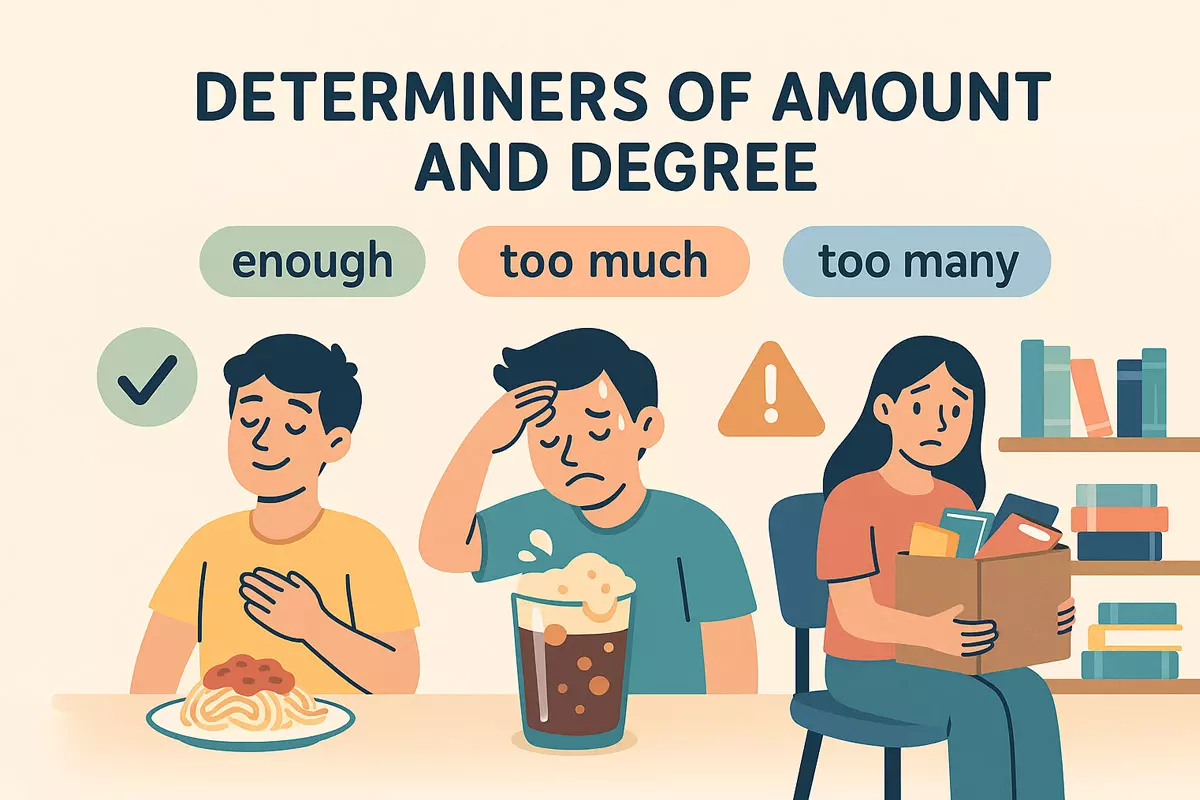 Here we amount and degree determiners, shows how to use enough, too much, and too many with nouns, explains the difference between too and very, addresses common mistakes, and includes practice sentences for rewriting.
- What amount and degree determiners are
- Using enough before and after nouns
- Using too much and too many with nouns
- Difference between too and very in simple sentences
- Talking about quantity problems: not enough, too little, too few
- Common errors with enough and too in beginner English
- Practice: rewrite sentences using enough, too much, or too many
Accurately expressing quantity and intensity in English can be challenging, particularly when you need to describe whether something is sufficient, excessive, or overwhelming. Choosing the right words to convey amount and extent allows you to communicate your ideas clearly and effectively. Words such as enough, too much, plenty, and countless each have specific nuances, so understanding how to use them appropriately is essential for precise communication. Developing this skill not only enhances clarity but also ensures your message matches your intent.
What amount and degree determiners are
Words like enough, too much, and too many help us describe quantity and degree in English. They act as modifiers, telling us how much or how many of something there is, or whether the quantity is sufficient or excessive. These expressions are especially useful when you want to be specific about limits, sufficiency, or excess.
How these determiners function
Amount and degree modifiers are used before nouns or after adjectives to give more detail about quantity or intensity. For example, you might say, “There isn’t enough time,” or “She has too many books.” The choice between much and many depends on whether the noun is countable or uncountable.
- enough: indicates sufficiency (“We have enough chairs.”)
- too much: signals excess with uncountable nouns (“There is too much noise.”)
- too many: points to excess with countable nouns (“He ate too many cookies.”)
Where to use these expressions
You’ll see these words before nouns or after adjectives and adverbs. Here are some common patterns:
- enough + noun: “enough water,” “enough people”
- adjective/adverb + enough: “old enough,” “quickly enough”
- too much + uncountable noun: “too much homework,” “too much sugar”
- too many + plural countable noun: “too many emails,” “too many cars”
Examples of usage
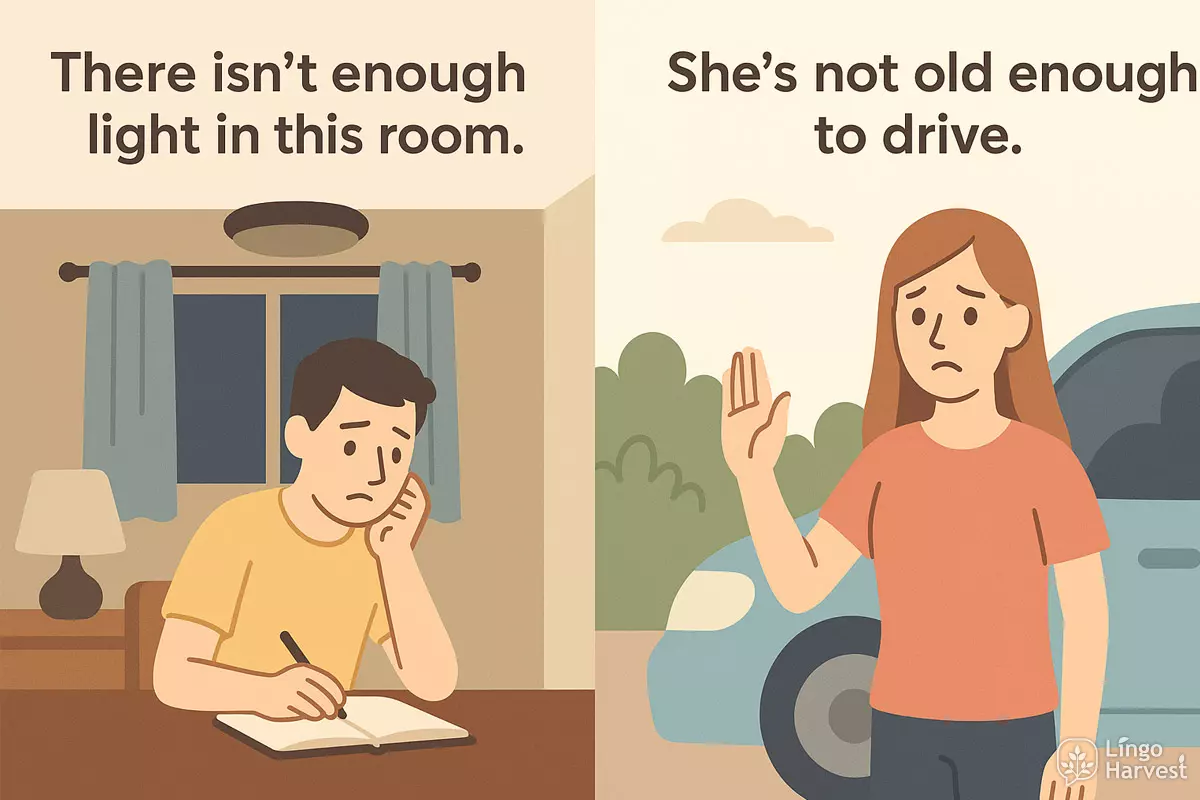
- There isn’t enough light in this room.
- She’s not old enough to drive.
- I have too many things to do.
- We drank too much coffee last night.
- Do you have enough information?
- He makes too many mistakes.
- Is there enough space for everyone?
- You’re running too much these days.
- They bought too many snacks.
- We don’t have enough time.
- She added too much salt to the soup.
- He doesn’t have enough experience.
- There are too many options to choose from.
- The room isn’t big enough.
- It’s too much work for one person.
- This box isn’t strong enough.
- Too many people arrived late.
- I didn’t sleep enough last night.
Choosing between “much” and “many”
| Expression | Used with | Example |
|---|---|---|
| too much | Uncountable nouns | too much water, too much information |
| too many | Countable nouns (plural) | too many books, too many apples |
| enough | Both countable and uncountable nouns | enough chairs, enough time |
| adjective + enough | Adjectives/adverbs | fast enough, loud enough |
Mastering these modifiers helps you communicate clearly about quantities, sufficiency, and excess, making your English more precise and natural.
Using enough before and after nouns
The word enough can be placed in different positions depending on what it modifies in a sentence. When talking about quantity, it generally appears before nouns, but when modifying adjectives or adverbs, it comes after them. Understanding these positions helps you sound more natural and avoid common mistakes.
Position with nouns
When referring to the quantity of something (countable or uncountable), enough is placed before the noun. This structure is the same for both singular uncountable nouns and plural countable nouns. Here are some examples:
- There isn't enough water for everyone. (uncountable)
- Do we have enough chairs for the guests? (countable)
- She didn’t bring enough money to pay the bill.
- We have enough apples to make a pie.
- Is there enough space in your bag?
- They don’t have enough reasons to complain.
- He ate enough food for two people.
- I didn’t get enough sleep last night.
- Do you think we brought enough supplies?
- She found enough evidence to support her claim.
Position with adjectives and adverbs
When enough is used with adjectives or adverbs, it is placed after the word it modifies, not before. This is a common area of confusion for learners. For example:
- He isn’t tall enough to reach the shelf. Not: enough tall
- She didn’t run quickly enough to catch the bus.
- This room isn’t big enough for all of us.
- Are you warm enough?
- He didn’t speak clearly enough for me to understand.
- We arrived early enough to get good seats.
- The instructions weren’t simple enough.
- She wasn’t old enough to vote.
- Did you study hard enough for the test?
- The soup isn’t hot enough.
Summary table: Placement of enough
| Type of word | Position of enough |
|---|---|
| Noun (countable or uncountable) | enough + noun enough time, enough books |
| Adjective or adverb | adjective/adverb + enough fast enough, big enough |
Remember, the position of enough changes meaning and clarity. Placing it incorrectly can lead to confusion or unnatural sentences. Practice with real-life examples to get comfortable with these patterns.
Using too much and too many with nouns
Understanding when to choose too much or too many depends on the type of noun you are describing. Both phrases express an excessive quantity, but they are used with different noun types: too much goes with uncountable nouns, while too many matches with countable nouns.
Countable vs. Uncountable Nouns
Countable nouns are items you can count individually (like apples, cars, mistakes). Uncountable nouns refer to things you cannot separate into individual units (such as water, information, money). The choice between too much and too many hinges on this distinction.
| Phrase | Use with | Example |
|---|---|---|
| too much | Uncountable nouns | too much sugar |
| too many | Countable nouns | too many books |
| too much | Abstract uncountable ideas | too much stress |
| too many | Plural countable nouns | too many emails |
Everyday Examples
Here are some typical uses to help you recognize when to use each form. Notice how the noun type guides your choice:
- too much noise
- too many people
- too much homework
- too many questions
- too much traffic
- too many shoes
- too much coffee
- too many meetings
- too much information
- too many problems
- too much work
- too many errors
- too much rain
- too many options
- too much salt
- too many tasks
Key Points to Remember
- Use too much for things you cannot count individually.
- Use too many for things you can count.
- Always check the noun: Is it singular and uncountable, or plural and countable?
- These phrases usually come before the noun they describe.
Mixing up these expressions is a common mistake, but focusing on the noun type will help you make the right choice. If you’re unsure, try to count the noun—if you can, use too many; if not, use too much.
Difference between too and very in simple sentences
“Too” and “very” are both used to describe the degree or amount of something, but they express different meanings and are used in different contexts. “Very” simply intensifies an adjective or adverb, showing a high degree, but still within a normal, acceptable range. On the other hand, “too” suggests an excessive amount—more than is wanted, needed, or acceptable. Understanding this distinction helps avoid misunderstandings in everyday conversation.
How "very" works in sentences
“Very” increases the strength of the word it describes but does not indicate a problem. For example, if you say “very tall,” you mean someone is much taller than average, but not to an undesirable extent. It’s a way to emphasize or boost the description.
How "too" changes meaning
When you use “too,” you imply something is beyond a suitable or comfortable level. For instance, “too tall” means the height is excessive, possibly causing issues or inconvenience. “Too” often carries a negative meaning and suggests that a limit has been crossed.
Quick comparison
- Very: a strong degree, but still acceptable (e.g., “very hot” means the heat is intense but manageable).
- Too: more than is acceptable or wanted (e.g., “too hot” means it’s uncomfortably or dangerously hot).
| Example with "very" | Example with "too" |
|---|---|
| She is very tired. (She is tired, but it’s just a strong feeling.) |
She is too tired to walk. (Her tiredness is so much that she cannot walk.) |
| This soup is very spicy. | This soup is too spicy for me. |
| He is very young. | He is too young to drive. |
| The box is very heavy. | The box is too heavy to lift. |
| That movie was very interesting. | The movie was too long. |
Common simple sentence patterns
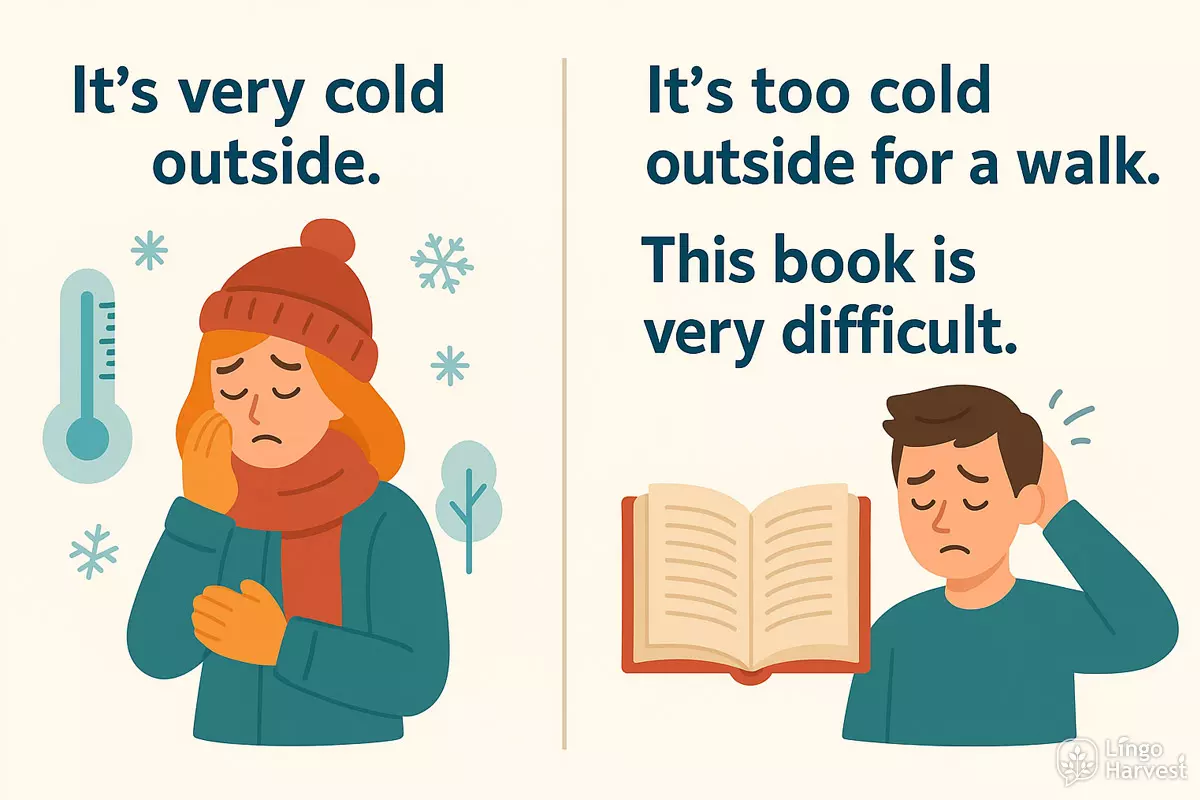
- It’s very cold outside.
- It’s too cold outside for a walk.
- This book is very difficult.
- This book is too difficult for me.
- She runs very fast.
- She runs too fast for me to follow.
- He is very hungry.
- He is too hungry to wait.
- This shirt is very small.
- This shirt is too small for me.
- The exam was very easy.
- The exam was too easy for advanced students.
In summary, “very” simply strengthens a description, while “too” signals an excessive amount that causes a problem or goes beyond what is suitable. Choosing between them changes the meaning of a sentence, so it’s important to use the right word for what you want to express.
Talking about quantity problems: not enough, too little, too few
Describing a lack or shortage in English often involves the phrases not enough, too little, and too few. Each is used in specific situations, depending on whether the noun is countable or uncountable, and whether you want to highlight insufficiency or express a negative result.
How to use "not enough," "too little," and "too few"
- Not enough is versatile and works with both countable and uncountable nouns: We don’t have enough chairs. / There isn’t enough water.
- Too little is used with uncountable nouns to stress that the amount is less than necessary: There is too little information.
- Too few is used with plural countable nouns when there are fewer items than needed: Too few people attended the meeting.
Common patterns and examples
- There’s not enough time to finish the test.
- We have too little money to buy a ticket.
- Too few buses run on Sundays.
- Not enough evidence was presented in court.
- He has too little patience with children.
- Too few students signed up for the class.
- There isn’t enough food for everyone.
- She did too little work to pass.
- Not enough volunteers came to help.
- Too few options are available.
- We had too little time to prepare.
- Not enough light enters this room.
- Too few chairs for all the guests.
- He brought too little water for the hike.
- Not enough support from the community.
- Too few examples in the book.
Comparing usage: countable vs. uncountable
| Phrase | When to use |
|---|---|
| Not enough | Both countable and uncountable nouns Not enough chairs / Not enough water |
| Too little | Uncountable nouns only Too little sugar / Too little time |
| Too few | Countable plural nouns only Too few books / Too few students |
Understanding these distinctions helps you accurately describe a lack or shortfall, making your speech and writing more precise.
Common errors with enough and too in beginner English
Learners often mix up the use of “enough” and “too” when talking about quantity or degree. This happens because these words look similar but work differently in English sentences. The confusion usually comes from word order, the type of noun (countable or uncountable), and the meaning each word expresses.
Word order confusion
A frequent mistake is putting “enough” in the wrong place. In English, “enough” comes after adjectives and adverbs, but before nouns. For example:
- Correct: She is tall enough to reach the shelf. ✅
- Incorrect: She is enough tall to reach the shelf. ❌
- Correct: We have enough chairs for everyone. ✅
- Incorrect: We have chairs enough for everyone. ❌
Mixing up “too much,” “too many,” and “enough”
Beginners sometimes use “too much” or “too many” instead of “enough,” or vice versa. The meanings are not the same: “enough” means the amount is sufficient, while “too much/many” means there is more than needed, usually a problem.
| Expression | When to use (with examples) | Typical mistake |
|---|---|---|
| enough + noun | We have enough water. (sufficient amount) | We have water enough. |
| adjective + enough | He isn’t old enough to drive. | He isn’t enough old. |
| too much + uncountable noun | There’s too much noise here. | There’s too many noise. |
| too many + countable noun | I bought too many apples. | I bought too much apples. |
Common example mistakes
Some errors repeat in early English learning. Watch for:
- Saying “too enough” together: It’s too enough hot.
- Using “too” for positive meaning: I have too many friends. (unless you want to say it’s a problem)
- Saying “enough of” with a noun: We have enough of chairs. (Correct: We have enough chairs.)
- Confusing countable and uncountable: There is too many sugar. (Correct: There is too much sugar.)
- Placing “enough” before adjectives: He is enough strong. (Correct: He is strong enough.)
- Using “enough” after the noun with no reason: They have people enough.
- Mixing “too much” with adjectives: It’s too much cold. (Correct: It’s too cold.)
- Trying to use “too many” with uncountable nouns: Too many information. (Correct: Too much information.)
- Forgetting to use “to” after “enough” or “too” when necessary: She’s tall enough reach the shelf. (Correct: She’s tall enough to reach the shelf.)
- Using “enough” in negative sentences incorrectly: We don’t have many enough books. (Correct: We don’t have enough books.)
Summary
Getting comfortable with these patterns takes time, but focusing on the order and meaning of “enough,” “too much,” and “too many” will help you avoid the most common pitfalls. Practice by checking if you’re talking about quantity (countable vs uncountable), sufficiency, or excess, and pay attention to word order in your sentences.
Practice: rewrite sentences using enough, too much, or too many
Understanding how to use "enough," "too much," and "too many" helps you express quantity and degree accurately in English. Try rewriting the following sentences to practice using these determiners correctly. Pay attention to whether the noun is countable or uncountable, as this will affect your choice.
Rewrite the sentences
Transform each statement by adding "enough," "too much," or "too many" as needed:
- There is food on the table for everyone.
- He bought sugar, but now the tea is very sweet.
- We have chairs, so everyone can sit.
- She brought bags, but now she can't carry them all.
- They gave us information, but it was overwhelming.
- The class has students, so it feels crowded.
- I didn’t sleep last night; I feel tired today.
- The soup is salty because there is salt in it.
- He has responsibilities and feels stressed.
- There are people at the party, and it’s hard to talk.
- Is there milk in the fridge for breakfast?
- The exam had questions, and I couldn’t finish.
- She spends time on her phone every day.
- They ordered pizzas for the group.
- The teacher gave us homework, and it took hours to finish.
Quick reference: Countable vs. Uncountable
Not sure when to use "too many" or "too much"? Here’s a handy comparison:
| Expression | Used with | Example |
|---|---|---|
| enough | Both countable & uncountable nouns | We have enough chairs. There isn’t enough water. |
| too much | Uncountable nouns | There is too much noise. |
| too many | Countable nouns (plural) | There are too many books. |
Show answers
- There is enough food on the table for everyone.
- He put too much sugar in the tea.
- We have enough chairs for everyone.
- She brought too many bags to carry.
- They gave us too much information.
- The class has too many students.
- I didn’t get enough sleep last night.
- The soup is too salty because there is too much salt in it.
- He has too many responsibilities.
- There are too many people at the party.
- Is there enough milk in the fridge for breakfast?
- The exam had too many questions.
- She spends too much time on her phone every day.
- They ordered enough pizzas for the group.
- The teacher gave us too much homework.