Zero Determiner with Plurals and Uncountables: full guide

 This article explains what the zero determiner is, when plurals and uncountable nouns use no article, the difference between zero article and the, common mistakes, useful general patterns, and provides practice choosing between a, the, or no article.
- What zero determiner means in simple terms
- When plurals use no article in general statements
- When uncountable nouns appear without a, an, or the
- Difference between zero article and the in similar sentences
- Typical beginner mistakes with missing or extra articles
- Useful patterns for talking about things in general
- Practice: choose between a, the, or zero determiner
Have you noticed that sometimes English sentences leave out words like "the" or "a" before plural or uncountable nouns? Knowing when to omit these articles is an important part of sounding natural and fluent in English. Articles are usually dropped when speaking about things in general, such as saying "Dogs are friendly" instead of "The dogs are friendly," or "Water is essential" rather than "The water is essential." Mastering this subtle grammar point can greatly improve the way you communicate in English.
What zero determiner means in simple terms
Zero determiner is a grammatical term for when you use a noun without any article or possessive word in front of it. In English, this often happens with plural countable nouns and uncountable nouns when you’re speaking about them in a general sense. Instead of “the apples” or “some information,” you just say “apples” or “information,” with nothing before the noun.
How it works in everyday English
When you use nouns with no “the,” “a,” “my,” or “some,” you are using a zero determiner. This is common in statements about things in general, not about specific items or amounts.
- Children like to play. (all children in general, not specific ones)
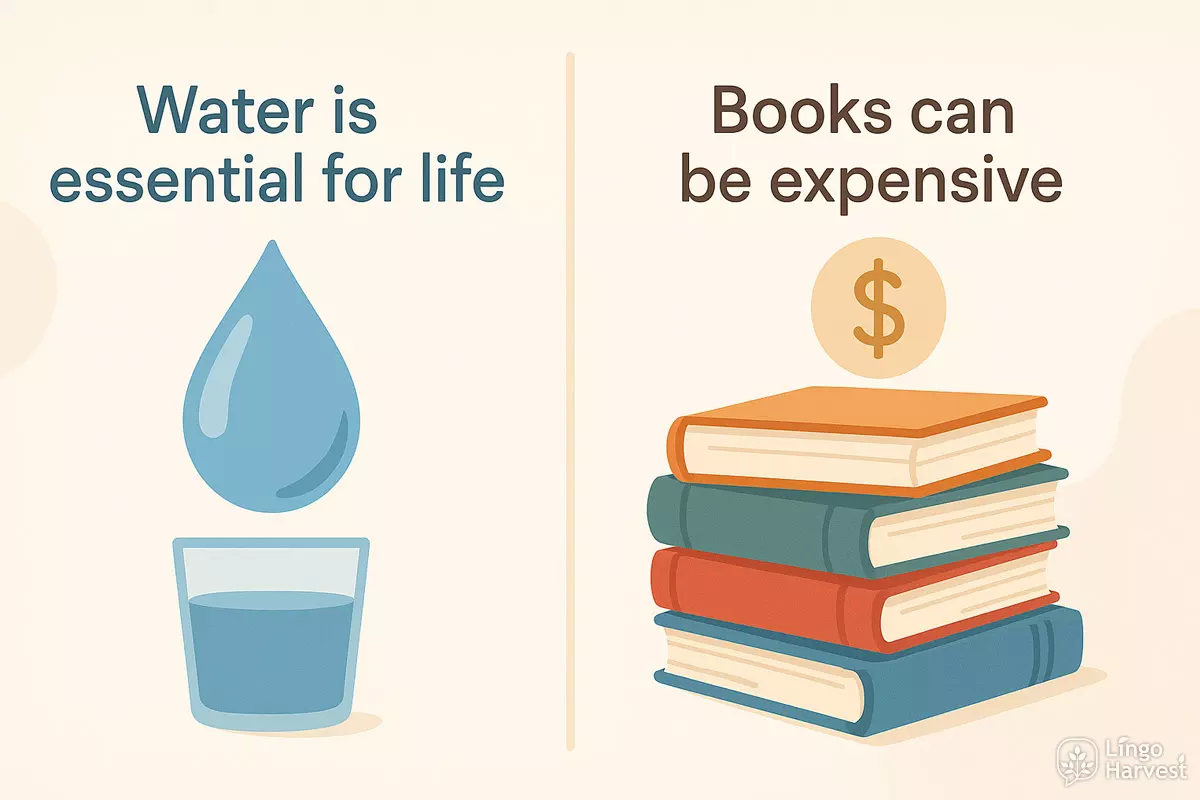
- Water is essential for life. (the concept of water, not a particular glass of water)
- Books can be expensive. (books in general, not certain books)
- Music helps me relax. (music as an idea, not a specific song)
- Dogs are loyal animals. (dogs as a category)
- Advice is helpful. (the idea of advice, not a specific tip)
- Cars pollute the air. (cars in general, not some specific vehicles)
- Information travels fast. (all information, not one piece)
- Ideas change the world. (any ideas, not particular ones)
- Tea is popular in Britain. (tea in general)
- Computers are everywhere. (all computers, not specific ones)
- Patience is important. (the quality, not a particular instance)
- Vegetables are healthy. (all vegetables)
- People need sleep. (people generally, not a group of people you know)
- Time flies. (the concept of time)
- Knowledge is power. (knowledge in general)
When do we use zero determiner?
Zero determiner is used in situations like:
- Talking about things in general (not specific)
- Using plural countable nouns in a general sense: “Cats are independent.”
- Using uncountable nouns in a general sense: “Milk is nutritious.”
Comparing zero, definite, and indefinite determiners
To make things clearer, here’s a comparison of how different types of determiners work with the same noun:
| Form | Example |
|---|---|
| Zero determiner | Books are useful. (all books in general) |
| Definite article (the) | The books on the table are mine. (specific books) |
| Indefinite article (a/an) | A book can change your life. (any one book, not specific) |
| Possessive determiner | My books are on the shelf. (books that belong to me) |
Key points to remember
- Zero determiner is normal with plural and uncountable nouns when talking generally.
- It is not used with singular countable nouns—those need a determiner.
- Using or omitting a determiner changes the meaning (general vs. specific).
In summary, a zero determiner just means leaving out words like “the,” “a,” or “some” in front of a noun when you want to speak about things in a broad, general way. This is a subtle but important part of English grammar, especially when talking about groups, ideas, or substances as a whole.
When plurals use no article in general statements
In English, plural nouns often appear without any article when we talk about things in a general sense. This “zero article” usage signals that we are not referring to specific items or groups, but rather to the entire category as a whole. For example, when saying “Dogs are loyal,” we mean all dogs in general, not particular dogs.
Key situations with zero article and plurals
- General truths: “Cats like milk.” (all cats, as a species)
- Habits and repeated actions: “Students use computers every day.”
- Categories of people or things: “Cars are expensive.”
- Abstract statements: “Friends are important.”
- Jobs and roles (in a general sense): “Doctors help patients.”
- Nationalities and groups: “Americans drive on the right.”
- Unspecified plural countable nouns: “Apples grow on trees.”
- Scientific facts: “Planets orbit stars.”
- Biological species: “Lions live in Africa.”
- General advice: “Vegetables are healthy.”
- Mass media and technology: “Computers change lives.”
- Social groups: “Teenagers love music.”
- Generalizations about behavior: “Children learn quickly.”
- Collective behaviors: “Birds migrate in winter.”
- Food types: “Bananas contain potassium.”
Comparing zero article vs. definite & indefinite articles
Using or omitting an article changes meaning. With no article, plural nouns refer to all members of the group, not just some or particular ones. Here’s a comparison for clarity:
| Form | Meaning |
|---|---|
| No article: “Horses run fast.” | Talking about all horses in general. |
| Definite article: “The horses are in the field.” | Refers to specific horses already known in the context. |
| Indefinite article: “A horse is an animal.” | Describes any single example from the group (not for plurals, but useful for comparison). |
Summary
Zero article with plural countable nouns is a core feature of general statements in English. It allows speakers to make broad claims, describe typical behaviors, or refer to whole categories without specifying which individuals are involved. This form is common in scientific, educational, and everyday language. Remember: when you mean “all” or “any” of a group, drop the article with plurals.
When uncountable nouns appear without a, an, or the
Many uncountable nouns in English do not take an article before them. This happens because these nouns refer to substances, qualities, or abstract ideas that aren’t easily counted or divided into discrete units. As a result, words like “information,” “music,” or “rice” typically stand alone, without the need for “a,” “an,” or “the,” unless a specific instance or quantity is implied.
Common Situations Where Uncountable Nouns Stand Alone
You’ll often encounter bare uncountable nouns in the following contexts:
- Talking about things in general: Water is essential for life.
- Discussing subjects or fields: Mathematics is challenging for some students.
- Referring to materials or substances: Glass can be recycled.
- Mentioning abstract concepts: Freedom is important to everyone.
- Describing weather or natural phenomena: Rain fell overnight.
Examples of Uncountable Nouns Without Articles
Here are some typical uncountable nouns commonly used without “a,” “an,” or “the” in general statements:
- Advice
- Information
- Furniture
- Equipment
- Milk
- Money
- Rice
- News
- Progress
- Salt
- Traffic
- Music
- Knowledge
- Research
- Time
- Weather
- Work
- Sand
- Air
- Education
How Meaning Changes With and Without Articles
Sometimes, adding an article to an uncountable noun changes its meaning or makes a sentence ungrammatical. Here’s a comparison:
| With Zero Article | With Article |
|---|---|
| She gave advice. | She gave an advice. ❌ (Incorrect) |
| We need information. | We need the information. (Specific information) |
| He drinks milk every morning. | He drinks a milk. ❌ (Incorrect) |
| Music relaxes me. | The music is too loud. (Particular music) |
| She has work to do. | She has a work. ❌ (Incorrect) |
Key Points to Remember
- Uncountable nouns usually appear without articles when talking about them in a broad or general sense.
- Adding “a” or “an” to these nouns is almost always incorrect; “the” is used only when specifying something known or previously mentioned.
- Words like “some,” “much,” or “a little” can be used to give more information about quantity, but do not make the noun countable.
Understanding when to omit articles with uncountable nouns helps you sound more natural in English and avoids common mistakes that can confuse listeners or readers.
Difference between zero article and the in similar sentences
Understanding when to use no article (zero determiner) versus the can be confusing, especially with plural countable nouns and uncountable nouns. The choice changes the meaning of a sentence, often distinguishing between general statements and references to something specific or previously mentioned.
General vs. Specific Meaning
The zero article is used to talk about things in a general sense. In contrast, the points to something particular, already known to the listener or reader. This is especially important with plural nouns and uncountable nouns:
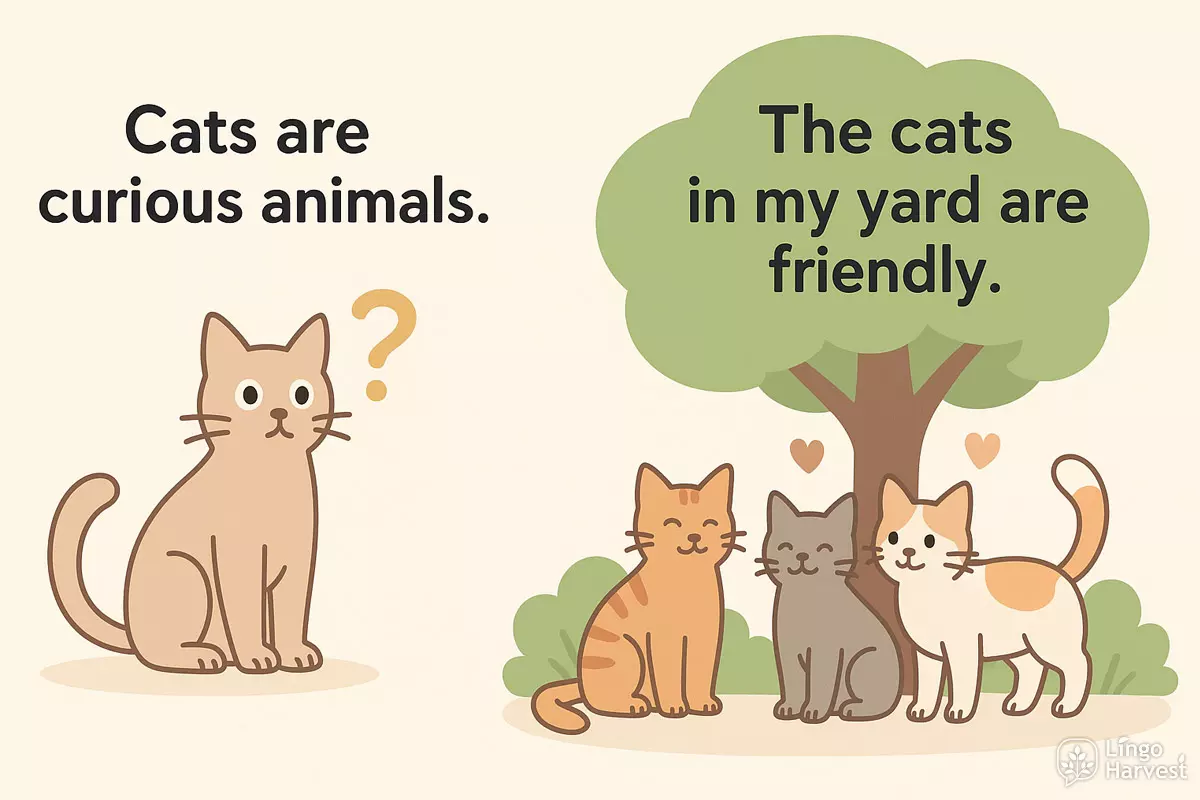
- Zero article: Cats are curious animals. (all cats in general)
- The: The cats in my yard are friendly. (specific group of cats)
- Zero article: Water is essential for life. (water in general)
- The: The water in this glass is cold. (particular water)
Common Patterns
Here are some typical sentence patterns where the difference between using no article and the changes the meaning:
| Zero Article Example | With "the" |
|---|---|
| Dogs are loyal. | The dogs next door are noisy. |
| Information is valuable. | The information you gave me was helpful. |
| Teachers work hard. | The teachers at our school are dedicated. |
| Music helps me relax. | The music at the party was too loud. |
| Children need sleep. | The children in this class are tired. |
| Books can be expensive. | The books on this shelf are mine. |
| Fruit is healthy. | The fruit on the table is ripe. |
| Ideas change the world. | The ideas in your essay are interesting. |
| Milk contains calcium. | The milk in the fridge is spoiled. |
| Computers are useful tools. | The computers in this lab are new. |
Quick Tips ✅
- Use no article with plural or uncountable nouns when making generalizations.
- Add the for specific, known, or previously mentioned items/groups.
- Context always determines the right choice—think about whether you mean "all" or "these particular ones."
Typical beginner mistakes with missing or extra articles
When learning how to use the zero determiner with plural and uncountable nouns in English, many learners stumble over when to omit articles and when to include them. This confusion often results in sentences that sound unnatural or change the intended meaning. Let’s explore where these errors commonly occur, why they happen, and how to fix them.
Common Issues with Plural Nouns
With plural countable nouns, English typically omits the article when speaking generally. However, beginners often add "the" or "a/an" unnecessarily, or forget to use any determiner when specificity is needed. Here are frequent pitfalls:
- Saying the cats are cute when meaning cats in general (should be cats are cute).
- Using a books instead of simply books for general statements.
- Forgetting "the" for specific reference: students in class are tired (should be the students in the class are tired if referring to a known group).
- Overusing "the" in lists: I like the apples and the oranges (when speaking generally, use apples and oranges).
Missteps with Uncountable Nouns
Uncountable nouns—like "information," "water," or "advice"—also typically appear without an article when discussed in general. Problems arise when learners add "a" or "the" without need, or omit them when specificity is required.
- Saying a water when referring to the substance in general (should be water).
- Using an information instead of information.
- Omitting "the" when referring to a specific item: water in bottle is cold (should be the water in the bottle is cold).
- Adding "the" unnecessarily: I love the music (when speaking about music in general, just I love music).
Comparison Table: Correct vs. Incorrect Usage
| Incorrect | Correct |
|---|---|
| I have a informations. | I have information. |
| The children like the ice cream. | Children like ice cream. |
| Students need the advice. | Students need advice. |
| She gave me an advice. | She gave me advice. |
| I saw a birds in the park. | I saw birds in the park. |
| The books are useful (when speaking generally). | Books are useful. |
| Can you give me a money? | Can you give me money? |
| She likes the music (general). | She likes music. |
Quick Tips to Avoid Article Errors
- Drop articles with plural countable nouns and uncountable nouns for general statements.
- Use "the" only when both speaker and listener know exactly which items or things are meant.
- Never use "a/an" with uncountable nouns.
- Review if you’re talking about something specific or general before choosing a determiner.
Careful attention to whether a noun is plural or uncountable, and whether your meaning is specific or general, will help you avoid the most frequent missteps with articles and the zero determiner.
Useful patterns for talking about things in general
Discussing topics broadly in English often involves using plural nouns or uncountable nouns without any determiner. This “zero determiner” structure is especially common when making statements about categories, groups, or substances in a general sense. Understanding these patterns helps you sound more natural and accurate.
Common sentence structures
When referring to things as a whole group or type, English typically drops articles before plural and uncountable nouns. Here are some practical patterns you’ll encounter:
- Cats make great pets. (all cats in general)
- Children need attention. (referring to children as a category)
- Water is essential for life. (the substance in general)
- Books provide knowledge. (books as a type, not specific ones)
- People want freedom. (humans in general)
- Information travels quickly online. (information as a concept)
- Dogs are loyal animals.
- Money can't buy happiness.
- Cars pollute the air.
- Music brings people together.
- Ideas shape society.
- Advice can be helpful.
- Teachers inspire students.
- Technology changes lives.
- Fruit contains vitamins.
- News spreads fast.
- Plants need sunlight.
- Milk is nutritious.
- Computers save time.
- Research improves medicine.
Negative and interrogative forms
Zero determiners also appear in negative and question forms:
- Do cats like water?
- Why do people lie?
- Is information reliable?
- Children don’t always listen.
- Books aren’t always accurate.
Comparing zero determiner with other forms
It’s helpful to see how the zero article contrasts with the use of “the” and “a/an” in similar contexts:
| Form | Example & Usage |
|---|---|
| Zero determiner (general) | Cats are independent. (all cats, cats in general) |
| The + noun (specific group) | The cats in this house are noisy. (a particular set of cats) |
| A/An + noun (single, not specific) | A cat can be a good friend. (any one cat, not a specific one) |
| Zero determiner (uncountable, general) | Milk is healthy. (all milk, in general) |
Mastering these patterns makes your English both more fluent and more precise when you’re speaking or writing about categories, substances, or groups in a general way.
Practice: choose between a, the, or zero determiner
Understanding when to use a, the, or leave out the article entirely can be tricky, especially with plural nouns and uncountable nouns. Try the following exercises to sharpen your intuition and spot the patterns behind each choice.
Fill in the blanks: Determiner selection
Insert a, the, or leave the space blank (zero determiner) in each sentence. Think about whether the noun is plural, uncountable, or specific/generic.
- ______ water in this river is very cold.
- I bought ______ apples from the market yesterday.
- She doesn't eat ______ meat.
- ______ information you gave was very helpful.
- We saw ______ beautiful painting at the gallery.
- ______ books on that shelf belong to Sarah.
- He wants to become ______ engineer.
- ______ music in this movie is amazing.
- They need ______ advice before making a decision.
- ______ dogs are friendly animals.
- Can you pass me ______ salt, please?
- ______ children love playing outside.
- She has ______ experience in teaching.
- ______ air in this room feels stuffy.
- We need to buy ______ bread for breakfast.
Show answers
- The
- — (zero determiner)
- — (zero determiner)
- The
- A
- The
- An
- The
- — (zero determiner)
- — (zero determiner)
- The
- — (zero determiner)
- — (zero determiner)
- The
- — (zero determiner)
Quick reference: When to use a, the, or zero determiner
| Noun Type | Use a/an | Use the or zero |
|---|---|---|
| Singular countable, not specific | a dog, an idea, a book | the dog (specific), — (not possible) |
| Plural countable, generic | — | dogs (zero), the dogs (specific group) |
| Uncountable noun, general | — | water (zero), the water (specific) |
| Uncountable noun, specific | — | the information, the advice |
Spot the pattern: Common zero determiner contexts
- Plural nouns in general statements: Cats are independent.
- Uncountable nouns in general: Milk is nutritious.
- Meals: We had lunch at noon.
- Languages: She speaks French.
- Subjects: He studies biology.
- Most places (by function): She went to school.
- Abstract ideas: Freedom is important.
- With some common expressions: Go to bed, be at home.
- Sports: He plays tennis.
- Days and months: Monday is busy for me.
Practicing with a range of examples helps you internalize when an article is needed, and when leaving it out (using a "zero determiner") is the natural choice.