Using Determiners Before Gerunds: the choosing of a leader

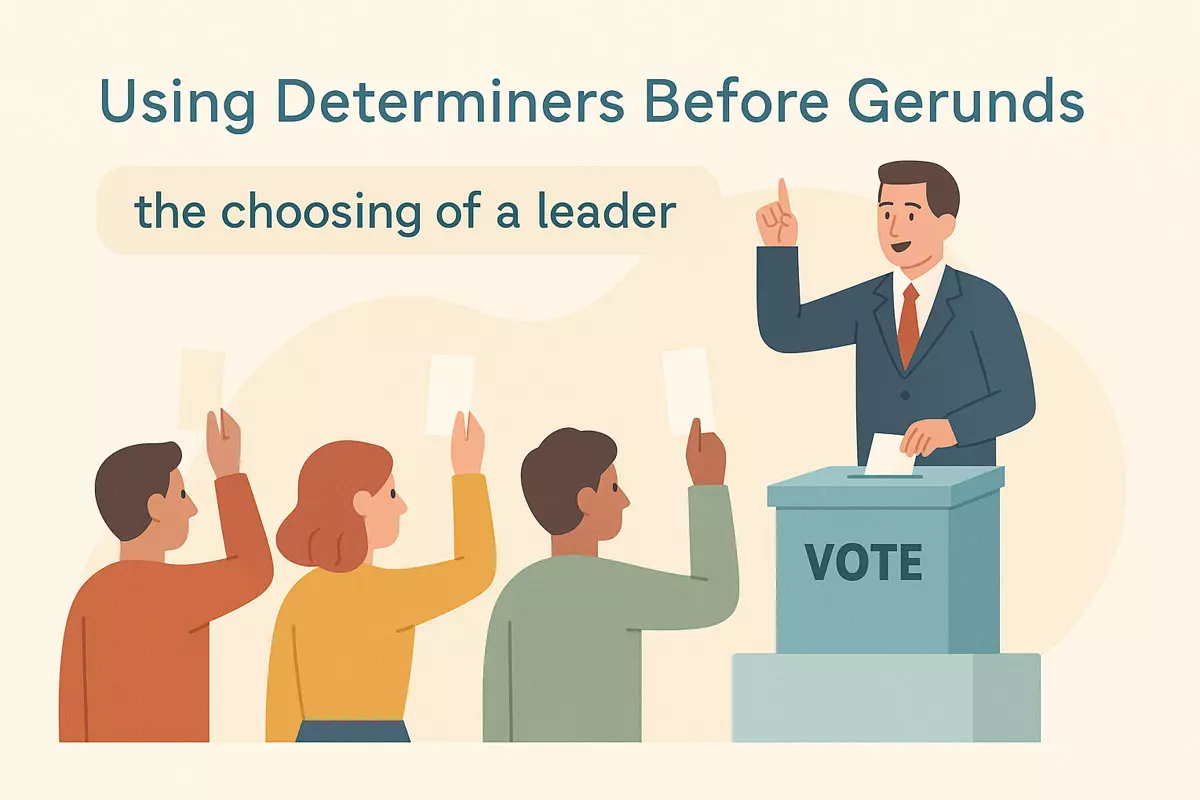 Here we how gerunds act as nouns, how determiners like the, this, and possessives are used before gerunds, gives examples such as the choosing of a leader, explains common learner mistakes, and provides practice with these forms.
- What a gerund is and how it behaves like a noun
- How determiners work before gerunds in noun phrases
- Examples like the choosing of a leader and the opening of the shop
- Using this, that, and possessives before gerunds
- Why we sometimes prefer gerund noun phrases in English
- Common learner problems with determiners and -ing forms
- Practice: build short phrases with determiners and gerunds
Choosing the right words can subtly shift a sentence’s meaning, particularly when pairing specific introductory words with verbs functioning as nouns. For example, examining how phrases like the process of choosing a leader are constructed highlights interesting nuances in English grammar. The selection of introductory words influences not only clarity but also the tone and precision of the expression, demonstrating that even small linguistic decisions can have a significant impact on how ideas are conveyed and understood.
What a gerund is and how it behaves like a noun
A gerund is the –ing form of a verb that functions as a noun in a sentence. While it looks like a verb (for example, choosing), it actually takes on the role of a subject, object, or complement—just like a typical noun would. This means gerunds can be the main “thing” in a sentence, represent an activity, or stand in for ideas and actions.
How gerunds act like nouns in sentences
Gerunds can fill positions where you’d expect a noun. For instance, they can be:
- Subjects: Running helps me relax.
- Objects: She enjoys reading.
- Objects of prepositions: They talked about traveling.
- Complements: His favorite hobby is painting.
Typical noun-like features of gerunds
Because gerunds behave like nouns, they can be modified by determiners and adjectives. For example, you might say the choosing of a leader, using “the” to specify which act of choosing you mean. This is similar to how you’d say the election of a leader.
| Verb Form | Gerund Used as Noun | Traditional Noun Equivalent |
|---|---|---|
| choosing | the choosing of a leader | the selection of a leader |
| running | her running surprised everyone | her performance surprised everyone |
| teaching | his teaching is effective | his instruction is effective |
| building | the building of bridges | the construction of bridges |
| planning | their planning saved time | their preparation saved time |
Examples of gerunds in action
- Swimming is good exercise.
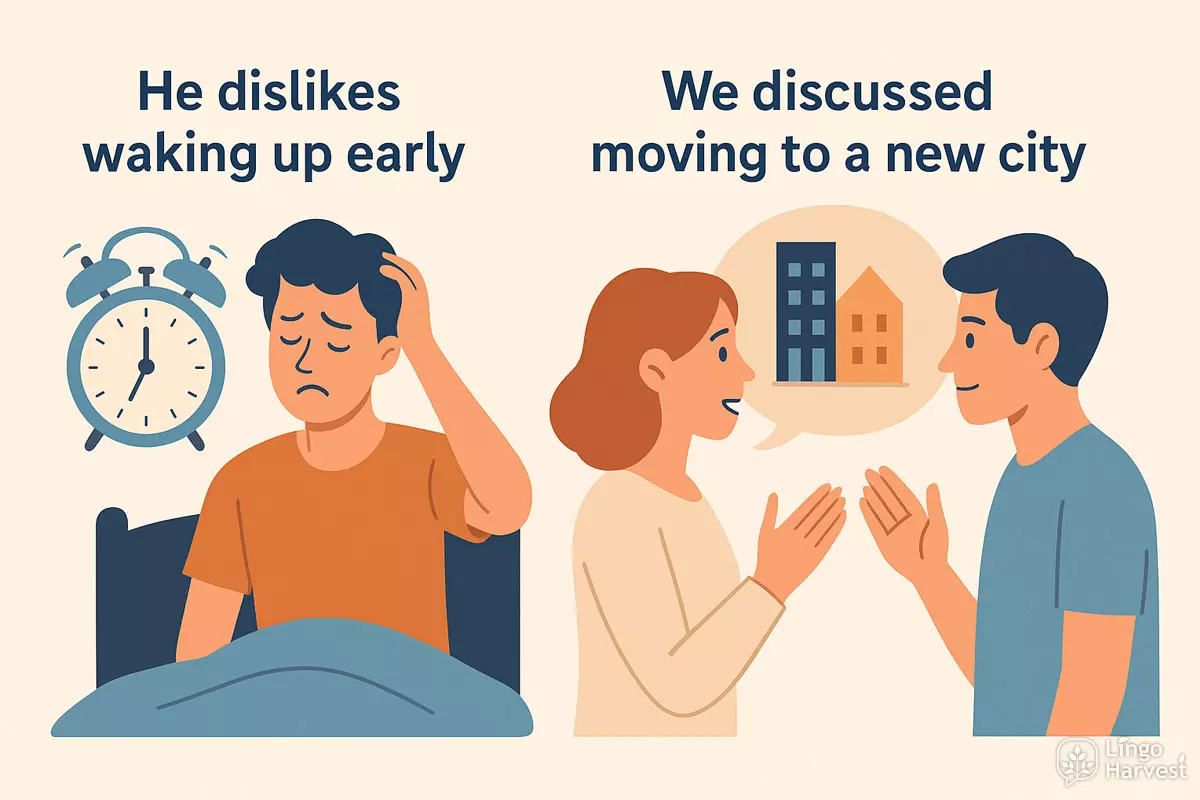
- He dislikes waking up early.
- We discussed moving to a new city.
- Eating healthy foods is important.
- She succeeded in solving the problem.
- Writing letters takes time.
- They apologized for being late.
- Listening closely helps understanding.
- Our goal is improving communication.
- He is interested in learning French.
- Traveling broadens your perspective.
- She is responsible for organizing the event.
- His hobby is collecting stamps.
- Jogging every morning is her routine.
- We look forward to meeting you.
In summary, gerunds stand out because they let you talk about actions and processes as if they were objects or things. This flexibility is why you’ll often see determiners like “the,” “his,” or “her” in front of them, turning verb ideas into concrete topics within your sentences.
How determiners work before gerunds in noun phrases
When a gerund acts as the head of a noun phrase, determiners help specify or limit its meaning. Instead of referring to actions in general, determiners such as "the," "my," or "some" point to a particular instance or type of the activity. For example, "the choosing of a leader" refers to a specific act of choosing, not the general concept of choosing.
Which determiners commonly appear before gerunds?
Several determiners work naturally with gerund phrases. Here are some of the most frequent ones:
- the (the building of bridges)
- this/that (this running of the engine)
- my/your/his/her/its/our/their (her singing of the anthem)
- some/any (some cleaning of the house)
- each/every (every painting of a portrait)
- no (no eating after midnight)
- such (such making of excuses)
- whose (whose handling of the situation)
- another (another telling of the story)
- their (their choosing of a location)
- all (all washing of hands)
- much/little (little understanding of the issue)
What do determiners do in gerund noun phrases?
Determinants clarify whether we are talking about a particular instance, quantity, or ownership of an action. For instance:
- The signing of the contract means one specific signing event, not just any signing.
- My forgetting of the date refers to one person’s particular mistake.
- Any breaking of the rules means one or more possible violations, not a specific act.
Comparison: Bare vs. Determined Gerund Phrases
| Without Determiner | With Determiner |
|---|---|
| Choosing a leader is difficult. (General activity) |
The choosing of a leader was controversial. (Specific event) |
| Eating late is unhealthy. (General habit) |
His eating of cake surprised us. (Specific instance) |
| Reading helps you learn. (General process) |
Her reading of the letter was emotional. (One particular action) |
| Running improves fitness. (All running) |
No running after dark is allowed. (Rule about a category) |
Summary
Adding a determiner before a gerund phrase makes your meaning more precise. It lets you refer to specific acts, types, or ownership of actions, turning a general idea into a concrete noun phrase. This helps you communicate clearly whether you’re talking about a rule, an event, or someone’s particular experience.
Examples like the choosing of a leader and the opening of the shop
When determiners such as "the," "a," or "this" are placed before a gerund, the phrase functions more like a noun group, often describing a specific event, action, or process. Consider phrases like "the opening of the shop" or "the choosing of a leader": these constructions highlight a particular instance or process rather than the activity in general. This use is common in formal and academic writing, where precision is needed.
Common Patterns with Determiners and Gerunds
The structure is typically: determiner + gerund + of + noun. This pattern frames the gerund as a concrete event or entity. Here are several illustrative examples:
- the signing of the contract
- the building of the bridge
- the closing of the store
- the cleaning of the office
- the launching of the campaign
- the approval of the budget
- the raising of the flag
- the lowering of the prices
- the introduction of the bill
- the selection of candidates
- the teaching of the class
- the painting of the house
- the funding of the project
- the reading of the will
- the training of the staff
- the announcement of the results
- the delivery of the speech
- the publication of the article
Why Use a Determiner Before a Gerund?
Adding a determiner before a gerund transforms the activity into a specific event or process, making it referential and concrete. For instance, "choosing a leader" is a general activity, while "the choosing of a leader" points to a particular instance or process.
Comparing Forms: With and Without Determiners
| Without Determiner | With Determiner |
|---|---|
| Choosing a leader can be difficult. | The choosing of a leader was controversial. |
| Opening the shop takes time. | The opening of the shop attracted a crowd. |
| Cleaning offices is necessary. | The cleaning of the offices is scheduled for Friday. |
| Approving budgets is important. | The approval of the budget is pending. |
These examples show how using a determiner before a gerund shifts the focus from a general action to a named event or process. This construction is especially useful when you want to discuss the result, organization, or significance of an activity in a formal or specific context.
Using this, that, and possessives before gerunds
When placing words like "this," "that," and possessive forms (such as "my," "her," "their") before gerunds, you highlight ownership or specify a particular instance of an action. This is common in more formal or academic English, especially when describing processes or abstract ideas, for example: "the choosing of a leader." Here, “the” or “their” gives focus or context to the act of choosing itself, not just the verb.
How demonstratives and possessives work with gerunds

Demonstratives ("this," "that," "these," "those") and possessives ("my," "your," "our," etc.) can precede gerunds to clarify which action is being discussed or who is responsible for it. This construction often turns the gerund phrase into a noun phrase, making it the subject or object of a sentence. For instance:
- This choosing of the location was unexpected.
- Her running surprised everyone.
- Our planning saved a lot of time.
- That singing is very loud.
- His forgetting was unfortunate.
- Their arriving late caused a problem.
- Your asking is appreciated.
- My explaining took longer than expected.
- Those cheering made the event lively.
- Its functioning depends on regular maintenance.
Comparing forms: definite article, demonstratives, and possessives
The choice between "the," demonstratives, and possessives before a gerund can subtly shift meaning. "The" refers to a specific or previously mentioned action, while demonstratives point to something near or far in context, and possessives show who is performing the action. See the table below for comparison:
| Form | Example Phrase | Usage/Meaning |
|---|---|---|
| The + gerund | the choosing of a leader | Refers to a specific act of choosing, often known to the audience |
| This/That + gerund | this choosing of a leader | Focuses on a particular instance, often recent or being discussed |
| Possessive + gerund | her choosing of a leader | Emphasizes who is performing the action |
| Plural demonstrative + gerund | those choosing of leaders | Refers to several instances or people involved in the action |
When to use these constructions
Such phrases are common in academic, formal, or descriptive writing, where the process or agent of the action is important. They are less frequent in everyday conversation but can add clarity or emphasis when discussing roles, responsibilities, or ongoing actions. For example, in committee reports or policy documents, you might see: "Our reviewing of the proposals led to new insights." In summary, applying demonstratives or possessives before gerunds allows for precise and nuanced expression, especially in contexts where the action or agent requires emphasis.
Why we sometimes prefer gerund noun phrases in English
English speakers often turn to gerund noun phrases when they want to describe actions or processes in a more abstract, general, or formal way. Using a gerund phrase like the choosing of a leader allows us to refer to the activity itself, not just the act of someone choosing. This construction can also add a layer of specificity or focus, especially when a determiner (such as the, this, their) is included.
Making actions into "things"
Transforming verbs into gerund noun phrases lets us treat activities as objects or concepts. This is useful in academic, legal, or formal writing, where discussing the process is more important than who is performing it. For example, the signing of the agreement emphasizes the event, not the people involved.
When gerund phrases are preferred
- To focus on the activity as a whole: the solving of the puzzle
- When specifying particular instances: her winning of the award
- In formal or written English, especially in academic contexts
- For clarity, especially when the action involves multiple steps or is ongoing
- When using modifiers or additional information: the careful planning of the event
- To match parallel structure in lists or comparisons
- When the agent is less important than the act itself
- To create clear, compact subject or object phrases
- In legal, bureaucratic, or technical language
- When a simple gerund wouldn’t be specific enough
Comparing forms: Plain gerund vs. gerund noun phrase
| Plain Gerund | Gerund Noun Phrase (with determiner) |
|---|---|
| Choosing is difficult. | The choosing of a leader is difficult. |
| Reading improves your mind. | The reading of ancient texts improves your mind. |
| Planning helps. | Careful planning of the trip helps. |
| Singing relaxes me. | Her singing of the anthem was moving. |
| Voting matters. | This voting of new members matters. |
Why do we add determiners?
Adding a determiner to a gerund phrase (like the choosing of a leader) helps specify which instance or type of action we mean. It also allows the phrase to function like a noun group, making it easier to use as the subject or object of a sentence. This can add clarity, formality, and nuance, especially in complex or official statements.
Common learner problems with determiners and -ing forms
Learners often face confusion when using words like "the," "a," or "this" before -ing forms (gerunds). One challenge is recognizing when a gerund acts as a noun and whether it can take a determiner. For example, "the choosing of a leader" is correct, but "a choosing of a leader" can sound odd unless the context supports it. Another issue is deciding if a determiner is needed at all, as in "choosing a leader" versus "the choosing of a leader." This often depends on whether the action is being spoken about in general or as a specific event.
Frequent Mistakes and Confusions
- Adding a determiner where it's not needed: saying the swimming is fun when just swimming is fun is better.
- Omitting a determiner when specifying a particular event: choosing of a leader was difficult instead of the choosing of a leader was difficult.
- Using indefinite articles with gerunds: a running of the race (rarely used, except in specific event names).
- Confusing gerunds with present participles: the singing bird (participle, describes the bird) vs. the singing of the bird (gerund, the act itself).
When Can Determiners Be Used?
The use of a determiner before an -ing form is generally limited to situations where the -ing form is functioning as a noun phrase and is being specified. For general activities, determiners are usually omitted. See the comparisons below:
| With Determiner | Without Determiner |
|---|---|
| The choosing of a leader took hours. | Choosing a leader can be difficult. |
| The building of the bridge was delayed. | Building bridges requires skill. |
| The signing of the contract is tomorrow. | Signing contracts is an important step. |
| The painting of the mural was impressive. | Painting murals requires creativity. |
Key Patterns to Watch
- Use "the" with gerunds to refer to a specific, known event or process.
- Omit "the" when talking about an activity in general.
- Rarely use "a" or "an" before -ing forms, except in formal or event names.
- Be careful with possessives: her singing was beautiful vs. the singing of the choir.
- After prepositions, gerunds rarely take determiners: by choosing wisely, not by the choosing wisely.
- Distinguish between gerunds (noun-like) and participles (adjective-like) to avoid confusion.
Learners are encouraged to notice these subtle distinctions in authentic English texts and practice forming sentences with and without determiners to strengthen their understanding.
Practice: build short phrases with determiners and gerunds
Understanding how to combine determiners with gerunds can help you build more natural and precise English phrases. In this section, you’ll get hands-on by constructing short expressions that pair determiners (like “the,” “this,” “my”) with gerunds (verbs ending in -ing used as nouns). This is especially important when describing processes or abstract ideas, such as “the choosing of a leader.”
Common Patterns
While working with gerunds, notice how determiners add specificity or ownership. Here are some typical combinations you might see:
- the choosing of a leader
- his running for office
- their organizing of the event
- my learning of the rules
- this planning of the strategy
- our preparing for the exam
- her writing of the proposal
- that watching of the ceremony
- every reading of the report
- your handling of the situation
- each voting in the election
- some understanding of the issue
- no knowing of the outcome
- their debating of the options
- the selecting of candidates
- his managing of the process
- our supporting of the nominee
- her questioning of the decision
Task: Make Your Own Phrases
Try combining a determiner and a gerund with a suitable object. Use the structure: [determiner] + [gerund] + of + [object]. Create at least three phrases for each determiner below:
- the
- my
- their
- this
- our
- his
- her
- that
- its
- any
Show answers
- the choosing of a representative; the planning of the event; the reviewing of documents
- my learning of new skills; my preparing of the agenda; my understanding of the problem
- their organizing of the conference; their managing of the budget; their supporting of the candidate
- this handling of complaints; this approving of the plan; this arranging of interviews
- our coordinating of tasks; our sharing of resources; our monitoring of progress
- his reporting of the incident; his drafting of the contract; his analyzing of the results
- her leading of the team; her scheduling of appointments; her evaluating of proposals
- that processing of data; that reviewing of applications; that implementing of changes
- its functioning of the system; its tracking of performance; its updating of records
- any providing of information; any delaying of responses; any violating of rules
Spot the Correct Phrase
Choose which of the following pairs uses the determiner and gerund combination correctly:
- the selecting a leader / the selecting of a leader
- my deciding of the time / my deciding the time
- their preparing of documents / their preparing documents
- her leading the group / her leading of the group
- our reviewing the proposal / our reviewing of the proposal
- his analyzing the data / his analyzing of the data
- the approving the plan / the approving of the plan
- your organizing the files / your organizing of the files
- its functioning properly / its functioning of the system
- their monitoring the progress / their monitoring of the progress
Show answers
- the selecting of a leader ✅
- my deciding the time ✅
- their preparing of documents ✅
- her leading of the group ✅
- our reviewing the proposal ❌ (correct: our reviewing of the proposal)
- his analyzing of the data ✅
- the approving of the plan ✅
- your organizing of the files ✅
- its functioning properly ❌ (correct: its functioning of the system)
- their monitoring of the progress ✅
Quick Reference
Below is a summary showing how determiners interact with gerunds in short phrases. This helps you visualize the pattern and apply it to new contexts.
| Determiner | Example Phrase |
|---|---|
| the | the choosing of a leader |
| my | my learning of the rules |
| their | their organizing of the event |
| this | this planning of the strategy |
| her | her writing of the proposal |
| our | our preparing for the exam |