Gerunds vs -ing Nouns: What Is the Difference

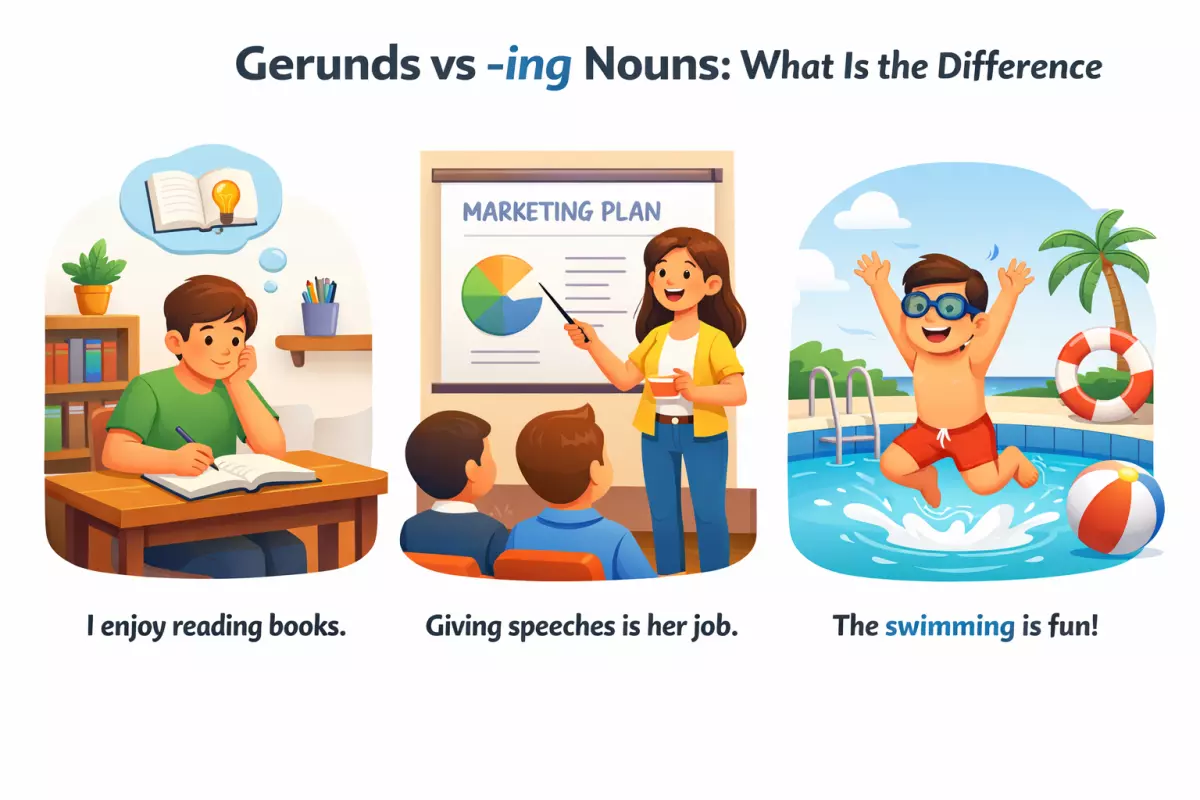 This article explains why -ing words can act differently in English, how to spot true gerunds, and how -ing nouns behave like regular nouns. It gives side-by-side sentence examples, practical clues, common learner confusions, and exercises to identify each in context.
- Why words ending in -ing can function differently in English
- How to recognize a true gerund in a sentence
- How -ing nouns behave like regular nouns in grammar
- Sentence examples comparing gerunds and -ing nouns
- Clues that help identify whether the word is a verb form or a noun
- Common learner confusion with -ing words in English
- Practice exercises: identify gerunds and -ing nouns in sentences
Words ending in -ing can be tricky because they may act like verbs or like nouns. Knowing whether an -ing form is verb-based or a true noun helps in everyday English. The difference appears in how it links to actions, objects, and time: one keeps the feeling of something happening, while the other names the activity as an idea. Spot the patterns and your sentences become clearer and more natural.
Why words ending in -ing can function differently in English
Forms ending in -ing are flexible because English uses the same spelling for several related structures. Sometimes the -ing word behaves like a verb inside a clause (taking objects and adverbs). Other times it behaves like a noun phrase (taking determiners and adjectives), or even like an adjective modifying a noun. The key is to look at the surrounding grammar: what the word is modifying, what can modify it, and whether it still has “verb-like” properties.
Common functions of -ing forms (and how to recognize them)
- Gerund (verb-like -ing used as a noun phrase head): functions as subject/object/complement, and can still take an object.
- Subject: “Swimming relaxes me.”
- Object: “I enjoy reading long novels.”
- With object: “Fixing the sink took hours.”
- -ing noun (fully noun-like): often takes a determiner (a/the/this), plural -s, and adjectives; it typically does not take a direct object the way a verb does.
- Determiner: “The building is old.”
- Plural: “Several paintings were stolen.”
- Adjective: “A quick meeting would help.”
- Present participle in a verb phrase (progressive aspect): part of the main verb with be.
- “She is writing an email.”
- “They were arguing about the plan.”
- Adjectival participle (modifier): describes a noun; often answers “what kind?”
- “A smiling child waved.”
- “The boiling water spilled.”
- Reduced clause / participle clause: adds extra information, often about time, reason, or result.
- Time: “Walking to work, I saw an accident.”
- Reason: “Knowing the answer, he stayed quiet.”
- Result: “She slipped, breaking her phone.”
Usage patterns that reveal whether an -ing form is more verb-like or noun-like
- Object after the -ing form usually signals a gerund: “writing reports,” “learning Spanish,” “fixing cars.”
- Adverbs modifying the -ing form lean verb-like: “quickly answering,” “carefully checking,” “quietly leaving.”
- Determiners (a/the/this/my) before the -ing word lean noun-like: “the opening,” “an ending,” “this painting,” “my savings.”
- Adjectives before the -ing word often indicate an -ing noun: “a brief meeting,” “a loud banging,” “the final screening.”
- Plural -s is a strong noun signal: “recordings,” “findings,” “bookings,” “spendings” (less common), “earnings.”
- Possessives before the -ing form are common with gerunds in careful style: “her singing,” “their arriving late,” “Sam’s complaining.”
- Prepositions frequently introduce gerund clauses: “good at explaining,” “interested in joining,” “tired of waiting.”
- Fixed noun meanings can override the “verb feel”: “building” (structure), “painting” (artwork), “heading” (title), “lighting” (equipment/effect).
- Stress and meaning can separate a noun from an action: “a recording” (the audio file) vs. “recording a song” (the activity).
- Context decides ambiguity: “I like drawing” (activity) vs. “I like the drawing” (the picture).
Quick set of examples to compare patterns
- ✅ “I remember locking the door.” (gerund with object)
- ✅ “I remember the locking of the door.” (more noun-like, formal)
- ✅ “The locking mechanism is broken.” (-ing noun used as modifier)
- ✅ “She is locking the door.” (progressive verb)
- ✅ “The shocking news spread fast.” (adjectival participle)
- ✅ “The shocking of the public was immediate.” (noun-like, formal)
- ✅ “His singing annoyed the neighbors.” (gerund as subject; possessive determiner)
- ✅ “The singing was loud.” (could be the activity or an event; context clarifies)
- ❌ “The singing the anthem was loud.” → better: “Singing the anthem was loud,” or “The singing of the anthem was loud.”
How to recognize a true gerund in a sentence

A true gerund is an -ing form that behaves like a verb while functioning as a noun in the sentence. The quickest way to identify one is to check whether the -ing word takes typical verb “partners” (objects, adverbs, complements) even though the whole phrase is doing a noun job (subject, object, complement).
Reliable tests you can apply
- Test 1: Can it take a direct object? A gerund can be followed by an object, just like a verb.
- ✅ Reading long articles improves focus. (reading what? long articles)
- ✅ She enjoys watching documentaries. (watching what? documentaries)
- ❌ The building bricks were delivered. (here building is not “doing” an action; it labels a type of bricks)
- Test 2: Can it be modified by an adverb (not an adjective)? Gerunds accept adverbs because they keep verbal meaning.
- ✅ Quickly replying to emails can prevent confusion. (adverb: quickly)
- ✅ He apologized for carelessly ignoring the warning. (adverb: carelessly)
- ❌ Quick replying is important. → Better: Quick replies are important. (adjective suggests a noun phrase, not a verbal one)
- Test 3: Does it have its own complements? A gerund can be followed by prepositional phrases or other complements that complete the verb idea.
- ✅ Working under pressure is part of the job.
- ✅ They discussed moving to a quieter neighborhood.
- ✅ I’m interested in learning about data privacy.
- Test 4: Is the whole -ing phrase acting as a noun slot? Even though it looks verbal inside, the phrase can fill noun positions.
- Subject: ✅ Taking notes helps retention.
- Object of a verb: ✅ She avoids driving at night.
- Object of a preposition: ✅ He left without saying goodbye.
- Subject complement: ✅ Her favorite hobby is painting landscapes.
- Test 5: Can it show voice (active vs. passive) like a verb? Gerunds can appear in passive form.
- ✅ He resents being interrupted.
- ✅ They denied having been informed earlier.
- Test 6: Can it show aspect (simple vs. perfect) like a verb? Gerunds can express earlier time with the perfect form.
- ✅ She regretted missing the meeting. (simple gerund)
- ✅ She regretted having missed the meeting. (perfect gerund: missing happened earlier)
- Test 7: Does it allow a logical “doer” (a subject) before it? Gerunds can take an explicit agent, often with a possessive or object form.
- ✅ I appreciate your helping me.
- ✅ I appreciate you helping me. (common in informal usage)
- ✅ We discussed Maria’s joining the team.
Common patterns where gerunds are especially likely
- After certain verbs: avoid, consider, enjoy, finish, imagine, keep, mind, miss, practice, recommend, risk, suggest
- ✅ They recommended updating the software.
- ✅ He risked losing the file.
- After prepositions: in, on, at, for, by, without, before, after
- ✅ She solved it by checking the logs.
- ✅ He left without locking the door.
- Fixed expressions: be worth, can’t help, it’s no use, there’s no point
- ✅ It’s no use arguing about it now.
- ✅ This book is worth reading twice.
When these tests point to “verb-like behavior” (objects, adverbs, voice/aspect) while the phrase occupies a noun position, you are looking at a gerund rather than an -ing noun that names a thing or concept.
How -ing nouns behave like regular nouns in grammar
An -ing noun (often called a verbal noun) works as a true noun inside the sentence: it can take determiners, plural endings, and adjective modifiers, and it typically refers to an activity as a thing or concept rather than an action performed by a subject.
Common noun-style patterns you can use
- Use an article (a/an/the) before it:
✅ The building is on the corner.
✅ We visited the painting yesterday. - Use demonstratives and other determiners:
✅ This signing took hours.
✅ That meeting was cancelled.
✅ My reasoning is simple. - Make it plural when you mean separate events/things:
✅ Several openings are available.
✅ Two readings of the will were scheduled.
✅ The museum has many paintings. - Modify it with adjectives (not adverbs):
✅ a careful editing of the report
❌ a carefully editing of the report - Use a prepositional phrase with of to show what it relates to:
✅ the building of the bridge
✅ the handling of complaints
✅ the recording of the interview - Use a possessive or noun phrase before it to show who is connected to it:
✅ the company’s hiring policy
✅ Jordan’s signing sparked debate
✅ the manager’s handling of the issue - Let it function as a subject or object like any other noun:
✅ Parking is limited.
✅ They discussed the restructuring in detail. - Pair it with common noun prepositions:
✅ concerns about the funding
✅ interest in the training
✅ arguments over the pricing - Use it after “there is/are” and other noun frames:
✅ There is a screening tonight.
✅ There were several bookings this morning. - Coordinate it with other nouns:
✅ The job involves planning, budgeting, and reporting.
✅ We covered staffing and scheduling. - Use it in compound noun phrases:
✅ training manual
✅ shopping list
✅ parking permit
✅ booking confirmation - Follow it with a noun complement when it names a result or product:
✅ a drawing of the layout
✅ a recording of the concert
✅ an editing error
Quick way to tell you’re dealing with an -ing noun
Look for signals that belong to noun grammar: an article or determiner before the -ing form, an adjective (not an adverb) modifying it, plural -s, or an of-phrase after it. When those cues are present, the -ing word is behaving like a regular noun rather than acting as a verb-like gerund.
Sentence examples comparing gerunds and -ing nouns

These examples show how an -ing form can behave like a verb (a gerund) or like a regular noun (an -ing noun). Watch what follows the word: gerunds often take objects and adverbs, while -ing nouns often take articles, adjectives, and of-phrases.
| Gerund (verb-like: can take an object/adverb) | -ing noun (noun-like: can take an article/adjective/of-phrase) |
|---|---|
| She enjoys reading long novels. | She enjoys the reading of long novels in winter. |
| Writing emails quickly saves time. | The writing on the envelope was hard to read. |
| They discussed building a new bridge. | They criticized the building of the new bridge. |
| I remember meeting him at the conference. | I remember the meeting with him at the conference. |
| Cooking dinner late makes me tired. | The cooking of dinner was left to the guests. |
| We postponed moving the furniture upstairs. | We planned the moving of the furniture for Saturday. |
| He admitted breaking the rule. | He explained the breaking of the rule as an accident. |
| Training new staff takes patience. | The training of new staff takes patience. |
| She worried about losing her keys. | She worried about the losing of her keys during travel. |
| They celebrated winning the final. | They celebrated the winning of the final as a turning point. |
| He’s good at solving problems logically. | He’s responsible for the solving of customer complaints. |
| Painting the fence carefully prevents drips. | The painting of the fence took all afternoon. |
What to notice in the patterns
- Direct object after the -ing form usually signals a gerund: “reading long novels,” “building a new bridge,” “painting the fence.”
- Articles and determiners often signal an -ing noun: “the writing,” “the meeting,” “the training.”
- Adverbs fit naturally with gerunds because they keep verb-like meaning: “writing emails quickly,” “solving problems logically.”
- Adjectives fit naturally with -ing nouns: “the careful planning,” “the constant complaining,” “the rapid processing.”
- Of-phrases are common with -ing nouns when you want a more “nouny” structure: “the building of the new bridge,” “the winning of the final.”
- Some pairs shift meaning: “I remember meeting him” focuses on the action/experience, while “I remember the meeting” points to the event as a thing.
Clues that help identify whether the word is a verb form or a noun
Many -ing words can look identical on the page, so the best way to classify them is to check how they behave in the sentence. The most reliable signals come from what the -ing form can take with it (objects, adverbs), what can modify it (adjectives, determiners), and what role it plays (action vs. “thing”).
1) Look for verb-like behavior (a strong sign of a gerund)
- It takes a direct object. If the -ing word is followed by a noun phrase that answers “what?” or “whom?”, it is acting like a verb: “reading the report,” “fixing the sink,” “calling her.”
- It is modified by an adverb (not an adjective). “quickly answering,” “carefully measuring,” “quietly waiting.” Adverbs naturally modify actions.
- It can take its own complements. “arguing about the budget,” “apologizing for being late,” “insisting on paying.” These are patterns typical of verbs.
- It can show voice with a passive form. “being promoted,” “being questioned,” “being ignored.” That “being + past participle” structure points to a verb form.
- It can show perfect aspect. “having finished,” “having missed,” “having spoken.” Perfect -ing forms are verbal, not nominal.
- It coordinates with other verb forms naturally. “She enjoys reading and writing,” “They discussed moving and renting.” (Coordination alone isn’t proof, but it often supports a verbal reading.)
- It appears after a verb that typically takes an -ing complement. Common triggers include: “avoid,” “enjoy,” “consider,” “suggest,” “finish,” “keep,” “mind,” “miss,” “practice,” “recommend,” “risk.” Example: “They avoided parking there.”
- It can take a subject-like possessor in formal style. “I appreciated his helping,” “We objected to their arriving late.” This pattern often appears with gerunds in careful writing.
2) Look for noun-like behavior (a strong sign of an -ing noun)
- It takes an article or determiner. “the hiring,” “a signing,” “this meeting,” “that painting,” “some fencing.” Determiners typically introduce nouns.
- It can be plural. “several sightings,” “two screenings,” “weekly meetings,” “multiple filings.” Gerunds are not normally pluralized this way.
- It is modified by an adjective (not an adverb). “a quick briefing,” “careful planning,” “regular training,” “noisy drilling.” Adjectives naturally modify things/events treated as nouns.
- It uses an of-phrase where a verb would take an object. Noun pattern: “the reading of the report,” “the fixing of the sink,” “the hiring of staff.” Verb pattern: “reading the report,” “fixing the sink,” “hiring staff.”
- It appears in a prepositional noun slot. “after the meeting,” “during the filming,” “before the screening,” “in the training.” Here the -ing word behaves like a named event.
- It can be replaced by a clear noun with minimal change in structure. “the signing” → “the ceremony,” “the screening” → “the showing,” “the building” → “the structure” (context-dependent, but a useful test).
- It can take a possessive ’s like other nouns. “the company’s hiring,” “the committee’s planning,” “yesterday’s briefing.” This is typical noun syntax.
3) Use role-in-the-sentence tests when the form is ambiguous
- If it names an activity in general, it often acts as a gerund. “Swimming helps my back,” “Working late bothers him,” “Learning languages takes time.” These feel like actions.
- If it labels a specific event, product, or institution, it often acts as a noun. “the wedding,” “a building,” “the screening,” “a painting,” “the housing.” These behave like “things” you can count, schedule, or point to.
- If it sits after “the” and sounds like a title, it is usually a noun. “the opening,” “the hearing,” “the meeting,” “the training.”
- If it can take “very” + adjective, it is likely noun-like. “a very boring meeting,” “a very demanding training.” With verb-like -ing forms, “very” does not fit the same way (you would typically use an adverb: “extremely carefully measuring”).
- Check what question it answers. Action reading: “What do you enjoy?” → “traveling.” Noun reading: “What did you attend?” → “the meeting.”
When more than one clue points the same way (for example, an object after the -ing form plus adverb modification), classification is usually straightforward. When the signals conflict, treat the -ing word according to the structure around it: verb-like patterns support a gerund analysis, while determiners, plural forms, and adjective modification support a noun analysis.
Common learner confusion with -ing words in English
Many -ing forms look identical on the page, but they behave differently in a sentence. Confusion usually comes from mixing up (1) a verb-like -ing form that can take objects and adverbs, and (2) a noun-like -ing form that acts more like a thing, often with articles, plurals, and adjective modifiers.
-
1) Treating a gerund like a countable noun
Gerunds usually name an activity in a general way and are often uncountable. Learners sometimes add a or make them plural when the meaning is not “a specific instance.”
- ✅
Swimming is good exercise.
- ❌
A swimming is good exercise.
- ✅
I enjoy swimming.
- ✅
We went for a swim. (different: a countable event using a different noun)
- ✅
-
2) Forgetting that a gerund can take an object
When the -ing form is still verb-like, it can take a direct object and be modified by adverbs. This is a strong signal you are dealing with a gerund/gerund phrase, not a simple noun.
- ✅
Reading long articles helps vocabulary.
- ✅
She apologized for arriving late.
- ❌
She apologized for late arrival in a context where the verb pattern requires -ing.
- ✅
-
3) Using an adjective where an adverb is needed (and vice versa)
Verb-like -ing forms prefer adverbs; noun-like -ing forms prefer adjectives. Mixing these up is common because both patterns are possible in English, but they mean different things.
- ✅
Quickly answering emails can create mistakes. (adverb + action)
- ✅
Quick answers can create mistakes. (adjective + noun)
- ✅
Carefully planning the trip saved money.
- ✅
Careful planning saved money. (more “noun-like”)
- ✅
-
4) Confusing “-ing as a modifier” with “-ing as the main noun”
An -ing word before another noun is often an adjective-like modifier (a type/usage label), not the head noun. This changes what can be pluralized and what the sentence is really about.
-
✅ Running shoes are expensive. (shoes for running; head noun = shoes)
-
✅ Running is expensive. (the activity; head noun = running)
-
✅ Cooking oil vs cooking (product vs activity)
-
✅ training program vs training (thing vs activity)
-
-
5) Misreading “the + -ing” structures
“The + -ing” can introduce a noun-like idea (a specific process or event), but it can also be part of a longer phrase. Pay attention to what follows.
-
✅ The building is new. (a noun: the structure)
-
✅ The building of the bridge took years. (a noun phrase meaning “the construction”)
-
✅ The building of bridges requires skill. (construction as a field/activity; still noun-like)
-
-
6) Mixing up possessives before -ing (my/his) with object forms (me/him)
Before a gerund, English often allows either a possessive (more formal, focusing on the action as a “thing”) or an object form (more common in speech). Learners may avoid the possessive entirely or use it in odd places.
-
✅ I don’t like his singing. (focus on the singing as an activity)
-
✅ I don’t like him singing. (focus more on him doing it)
-
✅ She was surprised by their arriving early.
-
✅ She was surprised by them arriving early. (common)
-
-
7) Choosing between an -ing form and an “of” noun phrase
Some meanings can be expressed either way, but the grammar around them differs. A noun-like -ing form often pairs with “of” to show what the action affects.
-
✅ the opening of the store (noun phrase)
-
✅ opening the store (gerund phrase with an object)
-
✅ the cleaning of the kitchen vs cleaning the kitchen
-
✅ the hiring of staff vs hiring staff
-
-
8) Overusing -ing nouns where English prefers a different noun
English has many established nouns that compete with -ing forms. Using the -ing version is sometimes possible but can sound unnatural or change the meaning.
-
✅ arrival (often preferred) → “His arrival was late.”
-
✅ decision → “Making a decision took time.” (here -ing is fine, but the noun is common too)
-
✅ permission → “You need permission to enter.” (not “entering permission”)
-
✅ sale → “The sale starts tomorrow.” (not usually “the selling starts tomorrow”)
-
✅ choice → “You have a choice.” (not “a choosing”)
-
-
9) Confusing participle adjectives with noun uses
Some -ing words are adjectives describing a quality, not naming an activity. These do not behave like gerunds.
-
✅ It was a boring lecture. (adjective)
-
✅ Listening to the lecture was boring. (gerund phrase)
-
✅ That’s an interesting idea. (adjective)
-
✅ Researching the topic is interesting. (gerund phrase)
-
-
10) Misplacing -ing phrases after prepositions
After a preposition, English typically uses an -ing form, not an infinitive. Learners often use “to + verb” because it feels like the basic dictionary form.
-
✅ She’s good at explaining grammar.
-
❌ She’s good at to explain grammar.
-
✅ They left without saying goodbye.
-
❌ They left without to say goodbye.
-
Practice exercises: identify gerunds and -ing nouns in sentences
Decide whether each highlighted -ing form is a gerund (verb-like: it can take an object or be modified like an action) or an -ing noun (more noun-like: it often names a thing/activity and can take articles like the or be plural). Use the patterns in the sentence to guide you.
Exercise 1: Label the -ing form
- Swimming relaxes me after work.
- The swimming pool closes at 8.
- I enjoy reading long novels.
- The reading of the will took an hour.
- Running a small business requires patience.
- The running of the event is handled by volunteers.
- She suggested taking the earlier train.
- The takings were higher than expected this weekend.
- Cooking dinner every night saves money.
- The cooking smells filled the hallway.
- We discussed moving to a quieter neighborhood.
- The moving costs surprised us.
Show answers
- Gerund (subject; action)
- -ing noun (part of a compound noun: “swimming pool”)
- Gerund (object of “enjoy”; takes an object “long novels”)
- -ing noun (headed by “the”; “of” phrase)
- Gerund (takes object “a small business”)
- -ing noun (headed by “the”; “of” phrase)
- Gerund (object of “suggested”; action)
- -ing noun (plural noun: “takings” = revenue)
- Gerund (subject; activity)
- -ing noun (plural noun: “smells” as things)
- Gerund (object of “discussed”; action)
- -ing noun (headed by “the”; “costs” associated with the event)
Exercise 2: Use the clues (object, article, plural, “of”)
- Her singing impressed the judges.
- Her singing the anthem impressed the judges.
- The building across the street is a museum.
- Building a website takes time.
- They complained about the parking in the city center.
- They complained about parking in the city center.
- The painting of the bridge will start Monday.
- Painting the bridge will take two weeks.
- The recording was uploaded yesterday.
- We avoided recording the meeting.
- The screening of the film begins at 7.
- Screening the film early helped us catch errors.
Show answers
- -ing noun (possessive + noun-like “singing” meaning performance/voice)
- Gerund (takes object “the anthem”)
- -ing noun (a concrete thing: a structure)
- Gerund (takes object “a website”)
- -ing noun (headed by “the”; refers to the situation/system)
- Gerund (object of “complained about”; activity)
- -ing noun (“the” + “of” phrase)
- Gerund (takes object “the bridge”)
- -ing noun (a thing: an audio/video file)
- Gerund (takes object “the meeting”)
- -ing noun (“the” + “of” phrase; event)
- Gerund (takes object “the film”)
Quick pattern checklist (use while you answer)
- If the -ing form takes a direct object (for example, “reading the report”), it is usually a gerund.
- If it is preceded by an article or determiner (“the/a/this”), it often behaves like an -ing noun (“the opening,” “a screening”).
- If it is plural (“takings,” “sightings,” “findings”), it is functioning as a noun.
- If it is followed by an of-phrase (“the signing of the contract”), that strongly suggests a noun use.
- If it appears in a compound noun (“swimming pool,” “walking stick”), it is typically an adjective-like modifier or part of a noun phrase, not a gerund.
- If it fills a verb slot after certain verbs/prepositions (“enjoy,” “avoid,” “talk about”), it is commonly a gerund.