Determiners in Spoken English: informality and ellipsis

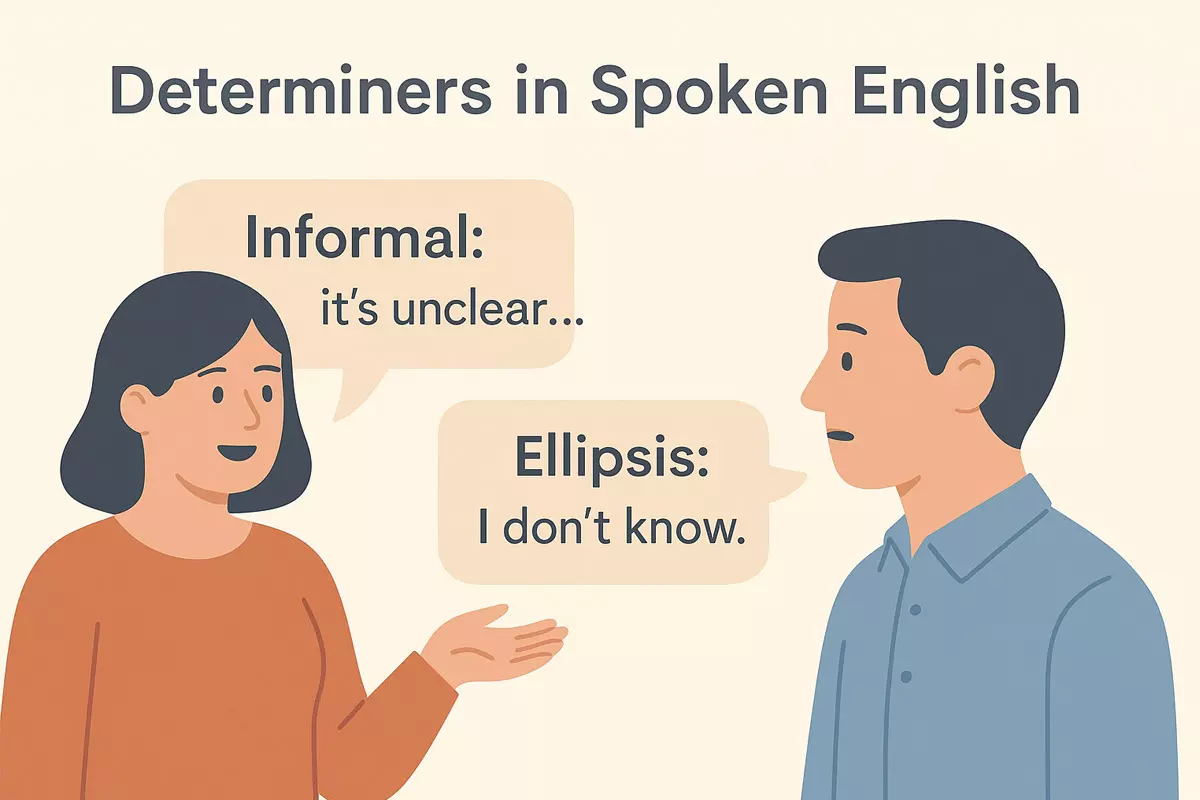 Here we how spoken English changes the use of determiners, including common reductions or omissions and informal demonstratives. It compares careful and casual speech, and provides listening tips and practice using written and spoken dialogues.
- How spoken English changes determiner use
- Typical reductions and omissions in fast speech
- When speakers drop a, the, and other determiners
- Informal demonstratives like this one, that guy
- Difference between careful and casual speech with determiners
- Listening tips for catching reduced determiners
- Practice: compare written and spoken versions of the same dialogue
In everyday conversations, people often bend grammar rules, particularly with words that indicate or quantify things. During informal speech, it's common to drop or shorten such markers, which gives spoken English a more casual and efficient tone. This tendency reflects how language adapts to make communication quicker and more comfortable in daily interactions, allowing speakers to focus more on meaning than on strict grammatical accuracy. As a result, spoken English can sound quite different from the more formal structures found in writing.
How spoken English changes determiner use
Spoken English often simplifies or omits determiners in ways that written English does not. Informal conversation encourages brevity, and speakers rely on context, tone, and shared knowledge rather than full grammatical structures. This leads to frequent ellipsis of articles, possessives, and other determiners, especially in rapid or familiar exchanges.
Common patterns of determiner omission in speech
- Leaving out "the" or "a/an" with familiar or generic nouns: "Going to store" instead of "Going to the store".
- Dropping possessive determiners when the owner is clear: "Got keys?" rather than "Have you got your keys?"
- Omitting demonstratives in questions: "Want apple?" instead of "Do you want this apple?"
- Removing determiners in headlines or commands: "Need help?" or "Take seat."
- Skipping articles in lists or informal instructions: "Bring pen, paper, notebook."
- Ellipsis with plural or uncountable nouns: "Need water?" (not "some water")
- Short responses: "Which one?" "Blue one."
- In exclamations: "What mess!" instead of "What a mess!"
- Questions with implied subjects: "Want coffee?"
- Omission with proper nouns: "Meeting John later."
- Ellipsis after prepositions: "Go to bed."
- Reduced forms in fixed expressions: "By car," "On foot," "At home."
- Leaving out articles in idioms: "In hospital," "Go to school."
- Zero article with meals: "Have lunch," not "Have a lunch."
- Ellipsis in diary-style speech: "Saw movie yesterday."
Comparison: Spoken vs. Written Determiner Use

| Spoken Example | Written Equivalent |
|---|---|
| Need ride? | Do you need a ride? |
| Got umbrella? | Have you got an umbrella? |
| Going out now. | I am going out now. |
| Want sandwich? | Would you like a sandwich? |
| Taking kids to park. | I am taking the kids to the park. |
| Need advice. | I need some advice. |
| Lost phone again. | I have lost my phone again. |
| Coming? | Are you coming? |
Why ellipsis and informality occur
In everyday speaking, efficiency and familiarity drive people to skip words that listeners can easily infer. Shared context between speakers means full noun phrases are often unnecessary. This tendency is especially strong in casual settings, quick exchanges, and when speakers know each other well. However, omitting determiners is less common in formal speech, where clarity and completeness are valued.
Understanding these informal patterns helps learners and listeners interpret meaning even when structures are reduced or incomplete. Recognizing these tendencies also highlights the flexibility of English grammar in natural communication.
Typical reductions and omissions in fast speech
When people speak informally and at a natural pace, determiners often get reduced, merged, or left out altogether. This is especially common in casual conversation, where grammatical precision takes a back seat to ease and speed. Listeners usually rely on context and shared knowledge to interpret missing or shortened elements without confusion.
Common Reductions of Determiners
In rapid speech, articles and other determiners can be weakened or contracted. For example, "the" is frequently pronounced as /ðə/ or even just /ð/ before consonants, and "a" is often reduced to a very short, almost imperceptible schwa sound. Demonstratives like "this" and "that" may lose their final consonant, sounding like "thi'" or "tha'".
| Word | Pronunciation | Example |
|---|---|---|
| the | /ðə/, /ð/ | The book is on the table. |
| a | /ə/ | I bought a new bag. |
| an | /ən/, /n/ | She has an idea. |
| some | /səm/ | I need some help. |
| this | /ðɪs/, /ðɪ/ | This answer is correct. |
| that | /ðæt/, /ðæ/ | That house is very old. |
| these | /ðiːz/ | These shoes are mine. |
| those | /ðoʊz/ | Those mountains look amazing. |
| my | /maɪ/, /mɪ/ | My phone is on the desk. |
| your | /jər/ | Your answer is correct. |
| our | /ɑr/, /aʊr/ | Our teacher is very kind. |
Omission of Determiners
In casual exchanges, especially when the meaning is obvious, speakers may drop determiners entirely. This is especially frequent with plural or mass nouns, and in fixed phrases.
- Going to store? (for "Are you going to the store?")
- Need help? (for "Do you need some help?")
- Want coffee? (for "Do you want a coffee?")
- Got time? (for "Have you got the time?")
- Kids outside. (for "The kids are outside.")
- She likes music. (for "She likes the music.")
- He found keys. (for "He found the keys.")
- Bring umbrella. (for "Bring an umbrella.")
- Lost phone. (for "I've lost my phone.")
- Meeting tomorrow. (for "We have a meeting tomorrow.")
Comparison of Full vs. Reduced/Omitted Forms
| Full Form | Reduced/Omitted in Fast Speech |
|---|---|
| Did you get the papers? | Get papers? |
| Are you bringing an umbrella? | Bringing umbrella? |
| Do you want some tea? | Want tea? |
| Where are my keys? | Where keys? |
| He likes that song. | He likes song. |
Why These Patterns Occur
Ellipsis and reduction are strategies that help speakers communicate efficiently. English speakers expect listeners to fill in missing information based on context, shared experience, and the structure of conversation. This tendency is not just laziness; it's a natural feature of spoken language that improves fluency and speed. In summary, reductions and omissions of determiners are widespread in everyday English, especially when the meaning remains clear. While formal writing retains full forms, spoken language often prioritizes brevity and ease, leading to these common spoken patterns.
When speakers drop a, the, and other determiners
In casual conversation, dropping articles and other determiners is common, especially in rapid or informal exchanges. This tendency often appears in headlines, notes, and certain set expressions, but it also colors everyday spoken English. The omission streamlines speech, making it faster and sometimes more emphatic, though it can also introduce ambiguity if listeners are not expecting it.
Contexts Where Determiners Are Omitted
Certain situations almost invite speakers to leave out words like "a," "the," "some," or "this." Here are some of the most frequent contexts:
- Headlines and bullet points: "Dog bites man" instead of "A dog bites a man."
- Instructions and commands: "Turn left at station" rather than "Turn left at the station."
- Notes and to-do lists: "Buy milk, call plumber" is more typical than "Buy some milk, call the plumber."
- Fixed expressions: "Go home," "Start school," "Catch bus."
- After certain verbs: "Need help?" instead of "Do you need help?"
- Telegraphic speech: Used by children or in hurried speech: "Want cookie," "See dog."
- In responses: "Need answer by Monday."
- Headings and labels: "Ingredients: flour, sugar, eggs."
- Exclamations: "What mess!"
- Diary entries: "Met friend at park."
Why Do Speakers Omit Determiners?
The main reasons include speed, informality, and context. When meaning is clear from the situation, speakers feel comfortable dropping unnecessary words. In English, this is especially true in environments where brevity is valued, such as text messages or spoken reminders.
Potential Ambiguity and Clarity
While omitting determiners can make speech more efficient, it sometimes creates confusion, especially for language learners or in situations where specificity is important. For example, "Give me pen" could mean any pen or a specific one, depending on context.
Common Examples: Full vs. Reduced Forms
Below are several examples showing how sentences change when determiners are dropped in informal speech:
- "I found a wallet." → "Found wallet."
- "She took the bus." → "Took bus."
- "We need some help." → "Need help."
- "He saw an opportunity." → "Saw opportunity."
- "Please bring the documents." → "Bring documents."
- "This is a problem." → "Is problem."
- "I have a question." → "Have question."
- "She has a car." → "Has car."
- "We visited the museum." → "Visited museum."
- "Leave the keys." → "Leave keys."
Summary
Omitting articles and determiners is a natural feature of informal English, particularly in speech. While it offers efficiency and immediacy, it requires careful listening and contextual understanding to avoid misunderstandings. Recognizing these patterns can help learners and listeners interpret meaning more effectively in real-life situations.
Informal demonstratives like this one, that guy
Spoken English often features demonstratives in ways that feel casual, context-driven, and even playful. Instead of sticking to textbook forms, speakers frequently use phrases such as “this one,” “that guy,” or “these things” to point out people or objects in a relaxed setting. These forms rely heavily on shared context—listeners usually know who or what is meant from the conversation or environment.
Common informal demonstrative patterns
Elliptical constructions and reduced forms are everywhere in casual speech. For instance, “that guy” might refer to someone you both see at a party, while “this one” could mean an item on a table. The noun that follows the demonstrative is often generic or even omitted entirely, especially when it’s obvious from context.
- this one – “I’ll take this one.”
- that guy – “Did you see that guy at the door?”
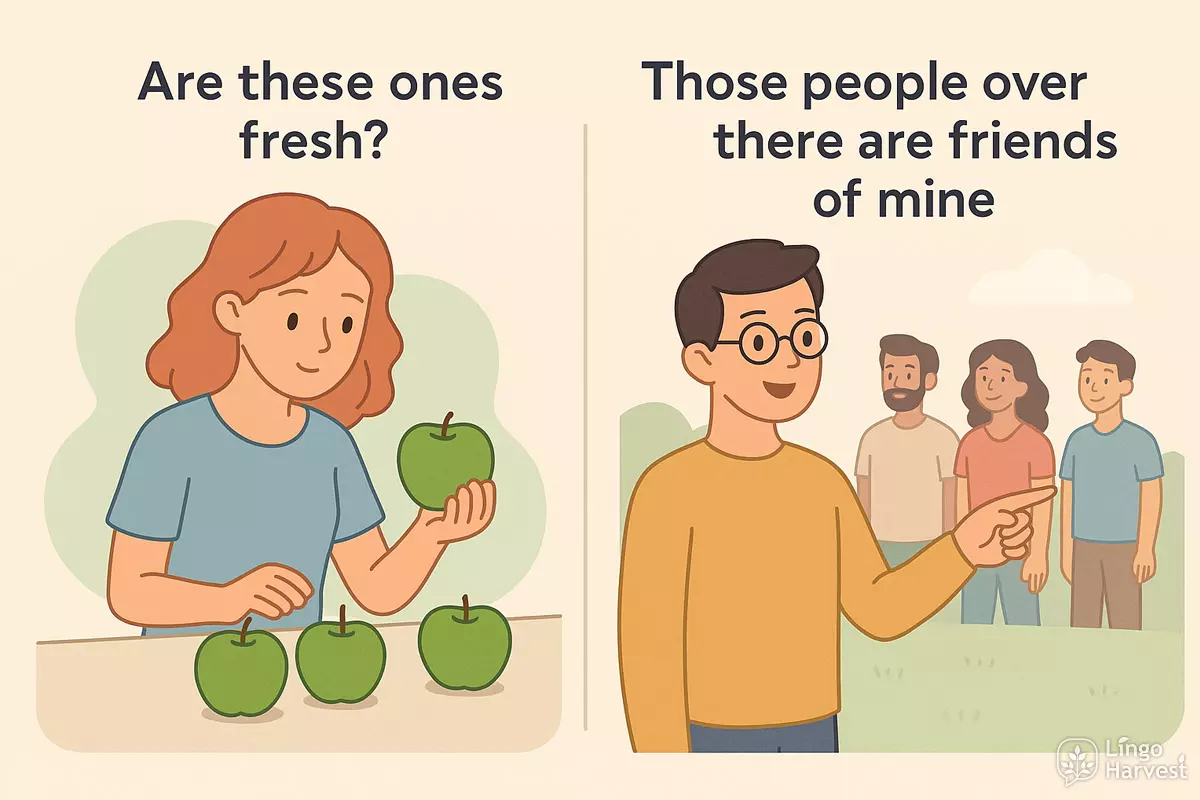
- these ones – “Are these ones fresh?”
- those people – “Those people over there are friends of mine.”
- that thing – “Can you pass me that thing?”
- those guys – “Those guys play here every weekend.”
- this stuff – “I don’t like this stuff.”
- that place – “Let’s go to that place you mentioned.”
- these guys – “These guys know what they’re doing.”
- those ones – “I prefer those ones.”
- this kid – “This kid is hilarious!”
- that lady – “That lady helped me out.”
- these people – “These people are waiting for the bus.”
- this dude – “This dude just cut in line.”
- those things – “Don’t touch those things.”
- that car – “That car is blocking the driveway.”
- these days – “Kids these days are so tech-savvy.”
- that kid – “That kid always has a story.”
- this place – “I love this place.”
Ellipsis and context in conversation
It’s common to drop the noun altogether when everyone knows what’s being referenced. For example, after someone offers two desserts, a response might simply be, “I’ll have that one,” with no need to specify “piece of cake” or “cookie.” This kind of ellipsis saves time and feels natural in everyday exchanges.
Subtle shifts in meaning and register
Choosing between “this” and “that” often signals not just physical proximity, but also emotional distance or attitude. “This guy” can imply camaraderie or irritation, depending on tone. These expressions can be playful, dismissive, or even affectionate, making them flexible tools in spoken language.
Comparison: formal vs. informal demonstratives
| Formal Use | Informal/Spoken Use |
|---|---|
| “This book on the table is mine.” | “This one’s mine.” |
| “Those individuals are waiting outside.” | “Those guys are waiting.” |
| “That object appears broken.” | “That thing’s broken.” |
| “These children are playing.” | “These kids are playing.” |
| “That person assisted me.” | “That lady helped me.” |
In summary, these forms let speakers point, refer, and express attitudes with minimal words. Their flexibility and reliance on shared understanding make them a key feature of informal English conversation.
Difference between careful and casual speech with determiners
When people speak formally or with extra attention, they tend to use determiners (like "the," "a," "some," "this," etc.) more precisely and completely. In contrast, everyday conversation often features dropped or reduced determiners, especially when the context makes the meaning clear. This shift reflects a broader pattern in spoken English: efficiency and speed are prioritized over grammatical completeness.
Patterns in Careful vs. Casual Speech
In formal settings—presentations, news, academic speech—speakers rarely omit determiners. However, in relaxed or rapid conversation, native speakers may leave out words like "the" or "a," particularly in phrases where the referent is obvious. Consider these examples:
- Careful: "Can you pass the salt?"
- Casual: "Pass salt?"
- Careful: "I saw a movie last night."
- Casual: "Saw movie last night."
- Careful: "Do you have any questions?"
- Casual: "Got questions?"
- Careful: "He is the manager."
- Casual: "He’s manager."
- Careful: "I need some help."
- Casual: "Need help."
- Careful: "This is the place."
- Casual: "This place."
- Careful: "I'll take the next train."
- Casual: "Take next train."
- Careful: "Is there a problem?"
- Casual: "Problem?"
Reasons for Variation
Speakers drop determiners in informal spoken English for several reasons:
- Context makes the meaning clear, so full forms feel redundant
- Speed: omitting function words saves time in fast-paced dialogue
- Informality: relaxed settings encourage brevity and directness
- Ellipsis: listeners easily infer the missing elements
Summary Table: Careful vs. Casual Use
| Careful Speech | Casual Speech |
|---|---|
| Do you have the time? | Got time? |
| I need a pen. | Need pen. |
| This is the one I want. | This one I want. |
| He’s the boss. | He’s boss. |
| We bought some apples. | Bought apples. |
| Are you the driver? | You driver? |
Takeaways
In summary, the use of determiners shifts noticeably depending on formality, context, and the speaker’s intent. While careful speech favors full, explicit forms, everyday conversation often relies on ellipsis and context to communicate efficiently. Recognizing these patterns can help learners sound more natural in different spoken settings.
Listening tips for catching reduced determiners
Recognizing reduced determiners in natural speech can be tricky, especially since they often become nearly inaudible in fast, informal conversation. Native speakers frequently shorten or blend these words into surrounding sounds. To improve your listening skills, it helps to know what to expect and how to spot these subtle cues.
Common patterns in spoken English
Many determiners lose their full pronunciation or merge with nearby words. For example, "a" becomes a quick /ə/ sound, and "the" often shrinks to /ðə/ or even just a soft /ð/ before consonants. Listen for these weak forms, especially in rapid dialogue.
- "a" often sounds like "uh": got a minute? /gɒt ə ˈmɪnɪt/
- "the" becomes /ðə/ or /ði/: pass the salt /pæs ðə sɒlt/
- "some" can reduce to /səm/: want some coffee? /wɒnt səm ˈkɒfi/
- "an" blends as /ən/: an apple /ən ˈæpl/
- "this"/"that" sometimes weaken to /ðɪs/ or /ðət/: that one /ðət wʌn/
- "these"/"those" may reduce: those kids /ðəz kɪdz/
- "each" can lose its clarity: each time /iːʧ taɪm/
- "every" often becomes /ˈevri/: every day /ˈevri deɪ/
- "my," "your," "our" may weaken: my car /maɪ kɑː/ → /mə kɑː/
- "her," "his," "their" can sound like /ə/, /ɪz/, /ðə/: her idea /ə aɪˈdiə/
- "no" may be barely stressed: no time /nəʊ taɪm/
- "one" may sound like /wən/: one chance /wən ʧɑːns/
- "somebody's" can reduce: somebody's car /ˈsʌmbədiz kɑː/
- "all" often merges: all the time /ɔːl ðə taɪm/
Active listening strategies
Pay attention to the rhythm and stress of the sentence. Determiners rarely carry the main stress, so they may be quick and quiet. Try shadowing practice—repeat what you hear to train your ear and tongue. Also, listen for context: if a noun seems bare or abrupt, a reduced determiner may be present but hard to catch.
Comparing full and reduced forms
| Full Pronunciation | Reduced/Spoken Form |
|---|---|
| the /ðiː/ | the /ðə/ |
| a /eɪ/ | a /ə/ |
| an /æn/ | an /ən/ |
| some /sʌm/ | some /səm/ |
| her /hɜːr/ | her /ə/ |
| our /ˈaʊər/ | our /ɑː/ |
Practice makes perfect
Frequent exposure is key. Listen to real conversations, movies, or podcasts, and focus on how determiners disappear or change. Over time, your ear will adjust and you’ll find it easier to pick up on these subtle but important words.
Practice: compare written and spoken versions of the same dialogue
Understanding how determiners work differently in speech and writing is best done by looking at real dialogues. Spoken English often omits words, especially determiners, to sound more natural and efficient. In contrast, written English usually follows more complete grammatical structures. Let’s explore these contrasts by examining sample dialogues and reflecting on the patterns.
Example Dialogue: Written vs. Spoken
Below are two versions of a simple exchange. Notice how determiners are handled:
- Written: Are you bringing the books to the meeting?
- Spoken: You bringing books to meeting?
In the spoken version, both instances of “the” are dropped. This kind of ellipsis is typical in casual conversation, especially when context makes the meaning clear.
Common Features in Spoken English
Speakers often omit determiners and use shorter forms. Here are other typical examples:
- Got a pen? → Got pen?
- Need an umbrella?
- Where’s the dog? → Where’s dog?
- He’s at the store. → He’s at store.
- Let’s take the bus. → Let’s take bus.
- I’ll send the email.
- Want some tea?
- She bought some apples.
- Give me the keys.
- Have you got any milk?
- I need a break.
- He’s looking for an answer.
- Is there a problem?
- Can you open the window?
- Let’s go to the park. → Let’s go park.
- Did you see the movie?
- She’s waiting for the bus.
- They’re in the kitchen.
Comparison Table: Determiners in Written vs. Spoken English
| Written English (with determiners) | Spoken English (with ellipsis) |
|---|---|
| Do you have a minute? | Got minute? |
| Can you pass the salt? | Pass salt? |
| I’ll take the train. | Taking train. |
| He needs an umbrella. | He needs umbrella. |
| Is there any news? | Any news? |
| She brought some snacks. | Brought snacks. |
Try It Yourself: Spot the Differences
Below are pairs of sentences. Decide which version is natural in standard English and which is an informal spoken shortcut. Identify where a determiner is omitted.
- Can you hand me the notebook? / Hand me notebook?
- Did you see the cat? / See cat?
- She wants an apple. / She wants apple.
- Is there any water? / Any water?
- Open the window, please. / Open window?
- Where is the teacher? / Where teacher?
- I bought a ticket. / Bought ticket.
- Do you need any help? / Need help?
- Put the keys on the table. / Put keys on table.
- Have you seen the manager? / Seen manager?
Show answers
- First is standard; second is spoken shortcut (the omitted).
- First is standard; second is spoken shortcut (the omitted).
- Only the first is correct in normal English; the second sounds unnatural because the article is required with singular countable nouns.
- First is standard; second is spoken shortcut (any omitted).
- First is standard; second is spoken shortcut (the omitted).
- First is standard; second is spoken shortcut (the omitted).
- First is standard; second is spoken shortcut (a omitted).
- First is standard; second is spoken shortcut (any omitted).
- First is standard; second is spoken shortcut (the omitted).
- First is standard; second is spoken shortcut (the omitted).
Note: In real spoken English, determiners like a, the, any are often omitted in short questions and commands. However, in normal full sentences (especially statements), omitting the article usually sounds incorrect or unnatural.
Reflection
When listening to native speakers, notice how often determiners are left out—especially in fast or informal contexts. Practicing both forms will help you understand and produce natural-sounding English in different situations.