Determiners with Collective Nouns: team, group, audience

 Here we what collective nouns are, how to use determiners such as a, the, this, and that with them, rules for singular and plural agreement, differences in meaning, common usage in news and work, frequent mistakes, and practice exercises.
- What collective nouns are and how they behave in English
- Using a, the, this, that with team, group, audience, and similar words
- Singular vs plural agreement and its effect on determiners
- Talking about the group as a whole vs its members
- Typical patterns in news, sports, and workplace English
- Common mistakes when combining determiners and collective nouns
- Practice: choose determiners for sentences with collective nouns
Selecting appropriate words before collective nouns such as group, audience, or team can be surprisingly challenging in English, as it requires a good grasp of articles and determiners. Mastering the use of words like a, the, this, or that with these terms is essential for effective and natural communication. For example, saying a team refers to any team in general, while the team points to a specific one already known to both the speaker and listener. Developing this understanding will help you express ideas more clearly and sound more fluent in English.
What collective nouns are and how they behave in English
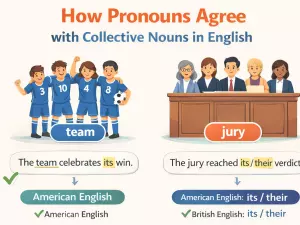
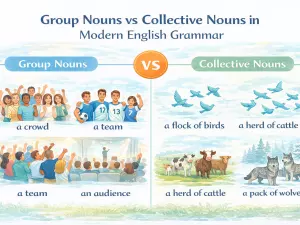
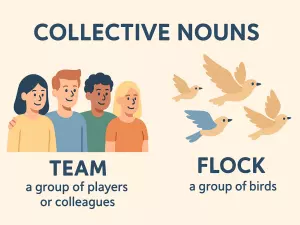
Collective nouns refer to words that describe groups of people, animals, or things as single units. Examples include “team,” “group,” “audience,” “committee,” and “family.” Even though a collective noun represents multiple members, it is usually treated as a singular noun in English grammar, especially in American English. However, there are cases where the verb form or pronoun agreement depends on whether the group is seen as acting together (as a single entity) or as individuals.
Common Collective Nouns
- team → The team is training for the final match.
- group → A group of students is waiting outside.
- audience → The audience was silent during the performance.
- committee → The committee has reached a final decision.
- family → Her family lives in another city.
- class → The class is taking a test today.
- jury → The jury has already announced its verdict.
- staff → The staff works late on Fridays.
- crew → The crew is preparing the plane for takeoff.
- panel → The panel is reviewing the applications.
- choir → The choir sings every Sunday.
- government → The government has introduced new laws.
- band → The band is playing on stage tonight.
- army → The army was deployed to the region.
- orchestra → The orchestra is rehearsing for the concert.
- public → The public has shown strong interest in the case.
- company → The company is expanding its business abroad.
- crowd → The crowd was cheering loudly.
- audience → The audience applauded at the end.
- cast → The cast is meeting for the first rehearsal.
How Collective Nouns Affect Verb and Pronoun Agreement
When using these nouns, it’s important to consider whether the group is acting as a unit or as individuals. For example:
- The team is winning. (The team acts as one unit.)
- The team are arguing among themselves. (The focus is on individual members.)
British English is more flexible with plural agreement, while American English tends to prefer singular verbs for collective nouns. Pronoun choice follows the same logic: use “it” for the group as a whole, or “they/them” if you mean the members.
Determiners with Collective Nouns
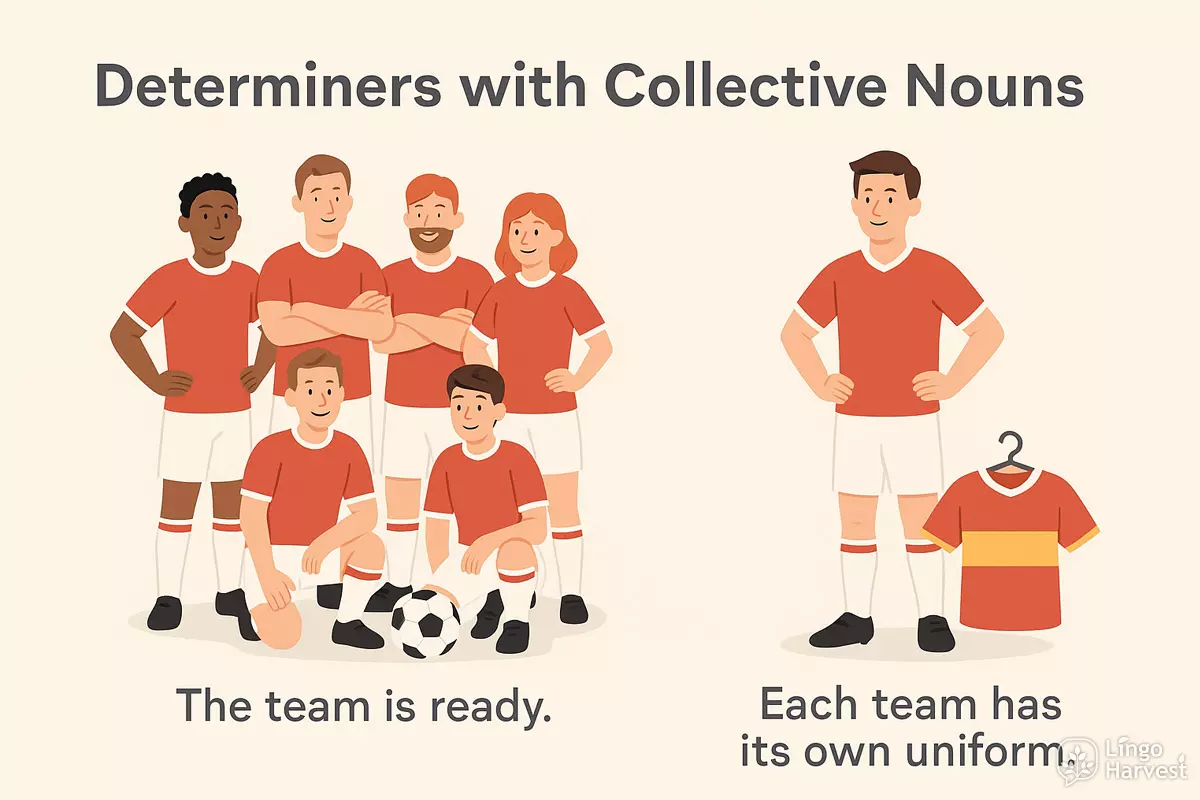
Collective nouns can take a range of determiners, such as “the,” “this,” “my,” “each,” or “every.” The choice of determiner may subtly affect the meaning:
- The team is ready.
- Each team has its own uniform.
- That group was loud.
- Every audience responds differently.
Some determiners, like “each” or “every,” signal that you are talking about individuals within the group, which can influence verb and pronoun agreement.
Summary Table: Collective Nouns and Agreement Patterns
| Collective Noun | Singular Agreement | Plural Agreement | Example Determiners |
|---|---|---|---|
| team | The team is winning. | The team are wearing their new shirts. | the, my, our, each |
| group | The group has arrived. | The group are discussing their ideas. | that, every, this |
| audience | The audience enjoys the show. | The audience are taking their seats. | an, the, that |
| committee | The committee meets on Monday. | The committee are divided in their opinions. | the, this, our |
In summary, collective nouns can act as either singular or plural depending on context and dialect. Understanding this flexibility helps you choose the right determiners and verb forms when writing or speaking about groups in English.
Using a, the, this, that with team, group, audience, and similar words
Choosing the right determiner before collective nouns like "team," "group," or "audience" depends on context and meaning. These words can refer to any such collection in general, a specific one, or something near or far in time or place.
Indefinite Article: a
Use a when you are talking about any single instance of a collective, not a specific one:
- a team of researchers
- a group of friends
- a committee of experts
- a crowd of fans
- a panel of judges
- a class of students
- a delegation of officials
- a choir of singers
- a jury of peers
- a board of directors
This article is only used with singular, countable collectives.
Definite Article: the
Use the when referring to a particular collective group known to the listener or reader:
- the team won the match
- the group presented their findings
- the audience applauded
- the committee will decide
- the class is starting
- the jury reached a verdict
- the choir performed last night
- the panel answered questions
- the board approved the proposal
- the crowd cheered loudly
Here, it’s clear which specific collective is meant.
Demonstratives: this, that, these, those
Demonstratives add information about proximity (physical or temporal). Use them to specify exactly which collective you mean, often in relation to the speaker.
- this team (close in context or time)
- that group (more distant in context or time)
- these audiences (plural, near)
- those committees (plural, far)
- this panel
- that class
- these choirs
- those delegations
- this board
- that jury
Comparison: Article and Demonstrative Usage
| Form | When to Use | Example |
|---|---|---|
| a/an | Any one group, not specified | a group of tourists arrived |
| the | Specific, known group | the audience was silent |
| this/these | Near in time or space; speaker’s focus | this team is ready |
| that/those | Far in time or space; less immediate | those committees were disbanded |
Key Points to Remember
- Don’t use a with plural collectives: ❌ a teams
- Use the when all listeners know which group is meant
- Choose this/these or that/those to show closeness or distance
- Context and specificity guide determiner choice
Understanding how articles and demonstratives work with collectives makes your English clearer and more precise. Always consider whether you’re speaking generally, specifically, or about something near or far to choose the right word.
Singular vs plural agreement and its effect on determiners
How we treat collective nouns like "team," "group," or "audience" in terms of number—singular or plural—directly shapes which determiners and verb forms we use. In English, these nouns can refer to the entity as a whole (singular) or to the individuals within the entity (plural), and this choice affects the determiners that sound natural or correct.
Choosing singular or plural agreement
When a collective noun refers to the group as a single unit, singular determiners and verbs are standard:
- The team is winning its game. ("The" as a definite article, "its" as a singular possessive)
- This group has made its decision.
- That audience seemed bored.
If the focus is on the individuals within the group, plural forms are possible, especially in British English:
- The team are wearing their new uniforms. ("Their" as a plural possessive)
- These groups have chosen their leaders.
- Those audiences were very enthusiastic.
Effect on determiners: patterns and examples
The choice between singular and plural impacts which determiners are appropriate. Some determiners only fit singular nouns, others only plural, and a few work for both. Here are typical patterns:
- This/That (singular): This team, That group
- These/Those (plural): These teams, Those groups
- Each (singular): Each audience
- All (plural): All teams, All groups
- Every (singular): Every team
- Some (plural or uncountable): Some teams, Some of the audience
- Many (plural): Many groups
- Few (plural): Few teams
- Much (singular/uncountable): Much of the audience
- Most (plural or uncountable): Most teams, Most of the group
- Its/Their (possessive, singular/plural): The group made its/their decision
- Another (singular): Another group
- Other (plural): Other teams
Summary: Determiner and number agreement
The following table illustrates how singular and plural agreement changes determiner choice and verb form for collective nouns:
| Collective Noun | Singular Agreement Example | Plural Agreement Example |
|---|---|---|
| team | This team is proud of its win. | These teams are proud of their wins. |
| group | That group has finished its work. | Those groups have finished their work. |
| audience | The audience showed its appreciation. | The audiences showed their appreciation. |
| committee | This committee reached its decision. | These committees reached their decisions. |
In summary, whether a collective noun is treated as singular or plural will influence the selection of determiners like "this/these" or "its/their." Paying attention to agreement ensures sentences are clear and natural.
Talking about the group as a whole vs its members
When working with collective nouns like team, group, or audience, it's important to decide whether you’re referring to the collection as a single unit or to the individuals inside it. This choice affects both the determiners you use and the verb agreement in your sentences.
Referring to the group as a single unit
If you view the collective noun as one entity, use singular determiners and verbs. This is common in American English, and it emphasizes the unity or collective action of the group.
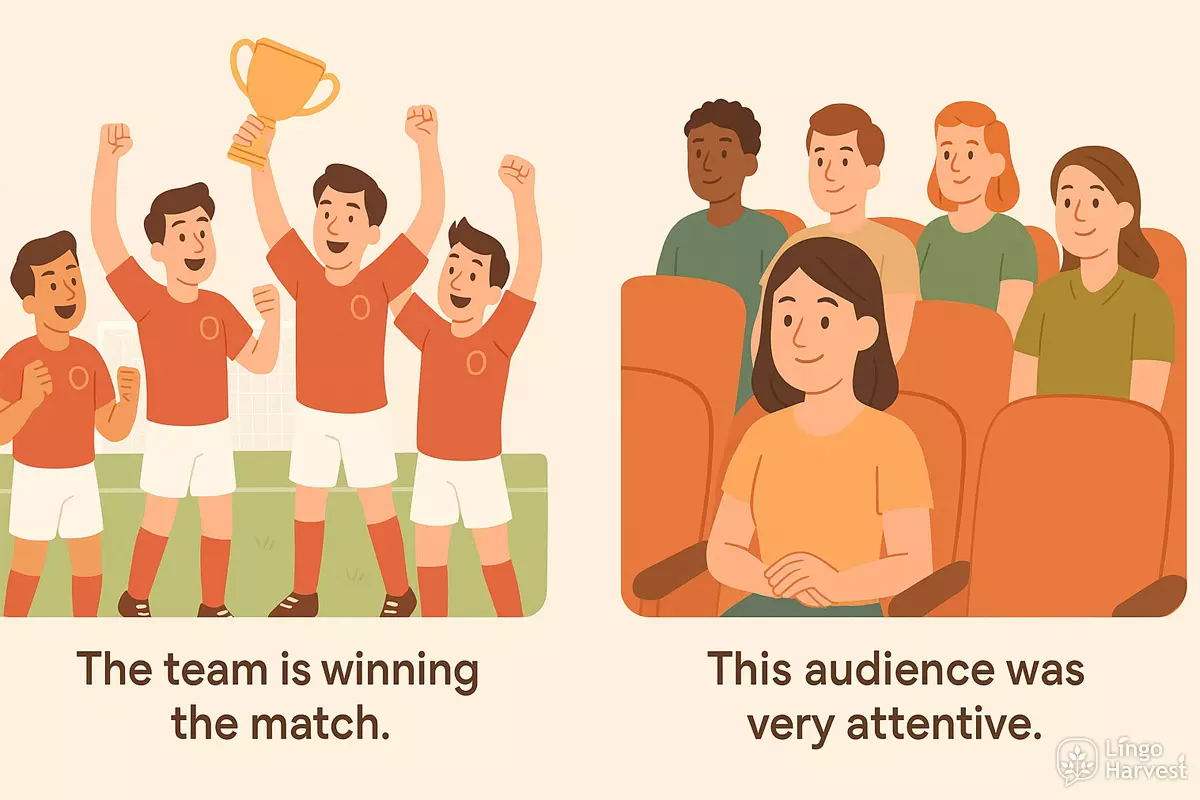
- The team is winning the match.
- This audience was very attentive.
- That group makes decisions quickly.
- My team has arrived.
- Each group presents its results.
- Our audience loves the show.
Focusing on individual members
Sometimes, you want to highlight the people within the collective. In these cases, plural determiners and verbs are often used (especially in British English), or you might add words like members or individuals for clarity.
- The team are wearing their new uniforms.
- Many audience members left early.
- Some groups have finished their tasks.
- Several teams are competing today.
- All members of the group agreed.
- Both teams are ready.
Common determiners with collective nouns
Choosing the right determiner depends on whether you’re speaking about the whole or the parts. Here’s a comparison of typical choices:
| Whole group (singular) | Members/parts (plural or specific) |
|---|---|
| This team, that group, the audience, my team, our group, each audience | Some teams, many group members, several audiences, all teams, both groups, a few audience members |
| Its (e.g., The group made its decision.) | Their (e.g., The group are sharing their ideas.) |
| Every team, the entire audience | Each member, individual members, most teams |
| Another group, one team | Other groups, different teams |
Quick tips
- Use singular determiners and verbs for unity or when the group acts as one.
- Use plural forms or add words like members to focus on individuals.
- British English is more flexible with plural verbs after collective nouns.
- Check if you mean the team as a whole, or the people within it, to guide your grammar choices.
Being mindful of this distinction helps your meaning stay clear and your sentences sound natural.
Typical patterns in news, sports, and workplace English
When discussing collective nouns like team, group, or audience, English usage in journalism, sports commentary, and office communication often follows certain conventions. The choice of determiners such as the, a, this, that, each, and every can subtly change the meaning or focus of a sentence. These words help clarify whether you are referring to a specific collective, any member of a type, or the whole as a single entity.
Common Determiner Patterns with Collective Nouns
- The team is ready for its match. (Specific, known group)
- A group was waiting outside. (Any group, not specified)
- This audience enjoys live music. (Specific, immediate)
- That team has improved a lot. (Specific, possibly less immediate)
- Each group presents its own findings. (Focus on individuals within the collective)
- Every team must register before the tournament. (All teams considered individually)
- Our team works remotely. (Possessive, familiar context)
- Some groups are still undecided. (Non-specific, part of a larger set)
- Another audience applauded the performance. (Additional, not the first mentioned)
- No team has solved the problem yet. (Negative, applies to all)
- Many teams face similar challenges. (Indefinite, more than one)
- Which group will present next? (Question form, choice among options)
- Such teams are rare. (Describing a type or quality)
- My group finished early. (Personal, possessive)
- All audiences responded positively. (Every member of all groups)
- These teams are finalists. (Plural, immediate context)
- Those groups submitted late. (Plural, more distant in time or place)
Contextual Usage in News, Sports, and Workplaces
Reporters and commentators often use the with well-known collectives, like sports teams or business units, while a and some introduce new or less familiar groups. In workplace emails and updates, determiners like each, every, and all help clarify responsibilities and actions for teams or project groups.
| Sentence | Context & Meaning |
|---|---|
| The team has announced its lineup. | Refers to a specific, known sports team. |
| A group voiced concerns at the meeting. | Any group, not previously mentioned. |
| Each audience member received a program. | Focuses on individuals within the collective audience. |
| All teams must submit their reports by Friday. | Every team, no exceptions. |
| Those groups need additional training. | Refers to specific, possibly previously mentioned groups. |
| No audience was present due to restrictions. | Zero audience members; absolute negative. |
In summary, determiners play a key role in shaping how collectives are referenced across different registers. Whether in headlines, match reports, or business updates, the choice of word before a collective noun influences clarity, specificity, and tone.
Common mistakes when combining determiners and collective nouns
When working with words like "team," "group," or "audience," it's easy to slip up with determiners. Many learners assume these nouns always behave like regular countable or uncountable nouns, but collective nouns have their own quirks. Misunderstandings about agreement, quantity, and specificity can lead to sentences that sound unnatural or are outright incorrect.
Mixing up singular and plural agreement
A frequent issue is confusion about whether to use singular or plural determiners with collective nouns. For example, saying "these team is ready" instead of "this team is ready." The right determiner depends on whether you view the collective noun as a single unit or as individuals.
- This team is winning. (the team as a whole)
- These teams are winning. (more than one team)
- That group was loud. (a single group)
- Those groups were loud. (multiple groups)
Using "many" with singular collective nouns
It's common to mistakenly pair "many" with a singular collective noun. "Many audience" is incorrect, because "audience" is singular. Use "much" or "a large" for the singular, and "many audiences" for the plural.
- ❌ Many audience enjoyed the show.
- ✅ A large audience enjoyed the show.
- ✅ Many audiences enjoyed the show.
Incorrect use of "some" and "any"
Learners often pair "some" or "any" with a singular collective noun, which can sound odd. These determiners are better with plural or uncountable nouns, unless you mean "some members of" the group.
- ❌ Some team is absent.
- ✅ Some teams are absent.
- ✅ Some members of the team are absent.
Omitting the definite article "the"
Collective nouns often need "the" when referring to a specific group. Forgetting "the" makes your sentence unclear or grammatically off.
- ❌ Audience applauded loudly.
- ✅ The audience applauded loudly.
Comparing correct and incorrect determiner usage
| Incorrect Example | Corrected Version |
|---|---|
| These team is strong. | This team is strong. |
| Much group supports the idea. | Many groups support the idea. |
| Some audience left early. | Some of the audience left early. Some audiences left early. |
| Group was excited. | The group was excited. |
| Those audience enjoyed the performance. | That audience enjoyed the performance. Those audiences enjoyed the performance. |
Other pitfalls with determiners and collective nouns
- Using "each" with a singular collective noun when you mean individuals: say "Each member of the team" instead of "Each team."
- Pairing "few" with singular forms: "A few teams" is correct, not "A few team."
- Using "all" ambiguously: clarify if you mean "All the group" (the whole group) or "All members of the group."
- Doubling determiners: avoid "The my team" or "Some the audience."
Paying attention to these patterns helps your sentences sound natural and precise when using determiners with collective nouns like "team," "group," and "audience."
Practice: choose determiners for sentences with collective nouns
Understanding how to select the correct determiner for collective nouns like "team," "group," or "audience" is essential for clear and accurate communication. Collective nouns can be tricky because they refer to multiple people but are treated as singular or plural depending on context and dialect. Below you'll find exercises and explanations to help you practice making the right choices.
Exercise: Fill in the blanks with suitable determiners
Choose the most appropriate determiner for each sentence below. Options include: the, a, this, that, these, those, my, our, every, each, some, any.
- ______ team is meeting after school for practice.
- ______ audience listened carefully to the speaker.
- ______ group of tourists arrived late.
- Have you seen ______ of the groups performing today?
- ______ teams are ready for the competition.
- ______ audience members asked questions at the end.
- ______ group needs more time to prepare.
- ______ team that wins will go to the finals.
- ______ of the audience was excited about the announcement.
- ______ group has submitted its project.
Show answers
- The team is meeting after school for practice.
- The audience listened carefully to the speaker.
- A group of tourists arrived late.
- Have you seen any of the groups performing today?
- These teams are ready for the competition.
- Some audience members asked questions at the end.
- That group needs more time to prepare.
- The team that wins will go to the finals.
- Each of the audience was excited about the announcement.
- My group has submitted its project.
Common determiners used with collective nouns
- The (specific, already mentioned or known group)
- A/An (one group, not previously mentioned)
- This/That (pointing to a particular group, near/far)
- These/Those (plural, for several groups, near/far)
- My/Our/Their (possessive, indicating ownership)
- Each/Every (emphasizing individuals in the group)
- Some/Any (non-specific or for questions/negatives)
Comparison: Determiners with "team", "group", and "audience"
| Collective Noun | Common Determiners & Example Phrases |
|---|---|
| team | the team, our team, this team, each team, another team Example: Our team is practicing. |
| group | a group, the group, any group, that group, several groups Example: That group finished early. |
| audience | the audience, an audience, some audience members, every audience Example: The audience applauded loudly. |
Quick practice: Which determiner fits?
Match the correct determiner to the sentence:
- ______ audience cheered for the performers. (the, a, some)
- ______ of the groups will present next. (each, any, my)
- ______ team forgot their uniforms. (this, that, those)
- ______ committee is meeting this afternoon. (the, a, some)
- ______ of the bands will perform tonight. (each, many, several)
- ______ family lives next door to us. (this, these, those)
- ______ jury has reached a decision. (the, some, many)
- ______ of the classes was canceled today. (each, all, few)
- ______ crowd was waiting outside the stadium. (the, a, some)
- ______ of the teams will advance to the final. (one, each, much)
Show answers
- The audience cheered for the performers.
- Each of the groups will present next.
- That team forgot their uniforms.
- The committee is meeting this afternoon.
- Each of the bands will perform tonight.
- This family lives next door to us.
- The jury has reached a decision.
- Each of the classes was canceled today.
- The crowd was waiting outside the stadium.
- Each of the teams will advance to the final.
Practicing with varied sentences will help you feel more confident choosing determiners when using collective nouns in both writing and conversation.