Group Nouns vs Collective Nouns in Modern English Grammar

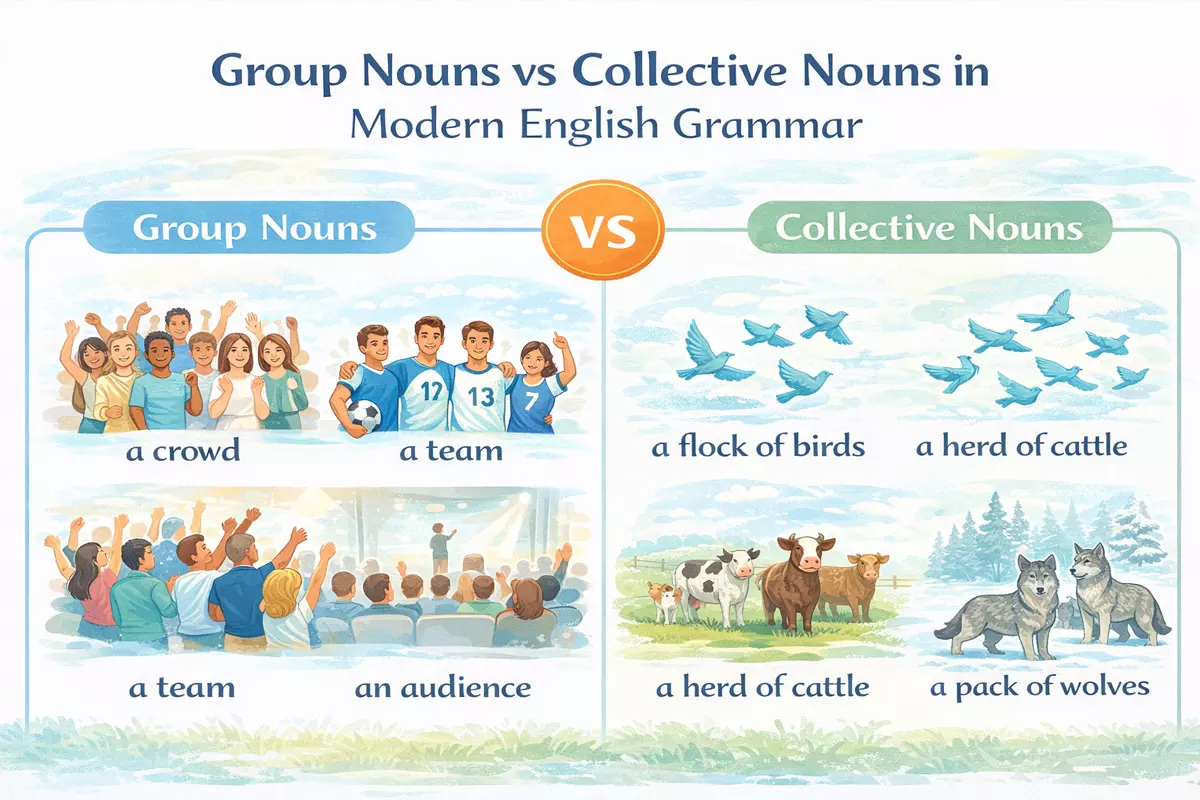 Here we the difference between group and collective nouns, how meaning affects verb agreement, British and American usage trends, examples for people, animals, and objects, and common learner confusion with words like team, staff, and family.
- Difference between group and collective nouns
- How meaning affects verb agreement
- British vs American agreement tendencies
- Collective nouns for people, animals, and objects
- Singular vs plural focus in real sentences
- Common learner confusion with team, staff, and family
- Practice: choose correct verb forms with group nouns
English often groups multiple entities under a single term, but distinguishing between similar-sounding group names is important because each serves a different purpose. Understanding these subtle differences in naming conventions for groups sheds light on how the language organizes meaning and grammatical agreement, highlighting the nuanced ways English expresses collective concepts. This careful attention to terminology not only clarifies communication but also deepens our appreciation for the structure and flexibility of English.
Difference between group and collective nouns
When exploring how English organizes people or things, it’s easy to mix up terms that sound similar but serve distinct roles. Group nouns and collective nouns both refer to more than one entity, but they differ in nuance and grammatical behavior.
What are group nouns?
Group nouns are words that refer to a set, category, or type of things or people, typically highlighting a common characteristic or shared purpose. They do not always imply that the items or people act as a single unit. Examples include team, category, type, class, and group itself.
What are collective nouns?
Collective nouns specifically refer to a collection of individuals (people, animals, or things) considered as one entity. They focus on the unified action or identity of the members. Words like flock, jury, committee, herd, and family are classic examples.
Key distinctions
The main difference lies in how these nouns function in a sentence and the imagery they evoke. A group noun can describe a category or a gathering, but a collective noun implies the members are acting as a single whole.
| Feature | Group Nouns | Collective Nouns |
|---|---|---|
| Definition | Names a set or category; does not always imply unity of action | Names a collection acting as a single unit |
| Examples | group, category, type, class, set, series | team, family, flock, herd, jury, committee |
| Grammatical Agreement | Usually followed by plural verb if referring to members | Can take singular or plural verb depending on context |
| Focus | Emphasizes the characteristic or classification | Emphasizes collective action or identity |
Usage patterns and examples
- Group noun: "This class consists of advanced students." (Focus on the type or category.)
- Collective noun: "The jury has reached a verdict." (The group acts as a single unit.)
- "A series of lectures will be held." (Group noun—sequence or set.)
- "The committee are divided in their opinions." (Collective noun—members acting separately.)
Summary list of typical collective vs group nouns
- Group: band, category, class, collection, group, range, selection, set, series, type, variety
- Collective: audience, board, choir, crew, crowd, family, flock, herd, jury, panel, staff, team, troop
In summary, while both types refer to multiple entities, group nouns tend to classify or categorize, whereas collective nouns stress the unity or joint action of the members. Context and verb agreement often reveal which is intended in modern English usage.
How meaning affects verb agreement
When dealing with group nouns and collective nouns, the choice between singular and plural verbs often depends on how the speaker views the group: as a single unit or as individuals. This distinction is especially visible in British and American English, where usage patterns can differ.
Semantic focus: unit vs. individuals
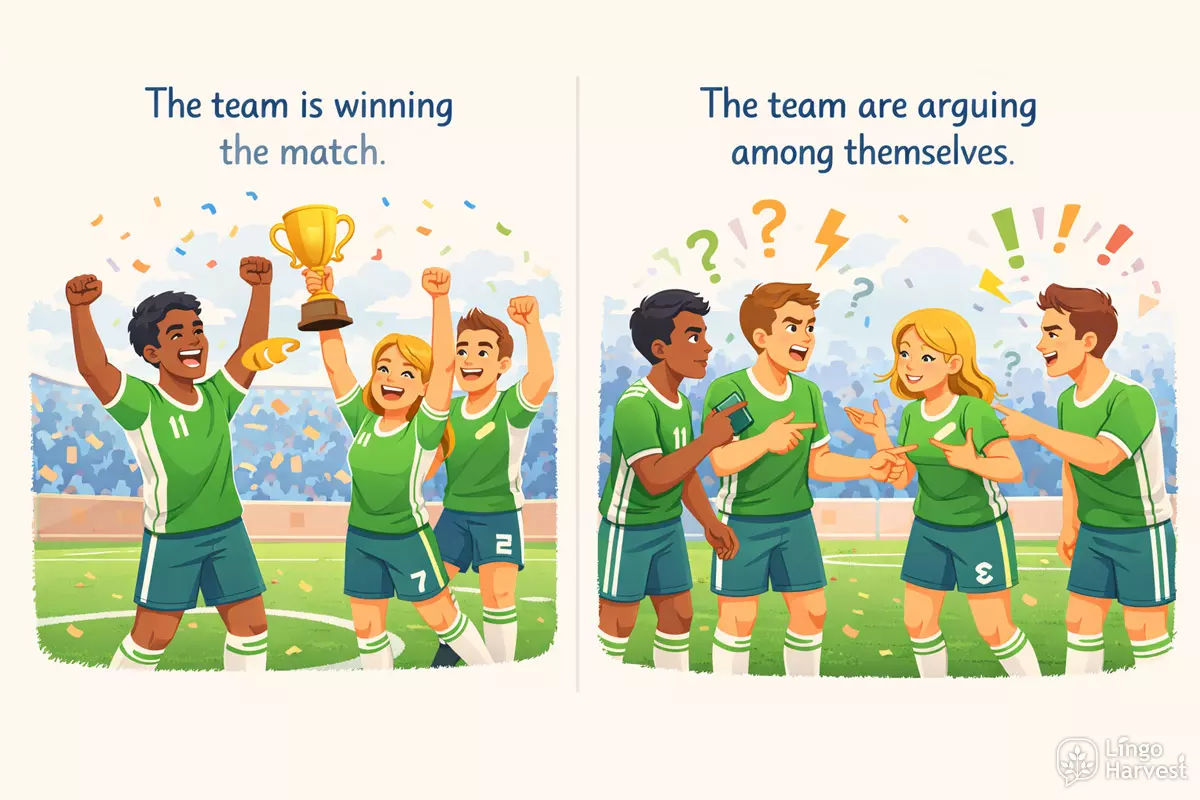
If the group is seen as acting together, a singular verb is typical. When the members are acting separately or individually, a plural verb is more natural. Consider the following examples:
- Singular (unit): The team is winning the match.
- Plural (individuals): The team are arguing among themselves.
- The committee has reached its decision. (unit)
- The committee have returned to their homes. (individuals)
- My family is large. (unit)
- My family are all coming for dinner tonight. (individuals)
- The staff is very professional. (unit)
- The staff are taking their breaks. (individuals)
- The jury delivers its verdict. (unit)
- The jury are divided in their opinions. (individuals)
- The class is noisy. (unit)
- The class are handing in their assignments. (individuals)
- The audience was silent. (unit)
- The audience were leaving their seats. (individuals)
British vs. American usage
In American English, singular agreement is much more common, even when the group’s members are acting individually. In British English, plural agreement is frequently used when the focus is on the members’ individuality.
| Noun | Singular Verb (Unit) | Plural Verb (Individuals) |
|---|---|---|
| Team | The team is playing well. | The team are wearing their new jerseys. |
| Family | My family lives nearby. | My family are planning their holidays. |
| Committee | The committee decides policy. | The committee have disagreed on this issue. |
| Government | The government is announcing reforms. | The government are divided on the matter. |
| Police | The police is investigating. ❌ (rare in both dialects) | The police are investigating. ✅ |
Key takeaways
- Choose a verb form based on whether the group is acting together or as individuals.
- British English allows (and often prefers) plural verbs for collectives when individual action is implied.
- American English generally sticks to singular verbs for most group and collective nouns.
- Certain nouns, like "police" and "people," are always treated as plural.
Understanding the intended meaning guides the choice of verb, ensuring clarity and naturalness in expression.
British vs American agreement tendencies
When it comes to how group nouns (like "team," "family," or "government") are matched with verbs and pronouns, British and American English often take different approaches. In the UK, these nouns are frequently treated as plural, especially when the emphasis is on the individuals within the group acting separately. In contrast, American usage tends to treat them as singular, focusing on the group as a single entity.
Key Differences in Agreement Patterns
The distinction is most obvious in sentences involving collective nouns. For instance, a Brit might say "The committee are meeting today," while an American would likely prefer "The committee is meeting today." This difference can affect not only the verb but also pronoun choice and even the overall feel of a sentence.
| Example | British Usage | American Usage |
|---|---|---|
| The team ____ winning. | are | is |
| The audience ____ their seats. | take | takes |
| The staff ____ decided to strike. | have | has |
| The jury ____ divided in their opinions. | are | is |
| The government ____ announced its plans. | have | has |
| The family ____ on holiday. | are | is |
| The band ____ playing tonight. | are | is |
| The police ____ investigating. | are | are |
| The class ____ taken their exams. | have | has |
| The company ____ changing their policy. | are | is |
Usage Notes and Flexibility
- In British English, plural agreement is more common when the group is seen as individuals acting separately.
- American English overwhelmingly prefers singular agreement unless the context clearly emphasizes individual members.
- "Police" is always treated as plural in both dialects: "The police are investigating."✅
- With words like "family" or "team," context can sway agreement even within the same dialect.
- Both varieties may switch agreement style for stylistic or contextual emphasis.
Takeaway for Writers and Learners
Awareness of these tendencies helps writers and speakers adapt their language to the audience. If you're writing for an international readership, consistency is important. Notice the verb and pronoun forms that follow group nouns, and consider the expectations of your target variety of English.
Collective nouns for people, animals, and objects
Groupings in English often have special words for referring to them as a single entity. These are known as collective nouns, and they add color and specificity to language. Whether talking about people, creatures, or things, collective terms help us describe groups efficiently and sometimes with a touch of tradition or humor.
People: Common and Quirky Terms

When referring to groups of individuals, English offers a range of collective nouns. Some are everyday words, while others are less common and can be quite creative:
- Team – a group working together toward a common goal
- Staff – employees of an organization
- Choir – singers performing together
- Audience – people watching or listening to an event
- Jury – individuals selected to decide a legal case
- Panel – experts assembled for discussion
- Class – students learning together
- Crew – people operating a vehicle or performance
- Band – musicians performing as a unit
- Cast – actors in a play or film
Animals: Traditional and Fun Expressions
English is famous for its rich set of collective nouns for animal groups. Some are widely used, others are more historical or playful:
- Pride – lions
- Flock – birds, sheep
- Pod – dolphins, whales
- Pack – wolves, dogs
- Herd – cattle, elephants
- Murder – crows
- Gaggle – geese (on land)
- School – fish
- Swarm – insects
- Colony – ants, penguins
- Parliament – owls
- Troop – monkeys
Objects: Everyday and Specialized Terms
Groups of objects also have collective terms, though these are generally more straightforward or utilitarian:
- Bunch – grapes, keys, flowers
- Stack – books, papers
- Fleet – ships, vehicles
- Set – tools, dishes, cards
- Pile – clothes, rubbish
- Collection – stamps, coins, art
- Bundle – sticks, hay
- Range – mountains, products
| Category | Example Collective Nouns |
|---|---|
| People | Team, Staff, Choir, Jury, Audience |
| Animals | Pride (lions), Flock (sheep), Pack (wolves), School (fish), Colony (ants) |
| Objects | Bunch (grapes), Stack (books), Fleet (ships), Set (tools), Pile (clothes) |
Understanding these terms makes descriptions more concise and expressive. While some are used daily, others add flavor or tradition to English, especially in literature and formal contexts.
Singular vs plural focus in real sentences
The way we treat group nouns and collective nouns in everyday language often depends on whether we see the group as a single unit or as individuals within that group. This choice shapes our verb forms and pronoun references, and it can vary between British and American English. Understanding these distinctions helps make writing and speech clearer and more precise.
How meaning changes with verb agreement
When a group noun stands for a single entity, we usually use a singular verb. If we want to emphasize the members acting individually, a plural verb is more appropriate. This is especially noticeable with words like team, family, or staff. Compare these sentences:
- The team is winning. (The team as a unit is ahead.)
- The team are arguing among themselves. (The players are acting as individuals.)
- My family enjoys Italian food. (As a group, one preference.)
- My family are all coming at different times. (Members are acting separately.)
Common group/collective nouns: usage patterns
Here are some nouns that often show this flexible agreement. Notice how the focus can shift depending on the context:
- audience → The audience applauded loudly.
- committee → The committee made a final decision.
- crew → The crew prepared the ship for departure.
- jury → The jury reached a verdict.
- class → The class listened to the teacher.
- staff → The staff welcomed the new manager.
- band → The band played live on stage.
- public → The public reacted positively.
- army → The army protected the border.
- group → Our group met after school.
- panel → The panel asked difficult questions.
- government → The government passed a new law.
- team → The team won the match.
- choir → The choir performed beautifully.
- company → The company hired new workers.
- family → The family traveled together.
- board → The board approved the project.
- club → She joined the book club.
- gang → The gang caused trouble in the area.
- faculty → The faculty supported the proposal.
British vs American tendencies
Speakers of British English are more likely to use plural verbs with group nouns, especially when emphasizing the individuals in the group, while American English typically favors singular verbs. For example:
- British: The staff are working late tonight.
- American: The staff is working late tonight.
Comparison: Singular vs Plural Focus in Sentences
| Singular focus | Plural focus |
|---|---|
| The committee decides the rules. | The committee are divided in their opinions. |
| The band plays every Friday. | The band are tuning their instruments. |
| The jury has reached a verdict. | The jury are discussing the evidence. |
| The team is on the field. | The team are wearing their new uniforms. |
| The family lives in London. | The family are arguing about dinner. |
Key points to remember
- Choose singular or plural agreement based on whether you mean the group as one or its members individually.
- Be consistent within each sentence.
- Notice regional differences—British English is more flexible, American English prefers the singular.
- Some group nouns are rarely used with plural verbs (e.g., public).
By paying attention to the intended focus—unit or members—you can use group and collective nouns naturally and accurately in your writing.
Common learner confusion with team, staff, and family
Understanding how to use words like “team,” “staff,” and “family” can be tricky for English learners because these nouns refer to groups but don’t always follow the same grammar rules. The confusion often centers on whether to treat these words as singular or plural, especially in modern English, where both forms are sometimes accepted but may differ between British and American usage.
Singular or plural: Which verb form?
The main challenge is deciding if a verb should agree in the singular or plural. For example, is it “The team is winning” or “The team are winning”? The answer depends on whether you’re thinking of the group as a single unit or as individuals.
- Singular: Used when the group acts as one entity. (e.g., “The family is on holiday.”)
- Plural: Used when emphasizing the members acting separately. (e.g., “The staff are arguing among themselves.”)
Common mistakes and uncertain cases
Learners often make errors like mixing singular subjects with plural verbs, or vice versa. Here are some examples that illustrate typical problems:
- ❌ “My family are very close.” (American English usually prefers ‘is’ here.)
- ✅ “My family is very close.”
- ✅ “The team are wearing their new uniforms.” (British English, focusing on individuals)
- ❌ “The staff is all late.” (Should be ‘are’ if referring to members individually)
Comparing usage in context
To clarify these differences, here’s a comparison of how these collective nouns work in various sentences:
| Noun | Singular (Group as a Unit) | Plural (Members Individually) |
|---|---|---|
| Team | The team is winning the match. | The team are wearing their new shirts. |
| Staff | The staff is very efficient. | The staff are preparing their presentations. |
| Family | My family lives in Canada. | My family are meeting at the restaurant. |
| Audience | The audience was silent. | The audience were leaving their seats. |
Quick tips for learners
- In American English, these nouns are almost always singular: “The team is...”
- In British English, both forms are possible, but plural is common when focusing on individuals.
- Check the verb: “is/was” (singular), “are/were” (plural).
- Context matters: unity = singular, individuality = plural.
- Listen for clues—pronouns like “their” often suggest plural agreement.
Getting comfortable with these patterns takes practice, but noticing how collective terms are used in real writing and conversation is the best way to master them.
Practice: choose correct verb forms with group nouns
Group nouns, also called collective nouns, can take either singular or plural verbs depending on whether the group is seen as a single unit or as individuals. This distinction often causes confusion, especially in sentences where context changes the verb agreement. Let’s explore how to select the appropriate verb form when using group nouns in modern English.
Quick Rule Recap
- Use a singular verb when the group acts as a single entity: The team wins every match.
- Use a plural verb when the members act individually: The team are arguing among themselves.
- Some group nouns are almost always singular (e.g., furniture, equipment), while others are flexible (e.g., family, jury, staff).
Practice: Choose the Correct Verb
Read each sentence and select the verb form that best fits the meaning.
- The committee (decides / decide) on the new rules today.
- My family (is / are) planning separate holidays this year.
- The team (plays / play) in the national league every spring.
- The staff (has / have) complained about the new schedule.
- Our class (enjoys / enjoy) different hobbies after school.
- The jury (was / were) split in their opinions.
- The audience (claps / clap) enthusiastically at the end of the show.
- The group (is / are) meeting their manager at 3 p.m.
- The crew (was / were) arguing about the best route.
- The orchestra (performs / perform) at festivals all over Europe.
Show answers
- decides
- are
- plays
- have
- enjoy
- were
- clap
- is
- were
- performs
Common Group Nouns and Typical Verb Agreement
Here are some collective nouns and the verb forms they typically use, depending on whether you treat the group as a whole or as individuals:
| Group Noun | Singular Verb Example | Plural Verb Example |
|---|---|---|
| Team | The team wins every game. | The team are getting changed. |
| Family | My family lives in Canada. | My family are all teachers. |
| Staff | The staff is very efficient. | The staff have gone home. |
| Audience | The audience was silent. | The audience are taking their seats. |
| Government | The government is introducing a new law. | The government are divided on this issue. |
| Jury | The jury has reached a verdict. | The jury are still deliberating. |
| Police | The police have arrested a suspect. | (rarely singular: "police is" is incorrect) |
| Class | The class is noisy today. | The class are handing in their assignments. |
Tips for Deciding on Verb Agreement
- Consider the meaning: Is the group acting as one, or as individuals?
- Remember regional differences: British English often prefers plural verbs for groups; American English tends to use singular verbs.
- Some nouns, like police and people, are always plural.
- Use context clues: Words like each, every, or members may influence your choice.
Mastering verb agreement with group nouns takes practice and attention to context. Review the examples above and try applying these patterns in your own sentences.