How Pronouns Agree with Collective Nouns in English

 Here we what collective nouns are, how they agree with verbs and pronouns in both British and American English, meaning-based agreement, common learner errors, formal writing preferences, and includes practice with choosing the right pronouns.
Choosing the correct pronoun for collective nouns such as teams, committees, or families can be challenging in English, as these groups may be treated as either singular or plural depending on context. When the group is acting as a single unit, a singular pronoun like "it" is appropriate; for example, "The committee has reached its decision." If the individuals within the group are acting separately, a plural pronoun such as "they" is used, as in "The family have gone their separate ways." Being mindful of this distinction enhances clarity and accuracy in your writing.
What collective nouns are
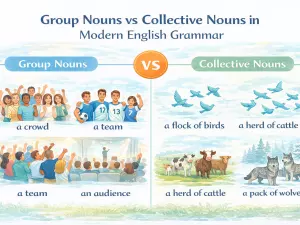
Collective nouns are words used to describe a group of individuals, animals, or things as a single entity. Even though these terms refer to more than one member, they are often treated grammatically as singular units. Understanding these words is essential because they affect how pronouns and verbs agree in a sentence.
In English, these group terms are common in both everyday speech and formal writing. They frequently refer to people, animals, or objects that act together as one unit. For example, when talking about a "team," the reference is to a group of players considered collectively. However, the meaning and pronoun agreement can change depending on whether the group is being seen as a whole or as individuals.
Common examples of group nouns
- Team → The team is working on a new strategy.
- Family → My family is planning a holiday together.
- Committee → The committee has made its final decision.
- Audience → The audience was silent during the speech.
- Staff → The staff is trained to handle emergencies.
- Class → The class is preparing for the final exam.
- Jury → The jury has reached a verdict.
- Group → The group meets every Friday.
- Government → The government is reviewing the policy.
- Band → The band is touring across Europe.
- Panel → The panel is discussing the proposal.
- Choir → The choir is rehearsing for the concert.
- Crowd → The crowd was waiting outside the stadium.
- Herd → A herd of cows is grazing in the field.
- Flock → A flock of birds is flying south.
- Army → The army is advancing toward the border.
- Orchestra → The orchestra is performing tonight.
- Fleet → The fleet is ready for deployment.
How collective nouns behave
Most collective nouns are singular in form but can be treated as either singular or plural, depending on context. For instance, when the group acts as a single unit, singular verbs and pronouns are used. If the individuals within the group act separately, plural forms are preferred, especially in British English. This flexibility can affect how you choose pronouns and verb forms.

| Collective Noun | Singular Example | Plural Example |
|---|---|---|
| Team | The team has finished its project. | The team have finished their projects. |
| Committee | The committee is making its decision. | The committee are arguing among themselves. |
| Family | My family celebrates its traditions. | My family are packing their bags. |
| Jury | The jury gives its verdict. | The jury are divided in their opinions. |
Recognizing these group terms and their flexible agreement is key to using pronouns correctly. The choice between singular and plural forms depends on whether the group is acting together or as separate individuals, which can subtly change the meaning of your sentences.
Singular vs plural agreement choices
When using collective nouns like team, audience, or government, writers and speakers must decide whether to use singular or plural verbs and pronouns. This choice depends on whether the collective noun is seen as a single entity or as a collection of individuals acting separately. The decision can affect verb forms, pronoun agreement, and even the nuance of a sentence.
How context influences agreement
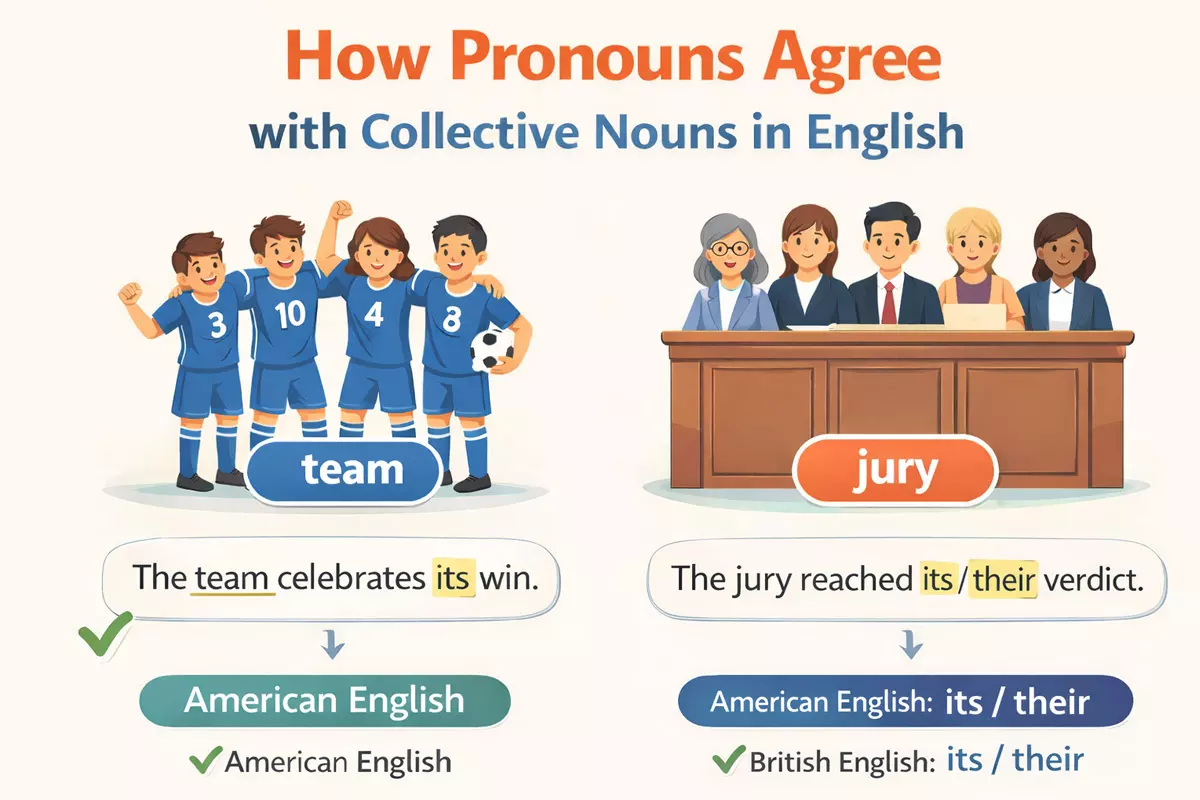
In American English, collective nouns are usually treated as singular, especially when the group acts as one. In contrast, British English often prefers plural agreement if the group members are acting individually. The surrounding context—such as the verb’s meaning and the focus on unity or individuality—guides which agreement form to use.
| Collective Noun Example | Singular Agreement | Plural Agreement |
|---|---|---|
| The team | The team is winning. It has a new coach. |
The team are arguing. They have different opinions. |
| The committee | The committee decides on the policy. It meets monthly. |
The committee disagree about the budget. They are voting now. |
| The family | The family enjoys its vacation. It travels every summer. |
The family are packing their bags. They can't agree on a destination. |
| The band | The band has released its album. It sounds great live. |
The band are tuning their instruments. They look excited. |
Common collective nouns and pronoun choices
- Audience: The audience is quiet. / The audience are clapping.
- Class: The class has finished its test. / The class are finding their seats.
- Staff: The staff works hard. / The staff are discussing their schedules.
- Government: The government is introducing its policy. / The government are debating among themselves.
- Jury: The jury has reached its verdict. / The jury are divided in their opinions.
- Council: The council meets weekly. / The council are expressing their views.
- Group: The group is traveling together. / The group are arguing over their plans.
- Board: The board has made its decision. / The board are submitting their reports.
- Crew: The crew is ready. / The crew are putting on their uniforms.
- Team: The team wins its game. / The team are celebrating their victory.
- Family: The family eats its dinner. / The family are sharing their stories.
- Company: The company is expanding. / The company are updating their software.
Quick tips for making the right agreement
- Use singular verbs and pronouns when the group acts as one unit: The board has finished its review.
- Use plural forms when emphasizing individuals within the group: The board are signing their names.
- Consider your audience—American readers expect singular agreement more often than British readers.
- Look for clues in the rest of the sentence to decide which sense (unity or individuality) is meant.
Choosing between singular and plural forms for collective nouns adds nuance and clarity to your writing. Paying attention to context and consistency will help you select the most natural and precise agreement every time.
British vs American usage differences
When it comes to collective nouns—words like team, committee, family, or government—the way pronouns agree with these nouns can differ depending on whether you’re following British or American English conventions. The main distinction boils down to whether the collective noun is treated as singular or plural, which then affects the form of pronouns and verbs that follow.
General tendencies
In American English, collective nouns are usually considered singular. This means they typically take singular verbs and pronouns. In contrast, British English often treats collective nouns as plural, especially when the group is being thought of as individuals acting separately. This difference can sometimes make sentences look or sound quite different depending on the variety of English in use.
| Collective Noun Example | Typical Usage in American English | Typical Usage in British English |
|---|---|---|
| The team | The team has lost its last three games. | The team have lost their last three games. |
| The government | The government made its decision. | The government have made their decision. |
| The jury | The jury reached its verdict. | The jury have reached their verdict. |
| The class | The class finished its project. | The class have finished their project. |
| The staff | The staff is updating its records. | The staff are updating their records. |
Patterns and considerations
- American writers prefer singular verbs and pronouns (it, its, itself) with most group nouns.
- British usage often selects plural verbs and pronouns (they, their, themselves) when the group’s members are acting individually or the group is seen as a collection of people.
- Some collective nouns, like police or people, are always plural in both varieties.
- Context matters: even in British English, a collective noun can be singular if the group is acting as one unit (e.g., “The team is winning.”).
- Pronoun agreement can shift within a text if the writer’s focus changes from the group as a whole to the individuals within it.
Common collective nouns and pronoun agreement differences
- Band → The band is releasing its new album.
- Audience → The audience was silent during the speech.
- Company → The company has changed its policy.
- Family → My family is moving next year.
- Government → The government has announced its decision.
- Committee → The committee has reached its conclusion.
- Staff → The staff is expanding its training program.
- Group → The group is planning its next meeting.
- Team → The team is confident in its strategy.
- Jury → The jury has delivered its verdict.
- Class → The class is starting the exam.
- Board → The board has approved the proposal.
- Council → The council has updated its regulations.
- Club → The club is opening a new facility.
- Army → The army is advancing to its position.
- Choir → The choir is performing tonight.
- Faculty → The faculty is revising the curriculum.
- Public → The public is losing patience.
- Cast → The cast is attending rehearsal.
- Party → The party has announced its platform.
Understanding these regional differences is especially useful when editing or writing for an international audience. If consistency is important, it’s best to pick one style and apply it throughout your document.
Meaning-based agreement with collectives
When collective nouns like team, family, or government are used in English, the choice of pronoun (and sometimes verb form) can depend on whether the group is seen as a single unit or as individual members. This flexible agreement is often called notional or semantic agreement, since it relies on the intended meaning rather than strict grammatical rules.
Choosing between singular and plural pronouns
Writers and speakers select either singular or plural pronouns based on whether they view the collective noun as acting together or as individuals. For instance, if the group is acting in unison, singular forms like it and its are typical. If members of the group are acting separately, plural pronouns such as they and their are more natural.
| Collective Noun | Singular Agreement | Plural Agreement |
|---|---|---|
| Team | The team has finished its project. | The team have finished their projects. |
| Family | My family is selling its house. | My family are packing their bags. |
| Government | The government announced its plan. | The government are divided in their opinions. |
| Committee | The committee reached its decision. | The committee are arguing among themselves. |
Common collective nouns with variable agreement
- Audience → The audience was quiet during the presentation.
- Board → The board approved the new policy.
- Class → The class is preparing for the final exam.
- Company → The company has expanded its operations.
- Crew → The crew is ready for departure.
- Faculty → The faculty supports the new curriculum.
- Group → The group meets every Monday.
- Jury → The jury has reached a verdict.
- Panel → The panel is reviewing the proposal.
- Staff → The staff is trained to handle emergencies.
- Team → The team is working on the project.
- Family → My family is planning a reunion.
- Government → The government is implementing new regulations.
- Committee → The committee has issued its report.
- Choir → The choir is rehearsing for the concert.
- Club → The club is organizing a charity event.
- Band → The band is recording a new album.
- Council → The council has approved the budget.
- Squad → The squad is training for the tournament.
- Organization → The organization is focused on sustainability.
Guidelines and regional differences
British English tends to use plural agreement with collectives more frequently, especially in formal writing and journalism (The staff are meeting in their offices). In American English, singular agreement is often preferred (The staff is meeting in its office), unless the context clearly emphasizes individual actions. Context and clarity should guide your choice, and consistency within a text is important.
To sum up, the choice between singular and plural agreement with collective nouns is guided by the writer’s or speaker’s perception of the group’s unity or individuality. Paying attention to context, regional conventions, and the precise meaning you want to convey will help you make these decisions naturally.
Pronouns referring back to collective nouns
Matching pronouns to collective nouns can be tricky because these nouns—like team, audience, or committee—refer to groups but are grammatically singular. The choice between singular and plural pronouns depends on whether the group is being considered as a single unit or as individuals acting separately.
Choosing singular or plural pronouns
When a collective noun is seen as a single entity, singular pronouns (it, its) are used. If the focus is on individual members within the group, plural pronouns (they, their, them) are more natural. This distinction is especially prominent in British English, while American English tends to favor singular agreement.
| Collective Noun Example | Pronoun Reference |
|---|---|
| The committee has made its decision. | Singular (the group as a whole) |
| The committee have finished their discussions. | Plural (members acting individually) |
| The family is proud of its heritage. | Singular (one family unit) |
| The family are packing their bags. | Plural (individual family members) |
| The team will defend its title. | Singular (the team as one entity) |
| The team are discussing their strategies. | Plural (players as individuals) |
Common collective nouns and their pronoun patterns

- Audience: "The audience showed its appreciation." / "The audience took their seats."
- Staff: "The staff is changing its policy." / "The staff are sharing their ideas."
- Government: "The government announced its plan." / "The government are divided in their opinions."
- Company: "The company released its report." / "The company are updating their profiles."
- Band: "The band has finished its tour." / "The band are tuning their instruments."
- Class: "The class took its exam." / "The class are presenting their projects."
- Crew: "The crew finished its work." / "The crew are putting on their uniforms."
- Jury: "The jury reached its verdict." / "The jury are returning to their homes."
- Team: "The team lost its first match." / "The team are practicing their passes."
- Group: "The group submitted its application." / "The group are introducing themselves."
Tips for clear pronoun reference
- Decide if you mean the group as a unit or the individuals acting separately.
- Be consistent with your pronoun choice throughout a paragraph or passage.
- In formal American English, singular pronouns are safest for most collective nouns.
- In British English, use plural pronouns if emphasizing the members’ actions.
- Rewrite sentences to avoid ambiguity when possible.
Understanding when to use singular or plural pronouns with group nouns can make your writing clearer and more natural. Context and variety in sentence structure are key to mastering this aspect of English grammar.
Common learner confusion patterns
Learners often struggle with pronoun agreement when collective nouns are involved. The challenge usually comes from differences between standard grammar rules and how native speakers actually use pronouns in everyday English. Collective nouns like team, family, and government can refer to a group as a single unit or to the individuals within the group, and this affects which pronouns should follow.
Typical sources of confusion
- Assuming all collective nouns always take singular pronouns.
- Overgeneralizing plural pronouns after any group noun.
- Switching between singular and plural pronouns within the same sentence.
- Not recognizing context: American vs. British usage can differ.
- Confusing semantic (meaning-based) and grammatical (form-based) agreement.
- Forgetting that some group words behave differently (police is always plural, for example).
- Using their for singular collective nouns even when not referencing individuals.
- Being influenced by native language patterns, especially if their first language doesn't use collective nouns in the same way.
- Noticing inconsistency in authentic texts and assuming there are no rules.
- Misapplying rules for animate vs. inanimate collective nouns.
Common mix-ups in context
The following table summarizes typical errors and correct forms when using pronouns with collective nouns, highlighting both American and British preferences:
| Collective Noun | Incorrect Pronoun Use | Correct (US) | Correct (UK) |
|---|---|---|---|
| Team | The team lost their match. ❌ | The team lost its match. ✅ | The team lost their match. ✅ |
| Family | My family finished their dinner. ❌ | My family finished its dinner. ✅ | My family finished their dinner. ✅ |
| Government | The government announced their plan. ❌ | The government announced its plan. ✅ | The government announced their plan. ✅ |
| Police | The police gave its statement. ❌ | The police gave their statement. ✅ | The police gave their statement. ✅ |
Other patterns to watch for
- Switching from singular to plural pronouns mid-paragraph when referring to the same collective noun.
- Uncertainty about whether to use it or they for sports teams, bands, or companies.
- Applying the same pronoun rule to all group nouns without checking for exceptions.
- Missing that context (emphasizing unity vs. individuality) can change the correct pronoun.
- Ignoring register: formal writing tends to follow stricter rules than casual conversation.
Understanding these tendencies can help learners avoid the most frequent pitfalls and use pronouns with collective nouns more confidently in both writing and speech.
Formal writing preferences
In academic and professional English, collective nouns—such as team, committee, or audience—usually take singular pronouns. This approach emphasizes the group as a single entity, which is the norm in most edited texts. For example, writers will say, “The committee made its recommendation,” rather than “their recommendation.” This singular agreement is preferred in American English and is common in business documents, research papers, and formal reports.
Common patterns in formal contexts
- The jury reached its verdict.
- The organization changed its policy.
- The class finished its project.
- The company revised its guidelines.
- The audience showed its appreciation.
- The family sold its house.
- The council announced its decision.
- The army began its march.
- The board lost its funding.
- The staff completed its work.
- The government published its report.
- The team earned its reputation.
Comparison: Singular vs. plural agreement
| Collective Noun Example | Preferred Formal Pronoun |
|---|---|
| The committee finished its review. | Singular (its) ✅ |
| The audience clapped its hands. | Singular (its) ✅ |
| The staff submitted their reports. | Plural (their) ❌ |
| The family celebrated its anniversary. | Singular (its) ✅ |
Writers may occasionally see plural pronouns with collective nouns, especially in British English or when the group is considered as individuals acting separately. However, using singular forms is the standard for most formal and academic prose. This consistency helps maintain clarity and meets the expectations of editors and readers in formal settings.
Practice: choose correct pronouns with collectives
This section gives you hands-on experience with selecting the right pronouns when dealing with collective nouns. Collective nouns—like "team," "staff," "family," or "committee"—can take either singular or plural pronouns depending on whether the group is seen as a single unit or as individuals. The correct choice often depends on context and regional preferences.
Try picking the right pronoun
For each sentence, decide which pronoun best agrees with the collective noun. Focus on whether the group is acting as one or as individuals.
- The jury has reached (its / their) verdict.
- The staff are changing (its / their) schedules this week.
- My family is proud of (its / their) traditions.
- The audience clapped (its / their) hands enthusiastically.
- The committee disagreed among (itself / themselves) about the proposal.
- The class finished (its / their) homework before the deadline.
- The team celebrated (its / their) victory together.
- The government announced (its / their) new policy yesterday.
- The group presented (its / their) findings at the conference.
- The orchestra tuned (its / their) instruments before the concert.
Show answers
- its
- their
- its
- their
- themselves
- its
- their
- its
- its
- their
Common collective nouns and their pronoun agreement
Here are examples of collective nouns and the pronouns they typically take, depending on context:
| Collective Noun | Typical Pronoun(s) | Example Sentence | Unit or Individuals? |
|---|---|---|---|
| Team | its / their | The team won its first game. / The team are putting on their uniforms. | Unit / Individuals |
| Family | its / their | My family is selling its house. / My family are packing their bags. | Unit / Individuals |
| Committee | its / their | The committee made its decision. / The committee are arguing among themselves. | Unit / Individuals |
| Government | its / their | The government announced its plan. / The government are divided in their opinions. | Unit / Individuals |
| Staff | its / their | The staff is changing its policy. / The staff are updating their records. | Unit / Individuals |
| Audience | its / their | The audience showed its appreciation. / The audience clapped their hands. | Unit / Individuals |
| Class | its / their | The class finished its work. / The class are handing in their essays. | Unit / Individuals |
| Orchestra | its / their | The orchestra played its final piece. / The orchestra are tuning their instruments. | Unit / Individuals |
| Group | its / their | The group reached its goal. / The group are introducing themselves. | Unit / Individuals |
| Company | its / their | The company updated its website. / The company are meeting their clients. | Unit / Individuals |
Quick tips for agreement with collectives
- Use a singular pronoun (it, its, itself) if the group acts as a unit.
- Use a plural pronoun (they, their, themselves) if you emphasize the individuals within the group.
- British English often uses plural verbs and pronouns with collectives, while American English prefers singular.
Practicing with real examples will help make your choices more natural. Always consider the context and whether you mean the group as a whole or the people in it.