Collective Nouns: Theory and Examples

 The article defines collective nouns, lists common groups, explains verb agreement and differences between British and American usage, provides real examples, points out common mistakes, and ends with a short practice activity on choosing the correct verb.
Have you ever thought about how one word can represent an entire group, like a troop of monkeys or a fleet of ships? These unique collective nouns enrich our language by making descriptions more vivid and precise. They also highlight interesting patterns in how we communicate about groups, whether referring to animals, objects, or people. Understanding and using these terms not only adds color to our speech but also helps us convey information more efficiently in daily conversations.
Definition of Collective Nouns
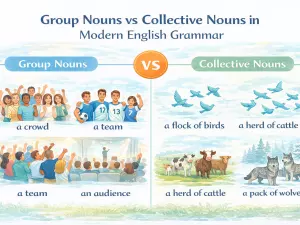
When we talk about words that represent groups, we are dealing with a specific type of noun. These terms describe a collection of people, animals, or things considered as a single entity. For example, instead of listing each member individually, English uses special words to refer to them as a whole.
What Makes a Noun Collective?
A collective noun refers to a group acting together as one unit. It can stand for multiple individuals or items, but is grammatically treated as either singular or plural depending on context and dialect. This unique feature creates interesting patterns in subject-verb agreement.
- Team — a group of players or colleagues
- Flock — a group of birds
- Family — relatives considered together
- Committee — people assembled for a purpose
- Audience — people watching a performance or event
- Class — students learning together
- Pack — a group of animals, e.g., wolves or dogs
- Staff — employees of an organization
- Choir — singers performing as a unit
- Fleet — a set of ships or vehicles
- Herd — animals such as cattle grouped together
- Jury — people judging a legal case
- Board — individuals managing an organization
- Swarm — insects, especially bees, in a group
- Army — soldiers as a collective force
- Band — musicians performing as one ensemble
- Gang — people acting together, often with a negative sense
- Panel — experts or judges assembled for discussion
- Troop — group of scouts or soldiers
- Orchestra — musicians playing classical music together
Singular or Plural Usage
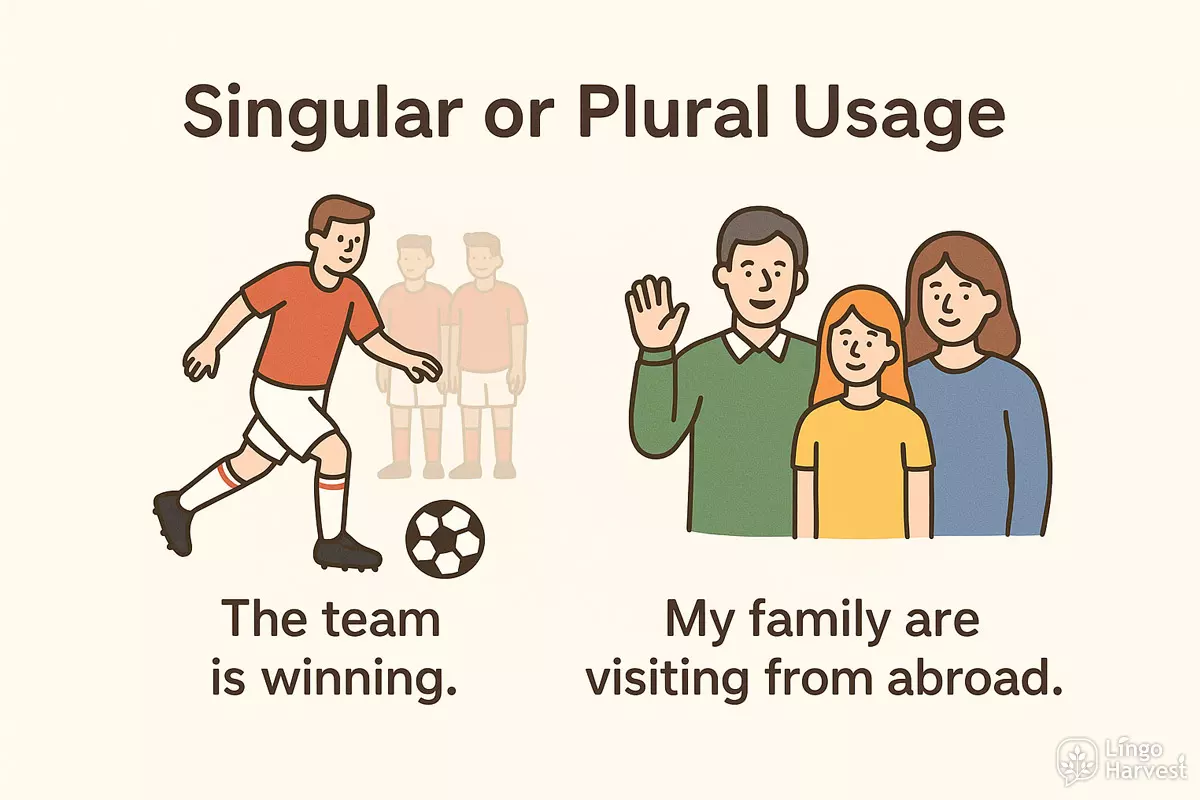
The way these nouns interact with verbs depends on whether the group is acting as a single unit or as individuals. For example, in British English, plural verbs are often used when the focus is on members acting separately, while American English tends to use singular verbs more consistently.
| Collective Noun | Example Sentence |
|---|---|
| Team | The team is winning. ✅ |
| Staff | The staff are preparing for the event. ✅ |
| Jury | The jury has reached a verdict. ✅ |
| Family | My family are visiting from abroad. ✅ |
| Choir | The choir sings beautifully. ✅ |
Summary
In essence, these group nouns help us refer to multiple entities efficiently and elegantly. Their grammatical behavior can vary, especially between varieties of English, but they always point to a group functioning as a unit or as individuals within that group.
Common Collective Noun Groups
When discussing groups in English, certain nouns are traditionally used to refer to collections of people, animals, or things as one entity. These terms often have vivid or historical origins, and using them can make language more precise or colorful.
Classic Examples for Animals
Writers and speakers often use specific words to describe animal gatherings. Some of these are well-known, while others are quite unique:
- a flock of birds
- a herd of cattle
- a pride of lions
- a school of fish
- a pack of wolves
- a swarm of bees
- a colony of penguins
- a gaggle of geese
- a murder of crows
- a pod of dolphins
People and Objects
Collective terms are not limited to animals. Everyday English also uses these nouns to describe groups of people or things:
- a team of players
- a crew of sailors
- a choir of singers
- a panel of experts
- a class of students
- a audience of spectators
- a fleet of ships
- a bundle of sticks
- a stack of books
- a range of mountains
Comparison of Common Animal Group Terms
Certain animals can have more than one collective term, depending on context or tradition. The table below highlights a few animals and the group nouns associated with them:
| Animal | Possible Group Nouns |
|---|---|
| Dog | Pack, Kennel |
| Fish | School, Shoal |
| Geese | Gaggle (on land), Skein (in flight) |
| Bees | Swarm, Hive |
| Horses | Team, Herd, String |
The use of these terms can add clarity or a touch of tradition to your writing. Some, like "team" or "group," are widely understood, while others such as "murder" (for crows) are more specific and can add vivid imagery. Understanding and choosing the right collective noun enhances both precision and style in communication.
Singular Form, Group Meaning
In English, certain nouns refer to collections of individuals or things but use a singular grammatical form. These are known as collective nouns. Even though they point to more than one member, they behave like singular nouns in most sentences. For example, we say “The team is winning,” not “The team are winning,” because “team” is treated as a single unit.
This can be confusing, especially for learners, since the word looks singular but describes a group. Context often determines whether to use a singular or plural verb, as some collective nouns can take either, depending on whether the group acts as one or as individuals.
Common Collective Nouns
Here are some frequently used terms that fit this pattern. Each one refers to a group but is typically singular in form:
- Audience
- Family
- Committee
- Team
- Government
- Staff
- Class
- Herd
- Jury
- Army
- Choir
- Flock
- Panel
- Crew
- Band
- Orchestra
- Board
- Public
How Singular Collective Nouns Work
When a collective noun is used as the subject, the verb usually matches in the singular form. For example: “The committee decides on the policy.” However, if you want to emphasize the members acting separately, you can use a plural verb in British English: “The committee are arguing among themselves.” In American English, the singular verb is more common.
Examples in Sentences
Notice how these words refer to many but act as one unit in the sentence:
- The band plays at the festival every year.
- The staff has agreed to work overtime.
- The jury delivers its verdict this afternoon.
- The flock is grazing in the field.
Singular vs. Plural Usage: Comparison Table
| Collective Noun | Typical Usage (Singular/Plural) |
|---|---|
| Team | The team is winning. ✅ The team are celebrating. (BrE, when focusing on members) ✅ |
| Family | My family lives nearby. ✅ My family are planning their holidays. (BrE) ✅ |
| Committee | The committee decides the rules. ✅ The committee are discussing their opinions. (BrE) ✅ |
| Jury | The jury has reached a verdict. ✅ The jury were divided in their decision. (BrE) ✅ |
| Staff | The staff is professional. ✅ The staff are on strike. (BrE) ✅ |
In summary, collective nouns present a unique blend of singular form and group reference. Understanding how they function helps avoid grammatical errors and clarifies meaning in both writing and speech.
Verb Agreement with Collective Nouns
Choosing the right verb form when using collective nouns can be tricky. Collective nouns refer to a group seen as either a single entity or as individual members. The verb choice—singular or plural—depends on whether the group acts as a unit or as individuals. This variation is particularly noticeable in British and American English.
How Context Affects Verb Choice
When the group acts together as one, treat the noun as singular and use a singular verb. If the members of the group act separately, a plural verb is appropriate. This distinction helps clarify meaning and ensures grammatical accuracy.
- The team is winning. (The team acts as one unit.)
- The team are arguing among themselves. (Members act individually.)
- The jury has reached its verdict. (A single decision.)
- The jury are disagreeing. (Members have different opinions.)
British vs. American Usage
In American English, collective nouns typically take singular verbs, especially in formal writing. British English often uses plural verbs when the emphasis is on the individuals within the group.
| Collective Noun | American English (Singular) | British English (Plural) |
|---|---|---|
| Family | The family is on vacation. | The family are packing their bags. |
| Government | The government has announced a new law. | The government have agreed on new measures. |
| Staff | The staff is meeting today. | The staff are having lunch. |
| Team | The team wins every game. | The team are wearing new uniforms. |
| Committee | The committee decides the policy. | The committee have made their recommendations. |
Common Collective Nouns and Verb Agreement Examples
- Audience: The audience was silent. / The audience are applauding.
- Class: The class has a test. / The class are handing in assignments.
- Police: The police have arrived. (Always plural in English.)
- Staff: The staff is small. / The staff are working overtime.
- Group: The group meets every week. / The group are discussing ideas.
- Choir: The choir sings beautifully. / The choir are practicing their parts.
- Team: The team has a coach. / The team are celebrating.
- Band: The band performs tonight. / The band are tuning their instruments.
- Company: The company is expanding. / The company are meeting with clients.
- Public: The public is concerned. / The public are expressing opinions.
When deciding on the verb form, consider whether the group functions as a single unit or as individuals. Pay attention to regional differences, and look for clues in the rest of the sentence. This attention to detail helps ensure your writing is clear and precise.
Differences in British and American Use
Usage of collective nouns often varies widely between speakers in the UK and the US, especially when it comes to verb agreement. In British English, collective nouns like team, staff, or government are frequently treated as plural, especially when the group is seen as made up of individuals acting separately. American English, by contrast, tends to treat these nouns as singular, focusing on the group as a single entity.
Verb Agreement Patterns
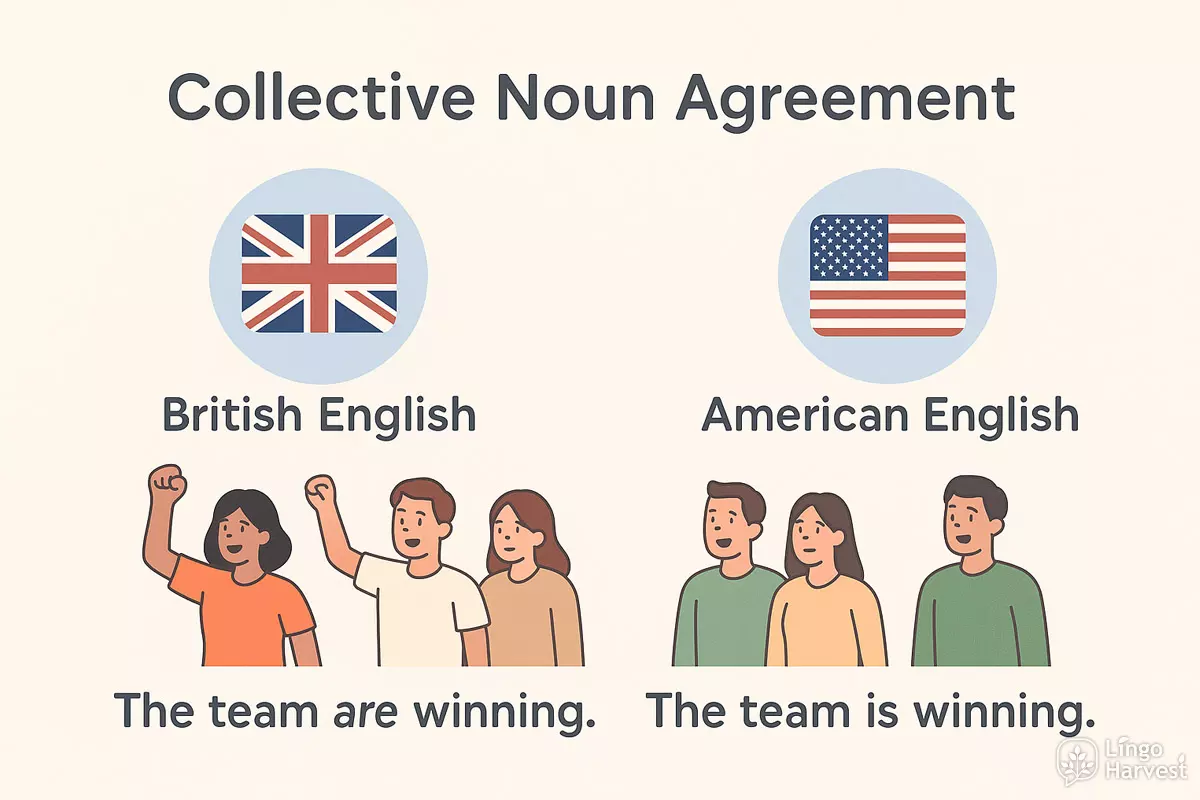
The most noticeable distinction is in whether a singular or plural verb follows a collective noun. For example, a British speaker might say, "The team are playing well," while an American would usually say, "The team is playing well." This difference reflects the underlying view of the group as either a collection of individuals (UK) or a unified whole (US).
| Collective Noun | British English Example | American English Example |
|---|---|---|
| Team | The team are winning. | The team is winning. |
| Government | The government have announced their plan. | The government has announced its plan. |
| Family | My family are on holiday. | My family is on vacation. |
| Staff | The staff are protesting. | The staff is protesting. |
| Band | The band are rehearsing. | The band is rehearsing. |
| Jury | The jury have reached a verdict. | The jury has reached a verdict. |
| Class | The class are taking their seats. | The class is taking its seat. |
| Committee | The committee have made their decision. | The committee has made its decision. |
| Police | The police are investigating. | The police are investigating. (always plural in both) |
| Crew | The crew are preparing the ship. | The crew is preparing the ship. |
Pronoun Reference
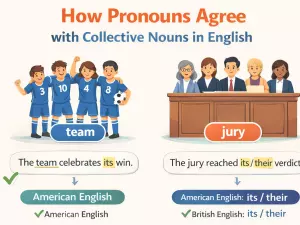
Another subtle difference involves pronoun choice. In the UK, it's common to refer back to collective nouns with plural pronouns (they, their), while American English typically uses singular forms (it, its). For example:
- UK: The council have finished their meeting.
- US: The council has finished its meeting.
Flexibility and Exceptions
While these general patterns are helpful, both varieties of English can be flexible. In British English, singular agreement is still common when the group acts as a unit. Likewise, American speakers may occasionally use plural verbs for emphasis or when the individuality of group members is clear. Some collective nouns, like police and people, are always plural regardless of dialect.
Summary of Key Points
- British English allows both singular and plural verbs with collectives; plural is favored when members act individually.
- American English usually uses singular verbs, seeing the group as a single entity.
- Pronouns in the UK often match the plural verb; in the US, they match the singular.
- Certain collective nouns (e.g., police, cattle) are always plural in both varieties.
Examples in Real Sentences
Understanding how group nouns function in everyday language helps clarify their usage. These special nouns describe collections of people, animals, or things as single units, even though they refer to multiple individuals. Below are practical examples to show how collective terms appear in typical statements.
Common Collective Nouns Used in Context
- The team is practicing for the championship this weekend.
- A flock of birds flew over the lake at sunrise.
- The jury has reached its decision after hours of discussion.
- Our family gathers every Sunday for dinner.
- The audience applauded loudly after the performance.
- The crew repaired the ship before the storm arrived.
- A pack of wolves was seen near the forest edge.
- The committee meets monthly to review new proposals.
- A bouquet of flowers brightened the room.
- The class is working on their science project together.
- The fleet set sail at dawn, heading for open waters.
- A herd of cattle grazed peacefully in the meadow.
- The staff has organized a charity event.
- The choir sings beautifully during the holidays.
- A swarm of bees surrounded the hive.
- The gang was known for its elaborate pranks.
- A panel of experts answered questions from the audience.
- The army marched through the city square.
- A bundle of sticks lay beside the fireplace.
- The orchestra will perform at the concert hall tonight.
Comparing Singular and Plural Verb Use
Sometimes, these group nouns can take either a singular or plural verb, depending on whether the group acts as a single unit or as individuals. This is especially common in British English.
| Sentence | Verb Agreement |
|---|---|
| The committee has made its decision. ✅ | Singular (acting as one unit) |
| The committee have disagreed among themselves. ✅ | Plural (acting as individuals) |
| The team is winning the match. ✅ | Singular (one group) |
| The team are arguing in the locker room. ✅ | Plural (members acting separately) |
These practical illustrations show how group words operate in context, helping to make your writing and speech clearer and more precise.
Mistakes to Avoid
When discussing collective terms, learners often encounter pitfalls that can lead to unclear or incorrect communication. Understanding these common errors will help you use group nouns with greater confidence and precision.
Confusing Singular and Plural Agreement
A frequent issue is deciding whether to use a singular or plural verb with a collective noun. In American English, most group terms are treated as singular when the group is acting as one unit, but plural when emphasizing individual members. British English, however, often prefers plural verbs in these cases. Consider the following:
- The team is winning. (The team as a single entity)
- The team are arguing among themselves. (Focus on individuals in British English)
Using the Wrong Verb Form
Choosing the correct verb form is essential. Some common mismatches include:
- ❌ The audience were excited. (American English – should be was)
- ❌ The committee have reached a decision. (American English – should be has)
- ✅ The jury is deliberating. (Correct in American English)
Incorrect Pronoun Reference
Matching pronouns to the sense of the group is another tricky area. If the group acts as a unit, use "it" or "its." If acting as individuals, use "they" or "their."
- The class finished its project. (One group, one project)
- The class finished their projects. (Each student did their own)
Overusing Plural Forms
It’s a mistake to add an -s to a collective noun when referring to the group itself, rather than multiple groups.
- ❌ The staffs are meeting. (Incorrect unless referring to multiple groups of staff)
- ✅ The staff is meeting. (Correct for one group)
Commonly Confused Collective Nouns
Some group words are easy to mix up or misuse. Here's a quick comparison to clarify:
| Group Term | Typical Usage / Example |
|---|---|
| Flock | A flock of birds |
| Herd | A herd of cattle |
| Swarm | A swarm of bees |
| Pack | A pack of wolves |
| Bunch | A bunch of grapes |
| Team | A team of players |
| Choir | A choir of singers |
| Fleet | A fleet of ships |
| Panel | A panel of experts |
| Audience | An audience of listeners |
Summary of Frequent Errors
Watch for the following when working with collective terms:
- Using inconsistent verb agreement
- Switching between singular and plural pronouns incorrectly
- Adding unnecessary plural endings
- Confusing similar-sounding group words (e.g., "herd" vs "flock")
- Forgetting regional differences in usage
Paying attention to these details will help you avoid confusion and communicate more clearly when referring to groups in English.
Short Practice: Choose the Correct Verb
Understanding how to pair collective nouns with the right verb form is essential for clear English. Sometimes, a collective noun takes a singular verb, and other times a plural one—depending on whether the group acts as a single unit or as individuals. Here’s a practice set to help you decide which verb fits each sentence. Read each example carefully and choose the correct verb.
Practice: Fill in the Blank
For each sentence, select the appropriate verb (singular or plural) so that the sentence is grammatically correct.
- The team ____ (is/are) winning the match.
- The committee ____ (has/have) agreed on the new policy.
- The family ____ (enjoys/enjoy) their holidays together every year.
- The jury ____ (was/were) divided in their opinions.
- My collection of stamps ____ (is/are) quite valuable.
- The staff ____ (is/are) planning their annual party.
- The audience ____ (was/were) cheering loudly.
- The class ____ (has/have) submitted its assignment.
- The crew ____ (was/were) preparing for departure.
- The flock of sheep ____ (is/are) grazing in the field.
Show answers
- is
- has
- enjoy
- were
- is
- are
- was
- has
- was
- is
Common Collective Nouns and Typical Verb Choices
Below is a list of collective nouns often used with either singular or plural verbs, depending on context:
- Team
- Family
- Audience
- Committee
- Class
- Staff
- Group
- Crew
- Jury
- Flock
- Pack
- Band
- Army
- Board
- Choir
- Herd
- Company
- Panel
Remember: the choice of verb depends on whether you’re emphasizing the group as a whole or the individuals within it. This distinction is especially important in British English, where plural verbs are more commonly used with collective nouns than in American English.