Words That Act as Both Nouns and Verbs in Modern English

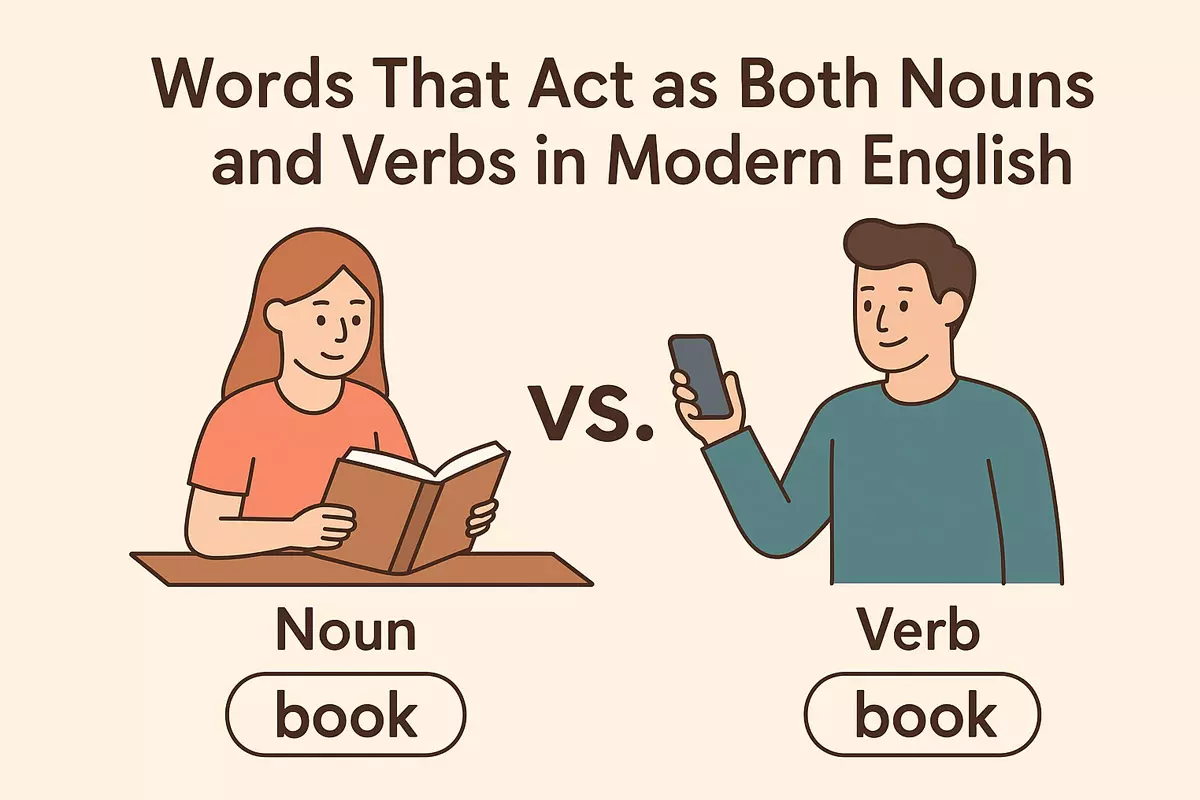 Here we dual-function English words such as run, work, and plan, showing how context reveals their noun or verb role. It discusses meaning shifts, stress changes, learner confusion, and includes practice choosing the correct function in sentences.
- What dual-function words are in English
- Common examples like run, work, and plan
- How context shows noun vs verb function
- Stress and pronunciation shifts in dual-use words
- Differences in meaning across noun and verb forms
- Typical learner confusion with word class changes
- Practice: choose correct function in mixed sentences
English often surprises us with its flexible vocabulary, as many words can shift roles depending on the context in which they are used. For example, certain terms may function as both nouns and verbs, allowing speakers to name objects or concepts and also to describe actions using the same word. This ability to transition between different grammatical roles adds variety and depth to our everyday conversations, making the language both dynamic and adaptable. Such versatility not only enriches communication but also encourages creativity in how we express ideas.
What dual-function words are in English
Many English words perform more than one grammatical role, often switching between noun and verb depending on how they’re used in a sentence. This flexibility is a hallmark of modern English, making communication more efficient and expressive. Understanding these dual-function words can help learners grasp how context determines meaning and usage.
How Noun-Verb Shift Works
A single word can often represent an object or idea when used as a noun, and an action or occurrence when used as a verb. The difference is usually clear from sentence structure and context. For example, “paint” can be a substance (noun) or the act of applying color (verb).
Common Examples of Dual-Function Words
- Play: to engage in activity (verb), a theatrical performance (noun)
- Run: to move quickly (verb), a period of continuous operation (noun)
- Watch: to observe (verb), a timepiece (noun)
- Plan: to organize (verb), a detailed proposal (noun)
- Answer: to respond (verb), a response (noun)
- Call: to phone or shout (verb), a telephone conversation (noun)
- Cook: to prepare food (verb), a person who prepares food (noun)
- Change: to make different (verb), coins or alteration (noun)
- Show: to display (verb), a performance or exhibition (noun)
- Design: to create plans (verb), a drawing or plan (noun)
- Dream: to experience visions (verb), an imagined event (noun)
- Love: to feel affection (verb), a deep affection (noun)
- Charge: to ask for payment (verb), a fee (noun)
- Test: to examine (verb), an assessment (noun)
- Order: to request (verb), a command or arrangement (noun)
- Mark: to label or note (verb), a symbol or grade (noun)
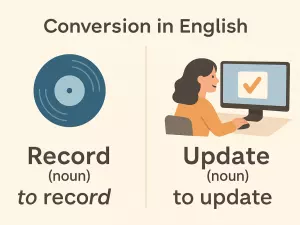
- Record: to capture data (verb), a stored piece of information (noun)
- Report: to describe formally (verb), a written account (noun)
- Light: to illuminate (verb), visible energy (noun)
- Return: to go back (verb), the act of coming back (noun)
Patterns in Dual-Function Word Usage
In many cases, the noun and verb forms are spelled identically and pronounced the same. Sometimes, pronunciation changes slightly between forms, especially with stress on different syllables (e.g., record as a noun vs. record as a verb).
Comparison of Usage in Sentences
| Word | Example Sentences |
|---|---|
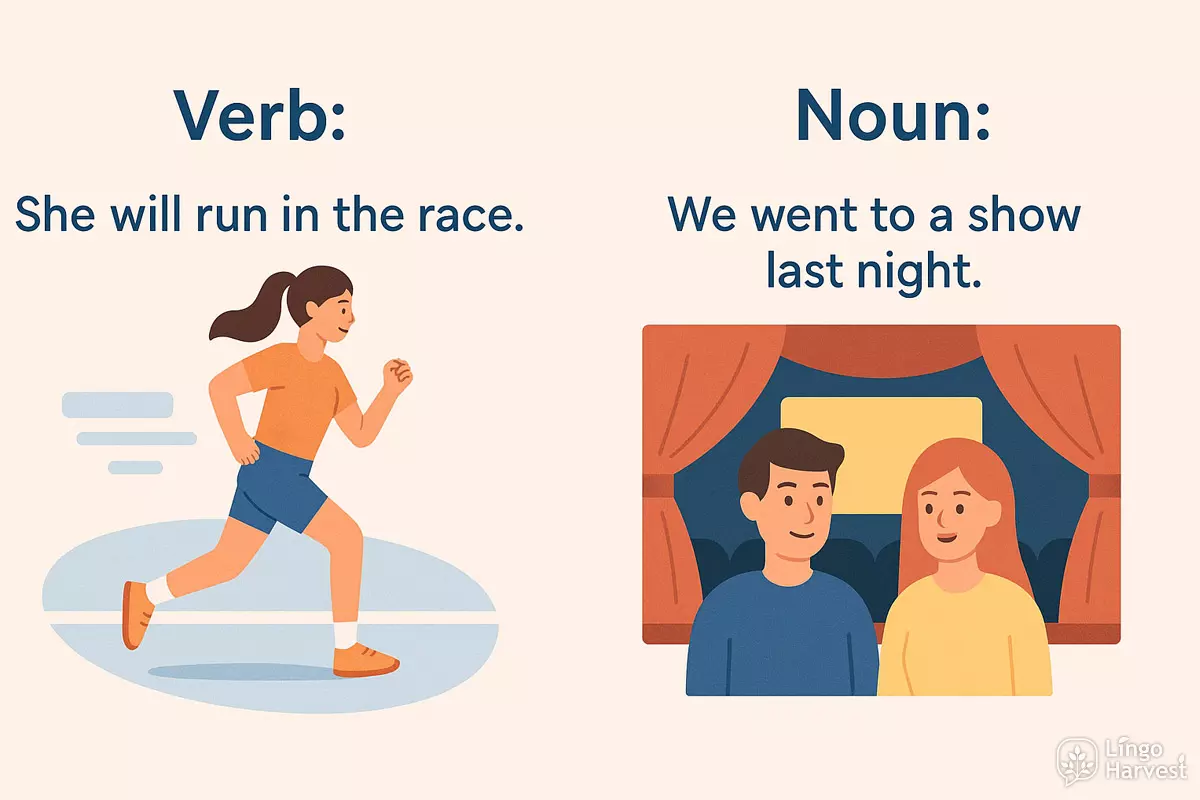
| Run | Verb: She will run in the race. Noun: She went for a run this morning. |
| Show | Verb: Can you show me how? Noun: We went to a show last night. |
| Light | Verb: Please light the candle. Noun: The light was very bright. |
| Plan | Verb: We plan to travel soon. Noun: That’s a good plan. |
| Order | Verb: I’d like to order coffee. Noun: Your order is ready. |
Recognizing and using these flexible words can make both writing and speech more concise and natural. They are a key feature of English’s adaptability and efficiency.
Common examples like run, work, and plan
Many English words serve double duty, functioning as both nouns and verbs depending on context. Understanding how these words shift meaning can clarify communication and add flexibility to your language use. Let’s look at how this dual role works in everyday vocabulary.
How context shapes meaning
Words like run, work, and plan are highly versatile. Their function in a sentence is determined by their placement and surrounding words. For example, “run” can describe both an action (to run a race) and a thing (a run in your stockings). Recognizing these shifts is key to mastering natural English expression.
Expanded list of dual-role words
Below are several common English words that act as both nouns and verbs. This list demonstrates the range of vocabulary that can change function based on usage:
- Run – She will run tomorrow. / He went for a run.
- Work – They work late. / She finished her work.
- Plan – We plan to travel. / The plan is ready.
- Play – The children play outside. / She wrote a play.
- Watch – I watch TV. / He bought a new watch.
- Call – Please call me. / I missed your call.
- Change – They change plans often. / There’s been a change.
- Answer – Can you answer this? / That’s a good answer.
- Report – She will report the news. / I read the report.
- Cook – I cook dinner. / He is a good cook.
- Drive – They drive fast. / The drive was long.
- Return – Please return the book. / The return was quick.
- Order – I will order pizza. / Your order is ready.
- Visit – We visit friends. / The visit was short.
- Paint – She paints landscapes. / The paint is wet.
- Travel – They travel often. / His travel was exciting.
- Offer – They offer help. / The offer was generous.
- Test – Please test the software. / The test was hard.
Comparing noun and verb usage
To highlight the difference in usage, here’s a comparison of a few sample words in both roles:
| Word | As a Verb | As a Noun |
|---|---|---|
| Run | They run every morning. | The run was exhausting. |
| Work | She works from home. | Her work is impressive. |
| Plan | We plan to meet at noon. | The plan changed suddenly. |
| Play | The kids play soccer. | We saw a play at the theater. |
| Change | Please change the channel. | There’s been a major change. |
| Order | I will order dessert. | Your order is ready. |
| Test | He will test the car. | The test was difficult. |
| Call | Please call me later. | I received a call today. |
By learning to recognize these flexible words, you can better interpret meaning from context and express yourself more precisely in both writing and conversation.
How context shows noun vs verb function
Distinguishing whether a word is being used as a noun or a verb often comes down to the surrounding words and the sentence structure. English relies heavily on context, not just word endings or strict positions, to signal which role a word is playing. Understanding these clues helps readers and listeners interpret meaning quickly and accurately.
Common Clues in Sentence Structure
Typically, nouns and verbs occupy different places and interact with different words in a sentence. Here are some reliable markers:
- Articles: Words like "a," "an," or "the" usually precede nouns (the run).
- Prepositions: Preceding prepositions often signal a noun (on the cover).
- Pronouns: Possessive pronouns like "my," "your," or "his" usually modify nouns (my call).
- Auxiliary verbs: Words like "will," "can," or "must" generally come before verbs (can run).
- Verb endings: Adding -ing or -ed typically marks a verb form (running, called).
- Subject-verb position: In statements, the verb usually follows the subject (She runs fast.).
Examples: Same Word, Different Roles
Some words in English frequently serve as both nouns and verbs. Their function is clear only when you see them in action:
- play: Noun – "He wrote a play." / Verb – "They play outside."
- watch: Noun – "She bought a new watch." / Verb – "We watch birds."
- brush: Noun – "Hand me the brush." / Verb – "Brush your teeth."
- drink: Noun – "Can I have a drink?" / Verb – "Drink your juice."
- call: Noun – "I missed your call." / Verb – "Call me later."
- cover: Noun – "The book’s cover is blue." / Verb – "Cover the pot."
- light: Noun – "Turn on the light." / Verb – "Light the candle."
- race: Noun – "The race starts at noon." / Verb – "They race every weekend."
- paint: Noun – "The paint is drying." / Verb – "Paint the wall."
- mark: Noun – "There’s a mark on the table." / Verb – "Mark your answer."
- plan: Noun – "What’s the plan?" / Verb – "Let’s plan our trip."
- show: Noun – "The show starts at 8." / Verb – "Show me how."
- design: Noun – "That’s a clever design." / Verb – "Design a logo."
- cook: Noun – "He’s a great cook." / Verb – "Cook dinner tonight."
- drive: Noun – "We went for a drive." / Verb – "Drive carefully."
Visual Comparison: Noun vs Verb Usage
For a quick reference, here’s how the same word can function differently depending on its placement and surrounding words:
| Word in a Noun Role | Word in a Verb Role |
|---|---|
| The watch is expensive. | They watch the game every Friday. |
| He made a call this morning. | Please call me at 8. |
| A fresh coat of paint helps. | Let’s paint the fence together. |
| She finished the race. | They race every summer. |
| Did you see the new show? | He will show us the trick. |
| I lost the cover of my pen. | Please cover your mouth when you cough. |
| The plan changed. | Let’s plan ahead. |
| He’s a good cook. | Cook the pasta for 10 minutes. |
| That’s a strange mark. | Mark your calendar. |
| She went for a drive. | Can you drive me home? |
Why Context Matters
English doesn’t always mark nouns and verbs with clear endings, so the words around them become essential for understanding. Paying attention to articles, auxiliaries, and word order helps you spot whether a term is naming something or describing an action. This flexible use of vocabulary is one reason English is so expressive, but it does demand a careful look at the context every time.
Stress and pronunciation shifts in dual-use words
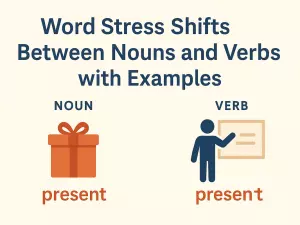
Many English words that serve as both nouns and verbs display noticeable changes in their pronunciation, especially in the placement of stress. These subtle shifts help listeners quickly distinguish between the intended grammatical roles during conversation. For example, in words like record and present, the noun form often has primary stress on the first syllable, while the verb form moves the stress to the second syllable. Such patterns are common in modern English and play a crucial part in spoken clarity.
Common patterns in stress placement
The most widespread pattern involves shifting the stress from the first syllable (noun) to the second (verb). This change not only signals the word’s function but can also slightly alter its vowel sounds and rhythm. Here are some frequently encountered examples:
- record: RE-cord (noun) → re-CORD (verb)
- permit: PER-mit (noun) → per-MIT (verb)
- object: OB-ject (noun) → ob-JECT (verb)
- conduct: CON-duct (noun) → con-DUCT (verb)
- present: PRES-ent (noun) → pre-SENT (verb)
- increase: IN-crease (noun) → in-CREASE (verb)
- export: EX-port (noun) → ex-PORT (verb)
- contract: CON-tract (noun) → con-TRACT (verb)
- refuse: RE-fuse (noun) → re-FUSE (verb)
- insult: IN-sult (noun) → in-SULT (verb)
- reject: RE-ject (noun) → re-JECT (verb)
- address: AD-dress (noun) → ad-DRESS (verb)
- misprint: MIS-print (noun) → mis-PRINT (verb)
- contest: CON-test (noun) → con-TEST (verb)
- subject: SUB-ject (noun) → sub-JECT (verb)
- progress: PRO-gress (noun) → pro-GRESS (verb)
- extract: EX-tract (noun) → ex-TRACT (verb)
- protest: PRO-test (noun) → pro-TEST (verb)
- permit: PER-mit (noun) → per-MIT (verb)
Why these shifts occur
Stress patterns in English have historical roots and are partly influenced by the origin of the word (Latin, French, or Germanic roots). The tendency to place stress at the beginning for nouns and move it to the end for verbs helps listeners process information efficiently in fast-paced speech. These shifts are not universal, but they are frequent enough to be a noticeable feature of English word formation.
Further pronunciation changes
Besides stress movement, some dual-purpose words undergo slight vowel changes or altered syllable reduction depending on their role in a sentence. For instance, use as a noun is pronounced /juːs/, while as a verb it is /juːz/. These nuances can be challenging for learners and even native speakers from different regions.
Being aware of these pronunciation shifts is key for both speaking and listening comprehension. They are a subtle, but essential, part of mastering the flexibility of English vocabulary.
Differences in meaning across noun and verb forms
It's common in English for a single word to function both as a noun and a verb, but the sense often shifts depending on which role it takes. The core idea may stay related, yet the practical meaning, nuance, or grammatical context changes. Sometimes, the noun and verb meanings are directly connected, while in other cases, the connection is more abstract or idiomatic.
Direct and Indirect Semantic Links
For many words, the noun names an object or concept and the verb describes an action connected to that object. For example, “paint” as a noun refers to the colored substance, while as a verb it means to apply that substance. In some cases, the verb has evolved a distinct sense, only loosely related to the noun.
Common Examples of Shifting Meaning
- Book: As a noun, a physical item to read; as a verb, to reserve or schedule (e.g., “book a table”).
- Run: Noun for a period or instance of running; verb for the physical act.
- Match: Noun for a contest or a stick for lighting; verb for finding something similar.
- Park: Noun for a green area; verb for leaving a vehicle in a spot.
- Change: Noun for coins or transformation; verb for making something different.
- Order: Noun for a request or arrangement; verb for requesting goods or organizing.
- Seal: Noun for an animal or a stamp; verb for closing tightly or confirming.
- Record: Noun for a physical or digital account; verb for the act of capturing information.
- Address: Noun for a location; verb for speaking to or dealing with something.
- Plant: Noun for a living organism or factory; verb for placing in the ground to grow.
- Charge: Noun for a fee or accusation; verb for billing or attacking.
- Light: Noun for illumination; verb for igniting or making something brighter.
- Wave: Noun for a moving ridge of water; verb for moving your hand as a signal.
- Watch: Noun for a timepiece; verb for observing or looking at something.
- Object: Noun for a thing; verb for expressing opposition.
- Project: Noun for a planned undertaking; verb for throwing or showing forward.
- Play: Noun for a theatrical work or activity; verb for engaging in recreation or performance.
- Ring: Noun for a circular band; verb for making a sound or calling.
- File: Noun for a collection of documents; verb for organizing or submitting documents.
- Face: Noun for the front part of the head; verb for confronting or dealing with.
Nuance and Context
Context often clarifies which meaning is intended. For instance, “She will record the meeting” (verb: to capture audio/video) versus “Listen to the record” (noun: a vinyl disc). Some forms may be pronounced differently—such as “record” (noun: RE-cord), “record” (verb: re-CORD)—illustrating how stress and context guide interpretation.
Summary Table: Noun vs. Verb Distinctions
| Word | Noun Meaning | Verb Meaning |
|---|---|---|
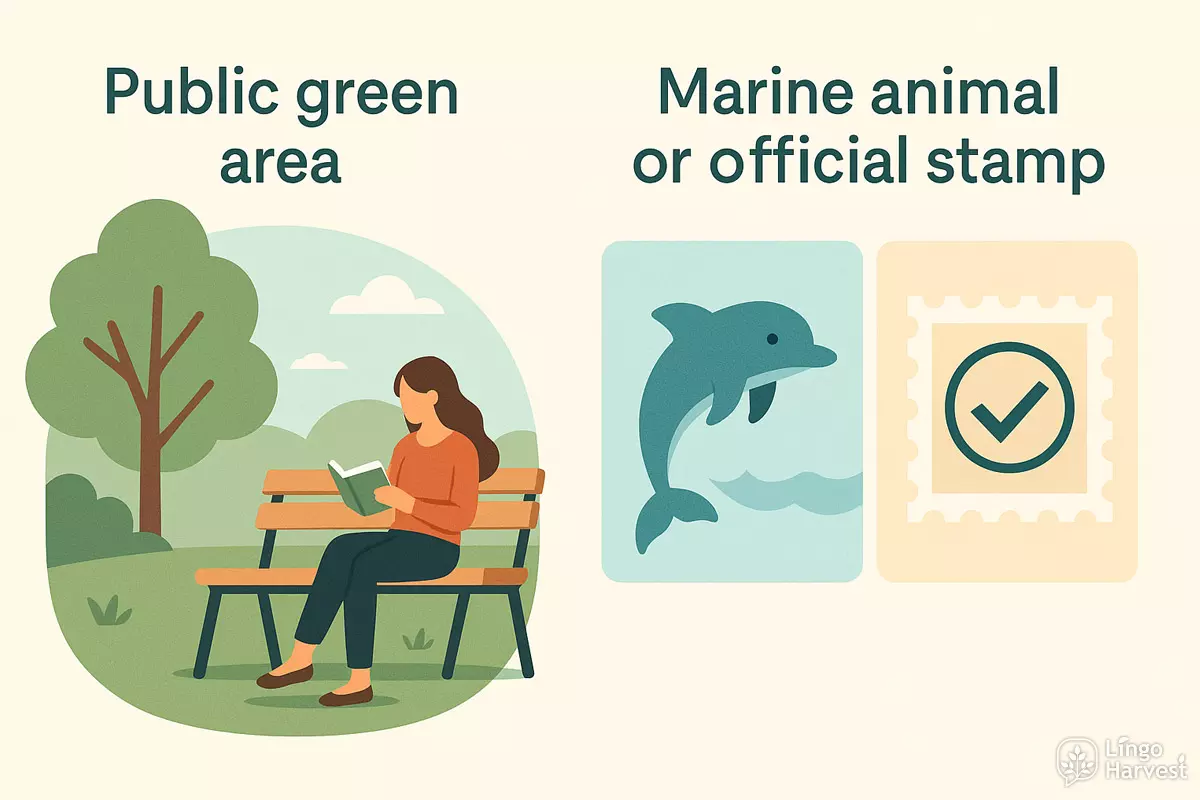
| Park | Public green area | To leave a vehicle |
| Seal | Marine animal or official stamp | To close tightly or confirm |
| Project | Planned undertaking | To throw or display outward |
| Address | Location details | To speak to or deal with |
| Order | Command or arrangement | To request or arrange |
| Light | Visible illumination | To ignite or brighten |
| Wave | Ridge of water or signal | To move the hand as a signal |
| File | Collection of documents | To organize or submit documents |
These patterns show how context, pronunciation, and even stress can influence the interpretation of words that straddle both noun and verb roles in English. Understanding these shifts helps with both comprehension and effective communication.
Typical learner confusion with word class changes
English learners often run into trouble when words shift from one part of speech to another, especially when a familiar noun suddenly acts as a verb, or vice versa. This flexibility, while a hallmark of modern English, can be perplexing for those used to more rigid grammar systems. Learners may misinterpret sentences, use incorrect forms, or fail to recognize the intended meaning because they expect a word to behave only as a noun or only as a verb.
Common misunderstandings
- Assuming fixed word roles: Many expect words like email or access to be just nouns, leading to confusion when they see "I'll email you" or "Can you access the file?"
- Incorrect verb conjugation: Learners may hesitate to add -ed or -ing to a word they only know as a noun (e.g., "texted," "messaging").
- Misplaced stress or pronunciation: Some words shift their pronunciation slightly depending on their role (e.g., record as a noun vs. record as a verb).
- Sentence parsing errors: Misreading a word’s function can cause misunderstanding of the whole sentence’s meaning.
Examples of words used as both noun and verb
- Book (noun: a novel; verb: to reserve)
- Play (noun: a performance; verb: to engage in activity)
- Run (noun: a sprint; verb: to move quickly)
- Park (noun: a green space; verb: to leave a vehicle)
- Call (noun: a phone conversation; verb: to phone someone)
- Face (noun: part of the body; verb: to confront)
- Cook (noun: a person who prepares food; verb: to prepare food)
- Change (noun: coins; verb: to make different)
- Answer (noun: a response; verb: to respond)
- Plan (noun: a strategy; verb: to make arrangements)
- Order (noun: a request or command; verb: to request something)
- Text (noun: written words; verb: to send a message)
- Record (noun: a music album; verb: to capture audio/video)
- Watch (noun: a timepiece; verb: to observe)
- Dance (noun: an event; verb: to move rhythmically)
- Ship (noun: a vessel; verb: to send something)
- Drive (noun: a journey; verb: to operate a vehicle)
- Design (noun: a plan or drawing; verb: to create a plan)
- Paint (noun: a colored substance; verb: to apply color)
- Question (noun: an inquiry; verb: to ask)
Spotting the difference in context
Context is key when identifying whether a word is functioning as a noun or a verb. Word order, surrounding words, and sentence structure offer clues. For example, in "They run every morning," run is clearly a verb, while in "She went for a run," it's a noun.
Summary: Why does this matter?
Understanding these shifts is essential for accurate reading, listening, and speaking. It helps learners avoid mistakes such as "I will park in the park" (where both park are used correctly, but with different meanings), and improves confidence when encountering new vocabulary used in unexpected ways.
Practice: choose correct function in mixed sentences
Understanding whether a word is acting as a noun or a verb in context is essential for clear communication in English. Below, you’ll find practice sentences featuring words that can serve both roles. Read each sentence carefully and decide if the highlighted word is functioning as a noun or a verb. This exercise will help you sharpen your grammatical intuition and deepen your understanding of flexible English vocabulary.
Identify the Function: Noun or Verb?
- She runs every morning before breakfast.
- The run was longer than usual today.
- Can you book us a table for dinner?
- He read an interesting book about history.
- They watch movies together on weekends.
- He glanced at his watch to check the time.
- Would you record the meeting for those who can’t attend?
- The record was broken in the 100m sprint.
- Let’s play chess this evening.
- The school’s annual play was a success.
- She likes to paint in her free time.
- The paint on the wall is peeling.
- He will call you later tonight.
- I missed your call this morning.
- They plan to travel next summer.
- The plan was approved by everyone.
- Please answer the question honestly.
- Your answer was very clear.
- The children race to the playground after school.
- The race begins at 9 a.m.
Show answers
- 1. verb
- 2. noun
- 3. verb
- 4. noun
- 5. verb
- 6. noun
- 7. verb
- 8. noun
- 9. verb
- 10. noun
- 11. verb
- 12. noun
- 13. verb
- 14. noun
- 15. verb
- 16. noun
- 17. verb
- 18. noun
- 19. verb
- 20. noun
Common Patterns to Help You Decide
Here are some clues to help you distinguish between noun and verb uses:
- Verbs often follow a subject (She runs), come after "to" (to book), or are part of verb phrases (will call).
- Nouns frequently follow articles (a run), possessives (her answer), or adjectives (annual play).
Quick Reference: Examples in Sentences
- He painted the wall. (verb)
- The paint dried quickly. (noun)
- She hopes to record a new song. (verb)
- The record is on the shelf. (noun)
- They plan carefully. (verb)
- The plan worked. (noun)