Determiners in Formal vs Informal English: stylistic differences

 The article explains how determiner choice in English reveals style and tone. It covers formal patterns with the, each, every, and any, informal uses like this or those, and includes practice changing informal sentences to formal ones.
- How style affects determiner choice in English
- More precise determiners in formal and academic contexts
- Looser and more flexible use in everyday speech and messages
- Typical formal patterns with the, each, every, and any
- Informal uses of this, that, these, those in conversation
- Recognizing tone shifts through determiner choice
- Practice: change informal sentences to more formal versions
Selecting precise words to clarify meaning can significantly enhance your writing style, particularly when shifting from everyday conversation to more formal, academic contexts. The use of small yet impactful modifiers such as articles and quantifiers often signals whether your language is casual or official, which in turn influences the overall tone and clarity of your message. By paying attention to these subtle elements, you can ensure your writing is both effective and appropriate for your intended audience.
How style affects determiner choice in English
The register of English—whether formal or informal—has a noticeable impact on which determiners speakers and writers prefer. In more official or academic settings, people tend to select determiners that sound precise and impersonal, while everyday conversation often favors simpler, more familiar forms.
Formal contexts: precision and clarity
In professional, academic, or official writing, determiners are chosen to avoid ambiguity and convey exact meaning. For example, words like each, every, any, and either often appear in contracts, reports, or scholarly articles. This style helps readers interpret statements unambiguously.
- Each participant must sign the agreement.
- Any deviation will be documented.
- Neither proposal was accepted.
- The aforementioned document outlines the procedure.
- Such measures are necessary.
Informal contexts: simplicity and familiarity
Conversational English, texts, and casual emails generally use basic determiners like some, a, this, and these. The tone is friendly and direct, often skipping determiners altogether when context makes meaning clear.

- Some people just don’t get it.
- A friend of mine called.
- This guy was hilarious.
- These shoes are comfy.
- Got any milk?
Comparing determiner usage: formal vs informal
| Style | Typical Determiners & Example Sentences |
|---|---|
| Formal |
|
| Informal |
|
Shifts in determiner choice
Switching from a formal to an informal tone often means swapping out exact or technical determiners for more accessible ones. For instance, the aforementioned issue in a report might become that thing in a chat. The choice depends not just on grammar, but on how speakers want to connect with their audience.
Overall, the style of communication subtly guides whether speakers use precise, sometimes elaborate determiners or stick to those that feel natural and conversational.
More precise determiners in formal and academic contexts
Writers and speakers in academic or professional settings tend to choose their determiners more carefully to avoid ambiguity. Instead of relying on general terms like "some" or "a few," they opt for expressions that specify exact quantities, relationships, or limitations. This precision helps readers and listeners understand the scope and intent of the statements.
Common types of precise determiners
- Quantitative determiners: many, several, numerous, a majority of, a minority of, a total of, at least, at most, fewer than, more than, exactly
- Demonstratives with specificity: this particular, that specific, these aforementioned, those previously mentioned
- Distributives: each, every, either, neither, any one of, all of the
- Partitive structures: a portion of, a subset of, a percentage of, a fraction of
- Definite determiners: the aforementioned, the latter, the former
Examples: informal vs. formal usage
| Informal Expression | Formal/Academic Equivalent |
|---|---|
| some students | a number of students / several students |
| a lot of evidence | substantial evidence / considerable evidence |
| all the results | the entire set of results |
| these things | these items / these factors / these variables |
| most people | the majority of individuals |
| some of them | a subset of the participants |
| lots of reasons | numerous reasons |
| the other study | the aforementioned study / the previously cited study |
| a few problems | a limited number of issues |
| any book | any given publication |
Why specificity matters
Greater specificity helps academic communication by reducing misunderstandings and clarifying the writer’s intent. For example, stating "a majority of respondents" instead of "most people" makes the claim clearer and easier to verify. Similarly, "the aforementioned results" signals a direct reference to previously discussed information, which is crucial for logical flow and citation.
Tips for using precise determiners
- Replace vague quantifiers (like "some," "many") with exact numbers or proportions when possible.
- Use partitive expressions ("a percentage of," "a subset of") to indicate partial groups.
- Refer back to earlier information with determiners like "the aforementioned," "the latter," or "the former" for clarity.
- Choose determiners that match the level of detail needed for your audience and purpose.
Precision in determiner choice is a key feature of clear and effective academic writing. This practice not only enhances credibility but also supports rigorous argumentation and analysis.
Looser and more flexible use in everyday speech and messages
In informal conversation and text messaging, determiners are often used with much less rigidity than in academic or professional writing. People frequently drop articles, use demonstratives in creative ways, or substitute one determiner for another without causing confusion. This relaxed approach reflects the focus on ease and speed over grammatical precision.
Common patterns in casual English
Speakers tend to bend the rules in several predictable ways. For instance, articles like "the" or "a" may be omitted when the context is clear. Demonstratives such as "this" and "that" are sometimes used for emphasis or to signal attitude rather than just to specify. Quantifiers are also frequently chosen for expressiveness, not just accuracy.
- Leaving out "the" or "a": "Going to store" instead of "Going to the store"
- Using "this" or "these" for emphasis: "Look at this mess!"
- Mixing up "some" and "any": "Got any milk?" / "Got some milk?"
- Doubling determiners: "That my friend" instead of "That is my friend"
- Using "them" as a determiner: "Them shoes are cool"
- Overusing "that" for storytelling: "So then this guy, right, he just walks in..."
- Dropping determiners in lists: "Need eggs, bread, milk"
- Informal quantifiers: "A bunch of stuff," "Loads of people"
- Using "a" where "an" is expected: "A apple" (common in rapid speech)
- Flexible use of "some": "Can I get some water?" (even for singular)
- Replacing "any" with "some" in questions: "Did you get some news?"
- Contractions: "'s a problem" for "It is a problem"
- Regional/dialectal forms: "Y'all got any questions?"
- Redundant determiners: "That there car"
- Non-standard forms: "This here book"
- Leaving out determiners entirely: "Want coffee?"
Comparison: Standard vs. informal determiner usage
| Standard (Formal) | Informal / Everyday Speech |
|---|---|
| I need an umbrella. | Need umbrella. |
| Are there any problems? | Got any problems? |
| This is the car I bought. | This my car. |
| Do you have some time? | Got some time? |
| The children are playing outside. | Kids playing outside. |
| Is that your phone? | That your phone? |
Why is this flexibility common?
Efficiency and shared context drive these relaxed patterns. In face-to-face or rapid digital communication, listeners can fill in gaps based on situation and prior knowledge. The result is a more direct, sometimes playful, and always context-driven style of determiner use. While not always "correct" by formal standards, these choices rarely hinder understanding among native speakers.
Typical formal patterns with the, each, every, and any
In formal English, certain determiners—such as "the," "each," "every," and "any"—are used in specific ways to convey precision and clarity. These words often appear in legal, academic, or official contexts, where exactness is crucial.
The definite article "the"
"The" is favored in formal writing to specify or single out particular nouns. Writers use it to refer to unique objects, previously mentioned items, or things considered common knowledge.
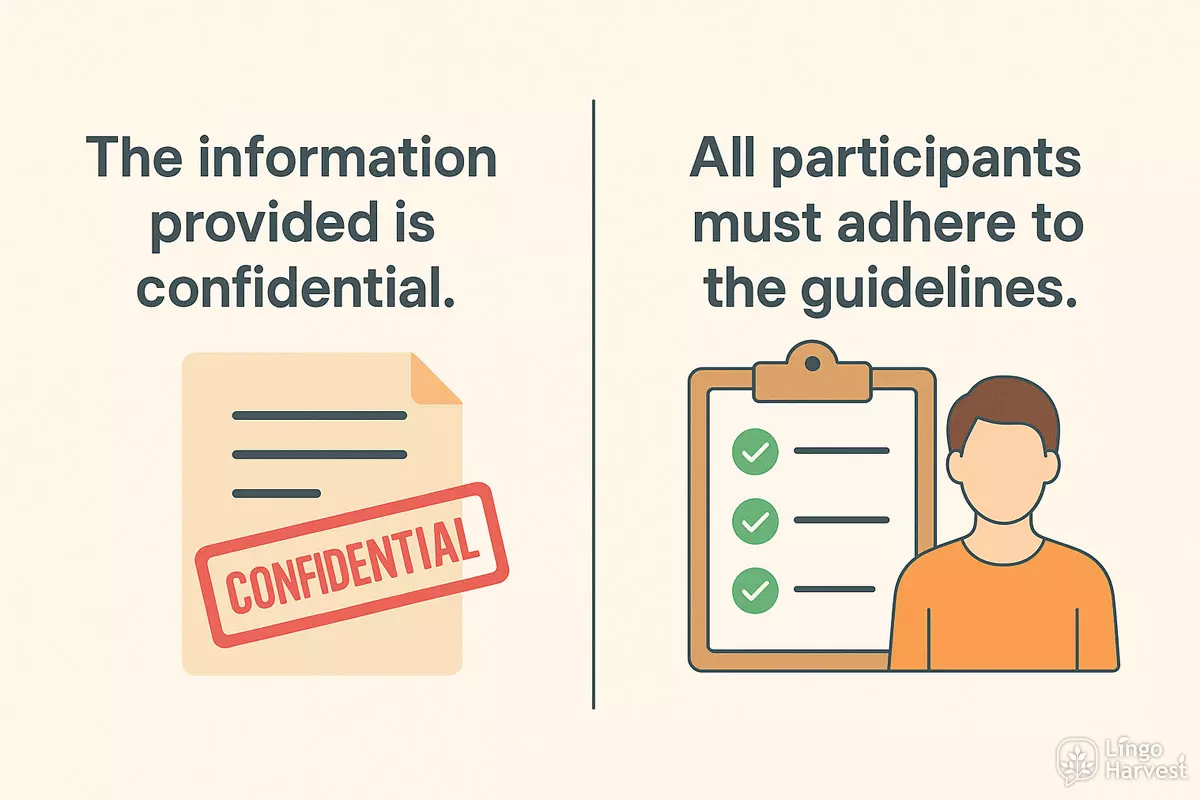
- The applicant must submit the required documents.
- The information provided is confidential.
- All participants must adhere to the guidelines.
Patterns with "each" and "every"
In elevated registers, "each" and "every" help express universality and individual treatment. "Each" emphasizes individuality, while "every" focuses on the group as a whole. These determiners are common in policy, instructions, and contracts.
| Determiner | Formal Example | Function |
|---|---|---|
| Each | Each employee must complete the form. | Highlights individual responsibility |
| Every | Every applicant is required to attend the briefing. | Applies the rule to all members of a group |
| Each of the | Each of the documents was reviewed. | Focuses on items within a specified set |
| Every one of | Every one of the proposals was considered. | Emphasizes the entirety of a group |
Use of "any" in formal contexts
"Any" is often used to broaden scope or indicate lack of restriction, especially in formal notices or requirements. It can introduce conditions, possibilities, or permissions.
- Should you have any questions, please contact the office.
- Any unauthorized use is prohibited.
- Applicants may submit any relevant documentation.
- The committee did not find any errors in the report.
Further examples of formal determiner usage
These constructions illustrate how determiners are chosen for precision and formality:
- Each participant must sign the attendance sheet.
- Every seat must be reserved in advance.
- The decision rests with the board.
- Any changes must be approved by management.
- The results of the study will be published.
- Each section of the report addresses a different issue.
- Every effort will be made to ensure accuracy.
- Any person entering the premises must have identification.
- The meeting will begin at the scheduled time.
- Each of the items listed below is mandatory.
In summary, the choice and placement of determiners like "the," "each," "every," and "any" are central to the tone and clarity of formal English. Mastery of these patterns ensures your writing is both precise and appropriately styled for formal settings.
Informal uses of this, that, these, those in conversation
In casual spoken English, "this," "that," "these," and "those" often take on extra functions beyond their textbook definitions. Speakers use them not just to point out objects, but also to add nuance, emotion, and attitude—sometimes even standing in for entire ideas or stories. Understanding these flexible uses helps you sound more natural and catch subtle meanings in everyday dialogue.
Pointing to Experiences and Stories
People often use "this" or "that" when introducing anecdotes or referencing shared knowledge, even if no physical object is present. For example:
- "So, this guy comes up to me and says..." (introducing a story)
- "Remember that time we got lost downtown?" (referring to a shared experience)
Expressing Attitude or Emotion
Demonstratives can carry a tone—sometimes showing approval, surprise, or even annoyance. Compare:
- "Ugh, that noise again!" (annoyance)
- "I love this song!" (enthusiasm)
- "Are you bringing those friends of yours?" (possibly skeptical or teasing)
Highlighting or Contrasting
Speakers use these words to compare or emphasize differences, especially in informal arguments or explanations:
- "I want this one, not that one."
- "These are fresh, those are old."
Filling in for Nouns and Ideas
Sometimes, demonstratives stand alone, referring back to something previously mentioned or understood from context:
- "I can't believe this." (unspecified, but clear in context)
- "Those were the days." (nostalgic reference)
Common Informal Patterns
Here's a list of typical conversational uses that go beyond strict grammar rules:
- "Check out this!" (instead of "Check this out!")
- "That was epic."
- "I need one of these."
- "Who’s that?" (when someone approaches)
- "This is what I’m talking about."
- "Don’t give me that!" (meaning ‘that attitude’ or ‘that excuse’)
- "All these people are here for you?"
- "That’s so you." (meaning ‘typical of you’)
- "I can’t with these." (expressing exasperation)
- "You know those days when nothing goes right?"
- "Is this your bag?"
- "What’s that supposed to mean?"
- "I’m over this."
- "Those look delicious."
- "This again?" (when something repeats)
Comparing Formal and Informal Usage
| Context | Informal Example |
|---|---|
| Storytelling or anecdotes | "So, this friend of mine calls me at midnight..." |
| Reacting emotionally | "That was amazing!" / "I can’t with these." |
| Referring to shared experiences | "Remember those trips we took last summer?" |
| Replacing specific nouns or ideas | "I don’t get this." / "Those were the days." |
| Highlighting differences | "I want this, not that." |
The flexible use of demonstratives in friendly conversation lets speakers be expressive and efficient. Picking up on these patterns helps you sound more natural and understand the subtle shades of meaning in everyday English.
Recognizing tone shifts through determiner choice
When comparing formal and informal English, subtle choices like which determiners to use can signal a shift in tone. The words we select at the start of a noun phrase—such as “these,” “some,” or “the”—can make our language sound more precise, distant, friendly, or casual. Paying attention to these small words helps readers and listeners pick up on the speaker’s intentions and the context of the conversation.
How determiners influence formality
In formal contexts, you’ll notice a preference for more explicit, unambiguous determiners. For instance, “each,” “every,” and “any” often appear in academic or official writing, emphasizing clarity and universality. Informal speech, on the other hand, favors relaxed and sometimes less precise words like “a bunch of,” “some,” or “this” in place of more specific terms. These choices can make the text feel friendlier or more conversational.
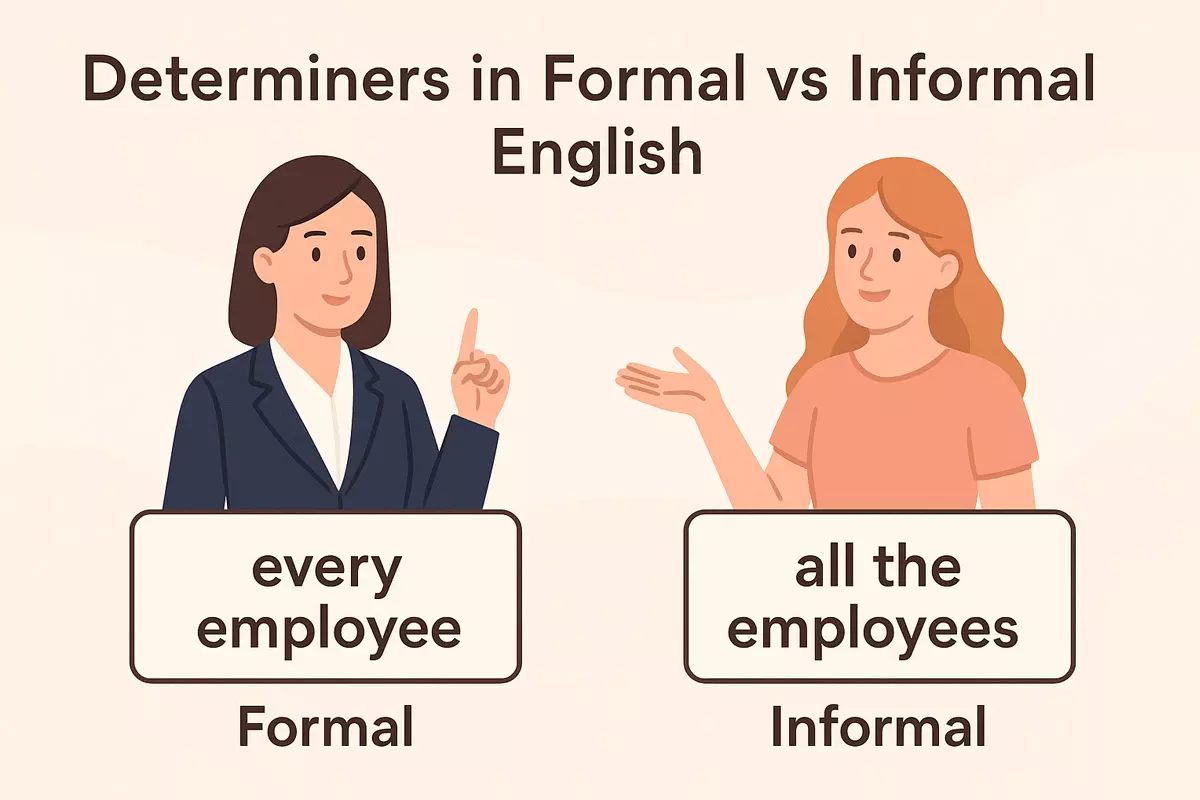
- Formal: “Each participant was evaluated.”
- Informal: “All the guys got checked out.”
- Formal: “Any individual may apply.”
- Informal: “Anyone can try for it.”
- Formal: “These findings suggest…”
- Informal: “This stuff shows…”
- Formal: “The aforementioned issue…”
- Informal: “That thing we talked about…”
- Formal: “Much of the evidence…”
- Informal: “A lot of the proof…”
- Formal: “Several factors contribute…”
- Informal: “A few things make it happen…”
- Formal: “Little progress was made.”
- Informal: “Not much happened.”
- Formal: “No further information is available.”
- Informal: “There’s nothing else to say.”
- Formal: “Those responsible…”
- Informal: “The folks who did it…”
Spotting tone shifts in context
Switching between formal and informal determiners often signals a change in a writer’s or speaker’s attitude. For example, using “the aforementioned” instead of “that” can distance the writer from the subject, while “this” or “these” brings the subject closer and more immediate. In emails, lectures, or essays, these choices can subtly shift how the message feels—whether it’s authoritative, neutral, or personal.
| Determiner Use | Effect on Tone |
|---|---|
| “Each applicant must…” | Precise, distant, formal |
| “Some people think…” | General, relaxed, informal |
| “That issue was resolved.” | Casual, personal, informal |
| “The aforementioned concern…” | Impersonal, authoritative, formal |
Understanding these subtle shifts is useful for tailoring your language to different audiences and situations. Whether you’re aiming for formality or a relaxed vibe, your determiner choices play a key role in shaping the overall impression.
Practice: change informal sentences to more formal versions
When shifting from casual to formal English, determiners often need to be adjusted for precision and tone. Below, you'll find a set of informal sentences that illustrate common choices in everyday conversation. Your task is to rewrite each sentence, making it suitable for academic, business, or official contexts. Pay special attention to determiners like "some," "a lot of," "that," and "these," as their formal equivalents can subtly change the impression your writing makes.
Exercise: Revise the following sentences
Rewrite each sentence so it sounds appropriate for a formal letter, report, or presentation. Focus on the use of determiners and overall stylistic upgrades.
- Can you send me some info about your products?
- Lots of people don’t agree with that idea.
- We need to fix these problems ASAP.
- That guy gave us a bunch of advice.
- There’s a lot of stuff we still have to do.
- She handed in her essay late and it had a ton of mistakes.
- Any chance you could give me a hand with this?
- He just wanted to talk about his own thing.
- We don’t have enough of those parts to finish.
- This sort of thing isn’t a big deal.
- They gave out some free samples at the event.
- We got a few questions after the speech.
- Everyone got their own copy of the handout.
- Can I get some more details?
- They didn’t provide any explanation.
- There’s something wrong with the report.
- He picked up a couple of things at the store.
- Are you gonna need all of those chairs?
- It’s not really my thing.
- They’re doing stuff for charity.
Show answers
- Could you please provide further information regarding your products?
- Many individuals do not support that proposal.
- We must address these issues as soon as possible.
- That individual offered us considerable advice.
- There are numerous tasks that remain to be completed.
- She submitted her essay late and it contained numerous errors.
- Would it be possible for you to assist me with this?
- He wished to discuss his own matter.
- We do not have a sufficient quantity of those components to complete the task.
- This type of issue is not significant.
- Complimentary samples were distributed at the event.
- We received several questions following the presentation.
- Each participant received an individual copy of the handout.
- Could you provide additional details?
- No explanation was provided.
- There appears to be an issue with the report.
- He purchased several items at the store.
- Will you require all of those chairs?
- It does not particularly interest me.
- They are participating in charitable activities.
Tips for Formalizing Determiners
- Replace vague quantifiers ("a bunch of," "lots of") with more precise terms ("several," "numerous," "a significant amount of").
- Use "individual" or "participant" instead of "guy" or "person" when clarity and respect are needed.
- Choose "provide" or "submit" over "give" or "hand in."
- Transform contractions ("there’s," "it’s") into their full forms ("there is," "it is").
- Swap "stuff" and "things" for specific nouns or "matters," "tasks," "items," etc.
- Use passive voice or impersonal constructions to increase formality when appropriate.