Determiners in Business and Professional Writing

 Here we why clear determiners are essential in business writing, including how to reference documents, specify quantities and deadlines, avoid vague terms in contracts, and use precise language in reports, proposals, meeting notes, and requests.
- Why determiners matter in business documents and emails
- Using the and this to refer to specific documents and actions
- Talking about quantity and deadlines with clear determiners
- Avoiding vague phrases like some and many in contracts
- Typical patterns in reports, proposals, and meeting notes
- Polite and precise reference in requests and offers
- Practice: improve short business texts by fixing determiners
Selecting precise language is crucial for effective business and professional communication, as it helps clarify meaning and reduce misunderstandings. Even seemingly minor elements such as articles and quantifiers can significantly influence how a message is interpreted by others. By carefully choosing your words, you convey information more accurately and demonstrate professionalism, which strengthens your credibility and fosters clearer, more productive interactions in the workplace.
Why determiners matter in business documents and emails
In the context of workplace writing, determiners play a crucial role in shaping meaning, precision, and tone. Whether you’re drafting a contract, sending a project update, or clarifying a request, the correct use of determiners—like “the,” “this,” “every,” or “some”—can make your message much clearer and more professional. Missing or misusing these small words often leads to confusion, ambiguity, or even costly misunderstandings.
Clarity and Specificity
Choosing the right determiner helps your reader know exactly what you’re referencing. For instance, “the report” refers to a specific document, while “a report” could mean any report. This distinction is especially important when multiple similar items exist, or when actions or deadlines depend on precise instructions.
- “This contract” vs. “a contract” – one is specific, the other is general
- “Each team member” vs. “all team members”
- “Some feedback” vs. “the feedback”
Professional Tone and Politeness
How you frame your requests or statements often depends on determiners. For example, “Could you send me the invoice?” is more direct than “Could you send me an invoice?” The former implies a specific, known document; the latter is broader and less pointed. Similarly, “any questions” signals openness, while “your questions” personalizes the invitation.
Common Determiners in Professional Writing
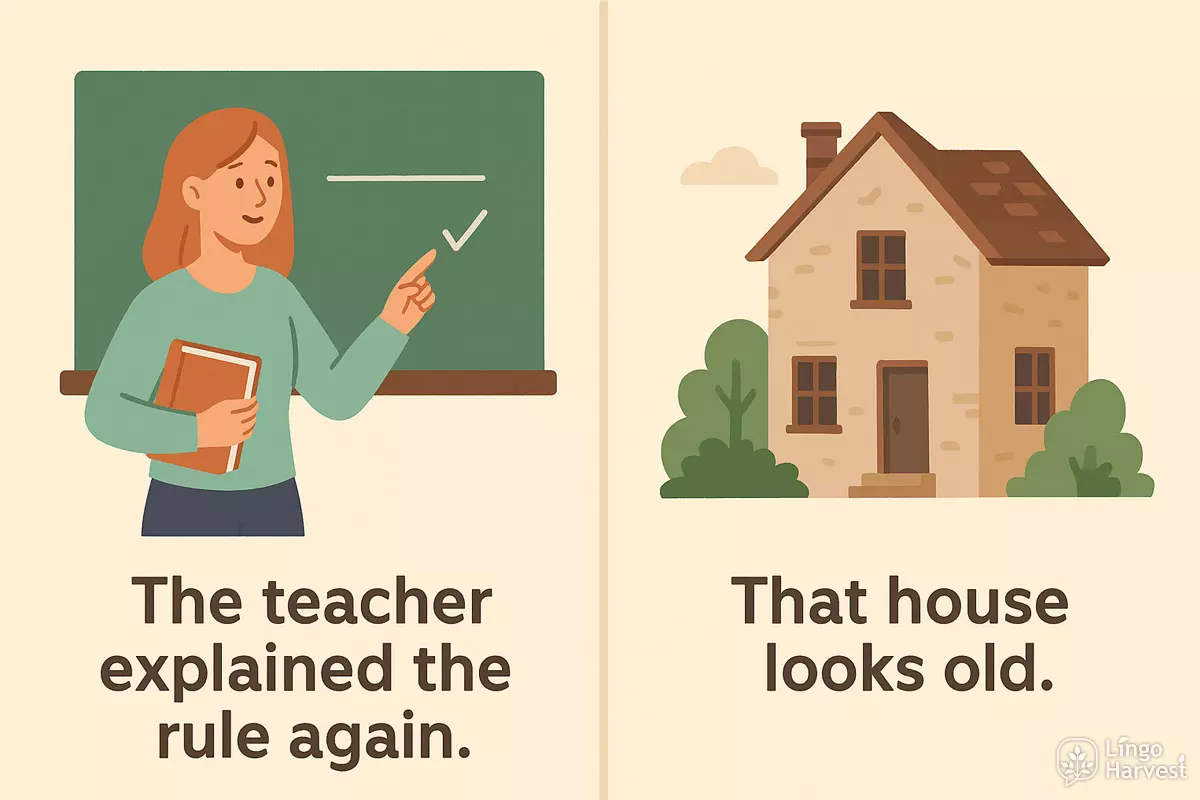
Using a variety of determiners appropriately helps maintain engagement and avoids repetition. Here are some frequently used options in business writing:
- the → The teacher explained the rule again.
- a / an → I saw a dog in the street. / She bought an apple.
- this / that → This book is mine. / That house looks old.
- these / those → These shoes are new. / Those students are from Spain.
- my / our / your / their → My phone is dead. / Our team won. / Is this your bag? / Their car is parked outside.
- each / every → Each child got a gift. / Every student must register.
- some / any → I need some help. / Do you have any questions?
- no → There is no solution to this problem.
- another → Can I have another cup of tea?
- either / neither → You can choose either option. / Neither answer is correct.
- such → It was such a difficult test.
- which / what / whose → Which book do you want? / What time is it? / Whose jacket is this?
Impact of Determiner Choice: Examples
Even small changes in wording can affect how your message is received. Consider the following pairs:
| With Determiner | Without / Different Determiner |
|---|---|
| Please review the proposal by Friday. | Please review a proposal by Friday. |
| We need every signature by noon. | We need signatures by noon. |
| I have attached this month’s statement. | I have attached a statement. |
| Let me know if you need any assistance. | Let me know if you need assistance. |
| We discussed those issues yesterday. | We discussed issues yesterday. |
Reducing Ambiguity and Risk
Ambiguous references can lead to missed deadlines, duplicated work, or strained relationships. Precision in language, especially through careful determiner use, reduces the risk of misinterpretation. This is especially true in international or cross-functional teams, where linguistic nuances matter even more. In summary, sharpening your awareness of determiners is a simple yet powerful way to enhance the clarity, tone, and effectiveness of your business writing.
Using the and this to refer to specific documents and actions
Precision in business and professional writing often depends on how you reference documents, processes, and actions. Articles like "the" and demonstratives such as "this" help direct your reader’s attention to specific items or steps, ensuring clarity and reducing ambiguity.
When to Use "the"
Use "the" to point to a particular document or action already mentioned or well-known in the context. This definite article indicates that both writer and reader share an understanding of which item is being discussed. For example:
- “Please review the attached proposal.”
- “The meeting agenda outlines our next steps.”
- “I have updated the contract as requested.”
In these examples, "the" signals that there is only one proposal, agenda, or contract relevant to the current discussion.
How "this" Adds Emphasis and Immediacy
"This" draws attention to a document or action that is immediate, just mentioned, or about to be introduced. It often signals that something is of current importance or is the focus of the next steps. For instance:
- “This report summarizes our findings.”
- “Refer to this section for further details.”
- “I recommend this course of action.”
"This" can also be useful in guiding readers through complex documents, ensuring they know exactly which part or action is being referenced.
Common Contexts and Examples
Writers frequently rely on "the" and "this" in the following professional scenarios:
- Clarifying which version of a document is relevant
- Directing attention to a specific process or step
- Highlighting a newly introduced proposal or idea
- Signaling that a document is attached or enclosed
- Describing follow-up actions or conclusions
- Referencing particular data or findings
- Identifying a specific requirement or policy
- Pointing to a section within a report or manual
- Emphasizing the importance of a current task
- Distinguishing between multiple items previously listed
- Summarizing a previous discussion or agreement
- Addressing a concern raised in a prior meeting
- Clarifying points in a chain of correspondence
- Assigning responsibility for a specific action
- Connecting an action to a referenced deadline
- Introducing a new procedure or guideline
- Outlining the next steps in a project
- Providing instructions tied to a particular document
Comparison: "The" vs. "This" in Business Writing
| Usage | Example |
|---|---|
| Refers to a known or previously mentioned item | The invoice was sent yesterday. |
| Points to something immediate, just referenced, or about to be introduced | This invoice needs your approval. |
| General reference to a unique document or action in context | Please sign the agreement. |
| Emphasizes the importance or relevance of a current item | This agreement outlines our terms. |
Choosing the right determiner—whether "the" for shared references or "this" for immediacy—improves accuracy and reader understanding in professional communication. Aim for consistency and clarity, especially when multiple documents or actions are involved.
Talking about quantity and deadlines with clear determiners
Precise communication is essential in business and professional writing, especially when discussing amounts and time frames. Using clear determiners helps eliminate ambiguity, ensuring all parties understand requirements and expectations. Whether you are specifying the number of items, the extent of a task, or a project deadline, the right choice of determiner makes your message direct and actionable.
Common determiners for expressing quantity
When you need to state how much or how many, determiners provide necessary clarity. Choosing the proper term depends on whether the noun is countable or uncountable, as well as the level of specificity required.
- All (e.g., All team members must attend the meeting.)
- Each (e.g., Each invoice must be approved.)
- Every (e.g., Every report is reviewed weekly.)
- Some (e.g., Some documents are missing.)
- Any (e.g., Any feedback is appreciated.)
- Many (e.g., Many clients requested changes.)
- Much (e.g., Much time was spent on revisions.)
- Few (e.g., Few errors were found.)
- Several (e.g., Several proposals were submitted.)
- Most (e.g., Most projects are on track.)
- Numerous (e.g., Numerous attempts were made.)
- Less (e.g., Less paperwork is required now.)
- More (e.g., More information will follow.)
- No (e.g., No updates are available.)
- Plenty of (e.g., There is plenty of time.)
- Both (e.g., Both options are viable.)
- Either (e.g., Either solution works.)
- Neither (e.g., Neither document is finalized.)
- Enough (e.g., Enough resources have been allocated.)
Determinants for setting deadlines and time frames
In professional settings, deadlines must be unambiguous. Determiners help specify exact dates, time periods, and expectations. This is critical for project management, deliverables, and scheduling.
- Each week → Each week we submit a progress report.
- Every month → Every month the team reviews its goals.
- All submissions by Friday → All submissions must be uploaded by Friday.
- No extensions → No extensions are allowed for this deadline.
- Some tasks due tomorrow → Some tasks are due tomorrow, so please prioritize them.
- Any updates before noon → Any updates before noon should be sent by email.
- Several days left → There are still several days left before the exam.
- Most deadlines are next quarter → Most deadlines are scheduled for the next quarter.
- Both projects due this month → Both projects must be completed this month.
- Few hours remaining → Only a few hours remain before the presentation.
Comparison of determiners in quantity and deadline phrases
| Quantity Example | Deadline/Time Frame Example |
|---|---|
| All documents are signed. | All documents must be submitted by 5 PM. |
| Each client received a copy. | Each client will be contacted this week. |
| Some questions remain unanswered. | Some responses are expected by Monday. |
| Few complaints were recorded. | Few days remain before the deadline. |
| No errors were detected. | No extensions will be granted. |
| Several items are out of stock. | Several tasks are due tomorrow. |
Selecting the right determiner for quantity or timing not only clarifies your intent but also supports efficient workflow and accountability. Clear language helps teams prioritize, allocate resources, and meet expectations without confusion.
Avoiding vague phrases like some and many in contracts
Precision matters in legal and business documents. Indefinite terms such as “some,” “many,” or “several” can lead to confusion, misinterpretation, and even costly disputes. When parties use these ambiguous determiners, the scope of obligations and rights often becomes unclear, making enforcement and compliance difficult.
Why Specificity Is Crucial
Contracts are intended to clarify the expectations and responsibilities of all parties. Using unclear quantifiers leaves room for disagreement. For example, stating that “some payments must be made in advance” invites arguments about how many payments are required and when. A more precise statement eliminates uncertainty.
Problematic Vague Determiners
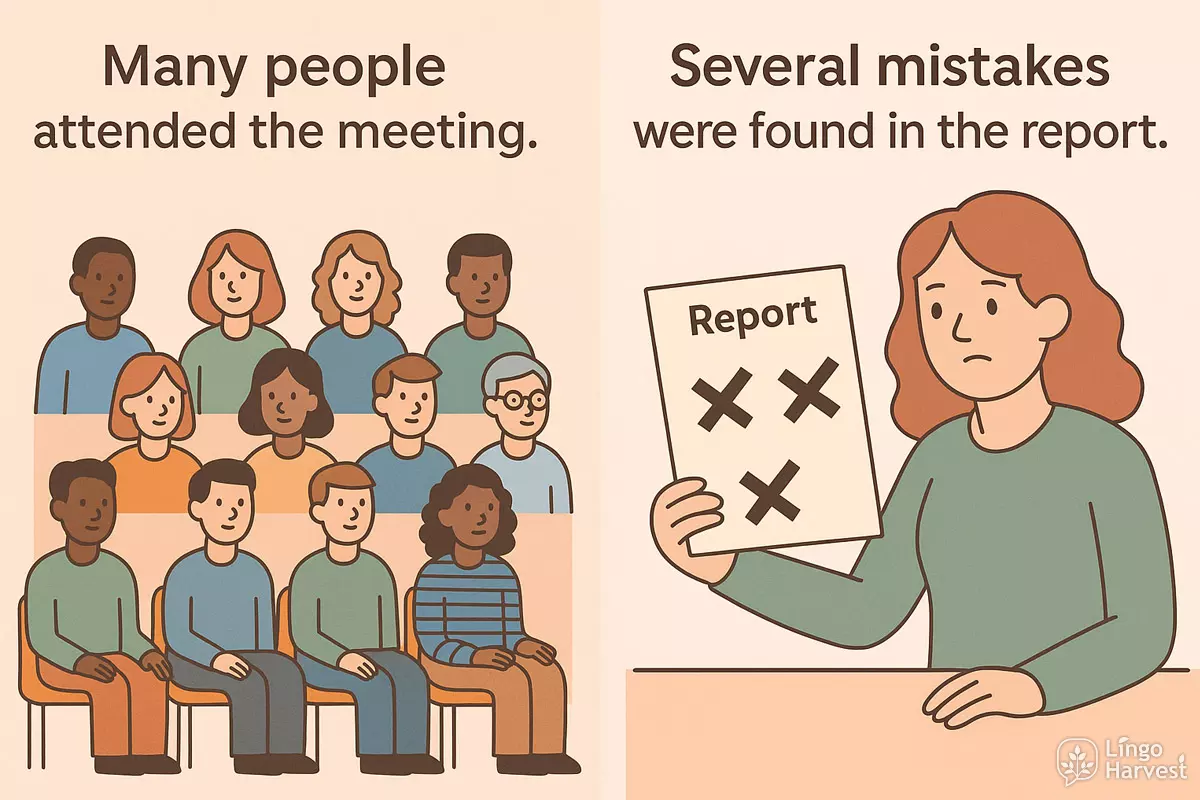
Writers should be wary of determiners that lack exactness, including:
- some → Some students stayed after class.
- many → Many people attended the meeting.
- several → Several mistakes were found in the report.
- a few → A few guests arrived early.
- various → Various problems were discussed.
- numerous → Numerous studies support this idea.
- certain → Certain details were left out.
- about → About thirty people joined the tour.
- approximately → Approximately ten minutes are left.
- few → Few employees understood the new rule.
- multiple → The system detected multiple errors.
- occasional → She makes occasional mistakes.
- frequent → He is a frequent visitor to the library.
- periodic → Periodic checks are required.
- varied → The menu offers a varied selection of dishes.
- variety of → A variety of options is available.
These words may seem harmless, but in contracts, each can be a source of ambiguity.
Clear Alternatives for Contract Language
Replacing imprecise quantifiers with exact figures or defined thresholds is a best practice. Consider these alternatives:
- “all invoices” instead of “some invoices”
- “at least three meetings per year” rather than “several meetings”
- “no more than $5,000” instead of “about $5,000”
- “between 10 and 15 units” instead of “a few units”
- “on each occasion” rather than “occasionally”
- “every employee” instead of “many employees”
- “the following items: [list]” instead of “various items”
- “once per quarter” instead of “periodically”
- “within 30 days” rather than “within about a month”
- “at least 80% of…” instead of “most of…”
Common Vague Phrases and Precise Replacements
| Vague Phrase | Clear Alternative |
|---|---|
| some of the products | specifically listed products: A, B, and C |
| many times | on no fewer than five occasions |
| about $2,000 | exactly $2,000 |
| various services | services detailed in Section 2.1 |
| several weeks | three weeks |
| a few employees | employees identified in Exhibit A |
| periodically | every 90 days |
| most items | at least 90% of items |
Tips for Drafting with Precision
- Define every group or quantity referenced in the contract.
- Use numbers, dates, and lists instead of general terms.
- Cross-reference specific sections or exhibits for clarity.
- When ranges are necessary, state them explicitly (e.g., “between 5 and 10 days”).
- Seek legal review to ensure language is unambiguous.
Clear, well-defined language helps all parties understand and uphold their obligations, minimizing the risk of disputes. Precise determiners are a vital tool for this clarity in professional writing.
Typical patterns in reports, proposals, and meeting notes
In business and professional writing, determiners play a crucial role in shaping clarity, tone, and precision. Reports, proposals, and meeting notes each favor certain structures that help convey information efficiently and avoid ambiguity. Understanding these patterns can make your documents more effective and reader-friendly.
Common determiner usage in formal documents
Writers often use determiners to specify, generalize, or limit meaning. In formal business texts, this helps prevent misinterpretation and ensures that responsibilities, timelines, and data are clearly referenced.
- The project timeline (indicates a specific timeline)
- Each department’s responsibilities (emphasizes individual accountability)
- Several options were considered (non-specific, but more than one)
- All stakeholders must approve (inclusive, no exceptions)
- Any revisions should be submitted by Friday (open, but time-bound)
- No further action required (absolute, closes discussion)
- This quarter’s results (time-bound, specific)
- That approach was rejected (refers to something previously mentioned)
- Some team members expressed concerns (unspecified subset)
- Another solution will be explored (alternative, not yet chosen)
- Few objections were raised (minimizes impact)
- Many clients requested updates (emphasizes scale)
- Most issues were resolved (majority, not all)
- Each proposal must be reviewed (individual attention)
- Every meeting note is archived (comprehensive)
- Neither option was feasible (excludes both choices)
- Both recommendations were accepted (includes two, equally)
- Our findings suggest... (shows ownership)
- Their feedback was incorporated (attribution)
- Its impact remains unclear (refers to a singular entity)
Typical errors and effective choices
Misusing determiners can lead to confusion, such as using "a" when "the" is needed, or omitting determiners entirely. For example, writing "project will start" instead of "the project will start" can make the sentence vague.
| Problematic Usage | Preferred Pattern |
|---|---|
| Project will start next week. | The project will start next week. |
| Send report to manager. | Send the report to the manager. |
| Meeting is scheduled for Monday. | The meeting is scheduled for Monday. |
| Feedback was positive. | The feedback was positive. |
| Provide update by Friday. | Provide an update by Friday. |
Style tips for clear professional communication
Aim for consistency when referring to specific items or groups. Use definite articles for known entities and indefinite or quantifying determiners for generalizations. This approach helps readers track references and understand the scope of your statements, especially in collaborative environments where precision is valued.
Polite and precise reference in requests and offers
When crafting requests or offers in business and professional contexts, the choice of determiners can subtly influence tone, clarity, and the perception of courtesy. Selecting the right words helps you avoid ambiguity and conveys respect for the recipient’s time and needs.
Using determiners to enhance courtesy
Specific determiners such as “some,” “any,” “a few,” or “this” add nuance to requests, making them less direct and more considerate. For example, “Could you send me some details about the project?” is softer than “Send me details about the project.” Indefinite determiners (“any,” “some,” “a little”) can soften requests, while definite determiners (“the,” “these,” “that”) clarify exactly what is needed without being abrupt.
- Could you provide some feedback on this report?
- May I request a few minutes of your time?
- Would you be able to share any recent updates?
- Please review the attached document at your earliest convenience.
- We would appreciate your signature on the agreement.
- Is this deadline suitable for your team?
- Let me know if there is anything else you need.
- Could you confirm the following details?
- Would you like to schedule another meeting?
- We can offer these options for your consideration.
- Are there other requirements we should address?
- Please let us know which solution you prefer.
- Would you mind reviewing this proposal?
- Could you send those files by Friday?
- Is there any way we can assist further?
- Please select one of the following options.
- May I have your feedback on the draft?
- Could we arrange a call next week?
- Would you prefer this or that approach?
- Let us know if either option works for you.
Comparison of determiners for directness and politeness
The following table contrasts common determiners, showing their typical effect on directness and courtesy in formal requests and offers:
| Determiner Example | Effect & Typical Use |
|---|---|
| some / any | Softens the request; implies flexibility or option, e.g., “Could you provide some guidance?” |
| the / this / that | Adds specificity; clarifies exactly what is needed, e.g., “Please sign the agreement.” |
| a few / several | Makes the request more precise but less demanding, e.g., “May I have a few minutes?” |
| your / our | Personalizes the offer or request; shows respect for roles and boundaries, e.g., “We appreciate your input.” |
| another / either / each | Highlights choices or alternatives, e.g., “Would you like another option?” |
Careful use of determiners in professional communication helps maintain a balance between clarity and politeness, ensuring your requests and offers are well-received and easy to act upon.
Practice: improve short business texts by fixing determiners
Clarity in business writing often depends on precise use of words like “the,” “a,” “an,” “some,” and “each.” Inaccurate or missing determiners can make professional communication ambiguous or even misleading. Below, you’ll find practical exercises and examples to help you recognize and correct common errors with determiners in business contexts.
Identify and Fix Determiner Errors
Read each sentence and decide if the determiner is missing, incorrect, or unnecessary. Then, rewrite the sentence to improve clarity.
- Please send invoice to finance department by end of day.
- We need more information before making decision.
- Project manager scheduled meeting for next week.
- Client requested update on delivery status.
- All employees must complete training by Monday.
Show answers
- Please send the invoice to the finance department by the end of the day.
- We need more information before making a decision.
- The project manager scheduled a meeting for next week.
- The client requested an update on the delivery status.
- All employees must complete the training by Monday.
Common Determiner Fixes in Business Writing
Here are some typical patterns where determiners are often omitted or misused. Review these examples to learn how to avoid mistakes:
- the contract (not just “contract”)
- a solution (not “solution”)
- every team member (not “team member” alone)
- an opportunity (not “opportunity”)
- this quarter (not “quarter”)
- some feedback (not “feedback” alone, when unspecified)
- each department (not “department” alone)
- the report (not “report” if it’s a specific one)
- these guidelines (not “guidelines” if referring to specific ones)
- our clients (not “clients” if you mean those belonging to your company)
- another option (not “option” alone when alternatives exist)
- any questions (not “questions” if inviting queries)
- the deadline (not just “deadline” if it’s known to both parties)
- their responsibilities (not “responsibilities” if referring to a specific group)
- this issue (not “issue” if referring to a current problem)
Editing Task: Improve the Following Business Email
Below is a short email with several determiner issues. Edit the text by adding, removing, or correcting determiners where needed.
Hello,
I reviewed proposal and have suggestions. Please find comments attached. If you have questions, let me know. Also, can you send updated timeline by Friday?
Best regards,
Maria
Show answers
Hello,
I reviewed the proposal and have some suggestions. Please find my comments attached. If you have any questions, let me know. Also, can you send the updated timeline by Friday?
Best regards,
Maria
Quick Reference: Determiner Corrections
Compare common business phrases with and without correct determiners:
| Incorrect | Correct |
|---|---|
| Send report to manager | Send the report to the manager |
| We need feedback | We need some feedback |
| Complete form by Friday | Complete the form by Friday |
| She is project lead | She is the project lead |
| Schedule meeting with client | Schedule a meeting with the client |
Careful attention to articles and other determiners ensures your business writing is precise, professional, and easy to understand.