Determiners in Storytelling: perspective and focus

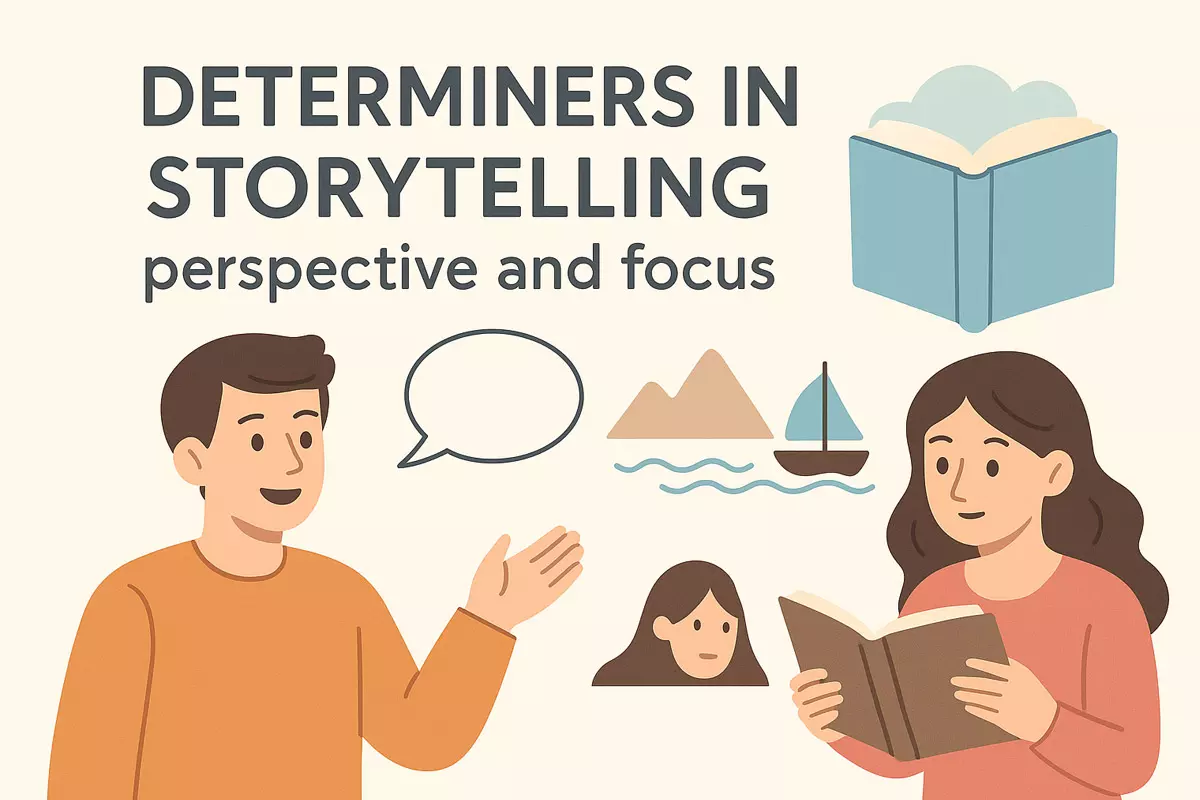 Here we how determiners help guide readers in stories by introducing new characters or objects, referring back to known elements, shifting focus or distance, and building mood. It includes examples and practice editing a short story for determiner use.
- How determiners guide the reader or listener in stories
- Introducing new characters and objects with a or an
- Referring back to known elements with the and this
- Using these and those to shift focus or distance
- Building mood and attitude with certain and that
- Examples from short narrative passages
- Practice: edit a short story to improve determiner use
Selecting precise words to introduce characters and objects subtly influences how a story develops and where readers concentrate their attention. Storytellers often guide perspective and enhance narrative focus through their use of articles and specific modifiers, shaping the reader’s understanding of what is important. By thoughtfully choosing these introductory words, writers can highlight certain details, establish tone, and control how information is revealed, ultimately affecting the overall impact of their storytelling.
How determiners guide the reader or listener in stories
Determiners play a critical role in shaping the reader’s or listener’s experience by signaling which elements of a narrative are important, familiar, or new. When storytellers choose words like “the,” “this,” “those,” or “every,” they help the audience understand not just what is being described, but also how to focus attention and interpret relationships between characters and events.
Establishing Perspective and Reference
Using specific determiners, a narrator can clarify whether an object or person is already known to the audience, or if it is being introduced for the first time. For example, “a dragon” suggests a new character, while “the dragon” refers to one previously mentioned or assumed to be known within the story’s world. This distinction helps orient the audience and supports the natural flow of information.
Shaping Focus and Emphasis
Storytellers often rely on determiners to direct the audience’s focus. Words like “this,” “that,” “these,” and “those” can draw attention to particular objects or moments, making them stand out in the narrative. Indefinite determiners such as “some” or “any” can create a sense of ambiguity or generality, which may be useful for building suspense or prompting curiosity.
- This: highlights something close or immediate (“This night was different”).
- That: points to something more distant or previously mentioned (“That day changed everything”).
- These/Those: indicate specific groups, near or far (“These woods,” “Those memories”).
- Every: emphasizes inclusiveness (“Every child in the village knew the legend”).
- Some: introduces non-specific elements (“Some travelers never returned”).
- Any: opens up possibility or choice (“Any door might lead outside”).
- Each: focuses on individuals within a group (“Each hero faced a test”).
- Many/Few: give a sense of quantity (“Many paths crossed,” “Few dared enter”).
- No: expresses absence (“No light shone through the window”).
- Another: signals addition or sequence (“Another riddle awaited them”).
- All: totalizes (“All eyes turned to the door”).
Comparing Effects of Different Determiners
The choice of determiner can subtly change the meaning or emotional tone of a sentence. Notice how shifting the determiner alters the reader’s expectations:
| Phrase | Effect on the Audience |
|---|---|
| The old house | Refers to a specific, possibly familiar house; signals importance or prior mention. |
| An old house | Introduces a new, non-specific house; may feel less significant at first. |
| That old house | Points to a particular house, possibly distant in time or space; adds emphasis or nostalgia. |
| Every old house | Generalizes, inviting the audience to imagine all such houses; can evoke universality or repetition. |
Guiding Narrative Flow
Effective use of determiners ensures that stories are coherent and engaging. By carefully choosing how to introduce and reference people, places, and objects, a storyteller guides the audience’s attention and helps them build a mental map of the narrative world. This subtle guidance is essential for clarity, pacing, and emotional impact, allowing stories to resonate more deeply with their audience.
Introducing new characters and objects with a or an
When telling a story, the moment you mention something or someone for the first time, you usually use "a" or "an" to signal that this is new information for your audience. This helps listeners or readers recognize that a character, animal, or object is being introduced into the narrative world for the very first time.
How "a" and "an" work in narrative beginnings
Writers use these indefinite articles to create a sense of novelty and to avoid assuming that the reader already knows what’s being discussed. The choice between "a" and "an" depends on the sound that follows: "a" before consonant sounds and "an" before vowel sounds.

- a dragon appeared in the sky
- a mysterious letter arrived
- an owl hooted nearby
- an umbrella floated down the river
- a young girl found a coin
- an old man sat on the bench
- a strange noise echoed
- an apple rolled across the table
- a silver key glimmered
- an enormous ship approached the harbor
- a black cat crossed the path
- an idea flickered in her mind
- a hidden door creaked open
- an unusual cloud drifted overhead
- a tiny mouse scurried by
- an ancient book lay forgotten
Signaling newness versus familiarity
Using "a" or "an" marks something as unfamiliar or previously unmentioned. Once the item or character has been introduced, "the" typically replaces "a" or "an" to specify which one is meant. This shift helps the audience track what’s new and what’s already part of the story’s world.
| First Mention | Subsequent Mention |
|---|---|
| a cat sat on the wall | the cat looked at me |
| an envelope was on the table | the envelope was sealed |
| a boy ran into the room | the boy was out of breath |
| an idea came to her | the idea changed everything |
Tips for storytellers
- Use "a" or "an" only when the listener or reader does not already know about the character or object.
- Switch to "the" once the person, animal, or object has been introduced and is now identifiable.
- Remember: "a/an" = new to the story; "the" = already known.
Choosing between "a" and "an" when introducing something sets the stage for your audience, helping them track what’s new and what’s already familiar in your story’s universe. This small detail can make storytelling clearer and more engaging.
Referring back to known elements with the and this
When telling stories, writers and speakers often need to signal that something has already been mentioned or is now familiar to the audience. English uses certain determiners—especially the and this—to help readers or listeners track which elements are already known within the narrative. These words guide the audience’s attention, making it clear when a character, object, or idea is being reintroduced or emphasized.
How “the” signals familiarity and shared knowledge
“The” is used to indicate that the noun it precedes refers to something specific, usually something already introduced or assumed to be known. This helps the audience connect the current mention to prior context. For example:
- Once upon a time, there was a dragon. The dragon lived in a cave.
- She found a key. The key was old and rusty.
In both cases, “the” marks the noun as something already present in the audience’s mental picture.
Using “this” for focus and immediacy
“This” draws attention to a particular object or idea, often with a sense of immediacy or importance. It can reintroduce something mentioned before or highlight a detail the storyteller wants the audience to notice:
- He picked up a strange coin. This coin shimmered in the sunlight.
- There was a loud noise. This noise startled everyone.
“This” can make the reference feel vivid, almost as if pointing directly at it.
Comparing “the” and “this” in narrative flow
The choice between these determiners changes the nuance of the story. While both can refer back to known items, “this” often adds emphasis or a sense of new relevance. Here’s a comparison of how each determiner shapes meaning:
| Example with “the” | Example with “this” |
|---|---|
| She found a letter. The letter was written in green ink. | She found a letter. This letter changed her life forever. |
| He saw a shadow. The shadow moved quickly. | He saw a shadow. This shadow sent chills down his spine. |
| They entered a room. The room was silent. | They entered a room. This room felt different from the others. |
| She picked up a book. The book was heavy. | She picked up a book. This book held a secret. |
Common storytelling patterns with “the” and “this”
Writers use these determiners in several typical ways:
- Introducing a new element with “a/an,” then referring back with “the.”
- Highlighting a surprising or significant element with “this.”
- Switching to “the” once “this” has established importance.
- Using “the” for background details, “this” for foregrounded action.
- Alternating between “the” and “this” to manage pacing and focus.
- Employing “this” in dialogue to reflect a character’s perspective.
- Relying on “the” for shared knowledge between narrator and audience.
- Shifting to “this” when a detail matters to the plot or emotion.
- Pairing “this” with adjectives (“this strange noise”) for extra emphasis.
- Using “the” for recurring motifs or symbols in a story.
Understanding how to use “the” and “this” effectively helps storytellers shape reader expectations, manage perspective, and keep the narrative clear and engaging.
Using these and those to shift focus or distance
Storytellers often rely on demonstratives like these and those to subtly guide the audience’s attention. These words do more than indicate plurality—they help establish spatial, temporal, or emotional proximity between the narrator, characters, and events. By choosing one over the other, an author can bring details closer or push them further away, both literally and figuratively.
Shifting narrative distance
When a narrator uses these, it often signals immediacy or connection, suggesting the objects or events are close in space, time, or emotion. In contrast, those can imply detachment, pastness, or separation. This distinction enables writers to control which elements feel accessible or remote to the reader.
- “These moments” — implies events are recent, vivid, or emotionally present.
- “Those days” — evokes nostalgia, distance, or events from an earlier time.
- “These people” — suggests characters are within the narrator’s current circle or focus.
- “Those choices” — refers to decisions already made, possibly with regret or analysis.
- “These problems” — highlights ongoing issues, inviting the listener into the current struggle.
- “Those mountains” — points out physical or metaphorical obstacles that are further away.
- “These words” — draws attention to what is being said now.
- “Those memories” — frames recollections as distant or faded.
- “These books” — indicates items near at hand, perhaps on a table or shelf.
- “Those rumors” — suggests hearsay that may not be relevant or trustworthy.
Comparing focus with demonstratives

To illustrate how demonstrative determiners alter perspective, consider these sample pairs. The first phrase in each pair draws the reader closer, while the second creates distance:
| Closer Focus (these) | Greater Distance (those) |
|---|---|
| These feelings won’t go away. | Those feelings faded long ago. |
| These questions need answers. | Those questions were never resolved. |
| These friends help me daily. | Those friends moved away years ago. |
| These streets are familiar. | Those streets belonged to another life. |
| These dreams keep me awake. | Those dreams are just memories now. |
Practical tips for storytellers
Use demonstratives with intention. If you want readers to feel involved, choose these to foster immediacy. To signal reflection or emotional distance, opt for those. This simple choice can subtly influence how events and characters are perceived, enriching the narrative’s perspective and emotional tone.
Building mood and attitude with certain and that
Writers often shape a story’s emotional tone through their choice of determiners. The words “certain” and “that” are especially powerful, subtly guiding how readers perceive characters, objects, or events. By signaling specificity or emotional distance, they can make the narrative world feel more vivid or, conversely, more ambiguous and distant.
How “certain” influences perception
Using “certain” before a noun adds an air of mystery, importance, or subjectivity. This determiner can suggest that the speaker knows more than they reveal, or that an object or person stands out for a hidden reason. For example, “a certain gentleman” feels more intriguing than “a gentleman.” In storytelling, this can:
- Imply hidden motives or secrets
- Highlight a character’s perspective or bias
- Create suspense or anticipation
- Suggest a shared understanding between narrator and reader
- Make an event or object feel fateful or significant
Using “that” for emotional distance or focus
“That” as a determiner often marks something as specific and known, but it can also shape mood. “That house” is not just any house—it’s one the speaker has in mind, possibly with emotional weight. Depending on context, “that” can:
- Signal emotional distance or judgment (“that idea of yours”)
- Point to something previously mentioned or remembered
- Emphasize contrast (“not this, but that problem”)
- Anchor the narrative in a shared reality or memory
- Convey affection, irritation, or nostalgia
Comparing mood effects: “certain” vs “that”
| Example Phrase | Mood/Attitude Conveyed |
|---|---|
| A certain smile | Mysterious, possibly private or significant to the narrator |
| That smile | Specific, possibly familiar or emotionally charged |
| A certain evening | Suggests a memorable or pivotal event, leaving details hidden |
| That evening | Directs attention to an exact time, often with shared knowledge or emotion |
| A certain look | Hints at unspoken understanding or subtle communication |
| That look | Refers to a specific, recognizable expression, possibly with judgment or familiarity |
Tips for storytellers
Choosing between “certain” and “that” lets you control narrative intimacy and focus. Use “certain” to keep readers guessing, or to show a character’s inner world. Turn to “that” when you want to anchor the story in shared knowledge, or highlight emotional connections and contrasts. Experimenting with these determiners can help you fine-tune the mood of your narrative—sometimes with just a single word.
Examples from short narrative passages
Narrative writing often relies on determiners to establish perspective and direct the reader’s attention. The use of articles, demonstratives, and possessives can subtly influence how a scene is viewed—either focusing tightly on a specific object or leaving the details more open-ended. Below are sample sentences and brief analyses to show how determiners shape narrative focus.
Spotlighting with Definite and Indefinite Articles
- A cat sat on the fence. (The animal is introduced for the first time; nonspecific.)
- The cat stretched and yawned. (Now, the story refers to a previously mentioned, specific cat.)
- Some children played in the yard. (Indefinite, but plural—suggesting more than one, but not all.)
- Those children ran toward the house. (Demonstrative determiners focus on a particular group.)
Demonstratives and Focus
- This old book was her favorite. (Draws attention to a particular object, possibly nearby or just introduced.)
- That night changed everything. (Highlights a specific event, often distant in time or space.)
Possessive Determiners and Perspective
- Her voice echoed in the empty hall. (Centers the perspective on a character’s experience.)
- My hands trembled as I opened the letter. (First-person focus, drawing readers into the narrator’s viewpoint.)
- Their laughter filled the garden. (Emphasizes the group’s shared experience.)
Comparing Determiner Choices
| Sentence | Effect on Perspective/Focus |
|---|---|
| A door creaked open. | Introduces a new, unspecified object—creates suspense or mystery. |
| The door creaked open. | Refers to a known or previously mentioned object—focuses attention on something familiar or important. |
| That door creaked open. | Directs the reader’s attention to a specific door, possibly in contrast to others. |
| Her door creaked open. | Anchors the detail to a character, deepening the sense of ownership and personal perspective. |
Other Common Patterns
- Each child held a balloon. (Focus on individuals within a group.)
- Every window was shut tight. (Universal focus—none left out.)
- No one saw what happened. (Zero quantity; narrows perspective.)
- Many stories begin the same way. (Non-specific, generalizes experience.)
- Several days passed in silence. (Ambiguous, but more than two.)
- Another reason soon became clear. (Signals addition, shifts focus.)
These varied uses of determiners help narrators subtly guide the reader’s attention, manage the introduction of new elements, and establish the narrative point of view. By carefully choosing determiners, writers can control how details are perceived and how much information is revealed at each moment.
Practice: edit a short story to improve determiner use
Editing short stories is an effective way to sharpen your understanding of determiners and their role in narrative clarity. Determiners—such as "the," "a," "an," "this," "that," "these," "those," "my," "some," and "every"—help readers track characters, objects, and settings. Misused or missing determiners can make a story feel vague or confusing. Below, you'll find a short story with errors in determiner usage, followed by activities to identify and correct them.
Short Story: Find and Fix the Determiner Issues
Read the story. Several determiners are missing, incorrect, or could be improved. Mark where changes are needed:
Old house stood on edge of village. Cat lived inside, always waiting for visitor. One day, boy came to door with basket of apples. Cat watched as boy knocked on wood. After moment, door creaked open. Boy smiled and offered apple to cat. Cat purred, happy for gift.
Common Determiner Problems to Watch For
- Missing articles before singular, countable nouns (e.g., "a house," "an apple").
- Using "the" instead of "a/an" (or vice versa), changing specificity or introducing ambiguity.
- Omitting demonstratives ("this," "that") where pointing out specifics adds clarity.
- Lack of possessive determiners ("his," "her," "their") when showing relationships.
- Forgetting quantifiers ("some," "many," "every") when expressing amount or frequency.
Activity: Edit the Story
- Identify all nouns that need a determiner.
- Decide which type of determiner best fits the context (article, demonstrative, possessive, or quantifier).
- Rewrite the story with improved determiner use.
Common Determiners for Storytelling
- the
- a / an
- this / that / these / those
- my / your / his / her / its / our / their
- some / any / every / each
- another / other / much / many / few / little
- no / all / both / either / neither
Challenge: Try Editing These Sentences
- Girl picked flower in garden.
- Dog chased ball across field.
- Children found treasure under tree.
- Baker gave loaf of bread to neighbor.
Show answers
- Edited Story: An old house stood on the edge of the village. A cat lived inside, always waiting for a visitor. One day, a boy came to the door with a basket of apples. The cat watched as the boy knocked on the wood. After a moment, the door creaked open. The boy smiled and offered an apple to the cat. The cat purred, happy for the gift.
- Edited Sentences:
- The girl picked a flower in the garden.
- The dog chased the ball across the field.
- The children found a treasure under the tree.
- The baker gave a loaf of bread to the neighbor.