Determiners Derived from Adverbs: such, certain, particular

 This article explains how determiners like such, certain, and particular develop from other word classes, how to use them with different nouns, their tone, how they show politeness or distance, and where they appear in writing. Practice is included.
- How some determiners develop from other word classes
- Using such with countable and uncountable nouns
- Using certain and particular to narrow down meaning
- Politeness and distance with certain and particular
- Differences in tone between these determiners
- Typical contexts: news, academic writing, and storytelling
- Practice: choose such, certain, or particular in short texts
Words like such, certain, and particular are important tools in English for specifying and clarifying meaning within sentences. These modifiers, which originally developed from adverbs, serve to focus attention on specific details or to distinguish one thing from another. By carefully choosing among these words, speakers and writers can express varying degrees of precision and emphasis, making their communication clearer and more effective. Their subtle use often shapes the nuance and intent behind a statement, demonstrating the richness of English expression.
How some determiners develop from other word classes
Words like such, certain, and particular illustrate how language evolves—these determiners have their roots in other parts of speech. Over time, adverbs and adjectives can shift roles, gradually taking on new grammatical functions. This process, known as grammaticalization, enriches the language and provides speakers with more nuanced ways to specify meaning.
Pathways from Adverbs and Adjectives to Determiners
Many determiners begin as adverbs or adjectives, then shift to mark specificity or selection in noun phrases. For example, such originally functioned as an intensifying adverb or adjective, but in modern English, it often introduces noun phrases: "such a day," "such people." Similarly, certain and particular started as adjectives but are now used to single out or specify nouns: "certain individuals," "a particular reason."
- such: from Old English swilc ("of this/that kind")
- certain: from Latin certus ("sure, fixed"), originally an adjective
- particular: from Latin particularis ("of a part"), also an adjective
- same: from Old English sam, originally an adjective
- other: from Old English ōther, initially an adjective
- any: from Old English ænig, adjective/adverb meaning "any one"
- each: from Old English ælc, adjective meaning "every, each"
- every: a compound from "ever" + "each"
- another: literally "an other," blending article and adjective
- enough: from Old English genōg, originally an adjective/adverb
- certain: now marks indefiniteness or limitation ("certain people")
- particular: often used to emphasize specificity ("a particular issue")
- such: can express similarity or type ("such behavior")
Comparing Original and Modern Determiner Uses
The table below outlines how some words transitioned from their original classes to their current function as determiners:
| Original Form/Class | Modern Determiner Use |
|---|---|
| such (adjective/adverb: "of that kind") | Determiner: "such a mess," "such people" |
| certain (adjective: "sure, fixed") | Determiner: "certain facts," "certain times" |
| particular (adjective: "specific, individual") | Determiner: "a particular reason," "particular students" |
| same (adjective: "identical") | Determiner: "the same issue," "same idea" |
| other (adjective: "different, another") | Determiner: "other options," "other people" |
Summary
The development of determiners from adverbs and adjectives is a dynamic process that reflects changes in usage and meaning. Words like such, certain, and particular serve as clear examples of how English recycles its vocabulary, allowing familiar items to take on new grammatical roles and enrich communication.
Using such with countable and uncountable nouns
Choosing when to use "such" with different types of nouns often causes confusion. "Such" functions as a determiner and can precede both countable and uncountable nouns, but the structure and meaning can shift slightly depending on the noun type. Understanding these patterns helps you sound more natural and precise in English.
With Countable Nouns

When "such" appears before countable nouns, it usually takes the form "such a/an + adjective + singular countable noun" or "such + adjective + plural countable noun." The article "a" or "an" is necessary for singular countables, but omitted for plurals. Some typical patterns include:
- such a beautiful day → It was such a beautiful day that we stayed outside until sunset.
- such an interesting book → She couldn’t put down such an interesting book.
- such clever children → The teacher was proud of such clever children.
- such long journeys → We were exhausted after such long journeys.
- such a noisy room → I couldn’t concentrate in such a noisy room.
- such talented musicians → The audience applauded such talented musicians.
- such a risky plan → He refused to agree to such a risky plan.
- such helpful friends → I’m grateful to have such helpful friends.
- such a strange idea → That sounded like such a strange idea at first.
- such old houses → Tourists love walking past such old houses.
Notice that the adjective is optional, but often included for emphasis. Plural countable nouns never take "a/an" after "such."
With Uncountable Nouns
For uncountable nouns, "such" is typically used as "such + adjective + uncountable noun," and no article is added. This works with abstract concepts, substances, or collective ideas:
- such valuable information → This report contains such valuable information.
- such bad luck → Missing the flight was such bad luck.
- such delicious food → We enjoyed such delicious food at the festival.
- such loud music → I can’t study with such loud music playing.
- such heavy traffic → We were late because of such heavy traffic.
- such excellent advice → She gave me such excellent advice.
- such terrible weather → They canceled the trip due to such terrible weather.
- such strong coffee → I couldn’t sleep after drinking such strong coffee.
- such clear evidence → The court accepted such clear evidence.
- such rapid progress → The teacher was impressed by such rapid progress.
Quick Reference: "such" with Noun Types
Below is a summary of the main patterns for using "such" with different noun types:
| Noun Type | Pattern Example |
|---|---|
| Singular countable | such a difficult question |
| Plural countable | such difficult questions |
| Uncountable | such difficult work |
| Uncountable (no adjective) | such work |
Points to Remember
- Never use "such a/an" with uncountable nouns. ❌ such a information is incorrect.
- "Such" emphasizes the degree or surprising nature of the noun it modifies.
- With plural countable or uncountable nouns, skip the article.
- The adjective can be left out: "such people," "such weather." However, including it often adds emphasis.
By mastering these patterns, you can use "such" confidently with a wide range of nouns in clear, natural English.
Using certain and particular to narrow down meaning
Certain and particular are determiners that help make statements more specific, often clarifying which people, things, or ideas are being referred to. Rather than talking about something in a vague or general way, these words signal that the speaker has a subset or a distinct example in mind. This focus is especially useful in both spoken and written English when you want your audience to understand exactly what or whom you mean.
How "certain" and "particular" function in sentences
Both terms serve to limit the scope of a noun, but they do so with subtle differences in emphasis. Certain is often used to refer to one or more members of a group, without naming them directly. Particular tends to stress uniqueness or specificity, sometimes implying the item is noteworthy or different from others.
- Some certain facts were omitted from the report. (Not all facts, just specific ones.)
- She prefers a particular kind of tea. (A unique or specific type.)
- Only certain students passed the exam. (A specific subset, not identified.)
- He wore a particular shirt for the interview. (A specific shirt, likely with importance.)
- There are certain risks to consider. (Some risks, not all.)
- I’m looking for a particular book. (A specific book, possibly with unique features.)
- We need to address certain issues before proceeding. (Some issues, not all.)
- Do you have a particular reason for asking?
- She invited certain friends to the party. (Not everyone, just specific people.)
- This solution works for a particular situation. (A unique or special case.)
- He’s interested in certain genres of music. (Some, not all genres.)
- They chose a particular date for the event. (A specific date, not just any.)
- Only certain employees have access. (A limited group.)
- I need a particular tool for this job. (A specific one, not just any tool.)
Comparing usage: "certain" vs. "particular"
| Usage | Example |
|---|---|
| Refers to some members of a group (unspecified) | I spoke with certain colleagues about the changes. |
| Emphasizes uniqueness or specificity | This particular solution saved us time. |
| Suggests selection based on unstated criteria | Only certain items are on sale. |
| Highlights one specific item or case | In this particular instance, we made an exception. |
Politeness and distance with certain and particular
When speakers choose between certain and particular as determiners, they often signal subtle social distance or tact. These words allow for a degree of vagueness or softening, which can be useful in formal or polite conversation. Instead of naming someone or something directly, using these determiners can avoid being too blunt, or may suggest that more information is withheld intentionally.
How “certain” and “particular” create distance
Both certain and particular help refer to a person or thing in a way that is less direct, which can be strategic in sensitive contexts. For example, saying “a certain colleague” instead of naming them outright can reduce the risk of sounding accusatory or gossipy. Particular often implies selectivity or a distinguishing feature, while certain tends to highlight that the speaker knows the referent, but chooses not to specify.
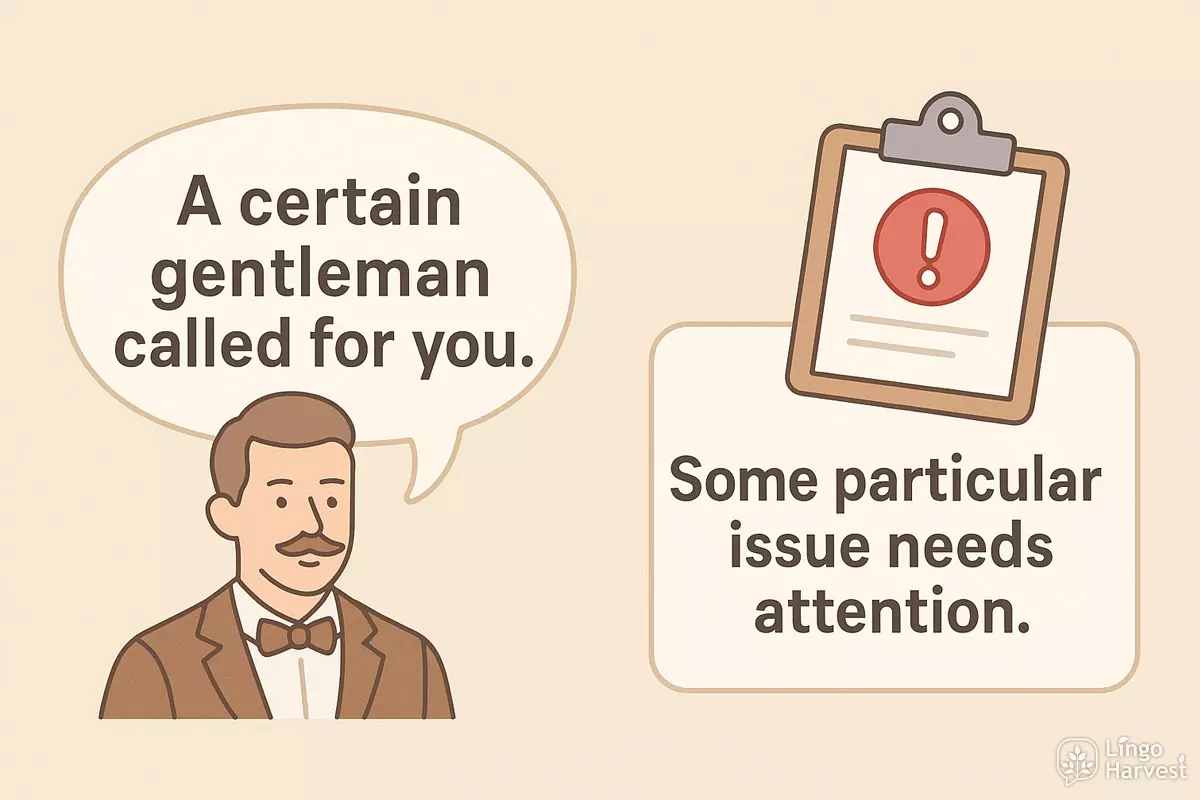
- “A certain gentleman called for you.” → Polite, avoids naming.
- “Some particular issue needs attention.” → Emphasizes a specific, but unnamed, problem.
- “She has a certain way of speaking.” → Suggests a unique style, without direct description.
- “They’re looking for a particular type of candidate.” → Implies select criteria, not openly listed.
- “A certain amount of caution is advised.” → General, indirect warning.
- “There was a particular reason for his absence.” → Withholds details, adds formality.
- “A certain book changed my perspective.” → Vague, possibly for privacy or effect.
- “We discussed a particular solution.” → Not naming which, keeps details minimal.
- “A certain restaurant was recommended.” → Polite, doesn’t reveal name.
- “She mentioned a particular concern.” → Focuses on one, but not specified, issue.
- “A certain someone forgot their keys.” → Light teasing, indirect reference.
- “He was talking about a particular event.” → Hints at specifics, but keeps distance.
Degrees of formality and tact
Using these determiners can make statements sound more formal or tactful. In professional settings, this approach may help avoid direct criticism or maintain confidentiality. The choice between certain and particular often depends on whether the speaker wants to stress their own knowledge (with certain) or the distinctiveness of the referent (with particular).
Differences in tone between these determiners
The determiners such, certain, and particular each bring a distinct nuance when introducing nouns. While all three can specify or single out entities, their tone and degree of emphasis vary, which affects both the formality and the implication of the sentence.
Overview of tonal distinctions
- Such often expresses a sense of degree, kind, or type. It can convey admiration, surprise, or even disapproval, depending on context. For instance, "such a mess" might communicate exasperation, while "such wonderful news" communicates delight.
- Certain introduces an air of selectivity or mild specificity, often implying that the noun is known to the speaker (but potentially not the listener). It can sound slightly formal or detached: "certain people" suggests a subset, not specified in detail.
- Particular is more precise and sometimes more insistent. It singles out something with emphasis on its distinctiveness or uniqueness: "this particular reason" highlights one reason out of many, focusing attention on its singular importance.
Pragmatic effects and register
Choosing among these determiners subtly changes how a statement is received. Such can make statements more vivid or emotional. Certain tends to be neutral or reserved, and is common in written or academic contexts. Particular can add a formal or even slightly pedantic tone, especially when precision is desired.
Comparison in context
| Determiner | Tone and Example |
|---|---|
| such | Expresses intensity or emotion; can be positive, negative, or neutral. Example: "I've never seen such chaos!" → surprise or dismay. |
| certain | Indicates selectivity or partial knowledge, more neutral or slightly formal. Example: "Certain factors must be considered." → some, not all, factors. |
| particular | Highlights specificity and uniqueness, often more formal or emphatic. Example: "I have no particular preference." → emphasizes lack of specificity. |
Expanded examples for tonal variation
- Such a strange coincidence! (emphasizes surprise)
- Such problems require urgent attention. (intensifies the noun)
- Certain individuals disagreed with the proposal. (unspecified, slightly formal)
- Certain details were omitted. (not all details, but some)
- Particular interest was shown in the new policy. (emphasis on which interest)
- In this particular case, exceptions were made. (focus on this specific instance)
- Such kindness is rare. (admirative tone)
- Certain risks are unavoidable. (general, understated)
- There is no particular reason for concern. (dismisses specificity)
- Such behavior is unacceptable. (strong disapproval)
- Only certain answers will be accepted. (selective, neutral)
- This particular solution works best. (singles out one solution)
- Such an opportunity comes once in a lifetime. (emphasizes rarity)
- Certain assumptions underlie the theory. (some, not all, are relevant)
- The particular features of the design make it unique. (specific characteristics emphasized)
In summary, these determiners are not interchangeable without shifting the mood or focus of a sentence. The choice among them allows speakers and writers to fine-tune the level of specificity, emotional charge, and formality they wish to convey.
Typical contexts: news, academic writing, and storytelling
Determiners like such, certain, and particular—originally formed from adverbs—often appear in distinct communicative situations, each carrying a subtle nuance. In journalistic texts, they help specify or generalize information for clarity or emphasis. In scholarly articles, these words introduce specificity, highlight uniqueness, or signal examples. Narratives and storytelling use them to guide the audience’s focus or introduce characters and events with deliberate ambiguity or detail.
Usage patterns across genres
Writers and speakers rely on these determiners to shape meaning. Here’s how they typically function:
- Such often presents examples or categories: “Such measures are necessary.”
- Certain singles out unspecified, but known, entities: “Certain factors were ignored.”
- Particular highlights specificity: “A particular incident changed everything.”
- They can all distance the speaker/writer from the subject, creating objectivity or mystery.
- They frequently precede countable nouns in both singular and plural forms.
- In news, they add authority or generalization: “Such claims require evidence.”
- Academic writing uses them for precision: “A certain methodology was adopted.”
- Storytelling leverages them to introduce or foreshadow: “On a particular evening…”
- They often work with modifiers or relative clauses: “Such people, who…”, “Certain books that…”
- Each can introduce hypothetical or typical scenarios: “Such a day would be memorable.”
- Sometimes, they help avoid repetition: “Certain issues, such as…”
- They can mark contrast with previous information: “Unlike such opinions,…”
- Writers use them to hedge or generalize: “Certain trends are noticeable.”
- They can suggest skepticism or selectivity: “Particular experts disagree.”
- In storytelling, they can increase suspense: “A certain stranger appeared.”
Comparing roles in different text types
| Word | Typical Function | Example (News/Academic/Storytelling) |
|---|---|---|
| Such | Grouping, exemplification, or categorization | “Such proposals have been debated for years.” |
| Certain | Indicating selectiveness or limited knowledge | “Certain participants withdrew from the study.” |
| Particular | Specifying uniqueness or notable detail | “One particular moment stood out.” |
Writers choose between such, certain, and particular depending on whether their aim is to generalize, limit scope, or draw attention to specific details. Recognizing the subtle distinctions in how these words function can greatly improve both comprehension and written expression in different genres.
Practice: choose such, certain, or particular in short texts
Understanding when to use "such," "certain," or "particular" can make your English clearer and more precise. Below you'll find a variety of short practice sentences and scenarios to help you select the correct determiner. Pay attention to the context: sometimes the answer depends on whether you’re being general, specific, or indicating a subset.
Fill in the blank
For each sentence, choose the best word from "such," "certain," or "particular" to complete the meaning.
- There are ________ rules that must always be followed in the laboratory.
- I don’t like ________ movies; I prefer comedies.
- He has ________ talent that makes him stand out from the rest.
- In ________ situations, you should call for help immediately.
- Are you looking for a ________ book, or just browsing?
- Not everyone is interested in ________ topics; some prefer more general discussions.
- She has ________ charm that is hard to describe.
- Only ________ people know the truth about what happened.
- I’m not looking for any ________ brand, just something reliable.
- He was surprised that ________ a mistake could happen.
Show answers
- certain
- particular
- such
- certain
- particular
- certain
- such
- certain
- particular
- such
When to Use Each Word: Quick Reference
- Such: Emphasizes degree or kind; often used with nouns and adjective-noun combinations (e.g., such a day, such beauty).
- Certain: Refers to some but not all; identifies a subset or unspecified members of a group (e.g., certain people, certain situations).
- Particular: Indicates one specific thing or person, or a precise choice or type (e.g., a particular reason, a particular book).
Spot the Correct Usage
Choose the sentence with the most natural word choice:
- A. I’m looking for a certain pair of shoes I saw last week.
B. I’m looking for a such pair of shoes I saw last week.
C. I’m looking for a particular pair of shoes I saw last week. - A. She has particular a talent for music.
B. She has such a talent for music.
C. She has certain a talent for music. - A. In such situations, it’s best to stay calm.
B. In particular situations, it’s best to stay calm.
C. In certain situations, it’s best to stay calm. - A. It was such difficult exam that everyone complained.
B. It was such a difficult exam that everyone complained.
C. It was certain a difficult exam that everyone complained. - A. She mentioned such problem in her report.
B. She mentioned a particular problem in her report.
C. She mentioned certain a problem in her report. - A. For certain reasons, we had to cancel the trip.
B. For such a reasons, we had to cancel the trip.
C. For particular a reasons, we had to cancel the trip. - A. I have a certain problem with this software.
B. I have such problem with this software.
C. I have particular a problem with this software. - A. They faced a such difficult situation last year.
B. They faced a difficult particular situation last year.
C. They faced such a difficult situation last year. - A. We discussed a certain issue in the meeting.
B. We discussed such issue in the meeting.
C. We discussed particular a issue in the meeting. - A. He pointed to particular a page in the book.
B. He pointed to such a page in the book.
C. He pointed to a particular page in the book.
Show answers
- C (particular)
- B (such)
- C (certain)
- B (such)
- B (particular)
- A (certain)
- A (certain)
- C (such)
- A (certain)
- C (particular)
Common Mistakes to Avoid
- Don’t use "such" before plural nouns without "a" (e.g., "such people," not "a such people").
- Don’t use "certain" when you mean one specific item (use "particular" instead).
- Don’t use "particular" to refer to an unspecified group; "certain" is better for that context.
With practice, distinguishing between these determiners becomes much easier. Review the examples above and try making your own sentences for extra reinforcement.