Determiner Placement in Multi-Adjective Structures

 The article explains where determiners are placed in adjective+noun phrases, reviews adjective order, demonstrates combining determiners with multiple adjectives, provides examples and common mistakes, and includes practice arranging words into natural noun phrases.
- Where determiners normally appear in adjective+noun phrases
- Review of basic adjective order in English
- Combining determiners with multiple describing words
- Examples with quantity, opinion, size, and other adjective types
- Common mistakes in long descriptive noun phrases
- When native speakers repeat or change determiners for effect
- Practice: arrange words to form natural noun phrases with determiners
Mastering word order in English can be challenging, particularly when multiple descriptive words and an article or possessive adjective are used before a noun. Knowing the correct sequence for these elements—such as which adjectives come first and where to place possessive terms—greatly improves clarity and naturalness in speech and writing. With practice and attention to common patterns, learners can communicate more fluently and avoid confusion, making their English sound both accurate and polished.
Where determiners normally appear in adjective+noun phrases
In English, determiners such as "the," "a," "my," or "some" almost always come at the very beginning of a noun phrase, even if there are multiple adjectives before the noun. The determiner sets the reference for the entire phrase, while adjectives provide additional information about the noun. This order is a core characteristic of standard English syntax.
Standard Placement in Adjective-Noun Combinations
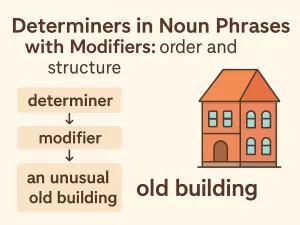
The typical structure is: determiner + adjective(s) + noun. The determiner never appears between adjectives, nor does it follow the noun. Even when several adjectives are present, the determiner remains at the front of the group.
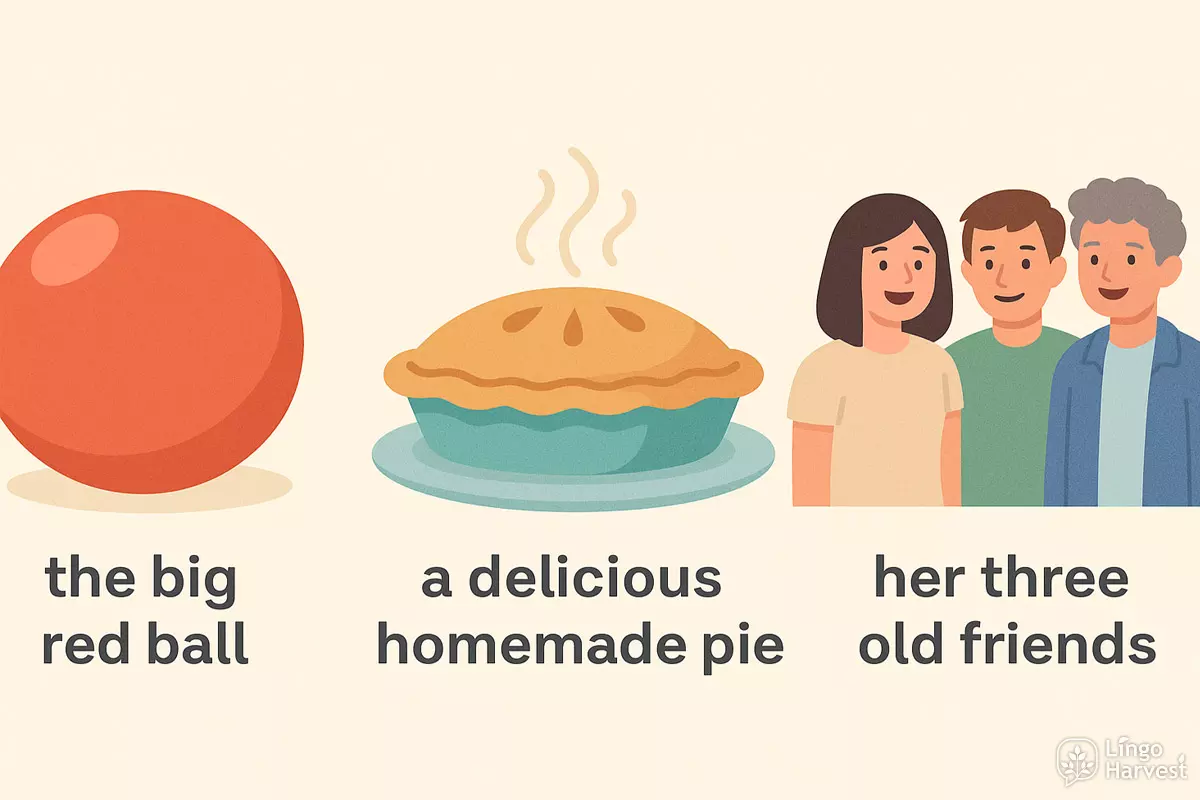
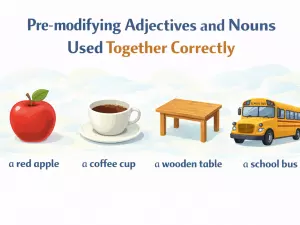
- the big red ball
- a delicious homemade pie
- her three old friends
- some interesting new ideas
- my favorite black shoes
- this large wooden table
- that unusual blue painting
- each small glass jar
- those spicy Mexican dishes
- our last family holiday
- his first published article
- an old French recipe
- these beautiful green hills
- any available meeting rooms
- no clear logical answer
- another exciting new project
- their favorite Italian restaurant
- such a difficult problem
Why Determiners Appear First
Placing the determiner before any adjectives helps clarify which noun is being referred to, regardless of how many descriptive words follow. This fixed position makes noun phrases easier to process and avoids ambiguity. If the order is changed, the phrase may sound unnatural or confusing.
Incorrect Placement: What to Avoid
Determinants do not typically appear between adjectives or after the noun. Here are some patterns that are not standard in English:
- ❌ big the red ball
- ❌ delicious a homemade pie
- ❌ black shoes my
- ❌ favorite her old friend
Summary Table: Position of Determiners in Multi-Adjective Phrases
| Phrase Component | Example |
|---|---|
| Determiner at the start of phrase ✅ | the old wooden door |
| Determiner after adjectives ❌ | old wooden the door |
| Determiner after noun ❌ | old wooden door the |
| Multiple adjectives, determiner still first ✅ | my three favorite childhood books |
Special Notes: Exceptions and Variations
In some poetic or archaic uses, word order may vary for stylistic effect, but in modern standard English, the determiner reliably comes before all adjectives and the noun. This rule helps keep communication clear and efficient, especially with longer or more complex noun phrases.
Review of basic adjective order in English
When multiple adjectives are used before a noun, they tend to follow a preferred sequence in English. This sequence isn’t random—native speakers apply it instinctively, but it can be confusing for learners. Understanding the typical order helps sentences sound natural and clear.
Standard Sequence for Multiple Adjectives
English arranges adjectives in a set order when more than one is used before a noun. The most widely accepted sequence is:
- Quantity or number
- Opinion
- Size
- Age
- Shape
- Color
- Origin
- Material
- Purpose
For example, in the phrase “three lovely small old round red French wooden dining chairs,” each adjective follows this sequence.
Adjective Order in Practice
Here are some common examples, illustrating the typical arrangement:
- a beautiful large ancient oval silver mirror
- two helpful young Spanish language teachers
- several tiny blue Italian glass beads
- an impressive new rectangular wooden desk
- four delicious hot Mexican chicken tacos
- a few charming little old English cottages
- many energetic black Labrador puppies
- some expensive antique French porcelain vases
- an unusual round green plastic container
- twelve sturdy modern steel office chairs
Summary Table: Adjective Order Categories
| Category | Sample Adjectives |
|---|---|
| Quantity/Number | one, two, several, many, a few |
| Opinion | beautiful, boring, lovely, unusual, helpful |
| Size | large, small, tiny, huge, massive |
| Age | old, young, new, ancient, modern |
| Shape | round, square, rectangular, oval, flat |
| Color | red, blue, black, green, yellow |
| Origin | French, Italian, Mexican, English, Spanish |
| Material | wooden, plastic, steel, porcelain, glass |
| Purpose | sleeping (bag), dining (table), language (course) |
Notes on Flexibility and Exceptions
While the order above is generally followed, native speakers may occasionally shift adjectives for emphasis or style. However, straying too far from the standard sequence usually results in awkward or confusing phrases.
Self-Check: Put the Adjectives in the Right Order
Arrange each set of adjectives before the noun. Write the most natural order:
- glass / small / blue / lovely / vase
- old / three / wooden / Italian / chairs
- delicious / chocolate / big / cake / round
- Spanish / fantastic / young / actors / two
- tiny / red / cute / plastic / toy
- modern / black / large / metal / table
- new / silk / long / green / scarf
- ancient / stone / massive / Greek / temple
- soft / white / comfortable / cotton / shirt
- interesting / small / yellow / old / book
Show answers
- a lovely small blue glass vase
- three old Italian wooden chairs
- a big round delicious chocolate cake
- two fantastic young Spanish actors
- a cute tiny red plastic toy
- a large modern black metal table
- a long new green silk scarf
- a massive ancient Greek stone temple
- a comfortable soft white cotton shirt
- an interesting small old yellow book
Combining determiners with multiple describing words
When a noun is modified by several adjectives, the determiner (such as "the," "a," "this," "some," or "my") always comes at the very beginning of the noun phrase. This placement is fixed, regardless of how many descriptive words follow. Understanding this order is crucial for producing natural, clear sentences.
General order in multi-adjective noun phrases
Determiners never appear between adjectives or after them—they must be placed before any descriptive words. The typical sequence is: Determiner → Opinion adjective → Size → Age → Shape → Color → Origin → Material → Noun. For example:
- The beautiful large old round blue French wooden table
- Some interesting new Italian novels
- My small red leather wallet
Examples of determiners with multiple adjectives
Here are various examples showing how determiners combine with more than one adjective:
- A noisy crowded street
- The tall young teacher
- These delicious homemade cookies
- His old blue jacket
- Our two friendly neighborhood dogs
- That heavy wooden door
- Some unusual antique clocks
- Each bright shiny apple
- Her long curly hair
- Those big brown eyes
- Several small plastic bottles
- Every busy city street
- His three energetic young cousins
- My favorite cozy wool sweater
- Their large modern apartment
- Another challenging math problem
Word order: Determiner position and adjective coordination
It’s important to note that, while adjectives can be stacked or separated by commas, the determiner’s position is always fixed at the start. For example:
- ✅ Those two smart, creative students
- ❌ Smart those two creative students
The incorrect example demonstrates how unnatural it sounds if the determiner is not placed before all adjectives.
Summary table: Determiner and adjective placement
| Determiner | Full Noun Phrase Example |
|---|---|
| the | the big old red car |
| my | my two favorite blue shirts |
| some | some delicious spicy Thai food |
| those | those beautiful green glass bottles |
| his | his new expensive watch |
Key takeaway
Always place the determiner at the very start, before any adjectives or descriptive words. This structure ensures your noun phrases are both grammatical and easy to understand.
Examples with quantity, opinion, size, and other adjective types
Understanding how determiners interact with multiple adjective types is key to building natural-sounding English noun phrases. In English, adjectives typically follow a preferred order: quantity, opinion, size, age, shape, color, origin, material, and purpose—before the noun. The determiner (such as "the," "some," or "my") comes at the very start. Let’s look at how this works in practice.
Typical Adjective Order with Determiners

When combining several adjectives, speakers usually follow an established sequence. For example:
- Those three beautiful large old wooden chairs (Determiner + quantity + opinion + size + age + material + noun)
- My two favorite small blue mugs
- Some clever young Italian scientists
- Every single tiny red apple
- Several boring big black books
- The first huge round silver tray
- Her many wonderful little green plants
- Our few interesting ancient Greek coins
- All those ugly enormous glass vases
- That one lovely small French café
- Each delicious small ripe tomato
- Any silly large plastic toy
- No boring tiny brown pencils
- Several amazing old bronze statues
- Some cheerful little yellow birds
- Few impressive tall modern buildings
- Their various elegant long silk scarves
- Many bright new Spanish tiles
Comparing Acceptable and Unacceptable Orders
Some adjective combinations sound awkward if the order is changed. Here’s a structured comparison:
| ✅ Natural Order | ❌ Unnatural Order |
|---|---|
| These two lovely big dogs | These big two lovely dogs |
| Some funny small old stories | Some old funny small stories |
| Several excellent large modern buildings | Several modern large excellent buildings |
| That one unique little red car | That red unique one little car |
| Our many fascinating ancient artifacts | Our ancient fascinating many artifacts |
Key Patterns to Remember
- The determiner always comes first: the, my, some, those.
- Quantity adjectives (e.g., three, several, many) precede opinions.
- Opinions (e.g., lovely, boring, wonderful) are placed before size.
- Size adjectives (e.g., big, tiny, enormous) come before age, color, and other descriptors.
- Rearranging this order can make phrases sound odd or unclear.
- By practicing with a variety of combinations, you build intuition for where each adjective and determiner should go in relation to the noun.
- This skill is especially useful in both writing and conversation, helping descriptions sound natural and fluent.
Common mistakes in long descriptive noun phrases
Writers often stumble when using determiners in multi-adjective sequences, especially as noun phrases become longer and more complex. Placing articles, quantifiers, or demonstratives incorrectly can lead to awkward or even ungrammatical sentences. Understanding common pitfalls helps to produce clearer, more natural English.
1. Misplacing the Determiner
The determiner (such as "the," "a," "some," "this," or "my") should always come at the very beginning of the noun phrase, before any adjectives. Inserting it elsewhere disrupts the standard structure.
- Incorrect: Red the big ball
- Correct: The big red ball
2. Omitting the Determiner
In English, most singular countable nouns require a determiner. Omitting it can make the phrase sound incomplete or ungrammatical.
- Incorrect: Large old oak tree stood in yard.
- Correct: A large old oak tree stood in the yard.
3. Repeating the Determiner
Only one determiner is needed per noun phrase. Doubling up is a frequent error, especially with possessives and articles.
- Incorrect: The my favorite blue sweater
- Correct: My favorite blue sweater
4. Incorrect Adjective Order
Adjectives in English typically follow a specific order: quantity, quality, size, age, shape, color, origin, material, purpose. Disregarding this order can confuse the reader or sound unnatural.
| Unnatural Order | Natural Order |
|---|---|
| Wooden old three chairs | Three old wooden chairs |
| French beautiful small painting | Beautiful small French painting |
| Leather elegant black boots | Elegant black leather boots |
| Plastic green new bottle | New green plastic bottle |
5. Overloading the Noun Phrase
Long strings of adjectives can be hard to process. If a noun phrase feels unwieldy, consider breaking it up, using relative clauses, or rephrasing for clarity.
6. Inconsistent Number Agreement
Ensure that determiners and adjectives match the noun’s number. For example, use "these" with plural nouns and "this" with singular nouns.
- Incorrect: This interesting books
- Correct: These interesting books
7. Using Articles with Proper Nouns
Proper nouns usually don’t require an article. Adding one can sound odd, unless the context specifically calls for it.
- Incorrect: The Paris Eiffel Tower
- Correct: The Eiffel Tower in Paris
Quick Reference: Frequent Issues in Multi-Adjective Structures
- Putting adjectives before the determiner
- Leaving out required articles or possessives
- Mixing up quantity and quality adjectives
- Combining incompatible determiners (e.g., "some my")
- Forgetting plural "s" with plural determiners
- Misplacing purpose adjectives (e.g., "sleeping" in "bag")
- Using "a" with plural noun phrases
- Double negatives with quantifiers ("any no")
- Incorrectly placing demonstratives ("that beautiful this dress")
- Using too many adjectives without commas or rephrasing
Careful attention to determiner placement and adjective order helps avoid these common mistakes, resulting in smoother, more precise communication.
When native speakers repeat or change determiners for effect
English speakers sometimes play with determiner use in multi-adjective structures to achieve emphasis, rhythm, or subtle shifts in meaning. While standard grammar prefers a single determiner before a string of adjectives (e.g., "the big red balloon"), in natural conversation and literary contexts, you may notice people repeating or swapping determiners for stylistic or expressive reasons.
Why do speakers vary determiners?
People may deliberately use more than one determiner to highlight contrast, create a poetic effect, or draw attention to individual qualities. This can make a description more vivid or help the listener focus on particular aspects of a noun phrase.
- Emphasis: Repeating determiners can stress each adjective independently ("those bright, those dazzling lights").
- Contrast: Changing determiners highlights differences ("this old house and that new house").
- Rhetorical effect: Writers and speakers sometimes use multiple determiners for dramatic or rhythmic impact ("the long, the winding, the lonely road").
- Clarity: In complex lists, determiners can signal separate items or clarify grouping ("every green apple and every red apple was counted").
- Poetic license: Literature often bends rules for mood or meter ("a single, a solitary, a silent star").
Examples of determiner repetition or variation
Here are some real-world patterns where determiners are intentionally repeated or changed:
- That old, that creaky, that beloved chair
- Each bright, each hopeful, each trembling face
- Such a strange, such a haunting melody
- This one, that one, and the other one
- Every single, every tiny, every precious detail mattered
- These blue and those green marbles
- My first, my only, my true love
- Some tired, some eager participants
- Another long, another difficult day
- No ordinary, no predictable outcome
- Those distant, those unreachable dreams
- Any fresh, any local ingredients
- His red, his famous scarf
- Our quiet, our peaceful neighborhood
- The last, the final attempt
- Many old, many forgotten traditions
- One small, one brave step
- Her gentle, her reassuring words
Comparing effects: single vs. repeated determiners
To see how meaning and emphasis change, compare these two forms:
| Single Determiner | Repeated/Changed Determiner |
|---|---|
| The dark, stormy night | The dark, the stormy night |
| Those tired, eager faces | Those tired, those eager faces |
| Every long, difficult journey | Every long, every difficult journey |
| That old and new building | That old and this new building |
| My first, true friend | My first, my true friend |
Takeaway
By choosing to repeat or swap determiners, native speakers can subtly shift focus, create rhythm, and make descriptions more memorable. While it's not always standard, this stylistic flexibility is a hallmark of expressive, nuanced English.
Practice: arrange words to form natural noun phrases with determiners
Understanding how to place determiners and adjectives in natural noun phrases is essential for fluency. The order of adjectives and the correct use of articles, demonstratives, and possessives can make your phrases sound native-like. In this section, you'll find exercises and tips to help you master the structure of noun phrases with multiple adjectives and determiners.
Task: Build Natural Noun Phrases
Try combining the given words into natural-sounding noun phrases. Each set contains a determiner, one or more adjectives, and a noun. Pay attention to the usual adjective order (opinion, size, age, shape, color, origin, material, purpose, noun) and the placement of the determiner at the beginning.
- old / a / wooden / chair
- those / red / lovely / apples
- my / black / leather / bag
- an / interesting / new / idea
- her / little / French / dog
- the / enormous / stone / statue
- some / delicious / homemade / cookies
- his / antique / silver / watch
- this / beautiful / blue / vase
- that / ugly / plastic / lamp
- our / big / round / table
- every / small / green / plant
- such / a / strange / old / painting
- your / favorite / wool / sweater
- each / new / digital / device
- the / large / modern / building
- an / adorable / little / kitten
- his / long / black / coat
- their / spacious / family / house
- these / spicy / Mexican / dishes
Show answers
- a old wooden chair → a wooden old chair is incorrect; an old wooden chair is correct
- those lovely red apples
- my black leather bag
- an interesting new idea
- her little French dog
- the enormous stone statue
- some delicious homemade cookies
- his antique silver watch
- this beautiful blue vase
- that ugly plastic lamp
- our big round table
- every small green plant
- such a strange old painting
- your favorite wool sweater
- each new digital device
- the large modern building
- an adorable little kitten
- his long black coat
- their spacious family house
- these spicy Mexican dishes
Common Patterns: Determiner and Adjective Placement
Here is a quick reference list showing typical patterns for combining determiners with multiple adjectives and nouns. Notice the consistent order: determiner + opinion + size + age + color + origin + material + noun.
- a beautiful old house
- this small red car
- my new Italian shoes
- an expensive silver ring
- the big wooden door
- her long silk dress
- our friendly young neighbor
- his large brown dog
- that old French book
- some tasty Chinese food
Mini-Quiz: Spot the Error
Identify the phrase with incorrect adjective or determiner placement in each set.
- the green beautiful garden / the beautiful green garden
- an old red car / a red old car
- these wool warm socks / these warm wool socks
- my Italian new bag / my new Italian bag
- a small black cute dog / a cute small black dog
- those wooden old chairs / those old wooden chairs
- her blue little dress / her little blue dress
- an interesting long story / a long interesting story
- that metal heavy box / that heavy metal box
- their French modern apartment / their modern French apartment
Show answers
- the beautiful green garden (correct)
- an old red car (correct)
- these warm wool socks (correct)
- my new Italian bag (correct)
- a cute small black dog (correct)
- those old wooden chairs (correct)
- her little blue dress (correct)
- an interesting long story (correct)
- that heavy metal box (correct)
- their modern French apartment (correct)
Practicing with varied examples and reflecting on the typical order will help you internalize natural noun phrase construction. Keep experimenting with your own combinations to reinforce the patterns.