Multiple Modifiers Before Nouns in Real English Sentences

 Here we how to use multiple modifiers in English noun phrases, detailing the natural order of adjectives, combining adjectives and noun modifiers, how order can change meaning, common mistakes, spoken versus written differences, and practice exercises.
- What multiple pre-modifiers are in noun phrases
- Natural order of adjectives before a noun
- Combining adjectives and noun modifiers together
- Meaning changes caused by modifier order
- Common errors with stacked modifiers before nouns
- Differences between spoken and written modifier stacking
- Practice: reorder modifiers to create natural noun phrases
Have you ever noticed how native speakers often use multiple descriptive words before a noun to paint vivid and precise pictures in conversation? By examining real-life English sentences, we can uncover interesting patterns and subtle rules that guide the order and combination of adjectives. These patterns not only help create clearer and more engaging descriptions but also reflect the natural flow and preferences of everyday communication among fluent speakers.
What multiple pre-modifiers are in noun phrases
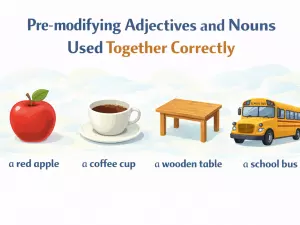
In English, it’s common to see several words stacked before a noun, all working together to describe or specify it. These words—called pre-modifiers—can include adjectives, nouns, participles, and other modifiers. When more than one appears, they form a chain, giving the noun a detailed context. For instance, in “a big red brick house,” big, red, and brick all modify house.
Types of pre-modifiers you’ll find before nouns
Pre-modifiers fall into several categories, and understanding their order helps sentences sound natural. Here are some common types:
- Opinion adjectives: lovely, boring, delicious
- Size adjectives: small, huge, tiny
- Age adjectives: old, new, ancient
- Shape adjectives: round, square, flat
- Color adjectives: blue, green, golden
- Origin adjectives: Italian, Victorian, American
- Material adjectives/nouns: wooden, silk, plastic
- Purpose/Qualifier: running (shoes), sleeping (bag), wedding (dress)
- Participle modifiers: running (water), broken (window)
- Noun modifiers: chicken (soup), stone (wall), car (alarm)
Typical order of multiple modifiers
When several descriptors come before a noun, native speakers usually follow a certain sequence. For example, we say “a beautiful big old round Italian marble dining table,” not “an Italian marble big round beautiful old dining table.” The order is not random—it’s guided by convention and clarity.
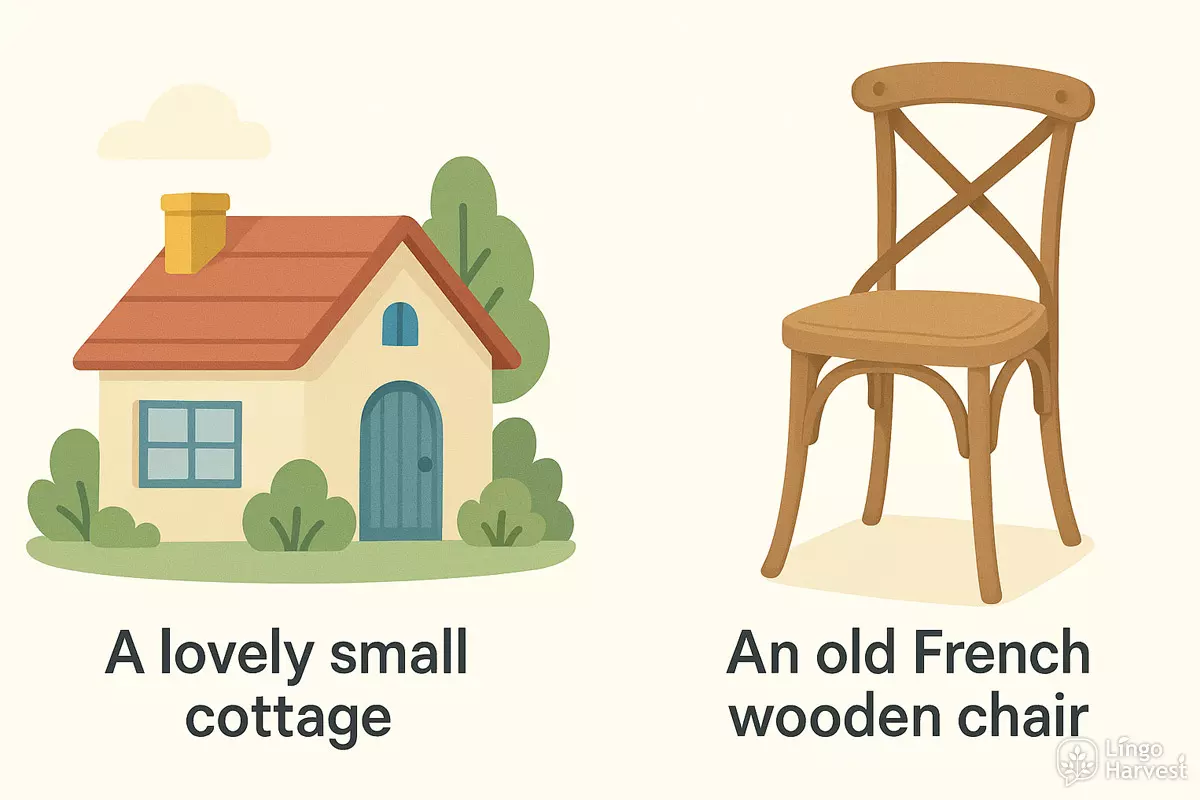
| Modifier Type | Example in a Noun Phrase |
|---|---|
| Opinion + Size + Noun | a lovely small cottage |
| Age + Origin + Material + Noun | an old French wooden chair |
| Color + Purpose + Noun | a black running shoe |
| Shape + Material + Noun | a round glass table |
| Participle + Noun + Noun | a broken car window |
| Opinion + Age + Origin + Noun | a charming old English village |
Real-life examples of stacked pre-modifiers
- a delicious homemade chocolate cake
- an enormous ancient oak tree
- the bright yellow safety helmet
- my new blue Italian sports car
- a large open-plan office space
- the long-awaited annual company meeting
- a well-known British television presenter
- the high-pitched alarm sound
- his sturdy black hiking boots
- an expensive modern art gallery
- a beautifully decorated wedding cake
- the old red brick school building
- a tiny plastic toy soldier
- the recently discovered Roman coin
- a comfortable three-seater leather sofa
- the famous Swiss chocolate factory
Using several modifiers before a noun allows for precise, vivid descriptions, but it’s important to use them in the right order for natural-sounding English. By paying attention to the type and sequence of each pre-modifier, you can make your writing clearer and more engaging.
Natural order of adjectives before a noun
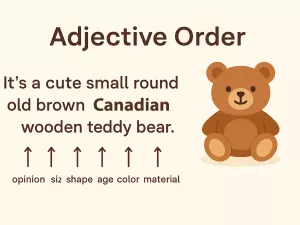
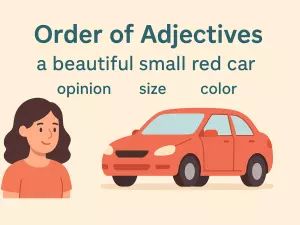
When several descriptive words are used before a noun in English, there's a typical sequence that native speakers follow almost instinctively. Placing adjectives in the right order makes sentences sound natural and clear. This order isn't random; it's based on categories such as opinion, size, age, shape, color, origin, material, and purpose. If the sequence is mixed up, the phrase can sound odd or confusing, even if the meaning is still clear.
Typical sequence of descriptive words
The traditional pattern for arranging multiple modifiers is as follows:
- Opinion (e.g., lovely, boring, interesting)
- Size (e.g., small, huge, tiny)
- Age (e.g., ancient, new, young)
- Shape (e.g., round, square, flat)
- Color (e.g., red, blue, dark)
- Origin (e.g., French, American, Eastern)
- Material (e.g., wooden, metal, silk)
- Purpose (e.g., sleeping [as in "sleeping bag"], racing [as in "racing car"])
Not every noun phrase will use all these categories, but when several are present, this is the most natural arrangement.
Examples of adjective order in real sentences
To see how this works, compare different phrases:
- a beautiful small old round green French marble table
- an ugly large new square black Italian leather sofa
- a lovely tiny ancient oval white Japanese porcelain vase
- an interesting big modern rectangular brown American wooden desk
- a boring little old flat gray English stone cottage
- a fantastic huge young triangular red Russian plastic kite
- a curious small vintage circular yellow Chinese silk fan
- a wonderful massive antique octagonal blue Spanish glass mirror
- a dull medium-sized old rectangular beige German paper envelope
- a charming petite ancient heart-shaped pink Indian cotton cushion
Notice how each phrase flows smoothly, even with many modifiers. If you change the order—like "a wooden French round green small beautiful table"—the result is awkward.
Quick reference table: adjective order in English
| Category | Examples |
|---|---|
| Opinion | nice, horrible, lovely, boring |
| Size | big, small, tiny, enormous |
| Age | old, young, ancient, new |
| Shape | round, square, flat, triangular |
| Color | blue, red, green, yellow |
| Origin | French, Italian, American, Chinese |
| Material | wooden, metal, plastic, silk |
| Purpose | sleeping (bag), racing (car), writing (desk) |
Tips for using multiple modifiers
- Native speakers rarely use more than three adjectives before a noun in ordinary conversation. Too many can sound unnatural.
- If unsure, prioritize essential details and drop unnecessary modifiers.
- Practice by combining adjectives from different categories and reading them aloud to check for natural flow.
Understanding the standard sequence helps you create phrases that sound fluent and clear, even when you stack several descriptors together.
Combining adjectives and noun modifiers together
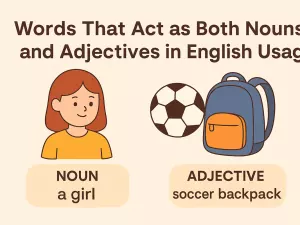
When you want to describe a noun in detail, English often allows several words to appear before the noun—sometimes both adjectives and nouns acting as modifiers. Understanding how to put them together in a natural order is important for clear, native-like sentences. Generally, adjectives (like "red," "old," "delicious") come first, followed by noun modifiers (like "chicken" in "chicken soup"). The noun modifier is closest to the main noun, forming a tight unit, while adjectives stack up in front. For example, in "spicy Thai chicken soup," "spicy" and "Thai" are adjectives, "chicken" is a noun modifier, and "soup" is the main noun.
Typical structure and order
The standard sequence for multiple pre-noun modifiers is:
- Opinion adjective (e.g., lovely, tasty)
- Size adjective (e.g., big, tiny)
- Age adjective (e.g., new, old)
- Shape adjective (e.g., round, square)
- Color adjective (e.g., red, blue)
- Origin adjective (e.g., French, American)
- Material adjective (e.g., wooden, silk)
- Noun modifier (e.g., chicken, tennis, school)
- Main noun (e.g., soup, shoes, teacher)
Not all positions are always filled; native speakers often use just two or three modifiers at a time.
Examples in real sentences
Here are some combinations you might see in everyday English:
- an old wooden garden bench
- a delicious homemade apple pie
- three large plastic storage boxes
- a beautiful Italian leather handbag
- an expensive Swiss watch collection
- the new city council policy
- a small round glass table
- my favorite science fiction book
- these blue cotton summer shirts
- a famous children’s story writer
- the annual school sports day
- an impressive mountain rescue team
- a sturdy metal garden gate
- her bright yellow raincoat
- the classic jazz piano album
- a well-known film festival organizer
- the regional tennis championship trophy
- our friendly neighborhood coffee shop owner
Comparing modifier placement
Word order matters for clarity. See how the order changes the meaning:
| Modifier Order | Meaning/Example |
|---|---|
| adjective + noun modifier + noun | a red wine bottle (a bottle for red wine) |
| noun modifier + adjective + noun | a wine red bottle (a red-colored bottle, possibly for wine) |
| multiple adjectives + noun modifier + noun | a large old stone house (a house made of stone, which is large and old) |
| adjective + multiple noun modifiers + noun | a famous children’s story writer (a writer of children’s stories, who is famous) |
Tips for natural combinations
- If in doubt, keep noun modifiers closest to the main noun.
- Don’t overload sentences with too many modifiers; two or three is usually enough.
- Practice with real examples to develop a sense for natural order.
- Remember that some patterns (like “science fiction novel”) are fixed in English.
With practice, combining descriptive words and noun modifiers becomes more intuitive, helping your English sound more fluent and precise.
Meaning changes caused by modifier order
The order of modifiers before a noun can significantly affect the interpretation of a sentence. In English, adjectives and other modifiers are usually arranged in a specific sequence, and changing this order can lead to shifts in nuance, focus, or even the basic meaning. Sometimes, swapping two modifiers makes the phrase ambiguous, or it emphasizes a different aspect of the noun. In other cases, the change may result in an unnatural or confusing expression that a native speaker would not use.
How modifier sequence affects interpretation
Modifiers closer to the noun often seem more tightly connected to it, while those further away feel more general. For example, “old wooden chair” suggests a chair that is both old and wooden, but “wooden old chair” sounds odd and might imply “old chair” as a type. The difference can be subtle or dramatic, depending on the words involved.
Examples of meaning shifts
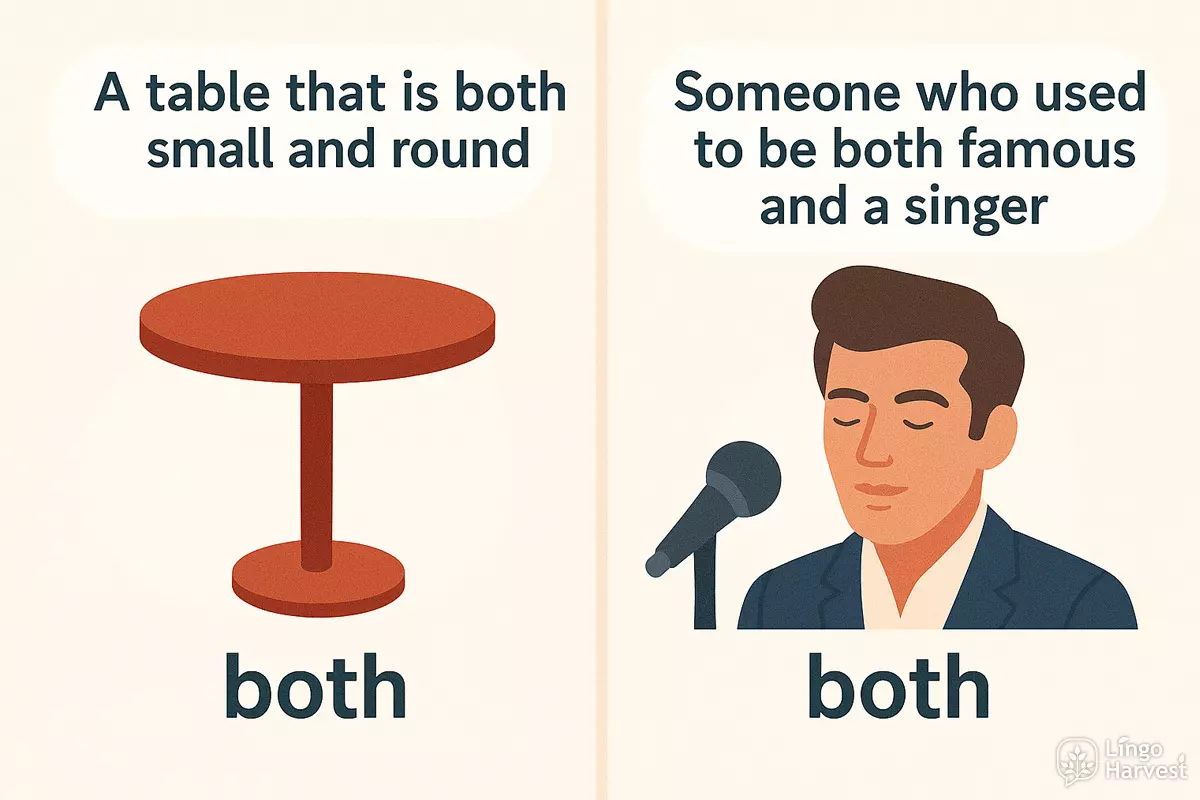
- small round table → a table that is both small and round
- round small table → awkward and possibly implies a “small table” that is round, but this order feels unnatural
- former famous singer → someone who used to be both famous and a singer
- famous former singer → someone who was once a singer and is famous for that, but may not be famous now
- plastic toy car → a toy car made of plastic
- toy plastic car → a plastic car that is a toy (less natural, could mean a car for toys)
- little old lady → an old lady who is little (standard phrase)
- old little lady → an odd, rarely used order; sounds strange
- big red ball → a ball that is both big and red
- red big ball → awkward, draws odd emphasis to “big”
- delicious homemade bread → bread that is both delicious and homemade
- homemade delicious bread → technically possible, but less natural and slightly different in emphasis
- new French restaurant → a restaurant that is both new and French
- French new restaurant → not idiomatic, may confuse the listener
- dangerous chemical plant → a chemical plant that is dangerous
- chemical dangerous plant → could imply a dangerous plant (living thing) that is chemical in nature
When order changes meaning versus when it just sounds odd
Not all changes in modifier order create a new meaning; sometimes, the result is simply unnatural or awkward. In other cases, the sequence determines which modifier groups with the noun and which modifies the whole phrase, affecting interpretation. Consider the following structured comparison:
| Phrase | Likely Meaning / Emphasis |
|---|---|
| old friend from school | a friend from school who is old (in age or duration) |
| school old friend | odd/unnatural; could imply “old friend” type associated with school |
| black leather jacket | a jacket made of black leather |
| leather black jacket | awkward; sounds like “black jacket” made of leather, but not idiomatic |
| fast electric car | an electric car that is fast |
| electric fast car | unusual; may suggest “fast car” that is electric, but not standard |
In summary, the sequence of modifiers before a noun is crucial for clarity and natural phrasing in English. Changing their order can subtly or dramatically shift meaning, or simply result in a construction that native speakers would find awkward or confusing.
Common errors with stacked modifiers before nouns
When several descriptive words pile up before a noun, it’s easy to lose track of order, clarity, or even basic grammar. Many learners—and even native speakers—run into trouble when stacking adjectives, participles, and other modifiers. These mistakes can make sentences confusing or awkward.
Misordering adjectives and modifiers
English has a natural sequence for different types of modifiers. Mixing up this order leads to sentences that sound odd or unnatural. For example, “a leather old brown bag” is incorrect because “old” should come before “brown,” and “brown” before “leather.”
- Unnatural: a leather old brown bag
- Natural: an old brown leather bag
- Unclear: a running small red dog
- Clear: a small red running dog
Omitting necessary commas
When two adjectives equally describe a noun, a comma is often needed. Skipping commas can make the meaning ambiguous.
- Right: a long, winding road
- Wrong: a long winding road (could be misread as “a winding road that is long” or “a long road that is winding”)
Overusing or misusing modifiers
Piling on too many descriptors can make a sentence cumbersome. Sometimes, modifiers clash or overlap in meaning, reducing clarity instead of adding detail.
- Wordy: the extremely tiny little small old wooden box
- Better: the small old wooden box
Confusing participles and adjectives
Modifiers like “bored,” “boring,” “interested,” and “interesting” are often mixed up, especially in longer modifier chains. This can change the meaning entirely.
- Incorrect: the boring interested student
- Correct: the bored, interested student
Ambiguous modifier attachment
Sometimes, it’s unclear which word a modifier is describing. This is especially common with prepositional phrases or participles.
- Confusing: the red-painted wooden house on the hill (Is the house red-painted, or is it the wooden house on the hill?)
- Clear: the wooden house, painted red, on the hill
Comparison table: natural vs. awkward modifier order
| Awkward/Incorrect Stacking | Natural/Correct Stacking |
|---|---|
| an American old famous actor | a famous old American actor |
| a silk beautiful blue scarf | a beautiful blue silk scarf |
| a running big brown dog | a big brown running dog |
| the kitchen new small table | the small new kitchen table |
| a glass tall water bottle | a tall glass water bottle |
| an Italian delicious traditional dish | a delicious traditional Italian dish |
| the wool warm green sweater | the warm green wool sweater |
| a working modern young woman | a young modern working woman |
Quick tips to avoid mistakes
- Follow the standard adjective order: opinion, size, age, shape, color, origin, material, purpose, noun.
- Use commas between equal adjectives, but not between cumulative ones.
- Limit the number of modifiers to what’s necessary for clarity.
- Check that each modifier clearly attaches to the right noun.
- Read your sentence aloud; if it sounds awkward, try rearranging the modifiers.
Getting the arrangement of multiple descriptive words right takes practice, but careful attention to order and clarity will help your sentences flow more naturally and avoid misunderstandings.
Differences between spoken and written modifier stacking
How we use and combine multiple modifiers before nouns can differ significantly between speech and writing. In conversation, modifier stacks are usually shorter and less complex. This is partly because listeners process information in real time, so speakers tend to keep noun phrases manageable. In contrast, writers have the luxury of editing and can create denser, more elaborate noun phrases without overwhelming their audience.
Typical tendencies in speech
- Modifiers are often limited to one or two before the noun.
- Pauses and intonation help clarify meaning.
- Speakers may use simpler or more familiar adjectives.
- Spoken language favors clarity over precision in stacking.
- Repetition or rephrasing is common if a stack becomes confusing.
Common features in writing
- Longer, more intricate stacks are possible (e.g., "the old red brick Victorian house").
- Punctuation, such as commas and hyphens, can clarify relationships.
- Writers often use specialized or technical modifiers.
- Modifier order is usually more rigid and follows established patterns.
- Ambiguity can arise more easily without careful construction.
Direct comparison of spoken vs. written modifier use
| Spoken English | Written English |
|---|---|
| Usually just 1–2 modifiers: "that big dog" | Often 3 or more: "those three large brown dogs" |
| Intonation and pauses signal grouping | Punctuation and word order clarify structure |
| May rephrase if misunderstood | Revised for clarity before finalizing |
| Spontaneous, context-driven choices | Deliberate, often follows style guides |
| Rarely uses technical or stacked descriptors | Can include technical, stacked, or nested modifiers |
Examples: How modifier stacking differs
- Spoken: "my new shoes" → Written: "my stylish new Italian leather shoes"
- Spoken: "that big old tree" → Written: "the enormous, centuries-old oak tree"
- Spoken: "the little blue car" → Written: "the compact, electric, sky-blue city car"
- Spoken: "her friend from school" → Written: "her long-time, highly accomplished school friend"
- Spoken: "this old book" → Written: "this rare, well-preserved nineteenth-century book"
- Spoken: "a nice warm coat" → Written: "a thick, insulated, water-resistant winter coat"
- Spoken: "those three cats" → Written: "those three mischievous, long-haired Siamese cats"
- Spoken: "the big round table" → Written: "the large, antique, round mahogany dining table"
- Spoken: "his old teacher" → Written: "his inspiring, much-admired former mathematics teacher"
- Spoken: "that tall guy" → Written: "that exceptionally tall, broad-shouldered basketball player"
In summary, stacking multiple modifiers before nouns is more flexible and elaborate in writing, while spoken language prioritizes clarity and ease of processing. Recognizing these patterns helps both language learners and native speakers adapt their style to suit the context.
Practice: reorder modifiers to create natural noun phrases
Understanding how to arrange adjectives and other modifiers before a noun is essential for clear, natural English. In real sentences, modifiers follow a typical order: quantity, opinion, size, age, shape, color, origin, material, and purpose. Let's practice reorganizing jumbled phrases to sound more like what native speakers use every day.
Task: Put the Modifiers in the Best Order
Below are phrases with their modifiers scrambled. Rearrange them to create natural-sounding noun phrases. Remember, native English speakers rarely use more than three or four modifiers at once, but these exercises help you get comfortable with longer combinations.
- antique / Spanish / beautiful / wooden / table
- old / little / brown / dog
- plastic / blue / new / water / bottle
- round / delicious / chocolate / big / cake
- sleeping / adorable / tiny / baby / white / kitten
- modern / glass / tall / office / building
- elegant / black / Italian / leather / shoes
- large / rectangular / red / Persian / wool / rug
- shiny / silver / sports / fast / car
- old / English / detective / famous / clever / story
Show answers
- beautiful antique wooden Spanish table
- little old brown dog
- new blue plastic water bottle
- big round delicious chocolate cake
- adorable tiny sleeping white baby kitten
- tall modern glass office building
- elegant black Italian leather shoes
- large rectangular red Persian wool rug
- fast shiny silver sports car
- famous clever old English detective story
Common Modifier Types: Quick Reference
- Quantity: two, several, many, some
- Opinion: lovely, ugly, interesting, boring
- Size: big, tiny, huge, small
- Age: new, ancient, young, old
- Shape: round, square, rectangular
- Color: blue, red, golden, black
- Origin: Italian, French, American, Spanish
- Material: wooden, plastic, glass, leather
- Purpose/Qualifier: sports (car), office (building), water (bottle)
Quick Self-Check: Modifier Order Patterns
Try making your own noun phrases. Pick any three to five modifiers from the reference list above, and see if you can put them in the natural order before a noun (for example: "three lovely old French books").
- Does the phrase sound natural? ✅ Good job!
- Does it feel awkward? ❌ Try switching the order, following the reference list.
Practicing with real sentence patterns builds your confidence in using multiple modifiers smoothly, just like in authentic English contexts.