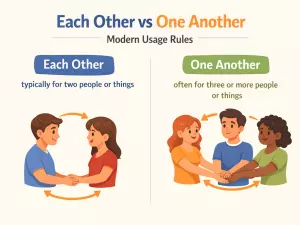
Using “the other,” “others,” and “the others”: complete guide

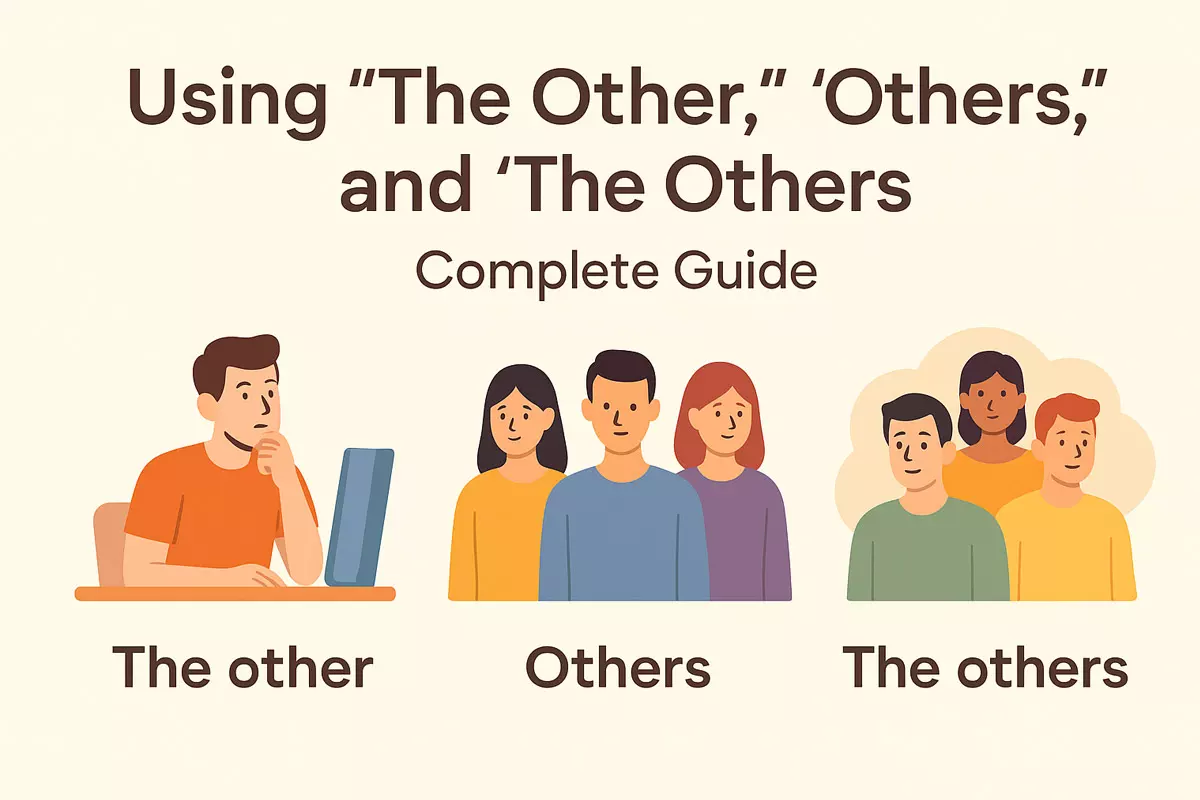 This article reviews how to use the other, another, others, and the others, explains their differences, shows typical contexts, points out common mistakes, and provides practice with mini-dialogues to help learners master these words.
- Review of other and another from lower levels
- Difference between the other and another in simple terms
- Using others with no noun after it
- Using the others to refer to a known remaining group
- Typical contexts in stories, instructions, and conversations
- Common learner mistakes with these forms
- Practice: complete mini-dialogues with the other, others, or the others
Understanding the subtle differences between terms that refer to different people or groups can be challenging, even for experienced English speakers. Knowing when and how to use these expressions correctly is essential for clear and confident communication. By paying close attention to context and the specific meanings of words, you can avoid misunderstandings and express your ideas more precisely. Developing this skill not only improves your language abilities but also helps you connect more effectively with others in both personal and professional settings.
Review of other and another from lower levels
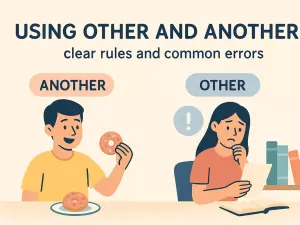
Before diving deeper into “the other,” “others,” and “the others,” it’s important to recall how other and another are used at beginner and pre-intermediate levels. These words help us talk about different or additional people and things, but they are not interchangeable.
Basic meanings and use
- Other is used to refer to something different or remaining. It can describe both singular and plural nouns.
- Another means “one more” or “an additional one.” It is always used with singular, countable nouns.
Common sentence patterns
- Do you have another pen? (one more pen)
- I don’t like this shirt. Can I see the other one?
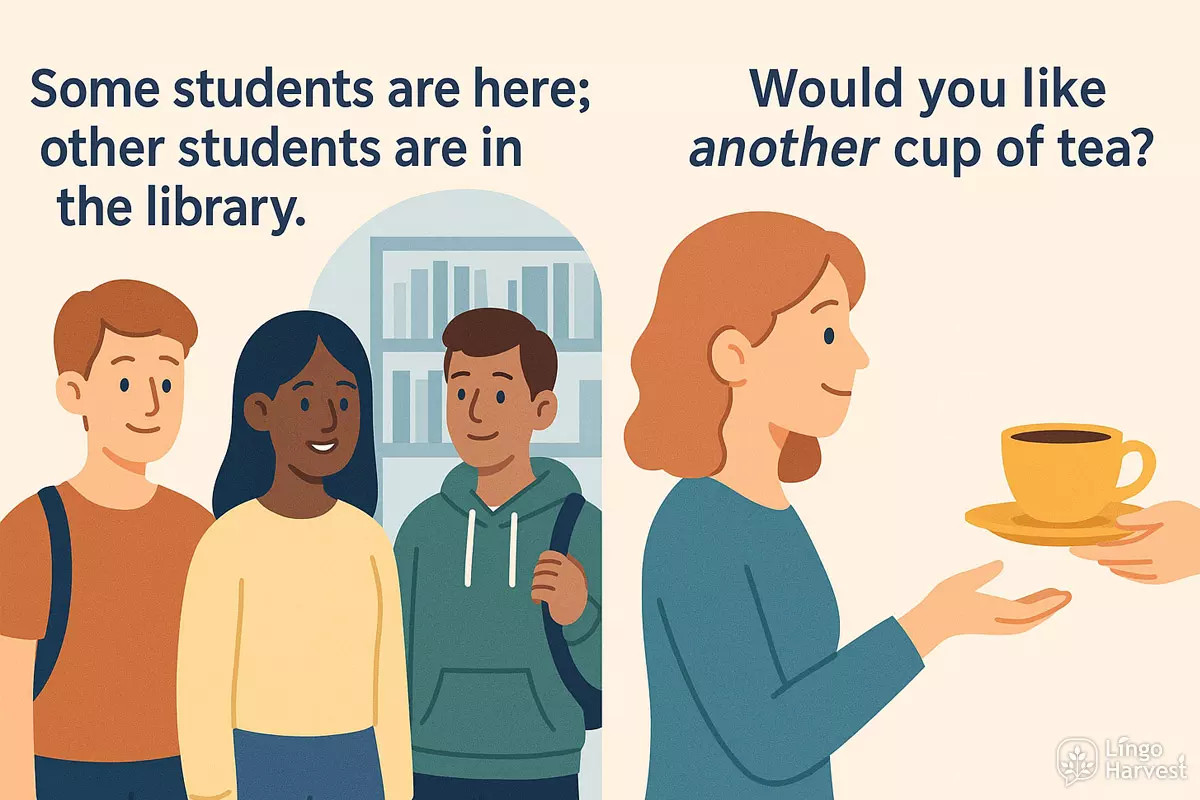
- Some students are here; other students are in the library.
- Would you like another cup of tea?
- Let’s try another way.
- I have two brothers. One lives in Canada; the other lives in Spain.
- You can ask other people for help.
- He has finished one project and will start another soon.
- Some children are playing. Other children are reading.
- Take one cookie now and save the other for later.
Quick comparison of basic forms
| Word | Usage | Example |
|---|---|---|
| other | with plural or uncountable nouns, or with “the” for singular | Other people, the other book |
| another | with singular, countable nouns only | Another apple, another idea |
Practice: Choose the correct word
- Would you like (other / another) slice of pizza?
- She took one glove and left the (other / another) on the table.
- Some people are late. (Other / Another) people have already arrived.
- He wants to buy (other / another) car next year.
- I don’t like this shirt. Can I try (other / another) one?
- One student was absent. The (other / another) students were present.
- This pen is broken. Do you have (other / another)?
- Some books are on the shelf. The (other / another) are in the box.
- She already has a bike, but she wants (other / another) one.
- I finished one task. Now I need to start (other / another).
Show answers
- another
- other
- Other
- another
- another
- other
- another
- other
- another
- another
Understanding these basic distinctions will help you use more advanced forms like “the other,” “others,” and “the others” with confidence.
Difference between the other and another in simple terms
Understanding when to use "the other" versus "another" can help make your English much clearer. Both words refer to something different or additional, but they are used in different situations.
Key points to remember
- "Another" means “one more” or “an additional one of the same kind.” Use it when talking about something extra or a different one of several.
- "The other" refers to the last remaining option or a specific alternative already known or mentioned.
Simple explanations with examples
- "Another": If you have one cookie and ask for "another," you want one more cookie, but it doesn’t matter which specific one.
- "The other": If there are two cookies, and you take one, "the other" means the one that is left.
- "Would you like another drink?" (any additional drink, not a specific one)
- "I have two pens. One is blue, the other is black." (only two pens; the second is specific)
- "I finished my sandwich. Can I have another?" (any extra sandwich)
- "There were two keys on the table. I took one and left the other." (the second, specific key)
- "She tried on one dress, then decided to try another." (any other dress, not specific)
- "He has two brothers. One is a doctor, the other is a teacher." (referring to the second brother)
- "We need another chair for the table." (one more, not a particular one)
- "I have two options. I chose one; my friend chose the other." (the remaining, specific option)
Quick comparison chart
| Word | When to Use | Example |
|---|---|---|
| Another | For any extra or different one, not specific | Can I have another slice of pizza? |
| The other | For the only remaining or specific alternative | I have two shoes; one is here, the other is missing. |
In summary
"Another" is used for more, extra, or any different item, while "the other" is for the last or specific remaining item in a known set. Keeping this distinction in mind will make your writing and speaking more precise.
Using others with no noun after it
When you see “others” used by itself, it acts as a pronoun, meaning “other people” or “other things” without repeating a specific noun. This is common in English to avoid unnecessary repetition and keep sentences clear and natural. The word stands in for a previously mentioned or understood group, so there’s no need to restate the noun. For example:
- Some students finished early; others needed more time. (others = other students)
- John likes hiking, but others prefer swimming. (others = other people)
- Some books are on the shelf; others are in my bag. (others = other books)
- We brought snacks, and others brought drinks. (others = other people)
- Some answers were correct; others were not. (others = other answers)
- Several chairs are broken, but others are fine. (others = other chairs)
- He solved a few problems; others remained unsolved. (others = other problems)
- Some options are expensive; others are more affordable. (others = other options)
- Many tried to help, but others just watched. (others = other people)
- Some were invited, while others were not. (others = other people)
- These shoes fit, but others are too small. (others = other shoes)
- He took some cookies, and others were left for us. (others = other cookies)
How “others” works in sentences
“Others” always refers back to a group already mentioned or understood from context. It is plural, so use it only when talking about more than one person or thing. If you want to refer to just one, use “another” instead.
Common mistakes to avoid
- Don’t use “others” with a noun directly after it. For example, say “others” or “other people,” but not “others people.”
- Don’t use “others” for singular references; use “another” for one more person or thing.
- Don’t use “the others” unless you’re referring to a specific remaining group.
This pronoun is especially useful in comparisons, contrasts, and when talking about groups or categories. It helps your speech and writing sound more fluent and less repetitive.
Using the others to refer to a known remaining group
When you say “the others,” you’re talking about the rest of a specific, already identified group—not just any group, but a set that everyone in the conversation knows. This phrase is most useful if you’ve already mentioned or separated part of the group, and now want to refer to all those who haven’t been singled out yet. For example, if you have five students and you’ve already talked about two by name, “the others” will naturally refer to the remaining three.
How “the others” works in context
“The others” replaces a list of people or things you don’t want to name individually, but that are known from context. It’s different from simply saying “others,” which is more general and could mean any additional people or things, not necessarily the rest of a specific set.
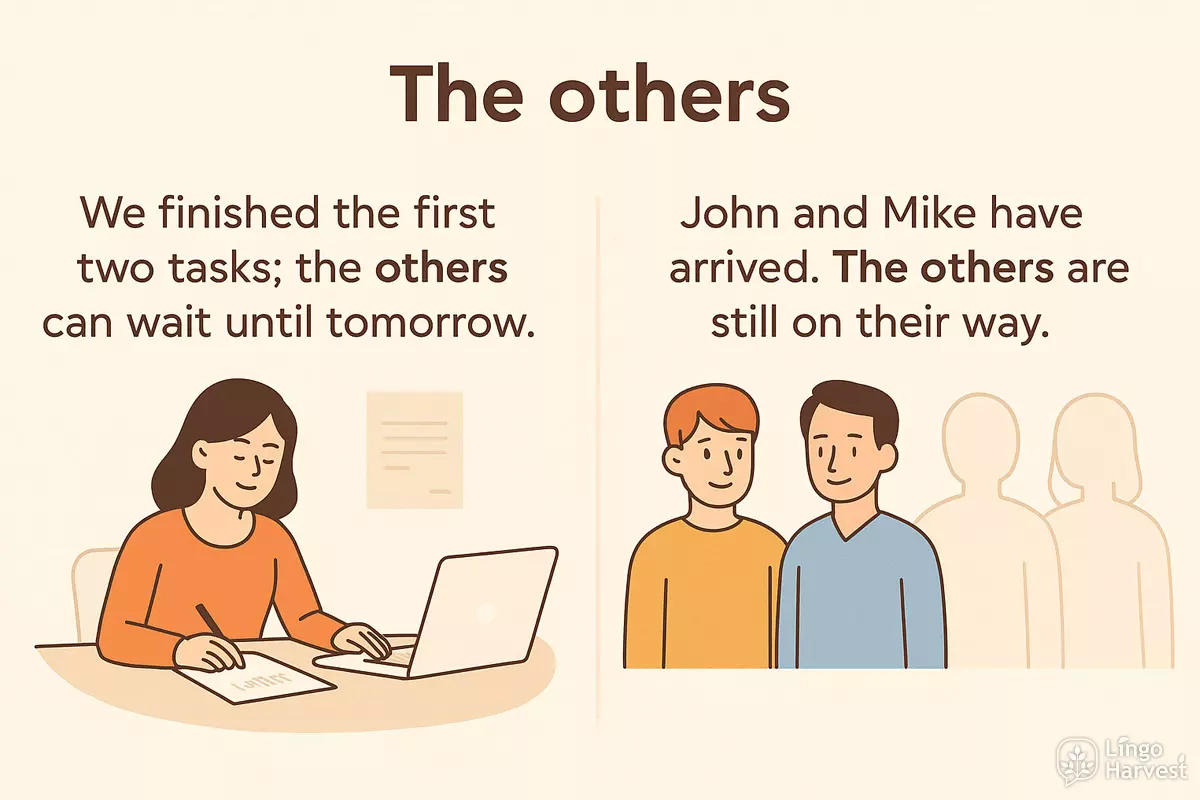
- We finished the first two tasks; the others can wait until tomorrow.
- John and Mike have arrived. The others are still on their way.
- Take one apple for yourself and give the others to your friends.
- Some tickets were handed out. The others are still available.
- Only three students passed. The others will need to retake the exam.
- Susan took her books, but the others left theirs behind.
- Of the six proposals, two were accepted. The others were rejected.
- I’ve read these articles; the others are new to me.
- Half the guests have arrived. The others should be here soon.
- He kept one key and gave the others to his coworkers.
- Keep this piece and put the others in the box.
- Some of the cookies are gone. The others are in the kitchen.
- Of all the options, these are the best. The others aren’t as good.
- One of the chairs is broken, but the others are fine.
- She chose three books; the others were left on the shelf.
Comparing “the others” with related expressions
It’s easy to mix up “the others” with similar phrases like “others” or “the other.” Here’s how they differ:
| Phrase | Usage Example & Meaning |
|---|---|
| the others | Refers to the rest of a specific, known group. Example: Three people left early. The others stayed until the end. |
| others | Means more people or things in general, not a defined set. Example: Some people like coffee; others prefer tea. |
| the other | Refers to the remaining one item/person from a known set of two. Example: I have one glove. Where is the other? |
Key points to remember
- Use “the others” only when your listener already knows the group you’re talking about.
- It always refers to the rest of a specific, previously mentioned set.
- This phrase helps you avoid repeating names or items, keeping communication clear and concise.
In summary, “the others” is a handy way to talk about a known remainder, making your speech or writing more efficient and avoiding unnecessary repetition.
Typical contexts in stories, instructions, and conversations
Understanding when to use “the other,” “others,” and “the others” depends heavily on the type of communication and its purpose. Whether you’re reading a story, giving instructions, or having a conversation, each form serves specific roles. Here’s how these expressions commonly appear across different scenarios.
Storytelling and Narratives
Writers use these phrases to clarify distinctions between characters, objects, or groups. “The other” often singles out one remaining item or person, while “others” refers to an unspecified number. “The others” specifies a known, remaining group.
- “She picked up one book and left the other on the table.”
- “Some students finished early; others needed more time.”
- “John and the others waited outside.”
- “He wanted to join the others at the party.”
- “One brother stayed, while the other left.”
Instructions and Procedures
In instructional contexts, these terms clarify steps or choices, helping listeners or readers distinguish between options or actions.
- “Cut one sheet in half. Leave the other whole.”
- “Place the apples in one basket, and the others in the fridge.”
- “If you finish early, help the others.”
- “Use one color for this section and another for the rest.”
- “First, complete this part; the other steps come later.”
Everyday Conversations
In daily speech, these expressions help clarify references, avoid repetition, and show contrasts or groupings.
- “I’ll take this seat; you can have the other.”
- “Some people love spicy food; others can’t handle it.”
- “Where are the others?”
- “I finished my work, but the others are still busy.”
- “Do you want the other piece of cake?”
- “He’s different from the others.”
- “Let’s meet the others at the entrance.”
- “Take one and pass the others around.”
- “She chose this one over the other.”
- “Some of us left early; the others stayed late.”
Quick Reference: Usage Patterns
| Phrase | Typical Use | Example |
|---|---|---|
| the other | Refers to the last remaining option or person (singular) | “I have two pens; one is blue, the other is black.” |
| others | Refers to additional, unspecified items or people (plural, indefinite) | “Some arrived early; others were late.” |
| the others | Refers to the remaining members of a known group (plural, definite) | “I saw Tom and the others at lunch.” |
Using these expressions correctly helps make your meaning clear, whether you’re narrating events, explaining steps, or chatting with friends. The precise context—whether it’s a story, a set of instructions, or an everyday exchange—usually determines which form fits best.
Common learner mistakes with these forms
Mixing up "the other," "others," and "the others" is a frequent stumbling block for English learners. These words look similar but are used in different situations, and confusing them can lead to awkward or unclear sentences. Here are some of the main issues people run into when using these forms.
Confusing singular and plural forms
Learners often use "the other" when they should use a plural form, or vice versa. For example, saying "the other students" when referring only to one student, or "others" when talking about a specific, known group.
Omitting "the" when it's needed
Another pitfall is forgetting the definite article "the" in "the other" or "the others." This changes the meaning or makes the sentence grammatically incorrect.
Using "others" incorrectly with nouns
"Others" is a pronoun, not a determiner, so it shouldn’t directly modify nouns. Learners sometimes write things like "others people" instead of "other people."
Mixing up reference: general vs. specific
"The others" refers to a specific, previously mentioned group, while "others" means some additional people or things in general. This distinction is often missed.
Common error patterns
- Writing "the others students" instead of "the other students"
- Using "the others" when "others" is correct: "Some people like tea, the others prefer coffee" (should be "others")
- Leaving out "the" in "the other": "I’ll take other seat" (should be "the other seat")
- Using "others" with a noun: "others books" (should be "other books")
- Using "the other" for plural: "I met the other yesterday" (unclear—should be "the others" or "another")
- Confusing "another" with "the other": "I need another pen" (correct if any pen), "I need the other pen" (correct if only two pens exist)
- Mixing up "other" as an adjective and "others" as a pronoun
- Forgetting to specify the group: "The others left" (which others?)
- Using "the others" with uncountable nouns
- Overusing "the" where it isn’t necessary
Comparison Table: Usage at a Glance
| Form | Usage Example | Common Mistake | Corrected Version |
|---|---|---|---|
| the other | I have two books. One is here, the other is on the table. | I have two books. One is here, other is on the table. | I have two books. One is here, the other is on the table. |
| others | Some students finished early; others are still working. | Some students finished early; the others are still working. (if not all are included) | Some students finished early; others are still working. |
| the others | Five people left; the others stayed. | Five people left; others stayed. (if all remaining are meant) | Five people left; the others stayed. |
| other + noun | Do you have other questions? | Do you have others questions? | Do you have other questions? |
Summary tips
Always check if you’re talking about one or many, specific or general, and whether you need a noun after the word. When in doubt, try replacing the word with a synonym or rephrasing the sentence to clarify your meaning. Small changes can make your English much clearer and more natural.
Practice: complete mini-dialogues with the other, others, or the others
Understanding how to correctly use "the other," "others," and "the others" can be tricky, especially in real conversation. Below you'll find a variety of short dialogues and sentences with missing words. Your task is to choose the correct form to complete each exchange naturally. This practice will help you become more confident when distinguishing between these commonly confused expressions.
Mini-dialogues: Choose the correct word
Read each mini-dialogue and select the best option: "the other," "others," or "the others."
- A: I have two pens. One is blue. Where did ___ go?
B: Check your bag. Maybe it's there. - A: Some students are here, but ___ are still outside.
B: Should we wait for them? - A: I finished my tasks. What about ___?
B: Not yet. I'll do them after lunch. - A: Only two people finished early. ___ are still working.
B: Let's give them more time. - A: This chair is broken. Use ___ one.
B: Thanks, this one is perfect. - A: Did you see my gloves?
B: I found one. Where is ___?
A: Maybe under the table. - A: Some of the books are missing. Where are ___?
B: I think they're in the library. - A: I like this cake. Do you want to try ___?
B: Sure, I love trying new things. - A: One of my keys is here. ___ must be at home.
B: Let's check when we get back. - A: There are many people at the party. Some are dancing, ___ are talking.
B: It's a lively group!
Show answers
- the other
- the others
- the others
- The others
- the other
- the other
- the others
- the other
- the other
- others
Quick check: When to use each form
- the other: Refers to the second of two items, or a specific additional item.
- others: Means "other people/things" in general, without specifying which ones.
- the others: Refers to a specific group of remaining people or things.
Sentence completion: Pick the right phrase
Choose the correct word or phrase to fill in the blanks.
- We have two options. I'll take one, you take ___.
- Some of my friends came early, but ___ were late.
- She likes this color, but prefers ___ one.
- I finished my work, but ___ still need to submit theirs.
- There are two doors. Use this one, not ___.
- A few students passed the exam, but ___ failed.
- This phone is old. I want to buy ___.
- Some apples are green; ___ are red.
- One shoe is under the bed; ___ is near the door.
- Several tasks are done, but ___ remain unfinished.
Show answers
- the other
- the others
- the other
- others
- the other
- the others
- another
- the others
- the other
- others
Practicing with these short exchanges helps reinforce the correct usage of these phrases in everyday speech. Try creating your own examples to further solidify your understanding.