Each Other vs One Another: Modern Usage Rules

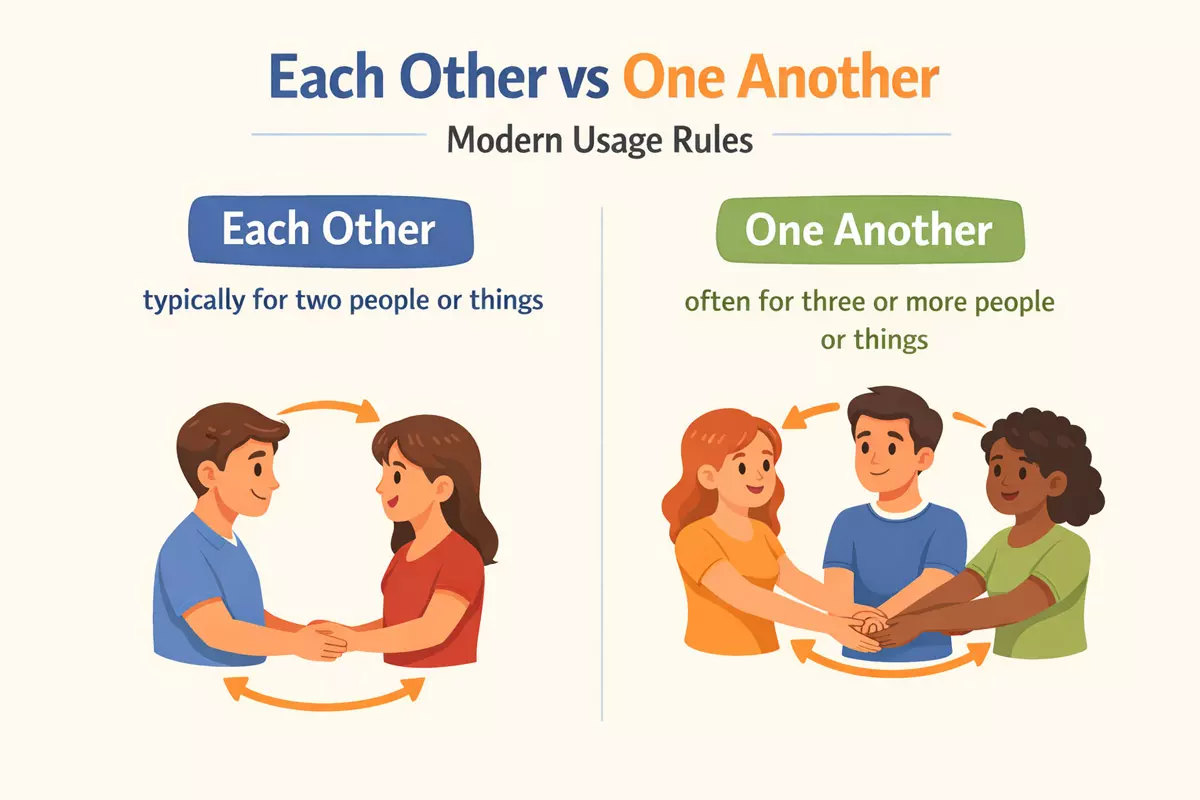 Here we what reciprocal pronouns mean, how traditional rules differ from modern usage, when to use each other or one another, and typical learner mistakes. It includes natural examples and a practice section on choosing the correct form.
Understanding when to use phrases that address mutual interactions or refer to groups in English can be challenging, as language is constantly evolving and the distinctions between such expressions are often subtle. For instance, choosing between terms like each other and one another depends on whether you are discussing two people or more, though modern usage is less strict about this rule. Similarly, deciding how to refer to groups—using collective nouns, plural forms, or inclusive pronouns—requires attention to context and audience. As grammar conventions shift, staying aware of these nuances helps ensure clear and effective communication.
What reciprocal pronouns express
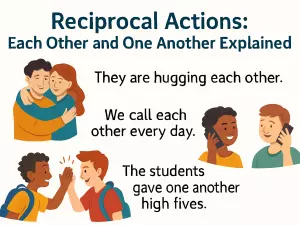
Reciprocal pronouns, such as each other and one another, highlight mutual actions or feelings shared by two or more participants. Instead of stating the same idea twice (“Alice hugged Bob, and Bob hugged Alice”), English uses these pronouns to show that the action goes both ways, creating smoother, less repetitive sentences.
They’re most often found in sentences where the verb’s action passes back and forth between the people involved. This includes actions, emotions, and even attitudes. The presence of a reciprocal pronoun signals that everyone in the group is both acting and being acted upon in the same way.
Core meanings and uses
- Expressing shared actions (e.g., “They greeted each other warmly.”)
- Indicating mutual feelings (“We trust one another.”)
- Clarifying that all members of a group participate equally
- Avoiding repetition in sentences with two-way actions
- Forming a compact way to describe reciprocal relationships
- Appearing after verbs to show the direction of the action
- Used with prepositions to clarify relationships (“They looked at each other.”)
- Appearing in both formal and informal English
- Occasionally used for emphasis (“They respect each other deeply.”)
- Helping distinguish between actions done together and those done reciprocally
Example patterns
Here are some typical ways these pronouns fit into everyday sentences:
- The students helped each other with homework.
- We smiled at one another.
- Neighbors often greet each other in the morning.
- The twins blamed each other for the mess.
- They wrote letters to one another.
- Everyone congratulated each other after the game.
- The cats chased each other around the yard.
- We listened to one another’s ideas.
- They promised to support each other.
- The partners trust one another completely.
Comparing types of mutual relationships
| Function | Example with Reciprocal Pronoun |
|---|---|
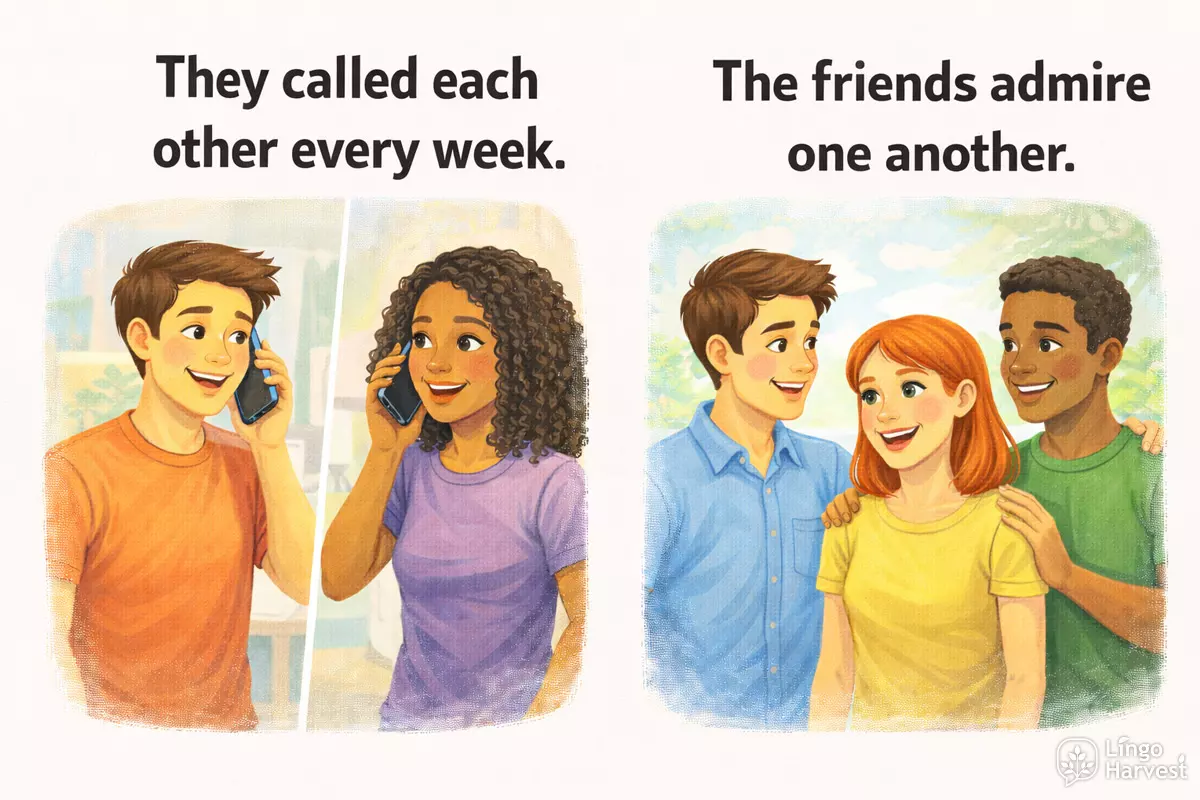
| Mutual Action | They called each other every week. |
| Shared Feeling | The friends admire one another. |
| Reciprocal Attitude | The teams respected each other’s efforts. |
| Two-way Communication | We wrote to one another during the summer. |
In summary, reciprocal pronouns efficiently convey the idea of mutual involvement, whether it’s about actions, emotions, or attitudes. Their use makes English more concise and clear when describing how people interact or relate within a group or pair.
Traditional rule vs modern usage
Historically, grammar guides made a clear distinction between “each other” and “one another.” The classic rule stated that “each other” should refer only to two people or things, while “one another” was reserved for groups of three or more. This guidance appeared in numerous style manuals and was taught in schools for generations. However, contemporary English often treats these expressions as interchangeable, and most modern writers and speakers do not observe the older restriction.
Old guideline: two versus more than two
The original distinction was simple: use “each other” for pairs, and “one another” for groups. For example:
- The twins looked at each other.
- The classmates congratulated one another after the exam.
Yet, even in 19th-century literature, writers sometimes ignored this rule, using both phrases in similar contexts regardless of group size.
| Traditional Rule | Modern Usage |
|---|---|
| “Each other” for two only → The two friends hugged each other. |
“Each other” for any group size → The team members encouraged each other. |
| “One another” for three or more → The siblings shared secrets with one another. |
“One another” for any group size → The couple smiled at one another. |
| Strict separation required | Interchangeable in most contexts |
| Prescriptive tradition | Descriptive, reflects real usage |
Current recommendations
Today, most modern dictionaries and usage experts agree that the old two-versus-many distinction is rarely observed in practice. Both “each other” and “one another” are used for any number of people or things interacting in reciprocal ways. The difference is now mostly stylistic, with “one another” sometimes chosen for variety or a more formal tone.
- Either phrase is acceptable in everyday writing.
- No major style guide requires strict separation.
- Clarity and naturalness of the sentence matter more than the number involved.
In summary, while the traditional guideline still appears in some reference works, it is not a rule that most English speakers follow today. Both expressions are widely accepted and can generally be used according to personal or stylistic preference.
Each other with two people or things
Traditionally, the phrase each other is linked to situations involving two people or objects. When two individuals interact or have a mutual relationship, this expression is typically used to convey that sense of reciprocity. For example, in the sentence “The twins always help each other with homework,” the implication is that the help is exchanged between just two people.
Classic Usage Examples
- John and Maria smiled at each other.
- The two dogs chased each other around the yard.
- We gave each other gifts for our anniversary.
- The players shook each other’s hands after the match.
- The siblings blamed each other for the mess.
- They looked at each other in surprise.
- The cats groomed each other.
- My parents always support each other.
- The partners trust each other completely.
- The two friends listened to each other’s stories.
This usage pattern helps clarify mutual actions or feelings that are strictly shared between two parties. When more than two participants are involved, traditional grammar guides suggest using one another instead. However, in modern English, the distinction has become less rigid, and “each other” is often accepted regardless of the number involved.
Comparing Mutual Pronouns
| Expression | Typical Context |
|---|---|
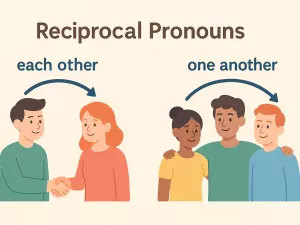
| each other | Two people or things exchanging actions or feelings |
| one another | Three or more people or things involved in mutual action |
While most native speakers now use these phrases interchangeably, understanding the traditional guideline can be helpful for formal writing or standardized tests. If you want to be precise according to older grammar rules, remember to use “each other” when referring to two participants, and “one another” for groups of three or more.
One another with groups
When discussing how people interact within collectives, the phrase "one another" often comes into play. Traditionally, "one another" was reserved for situations involving three or more participants, as opposed to "each other," which was used for just two. While modern usage has blurred this line, there are still contexts—especially in formal writing or careful speech—where adhering to this distinction can lend clarity.
How "one another" applies to group interactions
Imagine a team, committee, or class. When describing mutual actions among all members, "one another" helps emphasize the web of relationships. For example, in a classroom, students might share ideas with one another, suggesting a network of exchanges rather than just pairs.
- The committee members debated with one another before reaching a decision.
- Neighbors greeted one another at the annual block party.
- The players congratulated one another after each goal.
- Scientists share findings with one another at conferences.
- Colleagues support one another during challenging projects.
- Members of the choir listen to one another to stay in harmony.
- Children exchanged gifts with one another during the celebration.
- Friends rely on one another in difficult times.
- Volunteers coordinated with one another to organize the event.
- Audience members whispered to one another during the intermission.
Comparison with "each other" in group contexts
While "each other" is frequently used even with groups in everyday language, some style guides and careful writers still prefer "one another" when referring to more than two. The following table shows how both phrases can appear in group settings, but with subtle preference for "one another" when the context involves larger collectives:
| Context | Preferred Phrase |
|---|---|
| Three or more friends sharing stories | one another |
| Two teammates passing the ball | each other |
| All employees exchanging feedback | one another |
| Two siblings helping with chores | each other |
| Group of students reviewing assignments | one another |
In summary, using "one another" with collectives can highlight the interconnectedness of group members. While everyday English allows for flexibility, choosing the more traditional form can add precision when describing complex group dynamics.
Formal vs informal preferences
Writers often wonder whether "each other" or "one another" is more appropriate in different settings. Traditionally, style guides made a clear distinction: "each other" for two people, "one another" for three or more. However, contemporary English has relaxed these rules, especially in less formal writing. The choice now depends more on the tone, register, and sometimes personal preference than on rigid grammar.
Usage in formal writing
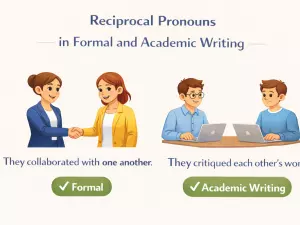
In academic papers, official documents, and other formal contexts, some editors still encourage maintaining the traditional distinction. This is especially true in legal, diplomatic, or scholarly texts, where precise language is valued. Such writing may also avoid contractions and prefer longer forms for clarity.
- Legal contracts: "The parties agree not to disclose information to one another."
- Academic analysis: "The authors reference each other's work."
- Policy documents: "Team members must support one another in achieving objectives."
Informal and everyday language
In conversation, emails, and most digital communication, the difference between the two phrases is rarely enforced. People naturally use whichever feels more comfortable, and the meaning remains clear either way. The phrases are often interchangeable, with "each other" being slightly more common in casual speech.
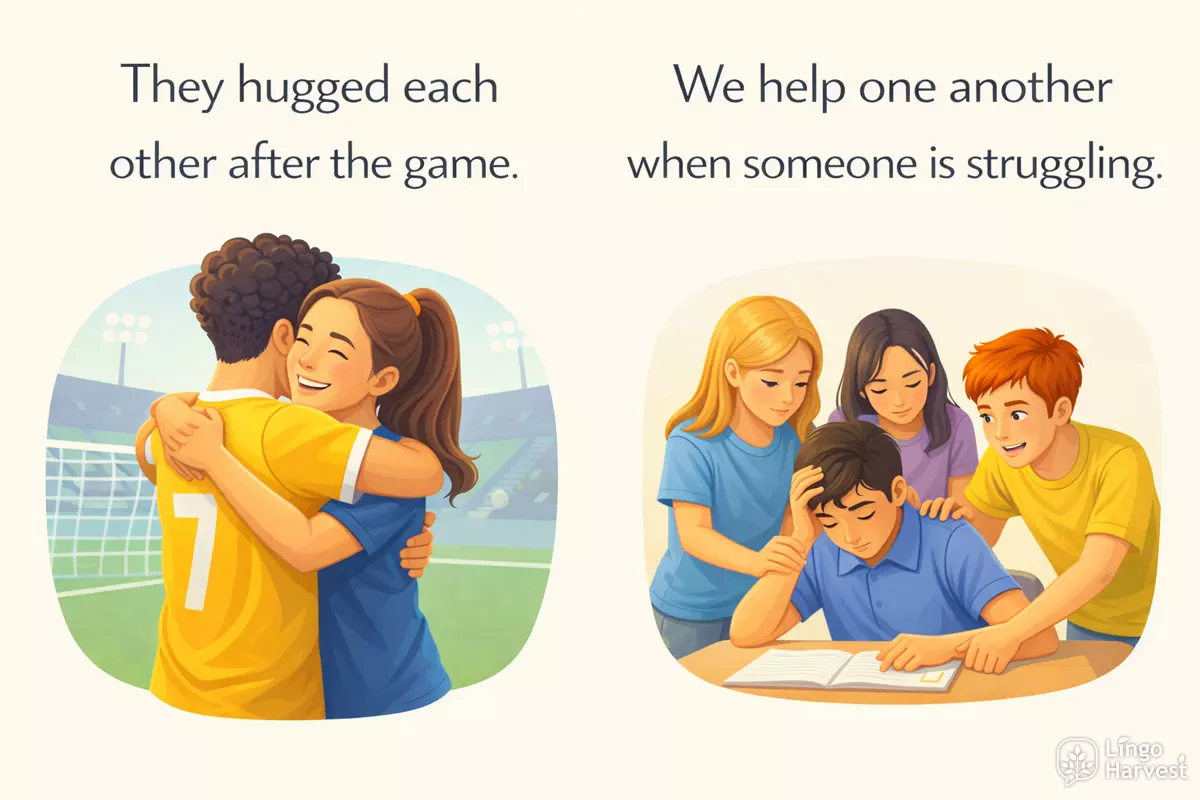
- "They hugged each other after the game."
- "We help one another when someone is struggling."
- "The cats groom each other every morning."
- "Neighbors should look out for one another."
Common patterns and preferences
Despite the overlap, some subtle preferences persist in modern usage. Here are typical patterns:
- "Each other" is often used for pairs and small groups, regardless of number.
- "One another" can sound slightly more formal or literary.
- Set phrases and idioms usually stick to one form ("love each other," not "love one another" in most songs).
- Both forms work as pronouns and possessives ("each other's opinions," "one another's support").
| Context | Preferred Phrase | Example |
|---|---|---|
| Formal writing (traditional) | One another | "Colleagues should respect one another." |
| Informal speech | Each other | "They text each other every day." |
| Legal documents | One another | "The parties will notify one another of changes." |
| Everyday conversation | Each other | "We see each other a lot." |
| Literary tone | One another | "They relied on one another through hardship." |
| Popular usage (general) | Each other | "Friends always help each other." |
Ultimately, while some subtle preferences and traditions remain, modern usage is flexible. Context, tone, and clarity matter more than strict adherence to old distinctions. Most readers and listeners will understand your meaning, whichever phrase you choose.
Common learner misconceptions
English learners often stumble over when to use "each other" and "one another," partly because the traditional rules are rarely enforced in modern English. Many assume there is a strict, unbreakable distinction between the two, but current usage is much more flexible. Let's clarify some of the most frequent misunderstandings about these expressions.
Traditional rule vs. real-world usage
The old grammar rule claims "each other" should refer to two people or things, while "one another" is for three or more. In actual practice, most native speakers use them interchangeably, regardless of the number involved. This leads to confusion, especially for those who have learned the "two vs. three or more" guideline by heart.
- Believing "each other" is only for pairs (❌ Not strictly true today)
- Assuming "one another" cannot refer to two people (❌ Modern English allows it)
- Thinking there is a meaningful difference in meaning (❌ In most cases, there is not)
- Feeling that only one form is correct in formal writing (❌ Both are widely accepted)
- Assuming native speakers always follow the old distinction (❌ Most do not notice or care)
Confusion with similar expressions
Another area where confusion arises is with expressions like "each," "every," and "together." Learners sometimes substitute these for "each other" or "one another," leading to awkward or incorrect sentences.
- Using "each" or "every" instead of "each other" ("They love each" ❌)
- Replacing "each other" with "together" ("They saw together" ❌)
- Mixing up possessive forms ("each other's books" vs. "one another's books")
Examples of correct and incorrect usage
It's helpful to see side-by-side examples that highlight common errors and their correct forms:
| Incorrect Example | Corrected Form |
|---|---|
| They looked at one another (when only two people are present). | They looked at each other. Or They looked at one another. (Both are fine in modern English.) |
| The three friends called each other every night. | The three friends called each other or one another every night. (Both accepted.) |
| The students helped every to finish the project. | The students helped each other (or one another) to finish the project. |
| They exchanged each other's gifts among the group of five. | They exchanged each other's or one another's gifts among the group of five. |
Summary of practical points
- Both phrases can be used for two or more people in modern English.
- Context and clarity matter more than strict adherence to old rules.
- Possessive forms ("each other's," "one another's") are both correct and natural.
- Substituting unrelated words ("each," "together") can confuse meaning.
Understanding how these expressions are used in everyday English will help learners communicate more naturally and avoid awkward mistakes.
Natural spoken examples
In everyday conversation, people often choose between "each other" and "one another" based on habit or convenience, rather than following strict grammar rules. Both expressions are used to talk about relationships or actions involving two or more people, but there are subtle differences in how speakers use them in real life.
How people actually use these phrases
Native speakers frequently use "each other" even when talking about groups larger than two, despite traditional rules. "One another" is less common in spoken English and sometimes sounds more formal or literary. Here are some snippets you might hear in daily speech:
- We help each other out whenever we can.
- The kids were chasing each other around the yard.
- In a big family, everyone looks out for one another.
- They’re always arguing with each other about something.
- The team members congratulated one another after the win.
- My friends and I text each other every day.
- The neighbors often invite one another over for dinner.
- We try to support each other through tough times.
- The birds were calling to each other across the trees.
- At the reunion, old classmates greeted one another warmly.
- They exchanged gifts with each other at the party.
- The dogs sniffed each other curiously.
- The volunteers thanked one another for their hard work.
Comparing casual and formal use
There’s a practical difference in tone: "each other" tends to sound relaxed, while "one another" often feels a bit more formal or deliberate. However, this distinction is fading, especially in spoken language. The table below illustrates typical contexts and speaker preferences:
| Phrase | Typical Spoken Use | Impression | Example |
|---|---|---|---|
| each other | Common, informal, any group size | Natural, relaxed | We text each other all the time. |
| one another | Less frequent, sometimes formal | Polished, sometimes distant | They supported one another throughout the project. |
Overall, in modern conversation, both options are widely understood and accepted. Most people won’t notice if you use them interchangeably, especially when speaking spontaneously.
Practice: choose the correct reciprocal form
Understanding when to use “each other” versus “one another” can be tricky, especially since both phrases often appear in similar contexts. To build confidence, try selecting the most natural option in the sentences below. Consider the number of people or things involved, as well as the tone (formal or informal).
Choose the appropriate reciprocal expression
- The two friends looked at ______ and laughed.
- In the meeting, the team members listened to ______'s ideas respectfully.
- The cats chased ______ around the garden all afternoon.
- We gave ______ gifts during the holiday party.
- The three siblings always support ______ when times are tough.
- During the debate, the students challenged ______'s arguments.
- The twins helped ______ with their homework every day.
- The dancers moved in perfect harmony with ______.
- Neighbors should look out for ______, especially in emergencies.
- All the players congratulated ______ after the match.
Show answers
- each other
- one another
- each other
- each other
- one another
- one another
- each other
- each other
- one another
- one another
Quick reference: when to use “each other” vs “one another”
| Expression | Typical Use |
|---|---|
| each other | Two people or things; common in everyday English |
| one another | Three or more people or things; slightly more formal |
| each other / one another | Both are often used interchangeably in modern writing |
| possessive forms (e.g., each other's, one another's) | Show ownership or relationships between parties |
Tips for using reciprocal pronouns naturally
- For groups of two, “each other” is the standard choice.
- For larger groups, “one another” is traditionally preferred, though “each other” is widely accepted.
- Both forms can be used for possessives: each other's books, one another's opinions.
- Context and clarity are more important than strict rules in everyday communication.