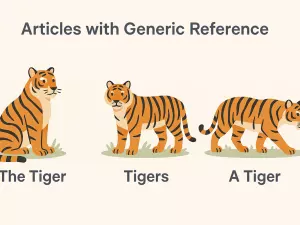
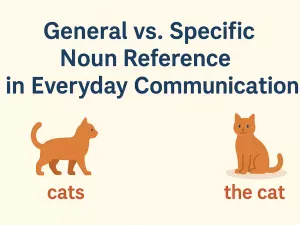
Generic Reference with Determiners: talking about things in general

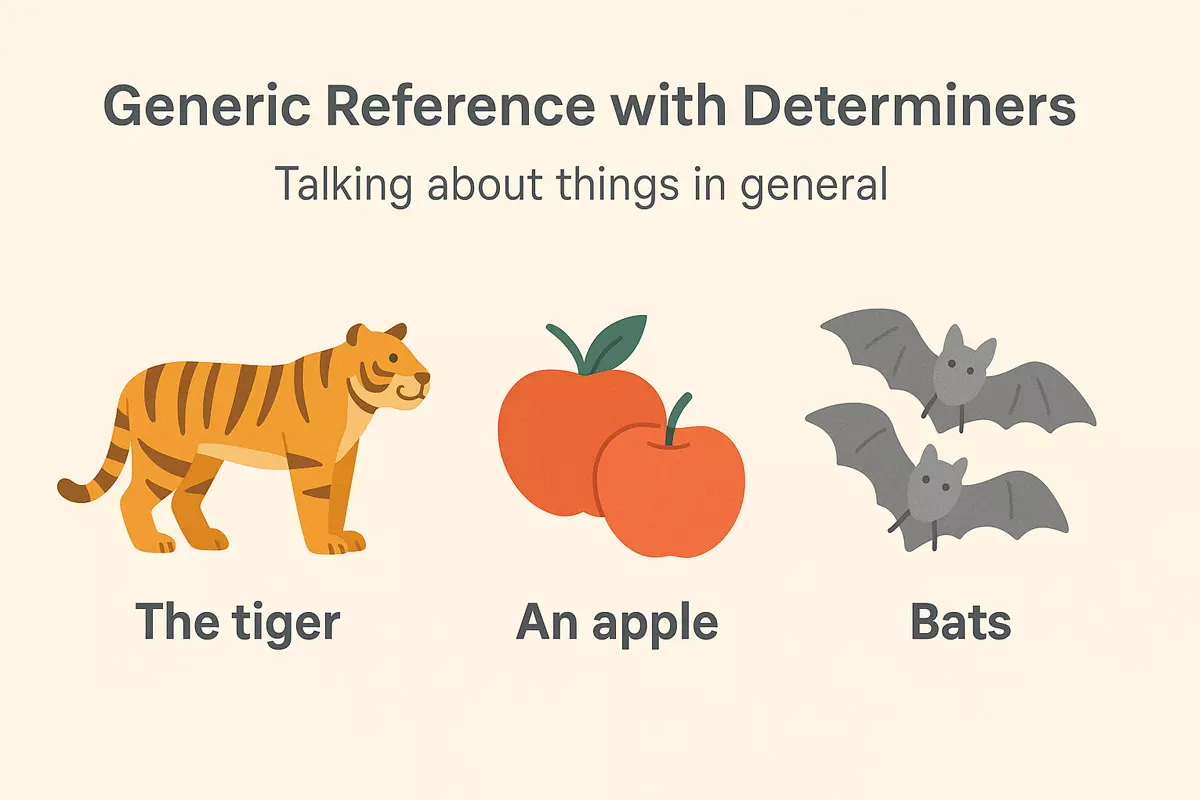 This article explains how English grammar uses determiners for generic reference, including when to use the, a/an, or no article for general statements. It covers common mistakes, academic examples, and offers practice rewriting sentences.
- What generic reference means in grammar
- Using the to represent a whole class
- Zero article for general truths and concepts
- A/an for typical examples of a category
- Common pitfalls with generic statements
- Examples from academic and explanatory writing
- Practice: rewrite statements using correct generic reference
When discussing objects, people, or ideas in a general and non-specific manner, the choice of words—particularly articles and quantifiers—plays a significant role in conveying meaning accurately. Using these small but important words correctly helps us communicate general truths, routines, and habits clearly in English. Mastery of articles such as "a," "an," and "the," as well as quantifiers like "some," "many," or "few," allows us to express ideas more precisely and avoid misunderstandings in everyday conversations and writing.
What generic reference means in grammar
In English grammar, a generic reference is when we talk about a whole class or category of things, not one specific example. Instead of describing a particular dog or a specific apple, we make statements about dogs or apples in general. This way of speaking is common when discussing facts, habits, or general truths.
How generic reference works
With generic reference, sentences express something about all members of a group, rather than an individual or a definite set. For instance, the sentence "Cats like milk" is not about some specific cats, but about the entire category of cats. This usage helps us make broad statements, share knowledge, or talk about customs and rules.
- The tiger is a dangerous animal. (Refers to tigers as a species)
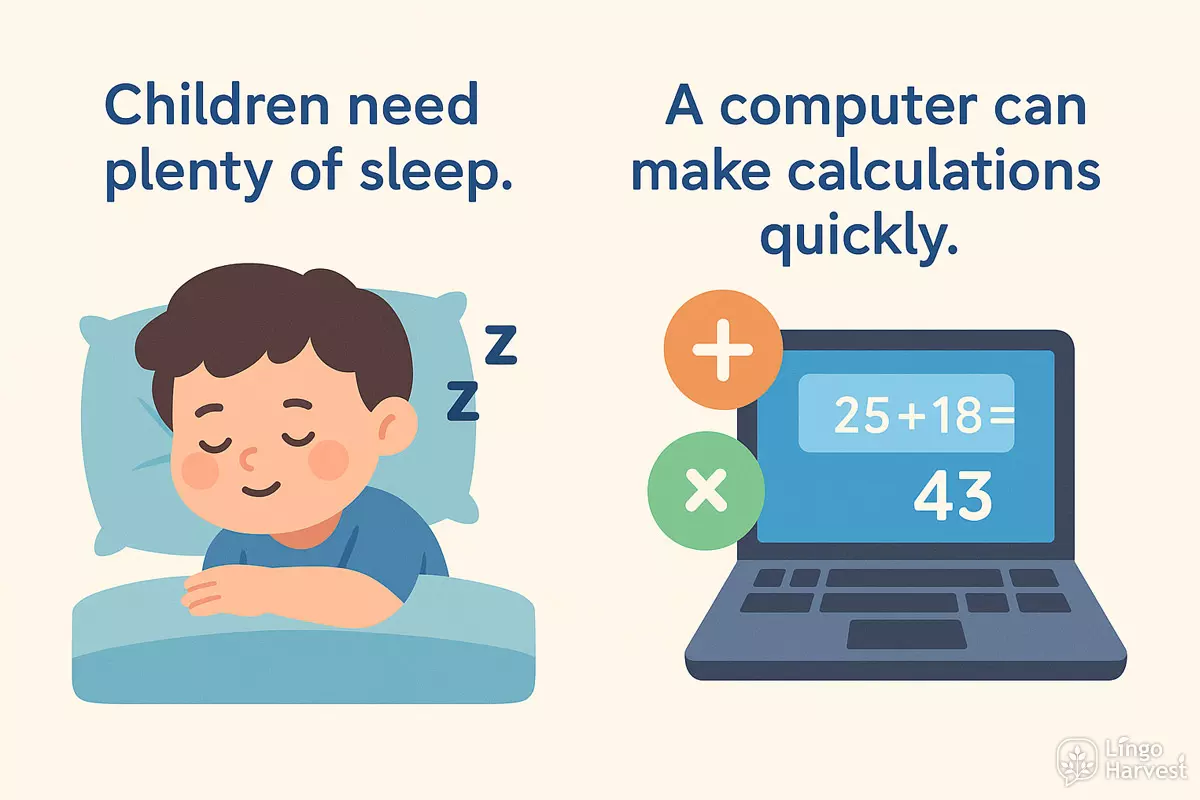
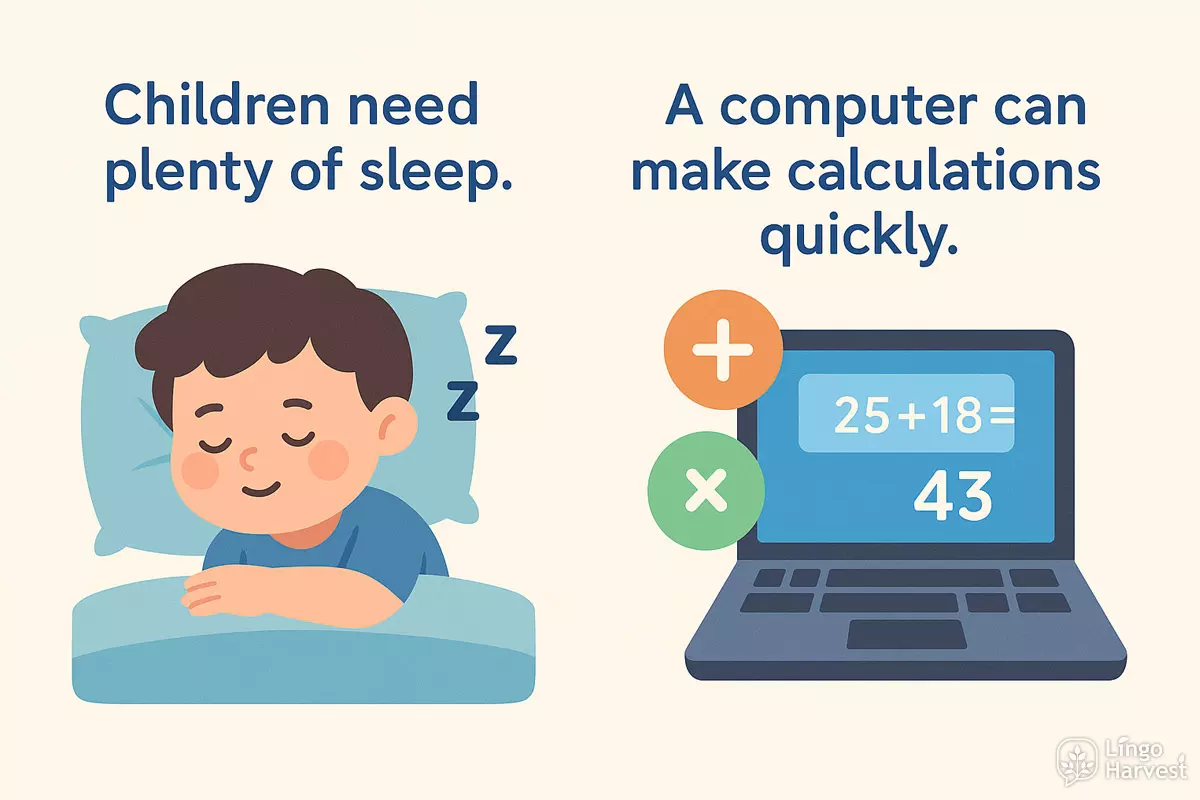
- Children need plenty of sleep. (All children, not specific ones)
- A computer can make calculations quickly. (Any computer in general)
- Water freezes at 0°C. (A general truth about water)
- Books are sources of knowledge. (Books in general)
- People enjoy music. (People as a group)
- Dogs bark. (Dogs as a species)
- An apple a day keeps the doctor away. (Any apple, not a particular one)
- Money can't buy happiness. (Money in general, not specific money)
- The elephant is the largest land animal. (The species as a whole)
- Plants need sunlight to grow. (All plants)
- Honesty is the best policy. (The concept of honesty)
- A car is useful for traveling. (Any car, not a particular one)
- Tea is popular in many countries. (Tea in general)
- Experience teaches best. (Experience as a general idea)
- The internet has changed communication. (The internet as a concept)
Common patterns for generic reference
There are several ways English uses determiners and noun phrases to make generic statements:
- Zero article: "Birds migrate south in winter."
- Definite article: "The whale is a mammal."
- Indefinite article (singular): "A bicycle is good exercise."
- Plural nouns: "Computers have transformed offices."
- Uncountable nouns: "Sugar is bad for your teeth."
By using these patterns, speakers can talk about general principles, characteristics, or facts about classes of objects, animals, people, or abstract concepts.
Why use generic reference?
Generic reference is useful for expressing rules, scientific facts, general opinions, habits, and social customs. It allows us to communicate ideas that are broadly true, rather than limited to a single case. Mastering this aspect of grammar helps in making your English sound more natural and precise when discussing generalizations.
Using the to represent a whole class
English sometimes uses "the" plus a singular countable noun to talk about an entire group or species, not just a single member. This usage is called the "generic definite" and is common when discussing animals, inventions, roles, or cultural concepts. Instead of referring to one specific thing, "the" here signals that we mean the whole type or category.
Common contexts where "the" means the entire class
- Species or animal types: "The elephant is a large animal." (All elephants, not a particular one.)
- Inventions: "The computer has changed our lives." (Computers in general.)
- Professions: "The engineer solves problems." (Engineers as a group.)
- Nationalities: "The French are known for their cuisine." (All French people.)
- Body parts (in set phrases): "He was shot in the arm." (Any person's arm.)
- Musical instruments: "She plays the piano." (Pianos in general.)
- Tools and technology: "The smartphone has revolutionized communication."
- Human experience: "The child needs love." (Every child.)
- Products or foods: "The apple is good for your health." (Apples in general.)
- Historical inventions: "The wheel was a major breakthrough."
Comparing generic reference forms
English offers several ways to speak about things in general. The table below summarizes the main patterns:
| Form | Example | When to use |
|---|---|---|
| The + singular countable noun | The lion is dangerous. | Talking about a whole species or class |
| Plural noun (no article) | Lions are dangerous. | General statements about all members of a group |
| Uncountable noun (no article) | Milk is good for you. | General reference to substances or concepts |
| A + singular countable noun | A lion is dangerous. | Any member of the group, often in definitions |
Notes and cautions
- Not every noun works with "the" for generic reference; often, plural or zero article is better ("Dogs are friendly" vs. "The dog is friendly").
- With nationalities, "the" + plural form is used ("the Dutch," "the Japanese").
- This pattern is more common in formal or scientific English than in everyday conversation.
- Using "the" with a singular noun for a group can sound old-fashioned or literary for some topics.
Mastering these patterns helps you express general truths and characteristics clearly in English.
Zero article for general truths and concepts
When speaking about universal facts, scientific laws, or abstract ideas, English typically omits the definite and indefinite articles. This pattern is known as using the "zero article." It is especially common with uncountable and plural nouns when the reference is generic, rather than specific. For example, we say "Water boils at 100°C" instead of "The water boils at 100°C" when making a general statement about all water.
Typical situations for zero article usage
- Talking about substances in a general sense: Air is essential for life.
- Describing scientific laws or facts: Gravity pulls objects toward earth.
- Referring to concepts and fields of study: Mathematics can be challenging.
- Making statements about groups in general: Dogs are loyal animals.
- Abstract nouns when speaking generally: Freedom is important to everyone.
- Languages and academic subjects: She studies history and French.
- Meals when talking in general: Breakfast is the most important meal.
- Sports and games: Football is popular worldwide.
- Seasons (when used generically): Spring brings flowers.
- Most institutions when used in a general sense: Children go to school.
Examples: zero article vs. definite/indefinite article
| With zero article (general) | With article (specific) |
|---|---|
| Life is unpredictable. | The life of a sailor is hard. |
| Science advances quickly. | The science behind this invention is fascinating. |
| Children need love. | The children in this class are noisy. |
| Music soothes the soul. | The music at the party was loud. |
| Honesty is valued. | An honesty that surprised everyone. |
These patterns help distinguish whether you are making a generalization or talking about a particular instance. Remember, omitting the article often signals that you’re referring to an entire category, idea, or truth, not just a single example.
A/an for typical examples of a category
When we want to talk about something as a representative of its group, English often uses "a" or "an" with a singular, countable noun. This pattern helps us describe a typical member, without focusing on any individual case. It's especially useful for discussing general truths, habits, or characteristics of a whole class. For example, if you say, "A lion is a dangerous animal," you mean lions in general, not one specific lion. This construction makes it clear that you’re referring to a whole category through one instance.
Common contexts for using "a/an" generically
- Describing typical features: "A smartphone can access the internet."
- Stating facts about a group: "A whale is a mammal."
- Talking about jobs or roles: "A teacher helps students learn."
- Explaining how something is used: "A hammer is used for driving nails."
- Giving instructions or advice: "If you see a snake, stay calm."
- Defining terms: "A polygon is a shape with straight sides."
- Expressing general truths: "A rose has thorns."
- Discussing habits: "A cat likes to chase mice."
- Describing hypothetical situations: "If a person works hard, they succeed."
- Making comparisons: "A bicycle is quieter than a car."
- Providing examples: "A penguin is a bird that cannot fly."
- Describing inventions or discoveries: "A telescope helps us see distant stars."
- Talking about food or drink types: "An apple a day keeps the doctor away."
- Explaining processes: "A plant needs sunlight to grow."
- Introducing a topic: "A computer can solve many problems."
Contrast with other determiner uses
It's different from talking about all members of a group (using plurals with no article, like "Lions are dangerous") or a specific member ("The lion in the zoo is old"). Using "a/an" for a generic sense emphasizes the typical, representative qualities of one example.
Examples in context
Below is a comparison to clarify how "a/an" works for generic reference, compared to other determiners:
| Form | Meaning / Use |
|---|---|
| A/an + singular noun (A dog is loyal.) |
Refers to any typical member of the group; describes general qualities. |
| Plural noun, no article (Dogs are loyal.) |
Refers to the group as a whole, all members in general. |
| The + singular noun (The dog is loyal.) |
Can refer to a specific dog, or sometimes the species as a whole in formal or scientific writing. |
| The + plural noun (The dogs in the park are noisy.) |
Refers to a specific set of members within the group. |
Understanding when to use "a/an" in this way helps make your English sound more natural and precise, especially when discussing generalizations or introducing new concepts.
Common pitfalls with generic statements
Making broad statements about groups or categories in English can be surprisingly tricky. Learners often make subtle errors when using determiners or expressing general truths. These slips can lead to misunderstandings or sentences that sound unnatural to native speakers.
Omitting or misusing articles
Leaving out necessary articles or using "the" where it isn’t needed is a frequent issue. For example, saying “The dogs are friendly” when you mean “Dogs are friendly” gives a different meaning. The first refers to a specific group, not dogs in general.
Overgeneralization and stereotypes
It's easy to accidentally make a statement that sounds like an unwarranted stereotype. For instance, “French people love wine” ignores individual differences and can be insensitive. Instead, use “Many French people enjoy wine” to avoid overgeneralizing.
Confusing singular and plural forms
Generic reference can be made with both singular and plural nouns, but the structure varies:
- Singular with "a/an": “A lion is a dangerous animal.”
- Plural without article: “Lions are dangerous animals.”
- Uncountable nouns: “Water is essential for life.”
Mixing these up can make sentences sound odd or incorrect.
Misapplying determiners
Certain determiners don’t work for general reference. For example, “Some lions are dangerous” means only a subset, not lions in general. Similarly, “The water is essential for life” usually refers to a specific water source, not the substance in general.
Ambiguity and unintended specificity
Sometimes, a sentence meant to be universal actually refers only to a particular group. Compare:
- “The elephant is an intelligent animal.” (can be generic, but often interpreted as one specific elephant)
- “Elephants are intelligent animals.” (clearly generic)
Being aware of these nuances helps convey the intended meaning.
Common mistakes and preferred forms
Below is a quick comparison of typical errors and their more natural alternatives:
| Common Error ❌ | Preferred Expression ✅ |
|---|---|
| People likes chocolate. | People like chocolate. |
| The cats are playful. (when talking about cats in general) | Cats are playful. |
| A water is important for health. | Water is important for health. |
| The life is short. | Life is short. |
| Dog is loyal animal. | A dog is a loyal animal. |
| Dogs is loyal animals. | Dogs are loyal animals. |
| The apple is healthy. | Apples are healthy. / An apple is healthy. |
| The music is relaxing. (referring to music in general) | Music is relaxing. |
| The English is difficult. | English is difficult. |
| The pollution is a problem. | Pollution is a problem. |
Summary tips
- Use plural nouns or indefinite singular (“a/an”) for generalizations.
- Avoid “the” unless you are talking about something specific or the whole class as a unique concept.
- Be mindful of stereotypes; qualify statements where needed.
- Check subject-verb agreement with plural subjects.
- Remember that uncountable nouns don’t take “a/an.”
Mastering these details helps your English sound more natural and precise when discussing things in general.
Examples from academic and explanatory writing
Academic texts and explanatory materials frequently use generic reference to describe classes of objects, people, or concepts in a broad, non-specific way. Determiners play a crucial role in shaping these statements, signaling whether the writer is referring to a general category or a specific instance. Below are some illustrative sentences and typical patterns found in scholarly and instructional contexts.
Typical Patterns with Determiners in Generalization
Writers often choose determiners like "the," "a," or omit them (zero article) when making broad statements. Here are some common patterns:
- The + singular noun: "The lion is a carnivorous animal."
- Zero article + plural noun: "Lions are found in Africa."
- A/an + singular noun: "A lion can run at high speeds."
- The + adjective: "The elderly require special care."
- Zero article + uncountable noun: "Information is valuable."
- Most + plural noun: "Most students need guidance."
- Every + singular noun: "Every organism needs energy."
- Any + singular noun: "Any solution must be tested."
- All + plural/uncountable noun: "All metals conduct electricity."
- Much/Many + noun: "Many theories explain this phenomenon."
Excerpts from Academic or Explanatory Texts
Consider these sentences, drawn from real-world sources:
- "The computer has revolutionized the workplace." (general reference to computers as a category)
- "A teacher must be patient." (refers to any member of the teaching profession)
- "Water boils at 100°C at sea level." (universal property of water, no determiner)
- "Children require adequate nutrition for growth."
- "The whale is the largest mammal."
- "Scientists often use models to predict outcomes."
- "A hypothesis should be testable."
- "The internet has changed communication."
- "Cars emit greenhouse gases."
- "A solution to this problem involves collaboration."
Comparing Determiner Use for General Reference
The table below contrasts how different determiners affect general statements in scholarly writing:
| Form | Example Sentence |
|---|---|
| The + singular noun | The elephant is an endangered species. |
| Zero article + plural noun | Elephants are social animals. |
| A/an + singular noun | An elephant can weigh several tons. |
| Zero article + uncountable noun | Knowledge grows over time. |
These patterns help clarify whether the statement applies to all members of a group, a typical representative, or an abstract concept. Recognizing and applying these structures enhances clarity and precision in academic communication.
Practice: rewrite statements using correct generic reference
When expressing general truths or talking about categories as a whole, choosing the right determiner is essential. Practice helps you recognize when to use "the," "a/an," or no article at all for generic reference. Below are exercises and guidance to help you rewrite statements so they correctly refer to things in general.
Instructions
Read each statement and decide how to rewrite it to refer to a whole class or concept. Think about whether the noun is countable or uncountable, and whether you mean all members of the group, any member, or the concept in general.
Rewrite the following statements using proper generic reference:
- Dog is loyal animal.
- Apple is healthy fruit.
- Car is expensive.
- Cat likes milk.
- Computer has changed world.
- Teacher should be patient.
- Book can be source of knowledge.
- Elephant is largest land animal.
- Student must study hard.
- Music makes people happy.
- Children love chocolate.
- Woman is good multitasker.
- Phone is useful device.
- Science helps us understand universe.
- Fish live in water.
- Artist creates art.
- Bird can fly.
- Internet connects people.
- Engineer solves problems.
- Mountain is high.
Show answers
- The dog is a loyal animal. / Dogs are loyal animals.
- The apple is a healthy fruit. / Apples are healthy fruits.
- The car is expensive. / Cars are expensive.
- The cat likes milk. / Cats like milk.
- The computer has changed the world. / Computers have changed the world.
- A teacher should be patient. / Teachers should be patient.
- A book can be a source of knowledge. / Books can be sources of knowledge.
- The elephant is the largest land animal. / Elephants are the largest land animals.
- A student must study hard. / Students must study hard.
- Music makes people happy. (uncountable noun, no article needed)
- Children love chocolate. (already correct generic reference)
- A woman is a good multitasker. / Women are good multitaskers.
- The phone is a useful device. / Phones are useful devices.
- Science helps us understand the universe. (uncountable noun, no article for "science")
- Fish live in water. (already correct generic reference)
- An artist creates art. / Artists create art.
- A bird can fly. / Birds can fly.
- The internet connects people. (unique noun, use "the")
- An engineer solves problems. / Engineers solve problems.
- A mountain is high. / Mountains are high.
Tips for Using Generic Reference with Determiners
- Use the plural form without an article to refer to all members of a group: Cats are independent.
- Use "the" + singular noun to refer to the whole class (formal, often in academic or scientific writing): The whale is a mammal.
- Use "a/an" + singular noun to refer to any example of the class: A teacher should be knowledgeable.
- Do not use an article with uncountable nouns when talking about them in general: Information is valuable.
- Some unique nouns take "the" even when talking generally: The internet is essential.
Practicing these patterns will help you make your general statements clearer and more natural in English.