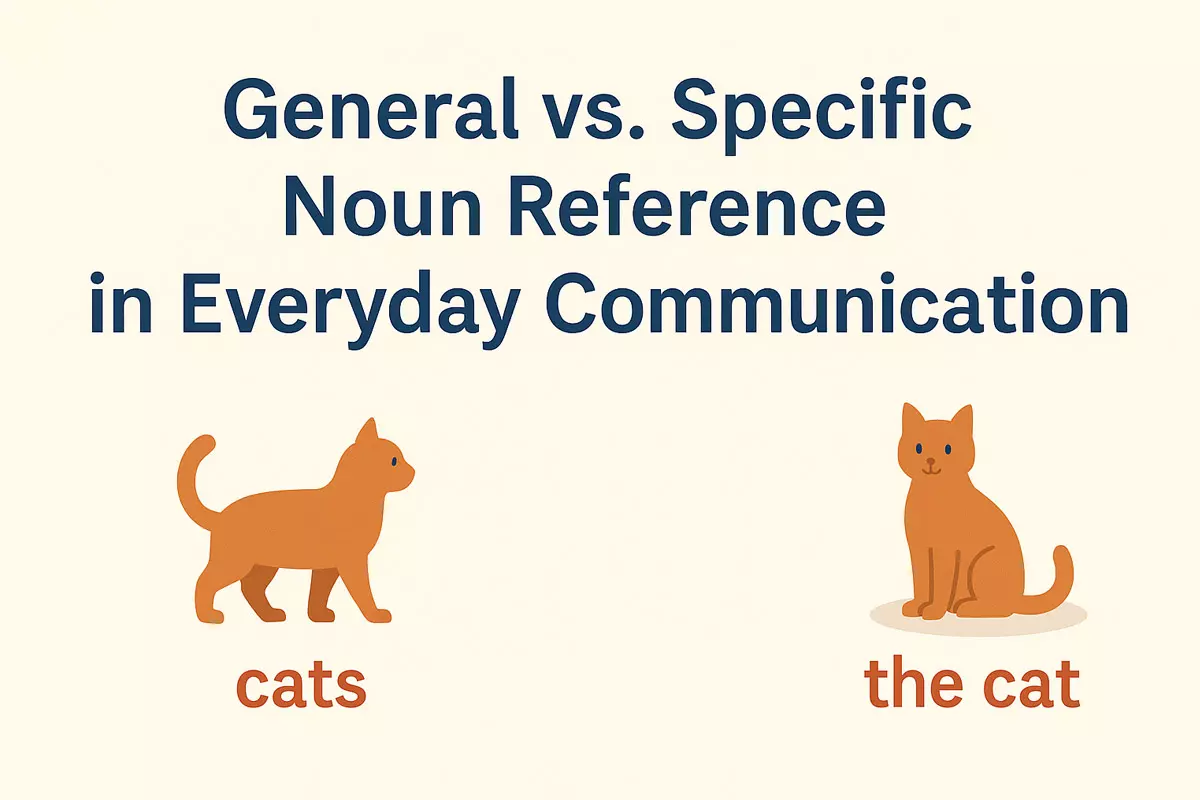
General vs Specific Noun Reference in Everyday Communication

 Here we how to distinguish between general and specific reference in English, how articles and determiners indicate specificity, using plurals and mass nouns for general statements, typical errors, and practice for making noun references precise.
- Difference between general and specific reference
- Using articles and determiners to show specificity
- Talking about things in general with plural and mass nouns
- Making clear reference to one specific person or thing
- Shifts between general and specific meaning in a paragraph
- Typical learner errors with vague noun reference
- Practice: rewrite sentences for precise noun reference
The choice between broad and precise nouns significantly influences how we communicate, whether in casual conversations or online discussions. Using precise nouns can make our meaning clearer and help listeners or readers understand exactly what we intend, while broader nouns may create ambiguity but allow for more general statements. Recognizing when to use each type of noun is an important skill that shapes both the effectiveness and tone of our communication in everyday life.
Difference between general and specific reference
Understanding how we refer to nouns—either broadly or with a particular target in mind—shapes how clearly we communicate. In English, speakers often choose between general and specific reference based on context, intent, and the need for precision. Let’s explore the key contrasts, supported by practical examples and explanations.
How general reference works
General reference means talking about a whole class or category, not pinpointing any one item. This is common when discussing habits, general truths, or categories. For instance, saying “Dogs are loyal” refers to all dogs, not a particular one. Indefinite articles (“a,” “an”), plural forms, and uncountable nouns often signal this usage.
How specific reference works
Specific reference, in contrast, targets a particular person, thing, or group already identified or known. For example, “The dog next door is barking” points to a particular animal, not dogs in general. Definite articles (“the”), demonstratives (“this,” “that”), possessives, and proper nouns typically indicate specificity.
Key contrasts at a glance
Below is a structured comparison highlighting core differences in usage, form, and effect:
| General Reference | Specific Reference |
|---|---|
| Refers to whole categories or types (e.g., “Books are useful”) |
Refers to a particular, identified entity (e.g., “The book on the table is mine”) |
| Often uses plural nouns or uncountables (“Cars cause pollution”) |
Uses definite articles, demonstratives, or possessives (“This car is fast”) |
| Common in statements of fact, habits, or generalizations | Common when providing details, sharing experiences, or clarifying identity |
| Can be vague or broad in meaning | Always precise and limited to the intended referent |
Common patterns and examples
- General: “Children like sweets.” → All children, in general.
- Specific: “The children in my class like sweets.” → A particular group.
- General: “Water is essential for life.”
- Specific: “The water in this bottle is cold.”
- General: “A teacher should be patient.”
- Specific: “My teacher is very patient.”
- General: “People need sleep.”
- Specific: “The people at table four need more water.”
- General: “Cats can be independent.”
- Specific: “That cat on the sofa is purring.”
- General: “Music helps me focus.”
- Specific: “The music from your room is too loud.”
Why this distinction matters in conversation
Choosing between a general or a particular noun reference affects clarity and nuance. Using broad terms can help convey universal truths, but switching to a specific reference allows for more targeted information and avoids ambiguity. In everyday communication, being aware of this distinction ensures your message matches your intention—whether you’re making a sweeping statement or referring to someone or something in particular.
Using articles and determiners to show specificity
Grammatical tools like articles (“a,” “an,” “the”) and determiners (“this,” “those,” “my,” “each,” etc.) play a major role in clarifying whether we are speaking about something definite or leaving things open-ended. These words help listeners and readers understand if we mean a particular object or just any example from a category.
How articles make meaning precise
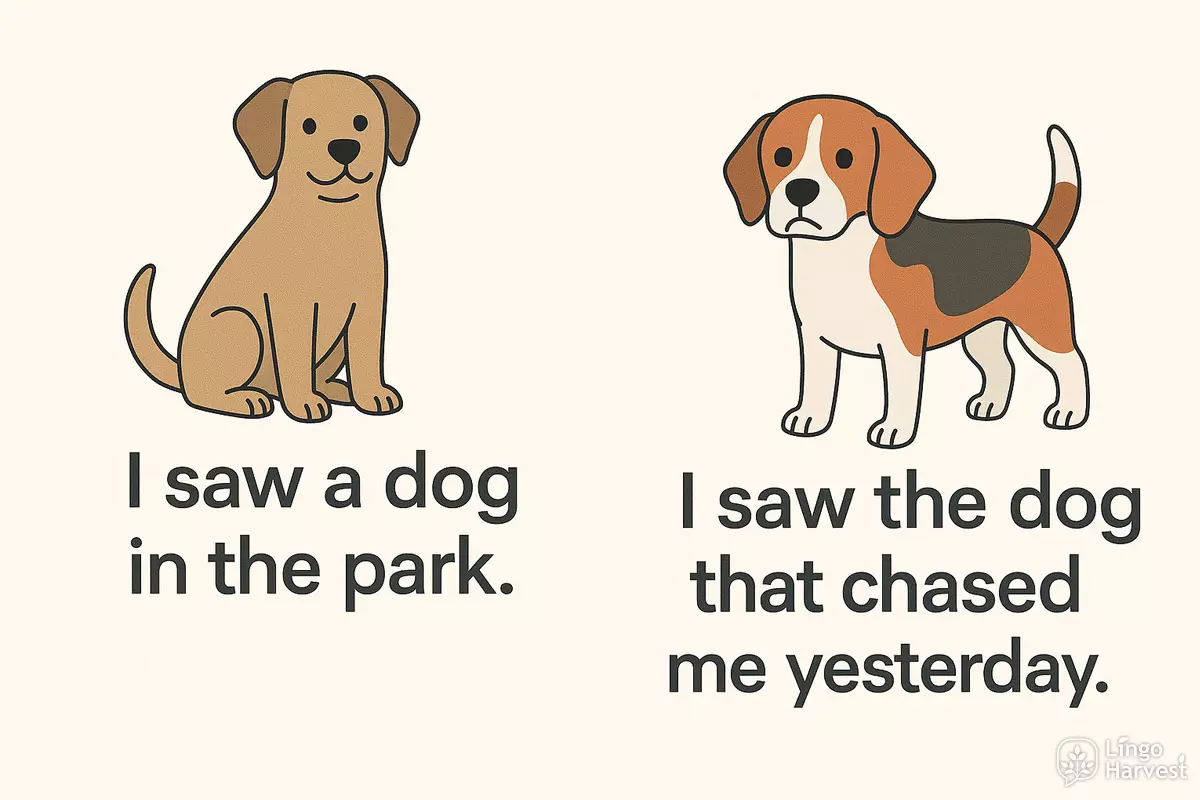
Articles are small but powerful. “The” is used when both the speaker and listener know which thing is meant (definite). “A” or “an” refers to any member of a group (indefinite). Compare these sentences:
- I saw a dog in the park. (any dog, not specific)
- I saw the dog that chased me yesterday. (a particular, known dog)
This distinction matters in daily communication, especially when giving instructions or telling stories.
Common determiners and their effects
Determiners go beyond articles. They include words that specify quantity, ownership, or which one(s) you mean. Here are some examples:
- My book (shows possession, specific)
- Some water (unspecified quantity, general)
- Each student (every individual, specific group)
- That car (singles out one, definite)
- All children (the whole group, general)
- These apples (specific items, near the speaker)
- Many people (unspecified, general)
- No answer (absence, general)
- Her idea (ownership, specific)
- Every morning (all instances, general but inclusive)
- Whose bag (asking about ownership, specific)
- Another chance (an additional, not specified which)
- Either option (one of two, not specified which)
- Those shoes (specific, distant from the speaker)
- Few mistakes (small number, general)
- Our house (group ownership, specific)
- This question (points to a particular one)
- Several reasons (more than two, not all, general)
Comparing specificity in context
The table below shows how changing articles and determiners can shift the meaning from general to specific or vice versa:
| General Reference | Specific Reference |
|---|---|
| A teacher can inspire students. | The teacher inspired me yesterday. |
| Books are important for learning. | These books belong to my friend. |
| Some people like spicy food. | My neighbor likes spicy food. |
| Any answer is acceptable. | This answer is correct. |
| Children often play outside. | The children next door are noisy. |
Understanding how to choose the right article or determiner helps you communicate with clarity. It allows you to guide your listener’s attention, avoid confusion, and express your meaning with confidence.
Talking about things in general with plural and mass nouns
When we want to make statements that apply broadly, English often relies on plural forms and mass nouns. This approach lets us talk about categories, habits, or truths without pointing to any one person or object. For example, saying "Dogs are loyal" doesn’t refer to specific dogs, but to the whole category.
Plural nouns for generalizations
Using plural countable nouns is a common way to express general ideas. Here are some illustrative patterns:
- Cats dislike water.
- Books can inspire people.
- Computers have changed our lives.
- Teachers shape the future.
- Cars pollute the air.
- Children learn quickly.
- Friends support each other.
- Students often feel stressed before exams.
- Birds migrate in winter.
- Doctors help people stay healthy.
- Apples are good for you.
- Trains connect cities.
Notice that no article ("the" or "a") is used before these plural nouns, signaling that the statement is about all members of the group.
Mass nouns for universal reference
Mass (uncountable) nouns refer to substances or abstract concepts that aren’t easily counted. When used without an article, they generalize about the entire substance or idea. Some common examples include:
- Water is essential for life.
- Music brings people together.
- Information travels fast nowadays.
- Air pollution is a serious problem.
- Education opens doors.
- Technology changes rapidly.
- Happiness can’t be bought.
- Chocolate tastes sweet.
- Time heals wounds.
- Patience is a virtue.
Again, the absence of an article suggests we mean all water, all music, or the general concept, not a specific instance.
Comparing general and specific reference
Sometimes, a sentence can be made general or specific simply by changing the noun form or adding an article. Here’s a comparison:
| General Reference | Specific Reference |
|---|---|
| Dogs need exercise. | The dogs in the park need exercise. |
| Milk is nutritious. | The milk in the fridge is spoiled. |
| Teachers are important. | The teachers at my school are friendly. |
| Music helps people relax. | The music you played yesterday was beautiful. |
Summary: Using plurals and mass nouns without articles is a concise way to make statements about broad categories or universal truths. By recognizing these patterns, you can communicate ideas that apply to groups or substances as a whole, rather than just individual cases.
Making clear reference to one specific person or thing
When we want to indicate exactly which individual or object we mean, we rely on specific noun reference. This approach helps avoid confusion and ensures our listener or reader knows precisely what we're talking about. Using names, definite articles, demonstratives, or possessive forms are common strategies for such pinpointing in conversation and writing.
Ways to Identify a Particular Person or Object
- Proper nouns: Maria, London, Amazon River
- Definite article: the cat (meaning a particular cat already known to both speaker and listener)
- Demonstratives: this book, that chair, these shoes, those cookies
- Possessives: my phone, John’s car, their house
- Restrictive clauses: the student who won the prize, the movie that you recommended
- Titles or roles: the president (when context is clear), Dr. Smith
- Specific numbers: the two apples on the table
- Unique descriptions: the tallest building in the city
- Personal pronouns (when context is unambiguous): he, she, it
- Dates or times: Monday’s meeting, the 5pm train
Comparing General vs. Specific Reference
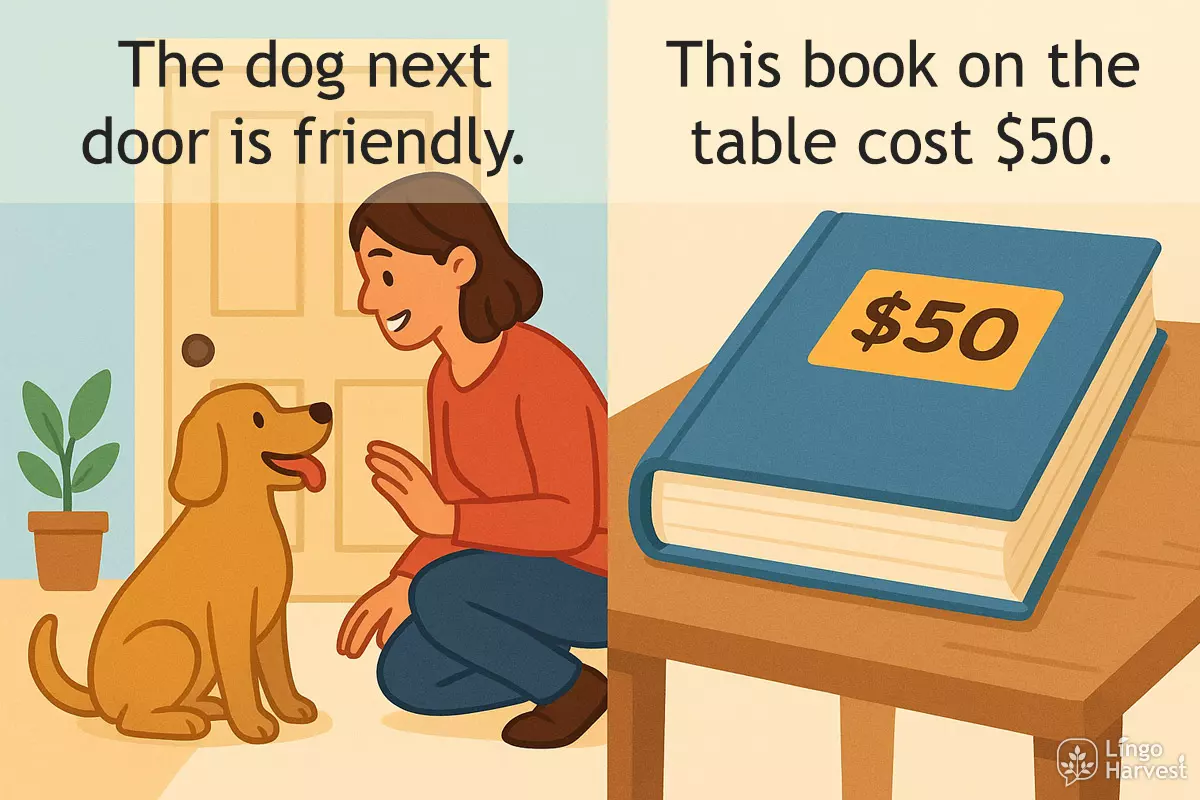
Precision in reference can dramatically change a sentence’s meaning. Consider the difference between general and exact references:
| General Reference | Specific Reference |
|---|---|
| Dogs are friendly. | The dog next door is friendly. |
| Books can be expensive. | This book on the table cost $50. |
| Teachers help students. | Ms. Lee helped me with math. |
| Cities can be crowded. | New York City is crowded in summer. |
Clarity and Misunderstandings
Being explicit about which person or item you mean prevents ambiguity. For instance, simply saying “Bring me the keys” works only if it’s clear which keys you’re talking about. Otherwise, you might need to specify: “Bring me the car keys on the kitchen counter.” This habit is especially important in instructions, storytelling, or situations where multiple similar items or people are present.
Conclusion
Using precise references is essential for effective communication. Whether you’re naming a friend, pointing to an object, or describing a unique characteristic, these language tools help your listener or reader follow exactly who or what you mean.
Shifts between general and specific meaning in a paragraph
In natural conversation and writing, it’s common for speakers and writers to move between broad references and more detailed ones within a single paragraph. This dynamic helps to introduce a topic clearly, then clarify or elaborate with precise details. For example, a paragraph might open with a general noun like “animals” and then narrow down to specific ones like “lions” or “parrots” as the discussion continues.
How transitions from broad to detailed references work
Writers often start with a general noun to set the context and then shift to particular examples to add richness or focus. This technique keeps communication both efficient and engaging. Consider how a discussion about “technology” might quickly become about “smartphones” or “artificial intelligence” as the paragraph unfolds.
- Opening with a general category, then zooming in on an instance
- Using pronouns to refer back to an earlier, more general noun
- Switching from a non-count noun (“equipment”) to a count noun (“laptops”)
- Describing a group, then mentioning individual members
- Moving from an abstract concept to a concrete example
- Referring to “food” before specifying “bread, cheese, and fruit”
- Starting with “problems” and specifying “traffic jams and pollution”
- Introducing “vehicles” before narrowing to “buses, cars, and bicycles”
- Beginning with “tools” and then naming “hammers and screwdrivers”
- Generalizing with “people” and then mentioning “students and teachers”
- Talking about “weather” before specifying “rain” or “sunshine”
- Noting “feelings” and then focusing on “anxiety” or “joy”
- Referring to “sports” before listing “tennis” and “basketball”
- Discussing “plants” then detailing “roses and lilies”
- Starting with “furniture” before specifying “chairs and desks”
Why these shifts matter
Alternating between general and particular references allows for clarity and emphasis. It helps readers or listeners understand the scope before diving into specifics. This approach also aids in avoiding repetition, since once a general term is established, more detailed nouns can be used without confusion.
| General Reference | Specific Example |
|---|---|
| Books | Novels by Jane Austen |
| Fruit | Bananas and apples |
| Music | Classical symphonies |
| Jobs | Nurse, engineer, pilot |
| Countries | Italy, Japan, Brazil |
| Clothing | Jackets and scarves |
| Transportation | Subways and buses |
| Pets | Cats and dogs |
Recognizing these shifts helps in both understanding and producing clear, natural communication. Whether you’re reading an article, listening to a presentation, or writing your own paragraph, being aware of how general topics lead into specifics can make your language more effective and precise.
Typical learner errors with vague noun reference
Many English learners tend to use unclear language when referring to people, things, or ideas, which can lead to confusion for listeners or readers. This often happens when the connection between a noun and what it actually represents isn’t obvious. Sometimes, this is due to missing context, overuse of pronouns, or unclear noun phrases.
Common patterns that cause confusion
- Using "it" or "this" without a clear subject
- Referring back to multiple possible nouns with a single pronoun
- Introducing "something," "someone," or "things" without explanation
- Relying on "they" or "them" when the group is not specified
- Leaving out the noun entirely and expecting the listener to guess
- Switching topics mid-sentence without clarifying the new subject
- Repeating "the" with unclear reference (e.g., "the problem" without context)
- Overusing "one" or "ones" without specifying what is meant
- Assuming shared knowledge that may not exist
- Using "which" or "that" clauses that do not clearly attach to a noun
- Mixing up singular/plural forms so the reference is lost
- Omitting necessary articles, making the noun too general
- Using "people" or "they" for an unspecified group
- Switching from specific to general nouns (or vice versa) without a clear link
- Assuming the previous sentence’s subject is still clear after several lines
Examples of ambiguous reference and clearer alternatives
| Unclear Reference | Improved Clarity |
|---|---|
| She put it on the table, but it broke. | She put the vase on the table, but the vase broke. |
| They said it was important. | The teachers said the homework was important. |
| If you see one, tell me. | If you see a lost dog, tell me. |
| This needs to be fixed. | This door needs to be fixed. |
| People think it’s easy, but it’s not. | Many students think learning grammar is easy, but it’s not. |
| The problem is difficult, but it helps. | The grammar problem is difficult, but solving it helps understanding. |
| They didn’t like that. | The customers didn’t like the new policy. |
| Which one do you want? | Which book do you want? |
| He gave it to her after the meeting. | He gave the report to her after the meeting. |
| Someone said it’s okay. | The manager said it’s okay. |
Tips for clearer noun reference
- Repeat the specific noun when there is any chance of confusion.
- Introduce new subjects with clear noun phrases before using pronouns.
- Use descriptive language, especially when switching topics.
- Check each pronoun’s reference—ask yourself if it could point to more than one thing.
- When in doubt, add a short explanation or restate the noun.
Practicing these strategies helps learners communicate more precisely and reduces misunderstandings in both writing and conversation.
Practice: rewrite sentences for precise noun reference
Clarity in communication often depends on how specifically we refer to people, things, and ideas. To build skill in using exact nouns, let's examine some common sentences that use general or ambiguous references. You'll practice making these more precise, improving both your written and spoken communication.
Exercise: Specify the Noun
Below are sentences where the noun reference is either too general or unclear. Rewrite each to make the meaning more exact. Consider what or whom each pronoun or general noun refers to, and replace it with a specific term where possible.
- She gave it to him.
- They didn’t like that.
- Put it over there.
- He saw it on the table.
- We need to fix this soon.
- Somebody left it outside.
- They said it wouldn’t work.
- He bought it yesterday.
- It is broken.
- Can you help me with this?
Show answers
- Maria gave the report to John.
- The students didn’t like the new schedule.
- Put the keys on the kitchen counter.
- He saw the letter on the table.
- We need to fix the leaking faucet soon.
- Somebody left the umbrella outside.
- The engineers said the new software wouldn’t work.
- He bought a new laptop yesterday.
- The printer is broken.
- Can you help me with this math problem?
Comparison: General vs. Specific Reference
Understanding the difference between vague and precise wording helps avoid confusion. The table below compares general and specific noun references in everyday contexts.
| General Reference | Specific Reference |
|---|---|
| I saw him there. | I saw Mr. Lee at the library. |
| She fixed it. | She fixed the broken chair. |
| They discussed it. | The managers discussed the quarterly report. |
| It was delicious. | The chocolate cake was delicious. |
| He lost it at work. | He lost his ID badge at the office. |
| Put them away. | Put the books on the shelf. |
| They finished it quickly. | The students finished the assignment quickly. |
| Someone called. | The delivery driver called. |
| It needs to be cleaned. | The kitchen needs to be cleaned. |
| Can you get it? | Can you get the mail? |
Tips for Rewriting with Precise Nouns
- Identify who or what the pronoun refers to and name it specifically.
- Replace vague words like “it,” “they,” or “this” with the actual noun.
- When context is unclear, ask yourself: “What exactly is being talked about?”
- Use specific nouns for objects, people, places, and actions.
- Review your writing for any ambiguous references and revise them.
Developing the habit of specifying noun references not only prevents misunderstandings but also makes your communication more effective and professional. Regular practice with these exercises will reinforce your ability to choose precise language in any context.