Using Determiners with Idiomatic Expressions and Fixed Phrases

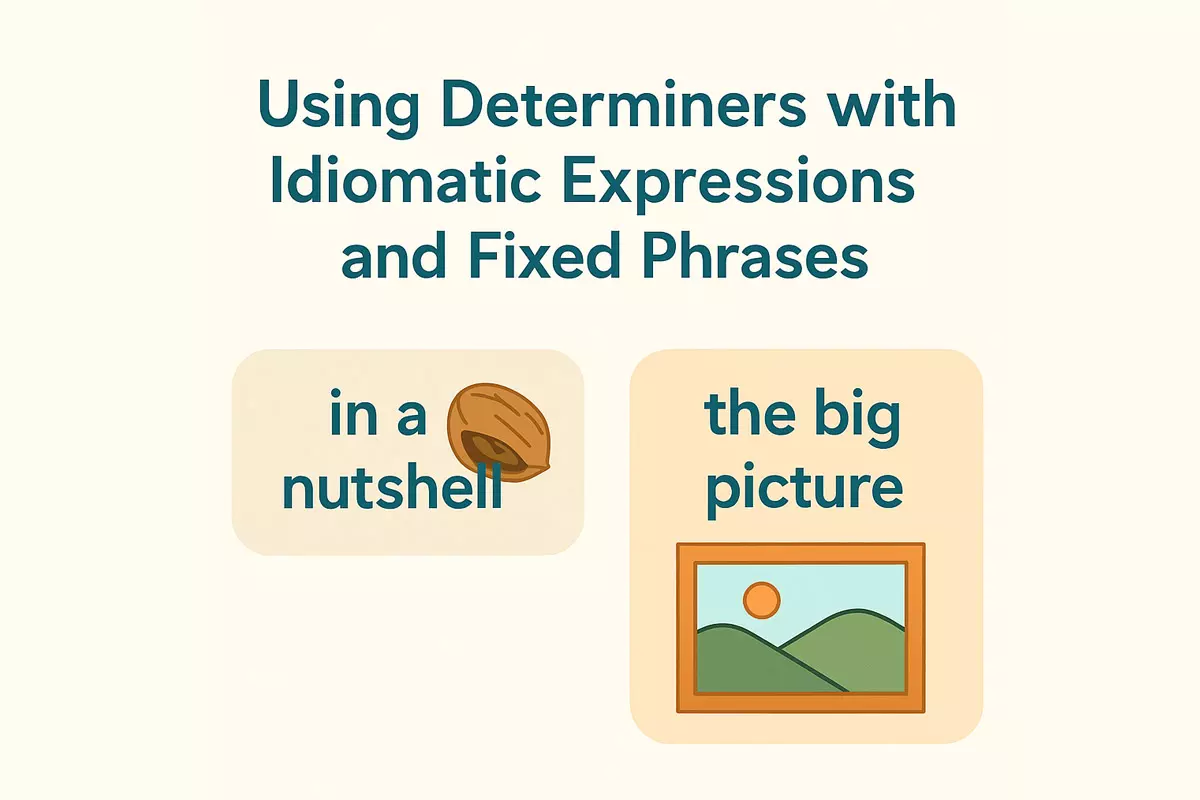 The article explains why idioms use unusual determiner patterns, examines fixed expressions with various articles, explores how determiners affect meaning, covers regional or stylistic differences, and provides practice with real-life examples.
- Why idioms use unusual determiner patterns
- Fixed expressions with a, the, and zero article
- Expressions where determiners change meaning
- Regional or stylistic variation in idiomatic determiners
- When determiners cannot be substituted or removed
- Examples from speech, media, and literature
- Practice: identify determiner patterns in idioms
Mastering idioms and set phrases in English often involves more than just memorizing their meanings; it also requires understanding how to use the correct articles and quantifiers within these expressions. Small words like "a," "the," "some," or "any" can significantly change the meaning or correctness of a phrase. Paying attention to how native speakers use these elements in context helps learners develop a more authentic and fluent style, making their spoken and written English sound both natural and accurate.
Why idioms use unusual determiner patterns
Idiomatic expressions often break the "normal" rules of determiners because they are fixed phrases with meanings that go beyond their literal words. These expressions were typically coined in specific historical or cultural contexts, and the wording has been preserved over time. As a result, articles like the, a, or even zero articles appear in ways that may seem odd to modern speakers or learners.
Fixed wording and non-literal meaning
Most idioms and set phrases are memorized as whole units. Their structure is not always logical by current grammar standards because their wording is "frozen" from the period or dialect in which they originated. For example, we say in a hurry (not in hurry or in the hurry) and by the book (not by a book). The determiner is part of the idiom’s identity and removing or changing it can destroy the idiomatic meaning.
How idioms defy determiner norms
Some idioms use articles where standard rules would not, or omit them where they would normally appear. This can be confusing for learners, but it’s a core feature of set phrases:
- on the whole (not on a whole)
- at a loss (not at loss)
- in the long run (not in a long run)
- take a seat (not take seat)
- by the way (not by a way)
- under the weather (not under a weather)
- in a nutshell (not in the nutshell)
- out of the blue (not out of blue)
- in a bind (not in the bind)
- on a roll (not on roll)
- hit the sack (not hit a sack)
- in the spotlight (not in a spotlight)
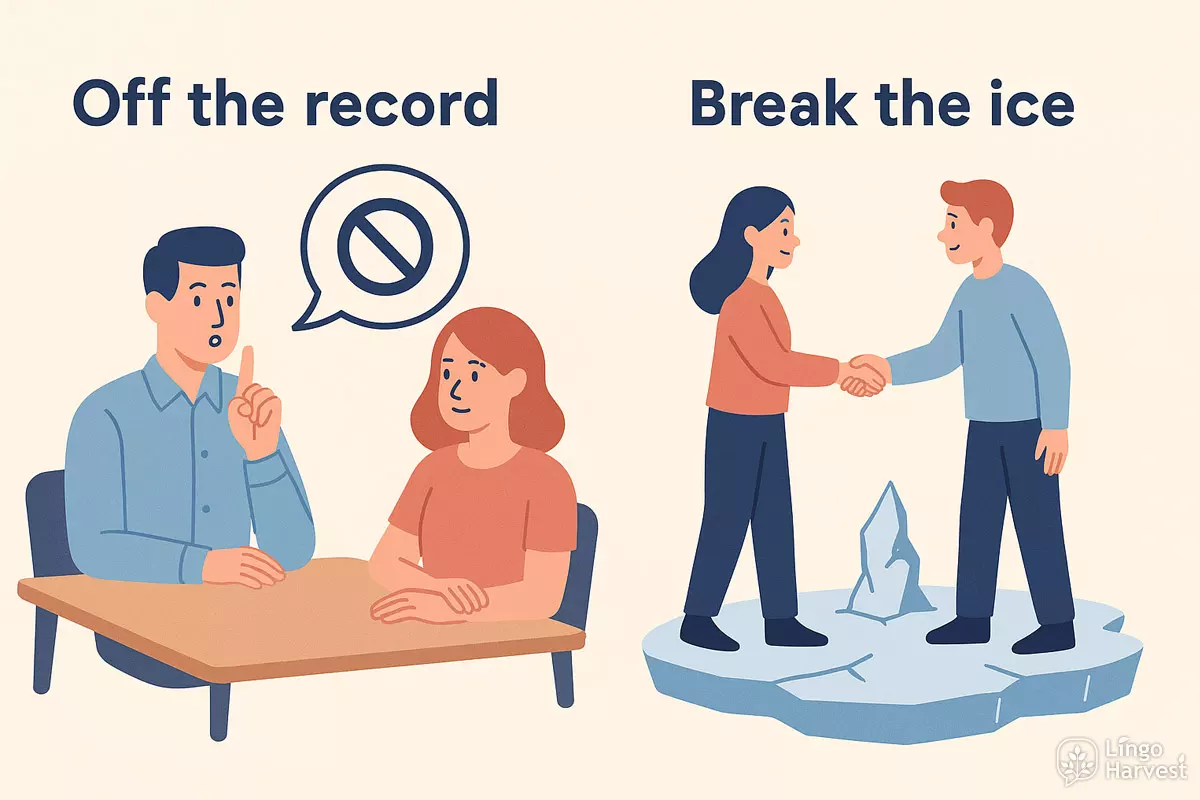
- off the record (not off a record)
- break the ice (not break an ice)
- in a pickle (not in the pickle)
- go the extra mile (not go an extra mile)
Why the patterns persist
Speakers retain these unusual determiner patterns because changing them would make the idiom sound strange or even unrecognizable. The idiomatic meaning relies on the specific form, not just the words. Over time, these expressions become accepted as exceptions to standard grammar, and their determiner use is rarely questioned by native speakers.
For learners, memorizing common fixed phrases with their determiners is the most practical approach. Trying to apply general grammar rules to idioms can lead to awkward or incorrect usage.
Fixed expressions with a, the, and zero article
Many idiomatic phrases in English have a fixed use of articles—sometimes "a," sometimes "the," and often no article at all. These set expressions do not follow the typical grammar rules for determiners. Instead, their structure is established by convention and must be learned as whole units.
Common patterns in idiomatic phrases
Some expressions always include a specific article, while others never use one. For instance, we say "in a hurry," not "in hurry," and "at the moment," not "at moment." Meanwhile, certain phrases drop the article altogether, such as "go home" or "by car." Recognizing and remembering these patterns helps learners sound more natural.
Examples of fixed phrases with different article usage
Below is a list of widely used English expressions, grouped by their article usage:
- With "a": in a hurry, have a look, take a seat, make a call, tell a joke, have a rest, make a difference, have a chance, in a minute, for a reason
- With "the": in the morning, on the other hand, at the moment, in the end, on the whole, by the way, in the meantime, on the right, at the top, in the past
- With zero article: go home, by car, at school, in prison, at work, go abroad, have breakfast, watch TV, go to bed, go shopping, play football, go to church, in class, on foot, go to hospital
Comparing article usage in set expressions
Sometimes, similar phrases differ only by their use of articles, and the meaning can change as a result. Here’s a comparison:
| Expression | Meaning/Usage |
|---|---|
| in a hospital | Inside any hospital building (location) |
| in hospital | Admitted as a patient (BrE idiom) |
| go to school | Attend as a student |
| go to the school | Visit the school as a place (not as a student) |
| at sea | On a voyage, on the ocean |
| at the sea | Located near the coast |
Tips for mastering these expressions
Learning which article (if any) to use in set phrases is mostly a matter of memorization and exposure. Pay attention to how native speakers use these expressions in context. Over time, these patterns will become more intuitive, making your English sound smoother and more idiomatic.
Expressions where determiners change meaning
Sometimes, swapping out a determiner in a familiar phrase causes a shift in meaning—sometimes subtle, sometimes dramatic. These changes are especially noticeable in idioms and set expressions, where the choice between "a," "the," "some," or "any" can completely alter interpretation. This section explores how these small words impact idiomatic usage and fixed phrases, often revealing nuances you might not expect.
Common Patterns Where Determiners Matter
In many English expressions, the article or determiner is more than just a grammatical necessity. It can switch an idiom from general to specific, or even flip its meaning. Here are some classic examples:
- Take a walk (any walk, unspecified) vs. take the walk (a particular, often significant walk)
- Catch a cold (become ill) vs. catch the cold (a specific cold, perhaps one going around)
- In a hurry (general state) vs. in the hurry (referring to a specific rushed situation)
- Have a point (make a valid argument) vs. have the point (possess a specific argument or purpose)
- On a roll (enjoying ongoing success) vs. on the roll (literally on a roll, e.g., a bread roll, or on a list/roster)
- In a pickle (in trouble) vs. in the pickle (inside a specific pickle, literal or figurative)
- Make a difference (impact in general) vs. make the difference (be the deciding factor)
- Have a clue (know anything) vs. have the clue (possess a specific piece of information)
- Lose face (suffer embarrassment) vs. lose the face (rare, but could mean a particular face or image)
- Under the impression (believe something specific) vs. under an impression (affected by a general feeling)
- In a fix (in trouble) vs. in the fix (referring to a particular problem)
- In a bind (general difficulty) vs. in the bind (specific predicament)
- On the fence (undecided) vs. on a fence (literal meaning, physically sitting)
- By a hair (by a narrow margin) vs. by the hair (by grabbing hair, usually literal)
- In a nutshell (in summary) vs. in the nutshell (inside a literal shell)
- On a mission (having a purpose) vs. on the mission (participating in a specific task or operation)
- Break a leg (idiomatic: good luck) vs. break the leg (literal: injure a specific leg)
- Have a ball (have fun) vs. have the ball (possess a specific ball, e.g., in sports)
- Make a scene (cause a disturbance) vs. make the scene (arrive at a place, be present)
- Hit a nerve (affect someone emotionally) vs. hit the nerve (literal, anatomical meaning)
Comparing Effects of Determiners in Set Phrases
To illustrate just how dramatically these small words can alter meaning, see the structured comparison below:
| Expression with "a" | Expression with "the" | Change in Meaning |
|---|---|---|
| make a difference | make the difference | "A difference" means any positive impact; "the difference" means the decisive factor. |
| in a hurry | in the hurry | General haste vs. a particular rushed event or context. |
| on a roll | on the roll | Experiencing success vs. being listed or literally on a bread roll. |
| on a mission | on the mission | Having a purpose vs. working on a specific assignment. |
| break a leg | break the leg | Wishing luck (idiom) vs. literal injury to a specific leg. |
| have a ball | have the ball | Enjoy oneself vs. possess a specific ball (e.g., in a game). |
| make a scene | make the scene | Cause a disturbance vs. arrive at a location or event. |
| catch a cold | catch the cold | Become ill in general vs. contract a specific illness circulating. |
Why Determiner Choice Matters
The slight modification of a phrase with a different determiner can change register, tone, or even the logic of what’s being said. In idiomatic contexts, the default article is often the only "correct" choice; using another can sound odd or even create confusion. Becoming aware of these patterns will help you both understand and produce more natural English, especially when encountering or using set expressions.
Regional or stylistic variation in idiomatic determiners
Idiomatic expressions often feature determiners that vary according to dialect, register, or even personal style. While many idioms are fixed, some allow for subtle shifts that reflect where or how English is spoken. For instance, British and American English sometimes favor different articles or quantifiers in well-known phrases, and informal speech can play with determiners for comic or emphatic effect.
Common patterns and regional preferences
In some cases, a phrase may include a definite article in one variety of English but omit it in another. Alternatively, a possessive or demonstrative may be substituted depending on the context or the speaker's intent. Consider these patterns:
- in (the) hospital – "in hospital" (UK) vs. "in the hospital" (US)
- go to (the) university – "go to university" (UK) vs. "go to the university" (US, for a specific institution)
- play (the) piano – "play piano" (US, informal) vs. "play the piano" (standard/UK)
- take (a) shower – "take a shower" (US) vs. "have a shower" (UK)
- on (the) weekend – "on the weekend" (US) vs. "at the weekend" (UK)
- go to (the) school – "go to school" (general activity) vs. "go to the school" (to a specific building)
- by (the) day – "by the day" (more common), but sometimes "by day" (in idioms such as "by day and by night")
- in (a) hurry – "in a hurry" (standard), sometimes "in hurry" (rare, poetic/old-fashioned)
- in (the) street – "in the street" (UK) vs. "in the street" or "on the street" (US, context-dependent)
- have (a) look – "have a look" (UK) vs. "take a look" (US)
- at (the) university – "at university" (UK) vs. "at the university" (US, for specificity)
- in (the) long run – "in the long run" (standard), but sometimes "in long run" (nonstandard or poetic)
Stylistic flexibility in fixed phrases
Writers and speakers sometimes adjust determiners for stylistic reasons, especially in creative or informal contexts. Dropping articles can create a more poetic or abrupt tone, while adding them might make speech sound more formal or precise. This flexibility is also seen in regional dialects, where certain constructions are more idiomatic.
Comparative overview: idiomatic determiners by region
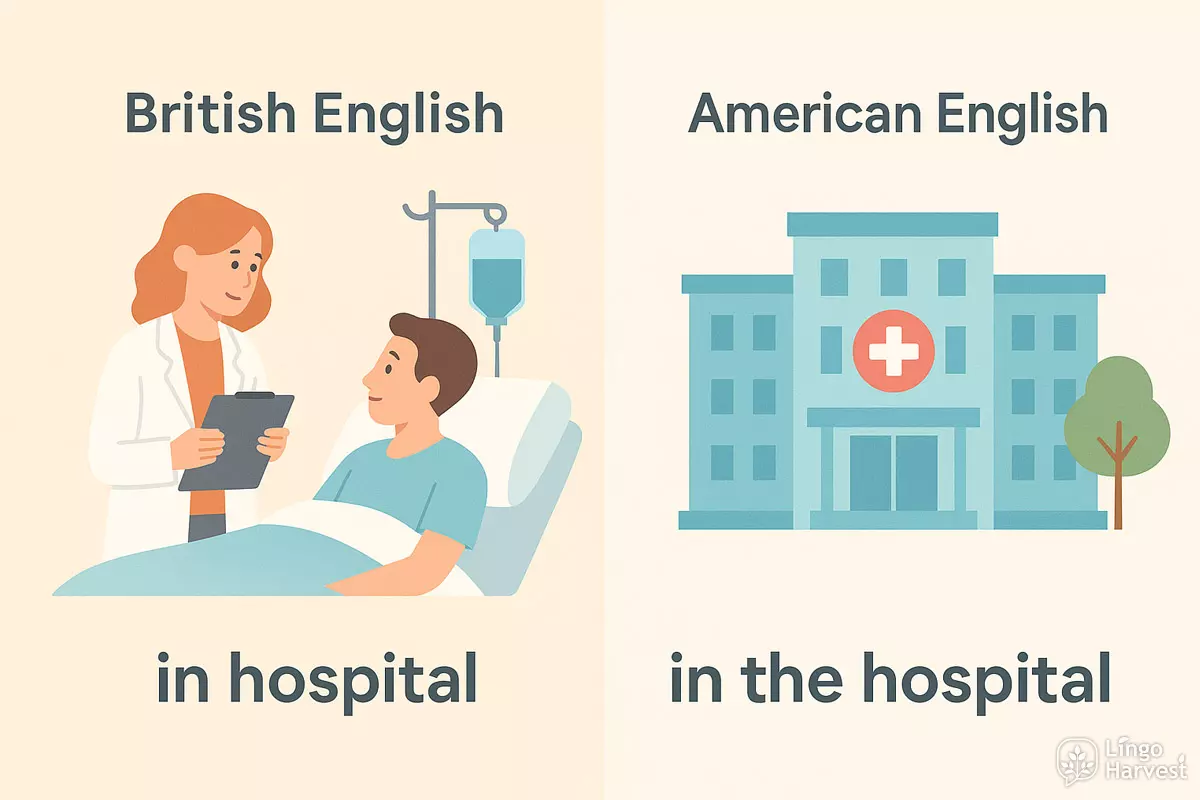
Below is a comparison of selected idiomatic expressions and how their determiners shift between British and American English:
| Expression | British English | American English |
|---|---|---|
| in (the) hospital | in hospital | in the hospital |
| play (the) piano | play the piano | play piano |
| have/take (a) shower | have a shower | take a shower |
| on/at (the) weekend | at the weekend | on the weekend |
| go to (the) university | go to university | go to the university |
| in (the) street | in the street | on the street |
| have/take (a) look | have a look | take a look |
| in (the) long run | in the long run | in the long run |
Summary
The way determiners are used in idiomatic and fixed expressions is not always universal. Regional norms, stylistic choices, and even register can all influence which article, quantifier, or possessive appears in a phrase. Being aware of these subtleties helps learners and speakers sound more natural and understand a wider range of idiomatic English.
When determiners cannot be substituted or removed
Some idiomatic expressions and set phrases in English are inseparable from their determiners. The articles, possessives, or demonstratives they contain are not just grammatical additions—they are essential to the meaning or form of the phrase. In these cases, changing or omitting the determiner would either make the expression ungrammatical or alter its meaning entirely.
Fixed Phrases with Essential Determiners
Many set expressions require a specific determiner. Trying to swap it for another, or leaving it out, would sound unnatural or be incorrect. For example, “in the long run” is a standard phrase; “in a long run” or “in long run” does not carry the same meaning.
- in the know (not “in a know”)
- on the whole (not “on whole”)
- at the end of the day (not “at end of the day”)
- in the meantime (not “in meantime”)
- in a hurry (not “in the hurry”)
- for the time being (not “for a time being”)
- under the weather (not “under a weather”)
- in a bind (not “in the bind”)
- on the spot (not “on a spot” if meaning “immediately”)
- by the way (not “by a way”)
- take the plunge (not “take a plunge” when meaning “commit decisively”)
- hit the sack (not “hit a sack” for “go to bed”)
- go the extra mile (not “go an extra mile” in idiomatic sense)
- play the fool (not “play a fool” when used idiomatically)
- hold the fort (not “hold a fort” in the idiom sense “take charge”)
- see the light (not “see a light” when meaning “understand suddenly”)
- break the ice (not “break an ice”)
- make the grade (not “make a grade”)
- read the riot act (not “read a riot act”)
- call it a day (not “call it the day”)
Why These Determiners Are Fixed
In these idioms, determiners have become part of the phrase’s identity. They often refer to a generic or abstract instance, not a specific one, and changing the determiner would break the idiomatic meaning. For example, “under the weather” uses “the” not to refer to a specific kind of weather, but as an intrinsic part of the phrase meaning “ill.”
Common Patterns
Some patterns emerge among these expressions:
- Use of the to refer to a general or abstract concept (e.g., “the point,” “the truth,” “the works”).
- Use of a/an in set phrases when referring to a single, unspecified event or state (“in a fix,” “in a jam”).
- Possessive determiners are sometimes fixed, as in “at one’s wit’s end.”
Comparison: Idioms with Inflexible Determiners vs. Flexible Ones
| Expression | Can Determiner Be Changed? | Notes |
|---|---|---|
| in the blink of an eye | ❌ No | Changing “the” or “an” breaks the idiom |
| on a roll | ✅ Sometimes | “on the roll” is possible but changes the meaning |
| hit the nail on the head | ❌ No | Required determiners for idiomatic sense |
| in a pickle | ❌ No | “In the pickle” is not idiomatic |
| pull the plug | ❌ No | “Pull a plug” loses idiomatic meaning |
Summary
With idioms and fixed expressions, the determiner is often as important as the rest of the phrase. These expressions must be learned as whole units; if the article or other determiner is changed or removed, the phrase may lose its recognizable meaning or become grammatically incorrect. Recognizing these patterns helps in both understanding and using idiomatic English naturally.
Examples from speech, media, and literature
How determiners are used—or intentionally omitted—with idiomatic expressions can be seen across everyday conversation, popular media, and classic literature. In many set phrases, the presence or absence of a determiner is crucial for preserving the idiomatic meaning. Sometimes, adding a determiner makes the phrase unidiomatic, while in other cases, determiners are fixed within the expression.
Common idiomatic patterns in spoken English
- In the end → In the end, we decided to cancel the trip.
- On the whole → On the whole, the presentation went very well.
- Out of the blue → She called me out of the blue after ten years.
- By the book → The audit was done strictly by the book.
- At a loss → I was at a loss for words when I heard the news.
- Take a seat → Please take a seat and wait for your name.
- Under the weather → I’m feeling under the weather today.
- Make a difference → A few kind words can make a difference.
- On a roll → She’s on a roll with three wins in a row.
- Hit the sack → I’m exhausted — time to hit the sack.
- Break the ice → A joke helped break the ice at the meeting.
- In a nutshell → In a nutshell, the deal was a success.
- Go the extra mile → He always goes the extra mile for his clients.
- Pull a fast one → He tried to pull a fast one, but we noticed.
- On the fence → I’m still on the fence about buying that car.
Media and literature: authentic usage
Writers and speakers often rely on these fixed forms for natural-sounding dialogue and narration. For example, in the television series Friends, the phrase "hit the sack" is used exactly as the idiom requires, with "the" included. Similarly, Charles Dickens uses "in the long run" in his novels, never omitting the determiner.
Comparison of determiner use in set phrases
| Fixed Phrase | Acceptable Form(s) | Unidiomatic Form |
|---|---|---|
| In the end | In the end | In end ❌ |
| At a loss | At a loss | At loss ❌ |
| Under the weather | Under the weather | Under weather ❌ |
| By the book | By the book | By book ❌ |
| On a roll | On a roll | On roll ❌ |
Paying attention to these patterns is essential for sounding natural, whether quoting a film character or writing an essay. Deviating from the established form can easily make the phrase sound awkward or even change its meaning.
Practice: identify determiner patterns in idioms
Understanding which determiners appear with idiomatic expressions and fixed phrases is key to sounding natural in English. Some idioms always use a particular article or quantifier, while others never take one. Let’s explore how determiners function in common idioms, and put your skills to the test with some practical exercises.
Common Determiner Patterns in Idioms
Many idioms have a fixed determiner that cannot be changed, while others omit determiners entirely. Here are some frequent patterns:
- “a” or “an” is often part of the idiom: in a hurry, make a mess, have a blast
- “the” is fixed in certain phrases: hit the sack, in the long run, on the other hand
- No determiner is used: by car, go home, take care
- Quantifiers like “some,” “many,” or “every” are rare but appear in idioms such as once in a blue moon or every now and then
Spot the Determiner: Idiom Examples
Here are some idiomatic expressions. For each, consider whether a determiner is present and, if so, which one:
- in a nutshell → In a nutshell, the project was a success.
- under the weather → I’m feeling under the weather today.
- break a leg → Break a leg at your performance tonight!
- go the extra mile → She always goes the extra mile for her students.
- spill the beans → He accidentally spilled the beans about the surprise.
- on cloud nine → She was on cloud nine after getting the job offer.
- by chance → We met by chance at the airport.
- at a loss → I was at a loss for words.
- make a difference → One kind action can make a difference.
- in the spotlight → The actor is in the spotlight this year.
- pull someone’s leg → Don’t worry, I’m just pulling your leg.
- at the drop of a hat → He would travel at the drop of a hat.
- on the fence → I’m still on the fence about moving abroad.
- in the loop → Please keep me in the loop about the meeting.
- hit the books → I need to hit the books before the exam.
- call it a day → Let’s call it a day and continue tomorrow.
- cost an arm and a leg → That car costs an arm and a leg.
- by heart → She knows the song by heart.
- in a bind → I’m in a bind and need your help.
- at sea → Without instructions, I felt completely at sea.
Practice: Choose the Correct Determiner
Try adding the correct article or quantifier where it belongs. If none is needed, leave the space blank.
- She was ________ ________ pickle after losing her keys.
- Let’s call it ________ day and finish tomorrow.
- He always goes ________ extra mile for his friends.
- They’re ________ cloud nine after the good news.
- We’re ________ the same boat.
- I learned the whole poem ________ heart.
- After the mistake, he was ________ hot water with his boss.
- She explained everything ________ a nutshell.
- He bought the tickets ________ the drop of a hat.
- I finally decided to get ________ the fence and choose.
Show answers
- in a
- a
- the
- on
- in
- by
- in
- in
- at
- off
Table: Determiner Usage in Idioms
| Idiom | Determiner Used |
|---|---|
| in a nutshell | a |
| under the weather | the |
| by heart | (none) |
| at the drop of a hat | the, a |
| spill the beans | the |
| cost an arm and a leg | an, a |
| make a difference | a |
| on cloud nine | (none) |
| in the spotlight | the |
| at sea | (none) |
Reflection
Notice how certain idioms always use a specific article or none at all. This pattern is not random—many idioms are only correct with their fixed determiner. For natural-sounding English, learn these combinations as chunks. Continue to observe new idioms and their determiner patterns as you encounter them in reading and conversation.