Determiners with Mass Nouns That Can Behave as Countable

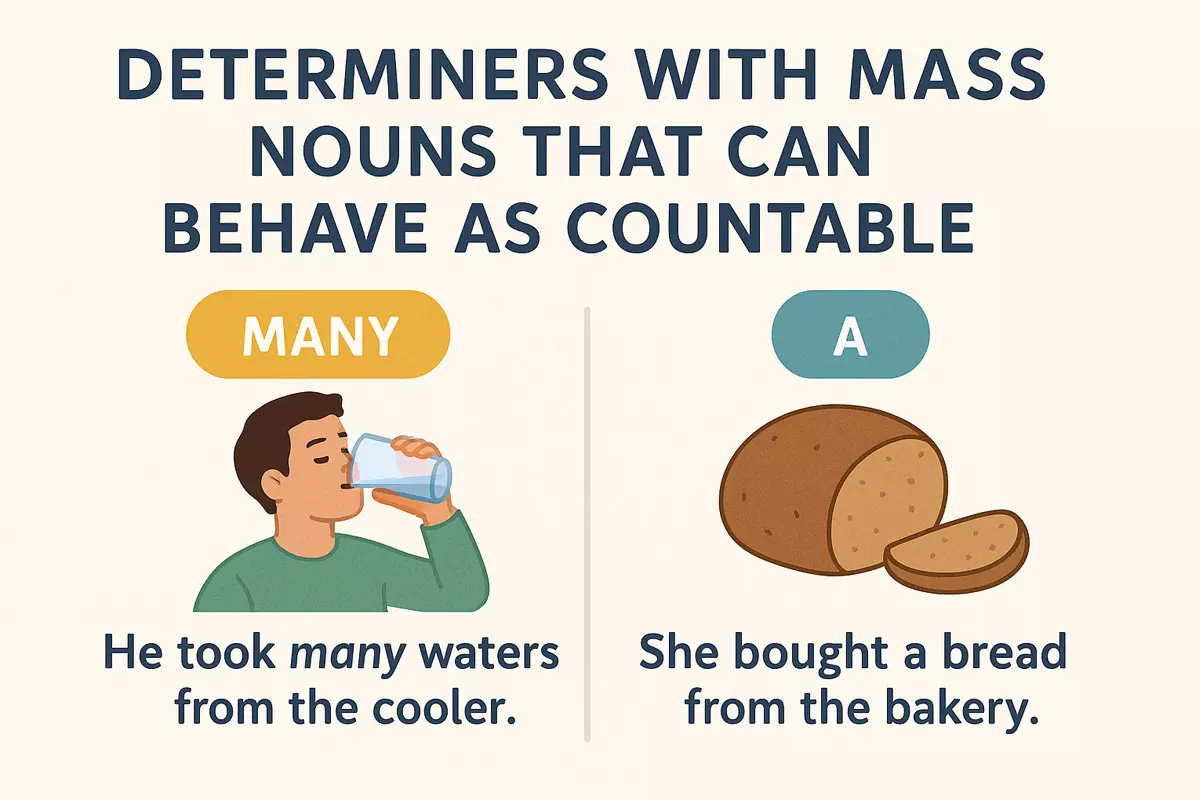 Here we how mass nouns such as coffee and cheese shift in meaning when treated as countable, explains article and quantifier usage for these cases, gives examples, discusses common errors, and provides practice in choosing correct determiners.
- Mass nouns that shift meaning when used as countable
- Using a, an, and the with reinterpreted nouns
- Changes in meaning with countable transformations
- Examples like coffees, waters, cheeses, experiences
- Quantifiers that work differently with mass vs countable nouns
- Common learner errors and interpretation issues
- Practice: choose determiners for mass/countable shifts
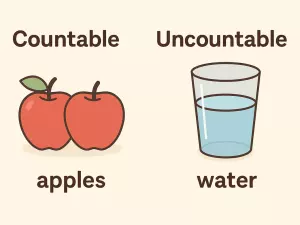
English learners often find it tricky when certain uncountable nouns, such as water or bread, are used as countable nouns in specific situations. For example, while we generally refer to water as an uncountable noun, we might say a glass of water or two waters when ordering at a restaurant. Similarly, bread is typically uncountable, but we can ask for two loaves of bread or three breads when talking about different types. Learning how these nouns can shift between countable and uncountable forms, and recognizing the determiners they require, helps clarify common confusions and improves overall fluency.
Mass nouns that shift meaning when used as countable
Many nouns in English are typically uncountable, but their meaning can change when they are used in a countable sense. This shift often highlights a specific type, portion, or instance of the material or concept rather than the substance as a whole. Understanding these shifts helps you use determiners correctly and makes your meaning clearer in context. When mass nouns are treated as countable, the reference usually narrows to a distinct unit, variety, or example. For instance, "paper" as a substance is uncountable, but "a paper" refers to a newspaper or an academic article. This distinction affects which determiners and quantifiers are appropriate.
Common mass nouns with countable forms
Some mass nouns develop a new meaning or nuance when used in the plural or with a countable article. Here are several frequently encountered examples:
- Paper – (mass: the material) / (countable: a newspaper, an essay)
- Glass – (mass: the substance) / (countable: a drinking vessel)
- Chicken – (mass: the meat) / (countable: a whole bird)
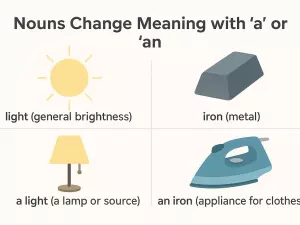
- Iron – (mass: the metal) / (countable: a pressing device)
- Work – (mass: labor in general) / (countable: a specific task, creation, or artwork)
- Experience – (mass: knowledge gained) / (countable: a particular event or incident)
- Light – (mass: illumination) / (countable: a lamp, bulb, or source of light)
- Chocolate – (mass: the food in general) / (countable: a piece or type of chocolate)
- Coffee – (mass: the drink in general) / (countable: a cup or serving of coffee)
- Salt – (mass: the substance) / (countable: a type or grain of salt)
- Water – (mass: the liquid) / (countable: a body of water, e.g., "the waters of the Nile")
- Time – (mass: the concept) / (countable: an occasion or instance, e.g., "three times")
- Hair – (mass: all hair collectively) / (countable: individual strands, e.g., "a hair in my soup")
- Fruit – (mass: fruit in general) / (countable: types or pieces, e.g., "tropical fruits")
- Stone – (mass: the substance) / (countable: a single rock or gem)
- Cheese – (mass: the food in general) / (countable: varieties, e.g., "several cheeses")
- Beer – (mass: the beverage) / (countable: a glass or bottle, e.g., "two beers")
- Noise – (mass: sound in general) / (countable: a specific sound, e.g., "a noise in the attic")
- Wood – (mass: the material) / (countable: a forest or type, e.g., "the woods" or "a pine wood")
Overview: Differences in meaning
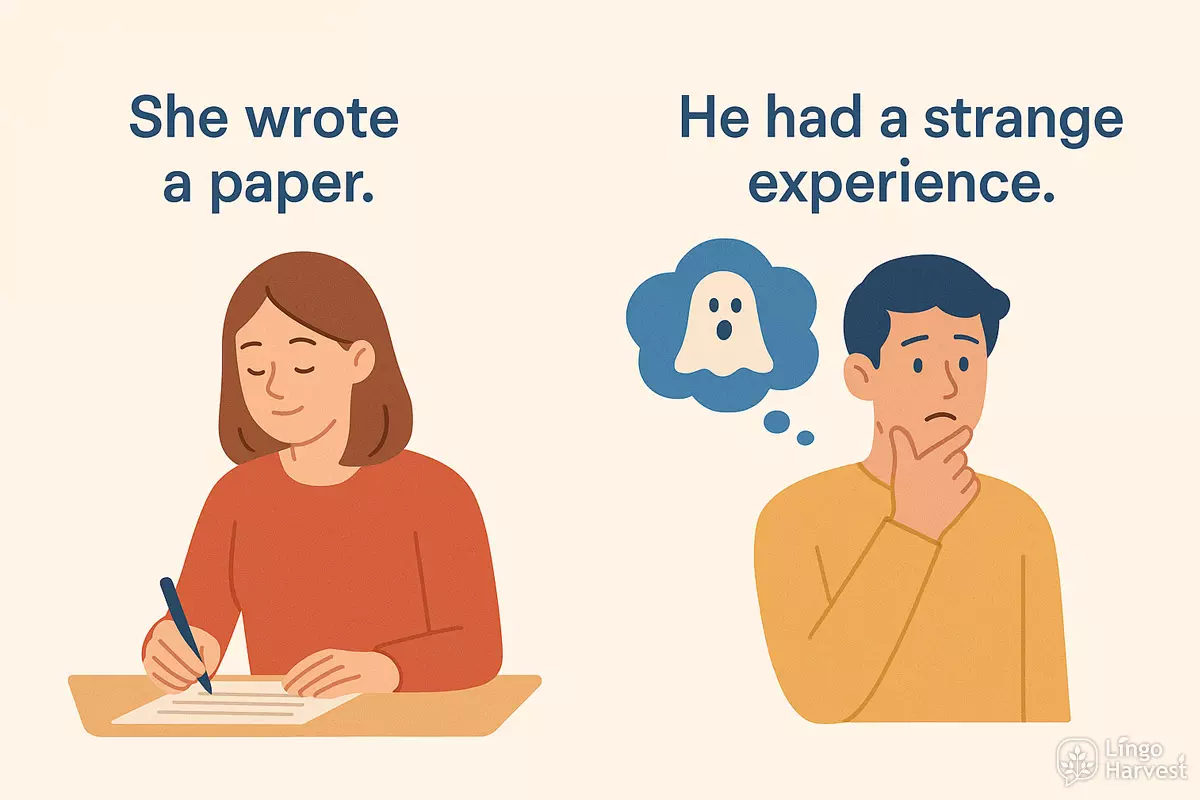
The following table illustrates how a noun’s meaning and usage can shift depending on whether it is treated as a mass noun or as a countable noun:
| Noun | Uncountable Use | Countable Use |
|---|---|---|
| Paper | She bought some paper. (the material) |
She wrote a paper. (an essay or article) |
| Experience | He has experience in teaching. (knowledge/skill) |
He had a strange experience. (an event) |
| Light | Light travels fast. (illumination) |
Turn on the light. (a lamp or bulb) |
| Coffee | Coffee is popular worldwide. (the beverage in general) |
Two coffees, please. (two cups/servings) |
| Hair | Her hair is long. (all hair together) |
There’s a hair in my soup. (one strand) |
Grasping these distinctions helps you choose appropriate determiners, whether you’re referring to a general material or a specific item, variety, or incident. This flexibility is a subtle but important feature of English usage.
Using a, an, and the with reinterpreted nouns
When certain mass nouns are reinterpreted as countable, articles like a, an, and the come into play. This transformation often happens when we’re talking about types, servings, or individual units of something that’s usually uncountable. Understanding how to use these determiners depends on the context and the meaning you want to express.
Reinterpreting Mass Nouns as Countable
Some mass nouns can shift their meaning in everyday conversation. For example, "coffee" is typically uncountable, but when you say "a coffee," you mean a cup or serving of coffee. This reinterpretation makes it possible (and necessary) to use the indefinite articles a or an. Similarly, the is used when both speaker and listener know which specific item is meant.
- a coffee → a cup of coffee
- a water → a bottle/glass of water
- a cheese → a type or portion of cheese
- a cake → an entire cake, or sometimes a piece of cake (context matters)
- a beer → a bottle, can, or glass of beer
- a chocolate → a piece or type of chocolate
- a wine → a glass, bottle, or type of wine
- a bread → a loaf, type, or piece of bread
- a paper → a newspaper, magazine, or academic article
- a sugar → a lump or packet of sugar, or type of sugar
- a tea → a cup or serving of tea
- a salad → a bowl or plate of salad
When to Use Each Article
Choosing between a/an and the depends on whether you’re introducing something new or referring to something specific. Use a or an for a non-specific or first mention, and the for something already known or previously mentioned.
| Article | Example with Reinterpreted Noun | Typical Meaning |
|---|---|---|
| a | a coffee | one cup of coffee |
| an | an ice cream | one portion/cone of ice cream |
| the | the bread | the specific bread we just bought |
| the | the wine | the wine we tried last night |
| a | a paper | one newspaper or academic article |
Summary Points
- Articles help distinguish between general mass and specific units or types.
- Context is key: "a cheese" refers to a type or piece, while "cheese" means the substance in general.
- Switching from mass to countable often relates to servings, types, or identifiable portions.
By recognizing when a mass noun is being treated as countable, you can confidently use a, an, or the to convey exactly what you mean.
Changes in meaning with countable transformations
When mass nouns are used with determiners typical of countable nouns, their sense often shifts. This transition can create new meanings, highlight different aspects, or specify portions rather than referring to an uncountable whole. For example, "coffee" as a mass noun refers to the substance in general, but "a coffee" means a serving or cup. Such shifts are frequent in everyday speech and can affect how we interpret statements.
Common patterns in countable transformations
Many mass nouns can take on countable forms, especially in casual or idiomatic contexts. Here are some typical transformations and the nuances they introduce:
- A water → a bottle/glass/portion of water
- Cheese vs. a cheese → type of cheese (e.g., "a French cheese")
- Paper vs. a paper → a newspaper, an essay, or a document
- Chocolate vs. a chocolate → a piece or type of chocolate
- Beer vs. a beer → a glass, can, or bottle of beer
- Experience vs. an experience → general knowledge vs. a specific event
- Glass vs. a glass → the material vs. a drinking vessel
- Work vs. a work → labor in general vs. a work of art
- Iron vs. an iron → the metal vs. a device
- Fruit vs. a fruit → the category vs. a kind or piece
- Salt vs. a salt → the substance vs. a chemical compound
- Light vs. a light → illumination vs. a lamp or fixture
- Time vs. a time → the concept vs. an occasion
- Hair vs. a hair → all hair collectively vs. a single strand
- Chicken vs. a chicken → the meat vs. the animal
- Toast vs. a toast → the food vs. an act of raising a glass
- Stone vs. a stone → material vs. a single rock
- Ice vs. an ice → frozen water vs. a piece or serving (as in "an ice" dessert)
- Oil vs. an oil → general substance vs. a type (e.g., "an essential oil")
- Noise vs. a noise → sound in general vs. a specific sound
Comparing meaning shifts
Sometimes, the transformation is subtle; other times, it results in a clear distinction between general and specific references. The table below highlights a few key examples:
| Mass Noun (Uncountable) | Countable Transformation | Resulting Meaning |
|---|---|---|
| Coffee | A coffee | A serving/cup of coffee |
| Experience | An experience | A particular event or incident |
| Paper | A paper | A document, essay, or newspaper |
| Glass | A glass | A drinking vessel |
| Chicken | A chicken | A whole bird/animal |
| Salt | A salt | A chemical variety or specific compound |
Summary
The ability of mass nouns to take on countable forms with determiners is a dynamic feature of English. It enables speakers to move from talking about substances or abstract concepts in general to identifying portions, types, or specific instances. Recognizing these shifts is essential for understanding meaning in context and using determiners naturally with flexible nouns.
Examples like coffees, waters, cheeses, experiences
Some mass nouns in English—such as "coffee," "water," "cheese," and "experience"—can sometimes be used in a countable way. This usually happens when we refer to types, servings, or specific instances rather than the general substance or concept. Recognizing when and how these nouns shift from uncountable to countable helps learners use determiners like "a," "some," "many," or "several" more naturally.
How mass nouns become countable
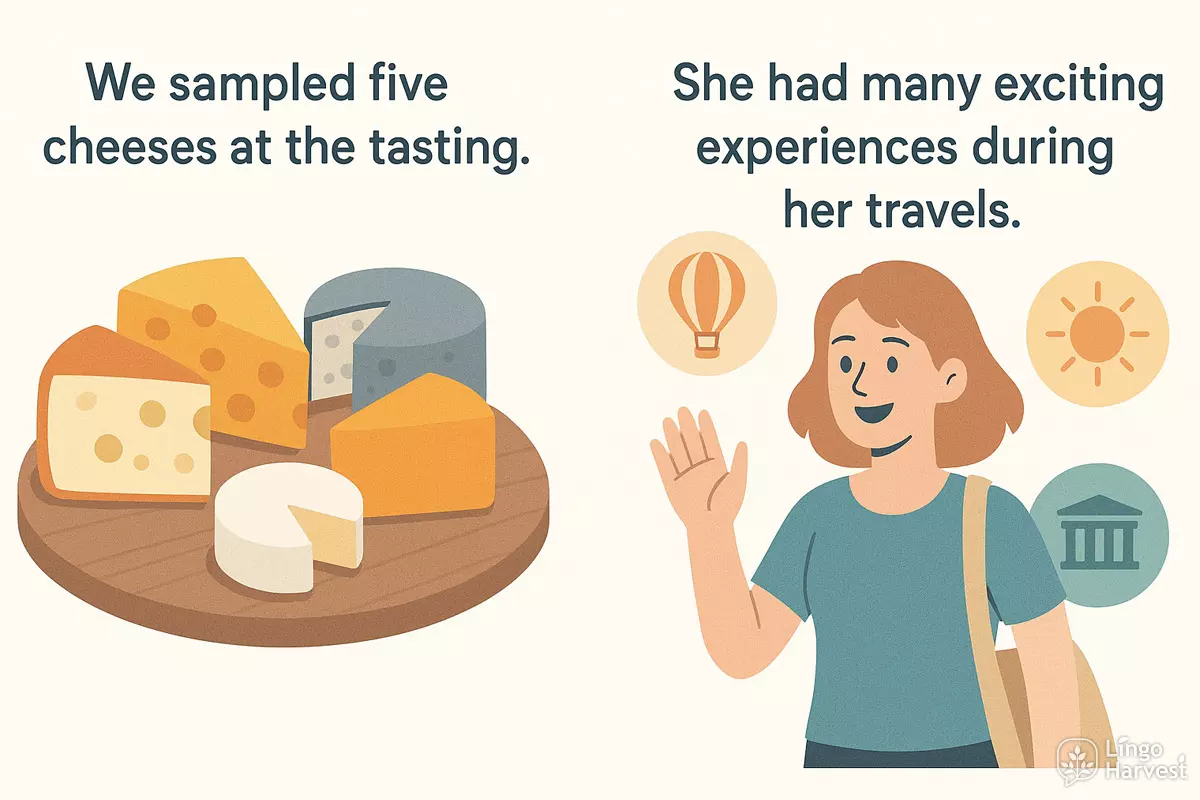
When talking about different varieties, individual servings, or distinct events, mass nouns often take on plural forms and pair with countable determiners. For example:
- Coffee: "Two coffees, please." (meaning two cups of coffee)
- Water: "The restaurant offers several waters from around the world." (meaning several brands or types)
- Cheese: "We sampled five cheeses at the tasting." (meaning five varieties)
- Experience: "She had many exciting experiences during her travels." (meaning separate events)
Common mass nouns used as countables
Here are more examples where mass nouns frequently appear in a countable sense:
- Beer: "Three beers" (three bottles, glasses, or types)
- Tea: "Different teas" (varieties or cups)
- Bread: "A selection of breads" (types or loaves)
- Fruit: "Exotic fruits" (individual items or kinds)
- Paper: "Several papers" (documents or newspapers)
- Chocolate: "Assorted chocolates" (pieces or types)
- Wine: "A few wines" (varieties or bottles)
- Salt: "Various salts" (types, e.g., sea salt, table salt)
- Work: "Different works" (creations, e.g., works of art)
- Light: "The city’s bright lights" (individual sources)
- Hair: "There are two hairs in my soup!" (individual strands)
- Snow: "Heavy snows" (separate snowfalls)
- Noise: "Strange noises" (distinct sounds)
- Time: "Good times" (instances or occasions)
- Space: "Open spaces" (areas or regions)
- Business: "Successful businesses" (companies)
- Advice: "Several pieces of advice" (individual suggestions)
Patterns with determiners
The choice of determiner changes depending on whether the noun is used in a mass (uncountable) or countable sense. Notice the difference in these sentences:
| Uncountable Use | Countable Use |
|---|---|
| Would you like some coffee? | We ordered two coffees. |
| There is cheese in the fridge. | They served three cheeses at the party. |
| She gained experience abroad. | He had many experiences during his trip. |
| He drinks water after running. | The shop sells several waters from Europe. |
Understanding these shifts helps in choosing the correct articles and quantifiers, making your language more precise and natural. Try noticing when native speakers use mass nouns in a countable way, especially in contexts involving types, servings, or specific events.
Quantifiers that work differently with mass vs countable nouns
Some quantifiers in English attach only to uncountable nouns (like water or information), while others are reserved for countable items (like apples or books). When mass nouns can take on a countable sense, the choice of quantifier must shift accordingly. Understanding which expressions work with each type helps speakers avoid awkward or incorrect combinations.
Common quantifiers for uncountable and countable nouns
Here’s a breakdown of some frequently used quantifiers and how their usage depends on whether the noun is treated as a mass or as countable:
- Much — used with uncountable nouns (much information), but not with countable ones.
- Many — for plural countable nouns (many problems), not for mass nouns.
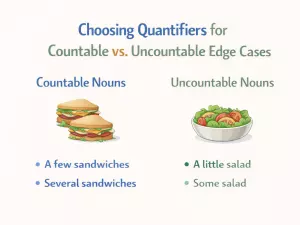
- A little — applies to uncountable nouns (a little advice).
- A few — used with countable nouns (a few suggestions).
- Less — with uncountable nouns (less furniture).
- Fewer — with countable nouns (fewer chairs).
- Some — flexible: works with both kinds (some sand, some grains).
- Any — also works with both (any milk, any bottles).
- Enough — can be used for both (enough sugar, enough cookies).
- A bit of — typically with mass nouns (a bit of news).
- A number of — only with countable nouns (a number of issues).
- A great deal of — for uncountable nouns (a great deal of trouble).
- A large amount of — uncountable (a large amount of evidence).
- A large number of — countable (a large number of emails).
- Plenty of — can be used with both (plenty of water, plenty of ideas).
- Lots of — also works for both (lots of bread, lots of loaves).
How usage changes when mass nouns become countable
Some nouns, like coffee or chicken, are usually uncountable but can be used in a countable way to mean "a type, portion, or serving." This changes which quantifiers are appropriate. For example:
- Uncountable: How much coffee do you want?
- Countable: How many coffees did you order?
Choosing the correct quantifier depends on whether you’re talking about the substance in general or individual servings/items.
| Quantifier | Mass noun example | Countable noun example |
|---|---|---|
| Much | much rice | ❌ much grains |
| Many | ❌ many rice | many grains |
| Less/Fewer | less bread | fewer rolls |
| A little/A few | a little time | a few minutes |
| Some/Any | some/any milk | some/any bottles |
| Plenty of/Lots of | plenty of water | plenty of glasses |
When a mass noun is used in a countable sense, be sure to switch to the appropriate quantifier. This distinction keeps your sentences natural and accurate.
Common learner errors and interpretation issues
Confusion often arises when mass nouns—words like “coffee,” “hair,” or “paper”—are used in ways that resemble count nouns. Learners may struggle to choose the correct determiner, especially when these nouns can switch between uncountable and countable meanings depending on context.
Mixing up definite and indefinite articles
Learners frequently overuse “a/an” with mass nouns or omit “some” when it’s needed. For instance, “I’d like a coffee” is correct for a single cup, but “I’d like a coffee powder” is not, since “powder” is rarely countable.
- Incorrect: I have a hair in my soup. (Implies a single strand, which may be correct)
- Incorrect: I have a hair on my head. (Implies only one strand, usually not what is meant)
- Correct: I have hair on my head.
- Incorrect: She gave me an advice.
- Correct: She gave me some advice.
Misinterpreting meaning when switching between count and mass uses
Some nouns shift in meaning when used countably. “Chicken” as mass means the meat, but as countable refers to the animal. Learners might misunderstand or create odd sentences by not recognizing this.
- Chicken (food, uncountable): “I ate chicken.”
- A chicken (animal, countable): “I saw a chicken.”
- Glass (material, uncountable): “The window is made of glass.”
- A glass (object, countable): “I drank from a glass.”
Errors with quantifiers and determiners
Choosing the wrong quantifier can lead to unnatural or incorrect sentences. Some learners use “much” with countable forms or “many” with uncountable forms.
| Incorrect Usage | Corrected Form |
|---|---|
| Much breads | Many breads / Much bread |
| Many rice | Much rice / Many types of rice |
| Few information | Little information / A few pieces of information |
| Several furniture | Several pieces of furniture |
| Two coffees (when meaning “two types”) | Two coffees (correct if referring to cups/kinds) |
Ambiguity and context dependence
Determiners can change the meaning subtly. For example, “a water” in a café means “a glass or bottle of water,” while “water” refers to the substance. Learners sometimes fail to notice such shifts, leading to confusion or communication breakdowns.
Summary of tricky nouns
Here are some mass nouns that commonly cause trouble when used with determiners:
- Paper (a paper = a newspaper/article, paper = material)
- Light (a light = a lamp, light = illumination)
- Iron (an iron = appliance, iron = metal)
- Time (a time = an occasion, time = general concept)
- Experience (an experience = an event, experience = knowledge)
- Chocolate (a chocolate = a piece/candy, chocolate = substance)
- Work (a work = a piece of art, work = employment or activity)
- Room (a room = space enclosed by walls, room = space in general)
- Glass, chicken, hair, stone, cheese, cake, beer, wine
Careful attention to context and meaning helps avoid these typical pitfalls. Noticing how native speakers use determiners with such nouns is especially helpful for mastering these subtle distinctions.
Practice: choose determiners for mass/countable shifts
Understanding how determiners interact with nouns that can be either mass or countable is essential for natural English. Some nouns, like "coffee" or "paper", can switch between a mass sense (uncountable) and a countable sense (referring to units, types, or servings). The choice of determiner changes depending on which meaning you want.
Task: Select the right determiner
Read each sentence and pick the most natural determiner (some, much, a, an, a few, a little, many, etc.) for the context. Think about whether the noun is being used in a mass or countable way.
- Would you like ___ coffee? (offering a drink)
- He ordered ___ coffee and two teas at the café.
- There isn’t ___ bread left, can you buy some?
- We tried ___ different breads at the bakery.
- I need ___ paper to write a letter.
- She bought ___ papers at the newsstand.
- He doesn’t have ___ experience in this field.
- She’s had ___ experiences traveling abroad.
- Do you want ___ chicken for dinner?
- We saw ___ chickens in the yard.
- There was ___ light in the room.
- Several ___ lights shone from the street outside.
- Can I have ___ water, please?
- They ordered three ___ of water for the table.
- He has ___ hair on his head.
- I found ___ hairs in my soup!
Show answers
- some
- a
- much
- many
- some
- some
- much
- many
- some
- some
- much
- lights
- some
- bottles/glasses
- much
- a few
Common Determiners for Mass and Countable Uses
When a noun can be both mass and countable, the determiners used will often signal which meaning you intend. Here’s a reference chart for quick comparison:
| Mass (Uncountable) Use | Countable Use |
|---|---|
| some coffee | a coffee (meaning a cup of coffee) |
| much bread | several breads (types/loaves) |
| a little experience | many experiences (events) |
| some water | two waters (bottles/glasses) |
| much hair | a few hairs |
| some light | several lights (sources) |
Tips for Choosing the Right Determiner
- Use some, much, a little with mass/uncountable nouns.
- Use a/an, many, several, a few with countable forms.
- If the noun means "a type", "a serving", or "an individual item", treat it as countable.
- If the noun refers to a general substance or concept, treat it as mass/uncountable.
This practice helps you notice context clues and adjust your determiner choices for more accurate, fluent English.