Choosing Quantifiers for Countable vs Uncountable Edge Cases

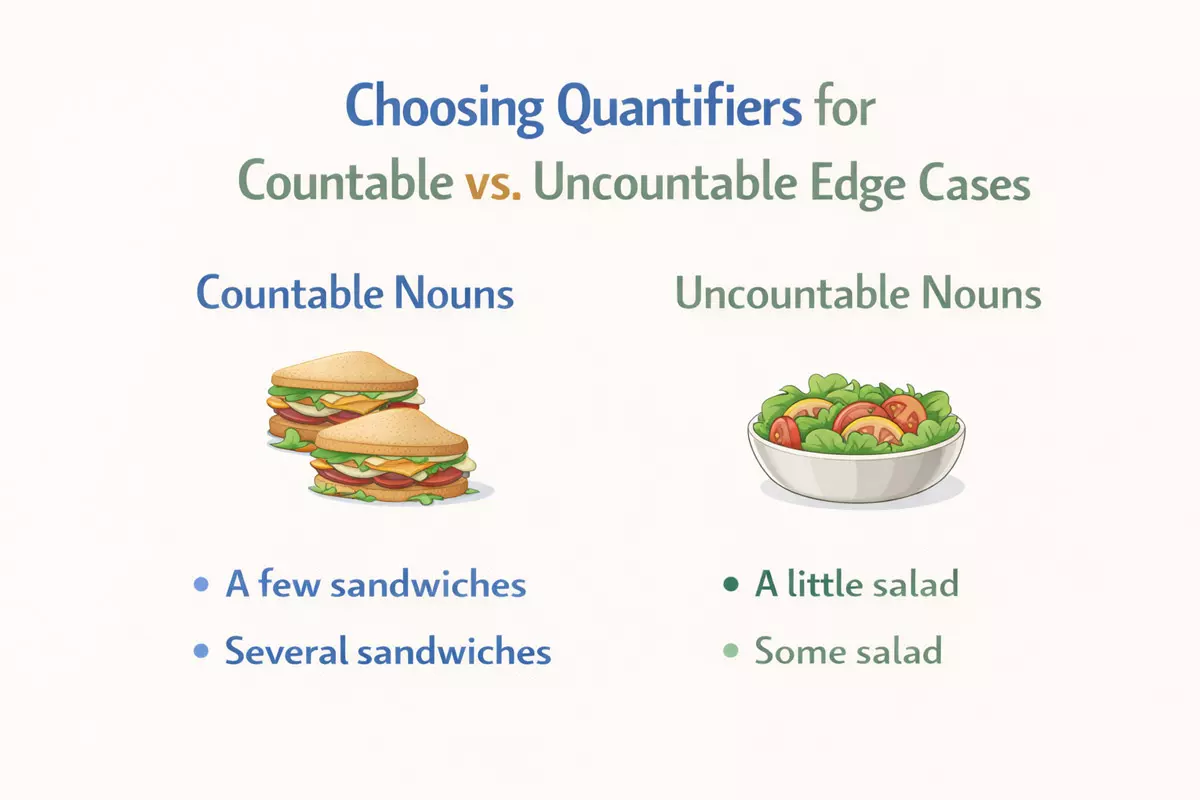 Here we what makes a noun an edge case, how some nouns shift between countable and uncountable forms depending on context, meaning changes based on noun type, common learner mistakes, and includes examples and practice for deciding correct usage.
- What makes a noun an edge case
- Nouns that shift between countable and uncountable
- How context changes quantifier choice
- Meaning differences created by noun type
- Common problem nouns for learners
- Typical errors and overgeneralization
- Examples showing contrast clearly
- Practice: deciding countable vs uncountable usage
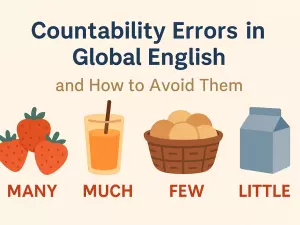
Expressing quantity in language can be challenging, particularly in situations where it is unclear whether items should be treated as countable or uncountable. Mastering the use of appropriate terms in these cases is important for clear and accurate communication. For example, choosing between words like "few" and "little" or "many" and "much" depends on whether the noun refers to something countable or not. Paying attention to these distinctions helps avoid confusion and ensures that the intended meaning is conveyed effectively.
What makes a noun an edge case
Some nouns resist easy classification as strictly countable or uncountable, leading to confusion when choosing quantifiers. This ambiguity often arises from context, meaning shifts, or usage conventions that don't fit the standard rules. Recognizing these “in-between” nouns is key to avoiding awkward phrasing or misunderstandings.
Why some nouns defy simple labels
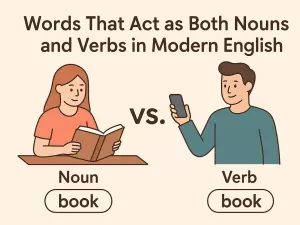
English is full of words that change category depending on how they're used. For example, “chicken” can refer to an animal (countable: three chickens) or food (uncountable: some chicken). This dual nature means the right quantifier depends on the speaker’s intent, not just the word itself.
Common characteristics of edge case nouns
- Meaning shift: The noun’s countability changes with its meaning (e.g. “paper” as a material vs. “paper” as a publication).
- Plural ambiguity: The plural form may be rare, awkward, or only used in specific senses (e.g. “fruit” vs. “fruits”).
- Context-driven: The setting or field (technical, culinary, everyday) alters whether the noun is treated as countable.
- Regional variation: Different varieties of English may treat the same noun differently (e.g. “accommodation” is uncountable in British English, but sometimes countable in American English).
- Abstract vs. concrete: Some nouns are uncountable when referring to concepts, but countable when referring to instances (e.g. “experience”).
Examples of nouns with ambiguous countability
Here are several nouns that frequently cause uncertainty when picking quantifiers:
- Light (a light in a room vs. some light)
- Hair (a hair vs. hair in general)
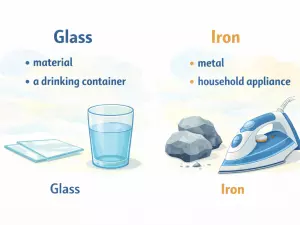
- Glass (a glass to drink from vs. glass as a material)
- Work (a work of art vs. work as employment)
- Iron (an iron for clothes vs. iron as a metal)
- Time (a time, as in an occasion, vs. time in general)
- Paper (a paper to read vs. paper for writing)
- Chicken (a chicken vs. chicken as food)
- Experience (an experience vs. experience in general)
- Room (a room in a house vs. room as space)
- Business (a business vs. business as commerce)
- Salt (a salt in chemistry vs. salt as seasoning)
- Stone (a stone as an object vs. stone as material)
- Language (a language vs. language as a concept)
- Chocolate (a chocolate as a candy vs. chocolate as a substance)
- Toast (a toast as a speech vs. toast as food)
- Water (a water as a specific body of water vs. water in general)
- Ice (an ice in a drink vs. ice as a substance)
- Fruit (fruits as varieties vs. fruit as a category)
- Noise (a noise vs. noise in general)
Comparing usage patterns
| Noun | Countable Usage | Uncountable Usage |
|---|---|---|
| Paper | Three papers (essays, newspapers) | Some paper (for writing) |
| Experience | An experience (an event) | Experience (knowledge) |
| Light | A light (a lamp) | Light (illumination) |
| Chicken | A chicken (the animal) | Chicken (meat) |
| Glass | A glass (drinking vessel) | Glass (material) |
When a noun falls into this ambiguous territory, context clues and intended meaning guide the choice of quantifier. Recognizing these edge cases is essential for precise and natural-sounding English.
Nouns that shift between countable and uncountable
Some English nouns can be used with both countable and uncountable meanings, depending on context. This flexibility can make choosing the right quantifier tricky, especially for learners. The meaning often changes subtly or significantly when the noun shifts between these forms. Recognizing these shifts is essential for accurate and natural expression.
Common Examples & Patterns
Below are several nouns that frequently change between individual items and mass concepts. The countable form typically refers to distinct units, while the uncountable form describes a general substance, concept, or collective whole. For each, the quantifier used must match the intended meaning.
- Light (a light in a room → the concept of light as brightness)
- Paper (a paper = a newspaper or essay → paper as a material)
- Chicken (a chicken = an animal → chicken as food)
- Hair (a hair = one strand → hair in general)
- Glass (a glass = a drinking vessel → glass as a material)
- Experience (an experience = a specific event → experience as knowledge)
- Iron (an iron = a device for pressing clothes → iron as a metal)
- Time (a time = an occasion → time in general)
- Work (a work = a piece of art or literature → work as labor or activity)
- Chocolate (a chocolate = a piece or candy → chocolate as a substance)
- Coffee (a coffee = a cup of coffee → coffee in bulk/liquid form)
- Stone (a stone = a rock → stone as building material)
- Salt (a salt = a type of chemical compound → salt as seasoning)
- Fruit (a fruit = a type of fruit → fruit in general, as a category or food)
- Cheese (a cheese = a variety/type → cheese as a food in general)
- Paper (a paper = an academic article → paper as a material — repeated for different senses)
- Toast (a toast = a speech → toast as food)
- Wine (a wine = a variety or glass → wine as an alcoholic drink in general)
How Quantifiers Change
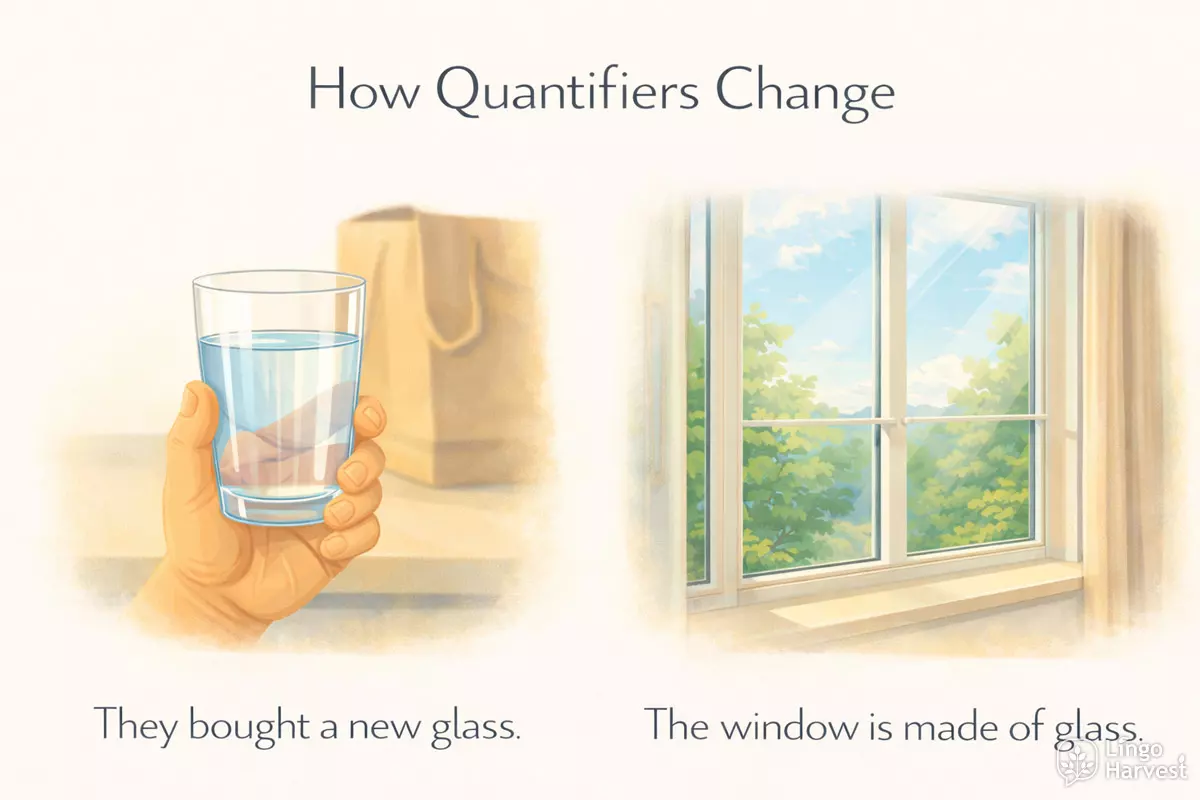
Choosing the correct quantifier depends on whether the noun is being used as a countable object or as an uncountable mass. Consider these examples:
| Countable Use | Uncountable Use |
|---|---|
| I'd like a coffee. ✅ | Do you drink coffee? ✅ |
| She found a hair in her soup. ✅ | He has thick hair. ✅ |
| They bought a new glass. ✅ | The window is made of glass. ✅ |
| He gave a toast at the wedding. ✅ | Would you like some toast? ✅ |
| This is a work of art. ✅ | He is looking for work. ✅ |
Tips for Edge Cases
- Always consider the intended meaning—object or substance? Event or concept?
- Some quantifiers only work with countable forms (many, a few), while others are for uncountable forms (much, a little).
- If unsure, rephrase the sentence or use a more general quantifier (some, any).
- Practice with real examples to internalize these patterns.
Understanding these shifts is key for choosing the right quantifiers in English, especially in situations where subtle differences in meaning matter.
How context changes quantifier choice
Context determines whether a quantifier like “much,” “many,” “a little,” or “a few” is appropriate—sometimes even more than whether a noun is strictly countable or uncountable. The surrounding words, the speaker’s intent, and the specificity of the situation all influence which quantifier fits best. For example, “some” is flexible and can apply to both countable and uncountable nouns, but the sentence’s meaning may shift subtly depending on the context.
Influence of sentence structure and meaning
Sometimes, the same noun can accept different quantifiers based on how it is used. For example, “time” is generally uncountable, but in “many times,” it refers to specific instances. Similarly, “chicken” is usually uncountable when referring to meat, but countable when talking about animals (“three chickens”). The context—whether we refer to the material or the individual item—guides the quantifier selection.
Common contexts that affect quantifier selection
- Talking about quantity vs. number (e.g., “much money” vs. “many coins”)
- Generalizations vs. specifics (e.g., “a little knowledge” vs. “a few facts”)
- Formal vs. informal situations (“several” vs. “a couple of”)
- Positive vs. negative sentences (“any sugar?” vs. “no sugar”)
- Abstract vs. concrete usage (“less effort” vs. “fewer tasks”)
- Mass vs. unit interpretation (“some cheese” vs. “two cheeses” for types)
- Politeness or suggestion (“Would you like some tea?”)
- Approximation vs. precision (“about ten people,” “a bit of rain”)
- Emphasis or understatement (“quite a few,” “only a little”)
- Regional or dialectal preferences (e.g., “much” in British English, “a lot of” in American English)
- Idiomatic expressions (“a piece of advice,” “a grain of sand”)
- Negation and questions (“any water?” “not many options”)
- Pluralized uncountables in special cases (“two coffees” meaning two cups)
- Measurement phrases (“a bottle of milk,” “a handful of coins”)
Comparison of quantifiers in varied contexts
| Context Example | Preferred Quantifier(s) | Explanation |
|---|---|---|
| Money (uncountable) | much, a lot of, some | Refers to total amount, not individual units |
| Coins (countable) | many, several, a few | Refers to individual items that can be counted |
| Advice (uncountable, but can be “pieces”) | some, a little, a piece of | “Advice” is uncountable, but “pieces” makes it countable |
| Experience (abstract vs. events) | much, a lot of / many, several | “Experience” as knowledge is uncountable; individual events are countable |
| Food/drink (mass vs. servings) | some, much / two coffees, three waters | “Coffee” is uncountable as a substance, but countable as servings |
| Time (duration vs. occasions) | much, a little / many, several | Duration is uncountable; occasions are countable |
In summary, the right quantifier isn’t determined by the noun alone. The speaker’s intent, the level of specificity, and even cultural habits all play a role in shaping which quantifier feels natural or correct in a given situation. This flexibility is especially important in edge cases with nouns that can be interpreted as both countable and uncountable, depending on context.
Meaning differences created by noun type
How you choose quantifiers often depends on whether the noun is countable or uncountable, and this can shift the whole meaning of a phrase. For edge cases—where a noun can be both, or where context blurs the line—the impact on meaning becomes especially noticeable. Some quantifiers are tied directly to the nature of the noun, while others can change nuance or even the grammaticality of a sentence.
Common quantifiers and their shifting meanings
Certain quantifiers naturally pair with count nouns ("few apples") or with mass nouns ("little water"), but some nouns can appear in both forms, leading to subtle differences. For example, "chicken" (the animal, countable) versus "chicken" (the food, uncountable) will affect which quantifiers are both correct and meaningful.
| Quantifier | Countable Use | Uncountable Use | Meaning Shift |
|---|---|---|---|
| few / a few | a few coins | ❌ | Refers to a small number of individual items |
| little / a little | ❌ | a little milk | Refers to a small quantity of a substance |
| some | some books | some sugar | Works with both; exact amount/number unspecified |
| much / many | many reasons | much time | Many = countable; much = uncountable; both signal large amounts |
| more | more chairs | more sand | Functions with both, but the type changes what "more" refers to |
| enough | enough problems | enough juice | Applies to both; context shapes the type of sufficiency |
| less / fewer | fewer errors | less noise | Fewer = countable, less = uncountable; mixing them can shift or distort meaning |
| all | all emails | all information | Works with both, but the noun type changes the scope |
| most | most students | most furniture | Both types, but the implied set changes |
| plenty of | plenty of chairs | plenty of water | Functions for both, meaning is shaped by the noun |
Edge cases: When a noun can be both
Some nouns change their type based on context, which can lead to confusion or subtle shifts in interpretation. For example:
- Paper: "a paper" (an article, countable) vs. "some paper" (the material, uncountable)
- Light: "a light" (a lamp, countable) vs. "some light" (illumination, uncountable)
- Chicken: "a chicken" (bird, countable) vs. "some chicken" (meat, uncountable)
- Experience: "an experience" (an event, countable) vs. "experience" (knowledge, uncountable)
- Hair: "a hair" (one strand, countable) vs. "hair" (all hair on head, uncountable)
- Glass: "a glass" (drinking vessel, countable) vs. "glass" (material, uncountable)
- Time: "a time" (an occasion, countable) vs. "time" (duration, uncountable)
- Work: "a work" (piece of art, countable) vs. "work" (labor, uncountable)
- Room: "a room" (space in a building, countable) vs. "room" (space in general, uncountable)
- Iron: "an iron" (appliance, countable) vs. "iron" (metal, uncountable)
How the noun type changes interpretation
Switching between countable and uncountable can alter the focus from individual items to a mass or general concept. For instance, "a few cakes" means several individual desserts, while "a little cake" refers to a small portion of one cake. Using the wrong quantifier can sometimes make a sentence ungrammatical or just odd, but more often, it subtly changes what is being communicated.
Recognizing these differences helps ensure your meaning is precise, especially in edge cases where the line between count and mass nouns is thin or context-dependent.
Common problem nouns for learners
Many English learners find it tricky to choose the right quantifiers with certain nouns, especially when the noun can be countable in one context and uncountable in another. These "edge case" nouns often lead to confusion and mistakes. Some words change meaning depending on their use, while others look plural but act uncountable, or vice versa. Understanding which quantifiers pair with these nouns is crucial for accurate expression.
Frequently Confusing Nouns
Below are some nouns that commonly cause uncertainty when selecting quantifiers. These may shift between countable and uncountable forms, or simply behave unexpectedly:
- Advice (uncountable: "some advice", not "an advice")
- Information (uncountable: "a piece of information", not "an information")
- News (uncountable: "some news", not "a news")
- Furniture (uncountable: "much furniture", not "many furnitures")
- Paper (uncountable: "some paper" for material; countable: "a paper" for an essay or article)
- Chicken (uncountable: "some chicken" for food; countable: "a chicken" for the animal)
- Experience (uncountable: "much experience" for knowledge; countable: "an experience" for a specific event)
- Light (uncountable: "much light" for illumination; countable: "a light" for a lamp)
- Hair (uncountable: "much hair" on your head; countable: "a hair" for a single strand)
- Work (uncountable: "much work" for tasks; countable: "a work" for a piece of art or literature)
- Time (uncountable: "much time" as a concept; countable: "a time" for an occasion or instance)
- Glass (uncountable: "some glass" for the material; countable: "a glass" for a drinking vessel)
- Toast (uncountable: "some toast" for the food; countable: "a toast" for a speech)
- Water (uncountable: "some water"; rarely countable except for "waters" in poetic or geographical contexts)
- Room (uncountable: "room" meaning space; countable: "a room" as in a part of a building)
- Iron (uncountable: "iron" the metal; countable: "an iron" for the device)
- Chocolate (uncountable: "some chocolate" for the substance; countable: "a chocolate" for a piece or candy)
- Paper (uncountable for the material; countable for documents or newspapers)
- Business (uncountable: "do business"; countable: "a business" as a company)
- Damage (uncountable: "some damage", not "a damage")
Common problem nouns and quantifier usage in context

- She gave me some advice about preparing for the exam, and it helped a lot.
- We received a piece of information that completely changed our plan.
- There isn’t much news about the project yet, but updates are expected soon.
- The office bought new furniture, but it didn’t buy many individual items.
- He has a lot of experience in marketing, but one experience taught him the most.
- There was very little light in the room, so she turned on a light near the desk.
- I don’t have much time today, but I remember a time when things were slower.
- She drank a glass of water, then noticed the broken glass on the floor.
- We had some chicken for dinner, and a chicken was walking around the yard outside.
Comparing Quantifiers for Edge Cases
The table below shows how quantifiers change with some of these nouns, depending on whether they are used in a countable or uncountable sense.
| Noun | Countable Usage | Uncountable Usage |
|---|---|---|
| Paper | a paper, two papers (essays, newspapers) | some paper, much paper (material) |
| Experience | an experience, several experiences (events) | much experience, a lot of experience (knowledge) |
| Light | a light, three lights (lamps) | much light, a little light (illumination) |
| Chicken | a chicken, chickens (animals) | some chicken, much chicken (food) |
| Hair | a hair, two hairs (individual strands) | much hair, a lot of hair (collective) |
When you encounter these nouns, consider whether you are talking about distinct items or a general substance or idea. This will help you pick the right quantifier—much, many, a, some, or another option—depending on the context.
Typical errors and overgeneralization
Many language learners and writers find it challenging to select the correct quantifiers when dealing with borderline or ambiguous cases—especially when a noun can be interpreted as either countable or uncountable depending on context. Missteps often arise from assuming that a quantifier used for one class of nouns will always work for the other, or from overlooking exceptions where the rules blur.
Common pitfalls when choosing quantifiers
Mistakes frequently stem from overapplying familiar patterns. For example, learners might use "many" with an uncountable noun or "much" with a countable noun, not realizing the shift in meaning or grammaticality. Here are some recurring issues:
- Using "many" with uncountable nouns: many information ❌
- Using "much" with countable nouns: much chairs ❌
- Forgetting that some nouns can be both: chicken (animal vs. food), paper (material vs. documents)
- Defaulting to "some" or "any" to avoid choosing, which can sound vague
- Applying "few" and "little" interchangeably, e.g., few advice ❌ instead of little advice
- Overgeneralizing "a lot of" as universally correct, which can be informal or imprecise in formal contexts
- Misusing "less" and "fewer": less cars ❌ instead of fewer cars
- Using "number of" with uncountables: a number of water ❌
- Confusing "amount" and "number": the amount of people ❌ vs. the number of people ✅
- Assuming all abstract nouns are uncountable, although some (like "experience," "difficulty") can be both
- Ignoring regional or idiomatic variations, such as "less than 10 items" in supermarket signage
- Not recognizing mass/count noun shifts with context: three coffees (cups of coffee) vs. some coffee (the substance)
Edge case examples: Overgeneralization patterns
Edge cases often trip up even advanced speakers. The table below contrasts some quantifier choices that commonly lead to confusion, especially in contexts where a noun's countability can change.
| Noun | Incorrect Quantifier | Correct Quantifier | Context/Explanation |
|---|---|---|---|
| Advice | Many advices | Much advice / a piece of advice | Uncountable; "advice" does not take "many" |
| Experience | Many experience | Much experience / many experiences | Uncountable for general knowledge, countable for events |
| Chicken | Much chickens | Many chickens / much chicken | Countable as animals, uncountable as food |
| Furniture | Many furnitures | Much furniture / pieces of furniture | Always uncountable in standard English |
| Paper | Much papers | Many papers / much paper | Countable for documents, uncountable for material |
| News | Many news | Much news / a piece of news | Uncountable; "news" does not take "many" |
| Time | Many times (for duration) | Much time / many times | "Much time" for duration, "many times" for frequency |
| Work | Many works (for employment) | Much work / many works | Uncountable for employment, countable for artistic creations |
| Water | Many waters | Much water / bottles of water | Uncountable as a substance; "waters" rare, poetic or idiomatic |
| Hair | Many hairs (for all hair) | Much hair / many hairs | Uncountable for total hair, countable for individual strands |
How to avoid these errors
Awareness of these traps is the first step. When in doubt, check if the noun refers to a substance or concept (likely uncountable) or individual items (likely countable). Pay special attention to context—sometimes, only the context will clarify whether a countable or uncountable quantifier is appropriate. Regular exposure to authentic usage and consulting reliable references can help reinforce correct patterns over time.
Examples showing contrast clearly
Understanding how quantifiers interact with countable and uncountable nouns is key when navigating tricky or ambiguous situations. In English, certain words are only appropriate with one type of noun, while others can fit both—sometimes with subtle changes in meaning. Below, you’ll find a variety of edge case examples that highlight these distinctions.
Common quantifier contrasts in context
- Few / A few vs. Little / A little:
- “Few options remain.” → Countable: options
- “Little hope remains.” → Uncountable: hope
- “A few suggestions were helpful.” → Countable: suggestions
- “A little sugar is enough.” → Uncountable: sugar
- Many vs. Much:
- “Many ideas were proposed.” → Countable: ideas
- “Much information was shared.” → Uncountable: information
- Several vs. Some:
- “Several books are missing.” → Countable: books
- “Some equipment is faulty.” → Uncountable: equipment
- Each vs. Every:
- “Each chair was painted.” → Countable: chair
- “Every advice is useful.” ❌ (Incorrect: advice is uncountable, so use “all advice” or “every piece of advice”)
- All applies to both:
- “All chairs are taken.” → Countable
- “All furniture is expensive.” → Uncountable
- Any and No work for both types:
- “Is there any water left?” → Uncountable
- “No tickets remain.” → Countable
- Plenty of is flexible:
- “Plenty of apples are available.” → Countable
- “Plenty of time remains.” → Uncountable
- More / Less / Fewer:
- “Fewer errors this time.” → Countable: errors
- “Less noise, please.” → Uncountable: noise
- “More bottles are needed.” → Countable: bottles
- “More patience is required.” → Uncountable: patience
- Amount vs. Number:
- “Amount of traffic” → Uncountable: traffic
- “Number of cars” → Countable: cars
- Much / Many in negatives and questions:
- “Do you have many siblings?” → Countable
- “Is there much milk left?” → Uncountable
Edge cases: Nouns that shift between countable and uncountable
Some nouns can be both countable and uncountable, but the quantifier must match the intended meaning. For instance, “experience” can refer to a general concept (uncountable) or specific events (countable).
| Noun | Countable Example | Uncountable Example |
|---|---|---|
| Experience | “She had several interesting experiences abroad.” | “She has much experience in teaching.” |
| Light | “There are three lights in the room.” | “There isn’t much light in here.” |
| Paper | “He wrote two papers on biology.” | “There isn’t any paper left in the printer.” |
| Chicken | “Three chickens escaped.” | “Would you like some chicken?” |
These examples highlight how the context and noun form determine the appropriate quantifier. When in doubt, check the meaning and structure of the noun phrase to choose the correct word.
Practice: deciding countable vs uncountable usage
Understanding when to treat a noun as countable or uncountable is essential for choosing the correct quantifier. While some words are always one or the other, many edge cases exist, especially with nouns that can be both, depending on context. Below, you'll find practice tasks and structured examples to help you distinguish these uses and select appropriate quantifiers.
Common Edge Case Nouns
Some nouns can function as both countable and uncountable, often with a shift in meaning. Here’s a quick reference list with example phrases:
- Paper: "a paper" (an article, document), "paper" (the material)
- Light: "a light" (a lamp), "light" (illumination in general)
- Experience: "an experience" (an event), "experience" (knowledge or skill)
- Chicken: "a chicken" (an animal), "chicken" (the meat)
- Hair: "a hair" (one strand), "hair" (all hair on your head)
- Time: "a time" (an occasion), "time" (the abstract concept)
- Room: "a room" (space in a building), "room" (space/area)
- Glass: "a glass" (a drinking vessel), "glass" (the material)
- Work: "a work" (a piece of art), "work" (the activity in general)
- Iron: "an iron" (the device), "iron" (the metal)
- Chocolate: "a chocolate" (an individual sweet), "chocolate" (the substance)
- Toast: "a toast" (a speech or act), "toast" (the food, as a mass noun)
- Fruit: "a fruit" (a type/kind), "fruit" (the food in general)
Quantifier Patterns: Countable vs Uncountable
To clarify usage, here's a structured comparison of quantifiers typically used with each type. Notice how the same noun may appear in both columns, depending on context.
| Countable Usage | Uncountable Usage |
|---|---|
| many books a few apples several experiences two glasses a hair |
much information a little rice some advice glass (material) hair (all hair) |
| a paper (article) an iron (appliance) a work of art a toast (speech) |
paper (material) iron (metal) work (effort/labor) toast (food) |
| a light (lamp) a chicken (animal) a fruit (type) |
light (illumination) chicken (meat) fruit (food in general) |
| few rooms (in a hotel) a time (event) |
room (space) time (general concept) |
Practice: Choose the Correct Quantifier
Read each sentence and decide which quantifier fits best. Consider the context to determine if the noun is countable or uncountable.
- There isn’t ________ sugar left in the bowl. (much/many)
- She gave me ________ advice before the exam. (a/an/some)
- I saw ________ lights in the distance. (some/a little)
- Could I have ________ water, please? (a/some)
- He has ________ experiences working abroad. (much/many)
- We need ________ paper to print this document. (a/some)
- They bought ________ new chairs for the office. (some/a little)
- There is ________ room for your suitcase. (a/some)
- I found ________ hair on my shirt. (a/some)
- Would you like ________ chocolate? (a/some)
Show answers
- much
- some
- some
- some
- many
- some
- some
- some
- a
- some
Spot the Odd Quantifier
Identify which quantifier does NOT fit with the noun in each pair.
- information: (a little / many / much)
- rooms: (few / much / several)
- water: (some / any / many)
- chickens (referring to animals): (few / many / much)
- money: (many / much / a few)
- books: (much / several / a little)
- advice: (many / a little / few)
- cars: (much / many / a little)
- time: (few / much / several)
- students: (much / many / a little)
Show answers
- much (information is uncountable)
- several (rooms are countable)
- some (water is uncountable, affirmative sentence)
- many (chickens are countable)
- much (money is uncountable)
- several (books are countable)
- a little (advice is uncountable)
- many (cars are countable)
- much (time is uncountable)
- many (students are countable)
By practicing these distinctions, you’ll become more confident in selecting the appropriate quantifier for each context—especially with nouns that shift between countable and uncountable use.