20 English Nouns That Change Meaning with “a” or “an”

 This article explains how using articles like a or an with English nouns can change meaning. It covers common examples, context-based differences, frequent learner mistakes, and includes a matching exercise to practice article use.
Did you know that adding an indefinite article like "a" or "an" to certain English nouns can significantly change their meanings? For example, "chicken" refers to the meat, while "a chicken" means the animal itself. Such subtle changes highlight how context and even a single small word can alter interpretation. Here, we will examine various examples to show how the presence or absence of an article can shift the definition of a word and impact the overall message in English communication.
How Articles Affect Meaning
Articles like “a” and “an” can completely change what a noun means in English. Sometimes, adding an indefinite article turns an uncountable or abstract noun into a countable, concrete example. In other cases, the article signals a shift from a general concept to a specific instance, or even a totally different meaning altogether. Understanding these changes is essential for clear communication.
Why Adding “a” or “an” Matters
The presence or absence of an article can signal if we’re talking about something in general, a specific example, or even a different idea. For example, “glass” refers to the material, but “a glass” means a drinking vessel. This pattern appears in many English nouns.
Common Nouns with Meaning Changes
Here are some nouns that shift their sense when you add “a” or “an”:
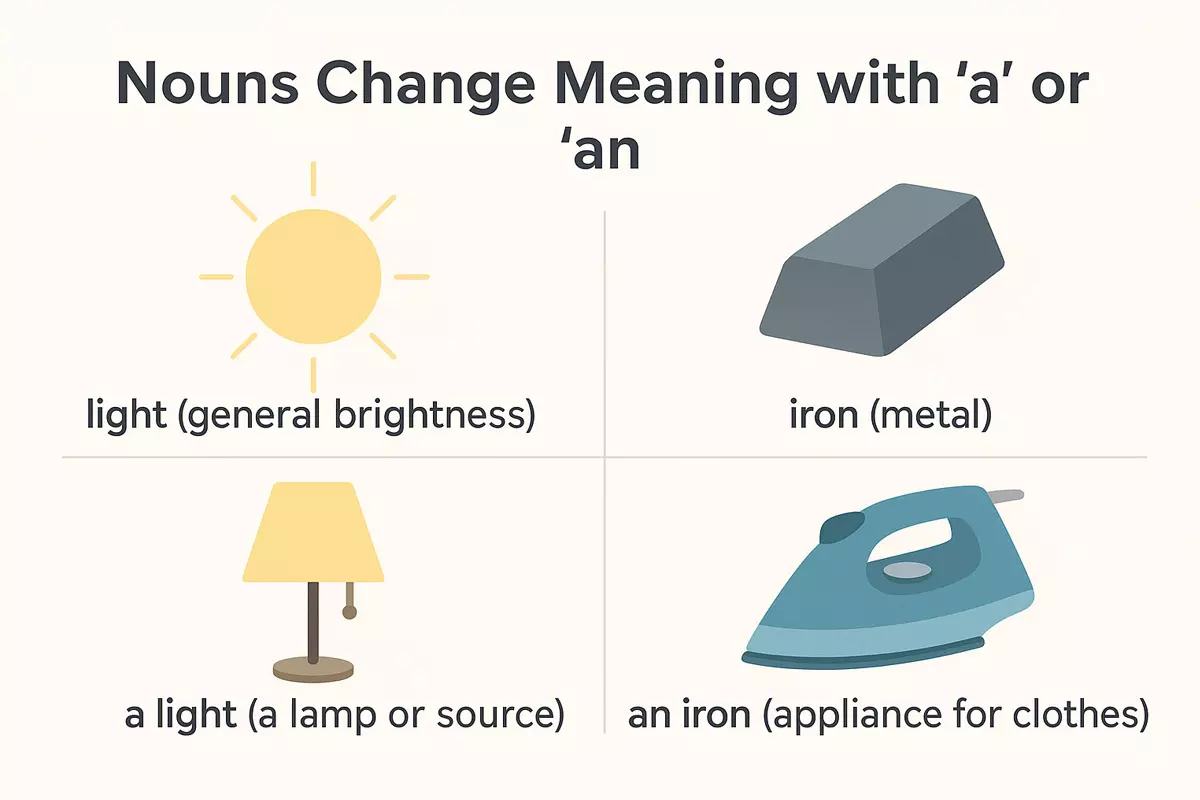
- Light (general brightness) → a light (a lamp or source)
- Paper (material) → a paper (a newspaper or academic article)
- Iron (metal) → an iron (appliance for clothes)
- Chicken (meat) → a chicken (the bird itself)
- Experience (general knowledge) → an experience (a specific event)
- Time (the concept) → a time (a particular instance)
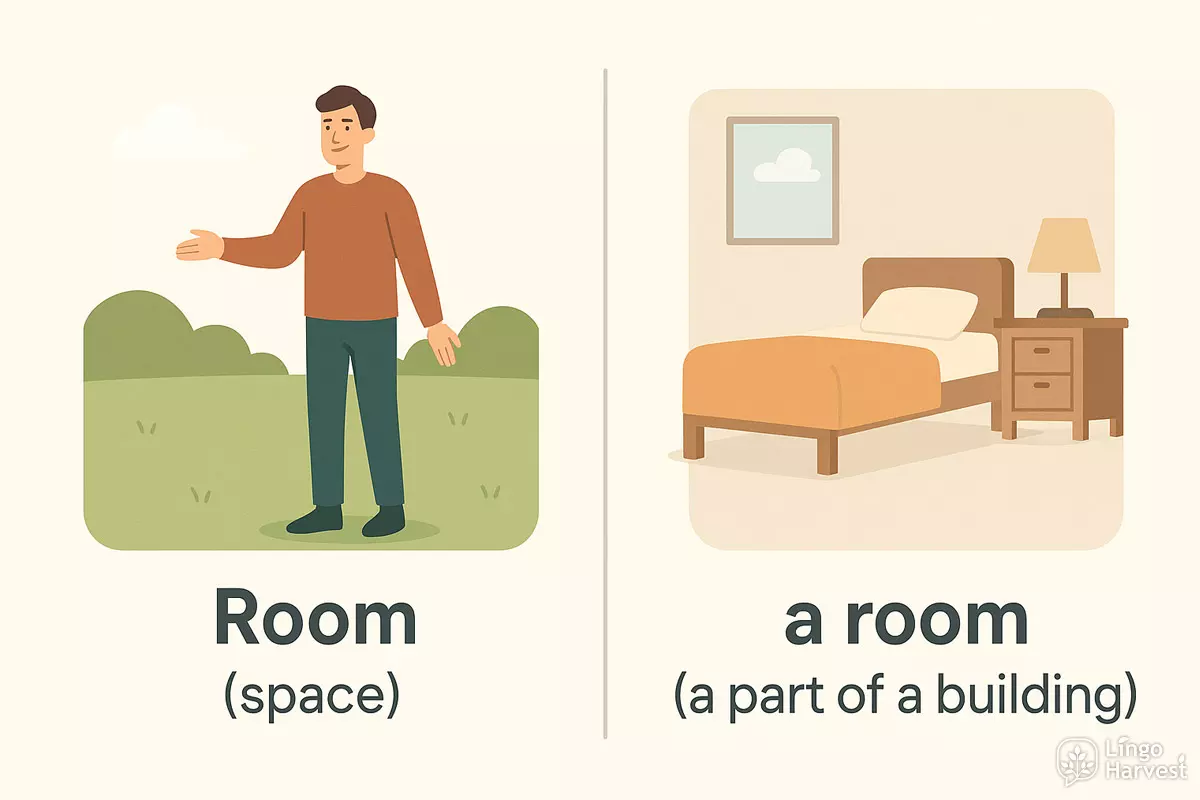
- Room (space) → a room (a part of a building)
- Work (employment/activity) → a work (a piece of art or writing)
- Toast (bread cooked) → a toast (a speech at a celebration)
- Business (commerce) → a business (a specific company)
- Memory (ability) → a memory (a specific recollection)
- Stone (material) → a stone (a single rock)
- Hair (in general) → a hair (one strand)
- Coffee (the drink) → a coffee (a cup of coffee)
- Chocolate (substance) → a chocolate (a piece or candy)
- Salt (the substance) → a salt (a specific chemical salt)
- Speech (ability to speak) → a speech (a formal talk)
- Mind (intellect) → a mind (an individual person’s thinking)
- Passion (feeling) → a passion (a particular interest)
- Water (liquid) → a water (a serving or brand of bottled water)
Comparison of Meanings
Some nouns have especially striking shifts. The table below shows a few notable examples:
| Noun Alone | With Article (“a”/“an”) |
|---|---|
| Glass (the material) | A glass (a drinking vessel) |
| Chicken (meat, food) | A chicken (the bird) |
| Experience (knowledge) | An experience (an event you had) |
| Iron (metal) | An iron (a device for ironing) |
| Paper (material) | A paper (newspaper/article) |
| Toast (bread cooked) | A toast (a celebratory speech) |
Why It’s Important for Learners
Mastering these subtle changes can help you avoid misunderstandings. For example, asking for “coffee” gets you the drink in general, but “a coffee” means one cup. Knowing the difference makes your English sound more natural and precise.
Common Examples Explained
Many English nouns change meaning when used with the indefinite articles "a" or "an" compared to when they stand alone or are used in the plural. This shift often happens because the article turns the noun into a countable version with a specific meaning, while the bare noun is uncountable or has a more general sense. Understanding these differences helps avoid confusion in both writing and conversation.
Notable Nouns with Shifting Meanings
- Chicken vs a chicken: "Chicken" (uncountable) refers to the meat, while "a chicken" means a live bird.
- Iron vs an iron: "Iron" is the metal, but "an iron" is a device for pressing clothes.
- Glass vs a glass: "Glass" is the material, "a glass" is a drinking vessel.
- Paper vs a paper: "Paper" is the material or concept, "a paper" means a newspaper or an academic article.
- Light vs a light: "Light" means illumination, "a light" means a lamp or light source.
- Business vs a business: "Business" means commerce in general, "a business" is a specific company.
- Room vs a room: "Room" means space, while "a room" is a part of a building.
- Work vs a work: "Work" is employment or effort, "a work" is a piece of art or literature.
- Experience vs an experience: "Experience" refers to overall knowledge, "an experience" is a specific event.
- Time vs a time: "Time" is the general concept, "a time" means a particular occasion.
- Hair vs a hair: "Hair" refers to the whole mass, "a hair" means a single strand.
- Chocolate vs a chocolate: "Chocolate" is the substance, "a chocolate" is a single piece or candy.
- Coffee vs a coffee: "Coffee" is the drink in general, "a coffee" means a cup or serving.
- Toast vs a toast: "Toast" is the food, "a toast" is a speech given at an event.
- Stone vs a stone: "Stone" is the material, "a stone" is a single rock or jewel.
- Message vs a message: "Message" as a concept, "a message" is a specific note or communication.
- Color vs a color: "Color" is the general property, "a color" is a specific shade or pigment.
- Spirit vs a spirit: "Spirit" means enthusiasm or essence, "a spirit" can be a ghost or supernatural being.
- Part vs a part: "Part" as a portion, "a part" as a role in a play or film.
- Life vs a life: "Life" as the general state of being alive, "a life" as a specific person’s existence or lifestyle.
Comparison Table: Contextual Meaning Shifts
| Without Article | With "a" or "an" |
|---|---|
| Chicken (the food) | A chicken (the animal) |
| Iron (the metal) | An iron (the appliance) |
| Paper (material or concept) | A paper (newspaper or essay) |
| Experience (knowledge) | An experience (an event) |
| Glass (substance) | A glass (drinking vessel) |
| Toast (bread) | A toast (a celebratory speech) |
| Light (brightness) | A light (a lamp or bulb) |
| Work (employment) | A work (a creation, e.g., "a work of art") |
| Stone (material) | A stone (an individual rock) |
| Spirit (enthusiasm) | A spirit (ghost, supernatural being) |
These examples show how the simple addition of "a" or "an" can completely change the interpretation of a word in context. Being aware of these patterns can help you communicate more accurately and understand English at a deeper level.
a Coffee vs Coffee
Understanding how the presence or absence of an article like “a” can change the meaning of a noun is essential for mastering English nuances. With “coffee,” the difference is a classic example: adding “a” shifts the word from a general, uncountable substance to a specific, countable item.
When Is “Coffee” Uncountable?
The word “coffee” usually refers to the drink or the substance in general. Used this way, it’s uncountable, similar to “water” or “sugar.” You can’t say “two coffees” when talking about the liquid itself. For example:
- “Coffee is popular around the world.”
- “Do you like coffee?”
- “There’s coffee on your shirt.”
In these sentences, “coffee” means the drink or the substance, not individual servings.
Adding “a” Makes It Countable
When you say “a coffee,” you’re talking about a specific cup or serving. In cafes, it’s common to order “a coffee,” meaning “a cup of coffee.” This is a shortcut for “a cup/mug/glass of coffee.” For example:
- “I’ll have a coffee, please.”
- “She brought me a coffee from the café.”
- “Let’s grab a coffee after work.”
Here, “a coffee” refers to one drink, not the general substance.
Comparing the Meanings
Sometimes, both uses appear in the same sentence, highlighting the difference:
- “I drink coffee every morning.” → general habit, the substance
- “I had a coffee with my friend yesterday.” → one serving, a specific event
More Examples of “a coffee” vs “coffee”
- “Would you like coffee or tea?” (substance)
- “Let’s get a coffee before the meeting.” (one cup/serving)
- “There’s too much coffee in this recipe.” (ingredient)
- “Could I have a coffee to go?” (order, one item)
- “He spilled coffee on the table.” (liquid)
- “She ordered two coffees.” (countable: two cups)
- “Coffee keeps me awake at night.” (in general)
- “Can you make me a coffee?” (one drink)
- “The smell of coffee is wonderful.” (all coffee, not a specific cup)
- “We chatted over a coffee.” (while drinking one cup each)
Summary Table: Countable vs Uncountable Usage
| Form | Meaning & Example |
|---|---|
| coffee (uncountable) | The drink or substance in general. “Coffee is my favorite beverage.” |
| a coffee (countable) | One cup, mug, or serving. “I’d like a coffee, please.” |
| two coffees (countable plural) | Two individual drinks. “We ordered two coffees.” |
| coffee (ingredient) | Used in recipes or as a flavor. “Add some coffee to the cake batter.” |
an Experience vs Experience
English speakers use the word experience in two distinct ways, and the presence or absence of an changes the meaning quite a bit. When you add the article, you’re talking about a single, specific event. Without it, you refer to knowledge or skill gained over time. This subtle difference can be confusing for learners, but it’s important for clear communication.
“An experience” – A Specific Event

When using an experience, you mean one particular incident or event that happened to you. It’s countable, so you can say an experience, two experiences, or many experiences. Here are some examples:
- I had an amazing experience while traveling in Japan.
- She described an unpleasant experience at the restaurant.
- That was an experience I’ll never forget.
- He told us about an experience with wild animals.
“Experience” – Knowledge or Skill
Without the article, experience is uncountable. It refers to the general knowledge, skills, or understanding you gain over time, often through repeated exposure or practice. Here are some ways it’s used:
- She has experience in teaching young children.
- You need more experience before applying for that job.
- His experience in customer service really shows.
- Learning a language is easier with some experience abroad.
Quick Comparison
| With “an” (Countable) | Without “an” (Uncountable) |
|---|---|
| Refers to a single event or incident | Refers to general knowledge or skill |
| “That was an experience I didn’t expect.” | “She has a lot of experience in marketing.” |
| Can be pluralized: “two experiences” | Cannot be counted: “much experience” |
| Often used with adjectives: “a strange experience” | Often used with prepositions: “experience in/with” |
Common Mistakes to Avoid
- Don’t say “an experience” when you mean general skill (❌ He has an experience in sales → ✅ He has experience in sales).
- Don’t drop “an” when talking about one event (❌ I had experience at the concert → ✅ I had an experience at the concert).
Understanding this distinction helps you sound more natural and precise in English, especially when describing your background or sharing stories.
Context and Usage Differences
Many English nouns change their meaning entirely when you add the article “a” or “an” in front of them. This shift usually marks the difference between a general concept and a specific, countable example. Recognizing when to use the article is crucial for clear communication, as the meaning can become almost the opposite or refer to a completely different idea.
Abstract vs. Concrete Meanings
Frequently, the noun without an article refers to a general idea or material, while adding “a” or “an” points to a single instance or a person associated with that term. For example, “glass” means the material, but “a glass” refers to a drinking vessel. The article transforms the abstract into something tangible or countable.
Specific Examples
- Chicken (meat) vs. a chicken (the animal)
- Iron (the metal) vs. an iron (appliance for clothes)
- Light (illumination) vs. a light (a lamp or bulb)
- Paper (material) vs. a paper (a newspaper or essay)
- Chocolate (the substance) vs. a chocolate (a single candy)
- Work (the concept) vs. a work (a piece of art or literature)
- Experience (general knowledge) vs. an experience (a specific event)
- Room (space) vs. a room (a part of a building)
- Time (the concept) vs. a time (a specific occasion)
- Business (general commerce) vs. a business (a specific company)
- Stone (material) vs. a stone (a single rock)
- Hair (all hair) vs. a hair (one strand)
- Salt (the substance) vs. a salt (a chemical compound of salts)
- Toast (the act of toasting) vs. a toast (a piece of toasted bread or a speech)
- Memory (ability) vs. a memory (a recollection)
- Noise (general sound) vs. a noise (a particular sound)
- Fire (element) vs. a fire (an incident or campfire)
- Passion (emotion) vs. a passion (a specific interest)
- Speech (ability) vs. a speech (an address or talk)
- Color (concept) vs. a color (a specific shade)
Comparison Table: General vs. Specific Meanings
| Without Article | With “a” or “an” |
|---|---|
| Glass (material) | A glass (drinking vessel) |
| Paper (material) | A paper (newspaper, essay) |
| Light (illumination) | A light (lamp, bulb) |
| Chicken (meat/food) | A chicken (the animal) |
| Iron (metal) | An iron (appliance) |
| Experience (general knowledge) | An experience (specific event) |
| Hair (all hair) | A hair (one strand) |
| Toast (the act) | A toast (a speech or bread slice) |
| Stone (material) | A stone (a single rock) |
| Memory (ability) | A memory (particular recollection) |
These shifts are not random but rooted in how English distinguishes between the uncountable (materials, concepts, abilities) and the countable (objects, people, events). Paying attention to the presence or absence of “a” or “an” can help you avoid confusion and use words with precision in both writing and conversation.
Common Learner Confusions
Many English learners are surprised to discover that simply adding "a" or "an" before certain nouns can completely change their meaning. This is especially tricky when the difference is subtle or unexpected. Sometimes, the noun without an article refers to a general concept or material, while the same word with "a" or "an" refers to a specific item or a person with a certain role. Understanding these shifts is crucial for clear communication.
Typical Problem Areas
Learners often mix up these nouns in everyday conversation. For example, "glass" (the material) is not the same as "a glass" (a drinking vessel). Similar confusion arises with words like "paper," "iron," or "chicken." Misusing these can lead to misunderstandings or awkward moments.
Examples of Meaning Changes
The following list highlights some common nouns where the presence of "a" or "an" alters the sense:
- Glass (material) vs. a glass (container for drinking)
- Paper (material/news) vs. a paper (an essay or newspaper)
- Chicken (meat/food) vs. a chicken (a live bird)
- Iron (metal) vs. an iron (appliance for clothes)
- Light (brightness) vs. a light (a lamp or bulb)
- Room (space) vs. a room (a part of a building)
- Time (concept) vs. a time (an occasion)
- Work (general labor) vs. a work (a piece, like a painting)
- Experience (knowledge) vs. an experience (a specific event)
- Hair (all the hair) vs. a hair (one strand)
- Business (commerce) vs. a business (a company)
- Memory (ability) vs. a memory (a specific recollection)
- Fire (element) vs. a fire (a campfire or fireplace)
- Toast (bread) vs. a toast (a speech or wish)
- Chocolate (substance) vs. a chocolate (a piece of candy)
- Speech (ability) vs. a speech (a formal talk)
- Position (state) vs. a position (a job)
- Color (quality) vs. a color (a shade/hue)
- Change (process) vs. a change (a specific alteration)
- Mind (intellect) vs. a mind (a particular way of thinking)
Side-by-Side Comparison
To make these differences easier to see, here’s a table contrasting the meanings of a few especially confusing word pairs:
| Without “a”/“an” | With “a”/“an” |
|---|---|
| Chicken (food on your plate) | A chicken (a living bird on a farm) |
| Paper (material used for writing) | A paper (a newspaper or academic essay) |
| Iron (the metal) | An iron (a device for pressing clothes) |
| Glass (the substance) | A glass (a cup for drinking) |
| Experience (overall knowledge) | An experience (a particular event) |
| Toast (bread cooked in a toaster) | A toast (a speech at a celebration) |
| Light (brightness in general) | A light (a lamp or light bulb) |
| Memory (the mental ability) | A memory (a specific thing you remember) |
Tips for Avoiding Mistakes
- Think about the context: Is it a material/concept, or a specific item?
- Ask yourself if you mean something countable or uncountable.
- Listen for how native speakers use these words in real situations.
- Practice with example sentences and notice the article’s effect on meaning.
Grasping these differences takes time and exposure, but paying attention to articles with these nouns will help you sound more natural and accurate in English.
Practice: Match Article to Meaning
Understanding how the presence of “a” or “an” can shift the sense of a noun is crucial for clear communication in English. Below are practical exercises to help you distinguish between words that change their meaning depending on whether an indefinite article is used.
Task 1: Match the Article + Noun to Its Meaning
Read each phrase and decide what it means. For each pair, select the correct meaning.
| Phrase | What does it mean? |
|---|---|
| glass | Material used for windows or bottles |
| a glass | A drinking vessel |
| paper | Material for writing or printing |
| a paper | A newspaper or an academic article |
| iron | A type of metal |
| an iron | A device for pressing clothes |
| chicken | Meat from a bird, or the animal itself |
| a chicken | One individual bird (alive) |
| room | Space or area |
| a room | A part of a building, like a bedroom |
| light | Illumination |
| a light | A lamp or light fixture |
| business | Commerce in general |
| a business | A specific company or shop |
| experience | Knowledge gained over time |
| an experience | A particular event you lived through |
| chocolate | Sweet food made from cocoa |
| a chocolate | One piece or candy of chocolate |
| coffee | The drink in general |
| a coffee | A cup of coffee |
| hair | All the hair on your head |
| a hair | A single strand |
Task 2: Short Quiz
Choose the correct article (“a/an” or none) for each sentence:
- I drink ______ coffee every morning.
- There is ______ light in the room.
- I found ______ hair in my soup!
- She bought ______ paper to read on the train.
- Please give me ______ glass of water.
Show answers
- coffee
- a
- a
- a
- a
Task 3: Identify the Meaning
- Is “an iron” a material or a tool?
- Does “room” mean space or a part of a building?
- When you say “a chocolate,” are you talking about a type of food or a single item?
- Is “experience” an event, or general knowledge?
Show answers
- Tool
- Space
- Single item
- General knowledge
Reviewing these distinctions can help you communicate with more nuance and avoid common misunderstandings when using English nouns that shift meaning with articles.