Countable and Uncountable Nouns: Theory

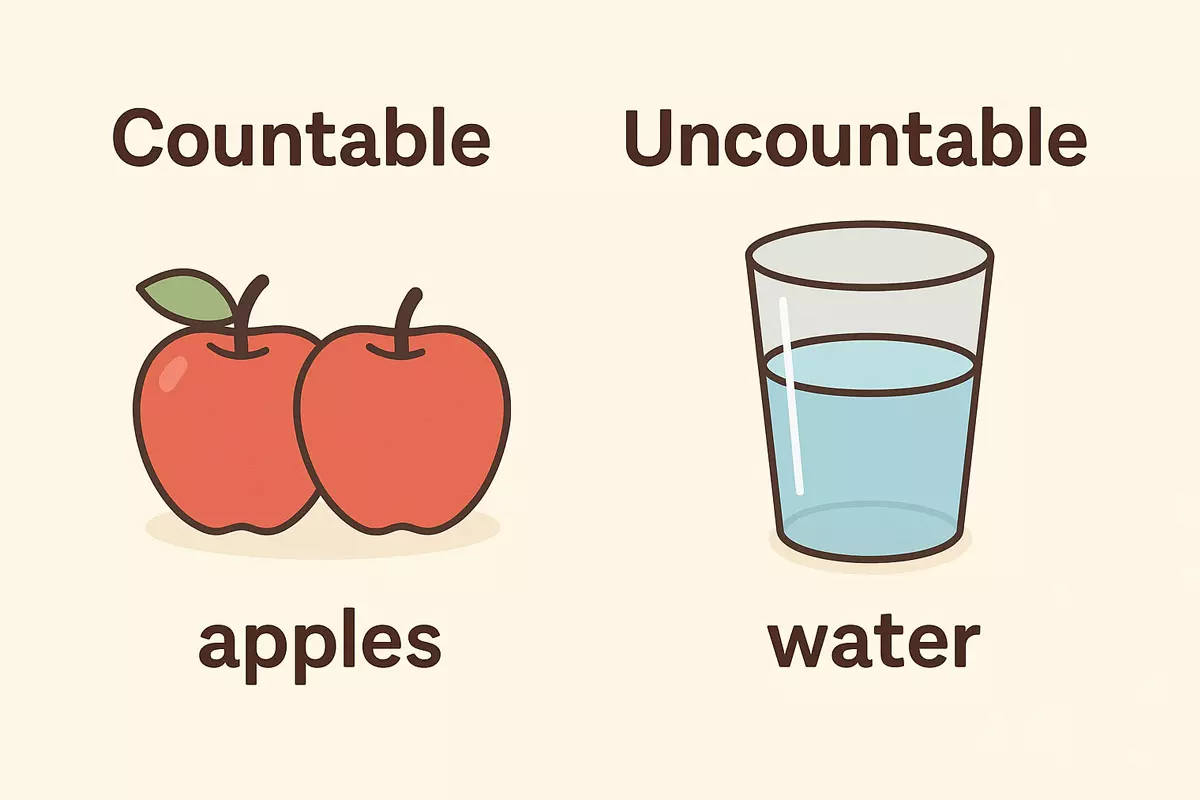 Here we the basics of countable and uncountable nouns, explains which articles and quantifiers to use with each, highlights exceptions, discusses why countability matters, and provides practice in identifying countable and uncountable nouns.
Recognizing the difference between countable and uncountable nouns is crucial for mastering English grammar, as it affects not only how we use articles like "a" and "an," but also impacts subject-verb agreement and the choice of quantifiers such as "many," "much," "few," and "little." For example, we say "many books" but "much information." Being aware of this distinction helps ensure clarity and accuracy in both writing and speaking, making communication more precise and effective in everyday situations.
Basic Idea of Countability
Understanding how nouns are classified helps us communicate quantity and specificity in English. Some nouns refer to individual items that can be counted, while others describe substances or concepts that cannot be divided into separate elements. This distinction affects grammar, such as the use of articles, quantifiers, and verb agreement.
What Makes a Noun Countable or Uncountable?
A word is considered countable if you can use numbers in front of it and make it plural. For instance, you can have "three books" or "several chairs." In contrast, uncountable nouns represent things that are not seen as separate units. You don't normally say "two rices" or "many informations." Instead, these words refer to whole masses, abstract ideas, or substances.
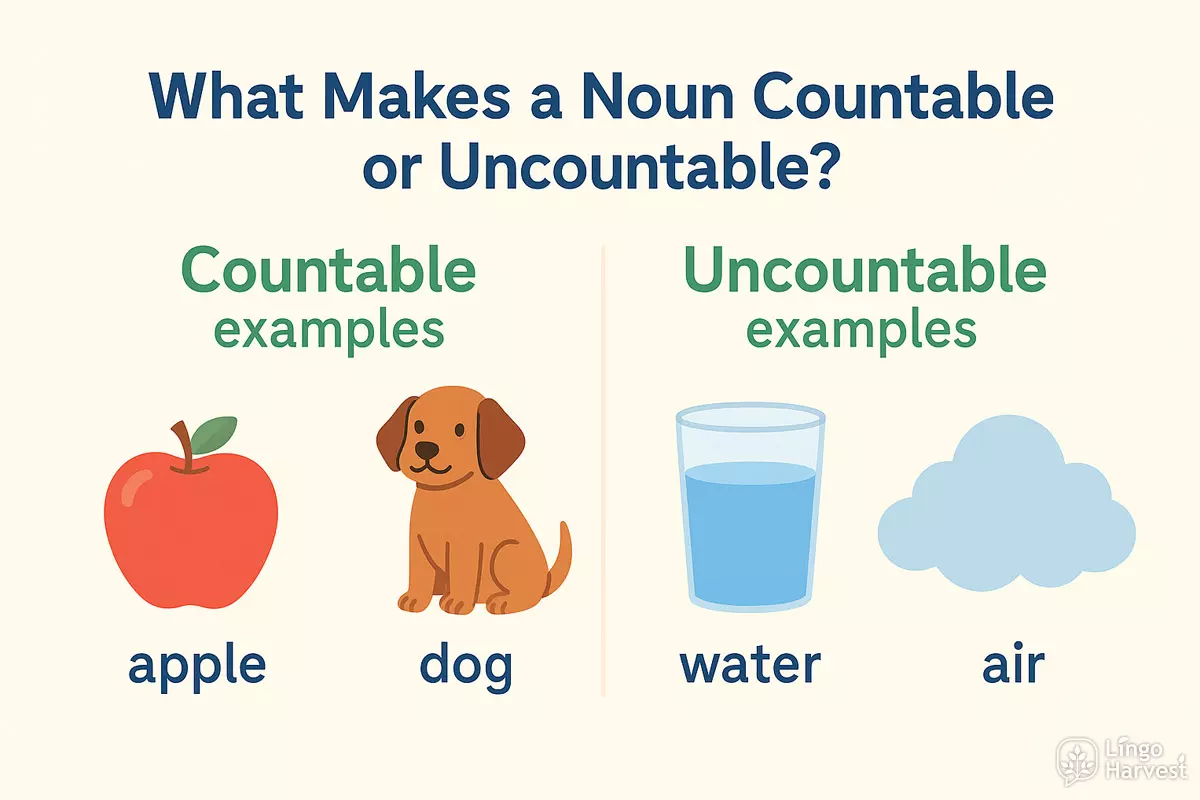
- Countable examples: apple, dog, idea, car, pencil, city, bottle, child, computer, question, student, friend, chair, coin, lesson, country, ball, ticket, bird, star
- Uncountable examples: water, air, information, advice, furniture, knowledge, rice, music, money, sugar, traffic, bread, equipment, homework, luggage, news, patience, weather, progress, courage
Grammatical Patterns
The way we use determiners and quantifiers changes based on whether a noun can be counted. Here are some patterns to notice:
- Use a/an or numbers with countable nouns: "a pen," "two apples."
- Use some or much with uncountable nouns: "some water," "much knowledge."
- Many/few go with countable; much/little with uncountable.
Common Confusions
Certain nouns may seem countable in one language but are uncountable in English, or vice versa. For example, "advice" is uncountable, so we say "some advice" instead of "an advice." Conversely, "apple" is countable, so "an apple" is correct.
| Countable Nouns | Uncountable Nouns |
|---|---|
| book ✅ "three books" |
water ❌ (not "three waters", but "some water") |
| chair ✅ "many chairs" |
music ❌ (not "many musics", but "much music") |
| student ✅ "a student" |
information ❌ (not "an information", but "some information") |
| idea ✅ "few ideas" |
advice ❌ (not "few advices", but "some advice") |
Grasping this distinction is important for accurate and natural-sounding English. It influences article use, pluralization, and the choice of quantifiers, all of which are key points in English grammar.
What Are Countable Nouns?
Countable nouns are words that describe things you can count as individual units. These nouns refer to objects, people, or concepts that have both singular and plural forms. For example, you can have one book, two books, or several books. If you can ask "How many?" and get a specific answer, you’re likely dealing with a countable noun.
Key Features of Countable Nouns
- They have a singular and a plural form (e.g., cat/cats).
- They can be used with numbers and the words a or an (e.g., a chair, three chairs).
- They often answer the question "How many?" rather than "How much?"
- Plurals are usually formed by adding -s or -es, but there are irregular forms too (e.g., child/children).
Common Examples
Here are some everyday words that fit this category:
- apple
- car
- dog
- idea
- student
- country
- pen
- table
- house
- egg
- friend
- question
- city
- computer
- shoe
- coin
- tree
- lesson
- ticket
- bag
How Countable Nouns Work in Sentences
When using these nouns, pay attention to their form and the words that go with them. In the singular, use a or an before the noun (a dog, an apple). In the plural, use numbers or quantifiers like many, few, or several (many students, two coins).
Singular and Plural Forms: Quick Comparison
| Singular | Plural | Example in a Sentence |
|---|---|---|
| book | books | I have three books. |
| child | children | The children are playing outside. |
| city | cities | Many cities are crowded. |
| egg | eggs | She bought a dozen eggs. |
| student | students | Each student has a question. |
Understanding these nouns helps you communicate quantity clearly and use correct grammar in English. They are essential for describing everyday objects, people, and ideas in precise terms.
What Are Uncountable Nouns?
Uncountable nouns refer to substances, concepts, or masses that cannot be separated into individual elements or counted as discrete units. These words describe things we view as wholes or quantities rather than distinct items. For example, we talk about “water,” “rice,” or “information” without thinking of one water, two waters, etc. Instead, these items are measured by volume, mass, or abstract amount.
Key Characteristics
Uncountable nouns share some distinct features:
- They do not have a plural form (no “waters” or “informations” in standard usage).
- They are not used with the indefinite article “a” or “an.”
- Quantifiers like “much,” “little,” and “some” are used instead of “many” or “few.”
Common Categories
These nouns can be grouped into several categories:
- Substances: water, air, oil, sand, sugar, salt
- Materials: wood, iron, plastic, glass, paper
- Abstract ideas: advice, knowledge, information, progress, happiness
- Activities: work, travel, research, homework
- Weather words: rain, snow, sunshine, thunder
- Food and drink (in bulk): bread, cheese, meat, coffee, tea, rice
Typical Usage Patterns
When referring to a specific quantity, partitive structures are used:
- a piece of advice
- a glass of water
- a loaf of bread
- a bit of information
- a grain of rice
This allows us to talk about “one” or “two” of something that is generally uncountable.
Comparing Countable and Uncountable Nouns
| Countable Nouns | Uncountable Nouns |
|---|---|
| apple, book, chair | milk, furniture, information |
| Can use “a/an” (an apple) | Cannot use “a/an” (❌ an information) |
| Have plural forms (books, apples) | No plural forms (❌ milks, informations) |
| Use “many/few” (many chairs) | Use “much/little” (much furniture) |
Quick Reference: Typical Uncountable Nouns
- bread
- furniture
- luggage
- news
- advice
- equipment
- traffic
- money
- music
- research
- education
- weather
- coffee
- rice
- cheese
- happiness
- progress
- freedom
Understanding which nouns are uncountable helps you use correct grammar, especially with articles and quantifiers.
Articles with Each Type
Understanding how articles work with countable and uncountable nouns is essential for correct English usage. The rules differ depending on whether a noun refers to something you can count (like “apples”) or something you cannot (like “water”). This distinction affects the choice of articles (“a,” “an,” “the”) and whether an article is used at all.
Indefinite Articles with Countable Nouns
Indefinite articles (“a” or “an”) are only used with singular countable nouns. You can say “a book” or “an apple,” but not “a rice” or “an information.” When you want to refer to one unspecified item, use the indefinite article:
- a dog
- an idea
- a chair
- an orange
Uncountable nouns do not take “a” or “an.” Instead, you might use words like “some” or phrases such as “a piece of.”
Definite Article: "The" with Both Types
The definite article “the” can be used with both countable and uncountable nouns when referring to something specific. For example:
- the chair (a particular chair)
- the information (specific information)
- the apples (those apples you mentioned)
- the water (the water in this glass)
“The” works equally well for singular and plural countable nouns as well as for uncountable nouns.
Zero Article (No Article)
Sometimes, no article is needed. This is common with uncountable nouns when speaking generally, and with plural countable nouns when not specifying:
- Books are useful. (plural, general)
- Water is essential. (uncountable, general)
- Children play outside. (plural, general)
- Music helps me relax. (uncountable, general)
Overview: Articles and Noun Types
For clarity, here’s a summary comparing how articles pair with both countable and uncountable nouns:
| Article | Countable Nouns | Uncountable Nouns | Example |
|---|---|---|---|
| a/an | Singular only | ❌ Not used | a car, an apple / ❌ a bread |
| the | Singular & plural | Used | the cat, the cats, the water |
| (no article) | Plural, general | General | Cats like milk. / Milk is white. |
| some | Plural, general amount | Used for unspecified quantity | some books, some rice |
Common Examples
Here are typical phrases showing articles with both types of nouns:
- a sandwich, an egg, a friend (singular, countable)
- the milk, the furniture (specific, uncountable)
- some apples, some advice
- bread (no article, general)
- the children, the news
- an umbrella, a question
- some information, some water
- chairs (no article, general plural)
- the sugar (specific)
- a pencil, an answer
Mastering these patterns helps you sound natural and clear in English conversations and writing.
Quantifiers That Fit Each Group
Understanding which words can be used to express quantity with different types of nouns is essential for accurate English usage. Some quantifiers work only with countable nouns, others only with uncountable nouns, and a few can be used with both—although their meaning or nuance may shift.
Common Quantifiers for Countable Nouns
When referring to items that can be counted individually, certain quantifiers are appropriate. Here are examples frequently used with plural countable nouns:
- many
- a few
- several
- a number of
- few
- fewer
- both
- each
- every
- numerals (e.g., two, ten, hundreds of)
These expressions help to specify amounts or give information about how numerous something is.
Quantifiers for Uncountable Nouns
For substances, concepts, or things that cannot be counted individually, different words are required. Some of the most common include:
- much
- a little
- little
- less
- a great deal of
- a bit of
- an amount of
- a piece of (for certain nouns, like advice or information)
These quantifiers help describe mass nouns, which do not have a plural form and are measured rather than counted.
Quantifiers Used with Both Groups
Some words can be used with both countable and uncountable nouns, but the context and meaning may differ. Here's a comparison for clarity:
| Quantifier | Examples |
|---|---|
| some | some books (countable) / some water (uncountable) |
| any | any chairs (countable) / any milk (uncountable) |
| a lot of / lots of | a lot of friends (countable) / a lot of time (uncountable) |
| plenty of | plenty of apples (countable) / plenty of money (uncountable) |
| no | no cars (countable) / no information (uncountable) |
Choosing the Right Quantifier
Selecting the correct quantifier depends on whether the noun is singular and countable, plural and countable, or uncountable. For example, we say many ideas but much information. Paying attention to noun type ensures natural and precise language use. If in doubt, consult a list or example sentences to check compatibility. By matching quantifiers to their appropriate noun group, your English will sound more accurate and fluent.
Special Cases and Exceptions
While the division between countable and uncountable nouns is a fundamental concept, there are numerous instances where the usual rules do not apply straightforwardly. Some words can shift category depending on context, regional usage, or intended meaning. Understanding these irregularities is essential for mastering natural English.
Words That Change Category
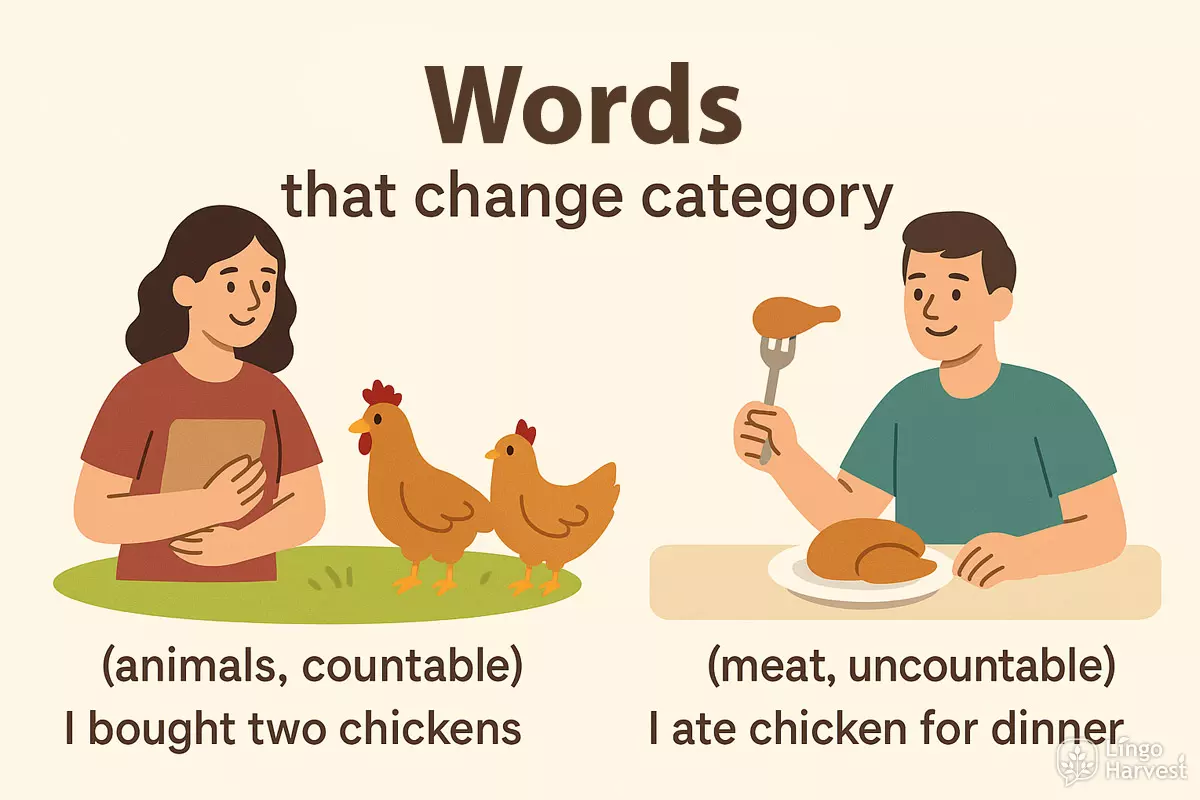
Certain nouns may be countable in some contexts but uncountable in others, based on whether they refer to a specific item or a general substance or concept. Here are common examples:
- Chicken: "I bought two chickens" (animals, countable) vs. "I ate chicken for dinner" (meat, uncountable)
- Paper: "I need a paper" (a newspaper, countable) vs. "I need paper" (the material, uncountable)
- Light: "There are three lights in the room" (lamps, countable) vs. "Open the curtains for more light" (illumination, uncountable)
- Hair: "There is a hair in my soup" (single strand, countable) vs. "She has long hair" (all hair, uncountable)
- Experience: "I had many experiences abroad" (events, countable) vs. "She has experience in teaching" (knowledge, uncountable)
Collective Nouns and Pluralia Tantum
Some nouns refer to groups or are always plural, challenging the standard countability rules.
- Furniture (uncountable): "We bought new furniture" ✅; not "furnitures" ❌
- Advice (uncountable): "She gave me some advice"
- Scissors, trousers, glasses (always plural): "These scissors are sharp"
- People (plural of person, but treated as countable): "Many people were there"
Unusual Plural Forms
Certain nouns have irregular plural forms or do not follow standard patterns. Some examples:
- Child → children
- Mouse → mice
- Fish (can be fish or fishes, depending on meaning)
- Data (treated as plural in formal contexts, but often singular in everyday speech)
Nouns with Both Countable and Uncountable Meanings
A number of English words can be both, with a shift in meaning. See the comparison below:
| Noun | Countable Usage | Uncountable Usage |
|---|---|---|
| Glass | I broke a glass (drinking vessel) | The window is made of glass (material) |
| Time | We had a good time (occasion) | Time passes quickly (concept) |
| Work | He has three works on display (pieces of art) | He is looking for work (employment) |
| Iron | He bought two irons (appliances) | The gate is made of iron (metal) |
| Chocolate | I ate two chocolates (candies) | I love chocolate (the substance) |
Regional and Register Differences
Some nouns may be used as countable in British English but not in American English, or vice versa. For instance, "accommodation" is uncountable in British English ("some accommodation" ✅), but "accommodations" (plural) is common in American English.
Abstract Nouns and Mass Nouns
Intangible concepts like "information," "progress," and "knowledge" are typically uncountable and rarely pluralized. Attempting to use them with "a" or in the plural form is a frequent error for learners.
- Information (not: an information, informations)
- Progress (not: progresses)
- News (always singular: "The news is good")
- Equipment (not: equipments)
- Bread (not: breads, unless referring to types)
- Money (not: moneys/moneies, except legal/financial jargon)
- Research (not: researches, except for separate studies)
- Traffic (not: traffics)
- Weather (not: weathers, except when discussing types)
- Homework (not: homeworks)
Being aware of these outliers will help you avoid common pitfalls and sound more natural when expressing both concrete and abstract ideas in English.
Why Countability Matters
Understanding whether a noun is countable or uncountable shapes how we use grammar, choose articles, and form plural or singular constructions. This distinction influences not only sentence structure but also how meaning is conveyed. Learners often make errors when they apply the wrong patterns, leading to confusion or unclear communication.
Article and Quantifier Choices
One of the most noticeable effects of noun type is the selection of articles (“a,” “an,” “the”) and quantifiers (“much,” “many,” “few,” “little,” etc.). For example, “a” or “an” is only possible with countable singular nouns (“a book,” not “a water”). Similarly, “much” is used with mass nouns (“much information”), while “many” is paired with plural countables (“many books”).
Pluralization and Sentence Patterns
Count nouns can have singular and plural forms, while uncountable nouns typically do not change form to indicate quantity. This impacts verb agreement and the types of modifiers we use. Here are some typical patterns you’ll encounter:
- a car / cars
- an idea / ideas
- some advice (not “advices”)
- much furniture (not “furnitures”)
- a few apples / a little milk
- many problems / much trouble
- less water / fewer bottles
- pieces of information
- a slice of bread
- a bit of news
- equipment (never plural)
- luggage (never plural)
- rice (not “rices”)
- suggestions (countable)
- progress (uncountable)
- money (uncountable, but “coins”/“dollars” are countable)
Common Learner Mistakes
Mixing up countable and uncountable nouns is a frequent source of mistakes. For instance, saying “informations” or “furnitures” is incorrect in standard English. Likewise, using “many” with an uncountable noun (e.g., “many water”) results in errors that native speakers immediately notice.
Grammatical Comparison
| Countable Nouns | Uncountable Nouns |
|---|---|
| Can be singular or plural e.g. cat/cats |
Only singular form e.g. sand |
| Use “a/an” e.g. a chair |
No “a/an” e.g. ❌ a sugar |
| “Many,” “few,” “a number of” | “Much,” “little,” “an amount of” |
| Can be counted directly e.g. three pens |
Measured in units or containers e.g. a glass of water |
Recognizing whether a noun is countable or not helps you avoid mistakes and build sentences that sound natural. This knowledge is essential for accuracy and fluency in both writing and speaking.
Practice: Mark Nouns as C or U
Understanding whether a noun is countable or uncountable is essential for correct grammar. In English, some nouns can be counted (like "apple" or "car"), while others refer to substances or concepts that cannot be counted individually (like "water" or "advice"). Try identifying which nouns in the following exercises are countable (C) and which are uncountable (U).
Task 1: Identify Each Noun
Decide if each noun below is countable (C) or uncountable (U). Write "C" or "U" next to each word.
- information
- apple
- music
- car
- rice
- idea
- bread
- dog
- furniture
- money
- student
- equipment
- time
- book
- news
- water
- child
- advice
- sand
- chair
Show answers
- information – U
- apple – C
- music – U
- car – C
- rice – U
- idea – C
- bread – U
- dog – C
- furniture – U
- money – U
- student – C
- equipment – U
- time – U
- book – C
- news – U
- water – U
- child – C
- advice – U
- sand – U
- chair – C
Task 2: Apply in Sentences
Below are several sentences. For each underlined noun, decide if it is countable or uncountable in that context.
- She gave me some advice.
- I bought three apples.
- There is a lot of traffic today.
- This music is beautiful.
- We need more chairs for the meeting.
Show answers
- advice – U
- apples – C
- traffic – U
- music – U
- chairs – C
Common Examples: Countable vs. Uncountable Nouns
Here is a quick comparison of some frequent nouns, showing their classification:
| Countable Nouns | Uncountable Nouns |
|---|---|
| apple | water |
| book | information |
| car | furniture |
| student | rice |
| idea | advice |
Remember, some words may be countable in one context and uncountable in another. Practicing with real examples will help you develop a natural sense for which nouns can be counted and which cannot.