Teaching Determiners: best examples for learners

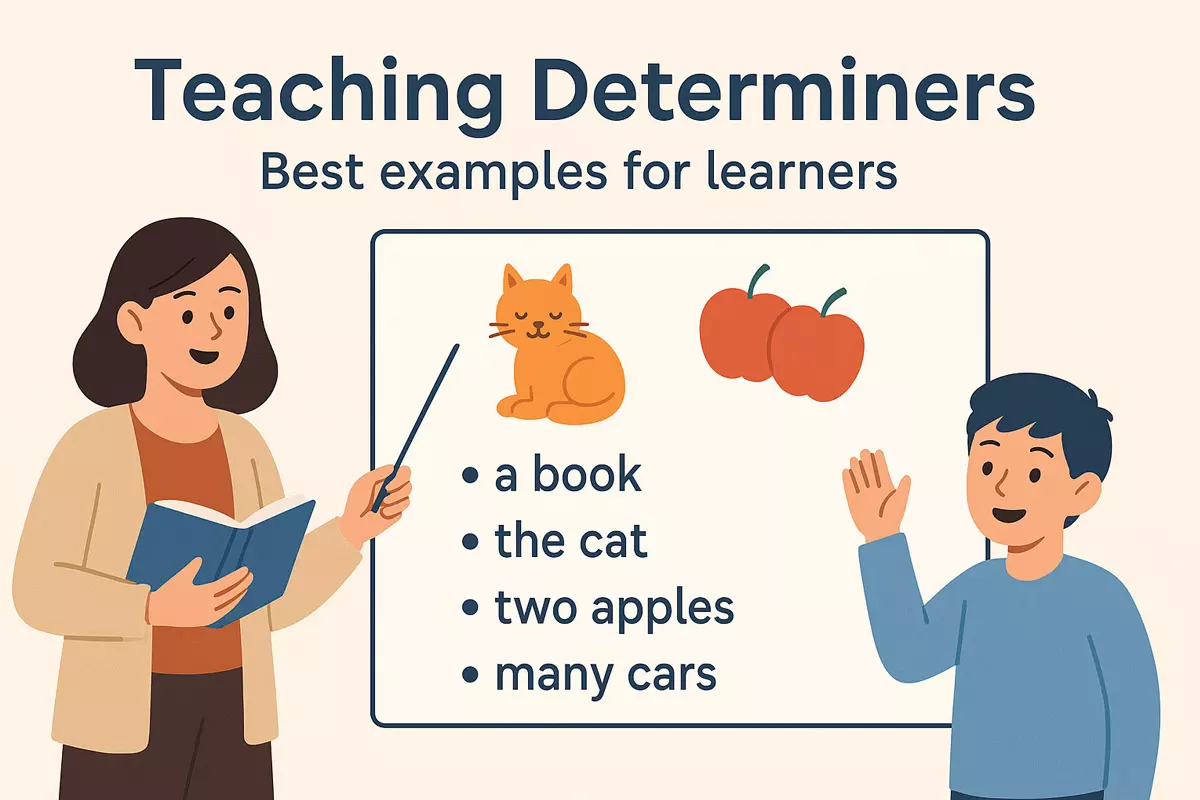 Here we essential concepts for teaching determiners, such as choosing clear contrasting examples, progressing from simple to complex types, addressing misconceptions, classroom activities, assessment tasks, and designing short teaching examples.
- Key concepts learners must understand early
- Choosing examples that show contrast clearly
- Progression from simple to complex determiner types
- Common misconceptions and how to correct them
- Classroom activities for practicing determiners
- Assessment tasks for different proficiency levels
- Practice: design short teaching examples using determiners
Teaching students to use words like a, the, and some can be challenging, but providing clear and practical examples is highly effective. By incorporating these words into relatable sentences and real-life situations, educators can help students understand their meaning and usage. Consistent practice with familiar contexts allows students to see how these small words function in everyday language, making it easier for them to master the nuances and apply them confidently in both speaking and writing.
Key concepts learners must understand early
Understanding how determiners function is essential for building clear and accurate sentences. Learners often confuse determiners with adjectives or pronouns, so it’s important to clarify their unique role: determiners introduce nouns and provide context such as quantity, ownership, or specificity. Early lessons should focus on recognizing determiners in sentences and distinguishing them from similar word types.
What determiners do in sentences
Determiners appear before nouns and help answer questions like: Which one? How many? Whose? Examples include words like the, some, my, every, and this. Without these, sentences can become confusing or incomplete.
Types learners encounter first
It’s helpful to introduce the most common categories early:
- Articles: a, an, the
- Demonstratives: this, that, these, those
- Possessives: my, your, his, her, its, our, their
- Quantifiers: some, any, many, much, few, little, several, all
- Numbers: one, two, three, etc.
Common mistakes and how to spot them
Learners frequently omit determiners or use the wrong one. For example, saying “I have cat” instead of “I have a cat,” or “Give me information” instead of “Give me the information.” Correct usage makes sentences sound natural and complete.
Comparing function: Articles vs. Demonstratives vs. Possessives
| Type | Function | Examples |
|---|---|---|
| Articles | Introduce nouns; indicate specificity | a, an, the |
| Demonstratives | Point to specific things near or far | this, that, these, those |
| Possessives | Show ownership or relationship | my, your, his, her, its, our, their |
| Quantifiers | Express quantity or amount | some, any, many, much, few, several |
Sample sentences for immediate practice
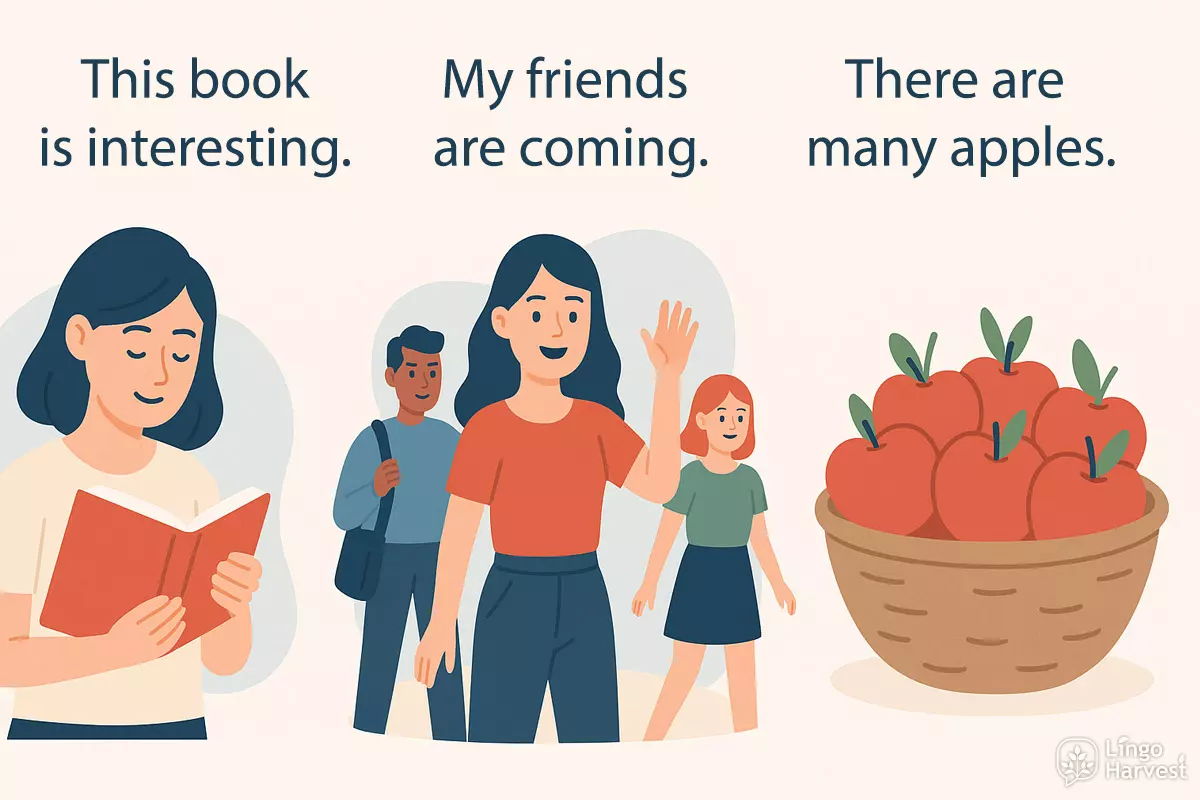
Learners benefit from seeing determiners in context. Here are varied examples to illustrate their use:
- This book is interesting.
- My friends are coming.
- There are many apples.
- She has a new car.
- Those shoes are mine.
- Give me some water.
- Each student received a pencil.
- The answer is correct.
- Few people know the truth.
- His idea was brilliant.
- All children must listen.
- That movie was exciting.
- Our teacher is absent.
- Any questions?
- Her bag is blue.
- An apple a day is healthy.
Grasping these distinctions and patterns early gives learners confidence and clarity as they build more complex sentences. With regular practice, students soon recognize how determiners shape meaning and guide the listener or reader.
Choosing examples that show contrast clearly
When teaching determiners, it's essential to highlight differences so that learners can see how meaning changes with word choice. Contrasting pairs help students notice subtle distinctions and avoid common mistakes. Using real-world sentences, especially those where a small word changes the whole meaning, makes the role of determiners vivid and memorable.
Why contrast is effective
Learners often struggle with determiners because they seem minor but can shift the meaning dramatically. By selecting sentence pairs that show both correct and incorrect uses, or that compare two different determiners, teachers can help students internalize these rules faster.
- This vs. That: This apple is sweet. That apple is sour.
- Some vs. Any: Do you have any questions? I have some answers.
- A vs. The: A dog barked. The dog ran away.
- Few vs. A few: Few people came to the meeting. A few people came to the meeting.
- Much vs. Many: How much water do you need? How many bottles do you need?
- Each vs. Every: Each student received a book. Every student received a book.
- Little vs. A little: There is little hope. There is a little hope.
- All vs. Both: All students passed. Both students passed.
- Another vs. Other: I need another pen. Where are the other pens?
- No vs. Not any: There are no cookies left. There are not any cookies left.
- Somebody vs. Anybody: Somebody called you. Did anybody call me?
- Much vs. A lot of: We don’t have much time. We have a lot of time.
- These vs. Those: These books are new. Those books are old.
- Every vs. All: Every child gets a gift. All children get a gift.
- Either vs. Neither: Either answer is correct. Neither answer is correct.
Structured contrast: A vs. The
The difference between indefinite and definite articles is a core area of confusion. Here’s a side-by-side comparison to clarify:
| Indefinite Article ("a/an") | Definite Article ("the") |
|---|---|
| She saw a cat in the garden. (Any cat, not specified) |
She saw the cat in the garden. (A specific cat, known to both) |
| I bought a car. (Any car, not defined) |
I bought the car we talked about. (The specific car already discussed) |
| He wants an apple. (Any apple) |
He wants the apple on the table. (A particular apple) |
| Let’s watch a movie. (No particular movie in mind) |
Let’s watch the movie you recommended. (A specific movie) |
Tips for selecting examples
Choose pairs that differ by only one determiner and keep the rest of the sentence identical. This highlights the effect of the determiner and minimizes distractions. Context matters too: short, relevant sentences are easier to process and remember. In summary, clear, contrasting examples make determiners more accessible and reduce confusion, especially when learners see both sides of a subtle difference.
Progression from simple to complex determiner types
Understanding how to introduce determiners in a classroom setting is crucial for learner success. Begin with the most straightforward forms before moving into more nuanced or advanced categories. This gradual approach helps students build confidence and recognize patterns, making the acquisition of more challenging structures smoother.
Starting with Basic Determiners
The most accessible determiners are those learners encounter daily. These include articles and demonstratives, which are easy to illustrate with objects or images. Examples include:
- a, an (indefinite articles): a cat, an apple
- the (definite article): the sun, the book
- this, that, these, those (demonstratives): this pen, those shoes
- my, your, his, her (possessives): my bag, her car
Moving to Quantifiers and Numbers
Once students are comfortable with basic forms, introduce quantifiers and numbers. These expand their ability to describe quantity and amount:
- some, any: some water, any questions
- many, much, few, little: many books, little time
- each, every: each student, every day
- all, both, several: all children, both answers
- one, two, three... (cardinal numbers): one apple, three dogs
Introducing Complex and Less Common Determiners
After mastering the basics, learners are ready for more challenging forms. Complex determiners often combine meanings or appear in less predictable ways:
- either, neither: either option, neither choice
- whose (interrogative/relative): Whose bag is this?
- such, what: such a mess, what a surprise
- enough: enough time, enough money
- another, other, the other: another chance, the other side
- most, several, plenty of: most people, several reasons, plenty of food
Overview: Simple vs. Complex Determiners
| Type | Examples |
|---|---|
| Simple | a, an, the, this, that, my, your |
| Intermediate | some, any, many, much, few, little, each, every |
| Complex | either, neither, whose, such, what, enough, another, other |
Tips for Effective Teaching
Present new determiners in context, not isolation. Use real-life examples, visuals, and dialogues. Encourage students to make their own sentences and notice determiners in authentic texts. Gradually revisit earlier forms to reinforce understanding as more advanced ones are introduced.
Common misconceptions and how to correct them
Confusion with determiners is widespread, especially among learners who speak languages with different systems. Below are some frequent misunderstandings, along with practical strategies to address them.
Mixing up "a" and "the"
Learners often use "a" and "the" interchangeably, not realizing that "a" introduces something unknown or new, while "the" refers to something already mentioned or known. To help clarify:
- Use "a" when mentioning something for the first time: "I saw a dog."
- Switch to "the" when referring to something already introduced: "The dog was brown."
Omitting determiners altogether
Some students drop articles completely, especially if their native language lacks them. Remind learners that in English, most singular countable nouns require a determiner.
Using "some" and "any" incorrectly
A common error is using "some" and "any" in the wrong contexts. "Some" is typical in positive sentences, "any" in negatives and questions. For example:
- "I have some apples." ✅
- "I don't have any apples." ✅
- "Do you have any apples?" ✅
Confusion with quantifiers and countability
Words like "much," "many," "few," and "little" cause trouble. Learners may say "much apples" ❌ instead of "many apples" ✅. The table below summarizes correct usage:
| Quantifier | Used with | Correct Example ✅ | Incorrect Example ❌ |
|---|---|---|---|
| Much | Uncountable nouns | much water | much apples |
| Many | Countable nouns | many books | many information |
| Few | Countable nouns | few cars | few money |
| Little | Uncountable nouns | little time | little apples |
Plural determiners with singular nouns
Errors like "these book" or "those car" are frequent. Teach that "these" and "those" always pair with plural nouns ("these books," "those cars").
Overusing "the" with proper nouns
Students sometimes add "the" before names: "the London," "the John." Explain that most names do not need "the," except for specific places or groups (e.g., "the United States," "the Alps").
Quick reference: frequent pitfalls
- Forgetting "an" before vowel sounds: "an apple" not "a apple"
- Using "each" with plural nouns: say "each student," not "each students"
- Confusing "every" and "all": "every" for singular, "all" for plural
- Using "some" with negatives: avoid "I don’t have some money" ❌
- Mixing "much" and "many": "much advice" (uncountable), "many friends" (countable)
- Leaving out articles with jobs: "She is a teacher," not "She is teacher"
- Using "any" in positive statements: "I have any books" ❌ instead of "I have some books"
- Incorrect order: "my two cats" (possessive before number)
- Adding determiners to uncountables: avoid "a furniture"
- Using "this" or "that" with plural: use "these" or "those" instead
Encourage practice with these patterns in context, and provide immediate feedback. Visual aids, such as charts and real-life examples, can make the distinctions clearer and easier to remember.
Classroom activities for practicing determiners
Engaging students in interactive tasks helps them internalize the use of words like "some," "any," "this," "those," and other similar structures. Below, you'll find a variety of hands-on exercises, group games, and written drills that can be adapted for different proficiency levels.
Warm-up: Spot the Determiner
Start with a quick challenge where students read a short paragraph and underline all the determiners. This can be done individually or in pairs. Afterward, discuss which words they found and why they qualify as determiners.
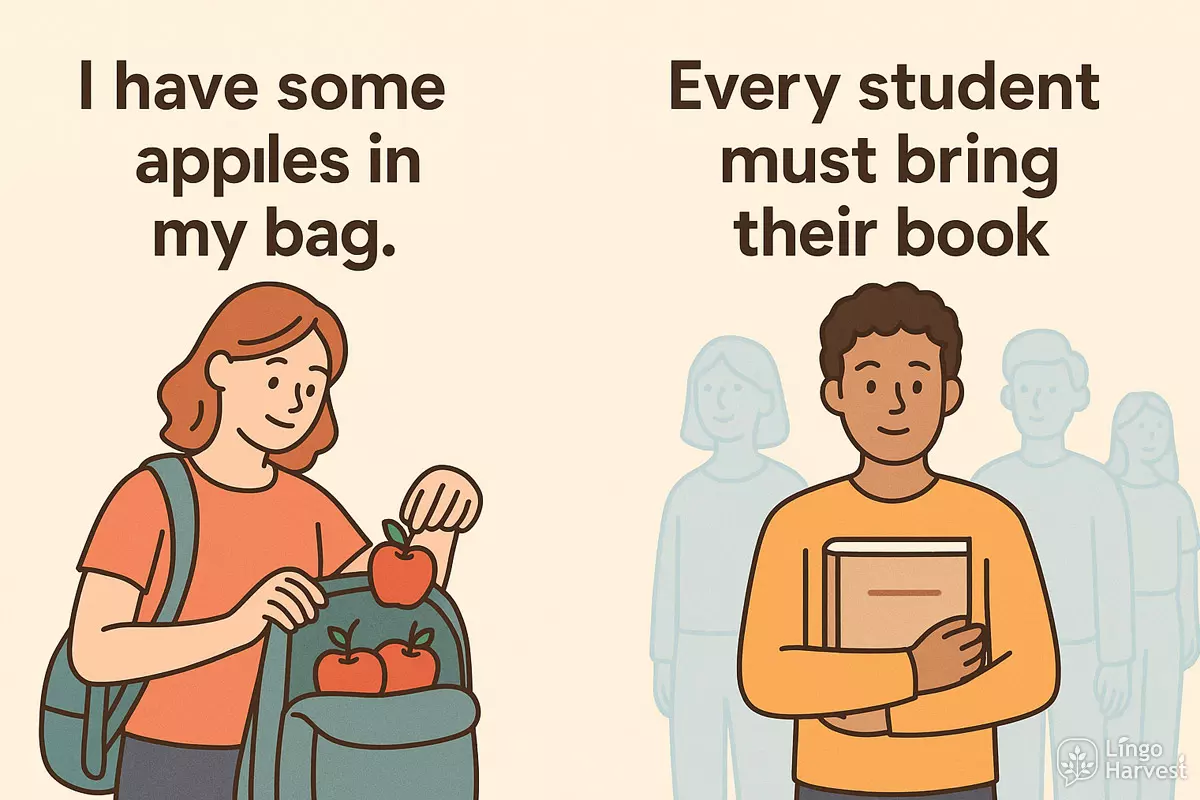
- I have some apples in my bag.
- Every student must bring their book.
- Is there any milk left?
- Those shoes are mine.
Matching Game: Determiner & Noun
Prepare cards with different determiners and nouns. Students work in groups to match determiners to appropriate nouns, such as "many books," "each question," or "that chair." This reinforces correct pairings and sparks discussion about countable and uncountable nouns.
Fill-in-the-Blank Practice
Give learners sentences with missing determiners. Let them decide which fits best, focusing on context and meaning.
- ______ apple a day keeps the doctor away.
- Did you see ______ birds in the park?
- She doesn’t have ______ money left.
- ______ of these pens is yours?
- ______ water is in the bottle?
- ______ students passed the test?
- Is there ______ milk in the fridge?
- ______ book do you want to borrow?
- He bought ______ umbrella because it was raining.
- ______ of the answers is correct?
Show answers
- An
- any
- any
- Which
- How much
- How many
- any
- Which
- an
- Which
Comparison Table: Common Determiners
To clarify differences between similar forms, consider this structured reference:
| Determiner | Used With | Example |
|---|---|---|
| Some | Countable plural / uncountable | I bought some bread. |
| Any | Questions/negatives, countable plural / uncountable | Do you have any friends here? |
| Much | Uncountable nouns | There isn’t much time. |
| Many | Countable plural nouns | How many chairs are there? |
| Each | Singular countable nouns | Each student must sign. |
| Every | Singular countable nouns | Every day is different. |
| This/These | Singular/plural, near to speaker | This book, these apples |
| That/Those | Singular/plural, far from speaker | That chair, those dogs |
Creative Writing with Prompts
Invite students to write short stories or descriptive paragraphs using a set number of determiners from a provided list. For example, challenge them to include "each," "some," "these," and "that" in their writing. Sharing aloud encourages peer feedback and raises awareness of different ways to use these words.
Real-life Role Play
Have pairs act out simple dialogues at a store, market, or library, using as many determiners as possible. Prompts might include:
- Shopping for groceries: "Do you have any bananas?" / "I’d like some bread, please."
- Asking for information: "Which bus goes to the museum?" / "How much is this ticket?"
These varied activities ensure that learners encounter determiners in multiple contexts, strengthening both recognition and production skills.
Assessment tasks for different proficiency levels
Effective evaluation of learners’ understanding of determiners requires tailored activities that reflect their stage of language development. Tasks should gradually increase in complexity, moving from simple identification and gap-filling to sentence creation and error correction. Here’s how you might differentiate activities for beginners, intermediate, and advanced students.
Beginner Tasks
- Multiple choice: Choose the correct word to complete the sentence.
Example: ______ apple is red. (A/the/an) - Underline the determiner: Read each sentence and underline the determiner.
Example: She has two cats. - Matching: Match determiners with suitable nouns.
Example: some / many / a with water / books / dog
Show answers
- 1. an
- 2. two
- 3. some – water, many – books, a – dog
Intermediate Tasks
- Fill in the blanks: Insert the appropriate determiner.
Example: ______ students in the class passed the test. - Error correction: Spot and correct mistakes in determiner usage.
Example: I have the umbrella. (should it be an or the?) - Sentence rewriting: Rewrite sentences using different determiners.
Example: She ate an apple. → She ate the apple. - Multiple choice: Choose the correct determiner.
Example: (Much/Many) people were waiting outside. - Question building: Make a question using the given determiner.
Example: which + book - Completion: Add a demonstrative determiner.
Example: ____ house is very old. - Identify the determiner:
Example: Those children are playing outside. - Replace the determiner: Change the sentence using a different determiner.
Example: I need some help. - Choose singular or plural: Pick the correct form.
Example: (This/These) apples are fresh. - Correction task: Fix the incorrect determiner.
Example: She gave me an informations.
Show answers
- Most / All / Some
- an umbrella
- She ate the apple.
- Many
- Which book is yours?
- This / That
- Those
- I need a little help. / I need much help.
- These
- She gave me some information.
Advanced Tasks
At higher proficiency, students can analyze subtle differences, justify choices, and work with complex structures. To compare common determiners and their contexts, see the table below:
| Determiner | Example & Usage |
|---|---|
| each / every | Each student received a book. (individual focus) Every student must attend. (group focus) |
| few / a few / the few | Few people know. (almost none) A few friends came. (some, positive) The few moments we had were special. (specific subset) |
| all / both / either / neither | All options are open. Both answers are correct. Either road leads there. Neither option works. |
| some / any / no | She has some money. Do you have any questions? No students were late. |
| much / many / a lot of | Much time was wasted. (uncountable) Many people agreed. (countable) A lot of energy is needed. (informal, both types) |
- Justification: Explain why a particular determiner is used in context.
- Editing: Edit a paragraph to improve determiner accuracy.
- Transformation: Convert direct speech sentences to reported speech, adjusting determiners as needed.
Show answers
- Each vs. every: “Each” for individuals, “every” for the group collectively.
- Editing: Replace “a information” with “some information.”
- Transformation: She said, “I have no time.” → She said that she had no time.
By selecting tasks suited to learners’ current abilities, teachers can effectively monitor progress and provide focused support as students grow in their command of determiners.
Practice: design short teaching examples using determiners
When introducing determiners to learners, short, targeted examples help clarify how each type is used in real sentences. Below are practical ways to create and use such examples, along with sample teaching items and interactive tasks.
Simple Example Sentences for Key Determiner Types
To illustrate the function of determiners, start with concise sentences. Here are sample patterns covering articles, demonstratives, possessives, quantifiers, and numbers:
- Articles: The dog is sleeping. / A cat is on the roof.
- Demonstratives: This book is new. / Those apples look fresh.
- Possessives: My bag is blue. / Their house is big.
- Quantifiers: Some students are absent. / Many people like music.
- Numbers: Two cars are parked outside. / Five birds sat on the fence.
- Other determiners: Each child received a gift. / Every answer was correct.
- Distributives: Either option is fine. / Neither team won.
- Interrogative determiners: Which coat is yours? / What time is the meeting?
- Negative quantifiers: No milk is left. / Few people understood.
- All/Some/Most: All rooms are clean. / Most children like ice cream.
Contrastive Table: Determiner Choices
Sometimes, showing similar sentences side by side highlights how different determiners change meaning. Use structured comparisons for clarity.
| Sentence | Determiner Used |
|---|---|
| This chair is broken. | Demonstrative |
| My chair is broken. | Possessive |
| Some chairs are broken. | Quantifier |
| No chairs are broken. | Negative quantifier |
| Which chair is broken? | Interrogative |
Quick Practice Tasks
Try the following exercises to check understanding or encourage students to make their own examples.
- Fill in the blank with a suitable determiner: ____ apple is green.
- Choose the correct determiner: (Some/Any) people were late.
- Make a question using "which" and "book".
- Rewrite: "Car is red." Add a demonstrative.
- Find the determiner: "Her answer was correct."
- Choose the correct determiner: (Much/Many) water is in the glass.
- Fill in the blank: ____ students passed the exam. (Most/Each)
- Rewrite using a possessive determiner: "The bag belongs to me."
- Find the determiner: "Those houses are old."
- Make a question using "how many" and "students".
Show answers
- The / An / This / That / One
- Some
- Which book is yours?
- This car is red. / That car is red.
- Her
- Much
- Most
- My bag
- Those
- How many students are there?
Tips for Creating Your Own Examples
- Keep sentences short and focused on one determiner per example.
- Use familiar nouns to avoid confusion.
- Highlight contrasts (e.g., "some" vs. "all") for deeper understanding.
- Invite learners to substitute their own nouns and determiners for practice.
Experiment with these patterns and adapt them to your learners’ level and interests for best results.