Advanced Quantifiers: a great deal of, a majority of, a variety of

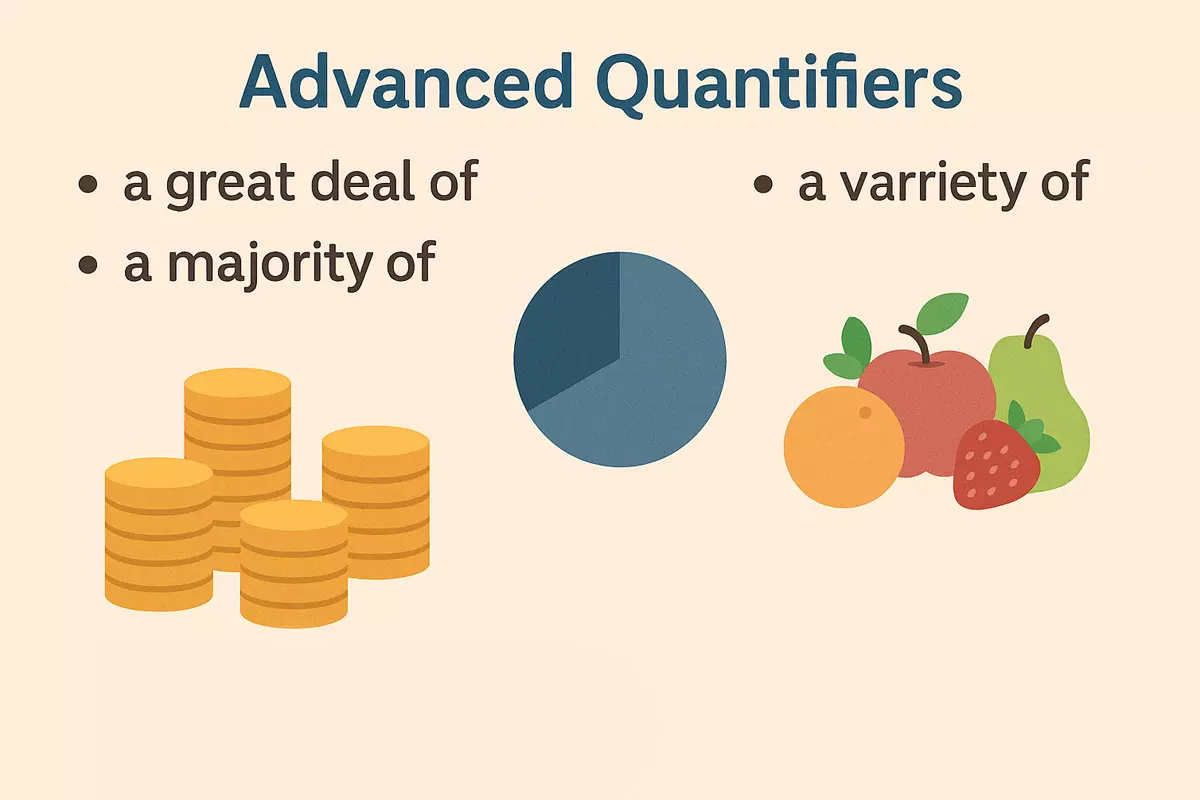 Here we the difference between basic and advanced quantifiers, explains how to use advanced forms like a great deal of, a majority of, and a variety of, discusses tone and precision, and provides practice for formal academic statements.
- Difference between basic and advanced quantifiers
- Using a great deal of for uncountable nouns
- Using a majority of for statistical or formal contexts
- Using a variety of to show range or diversity
- Register and tone differences among quantifiers
- Common precision mistakes in academic writing
- Practice: choose advanced quantifiers for formal statements
Mastering nuanced ways to express quantity can significantly enhance your English communication by enabling you to convey precise meanings in both speech and writing. Using varied phrases to describe amounts or proportions, such as a handful, a great deal, a small number, or a significant portion, helps you sound more fluent and sophisticated. This skill not only enriches your vocabulary but also allows you to adapt your language to different contexts, making your interactions clearer and more engaging for your audience.
Difference between basic and advanced quantifiers
When comparing simple quantifiers like “many,” “few,” or “some” to more advanced forms such as “a great deal of,” “a majority of,” or “a variety of,” the main distinction lies in their specificity and nuance. Basic quantifiers are straightforward and commonly used, suitable for general statements. In contrast, advanced quantifiers convey more precise information, often suggesting quantity, diversity, or statistical majority.
Usage and Meaning
Basic quantifiers:
- Used for general amounts (e.g., “many people,” “some books”)
- Apply to both countable and uncountable nouns, but with limited variation
- Are universally understood and informal
Advanced quantifiers:
- Express a more exact or nuanced meaning (e.g., “a great deal of patience”)
- Often used in academic, formal, or precise contexts
- May indicate statistical or qualitative aspects (e.g., “a majority of voters”)
Examples of Common Quantifiers
- Basic: much, many, some, few, little, any, all, most
- Advanced: a great deal of, a majority of, a variety of, a large number of, a small amount of, a wide range of, a couple of, a handful of, a minority of, a series of, a portion of, a selection of, an array of, a host of, a set of, a multitude of
Comparison of Basic vs. Advanced Quantifiers
| Basic Quantifiers | Advanced Quantifiers |
|---|---|
| many students | a majority of students |
| some options | a variety of options |
| much time | a great deal of time |
| few ideas | a handful of ideas |
| all participants | a selection of participants |
When to Use Each Type
Choose basic forms when you want to keep language simple and direct, especially in everyday conversation. Opt for more advanced expressions to add depth, accuracy, or formality—particularly in writing, presentations, or academic work. Advanced quantifiers can also help avoid repetition and make your speech or text more engaging.
Using a great deal of for uncountable nouns
When talking about large quantities of something that cannot be counted individually—like information, patience, or water—English speakers often use the phrase a great deal of. This quantifier is particularly useful for abstract or mass nouns that don’t have plural forms. It adds variety to your language and sounds more natural in both formal and informal contexts.
Choosing the Right Contexts
You’ll hear this phrase most often in academic, professional, or descriptive writing where the speaker wants to emphasize a significant amount. It’s less common in casual speech compared to words like a lot of, but it is more precise and formal.
Common Uncountable Nouns Paired with "a great deal of"

Here are some typical examples where this quantifier fits naturally:
- advice → She gave me some useful advice.
- progress → We have made great progress this month.
- evidence → There is strong evidence to support the claim.
- knowledge → He has extensive knowledge of history.
- time → I don’t have much time today.
- money → They spent a lot of money on the renovation.
- interest → She showed little interest in politics.
- support → He received strong support from his team.
- attention → The teacher paid close attention to each student.
- energy → I don’t have enough energy to work tonight.
- work → There is still a lot of work to do.
- effort → He put a lot of effort into the project.
- experience → She has years of experience in marketing.
- research → The research takes several years to complete.
- enthusiasm → He showed great enthusiasm for the idea.
- stress → Too much stress can affect your health.
- damage → The storm caused serious damage to the roof.
- noise → There was a lot of noise outside the window.
- fun → We had a lot of fun at the party.
- space → There isn’t enough space in this room.
Example Sentences
To see this phrase in action, consider these sentences:
- She has a great deal of patience with children.
- There is a great deal of uncertainty about the results.
- He invested a great deal of money into his business.
- We need a great deal of information before making a decision.
Comparison with Other Quantifiers
The phrase a great deal of is often compared with other quantifiers like a lot of and much. While all three can describe large amounts, a great deal of usually sounds more formal or emphatic. Here’s a quick comparison:
| Quantifier | Typical Usage | Register |
|---|---|---|
| a great deal of | Uncountable nouns (e.g. "a great deal of research") | Formal, written, spoken |
| a lot of | Countable & uncountable nouns ("a lot of money", "a lot of books") | Neutral, informal, spoken |
| much | Uncountable nouns, often in negatives or questions ("not much time") | Formal, written |
| plenty of | Countable & uncountable nouns ("plenty of advice") | Neutral, spoken |
Quick Usage Tips
- Don’t use this phrase with countable nouns (e.g. ❌ a great deal of apples).
- It’s perfect for essays, reports, and presentations where you need to sound precise.
- For variety, alternate with similar expressions like a large amount of or considerable.
Choosing this quantifier can make your English sound more fluent and nuanced, especially when discussing abstract concepts or mass nouns.
Using a majority of for statistical or formal contexts
When discussing statistics, research findings, or making formal statements about groups, "a majority of" is a useful quantifier. This phrase refers to more than half of a group, typically 51% or more, and is common in reports, surveys, and academic writing. It helps specify that a statement applies to the larger part of a set, without needing to give exact numbers.
Typical Uses
- Summarizing survey or poll results
- Describing voting outcomes
- Reporting on trends in data
- Stating generalizations based on evidence
- Formal or legal writing
Examples in Context
- A majority of respondents supported the new policy.
- A majority of the committee members voted in favor.
- In recent years, a majority of students have chosen online courses.
- A majority of citizens expressed concern about the proposal.
- Research shows that a majority of cases were resolved within six months.
- A majority of employees prefer remote work options.
- A majority of participants completed the survey.
- According to the data, a majority of households own at least one car.
- A majority of the population lives in urban areas.
- A majority of experts agree with these conclusions.
- A majority of voters rejected the amendment.
- A majority of customers rated the service as excellent.
- A majority of applicants met the requirements.
- A majority of the board members approved the budget.
- Studies indicate that a majority of patients responded positively to treatment.
- A majority of the staff attended the training session.
Comparing "a majority of" and Similar Quantifiers
| Quantifier | Typical Context | Implied Proportion |
|---|---|---|
| a majority of | Formal, statistical, legal documents | More than 50% |
| most | Everyday speech, informal writing | Typically >50%, but less precise |
| many | General statements, less specific | Large number, not necessarily majority |
| a large number of | Emphasis on quantity, not proportion | Significant, may be less than half |
Notes on Usage
- Follow "a majority of" with a plural noun: a majority of employees.
- It’s often used with plural verbs: A majority of voters are in favor.
- For formal or statistical writing, this phrase enhances clarity and precision.
- Avoid using it for very small groups; it's best for larger populations or samples.
Choosing "a majority of" signals careful, evidence-based communication. This makes it especially valued in academic, professional, and analytical contexts.
Using a variety of to show range or diversity
When you want to highlight the breadth or assortment within a group, "a variety of" is a practical phrase. It’s often used to indicate that something is not limited to a single type, but instead encompasses multiple forms, kinds, or options. This quantifier is especially useful when discussing topics where diversity, multiplicity, or choice are important.
Common contexts for "a variety of"
You’ll frequently find "a variety of" in contexts such as:
- Describing foods or products available (e.g., "a variety of cheeses")
- Talking about experiences or activities ("a variety of outdoor activities")
- Referring to opinions or viewpoints ("a variety of perspectives")
- Explaining research samples ("a variety of participants")
- Introducing options or solutions ("a variety of approaches")
Patterns and sentence examples
This quantifier is typically followed by a plural noun. Here are some useful patterns:
- a variety of + plural noun (e.g., "a variety of books")
- a wide variety of + plural noun (adds emphasis on diversity)
- offer/provide a variety of + plural noun
- choose from a variety of + plural noun
Expanded examples
Explore how "a variety of" fits naturally into different sentences:
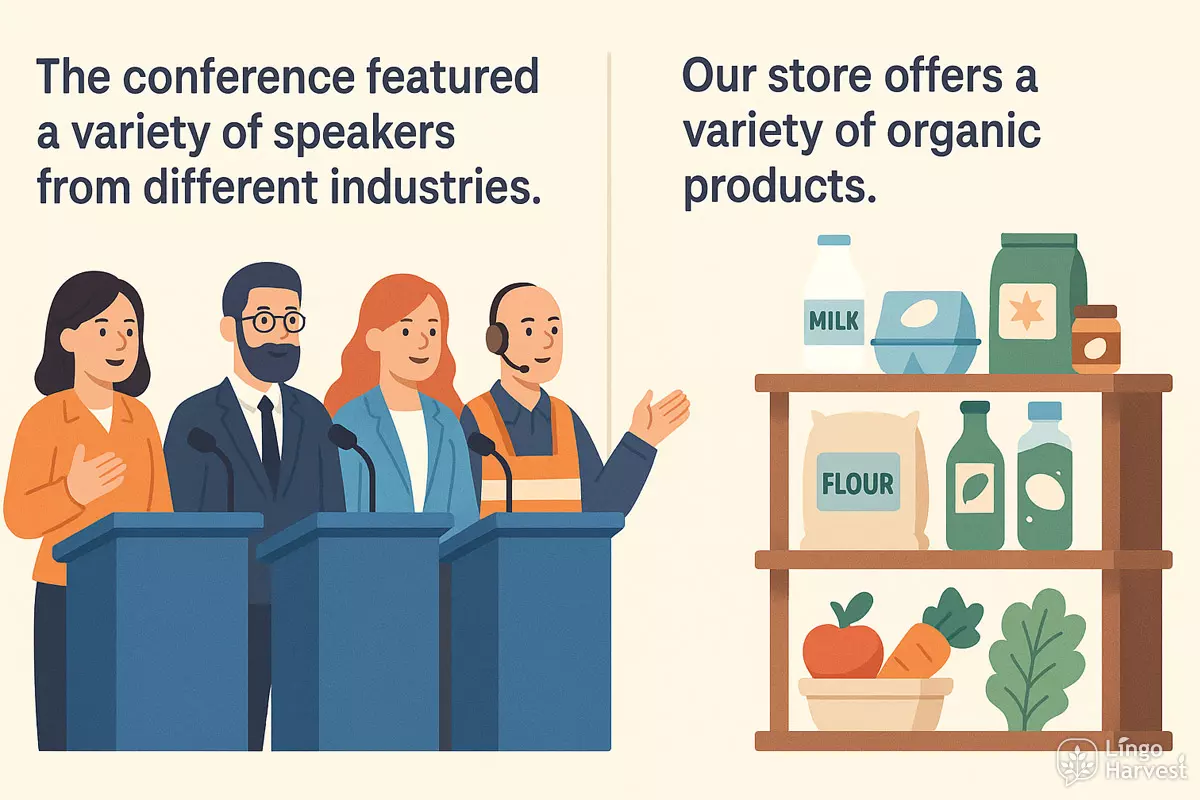
- The conference featured a variety of speakers from different industries.
- Our store offers a variety of organic products.
- Students can select from a variety of electives.
- The menu includes a variety of vegetarian dishes.
- She listened to a variety of music genres during the trip.
- The museum displays a variety of ancient artifacts.
- They encountered a variety of challenges on their journey.
- The company provides a variety of training programs.
- Visitors can enjoy a variety of recreational activities.
- We sampled a variety of desserts at the festival.
- The survey collected a variety of responses.
- He owns a variety of classic cars.
- The workshop covers a variety of topics.
- There are a variety of reasons for her decision.
- The app supports a variety of languages.
Comparing "a variety of" with similar expressions
Sometimes, learners confuse "a variety of" with other quantifiers. Here’s how it compares:
| Expression | Usage Example | Emphasis |
|---|---|---|
| a variety of | a variety of flavors | Focuses on diversity or range within a group |
| a number of | a number of issues | Highlights quantity, not necessarily diversity |
| a selection of | a selection of wines | Stresses choice from a group, less on range |
| many | many options | General quantifier, not focused on range or types |
Using "a variety of" is a clear way to convey richness and assortment, making your descriptions more precise and engaging when discussing groups that are not uniform.
Register and tone differences among quantifiers
How you choose between advanced quantifiers like a great deal of, a majority of, and a variety of can subtly influence the formality, precision, and attitude of your statements. Some quantifiers sound more formal or academic, while others fit neutral or even conversational settings. Recognizing these distinctions helps you match your language to context, whether writing a research paper or having a casual discussion.
Formality and Usage Context
- a great deal of: Tends to be semi-formal. Common in both spoken and written English, but slightly more polished than basic quantifiers like "lots of."
- a majority of: Formal and precise. Frequently used in academic, technical, and professional contexts to indicate statistical or factual dominance.
- a variety of: Moderately formal. Suitable for both professional and informal writing when emphasizing range or diversity.
Implications for Tone
Choosing among these advanced quantifiers can also affect the nuance of your message. For example, a great deal of can express emphasis or a subjective sense of abundance, whereas a majority of is objective and factual. A variety of highlights diversity, often with a positive or neutral undertone.
Comparative Examples
To illustrate how register and tone shift with different quantifiers, consider these sample sentences:
- We encountered a great deal of resistance during the negotiations. (Emphasizes intensity, slightly formal)
- A majority of voters supported the proposal. (Objective, formal, statistical)
- There are a variety of solutions available. (Highlights diversity, moderately formal)
- She spent a great deal of time on her research. (Subjective emphasis)
- A majority of the committee agreed. (Precise, official-sounding)
- The store offers a variety of products. (Emphasizes range)
- We received a great deal of feedback. (Intensive, but not overly formal)
- A majority of cases were resolved. (Factual)
- Participants had a variety of backgrounds. (Diversity, inclusive tone)
- She has a great deal of experience. (Emphasizes extent)
- Only a majority of members were present. (Restrictive, formal)
- The workshop covered a variety of topics. (Range, positive connotation)
Summary Table: Register and Tone
| Quantifier | Typical Register | Tone/Nuance |
|---|---|---|
| a great deal of | Semi-formal, neutral | Emphatic, often subjective |
| a majority of | Formal, academic, official | Objective, factual, precise |
| a variety of | Moderately formal, inclusive | Highlights diversity, positive/neutral |
In summary, choosing the right quantifier not only clarifies meaning but also helps you strike the right balance between formality and approachability. Being mindful of these subtle distinctions can make your communication more effective and appropriate for your audience.
Common precision mistakes in academic writing
Writers in scholarly contexts often struggle with quantifiers like "a great deal of," "a majority of," or "a variety of." These expressions can introduce ambiguity if not chosen or used carefully. The misuse of such terms may lead to overgeneralization, vague claims, or confusion about the scale and scope of findings.
Ambiguous Quantifier Usage
Choosing an imprecise quantifier can obscure meaning. For example, "a great deal of" might suggest a large but undefined amount, while "a majority of" has a specific mathematical implication (over 50%). Failing to recognize this distinction can weaken arguments or misrepresent data.
- Overusing vague quantifiers: Relying on "a variety of" or "a great deal of" without specifying what or how many undermines clarity.
- Confusing quantifiers: Mixing up "a majority of" with "many" or "most" can change the intended meaning.
- Inflating claims: Using "a majority of" when only a small proportion is involved misleads readers.
- Unclear referents: Not identifying what "a variety of" refers to (e.g., types, sources, categories) leaves statements open to interpretation.
- Imprecise data support: Failing to provide numbers or percentages alongside quantifiers reduces the reliability of claims.
Comparison of Common Quantifier Errors
| Incorrect Usage | Why It’s Problematic | Improved Version |
|---|---|---|
| A great deal of participants expressed concern. | Lacks specificity; "a great deal" is subjective. | Over 70% of participants expressed concern. |
| A majority of the articles were reviewed. | Unclear if actually more than 50% or just "many". | Twelve out of twenty articles (60%) were reviewed. |
| A variety of sources suggest this trend. | Unspecified; "variety" could mean two or twenty. | Sources from economics, sociology, and psychology suggest this trend. |
| A majority of respondents disagreed, but some agreed. | Vague; proportions of each group not clear. | 58% of respondents disagreed, while 32% agreed. |
Tips for Greater Precision
- Where possible, replace vague quantifiers with exact numbers or percentages.
- Clarify what group or category your quantifier refers to.
- Reserve "a majority of" for cases where the proportion clearly exceeds half.
- Specify the types or sources when using "a variety of."
- Support general statements with data or references.
- Review for consistency; do not switch between quantifiers without clear logic.
- Be mindful of audience expectations for rigor and transparency.
Careful attention to quantifier choice enhances both the accuracy and credibility of academic writing. By avoiding common pitfalls, writers communicate their findings more effectively and uphold scholarly standards.
Practice: choose advanced quantifiers for formal statements
Selecting the right advanced quantifier can make your formal writing more precise and nuanced. Expressions like a great deal of, a majority of, and a variety of each convey different shades of meaning, so it’s important to match them to your intended message. The following exercises and examples will help you recognize when each phrase is appropriate and how to use them effectively in academic or professional contexts.
Choose the most suitable quantifier
Fill in each blank with a great deal of, a majority of, or a variety of to complete these formal statements:
- __________ evidence suggests that the new policy will be effective.
- __________ participants expressed satisfaction with the results.
- The research covers __________ topics within the field of sociology.
- __________ time and resources were devoted to the initial phase of the project.
- __________ respondents reported similar concerns about data privacy.
- The library provides access to __________ academic journals and databases.
- __________ board members voted in favor of the proposed changes.
- The company invested __________ effort into developing sustainable practices.
- __________ approaches can be used to address this complex issue.
- __________ students agreed with the conclusions drawn by the study.
Show answers
- a great deal of
- a majority of
- a variety of
- a great deal of
- a majority of
- a variety of
- a majority of
- a great deal of
- a variety of
- a majority of
Comparison of advanced quantifiers
Understanding subtle distinctions helps you choose the most precise expression. The table below summarizes the main uses and examples for each quantifier:
| Quantifier | Typical Use & Example |
|---|---|
| a great deal of | Large amount (uncountable nouns). A great deal of research has been conducted on this topic. |
| a majority of | More than half (countable plural). A majority of students supported the new curriculum. |
| a variety of | Several different kinds (countable plural). A variety of solutions were proposed during the meeting. |
Practice rewriting: make statements more formal
Transform the following informal sentences by choosing and inserting an appropriate advanced quantifier:
- Many kinds of software are available for data analysis.
- Most people thought the conference was useful.
- We put in a lot of effort to finish the assignment on time.
- Many students participated in the online course.
- Most of the information was reliable.
- We spent a lot of time preparing the presentation.
- Many factors influenced the final decision.
- Most researchers agree with this conclusion.
- We made a lot of progress this semester.
- Many companies invest heavily in cybersecurity.
Show answers
- A variety of software is available for data analysis.
- A majority of participants thought the conference was useful.
- A great deal of effort was invested to finish the assignment on time.
- A large number of students participated in the online course.
- The majority of the information was reliable.
- A significant amount of time was spent preparing the presentation.
- A range of factors influenced the final decision.
- The majority of researchers agree with this conclusion.
- A great deal of progress was made this semester.
- A large number of companies invest heavily in cybersecurity.
Quick reference: contexts for each quantifier
- a great deal of: use with uncountable nouns (work, time, information, effort).
- a majority of: use with countable plural nouns when referring to more than half.
- a variety of: use with countable plural nouns to indicate diversity or range.