Verbs Followed by Gerunds: Rules and Examples

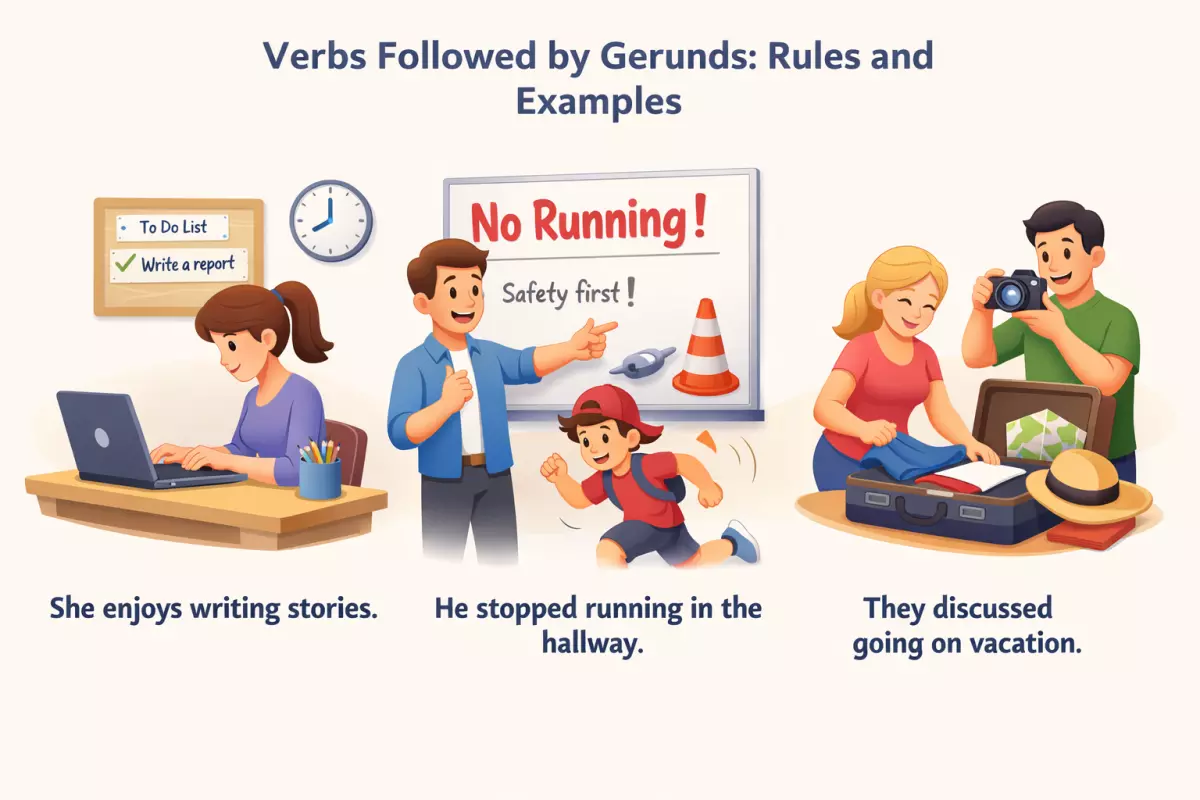 The article explains why some English verbs must be followed by a gerund, lists the most common ones, and shows real sentence patterns for verb plus gerund in everyday use. It also covers mistakes with enjoy, avoid, consider, gives memory tips, and includes practice exercises.
- Why some English verbs must be followed by a gerund
- The most common verbs that require a gerund after them
- Sentence patterns with verb + gerund in real English sentences
- How verbs + gerund structures work in everyday communication
- Typical learner mistakes with verbs like enjoy, avoid, and consider
- Practical tips for remembering verbs that require gerunds
- Practice exercises: complete sentences using the correct gerund
Some English verbs are typically followed by an -ing form, and learning this pattern can make your speech sound smoother. You’ll hear it in everyday sentences such as I enjoy cooking, She finished studying, and They avoid driving in traffic. This guide highlights common verbs that take -ing, explains the basic idea behind the structure, and shows how to use it naturally and confidently in real conversations.
Why some English verbs must be followed by a gerund
In English, certain verbs naturally connect to an action as a noun-like idea. The -ing form works well here because it can function like a noun (a “thing” you do), so it fits after verbs that talk about experiences, preferences, avoidance, or completion. With these verbs, an infinitive often sounds unnatural or changes the meaning.
1) The verb treats the next action as an “activity” or “experience”
Many common verbs describe how you feel about an activity or how you respond to it. After them, the gerund is the standard pattern because the action is being discussed as a concept.
- enjoy + gerund: I enjoy reading before bed.
- hate + gerund: She hates waiting in long lines.
- love + gerund: They love traveling in winter.
- prefer + gerund: He prefers working early.
- dislike + gerund: We dislike arguing about money.
- can’t stand + gerund: I can’t stand being interrupted.
- don’t mind + gerund: I don’t mind helping you.
- appreciate + gerund: I appreciate having clear instructions.
2) The verb focuses on avoiding, delaying, or risking an action
Another large group expresses “not doing” something, postponing it, or taking a chance. These verbs commonly require the -ing form because the action is treated as a situation you avoid, postpone, or risk.
- avoid + gerund: Try to avoid using your phone while driving.
- delay + gerund: They delayed signing the contract.
- postpone + gerund: We postponed meeting until Friday.
- risk + gerund: You risk losing your data.
- quit + gerund: She quit smoking.
- give up + gerund: He gave up drinking soda.
- consider + gerund: Consider taking the earlier train.
- suggest + gerund: I suggest starting with the basics.
3) The verb describes starting, continuing, or finishing an activity
When the main verb is about the progress of an activity, the gerund is often the most natural complement. Some of these verbs can also take an infinitive, but the gerund is very common and sometimes preferred in everyday usage.
- finish + gerund: I finished writing the report.
- stop + gerund: He stopped talking when the teacher entered.
- keep + gerund: They kept asking the same question.
- continue + gerund: She continued working after lunch.
- practice + gerund: We practiced pronouncing the new words.
- resume + gerund: The team resumed training on Monday.
4) Some verbs are “gerund-only” in normal patterns
A few high-frequency verbs strongly favor the gerund and typically sound wrong with an infinitive in standard usage. Learning them as fixed patterns is efficient.
- ✅ She admitted lying. ❌ She admitted to lie.
- ✅ He denied taking the file. ❌ He denied to take the file.
- ✅ We discussed moving abroad. ❌ We discussed to move abroad.
- ✅ I miss seeing my friends. ❌ I miss to see my friends.
- ✅ They recommended waiting. ❌ They recommended to wait.
- ✅ She mentioned meeting him before. ❌ She mentioned to meet him before.
5) A practical way to choose: “activity noun” test
If the second verb feels like the name of an activity (similar to a noun), the -ing form is usually the right choice after these verbs. For example, “I enjoy reading” works because “reading” functions like “this activity.” When you see verbs of preference, avoidance, or completion, expect a gerund and treat it as the object of the main verb.
The most common verbs that require a gerund after them
Many English verbs naturally take an -ing form as their object. In these patterns, the gerund works like a noun (the activity becomes “the thing” you talk about), so it commonly follows the main verb directly.
Use this structure:
- Verb + gerund: They enjoy cooking.
- Verb + object + gerund (when the verb allows an object): She caught him cheating.
High-frequency verbs followed by a gerund
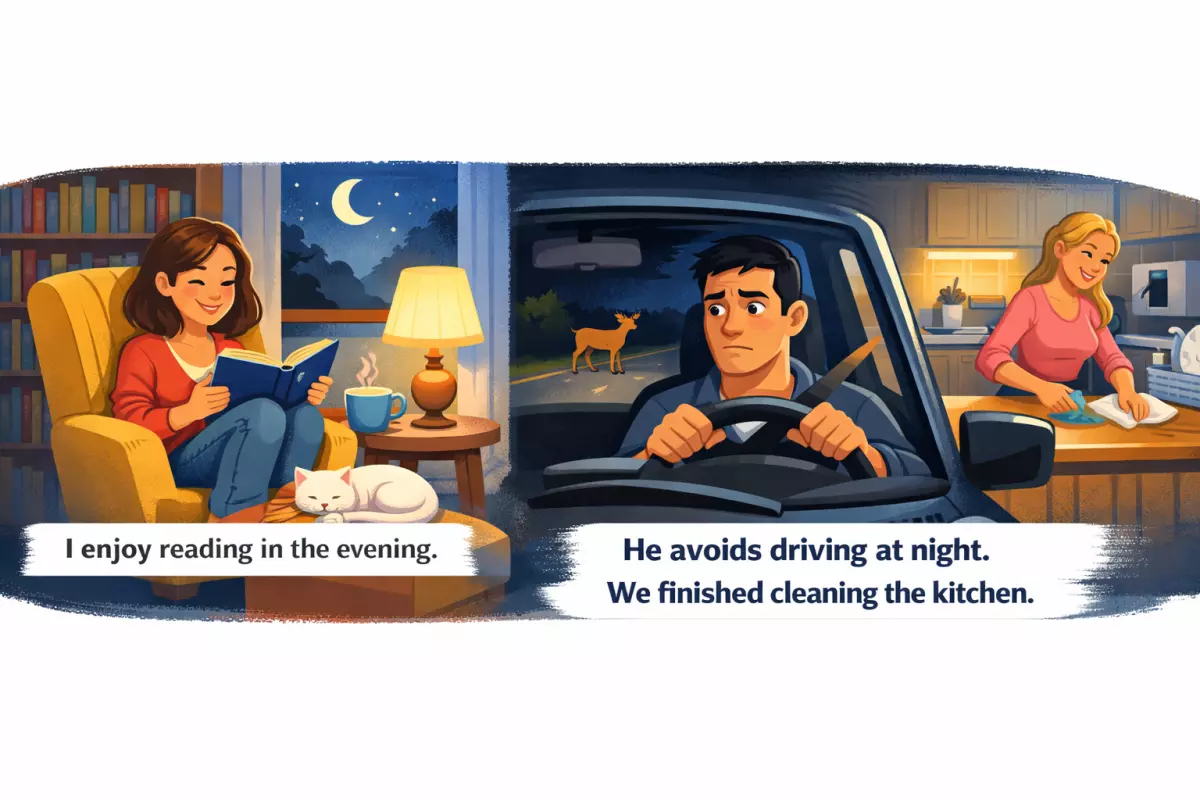
- enjoy: I enjoy reading in the evening.
- avoid: He avoids driving at night.
- finish: We finished cleaning the kitchen.
- consider: She’s considering changing jobs.
- suggest: They suggested taking a taxi.
- recommend: I recommend starting early.
- mind: Do you mind waiting a moment?
- admit: He admitted making a mistake.
- deny: She denied breaking the rules.
- risk: You risk losing your data.
- miss: I miss seeing my friends.
- practice: She practices speaking every day.
- keep: He keeps forgetting his keys.
- stop (meaning “quit”): She stopped smoking.
- postpone: They postponed meeting until Friday.
- delay: Don’t delay submitting the form.
- discuss: We discussed moving to a new office.
- imagine: Can you imagine living abroad?
Usage notes and common pitfalls
- “Suggest” and “recommend” usually take a gerund: ✅ They suggested going by train. ❌ They suggested to go by train.
- “Stop” changes meaning with the infinitive:
- ✅ She stopped smoking. (She quit the habit.)
- ✅ She stopped to smoke. (She paused in order to smoke.)
- “Mind” is typically used in questions/negatives with a gerund: Do you mind opening the window? / I don’t mind waiting.
- Some verbs often take a gerund after a preposition: They insisted on paying. (Here, on requires an -ing form.)
Sentence patterns with verb + gerund in real English sentences
Many common verbs are naturally followed by an -ing form (a gerund). The patterns below show how these verbs behave in everyday sentences, including where objects, possessives, and prepositions fit.
Core pattern: verb + gerund
- Enjoy: I enjoy cooking on weekends.
- Avoid: She avoids driving at night.
- Consider: We’re considering moving closer to work.
- Finish: He finished writing the report before lunch.
- Keep: They keep asking the same question.
- Miss: I miss talking to my old classmates.
- Practice: She practices speaking English every day.
- Suggest: He suggested taking a different route.
- Risk: You risk losing your data if you don’t back it up.
- Delay: They delayed signing the contract.
- Quit: He quit smoking last year.
- Admit: She admitted making a mistake.
Verb + object + gerund (who does the action)
- Stop: Please stop interrupting me.
- Prevent: The guard prevented him from entering the building.
- Catch: I caught my dog chewing my shoes.
- Imagine: Can you imagine your boss saying that in public?
- Leave: Don’t leave the engine running in the garage.
- Find: We found them waiting outside.
Verb + gerund with a possessive (more formal)
- ✔️ I appreciate your helping me with this.
- ✔️ She didn’t like his arriving late.
- In informal speech, many people use an object pronoun instead: I appreciate you helping me.
Verb + preposition + gerund (common fixed combinations)
- Apologize for: I apologized for being late.
- Insist on: She insisted on paying for dinner.
- Think about: We’re thinking about changing providers.
- Worry about: He worries about forgetting names.
- Look forward to: I’m looking forward to meeting your team.
- Be interested in: They’re interested in learning more.
- Be good at: She’s good at explaining complex ideas.
- Be responsible for: He’s responsible for managing the schedule.
Pattern contrast: gerund vs. infinitive changes meaning
- Stop: I stopped smoking. (I quit the habit.)
- Stop: I stopped to smoke. (I paused another activity in order to smoke.)
- Remember: I remember locking the door. (I have the memory.)
- Remember: Remember to lock the door. (Don’t forget in the future.)
- Try: Try restarting the computer. (Experiment: see if it helps.)
- Try: I tried to restart the computer. (I attempted, maybe unsuccessfully.)
When you build sentences with these patterns, focus on what comes immediately after the verb: if the verb “selects” an -ing form, the gerund acts like a noun phrase and can take objects and modifiers (for example, “consider moving to a new city” or “avoid making the same mistake again”).
How verbs + gerund structures work in everyday communication

In daily English, many common verbs naturally connect to an -ing form to describe real actions, routines, preferences, and reactions. This pattern is especially frequent after verbs that express enjoyment, avoidance, completion, or emotional response. The gerund behaves like a noun, so it can function as the object of the verb and answer questions like “What?” or “Which activity?”
What the pattern communicates
Using a gerund after certain verbs often frames the activity as a general idea, an experience, or a repeated behavior rather than a single future event. Compare the meaning focus:
- General activity / habit: “I enjoy cooking.” (cooking as an activity in general)
- Experience / memory: “I remember meeting her.” (the meeting happened)
- Avoidance: “He avoided answering.” (he did not answer)
- Completion: “They finished cleaning.” (the cleaning is done)
High-frequency verbs that take a gerund
These verbs are common in conversation and are typically followed by an -ing form. The examples show natural, everyday contexts.
- admit: “She admitted making a mistake.”
- avoid: “I’m avoiding checking my email tonight.”
- consider: “We’re considering moving closer to work.”
- delay: “They delayed signing the contract.”
- deny: “He denied taking the keys.”
- dislike: “I dislike waiting in long lines.”
- enjoy: “Do you enjoy working from home?”
- finish: “I finished writing the report.”
- imagine: “I can’t imagine living without music.”
- keep: “She kept asking the same question.”
- mind: “Do you mind opening the window?”
- miss: “I miss talking to you.”
- practice: “He practices speaking every day.”
- recommend: “I recommend trying the soup.”
- regret: “I regret saying that.”
- risk: “You risk losing your progress.”
- suggest: “They suggested taking a break.”
- stop: “She stopped complaining.” (she quit the action)
Common sentence shapes you’ll hear
Gerund structures show up in a few repeatable frames. Learning these helps you produce fluent, natural sentences quickly.
- Verb + gerund: “He avoided driving in the snow.”
- Verb + object + gerund: “They caught him copying answers.”
- Verb + gerund + complement: “I enjoy reading before bed.”
- Negative gerund: “She regrets not studying earlier.”
- Gerund with a possessive (more formal): “I appreciated your helping me.”
Quick accuracy checks (typical learner issues)
- ✅ “I enjoy swimming.” ❌ “I enjoy to swim.” (with enjoy, use -ing)
- ✅ “Do you mind waiting?” ❌ “Do you mind to wait?”
- ✅ “He suggested taking a taxi.” ❌ “He suggested to take a taxi.”
- ✅ “She stopped smoking.” (quit) → “She stopped to smoke.” (stopped in order to smoke)
In conversation, choosing the gerund after the right verb makes your meaning sound settled and idiomatic. When you learn a new verb, it helps to learn it together with its usual form (for example, “recommend + -ing,” “avoid + -ing”) so you can use it smoothly without pausing to decide.
Typical learner mistakes with verbs like enjoy, avoid, and consider
With these verbs, the most common problems come from choosing the wrong verb form, mixing up patterns with infinitives, and misusing objects (especially pronouns). Because enjoy, avoid, and consider typically take a gerund (verb + -ing), accuracy depends on spotting what comes after the verb and building the rest of the sentence around that pattern.
1) Using an infinitive instead of a gerund
Many learners overuse to + verb after almost any verb. However, these verbs normally require -ing when the next word is another verb.
- ❌ I enjoy to swim. → ✅ I enjoy swimming.
- ❌ She avoids to drive at night. → ✅ She avoids driving at night.
- ❌ We considered to move. → ✅ We considered moving.
- ❌ Do you enjoy to cook? → ✅ Do you enjoy cooking?
- ❌ He considered to apply for the job. → ✅ He considered applying for the job.
2) Forgetting the object before the gerund
When you want to say who does the action, you often need an object (noun or pronoun) before the gerund. Without it, the meaning can become unclear or unnatural.
- ❌ I enjoy watching in the evening. → ✅ I enjoy watching TV in the evening.
- ❌ They avoided talking about the issue with. → ✅ They avoided talking about the issue with us.
- ❌ We considered inviting to the meeting. → ✅ We considered inviting her to the meeting.
- ✅ I enjoy listening to music. (clear object of the preposition to)
- ✅ She avoided answering my question. (clear object of answering)
3) Confusing “consider + -ing” with “consider + noun/that-clause”
Consider can be followed by a gerund, a noun phrase, or a that-clause. Errors happen when learners blend these structures.
- ❌ We considered that moving to Berlin. → ✅ We considered moving to Berlin.
- ❌ She considered to be late. → ✅ She considered being late a problem.
- ✅ We considered the proposal carefully.
- ✅ We considered that the proposal was risky.
- ✅ We considered accepting the proposal.
4) Misplacing “not” with gerunds
To make the gerund negative, place not directly before the -ing form. Learners often put not in the wrong position or negate the wrong part of the sentence.
- ❌ I enjoy not to work on weekends. → ✅ I enjoy not working on weekends.
- ❌ She avoided to not mention it. → ✅ She avoided mentioning it.
- ✅ They considered not buying a car.
- ✅ He avoided not answering by changing the topic. (possible, but meaning is specific: he tried to avoid failing to answer)
5) Using the wrong subject with gerunds (especially after pronouns)
After these verbs, the -ing form acts like a noun. When you add a person before it, learners sometimes choose an unnatural pronoun form. In everyday English, an object pronoun is common; a possessive is also possible but more formal.
- ✅ I don’t enjoy him calling me late at night. (common)
- ✅ I don’t enjoy his calling me late at night. (more formal)
- ❌ I don’t enjoy he calling me late at night.
- ✅ She avoided them asking questions.
- ✅ She avoided their asking questions. (more formal)
6) Treating the gerund like a present continuous verb
A gerund looks like a verb in the -ing form, but it functions as a noun. Problems appear when learners try to add extra auxiliaries or tense markers as if it were a full verb phrase.
- ❌ I enjoy am reading before bed. → ✅ I enjoy reading before bed.
- ❌ She avoids is driving in heavy traffic. → ✅ She avoids driving in heavy traffic.
- ✅ I enjoy reading before bed.
- ✅ She avoids driving in heavy traffic.
7) Overgeneralizing: assuming all verbs work the same way
It helps to learn these verbs as “gerund verbs,” but not every verb follows the same pattern. Mixing patterns leads to sentences that sound unnatural even if the meaning is understandable.
- ✅ I enjoy cooking. (gerund)
- ✅ I want to cook. (infinitive)
- ✅ I decided to cook. (infinitive)
- ✅ I suggested cooking. (gerund)
- Tip: when you learn a new verb, record it with a short pattern note, such as “enjoy + -ing” or “decide + to + verb.”
Practical tips for remembering verbs that require gerunds
Memorizing which verbs take an -ing form gets easier when you learn the patterns behind them. Instead of treating each verb as an isolated fact, group them by meaning, test them in short sentence frames, and watch for the few common “trap” verbs that look similar but behave differently.
1) Learn meaning-based clusters (the fastest memory shortcut)
Many gerund-taking verbs share a similar idea (liking, avoiding, finishing, admitting). When you connect grammar to meaning, recall becomes more automatic.
- Enjoyment / preference: enjoy, like, love, hate, prefer (often possible with “to” too, but -ing is very common in general statements).
- Avoidance / delay: avoid, postpone, delay, put off, risk.
- Completion / stopping: finish, complete, quit, stop (stop + -ing = stop the activity).
- Admission / responsibility: admit, deny, confess, acknowledge, regret (regret + -ing = regret a past action).
- Consideration / suggestion: consider, suggest, recommend, propose, discuss, mention.
- Mind / tolerate: mind, can’t stand, can’t help, don’t mind.
- Practice / process: practice, keep, continue (continue can also appear with “to” in some contexts).
- Anticipation: look forward to (note: “to” here is a preposition, so it must be followed by a gerund).
2) Use “mini-frames” to drill the structure
Short sentence frames help you store the verb + pattern together, not separately. Say them aloud and swap only the activity.
- I avoid -ing when I’m tired. (avoid working / avoid driving / avoid arguing)
- She suggested -ing. (suggested taking a break / suggested meeting earlier)
- They admitted -ing. (admitted cheating / admitted forgetting)
- We finished -ing. (finished cleaning / finished writing)
- Do you mind -ing? (mind waiting / mind closing the door)
3) Watch for “preposition + -ing” signals
Sometimes it’s not the main verb but the preposition that forces the gerund. If a verb is typically followed by a preposition, expect an -ing form after that preposition.
- look forward to + -ing (I look forward to meeting you.)
- insist on + -ing (He insisted on paying.)
- apologize for + -ing (She apologized for being late.)
- think about + -ing (I’m thinking about moving.)
- be interested in + -ing (They’re interested in learning French.)
- be good at + -ing (He’s good at explaining.)
4) Separate gerund verbs from the most common “confusers”
A small set of verbs causes most mistakes because their meaning shifts depending on whether you use -ing or an infinitive. Keep these pairs clear with one-line contrasts.
- ✅ stop smoking = quit the habit → ❌ stop to smoke = stop another action in order to smoke
- ✅ remember locking the door = recall a past action → ❌ remember to lock the door = don’t forget a future task
- ✅ try restarting the computer = experiment with a method → ❌ try to restart the computer = attempt (may fail)
- ✅ regret saying that = feel sorry about the past → ❌ regret to say that = formal announcement of bad news
5) Build a personal “top 15” list and recycle it
High-frequency verbs deserve repeated exposure. Choose a core set and use them in your own examples until the pattern feels natural.
- avoid, enjoy, finish, suggest, recommend
- consider, discuss, mention, admit, deny
- mind, miss, practice, keep, quit
6) Check your sentence with a quick diagnostic question
When you’re unsure, test the meaning. If the verb describes an attitude toward an activity (liking, avoiding, admitting, finishing), the -ing form is usually the right choice.
- Is it about enjoying an activity? → enjoy + -ing
- Is it about avoiding an activity? → avoid + -ing
- Is it about completing an activity? → finish + -ing
- Is it about a suggestion or idea? → suggest/consider + -ing
- Is there a preposition right before the verb form? → preposition + -ing
Practice exercises: complete sentences using the correct gerund
Complete each sentence with the correct gerund (-ing form) after the verb. Focus on the pattern: verb + gerund (not an infinitive). Use the base verb in parentheses to form the -ing word.
Exercise 1: Common verbs that take a gerund
- I enjoy ________ new recipes on weekends. (cook)
- She suggested ________ the meeting until Friday. (move)
- They admitted ________ the instructions. (ignore)
- He avoided ________ about the mistake. (talk)
- We considered ________ to a smaller apartment. (move)
- Do you mind ________ the window? (close)
- My boss recommended ________ the report again. (read)
- He denied ________ the email. (send)
- I miss ________ with my old classmates. (study)
- She finished ________ the presentation late at night. (prepare)
- They postponed ________ the launch because of delays. (announce)
- He kept ________ the same question. (ask)
Show answers
- cooking
- moving
- ignoring
- talking
- moving
- closing
- reading
- sending
- studying
- preparing
- announcing
- asking
Exercise 2: Gerunds after prepositions
In these items, the -ing form is required because it follows a preposition (for, about, of, in, to, without, etc.).
- Thank you for ________ me with the forms. (help)
- She’s interested in ________ Japanese. (learn)
- He left without ________ goodbye. (say)
- They apologized for ________ so late. (arrive)
- I’m tired of ________ the same problem. (repeat)
- We talked about ________ a new schedule. (create)
- She succeeded in ________ the exam on her first try. (pass)
- He insisted on ________ for dinner. (pay)
Show answers
- helping
- learning
- saying
- arriving
- repeating
- creating
- passing
- paying
Exercise 3: Gerund vs. infinitive traps (choose the gerund)
Each sentence contains a verb that is typically followed by a gerund. Complete it with the -ing form, even if an infinitive sounds tempting.
- He can’t stand ________ in long lines. (wait)
- She quit ________ coffee in the evening. (drink)
- We discussed ________ the budget this afternoon. (cut)
- I don’t feel like ________ out tonight. (go)
- They practiced ________ before the performance. (sing)
- He risked ________ his phone in the ocean. (drop)
- She imagined ________ abroad for a year. (live)
- We can’t afford ________ time on avoidable tasks. (waste)
Show answers
- waiting
- drinking
- cutting
- going
- singing
- dropping
- living
- wasting
Quick accuracy check
- After these verbs, use -ing: enjoy, avoid, consider, suggest, admit, deny, finish, postpone, keep, miss, can’t stand, quit, discuss, practice, risk, imagine, feel like.
- After a preposition, use -ing: for helping, in learning, without saying, about creating.
- If you’re unsure, test the structure: verb + object (optional) + gerund. Example: “They suggested moving the meeting.”