Questions with Gerunds and Infinitives in English

 Here we how to form questions with gerunds and infinitives, explains verbs that change meaning, and when to use each form. It also highlights common mistakes, differences in formal and informal usage, and includes practice exercises with self-checks.
Forming questions with verbs ending in -ing or with to before them can seem challenging, but understanding the patterns makes it easier to communicate effectively. When using -ing forms, questions often focus on activities or ongoing actions, such as "Are you enjoying reading this book?" With verbs that have to before them, questions typically involve intentions or plans, like "Do you want to go to the movies?" Practicing these structures helps your English sound more natural and confident in everyday conversations.
Gerunds and Infinitives Overview
Understanding when to use gerunds and infinitives is a key part of mastering English sentence structure. A gerund is the -ing form of a verb that functions as a noun (for example, "swimming" in "Swimming is fun"), while an infinitive is the base form of a verb, usually preceded by "to" (like "to swim" in "I like to swim"). Both forms can act as subjects, objects, or complements in sentences, but their usage depends on the verb or expression that comes before them.
What Are Gerunds?
Gerunds look like verbs ending in -ing, but they work as nouns in a sentence. You might see them as the subject, the object of a verb, or the object of a preposition. Here are some common verbs and phrases that are typically followed by a gerund:
- enjoy (e.g., enjoy reading)
- avoid (e.g., avoid eating late)
- consider (e.g., consider moving)
- suggest (e.g., suggest going out)
- mind (e.g., don’t mind waiting)
- finish (e.g., finish writing)
- admit (e.g., admit breaking the rule)
- deny (e.g., deny stealing)
- imagine (e.g., imagine living abroad)
- recommend (e.g., recommend trying this)
What Are Infinitives?
Infinitives are the base form of the verb, usually with "to" in front. They also act as nouns, adjectives, or adverbs. Some verbs and expressions are almost always followed by an infinitive. Here are a few examples:
- decide (e.g., decide to leave)
- hope (e.g., hope to see you)
- plan (e.g., plan to travel)
- promise (e.g., promise to help)
- learn (e.g., learn to drive)
- agree (e.g., agree to cooperate)
- offer (e.g., offer to pay)
- refuse (e.g., refuse to answer)
- ask (e.g., ask to speak)
- expect (e.g., expect to win)
Examples: Gerunds and Infinitives in Questions
- Are you enjoying learning English online?
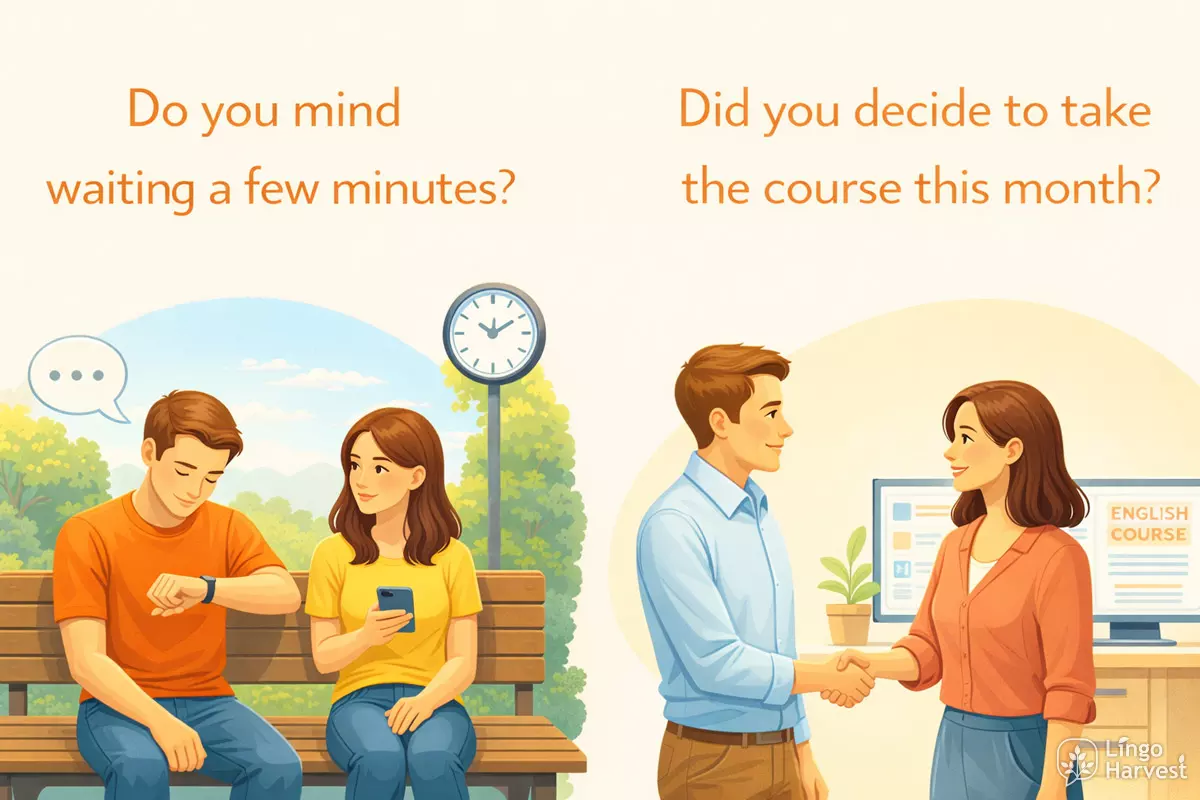
- Do you mind waiting a few minutes?
- Have you considered moving to another city?
- Do you want to join the study group today?
- Did you decide to take the course this month?
- Are you planning to travel abroad next year?
Comparing Gerund and Infinitive Use
Some verbs can be followed by either a gerund or an infinitive, but the meaning may change. Others strictly require one form. Here’s a comparison for clarity:
| Verb | Followed by Gerund | Followed by Infinitive | Notes |
|---|---|---|---|
| remember | remember doing | remember to do | Past action (gerund) vs. future action (infinitive) |
| stop | stop doing | stop to do | Cease an activity vs. pause to do something else |
| try | try doing | try to do | Experiment vs. attempt/effort |
| forget | forget doing | forget to do | Memory of past vs. neglecting a task |
Summary
Choosing between a gerund and an infinitive often depends on the main verb, the overall meaning, and the structure of the sentence. Some verbs only allow one form, while others allow both but with differences in meaning. Familiarity with these patterns helps you form natural and accurate questions and statements in English.
Questions with Gerunds
Understanding how gerunds function in questions is essential for clear and natural English communication. Gerunds, which are the -ing forms of verbs used as nouns (like swimming, reading, or cooking), often appear in both direct and indirect questions. These forms can be the subject or object within a question, and sometimes follow certain verbs or prepositions.
How Gerunds Work in Question Structures
When constructing questions, the gerund can be used after verbs or prepositions, or as the main focus of the inquiry. The structure of the question often depends on whether you are asking about an activity itself or about someone’s opinion or experience related to that activity.
- What do you enjoy doing on weekends?
- Is learning English difficult for you?
- Who is responsible for organizing the meeting?
- How do you feel about traveling alone?
- Do you mind waiting for a few minutes?
- Are you interested in joining the club?
- What are the benefits of exercising regularly?
- Why did you stop eating meat?
- Would you consider moving to another city?
- Is there anything you dislike about cooking?
- Where can we go swimming nearby?
- Who suggested starting the project early?
Common Patterns with Gerunds in Questions
Some question patterns are especially common when using gerunds. These help English speakers ask about preferences, routines, or experiences. Often, the gerund follows a preposition, or is used after certain verbs.
| Question Pattern | Example Question |
|---|---|
| Do you enjoy + gerund? | Do you enjoy reading before bed? |
| Are you good at + gerund? | Are you good at drawing? |
| What about + gerund? | What about going for a walk? |
| How long have you been + gerund? | How long have you been living here? |
| Would you mind + gerund? | Would you mind closing the window? |
| Who suggested + gerund? | Who suggested trying this restaurant? |
| Is it worth + gerund? | Is it worth visiting the museum? |
| What’s the best thing about + gerund? | What's the best thing about working from home? |
Tips for Using Gerunds in Questions
- After prepositions (like about, for, in), always use the gerund form.
- Certain verbs (enjoy, mind, suggest, avoid, finish) are usually followed by gerunds, even in questions.
- Indirect questions can also use gerund forms: “Can you tell me if she enjoys swimming?”
- Remember, gerunds act as nouns, so they can be the subject or object in your question.
Practicing these structures helps you sound more fluent and natural. Try forming your own questions using gerunds to ask about hobbies, routines, or preferences in everyday conversation.
Questions with Infinitives
When we want to ask about actions, intentions, or preferences involving infinitive forms (to + base verb), English offers several patterns. These constructions are common in both direct and indirect questions, and they help clarify what someone wants, needs, or hopes to do. Understanding these patterns makes it easier to form natural questions and to interpret them correctly in conversation.
Common Patterns for Infinitive Questions
Often, infinitives appear in questions that ask about purposes, plans, or choices. Here are some typical ways to frame such questions:
- What do you want to do?
- Who would you like to meet?
- Where do you hope to travel?
- When do you plan to start?
- Which book do you want to read?
- Why did you decide to move?
- Who do you need to talk to?
- What are you trying to say?
- Who do you expect to see?
- How do you hope to improve?
- What would you love to learn?
- Who do you intend to invite?
- Where do you want to go?
- What did you forget to bring?
- Who do you prefer to work with?
- What do you hope to achieve?
- When do you plan to call?
- What did you promise to do?
- Who are you supposed to meet?
- What do you need to remember?
Indirect Questions Using Infinitives
Indirect questions often use infinitives after certain verbs or phrases. These are especially common when asking for advice or instructions. Notice that these questions may start with words like "how," "what," or "where," followed by an infinitive:
- Can you show me how to use this?
- Do you know what to say?
- Could you tell me where to go?
- Do you remember when to call?
- Can you explain how to solve this?
- Do you know who to contact?
- Would you mind showing me what to do?
- Can you tell me when to start?
- Do you have any advice on how to prepare?
Comparison: Direct vs. Infinitive-Pattern Questions
Direct questions usually use the auxiliary verb and the base verb, while questions with infinitives use the infinitive form. Here's a comparison to clarify the difference:
| Direct Question | Infinitive-Pattern Question |
|---|---|
| What should I do? | Can you tell me what to do? |
| Where can I go? | Do you know where to go? |
| How do I start? | Could you show me how to start? |
| Who must I contact? | Do you know who to contact? |
Key Points to Remember
- Infinitive-based questions are common in both direct and indirect forms.
- Use infinitives to ask about purposes, intentions, or instructions.
- Indirect forms often sound more polite or formal.
- Verbs like "want," "need," "hope," "prefer," and "plan" frequently introduce infinitive questions.
- Question words such as "what," "where," "how," and "who" often combine with infinitives in indirect questions.
Mastering these patterns will help you ask about actions, choices, and advice more effectively in English conversations.
Verbs That Change Meaning
Some English verbs take both gerunds and infinitives, but the meaning changes depending on which form is used. This can be confusing for learners, since the difference is often subtle but important. Understanding these distinctions helps you communicate more precisely.
Common Verbs with Different Meanings
Several verbs change their meaning based on whether they are followed by a gerund (-ing form) or an infinitive (to + base verb). Here are some of the most frequent examples:
- Remember: "I remember meeting her" (I have a memory of the meeting) vs. "Remember to meet her" (don’t forget to meet her in the future).
- Forget: "I forgot locking the door" (I don’t recall the action) vs. "I forgot to lock the door" (I didn’t do it).
- Stop: "He stopped smoking" (he quit the habit) vs. "He stopped to smoke" (he paused another activity in order to smoke).
- Try: "Try restarting your computer" (experiment with this solution) vs. "Try to restart your computer" (make the effort, but it might not work).
- Regret: "I regret telling you" (I’m sorry I told you) vs. "I regret to tell you" (I’m sorry about what I’m about to say).
- Go on: "She went on talking" (she continued talking) vs. "She went on to talk" (she finished one thing and then talked about something else).
- Mean: "This means changing our plan" (it involves changing) vs. "I meant to call you" (I intended to call).
- Need: "The car needs washing" (it needs to be washed) vs. "I need to wash the car" (I have to do it).
- Quit: "She quit working here" (she stopped working here) vs. "She quit to work somewhere else" (she left in order to work elsewhere).
- Intend: "I intend going" (less common, but possible in British English) vs. "I intend to go" (I plan to go).
Comparison Table: Gerund vs. Infinitive Meanings
| Verb + Gerund | Verb + Infinitive |
|---|---|
| He stopped smoking. (He quit the habit.) |
He stopped to smoke. (He paused to have a cigarette.) |
| I remember locking the door. (I have a memory of doing it.) |
Remember to lock the door. (Don’t forget in the future.) |
| She regrets telling him. (She is sorry about a past action.) |
She regrets to tell him. (She is sorry she has to give bad news.) |
| Try restarting your computer. (Try this as an experiment.) |
Try to restart your computer. (Make an effort to do it.) |
Tips for Mastery
- Always check the meaning in context; a dictionary can help clarify which form is appropriate.
- Practice by making your own sentences with both forms of each verb.
- Pay attention to examples in reading and listening to see how native speakers use these patterns.
Knowing how these verbs work with gerunds and infinitives will make your English more natural and accurate.
Question Word + Gerund or Infinitive
When asking about actions or possibilities, English often combines question words (like what, how, where, when, who, which, or whether) with either the -ing form of a verb (gerund) or the to-infinitive. This structure helps express uncertainty, intentions, or choices about activities. The form you use can depend on the main verb in the sentence and the nuance you want to convey.
Common Verbs Used Before This Structure

Certain verbs are frequently followed by a question word plus either a gerund or an infinitive. Here are some of the most common:
- ask → She asked how to solve the problem.
- decide → He decided what to say next.
- discover → They discovered how to improve the results.
- discuss → We discussed where to meet after work.
- explain → The teacher explained how to use the formula.
- find out → I found out where to buy the tickets.
- forget → She forgot what to bring to the meeting.
- know → Do you know how to fix this error?
- learn → He learned how to speak confidently.
- remember → I remember where to park the car.
- show → Can you show me how to do this?
- teach → They taught us how to write formal emails.
- think about → She is thinking about how to change careers.
- understand → He understands what to do in this situation.
- wonder → I wonder how to explain it clearly.
How the Patterns Work
Often, these verbs are followed by a question word and then either a gerund or an infinitive. The choice between -ing or to + verb depends on the main verb and the meaning. For example:
- He’s considering what to do next. (to-infinitive)
- I can’t remember where to park. (to-infinitive)
- They discussed who should go. (infinitive or clause)
- She talked about how working from home affects her. (gerund phrase)
Typical Patterns and Examples
Below is a table showing how common verbs combine with question words and either gerunds or infinitives, with example sentences for each pattern:
| Verb + Question Word | Example Sentence |
|---|---|
| decide + what to do | I can’t decide what to do tonight. |
| know + how to cook | Do you know how to cook Italian food? |
| ask + where to go | She asked where to go for help. |
| learn + when to start | He learned when to start the project. |
| discuss + whether going is necessary | We discussed whether going is necessary. |
| think about + what doing means | I’m thinking about what doing this will mean. |
| wonder + which to choose | I wonder which to choose. |
| remember + how to get there | Do you remember how to get there? |
When to Use Gerunds or Infinitives
Generally, the infinitive form (to + verb) is used after verbs like decide, know, learn, remember, show, and teach, especially when expressing ability or intention. Gerunds (-ing forms) often appear after prepositions or certain verbs like discuss, think about, and talk about, particularly when the focus is on the activity itself.
Tips for Learners
- Pay attention to the main verb—some always take the infinitive, others prefer the gerund.
- If you can replace the structure with “how to + verb,” the infinitive is usually correct.
- After prepositions, use the gerund (-ing) form.
- Practice with real-life questions: “Do you know what to say?” vs. “We talked about what saying that means.”
Understanding these patterns makes it easier to ask and answer questions about actions, plans, and possibilities in English.
Formal and Informal Usage
The way we use gerunds and infinitives can change depending on whether we’re speaking or writing in a formal or informal context. In everyday conversation, people often choose simpler, more direct patterns, while in academic, business, or official settings, certain verbs or structures may be preferred. Understanding these differences helps you sound more natural and appropriate for the situation.
Patterns in Conversation vs. Writing
Spoken English frequently relies on gerunds after common verbs, especially when the action is familiar or habitual. Infinitive forms, on the other hand, are often used in formal writing or when expressing intentions, obligations, or abstract ideas. Consider how the choice can affect the tone and clarity:
- Gerunds in speech: "I enjoy reading," "She suggested meeting later."
- Infinitives in formal writing: "We decided to postpone the meeting," "It is important to follow instructions."
Common Verbs and Their Typical Use
Some verbs usually pair with a gerund in casual settings, while others take an infinitive, especially in more official communication. Here’s a breakdown of how these verbs are typically used:
| Verb | Typical Usage | Example (Question Form) | Context |
|---|---|---|---|
| enjoy | Gerund | Do you enjoy working here? | Informal/Neutral |
| plan | Infinitive | Do you plan to attend the seminar? | Formal/Neutral |
| suggest | Gerund | Would you suggest taking a break? | Informal/Neutral |
| agree | Infinitive | Did you agree to help with the project? | Formal |
| avoid | Gerund | Do you avoid eating late at night? | Informal/Neutral |
| decide | Infinitive | Did you decide to join us? | Formal/Neutral |
| recommend | Gerund | Can you recommend reading this book? | Informal/Neutral |
| promise | Infinitive | Did you promise to call him? | Formal |
Typical Features in Informal Language
- Shorter, direct questions: "Mind helping me?"
- Omitting the subject when clear: "Want to come?"
- Gerunds after verbs like "like," "love," "hate": "Do you like swimming?"
- More contractions and idiomatic usage: "Thinking of going?"
Characteristics of More Formal Usage
- Full sentence structures: "Do you intend to participate in the discussion?"
- Infinitives to express purpose or obligation: "Is it necessary to submit the form today?"
- Polite modal verbs with infinitives: "Would you be willing to assist?"
- Less use of contractions and idioms
Choosing between gerunds and infinitives is not just about grammar rules; it’s also about matching your language to the audience and situation. Being aware of these distinctions will help you form questions that fit both casual conversations and formal exchanges.
Typical Errors Learners Make
Learners often run into trouble when forming questions with gerunds and infinitives. These issues usually stem from confusion about which verbs are followed by a gerund or an infinitive, as well as mistakes with word order and auxiliary verbs. Understanding these patterns makes it easier to avoid common pitfalls.
Confusing Gerunds and Infinitives After Certain Verbs
Some English verbs are followed by a gerund, others by an infinitive, and a few can take both with a change in meaning. Mistakes happen when learners mix them up, especially in questions. For example, "Do you enjoy to swim?" is incorrect; it should be "Do you enjoy swimming?" This confusion is especially common with verbs like "stop," "remember," "try," "like," and "forget."
Incorrect Question Formation
Many learners place the gerund or infinitive in the wrong position when forming questions, or they omit necessary auxiliary verbs. For instance, "You like to dance?" should be "Do you like to dance?" Word order is also a frequent source of errors.
Omitting 'to' in Infinitive Questions
When forming questions with infinitives, forgetting the "to" is a frequent error. For example, "Do you want go out?" is incorrect; it should be "Do you want to go out?"
Using the Wrong Verb Form After Prepositions
After prepositions, learners sometimes mistakenly use an infinitive instead of a gerund. For example, "Are you interested to learn English?" is incorrect; it should be "Are you interested in learning English?"
Common Mistakes and Corrections
- Incorrect: Do you enjoy to cook? ❌
Correct: Do you enjoy cooking? ✅ - Incorrect: Did you decide going to the party? ❌
Correct: Did you decide to go to the party? ✅ - Incorrect: Are you good to sing? ❌
Correct: Are you good at singing? ✅ - Incorrect: Why did you stop to smoke? (meaning: quit the habit) ❌
Correct: Why did you stop smoking? ✅ - Incorrect: Do you want learning Spanish? ❌
Correct: Do you want to learn Spanish? ✅ - Incorrect: What do you suggest to do? ❌
Correct: What do you suggest doing? ✅ - Incorrect: Are you interested to travel? ❌
Correct: Are you interested in traveling? ✅ - Incorrect: Did you remember to send the email? (when asking about a memory of the past) ❌
Correct: Do you remember sending the email? ✅ - Incorrect: Do you mind to close the window? ❌
Correct: Do you mind closing the window? ✅ - Incorrect: She suggested to meet at 6. ❌
Correct: She suggested meeting at 6. ✅
Verbs Commonly Confused With Gerunds and Infinitives
| Verb | Correct Pattern | Example Question |
|---|---|---|
| enjoy | verb + gerund | Do you enjoy reading? |
| want | verb + to + infinitive | Do you want to travel? |
| suggest | verb + gerund | What do you suggest doing? |
| decide | verb + to + infinitive | When did you decide to leave? |
| stop | verb + gerund / verb + to + infinitive (different meanings) | Why did you stop smoking? / Did you stop to buy milk? |
| try | verb + gerund / verb + to + infinitive (different meanings) | Have you tried restarting the computer? / Did you try to open the door? |
Summary
Awareness of these frequent slip-ups can help learners ask questions more accurately. Reviewing which verbs take gerunds or infinitives and practicing correct question structure are both key to mastering this aspect of English grammar.
Practice Exercises and Self-Check
Understanding how to form questions using gerunds and infinitives is essential for clear communication in English. The following activities are designed to help you practice recognizing and using these structures accurately. Take your time with each exercise, and check your answers when you finish to see how you did.
Identify the Correct Form
For each sentence below, decide if the verb in parentheses should be followed by a gerund (-ing form) or an infinitive (to + base form). Write the complete phrase.
- She admitted (make) a mistake.
- Do you want (come) with us?
- He enjoys (swim) in the ocean.
- We decided (leave) early.
- They suggested (try) the new restaurant.
- Did you remember (lock) the door?
- The teacher expects (finish) the project soon.
- I can't afford (buy) a new car right now.
- He promised (call) me later.
- She avoided (talk) about the problem.
Show answers
- making
- to come
- swimming
- to leave
- trying
- to lock
- to finish
- to buy
- to call
- talking
Rewrite Questions Using Gerunds or Infinitives
Transform these statements into questions. Use gerunds or infinitives as needed.
- You plan to visit Paris. (Ask about the plan)
- She enjoys reading novels. (Ask about the activity she enjoys)
- They decided to move abroad. (Ask about their decision)
- He finished doing his homework. (Ask about what he finished)
- We hope to see you soon. (Ask about their hope)
- Anna suggested meeting earlier. (Ask about what she suggested)
- He refused to answer the question. (Ask about what he refused to do)
- They are considering buying a new car. (Ask about what they are considering)
- We agreed to help with the project. (Ask about what you agreed to do)
- She avoided talking about the problem. (Ask about what she avoided)
Show answers
- Do you plan to visit Paris?
- What does she enjoy doing?
- What did they decide to do?
- What did he finish doing?
- What do you hope to do soon?
- What did Anna suggest doing?
- What did he refuse to do?
- What are they considering doing?
- What did you agree to do?
- What did she avoid doing?
Common Verbs with Gerunds and Infinitives
Some verbs are typically followed by gerunds, others by infinitives, and a few can take both with a change in meaning. Here's a selection of common verbs grouped by their usual pattern:
- Verbs followed by gerunds: enjoy, suggest, avoid, admit, finish, consider, deny, mind, recommend, risk
- Verbs followed by infinitives: decide, hope, promise, learn, want, need, plan, offer, refuse, expect
- Verbs that can take both, with a change in meaning: remember, stop, try, forget, regret
Practice: Choose the Right Question Form
Match the sentence on the left with the correct question on the right by writing the letter next to the number.
| Statement | Question |
|---|---|
| 1. She forgot to call her friend. | f. What did she forget to do? |
| 2. He stopped smoking. | c. What did he stop doing? |
| 3. They want to learn Spanish. | h. What do they want to learn? |
| 4. We discussed moving to Canada. | a. What did you discuss? |
| 5. I enjoy watching documentaries. | j. What do you enjoy doing? |
| 6. He promised to help us. | b. What did he promise to do? |
| 7. She avoided talking about the issue. | e. What did she avoid doing? |
| 8. They decided to leave early. | g. What did they decide to do? |
| 9. We learned to use the new software. | d. What did you learn to do? |
| 10. He suggested taking a break. | i. What did he suggest doing? |
Show answers
- f
- c
- h
- a
- j
- b
- e
- g
- d
- i
Regular practice with these types of questions will help you become more comfortable with gerunds and infinitives in everyday English conversation. Review the answers to see where you can improve, and try creating your own questions for extra practice.