Verbs Followed by Infinitives: Rules and Examples

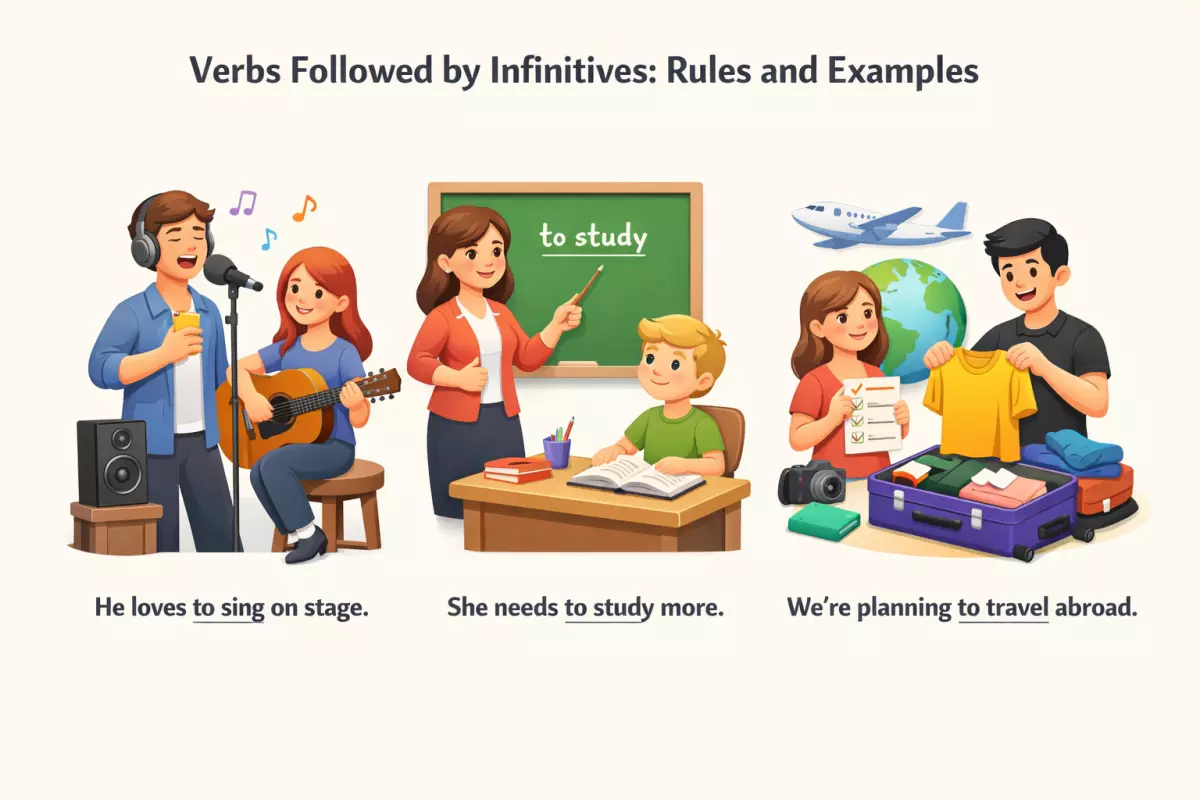 Learn why some verbs need the to + verb infinitive, which common verbs follow this rule, and the main verb + infinitive sentence patterns. See real examples, avoid mistakes with decide, hope, and plan, and use memory tips plus choose-the-correct-form practice exercises.
- Why certain verbs require the 'to + verb' infinitive form
- Common English verbs followed by infinitives
- Sentence patterns with verb + infinitive structures
- How verb + infinitive structures appear in real English sentences
- Common mistakes learners make with verbs like decide, hope, and plan
- Practical tips for remembering verbs that take infinitives
- Practice exercises: choose the correct infinitive form
Many verbs naturally lead into the to form of the next action, making it easier to express what you want, plan, or decide. In everyday English, you hear this pattern in sentences like I want to leave, She decided to call, and They promised to help. Learning which common verbs use this structure helps your speech sound smoother and your writing become clearer and more confident.
Why certain verbs require the 'to + verb' infinitive form
Some English verbs naturally “point forward” to another action, so they are typically followed by an infinitive with to. In these patterns, the infinitive works like a complement: it completes the meaning of the main verb by naming the next action, plan, decision, or intention.
Common usage patterns that lead to a to-infinitive
- Plans and intentions: the main verb expresses what someone intends, and the infinitive names the intended action.
- She plans to move in July.
- They intend to expand the team.
- Decisions and choices: the verb signals a choice, and the infinitive states what was chosen.
- He decided to take the earlier train.
- I chose to stay home.
- Effort and attempts: the verb describes trying, and the infinitive gives the goal of the attempt.
- We tried to call you.
- She managed to finish on time.
- Learning and preparation: the verb relates to readiness or skill-building, and the infinitive states the skill or task.
- He learned to drive.
- They prepared to present the results.
- Need, obligation, and expectation: the verb expresses necessity or a standard, and the infinitive identifies what must happen.
- You need to sign here.
- We expect to hear back soon.
- Permission and requests: the verb frames a request or permission, and the infinitive names the requested action.
- She asked to leave early.
- They agreed to help.
Verbs that commonly take “to + verb”
- agree to + verb: We agreed to meet at noon.
- aim to + verb: The company aims to reduce waste.
- arrange to + verb: I arranged to pick her up.
- attempt to + verb: He attempted to explain the problem.
- choose to + verb: She chose to study abroad.
- decide to + verb: They decided to postpone the launch.
- expect to + verb: I expect to finish today.
- fail to + verb: He failed to notice the sign.
- forget to + verb: Don’t forget to lock the door.
- hope to + verb: We hope to see you soon.
- learn to + verb: She learned to swim.
- manage to + verb: He managed to solve it.
- need to + verb: You need to update the file.
- offer to + verb: She offered to help.
- plan to + verb: I plan to call tomorrow.
- promise to + verb: They promised to return the keys.
- refuse to + verb: He refused to answer.
- seem to + verb: It seems to work fine.
- tend to + verb: She tends to arrive early.
- want to + verb: I want to try that restaurant.
Two frequent learner issues
- “Stop” changes meaning depending on the structure:
- ✅ I stopped to talk to him. (I paused another activity in order to talk.)
- ✅ I stopped talking to him. (I ended the conversation/habit.)
- “Forget/remember” can refer to an action before or after the remembering:
- ✅ Remember to email her. (Do it later; don’t miss the task.)
- ✅ I remember emailing her. (I recall doing it in the past.)
When you see a verb that expresses intention, decision, effort, or necessity, the to-infinitive is a strong default. If the verb instead describes enjoying, finishing, avoiding, or considering an activity, English often prefers a gerund (-ing) pattern, which is covered in other sections of the topic.
Common English verbs followed by infinitives

Many everyday verbs are typically followed by to + base verb (the infinitive). This pattern often appears after verbs that express plans, decisions, attempts, promises, or willingness. The verbs below are grouped by meaning to make the pattern easier to remember.
Plans, intentions, and decisions
- plan: We plan to move next year.
- decide: She decided to take the earlier train.
- choose: He chose to stay home.
- intend: I intend to finish the report today.
- hope: They hope to visit in July.
- expect: We expect to hear back soon.
- want: I want to learn Spanish.
- would like: I’d like to speak with the manager.
Effort, attempts, and learning
- try: Try to arrive a little early.
- attempt: He attempted to fix the printer.
- manage: She managed to solve the problem.
- fail: I failed to notice the sign.
- learn: He learned to drive at 18.
- teach: They teach students to write clearly.
- remember: Remember to lock the door.
- forget: Don’t forget to send the email.
Promises, agreements, and refusals
- promise: She promised to call after work.
- agree: We agreed to meet at noon.
- offer: He offered to help with the boxes.
- refuse: The company refused to comment.
- pretend: He pretended to understand.
- threaten: They threatened to cancel the contract.
Readiness, preference, and willingness
- be ready: I’m ready to start.
- be willing: She’s willing to negotiate.
- prefer: I prefer to work in the morning.
- need: You need to show your ID.
- seem: He seems to know the answer.
- appear: The results appear to be accurate.
Useful usage notes (common patterns)
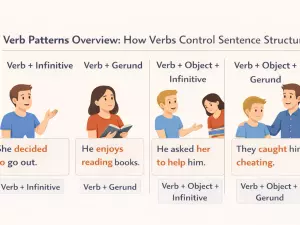
- Verb + to-infinitive: We decided to leave early.
- Verb + object + to-infinitive: She asked me to wait. / They told him to sit down.
- Adjective + to-infinitive: It’s important to check the details.
- Correct vs. incorrect form: ✅ I want to go. ❌ I want go.
Sentence patterns with verb + infinitive structures
Many English verbs are followed by an infinitive (to + base verb). The meaning often depends on the pattern around the infinitive: whether it has its own subject, whether it is negative, and whether it expresses purpose, a plan, or a reaction. The models below show the most common structures and how to use them accurately.
Core patterns you’ll see most often
- Verb + to-infinitive (no object):
agree to help; decide to leave; hope to win; plan to study; refuse to pay; learn to drive. - Verb + object + to-infinitive (the object “does” the infinitive):
ask him to call; want you to stay; need them to sign; tell her to wait; remind me to email. - Verb + to-infinitive after adjectives (common in responses and opinions):
be happy to help; be ready to go; be surprised to hear; be careful to check. - Verb + question word + to-infinitive (indirect questions about choice or method):
explain how to use it; show me where to park; decide what to do; ask when to start. - Verb + to-infinitive for purpose (often after movement or action verbs):
go to buy groceries; stop to talk; come to see you; open the window to get fresh air.
Common verb groups and their typical sentence frames
- Plans and intentions (Verb + to-infinitive):
intend to apply; aim to improve; choose to continue; promise to return. - Decisions and willingness (Verb + to-infinitive):
decide to postpone; agree to meet; offer to help; refuse to answer. - Requests and instructions (Verb + object + to-infinitive):
ask the staff to confirm; tell the kids to sit; encourage her to try; warn them to slow down. - Need and expectation (Verb + object + to-infinitive):
need you to listen; expect them to arrive; require applicants to provide ID. - Permission and obligation (Verb + object + to-infinitive):
allow employees to work remotely; permit visitors to enter; force him to apologize.
Negative infinitives and emphasis
- Verb + not to-infinitive:
decide not to go; promise not to tell; try not to worry. - Verb + object + not to-infinitive:
ask him not to shout; tell them not to touch; remind me not to forget. - Common error check: ✅ She decided not to come. ❌ She decided to not come. (Both can exist, but placing not before to is usually the safer default in neutral writing.)
Infinitives with their own subject
- For + noun/pronoun + to-infinitive (often explains what is desirable/necessary):
It’s important for you to rest.
There’s time for us to finish. - Too/Enough + to-infinitive (ability/degree):
too tired to continue; strong enough to lift it; too late to change the booking.
Mini pattern bank (quick models you can reuse)
- They managed to solve the problem.
- We agreed to meet at noon.
- She failed to notice the sign.
- He learned to cook during college.
- I offered to drive.
- We arranged to talk tomorrow.
- She asked me to explain the rules.
- They invited us to join them.
- The teacher reminded the class to submit the homework.
- His parents encouraged him to apply.
- Do you know how to reset the router?
- Can you show me where to upload the file?
- It’s unusual to see snow here.
- It was kind of you to help.
- He went to the store to buy batteries.
- She stopped to answer the phone.
How verb + infinitive structures appear in real English sentences
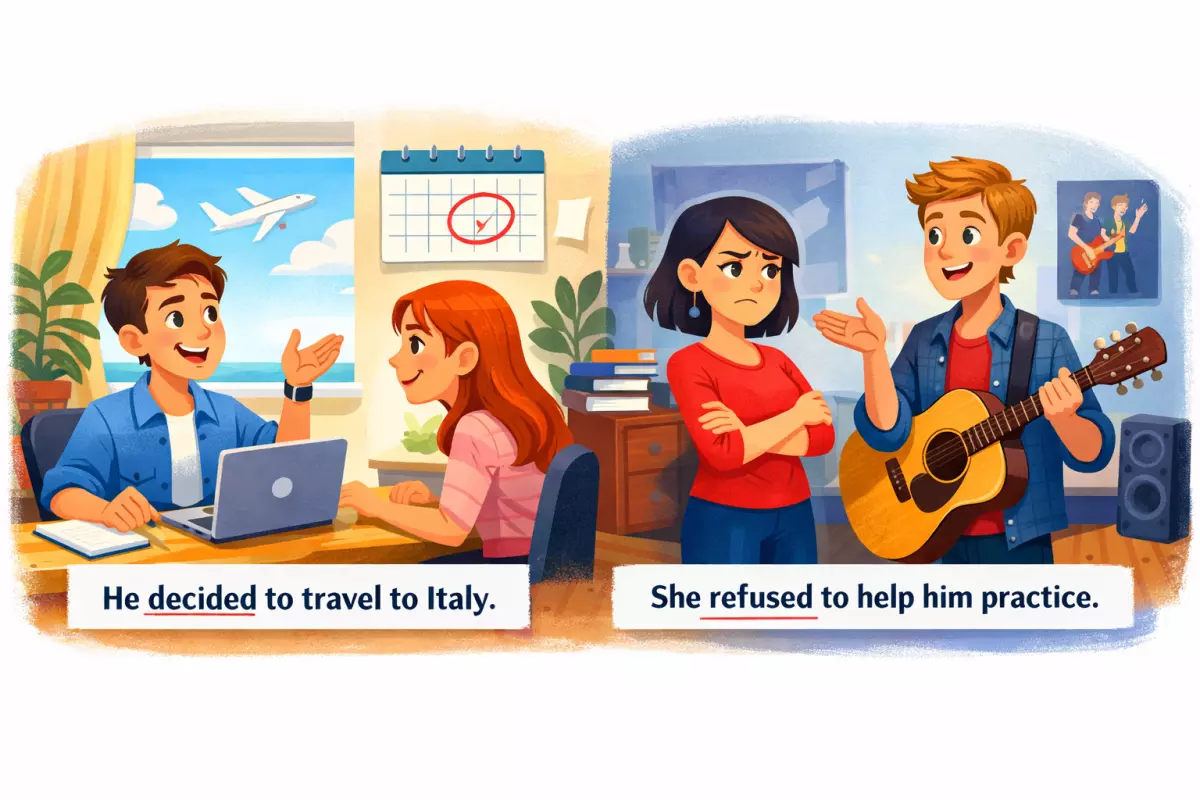
In everyday English, an infinitive often follows a main verb to show purpose, intention, decision, or an expected action. The pattern is usually verb + to + base verb, and it commonly appears after verbs about plans, promises, choices, and requests.
Common patterns you will see
- Decision or plan: verb + to-infinitive to show what someone chooses or intends to do.
- Agreement or refusal: verb + to-infinitive to show willingness or unwillingness.
- Request or instruction: verb + object + to-infinitive to show what someone wants another person to do.
- Learning and effort: verb + to-infinitive to show an attempt or process.
- Expectation: verb + to-infinitive to show what is predicted or supposed to happen.
Realistic example sentences (with useful variations)
- I decided to leave early because of the weather.
- She plans to study abroad next year.
- They agreed to meet at noon.
- He refused to answer the question.
- We hope to finish the report today.
- Do you want to join us for dinner?
- I need to call my bank before it closes.
- She managed to find a cheaper flight.
- He failed to notice the warning sign.
- They learned to drive in the city.
- The team aims to improve its customer support.
- I offered to help with the presentation.
- She promised to text when she arrived.
- We forgot to lock the door. ✅ (not: forgot locking, in this meaning)
- Please remember to bring your ID.
- The manager asked me to send the updated file.
- I told him to wait outside.
- They encouraged us to apply for the grant.
Where learners often make mistakes
- Using the wrong form after “to”: ✅ I decided to go. ❌ I decided to went.
- Missing the object when it is required: ✅ She told me to call. ❌ She told to call.
- Confusing “to” with a preposition: In “I want to leave,” to is part of the infinitive; in “I’m used to noise,” to is a preposition (so it is followed by a noun or -ing form).
When you read or listen to English, notice how these constructions often answer an implied question: “What next?” The main verb sets the attitude (plan, refuse, promise, ask), and the infinitive names the action that follows.
Common mistakes learners make with verbs like decide, hope, and plan
Verbs such as decide, hope, and plan are typically followed by the to-infinitive (to + base verb). Many errors come from mixing this pattern with -ing forms, adding extra words, or choosing the wrong structure after these verbs.
1) Using an -ing form when a to-infinitive is needed
After decide/hope/plan, learners often use a gerund because other verbs allow it. With these verbs, the standard pattern is verb + to + base verb.
- ❌ I decided going home. → ✅ I decided to go home.
- ❌ She plans studying abroad. → ✅ She plans to study abroad.
- ❌ We hope seeing you soon. → ✅ We hope to see you soon.
- ❌ They decided changing the schedule. → ✅ They decided to change the schedule.
- ❌ He planned buying a car. → ✅ He planned to buy a car.
2) Adding an unnecessary preposition (especially “to”) before the infinitive
Learners sometimes insert an extra preposition because it feels natural in their first language. In English, these verbs connect directly to the infinitive.
- ❌ I decided to to call her. → ✅ I decided to call her.
- ❌ We plan for to meet at six. → ✅ We plan to meet at six.
- ❌ She hopes for to get the job. → ✅ She hopes to get the job.
- ❌ They decided about to leave early. → ✅ They decided to leave early.
3) Confusing “hope to” with “hope that” (and mixing the structures)
Both patterns are common, but they are built differently. Avoid combining them in one clause.
- ❌ I hope to I can come. → ✅ I hope I can come.
- ❌ She hopes that to finish soon. → ✅ She hopes to finish soon.
- ❌ We hope to that you understand. → ✅ We hope that you understand.
- ✅ I hope to visit next month. (focus on the speaker’s action)
- ✅ I hope (that) you feel better soon. (focus on another situation/person)
4) Using an object after “decide/plan” when English usually prefers “to” + verb
With these verbs, English often expresses the action with an infinitive rather than a noun-only structure. If you use a noun, make sure the meaning stays clear.
- ❌ We decided a new strategy. → ✅ We decided to use a new strategy.
- ❌ She planned a trip (when you mean the action). → ✅ She planned to take a trip.
- ✅ We decided on a new strategy. (different structure: decide on + noun)
- ✅ She planned a trip. (OK if you mean “organized a trip”)
5) Misplacing “not” in negative infinitives
In negative forms, not comes before the infinitive: decide/hope/plan + not to + verb.
- ❌ I decided to not go. → ✅ I decided not to go.
- ❌ They plan to not tell anyone. → ✅ They plan not to tell anyone.
- ❌ She hopes to not be late. → ✅ She hopes not to be late.
6) Trying to use “hope” like “want” (incorrect object pattern)
Unlike want, hope does not normally take an object + infinitive (hope someone to do). Use a that-clause or a different verb.
- ❌ I hope you to come. → ✅ I hope you come.
- ❌ She hopes him to call. → ✅ She hopes he calls.
- ✅ I want you to come. (different verb pattern)
7) Tense and time confusion: “plan/decide” vs. “hope”
Plan and decide usually describe an intention or choice; hope describes a wish about a future outcome. Mixing them can make the meaning unclear.
- ❌ I hope to buy it yesterday. → ✅ I hoped to buy it yesterday, but I couldn’t.
- ❌ We decided to win tomorrow. → ✅ We hope to win tomorrow.
- ❌ She planned to pass the exam (meaning “she wishes”). → ✅ She hopes to pass the exam.
- ✅ He decided to apply today. (a choice)
- ✅ They plan to move next year. (an arrangement/intention)
Practical tips for remembering verbs that take infinitives
Learn infinitive-taking verbs faster by grouping them by meaning and by the sentence patterns they typically appear in. Instead of memorizing long lists, focus on a few “families” of verbs and practice them in short, repeatable frames (for example: “I decided to…”, “She managed to…”, “They offered to…”).
1) Memorize by meaning “families” (the pattern usually stays the same)
- Plans and decisions: decide to, choose to, plan to, intend to, agree to, refuse to
- Effort and attempts: try to, attempt to, struggle to, learn to
- Success and failure: manage to, fail to, forget to, remember to
- Promises and commitments: promise to, swear to, vow to, guarantee to
- Requests and persuasion: ask to, beg to, persuade (someone) to, encourage (someone) to
- Offers and willingness: offer to, volunteer to, be willing to, be ready to
- Need and obligation: need to, have to, be able to, be allowed to
2) Learn the most common “frames” and swap verbs in
Many errors disappear when you practice a stable sentence frame. Use these as drills and replace the verb and infinitive with your own content.
- Subject + verb + to + base verb: “I decided to leave.” / “We agreed to meet.”
- Subject + verb + not + to + base verb: “She refused not to help” (rare) vs. “She refused to help” (common); “I decided not to go.”
- Subject + verb + (object) + to + base verb: “They encouraged him to apply.” / “I asked her to wait.”
- It + verb + (object) + to + base verb (common with “take”): “It took me an hour to finish.”
3) Watch the object: some verbs change meaning depending on it
- ask: “ask to leave” (request permission for yourself) vs. “ask him to leave” (request someone else does it)
- need: “need to call” (you must call) vs. “need him to call” (you require him to call)
- expect: “expect to win” (about yourself/your group) vs. “expect them to win” (about others)
- want: “want to go” vs. “want you to go”
4) Separate “remember/forget/stop” meanings that often get mixed up
- ✅ “Remember to lock the door.” (don’t forget this task)
- ✅ “I remembered to email her.” (I did the task)
- ✅ “Stop to talk.” (pause one action in order to talk)
- ❌ “Stop talking to…” (different structure; gerund, not an infinitive)
- ✅ “Don’t forget to bring your ID.” (future task)
- ❌ “Don’t forget bringing your ID.” (unnatural in standard usage)
5) Use quick “diagnostic questions” to choose the infinitive
- Is it a future action from the viewpoint of the main verb? If yes, an infinitive is often likely: “I hope to see you tomorrow.”
- Is there an intention, decision, or attempt? These commonly take “to”: “They planned to expand.”
- Is someone trying to make another person do something? Look for “verb + object + to”: “She persuaded him to stay.”
- Does the verb express success/failure? Often “to”: “He managed to fix it.” / “They failed to respond.”
6) Build a personal mini-list and recycle it in speaking and writing
- Pick 12 high-frequency verbs that fit your needs (work, study, travel).
- Write one short sentence for each using the same topic, so the pattern stands out.
- Practice in pairs: present (“I decided to…”), past (“I decided to…”), and negative (“I decided not to…”).
- Upgrade with detail: add time, reason, or result (“I decided to leave early to avoid traffic.”).
7) Keep a short “core set” for automatic use (15 useful verbs)
- decide to
- plan to
- intend to
- agree to
- refuse to
- promise to
- offer to
- hope to
- try to
- learn to
- manage to
- fail to
- forget to
- remember to
- need to
Once these patterns feel automatic, add less common items in the same families (for example, “struggle to” with effort verbs or “volunteer to” with offer verbs). The goal is to recognize the structure quickly: a main verb that points forward to an action, followed by “to + base verb.”
Practice exercises: choose the correct infinitive form
Choose the best option based on the verb pattern: some verbs take to + infinitive, some take the bare infinitive (infinitive without to), and some allow both with a meaning change. Focus on what comes immediately after the main verb.
Exercise 1: to-infinitive or bare infinitive?
- She decided (to leave / leave) early.
- I can’t afford (to buy / buy) a new laptop right now.
- They made him (to apologize / apologize) in front of everyone.
- We hope (to see / see) you again soon.
- Did you let her (to use / use) your phone?
- He promised (to call / call) after the meeting.
- You should (to check / check) the instructions first.
- My parents encouraged me (to apply / apply) for the scholarship.
- I heard her (to sing / sing) in the next room.
- The teacher helped us (to understand / understand) the rule.
- He refused (to answer / answer) the question.
- We watched them (to play / play) basketball.
Show answers
- to leave
- to buy
- apologize
- to see
- use
- to call
- check
- to apply
- sing
- to understand
- to answer
- play
Exercise 2: verb + object + infinitive
Pick the correct form after the object. Pay attention to common patterns: verbs like want/ask/tell/encourage usually take to + infinitive, while make/let take the bare infinitive.
- She asked me (to wait / wait) outside.
- The manager told us (to finish / finish) the report by Friday.
- My friend let me (to borrow / borrow) his bike.
- The joke made everyone (to laugh / laugh).
- They invited us (to join / join) them for dinner.
- Don’t force him (to explain / explain) if he’s uncomfortable.
- The guide warned us not (to touch / touch) the paintings.
- I want you (to be / be) honest with me.
- Her coach encouraged her (to practice / practice) every day.
- Please remind me (to send / send) the email.
Show answers
- to wait
- to finish
- borrow
- laugh
- to join
- to explain
- to touch
- to be
- to practice
- to send
Exercise 3: verbs that can take both forms (meaning changes)
Choose the option that matches the intended meaning. Remember these common contrasts: remember/forget/regret can refer to an action before or after the remembering; stop can mean “finish an activity” or “pause in order to do something else.”
- I remembered (to lock / locking) the door, so we didn’t have to go back. (The door was locked earlier.)
- Remember (to bring / bringing) your ID tomorrow. (Don’t forget a future action.)
- He stopped (to smoke / smoking) last year. (He quit the habit.)
- On the way home, we stopped (to get / getting) some milk. (We paused in order to do it.)
- She’ll never forget (to meet / meeting) her favorite author. (A past experience.)
- Don’t forget (to turn off / turning off) the lights. (A future action.)
- I regret (to say / saying) that we can’t offer you the job. (Formal: giving bad news now.)
- He regrets (to spend / spending) so much money on that course. (He feels sorry about a past action.)
Show answers
- locking
- to bring
- smoking
- to get
- meeting
- to turn off
- to say
- spending
Quick pattern reminders (useful while checking your choices)
- to + infinitive after: agree, decide, hope, plan, promise, refuse, seem, want, need, offer.
- bare infinitive after modal verbs: can, could, may, might, must, should, will, would.
- bare infinitive after: let + object, make + object; and after verbs of perception in active voice: see/hear/feel + object + do.
- to + infinitive is common after an object with: ask, tell, remind, warn, invite, encourage, persuade.
- Meaning changes with: remember, forget, regret, stop (choose based on time and intention).