Verbs Followed by Gerund or Infinitive (Same Meaning)

 This article explains why some verbs take either a gerund or an infinitive, which common verbs keep the same meaning, and how sentence structure shifts when you switch forms. It covers start, begin, continue, and prefer, why one option may sound more natural, common learner mix-ups, and rewrite exercises.
- Why some verbs allow both gerunds and infinitives
- Common verbs where both forms keep the same meaning
- How sentence structure changes when switching between forms
- Examples of verbs like start, begin, continue, and prefer
- Why one form may sound more natural in certain contexts
- Typical learner confusion with interchangeable forms
- Practice exercises: rewrite sentences using both structures
Some English verbs can take either an -ing form or a to-infinitive with little or no change in meaning. This small detail matters in everyday speech because it lets you choose the structure that sounds most natural while keeping your message clear. Here we cover common verbs that work both ways, how they appear in real conversation, and a few tricky cases that can confuse learners.
Why some verbs allow both gerunds and infinitives
Some English verbs can be followed by either a gerund (-ing form) or an infinitive (to + base verb) because both structures can express the same basic idea: an activity or event treated as a “thing.” In these cases, the verb is flexible about how that activity is packaged, so the meaning stays essentially the same.
1) Both forms can act like a noun after certain verbs
After many common verbs, the next idea functions as an object (something you like, love, hate, prefer, etc.). English allows that object to be expressed either as a gerund phrase or as an infinitive phrase.
- Gerund as an object: “I like swimming.”
- Infinitive as an object: “I like to swim.”
- Because both “swimming” and “to swim” can fill the object slot, the choice often doesn’t change the core message.
2) The verb’s meaning is “general attitude,” not a specific time reference
Verbs that express a general attitude (enjoyment, dislike, preference, intention in a broad sense) often accept either form without forcing a change in time or sequence. The listener understands the action as a general activity, not as “before” or “after” something else.
- “She loves traveling.” / “She loves to travel.”
- “They hate waiting.” / “They hate to wait.”
- “We prefer walking.” / “We prefer to walk.”
- In contrast, verbs like “remember” or “stop” usually change meaning depending on the form, because they encode time/sequence more strongly.
3) Register and rhythm can influence the choice
When meaning is the same, speakers often choose the structure that sounds more natural in context. The infinitive can feel slightly more “goal-focused” or formal in some sentences, while the gerund can feel more like a general habit or experience. This is a tendency, not a hard rule, and both are usually acceptable.
- More general/habit: “I like reading before bed.”
- More situational/choice: “I like to read before bed when I have time.”
- Sound and flow: “I love to cook, but I hate doing the dishes.”
4) Pattern clues: which verbs are most likely to allow both
When a verb describes preference, enjoyment, or a general choice, it often allows both complements. These are common “flexible” verbs learners meet early, especially in everyday speech.
- Like: “I like cooking.” / “I like to cook.”
- Love: “She loves dancing.” / “She loves to dance.”
- Hate: “He hates waiting.” / “He hates to wait.”
- Prefer: “We prefer staying home.” / “We prefer to stay home.”
- Start: “It started raining.” / “It started to rain.”
- Begin: “They began talking.” / “They began to talk.”
- Continue: “She continued working.” / “She continued to work.”
- Can’t stand: “I can’t stand listening to that.” / “I can’t stand to listen to that.”
- Attempt: “He attempted fixing it.” / “He attempted to fix it.”
- Intend (sometimes in modern usage): “I intend going early.” / “I intend to go early.”
- Cease (more formal): “The noise ceased bothering me.” / “The noise ceased to bother me.”
- Neglect (more formal): “She neglected locking the door.” / “She neglected to lock the door.”
5) A practical guideline for learners
- If the verb expresses a feeling or preference, either form is often fine: “like/love/hate/prefer.”
- If the verb describes the start or continuation of an action, both are often possible: “start/begin/continue.”
- If changing the form changes the meaning (common with “remember,” “stop,” “try,” “regret”), treat it as a different category and learn the two patterns separately.
- When unsure, choose the form that is most common with that verb in your variety of English, and keep the sentence consistent in style.
Common verbs where both forms keep the same meaning
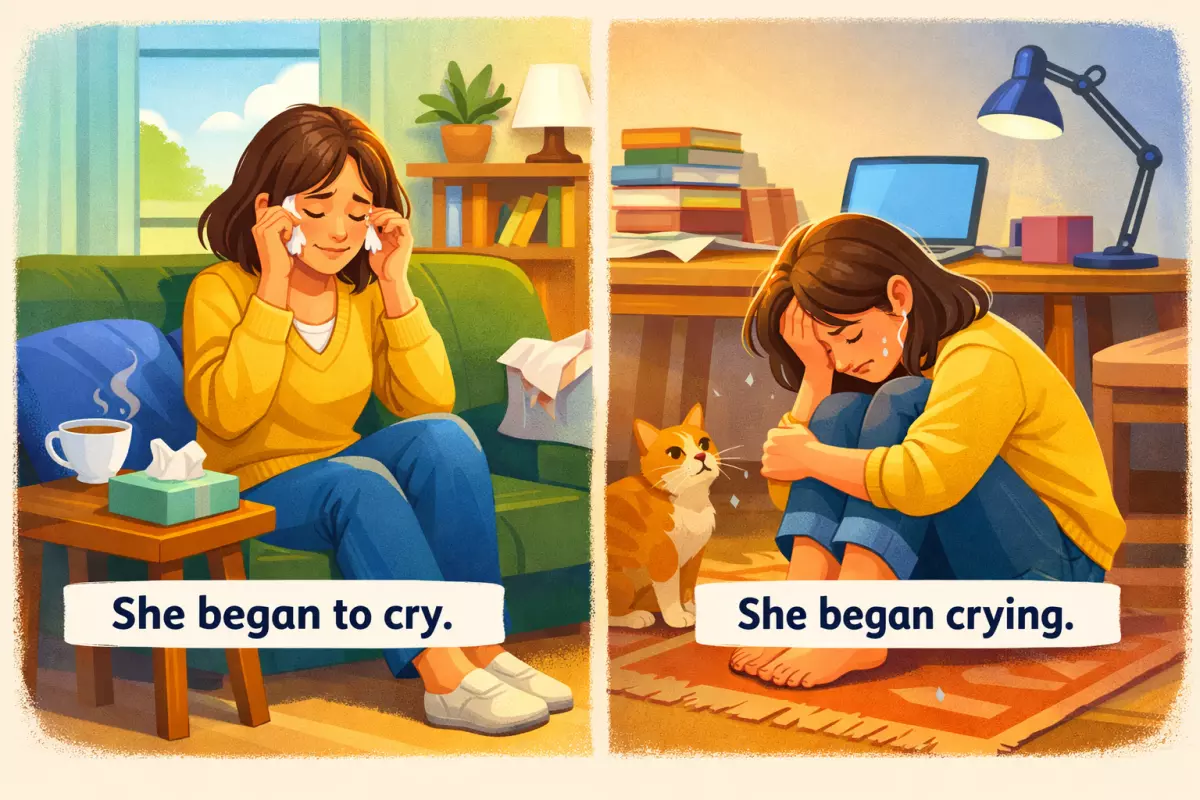
Some verbs can be followed by either a gerund (-ing) or an infinitive (to + base verb) with little or no change in meaning. In these cases, the choice is usually about style, rhythm, or what sounds more natural in context, rather than a difference in time or intention.
Use the patterns below as a guide. The examples show both options; both are acceptable unless a note says there is a common preference.
Verbs that usually allow both forms (no major meaning change)
- begin: She began to cry / She began crying when she heard the news.
- start: They started to talk / They started talking about the plan.
- continue: He continued to work / He continued working despite the noise.
- intend (often infinitive, but gerund can appear in some contexts): I intend to apply / I intend applying next week (less common).
- love: I love to cook / I love cooking for friends.
- like: She likes to read / She likes reading before bed.
- hate: He hates to wait / He hates waiting in long lines.
- prefer: We prefer to walk / We prefer walking when the weather is good.
- can’t stand: I can’t stand to be / I can’t stand being interrupted.
- can’t bear: She can’t bear to watch / She can’t bear watching scary movies.
- attempt (often infinitive, but both occur): They attempted to fix / They attempted fixing the leak.
- cease (more formal): The factory ceased to operate / ceased operating last year.
Usage notes that help you choose naturally
- With “start” and “begin,” both forms are common. Many speakers avoid the gerund when the next word is another -ing form for sound reasons: ✅ It started to rain. (Many avoid: It started raining heavily, though it is still grammatically fine.)
- With “like/love/hate/prefer,” the meaning is usually the same, but the infinitive can sound slightly more like a choice or habit in some contexts: I like to get up early (habit) / I like getting up early (enjoyment). In most everyday sentences, either works.
- After “can’t bear/can’t stand,” gerunds are very common in modern English, but infinitives are also correct, especially in more formal or careful speech.
- Keep the structure consistent when you coordinate verbs: She started to read and to take notes (parallel) / She started reading and taking notes.
Quick pattern reminder
- Gerund: verb + -ing → She continued working.
- Infinitive: verb + to + base verb → She continued to work.
How sentence structure changes when switching between forms
When a verb allows both a gerund and an infinitive with little or no change in meaning, the grammar around it still shifts in predictable ways. The main changes involve how you place objects, how you express purpose, and which extra words (like possessives or prepositions) sound natural.
Common structural shifts to watch
- Direct object position often stays the same, but the verb form changes:
✅ I like reading mystery novels.
✅ I like to read mystery novels. - When the “action” has its own object, both forms usually take it normally (no extra preposition needed):
✅ She loves cooking Italian food.
✅ She loves to cook Italian food. - With a person as the object, many verbs allow two patterns, but the meaning can shift slightly (preference vs. request/choice). Keep the structure consistent:
✅ I prefer to leave early.
✅ I prefer leaving early.
✅ I prefer you to leave early. (different structure; more like a preference about someone else) - Infinitives more easily take an explicit subject (object + to + verb). This is common after verbs like like, love, hate, prefer, intend:
✅ I’d like you to join us.
❌ I’d like you joining us. (possible in some contexts, but not the normal structure for “want/would like”) - Gerunds behave like nouns, so they fit naturally after prepositions and in noun-like slots (subject, complement):
✅ Swimming helps me relax.
✅ My hobby is painting.
❌ My hobby is to paint. (possible but less natural in this “noun label” pattern) - Infinitives often sound more “goal/purpose” oriented, so they are common after adjectives and in purpose-like frames:
✅ I’m happy to help.
✅ I called to ask a question. - Gerunds often sound more general or activity-focused, especially when talking about something as a category:
✅ He hates waiting in lines.
✅ He hates to wait in lines. (possible, often more specific to situations) - Negative placement changes slightly depending on the form:
✅ She decided not to go.
✅ She dislikes not getting feedback. - Perfect forms shift the time reference and can be used with either structure when allowed by the main verb:
✅ He regrets having said that. (gerund perfect: earlier action)
✅ He seems to have forgotten my name. (infinitive perfect: earlier action) - Passive forms are available in both, but the infinitive passive is especially common after “want/need/expect”-type meanings:
✅ The report needs editing.
✅ The report needs to be edited. - Possessives before gerunds are possible in more formal English when you want to highlight who performs the action:
✅ I appreciate your helping me.
✅ I appreciate you helping me. (more common in everyday speech) - “Too” and “enough” patterns prefer infinitives, so switching to a gerund usually forces a different structure:
✅ She’s too tired to drive.
❌ She’s too tired driving. - Question structure stays the same, but the complement changes form:
✅ Do you like working from home?
✅ Do you like to work from home? - Parallel lists should keep the same form for clarity (don’t mix gerunds and infinitives without a reason):
✅ She likes reading, writing, and drawing.
✅ She likes to read, to write, and to draw. - Short answers and reduced clauses often favor gerunds because they act like compact noun phrases:
✅ I enjoy traveling.
✅ I enjoy to travel. (grammatical, but less common as a standalone preference statement) - Some verbs allow both, but the “feel” changes with context: gerunds often sound like a general habit; infinitives can sound more like a choice at a moment in time:
✅ I like getting up early. (general preference)
✅ I like to get up early when I have time. (often situational)
When you switch between the two forms, keep an eye on what comes immediately after the main verb: a noun-like phrase (gerund) tends to fit smoothly into “topic/activity” sentences, while an infinitive often pairs naturally with patterns that express intention, preference in a specific situation, or an explicit subject (object + to + verb).
Examples of verbs like start, begin, continue, and prefer

With certain verbs, both the gerund (-ing) and the infinitive (to + base verb) can follow with little or no change in meaning. The choice often depends on style, rhythm, and whether the sentence sounds more natural with a noun-like form (gerund) or a more “purpose/plan” feeling (infinitive).
Start / begin
- start + -ing / to + verb: “She started working early.” / “She started to work early.”
- begin + -ing / to + verb: “It began raining.” / “It began to rain.”
- After these verbs, both forms are common in speech and writing; the gerund is especially frequent with activities: “He started reading more.”
- When the following verb is short and the sentence is formal, the infinitive can sound slightly more neutral: “The meeting began to proceed as planned.”
- With a long -ing phrase, the infinitive may feel lighter: “She began to explain how the system works.”
Continue
- continue + -ing / to + verb: “They continued talking.” / “They continued to talk.”
- Use either form to show that an action does not stop: “He continued working despite the noise.”
- The infinitive often fits well when the next action is described as a decision or plan: “After a short break, we continued to discuss the budget.”
- With repeated or ongoing activities, -ing is very natural: “She continued practicing every day.”
Prefer
- prefer + -ing / to + verb (general preference): “I prefer walking.” / “I prefer to walk.”
- prefer + -ing + to + -ing (clear comparison): “I prefer walking to driving.”
- prefer + to + verb + rather than + verb (more formal comparison): “I prefer to walk rather than drive.”
- Keep the structure parallel in comparisons: ✅ “prefer reading to watching TV” ❌ “prefer reading to watch TV”
- Use -ing to talk about activities as categories: “She prefers studying in the morning.”
- Use the infinitive when the preference feels like a choice in a specific situation: “I prefer to sit near the window today.”
More model sentences (mix and match)
- “When the lights went out, we started to look for our phones.”
- “He began learning Spanish last year.”
- “They continued to negotiate until midnight.”
- “She continued working without complaining.”
- “I prefer to cook at home on weekdays.”
- “I prefer cooking at home to eating out.”
- “The audience began to clap.”
- “The baby started crying as soon as we left.”
- “He prefers to take notes during lectures.”
- “She began to understand the rules after a few examples.”
Why one form may sound more natural in certain contexts
With verbs that can take either a gerund or an infinitive without a real change in meaning, speakers still tend to choose one form more often in certain situations. The preference usually comes from rhythm, register (formal vs. informal), and what the speaker wants to emphasize: the activity itself, a specific action, or a general plan.
Common usage patterns that influence the choice
- General plan vs. activity focus: The infinitive often highlights a plan or intention; the gerund often highlights the activity as a thing.
- Infinitive: “I like to get up early on weekdays.” (routine choice/plan)
- Gerund: “I like getting up early.” (the experience in general)
- More formal or careful style: In many contexts, the infinitive sounds slightly more formal or “written.”
- “We love to inform you that…” (formal)
- “We love hearing from you.” (more conversational)
- Fixed-sounding collocations: Some combinations are simply more common in everyday English, so they feel more natural.
- More common: “I like to think…”
- More common: “I love to see…”
- More common: “I prefer to wait.”
- After would for preferences: When expressing a polite preference, the infinitive is strongly preferred.
- ✅ “I’d like to leave now.”
- ❌ “I’d like leaving now.”
- ✅ “I’d prefer to sit here.”
- ❌ “I’d prefer sitting here.”
- One-time choice vs. general enjoyment: The infinitive can sound like a specific choice in a particular situation; the gerund often sounds like a general statement.
- “I like to walk home today.” (today’s choice)
- “I like walking home.” (general preference)
- Sound and rhythm: Speakers often pick the form that flows better with the next words, especially in longer sentences.
- “I prefer to work from home when it’s raining.” (smooth before a long condition)
- “I prefer working from home.” (short, self-contained)
Verb-by-verb tendencies (same meaning, different “feel”)
- like: “like + gerund” is common for general enjoyment; “like + infinitive” is common for habits or choices.
- “She likes reading in bed.”
- “She likes to read before sleep.”
- love: both are possible; “love + gerund” often sounds warmer and more immediate in casual speech.
- “I love cooking for friends.”
- “I love to cook on weekends.”
- prefer: “prefer + infinitive” is especially common when comparing choices; “prefer + gerund” is common for general preferences.
- “I prefer to drive at night.”
- “I prefer driving to taking the train.”
- begin / start: both forms are normal; the choice is often about style and sentence shape (not meaning).
- “It started to rain.”
- “It started raining.”
- continue: both are acceptable; “continue + infinitive” can sound slightly more formal.
- “He continued to speak.”
- “He continued speaking.”
Quick examples where one option is often the default
- Polite requests/preferences: “I’d like to ask a question.”
- General enjoyment: “They love traveling.”
- Habits/routines: “I like to check my email in the morning.”
- General statement about an activity: “I like swimming.”
- Starting an event (common in conversation): “She started crying.”
- Starting a deliberate action (often sounds careful): “She started to explain.”
- Continuing a process (neutral): “He continued working.”
- Continuing in a formal report: “The company continued to expand.”
- Comparing options: “I prefer to stay home rather than go out.”
- Preference as a hobby-like statement: “I prefer hiking.”
In most cases, both forms are grammatically correct and understandable. The more natural choice depends on whether the sentence is about a general activity, a specific decision, or a more formal statement, and on which pattern is more common with that verb in that situation.
Typical learner confusion with interchangeable forms
When a verb can take either a gerund (-ing) or an infinitive (to + base verb) with little or no change in meaning, learners often overgeneralize the pattern or mix the two forms in the same structure. The points below focus on the most common usage traps and how to avoid them.
1) Mixing two patterns after one verb
- ❌ I like to swimming. → ✅ I like swimming / I like to swim.
- ❌ She prefers to working alone. → ✅ She prefers working alone / She prefers to work alone.
- ❌ We started to going earlier. → ✅ We started going earlier / We started to go earlier.
- Tip: choose one form and keep it consistent within the same clause.
2) Forgetting that some verbs are “interchangeable” only in certain meanings
- Like: “I like swimming” and “I like to swim” are both common, but “like to” often sounds more like a choice or habit in a specific situation.
- Love / hate: both forms are possible, but “hate to” is frequently used for actions someone feels forced to do (e.g., “I hate to interrupt”).
- Start / begin: both forms are possible, but the -ing form is often preferred for ongoing activities in natural speech.
- Tip: if the verb has more than one meaning (or a common fixed phrase), check whether the meaning stays the same before swapping forms.
3) Confusing “try” and “stop” with the same-meaning group
- Some learners assume any verb can take both forms without changing meaning. That is not true for key verbs like try and stop.
- ✅ I stopped smoking. (I quit the activity.)
- ✅ I stopped to smoke. (I paused another action in order to smoke.)
- ✅ Try restarting the computer. (Experiment: see if it helps.)
- ✅ Try to restart the computer. (Make an effort; attempt.)
- Tip: don’t “trade” -ing and to-infinitive with these verbs unless you want the meaning to change.
4) Overusing the infinitive after “go”
- For activities, English often uses go + gerund, not “go + to + verb.”
- ❌ Let’s go to swim. → ✅ Let’s go swimming.
- ❌ They went to shop yesterday. → ✅ They went shopping yesterday.
- Note: “go to swim” can exist, but it usually means “go to the place in order to swim” and sounds more specific/less idiomatic than “go swimming.”
5) Choosing a form that clashes with time or style
- Even when meaning is similar, one form may sound more natural in a particular context.
- General enjoyment often sounds smoother with -ing: “I like reading in bed.”
- One specific choice often sounds smoother with to-infinitive: “I like to read before I sleep tonight.”
- With would like / would love / would hate, the infinitive is strongly preferred: ✅ “I’d like to leave early.” (Not: “I’d like leaving early.”)
6) Misplacing objects and pronouns
- When there is an object, keep the object directly after the main verb, then use the gerund or infinitive pattern that fits.
- ✅ I prefer him to drive. / I prefer driving. (Different structures; don’t merge them.)
- ❌ I prefer him driving alone. (Possible in some contexts, but it changes the structure and can sound less direct than “prefer him to drive.”)
- ✅ She likes me to help. / She likes helping. (Avoid “likes me helping” unless you specifically mean you are already doing it.)
7) Treating “remember/forget/regret” as interchangeable
- These verbs can take both forms, but the meaning usually changes (time reference), so they don’t belong to the “same meaning” set in most sentences.
- ✅ I remembered to lock the door. (First remember, then lock.)
- ✅ I remember locking the door. (Memory of a past action.)
- Tip: if the verb relates to memory or feelings about the past, switching forms often changes the timeline.
8) Quick checklist for safer choices
- If the verb is commonly flexible (like, love, hate, start, begin, continue), either form may work, but pick the one that fits the context (general vs. specific).
- If the verb is known for meaning changes (stop, try, remember, forget, regret), don’t swap forms unless you intend the different meaning.
- If the structure is “go + activity,” default to go + -ing (go shopping, go running, go swimming).
- If you see “would like/love/hate,” default to to + verb.
Practice exercises: rewrite sentences using both structures
Rewrite each sentence in two ways: one version with a gerund (-ing) and one version with an infinitive (to + base verb). Keep the meaning the same, and adjust pronouns or word order only when needed.
Task A: Two-way rewrites (gerund and infinitive)
- I started to learn Spanish last year.
- She began working at 7 a.m.
- We continued to talk after the meeting.
- They continued walking despite the rain.
- He likes to cook for friends.
- He likes cooking for friends.
- Do you love to travel alone?
- Do you love traveling alone?
- I hate to interrupt, but we’re late.
- I hate waiting in long lines.
- She prefers to study in the morning.
- She prefers studying in the morning.
Show answers
- I started learning Spanish last year. / I started to learn Spanish last year.
- She began to work at 7 a.m. / She began working at 7 a.m.
- We continued talking after the meeting. / We continued to talk after the meeting.
- They continued to walk despite the rain. / They continued walking despite the rain.
- He likes cooking for friends. / He likes to cook for friends.
- He likes to cook for friends. / He likes cooking for friends.
- Do you love traveling alone? / Do you love to travel alone?
- Do you love to travel alone? / Do you love traveling alone?
- I hate interrupting, but we’re late. / I hate to interrupt, but we’re late.
- I hate to wait in long lines. / I hate waiting in long lines.
- She prefers studying in the morning. / She prefers to study in the morning.
- She prefers to study in the morning. / She prefers studying in the morning.
Task B: Choose the correct verb form, then rewrite using the other structure
Complete each sentence with either the gerund or the infinitive (both are possible). Then rewrite the full sentence using the alternative form.
- We started ________ (pack) as soon as the taxi arrived.
- He continued ________ (work) even when the computer froze.
- My parents love ________ (watch) old movies on weekends.
- I prefer ________ (take) the train if the weather is bad.
- She hates ________ (make) phone calls in public.
- They began ________ (discuss) the budget in detail.
- Do you like ________ (study) with music on?
- We continued ________ (wait) because the announcement was unclear.
- He prefers ________ (work) from home on Fridays.
- I love ________ (meet) new people when I travel.
Show answers
- We started packing as soon as the taxi arrived. / We started to pack as soon as the taxi arrived.
- He continued working even when the computer froze. / He continued to work even when the computer froze.
- My parents love watching old movies on weekends. / My parents love to watch old movies on weekends.
- I prefer taking the train if the weather is bad. / I prefer to take the train if the weather is bad.
- She hates making phone calls in public. / She hates to make phone calls in public.
- They began discussing the budget in detail. / They began to discuss the budget in detail.
- Do you like studying with music on? / Do you like to study with music on?
- We continued waiting because the announcement was unclear. / We continued to wait because the announcement was unclear.
- He prefers working from home on Fridays. / He prefers to work from home on Fridays.
- I love meeting new people when I travel. / I love to meet new people when I travel.
Quick usage reminders while you rewrite
- With start and begin, both forms are common; choose one and keep the tense consistent: started/began + -ing or started/began + to + verb.
- With continue, both options work; the infinitive can sound slightly more formal in some contexts.
- With like/love/hate/prefer, both patterns are usually possible when you mean a general preference; keep the sentence meaning stable when you switch forms.
- If you add an object, place it after the verb phrase: love meeting new people / love to meet new people.
- When the sentence includes a short interruption (for example, “but …”), rewrite the verb form without changing punctuation or the message.