Verbs Followed by Gerund or Infinitive (Different Meaning)

 This article explains why meaning shifts between gerunds and infinitives, focusing on verbs like remember, stop, forget, and try. It gives paired sentence examples, shows how context picks the right pattern, flags common mistakes, and ends with practice exercises.
- Why the meaning changes with gerund vs infinitive
- Key verbs like remember, stop, forget, and try
- Sentence examples showing different meanings with each form
- How context determines the correct verb pattern
- Common learner mistakes with verbs that change meaning
- How meaning changes depending on the structure used
- Practice exercises: choose the correct form based on meaning
Some English verbs can take either an -ing form or a to form after them, and the choice can subtly change the meaning. This matters in everyday talk about memories, plans, and regrets: I remember meeting her differs from I remembered to meet her. In this lesson, you will learn to notice these shifts and pick the form that matches what you truly intend to say.
Why the meaning changes with gerund vs infinitive
The choice between a gerund (-ing) and an infinitive (to + verb) often signals how the speaker frames the action: as a real experience, a habit, or a completed event (gerund), versus an intention, purpose, plan, or “next step” (infinitive). With a small group of verbs, that shift in framing is strong enough to create a different meaning.
Core idea: “experienced/actual” vs “intended/possible”
- Gerund (-ing) commonly points to something seen, done, or remembered as an actual event (often looking backward or describing a general activity).
- Infinitive (to + verb) commonly points to a goal, decision, promise, or action that happens after the main verb (often looking forward).
- Some verbs allow both forms because they can express either viewpoint; the form you choose tells the listener which viewpoint you mean.
Meaning shifts you can predict (with examples)
- remember
- Gerund = memory of a past action: “I remember locking the door.”
- Infinitive = don’t forget a duty: “Remember to lock the door.”
- forget
- Gerund = memory disappears (past): “I’ll never forget meeting her.”
- Infinitive = fail to do something (future/obligation): “I forgot to call you.”
- stop
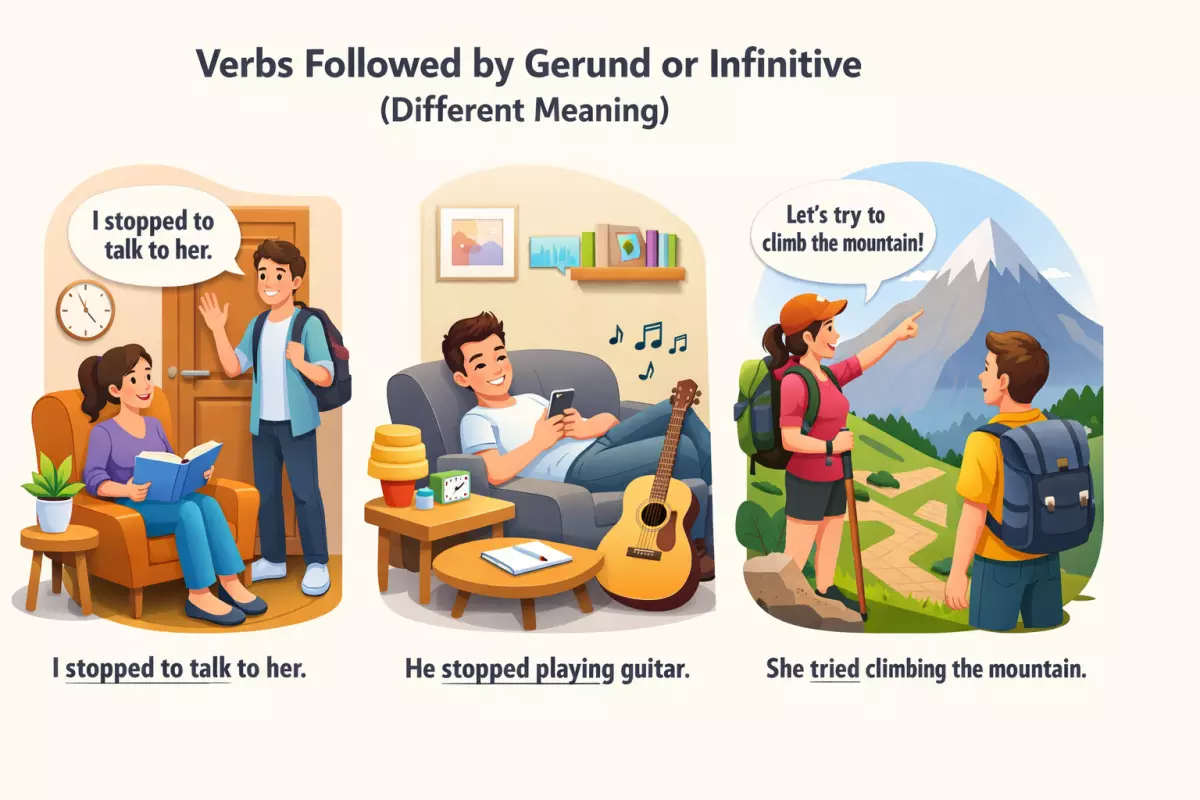
- Gerund = quit an activity: “He stopped smoking.”
- Infinitive = pause one action in order to do another: “He stopped to smoke.”
- try
- Gerund = experiment with a method: “Try restarting the computer.”
- Infinitive = attempt something difficult: “I tried to restart it, but it wouldn’t turn on.”
- regret
- Gerund = feel sorry about a past action: “She regrets leaving early.”
- Infinitive = formal/polite bad news (the speaking happens now): “We regret to inform you that…”
- go on
- Gerund = continue the same activity: “He went on talking.”
- Infinitive = move to the next step/topic: “He went on to explain the rules.”
- mean
- Gerund = involve/require: “This job means working weekends.”
- Infinitive = intend: “I meant to call you.”
- need
- Gerund (often passive meaning) = requires attention: “The car needs cleaning.”
- Infinitive = it is necessary to do: “I need to clean the car.”
Usage patterns that explain the difference
- Time relationship: gerunds often point to an action that happened before (or is generally true); infinitives often point to an action that happens after the main verb.
- Function in the sentence: a gerund behaves like a noun (an activity or experience), while an infinitive often behaves like a “plan” or “purpose” unit.
- Control and intention: infinitives frequently highlight choice or intention (“decide to…”, “plan to…”), while gerunds often describe the activity itself (“enjoy doing…”, “avoid doing…”).
- Common learner trap: mixing up “stop doing” and “stop to do” changes the meaning completely. ✅ “Stop talking.” ❌ “Stop to talk.” (unless you mean “pause something else in order to talk”).
Key verbs like remember, stop, forget, and try
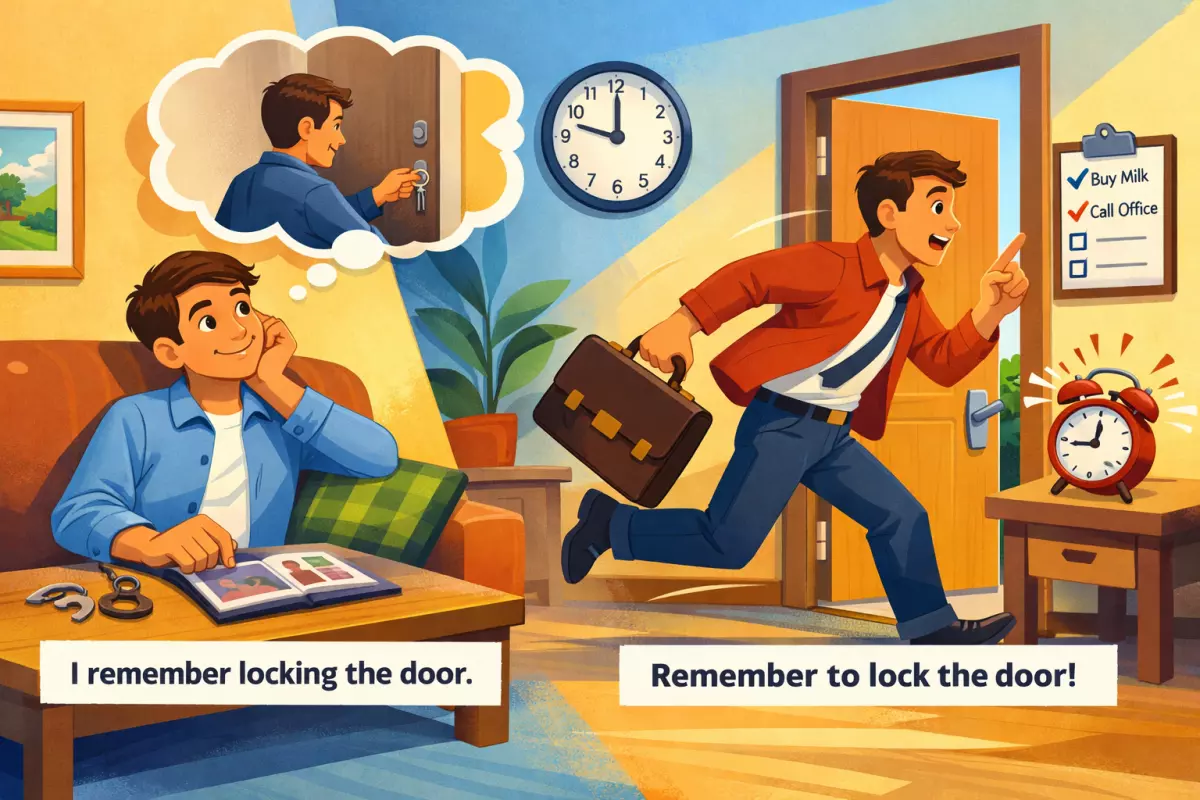
Some common verbs can be followed by either a gerund (-ing) or an infinitive (to + base verb), but the meaning changes depending on the form. The difference is usually about time (before vs. after), intention, or whether an action is a memory, a plan, or an experiment.
| Verb | Verb + gerund (V-ing): typical meaning | Verb + infinitive (to + V): typical meaning | Examples |
|---|---|---|---|
| remember | Remember a past action (memory of doing it). | Remember to do something (don’t forget a task). | I remember locking the door. / Remember to lock the door. |
| forget | Forget a past action (no memory of doing it). | Forget to do something (fail to do a task). | I’ll never forget meeting her. / I forgot to call you. |
| stop | Stop an activity (quit the action in progress). | Stop in order to do something else (pause one action for another). | He stopped smoking. / He stopped to smoke. |
| try | Experiment with a method; see what happens. | Make an effort; attempt something difficult or uncertain. | Try restarting the computer. / Try to restart the computer. |
Remember vs. forget: memory (gerund) vs. responsibility (infinitive)
With remember and forget, the gerund usually looks back at an earlier experience, while the infinitive points forward to a task that should happen later. This is one of the most reliable meaning shifts in English.
- remember + V-ing: “I have a memory of this.” → I remember seeing that movie in 2019.
- remember + to + V: “Don’t miss this task.” → Remember to bring your ID.
- forget + V-ing: “I can’t recall it happened.” → She forgot meeting him at the conference.
- forget + to + V: “The task didn’t happen.” → They forgot to send the invoice.
- Time clue: if the action is already completed, the -ing form is more likely; if it is a duty or plan, the infinitive is more likely.
- Common contexts for the infinitive: reminders, instructions, checklists, warnings (Remember to…, Don’t forget to…).
Stop: ending an activity vs. stopping in order to do something
Stop + V-ing means the activity itself ends. Stop + to + V means you pause one activity so you can do another action (often briefly). The two patterns can produce very different meanings in real situations.
- stop + V-ing: He stopped talking when the teacher entered.
- stop + V-ing: I stopped working at 6 p.m.
- stop + V-ing: They stopped complaining after the policy changed.
- stop + to + V: She stopped to talk to a neighbor.
- stop + to + V: We stopped to get coffee on the way home.
- stop + to + V: He stopped to check his phone, then kept walking.
- Quick check: ask “What did the person stop?” If the answer is an activity (smoking, talking, working), use -ing. If the answer is “stopped walking/driving/etc. in order to…”, use to + V.
Try: experiment (gerund) vs. attempt (infinitive)
Try + V-ing often suggests testing a possible solution. Try + to + V focuses on effort, especially when success is uncertain or the action is difficult to complete.
- try + V-ing: Try turning it off and on again.
- try + V-ing: If you can’t sleep, try reading for a few minutes.
- try + V-ing: Try using a different password.
- try + to + V: I tried to open the window, but it was stuck.
- try + to + V: She’s trying to learn Japanese.
- try + to + V: We tried to contact support all morning.
- Meaning clue: “try -ing” = “test this method”; “try to” = “make an effort to achieve the result.”
Common learner mistakes to watch for
- ❌ I remembered to lock the door yesterday. (This sounds like a completed memory, so it usually needs -ing.) → ✅ I remember locking the door yesterday.
- ❌ I forgot locking the door, so I left it open. (If it was left open, the task didn’t happen.) → ✅ I forgot to lock the door, so I left it open.
- ❌ He stopped to smoke means he quit smoking. (It usually means he paused another activity in order to smoke.) → ✅ He stopped smoking = he quit.
- ❌ Try to restart your router (when giving a quick suggestion). (This can sound like a difficult attempt.) → ✅ Try restarting your router (suggested method).
Sentence examples showing different meanings with each form
Some verbs can be followed by either a gerund (-ing) or an infinitive (to + base verb), but the choice changes the meaning. The examples below show the most common patterns and what each form communicates in real sentences.
| Verb + gerund (meaning) | Verb + infinitive (meaning) |
|---|---|
| remember + -ing: I remember locking the door. (I have a memory of it.) | remember + to: Remember to lock the door. (Don’t forget to do it.) |
| forget + -ing: I’ll never forget meeting her. (I will always remember that past event.) | forget + to: I forgot to email you. (I didn’t do the action.) |
| stop + -ing: She stopped smoking. (She quit the activity.) | stop + to: She stopped to smoke. (She paused another action in order to smoke.) |
| try + -ing: Try restarting the router. (Experiment with a method to see if it helps.) | try + to: I tried to restart the router, but it wouldn’t turn on. (Attempted, possibly unsuccessfully.) |
| regret + -ing: I regret telling him the secret. (I’m sorry about a past action.) | regret + to: We regret to inform you that your application was unsuccessful. (Formal: sorry to give bad news now.) |
| go on + -ing: He went on talking for hours. (Continued the same activity.) | go on + to: He went on to explain the next step. (Moved to a new action/topic.) |
| mean + -ing: This job means working weekends. (Involves; has as a result.) | mean + to: I meant to call you. (Intended to.) |
| need + -ing: The kitchen needs cleaning. (Passive meaning: it needs to be cleaned.) | need + to: I need to clean the kitchen. (The subject must do it.) |
| want + -ing: The car wants washing. (BrE: needs washing; passive meaning.) | want + to: I want to wash the car today. (Desire/plan.) |
| like + -ing: I like getting up early. (Enjoy it as an activity/habit.) | like + to: I like to get up early on weekdays. (Preference/choice; often sounds like “I think it’s a good idea.”) |
| hate + -ing: She hates waiting in lines. (Dislikes the experience in general.) | hate + to: I hate to interrupt, but we’re out of time. (Dislike doing it in this situation; often polite.) |
| love + -ing: They love traveling by train. (Enjoy the activity.) | love + to: He loves to travel when work is slow. (Enjoys doing it; can sound more general or habitual.) |
Quick usage notes
- Memory vs. obligation: remember/forget + -ing looks back; remember/forget + to looks forward to an action you must do.
- Quit vs. pause for a purpose: stop + -ing ends an activity; stop + to interrupts one action to do another.
- Experiment vs. attempt: try + -ing suggests “test this method”; try + to focuses on effort and whether you succeeded.
- Formal announcements: regret + to is common in official messages; regret + -ing is personal and refers to a past choice.
- Passive meaning with -ing: need/want + -ing often means “needs to be done,” especially with things (not people).
How context determines the correct verb pattern

Choosing between a gerund (-ing) and an infinitive (to + base verb) often depends on what the speaker is trying to communicate: a completed action vs. an intention, a memory vs. a reminder, or an action as a general activity vs. a specific future plan. With several verbs, the form is not just “grammar”; it changes the meaning.
Decide the meaning first, then choose the form
- Past vs. future focus: some verbs use the gerund to look back at a real event, and the infinitive to point forward to a planned or expected action.
- Experience vs. intention: the -ing form can describe what actually happened; the infinitive can describe what was meant to happen.
- General activity vs. a specific occasion: gerunds often treat the action as an activity in general, while infinitives often highlight a particular instance, purpose, or goal.
- Stopping/starting meaning changes: with a few verbs, the form signals whether you stop the action itself or stop another action in order to do something else.
- Advice/warning vs. recollection: some verbs use the infinitive for reminders and the gerund for memories.
Common context-driven pairs (meaning changes)
| Verb + gerund (-ing) | Verb + infinitive (to + verb) | Typical context | Example contrast |
|---|---|---|---|
| remember doing | remember to do | memory vs. reminder | I remember meeting her in 2019. / Remember to meet her at 3. |
| forget doing | forget to do | no memory of a past action vs. fail to do a task | I forgot locking the door. / I forgot to lock the door. |
| stop doing | stop to do | end an activity vs. pause another activity for a purpose | He stopped smoking. / He stopped to smoke. |
| try doing | try to do | experiment with a method vs. attempt a difficult goal | Try restarting the phone. / I tried to restart it, but it wouldn’t turn on. |
| regret doing | regret to do | feel sorry about a past action vs. formal bad-news announcement | I regret saying that. / We regret to inform you that your order was canceled. |
| go on doing | go on to do | continue the same activity vs. move to the next step | She went on talking. / She went on to explain the main rule. |
| mean doing | mean to do | involve/require vs. intend | This means working weekends. / I meant to call you. |
| need doing | need to do | passive meaning (requires) vs. responsibility/plan | The kitchen needs cleaning. / I need to clean the kitchen. |
| can’t help doing | can’t help (to) do | unable to stop oneself (common) vs. rare/older “cannot avoid” | I can’t help laughing. / (Less common) I can’t help to notice the mistake. |
| be afraid of doing | be afraid to do | fear of a possible result vs. reluctance to take an action | I’m afraid of falling. / I’m afraid to climb that ladder. |
Quick checks to avoid the most common mix-ups
- Use “remember/forget + -ing” when you are talking about a real past event: “I remember paying,” “She forgot turning it off.”
- Use “remember/forget + to” for tasks and obligations: “Remember to pay,” “She forgot to turn it off.”
- Use “stop + -ing” when the activity ends: “They stopped arguing.”
- Use “stop + to” when the first action pauses for a purpose: “They stopped to argue with the manager.”
- Use “try + -ing” to suggest a method: “Try taking notes,” “Try using a different charger.”
- Use “try + to” to describe effort toward a goal: “I tried to explain,” “We tried to finish on time.”
- Use “go on + -ing” for continuing: “He went on complaining.”
- Use “go on + to” for the next stage: “He went on to complain about the service.”
- Use “need + -ing” when the thing requires an action (passive meaning): “The report needs editing.”
- Use “need + to” when a person has a duty or plan: “I need to edit the report.”
When you’re unsure, test the sentence with a simple question: “Am I talking about a past experience, or a future intention?” If the meaning is about an earlier event, the -ing form is often the better fit; if it’s about a plan, purpose, or obligation, the infinitive is usually the clearer choice.
Common learner mistakes with verbs that change meaning
Many errors happen when learners choose a gerund or an infinitive based on “what sounds right” instead of the meaning change. With certain verbs, the grammar choice signals time (before vs. after), intention, or whether something is real or only planned.
Frequent pattern errors (and how to fix them)
- Mixing up “remember doing” vs. “remember to do”
❌ I remembered to lock the door yesterday. (if you mean the memory of a past action)
✅ I remembered locking the door yesterday. (I have the memory)
✅ I remembered to lock the door. (I didn’t forget the task) - Using “forget to do” when you mean “forget doing”
❌ I’ll never forget to meet you. (sounds like you might fail to meet)
✅ I’ll never forget meeting you. (the memory of meeting) - Confusing “stop to do” with “stop doing”
❌ She stopped smoking to answer the phone. (means she quit smoking permanently in order to answer)
✅ She stopped smoking to answer the phone. (only correct if she paused the activity)
✅ She stopped to answer the phone. (she paused another activity in order to answer) - Overusing the gerund after “try” when you mean an attempt
❌ Try calling him again, I’m sure it will work. (could be OK, but often not the intended meaning)
✅ Try to call him again. (make an effort; attempt)
✅ Try calling him again. (experiment with this method; see what happens) - Using “regret to…” for past mistakes
❌ I regret to say that yesterday. (if you mean you feel sorry about saying it)
✅ I regret saying that yesterday. (regret about a past action)
✅ I regret to say that the shop is closed. (formal: sorry to announce now) - Using “go on to do” when you mean “continue doing”
❌ He went on to talk for hours about the same topic. (often misused)
✅ He went on talking for hours. (continued the same activity)
✅ He went on to talk about a different topic. (moved to the next thing) - Confusing “mean doing” with “mean to do”
❌ This new rule means to work overtime. (incorrect for “involves”)
✅ This new rule means working overtime. (involves / results in)
✅ I meant to call you. (intended) - Using “need to be done” vs. “need doing” incorrectly
❌ The car needs washed. (only acceptable in some dialects; avoid in standard international English)
✅ The car needs washing. (BrE: needs + gerund = passive meaning)
✅ The car needs to be washed. (clear passive meaning) - Assuming “like/love/hate + -ing” and “to + verb” always match
Learners often miss the nuance: gerund can sound more general/real; infinitive can sound more specific or chosen.
✅ I like swimming. (general enjoyment)
✅ I like to swim in the morning. (habit/preference/choice) - Using “start/begin” as if meaning never changes
With start/begin, both forms are often possible, but context matters. Avoid switching forms mid-sentence without a reason.
❌ She started to studying medicine. (mixed forms)
✅ She started studying medicine.
✅ She started to study medicine. - Misplacing the time reference with “remember/forget/regret”
A useful check is: “Is it a memory of the past (gerund) or a task/announcement now or later (infinitive)?” If your sentence has “yesterday/last year,” it often points to the gerund meaning.
Quick meaning checks that prevent most mistakes
- Gerund often points backward: memory, experience, or a completed action (remember doing, regret saying, forget meeting).
- Infinitive often points forward: intention, duty, or the next action (remember to do, stop to do, mean to do).
- With “try”: “try to” = attempt; “try + -ing” = experiment with a method.
- With “stop”: “stop + -ing” = quit/cease; “stop to” = pause in order to do something else.
- With “go on”: “go on + -ing” = continue; “go on to” = move to the next step/topic.
When you edit your own writing, check these verbs first. If changing the form changes the timeline (past memory vs. future action) or the purpose (pause to do something vs. stop an activity), you are in the “different meaning” group and the choice is not optional.
How meaning changes depending on the structure used
Some verbs can be followed by either a gerund (-ing) or an infinitive (to + base verb), but the choice is not just grammar—it changes the message. In these pairs, the structure signals time (before vs. after), intention, or whether something is real, remembered, or only planned.
| Verb + structure | Meaning and typical use | Example |
|---|---|---|
| remember + to + verb | Don’t forget to do something (action is in the future) | Remember to lock the door. |
| remember + verbing | Recall a past event (memory of something already done) | I remember locking the door. |
| forget + to + verb | Fail to do something (the action never happens) | I forgot to call her. |
| forget + verbing | Not remember a past event (the action happened, but the memory is missing) | I’ll never forget meeting you. |
| stop + verbing | Quit an activity (end the action) | He stopped smoking. |
| stop + to + verb | Pause one action in order to do another | He stopped to answer the phone. |
| try + to + verb | Make an effort; attempt something difficult or uncertain | She tried to lift the box. |
| try + verbing | Experiment with a method to see what happens | Try adding more salt. |
| mean + to + verb | Intend to do something | I meant to text you earlier. |
| mean + verbing | Involve or require something (result/implication) | Taking this job means moving abroad. |
| regret + to + verb | Formal: announce bad news politely (often present/future) | We regret to inform you that your order was canceled. |
| regret + verbing | Feel sorry about something done in the past | I regret saying that. |
| go on + to + verb | Move to the next step; do something new after finishing the first thing | She finished the report and went on to present it. |
| go on + verbing | Continue the same activity | She went on talking even after the meeting ended. |
| need + to + verb | It is necessary for someone to do something | You need to update your password. |
| need + verbing | Something requires attention (passive meaning; common in informal English) | The kitchen needs cleaning. |
| hate / love / like + to + verb | Often used for choices, habits, or “in general” preferences (can sound more deliberate) | I like to check my email in the morning. |
| hate / love / like + verbing | Often used for enjoyment/dislike of the activity itself (more “experience-focused”) | I like working early. |
Quick usage notes
- Time clue: With remember/forget/regret, the infinitive usually points forward (what you should do), while the gerund points back (what happened).
- Purpose clue: With stop, “stop + -ing” ends an activity, but “stop + to” introduces the purpose of the pause.
- Method clue: With try, “try + to” is an attempt; “try + -ing” is testing a possible solution.
- Formality clue: “regret to inform you” is a set, formal pattern; “regret doing” is the everyday way to talk about past mistakes.
- Passive meaning: “need + -ing” often equals “need to be + past participle” (The car needs washing = The car needs to be washed).
Practice exercises: choose the correct form based on meaning
Choose the gerund (-ing) or infinitive (to + verb) that matches the intended meaning. Focus on the common contrast patterns: past action vs. future intention, memory vs. reminder, stopping an activity vs. stopping to do something, and similar meaning shifts.
Exercise 1: Choose the correct form
- I remember (lock / to lock / locking) the door, but I can’t find my keys now.
- Please remember (to lock / locking) the door when you leave.
- We stopped (to have / having) lunch on the way to the airport.
- He stopped (smoking / to smoke) last year.
- I’ll never forget (meeting / to meet) her for the first time.
- Don’t forget (to email / emailing) me the final version tonight.
- She tried (restarting / to restart) the router, but the internet still didn’t work.
- Try (to restart / restarting) the router; it often fixes this problem.
- I regret (to tell / telling) you that the flight has been cancelled.
- He regrets (leaving / to leave) school early; he wishes he had stayed.
- They went on (talking / to talk) even after the meeting ended.
- After finishing the intro, the teacher went on (explaining / to explain) the exam format.
Show answers
- locking
- to lock
- to have
- smoking
- meeting
- to email
- restarting
- to restart
- to tell
- leaving
- talking
- to explain
Exercise 2: Pick the meaning that fits the situation
- “I’ll always remember ___ you about the deadline.” (The speaker means: I didn’t forget to do it at the time.)
- “I remember ___ you about the deadline.” (The speaker means: I have a memory of that past conversation.)
- “She stopped ___ to answer the phone.” (She paused one activity in order to do another.)
- “She stopped ___ because of her health.” (She ended the habit permanently.)
- “Try ___ the handle more gently.” (Experiment; see what happens.)
- “Try ___ the handle; it’s stuck.” (Make an effort; it may be difficult.)
- “He regrets ___ that comment.” (He feels sorry about a past action.)
- “We regret ___ you that your application was unsuccessful.” (Formal announcement of bad news.)
Show answers
- to tell
- telling
- to answer
- smoking
- opening
- to open
- making
- to inform
Exercise 3: Error correction (one option is wrong)
- ❌ I stopped to smoke two years ago. → Correct it to match the meaning “quit the habit.”
- ❌ Remember locking the door before you leave. → Correct it to match the meaning “don’t forget to do it.”
- ❌ I regret to say that yesterday I broke your mug. → Correct it to express regret about the past action.
- ❌ Try to adding a little salt; it might taste better. → Correct it to give an “experiment” suggestion.
- ❌ After the break, the lecturer went on explaining the new topic. → Correct it to mean “moved to the next topic.”
- ❌ I’ll never forget to meet you at the station. → Correct it to mean “the memory of meeting you.”
Show answers
- I stopped smoking two years ago.
- Remember to lock the door before you leave.
- I regret saying that yesterday I broke your mug.
- Try adding a little salt; it might taste better.
- After the break, the lecturer went on to explain the new topic.
- I’ll never forget meeting you at the station.
Quick pattern reminder (use when checking your choices)
- remember / forget: gerund = memory of a past action; infinitive = responsibility or plan (something to do).
- stop: gerund = end an activity/habit; infinitive = pause one action in order to do another.
- try: gerund = experiment with a method; infinitive = make an effort (often difficult).
- regret: gerund = regret about a past action; infinitive = formal, polite way to introduce bad news.
- go on: gerund = continue the same activity; infinitive = move on to the next activity/topic.