Using Infinitives After Adjectives in English

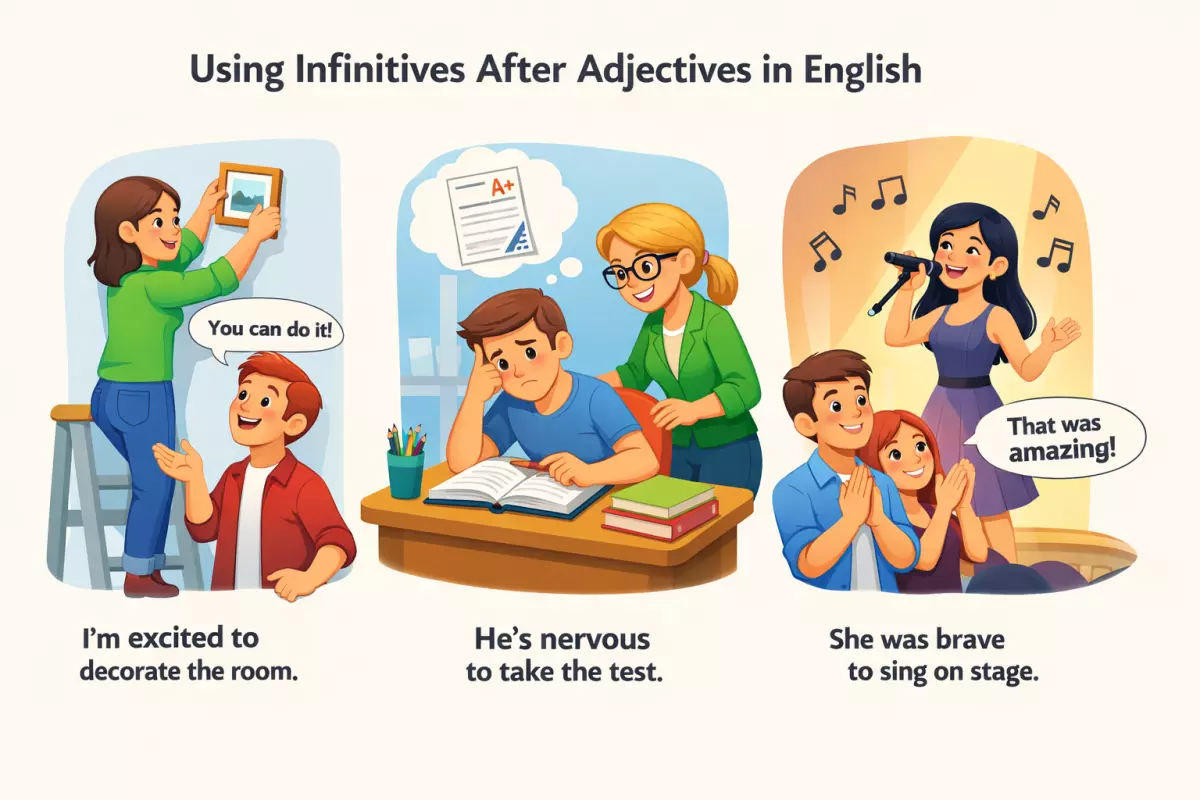 This article explains why adjectives often take infinitives, shows key adjective + to + verb patterns, lists common adjectives, and gives real examples where infinitives express feelings, reactions, or results. It also flags typical mistakes and includes practice exercises.
- Why adjectives are often followed by infinitives
- Sentence patterns with adjective + to + verb
- Common adjectives used with infinitives in English
- How adjective + infinitive structures work in real sentences
- How infinitives explain feelings, reactions, or results
- Typical learner mistakes when using adjectives with infinitives
- Practice exercises: build sentences using adjective + infinitive
When you describe feelings or situations in English, you can place a to-verb after an adjective to show what happens next or why something matters. This simple pattern makes everyday speech sound more natural, whether you are eager to learn, ready to help, or afraid to ask. You will learn when to use it, what it means, and how to avoid common errors.
Why adjectives are often followed by infinitives
In English, an adjective often needs an extra piece of grammar to complete its meaning. The to + base verb form is a compact way to add an action, goal, or situation that explains what the adjective refers to. This pattern is especially common when the adjective describes a person’s feelings, an evaluation, or how easy/difficult something is.
Common usage reasons and the patterns they create
- To explain the cause or focus of a feeling: the adjective names the emotion; the infinitive names what triggers it.
- I’m happy to see you.
- She was surprised to hear the news.
- They’re relieved to know everyone is safe.
- To give an evaluation of an action: the adjective judges the action rather than a thing.
- It was careless to leave the door unlocked.
- That was kind to help him.
- It’s unreasonable to expect instant results.
- To describe difficulty, ease, or practicality: the adjective comments on how manageable the action is.
- This rule is easy to remember.
- The instructions are hard to follow.
- The apartment is convenient to reach by train.
- To express readiness, willingness, or obligation: the adjective signals a state that naturally points forward to an action.
- I’m ready to start.
- He’s willing to compromise.
- We’re unlikely to finish today.
- To show purpose after an adjective: the adjective describes suitability or usefulness; the infinitive gives the purpose.
- This tool is useful to remove tight screws.
- The room is ideal to study in.
- The box is big enough to hold all the files.
- To keep the sentence light and direct: the infinitive is often shorter than a full clause and avoids repeating subjects.
- Clear: I’m glad to meet you. → (instead of a longer clause)
- Natural: It’s important to check the details.
High-frequency adjective + infinitive combinations
- happy to + verb (happy to help / happy to explain)
- glad to + verb (glad to hear / glad to meet)
- relieved to + verb (relieved to know / relieved to see)
- surprised to + verb (surprised to learn / surprised to find)
- shocked to + verb (shocked to discover / shocked to hear)
- proud to + verb (proud to represent / proud to announce)
- sorry to + verb (sorry to interrupt / sorry to say)
- afraid to + verb (afraid to ask / afraid to look)
- ready to + verb (ready to go / ready to begin)
- eager to + verb (eager to learn / eager to try)
- willing to + verb (willing to wait / willing to negotiate)
- able to + verb (able to attend / able to solve)
- unlikely to + verb (unlikely to change / unlikely to happen)
- likely to + verb (likely to rain / likely to improve)
- easy to + verb (easy to use / easy to understand)
- hard/difficult to + verb (hard to explain / difficult to achieve)
- important to + verb (important to remember / important to confirm)
- safe to + verb (safe to drink / safe to enter)
Two common structures learners mix up
- “It + be + adjective + to…” is often used for general judgments.
- ✅ It’s important to back up your files.
- ✅ It was rude to ignore her message.
- “Subject + be + adjective + to…” is common when the adjective describes the subject’s feelings or readiness.
- ✅ I’m excited to start the course.
- ✅ They’re hesitant to invest right now.
In many cases, the infinitive acts like a neat “answer” to the question the adjective raises: happy about what, easy in what way, important for what action. That’s why this structure is so frequent in everyday English.
Sentence patterns with adjective + to + verb
Many adjectives are followed by an infinitive (to + base verb) to explain a reaction, evaluation, or readiness. These structures often answer “in what way?” or “for what action?” and they are especially common after forms of be (am/is/are/was/were), though other linking verbs can appear too.
Common structures and how they work
- Be + adjective + to-infinitive (general evaluation):
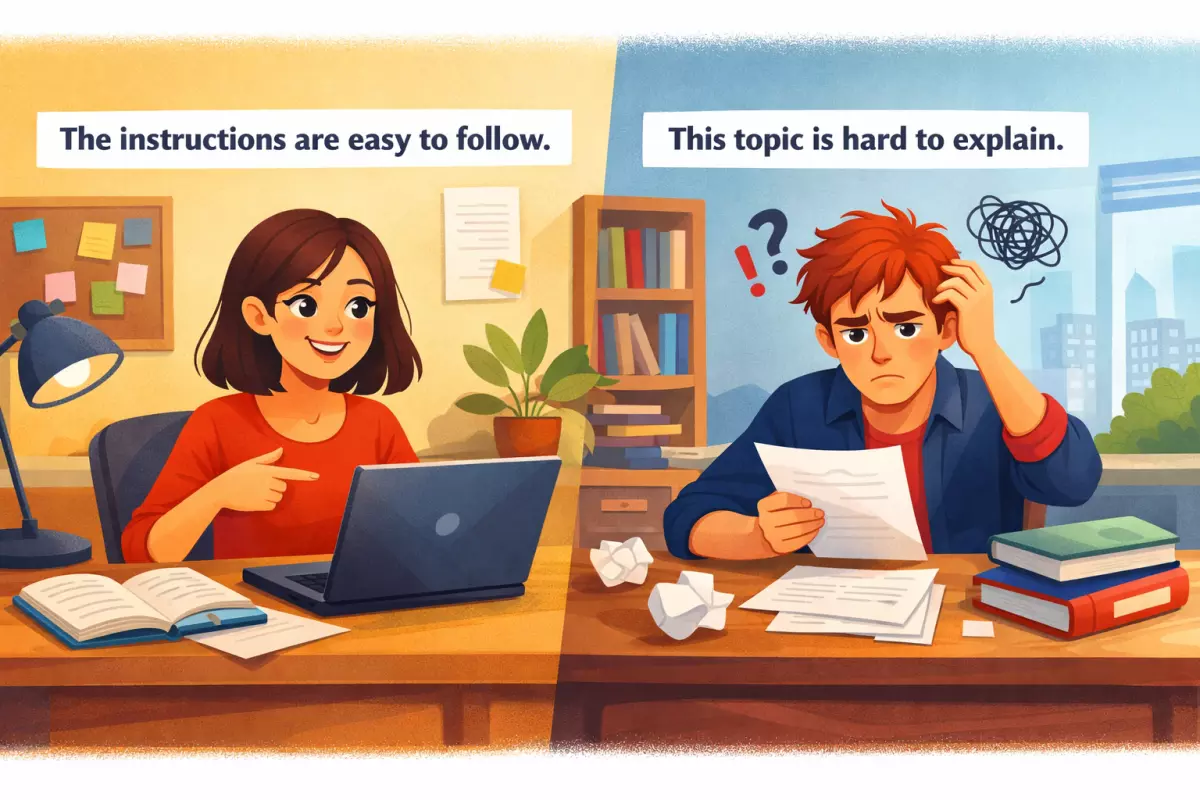
“The instructions are easy to follow.” / “This topic is hard to explain.” - Be + adjective + to-infinitive (feelings about an action):
“I’m happy to help.” / “She was surprised to hear the news.” - Be + adjective + to-infinitive (readiness or willingness):
“We’re ready to leave.” / “He’s reluctant to apologize.” - Be + adjective + to-infinitive (necessity/importance):
“It’s important to check the details.” / “It’s necessary to sign here.” - Be + adjective + for + noun/pronoun + to-infinitive (who the action is suitable/necessary for):
“It’s difficult for beginners to understand.” / “It’s unusual for him to be late.” - Be + adjective + of + person + to-infinitive (judgment about someone’s behavior):
“It was kind of you to call.” / “It was careless of me to forget.” - Adjective + enough + to-infinitive (sufficient degree):
“She’s old enough to vote.” / “The box is light enough to carry.” - Too + adjective + to-infinitive (excess prevents the action):
“It’s too noisy to work.” / “He was too tired to drive.” - So + adjective + as + to-infinitive (formal result; less common):
“He was so kind as to wait.” - Adjective + to-infinitive after other linking verbs (less common but possible):
“The plan seems easy to implement.” / “She looked ready to speak.”
Expanded examples you can model
- “I’m glad to see you.”
- “They were relieved to finish on time.”
- “It’s nice to meet your team.”
- “It was foolish to ignore the warning.”
- “She’s eager to learn.”
- “He’s hesitant to commit.”
- “We’re lucky to have support.”
- “It’s safe to drink.”
- “This app is simple to use.”
- “That rule is tough to remember.”
- “It’s possible to solve this quickly.”
- “It’s impossible to predict the result.”
- “It was generous of them to donate.”
- “It’s unfair of you to blame her.”
- “It’s common for people to feel nervous.”
- “It’s unusual for a child to sit still that long.”
Meaning differences to watch
- “It’s + adjective + to…” often gives a general opinion: “It’s important to rest.”
- “I’m + adjective + to…” often describes the speaker’s feeling or attitude: “I’m happy to rest.”
- “of + person” is typically a judgment of someone’s action: ✅ “It was brave of her to speak up.” ❌ “It was brave for her to speak up.” (possible in some contexts, but “of” is the standard choice for judging character)
- “for + person” usually marks suitability/expectation: “It’s hard for him to concentrate.”
Common adjectives used with infinitives in English
Many adjectives are naturally followed by an infinitive (to + base verb) to explain a reaction, evaluation, or readiness to do something. This pattern is especially frequent when the subject is a person (or a group) and the adjective describes feelings, difficulty, or willingness.
Typical pattern
- Pattern: Subject + be + adjective + to-infinitive
- Example: She is happy to help.
- Meaning: The adjective gives an attitude or judgment; the infinitive adds the action.
Adjectives that commonly take a to-infinitive
- happy + to-infinitive: I’m happy to answer your questions.
- glad + to-infinitive: We’re glad to hear you’re feeling better.
- pleased + to-infinitive: She was pleased to meet the team.
- delighted + to-infinitive: They’re delighted to announce the results.
- surprised + to-infinitive: I was surprised to see him there.
- shocked + to-infinitive: He was shocked to find out the truth.
- relieved + to-infinitive: She was relieved to know everyone was safe.
- disappointed + to-infinitive: We were disappointed to miss the event.
- proud + to-infinitive: I’m proud to be part of this project.
- lucky + to-infinitive: You’re lucky to have such supportive friends.
- ready + to-infinitive: Are you ready to leave?
- eager + to-infinitive: The students are eager to learn.
- willing + to-infinitive: She’s willing to compromise.
- able + to-infinitive: He wasn’t able to attend the meeting.
- unable + to-infinitive: I’m unable to log in right now.
- free + to-infinitive: Are you free to talk later?
- careful + to-infinitive: Be careful to lock the door.
- certain + to-infinitive: She’s certain to arrive on time.
- likely + to-infinitive: They’re likely to agree.
- unlikely + to-infinitive: It’s unlikely to happen this week.
Notes on usage and meaning
- Feelings and reactions: Adjectives like happy, surprised, relieved, and disappointed often describe how someone feels about an action or event. The infinitive gives the reason for that feeling.
- Readiness and willingness: ready, eager, willing, and free commonly introduce what someone intends or agrees to do.
- Ability and possibility: able/unable focus on capability, while likely/unlikely/certain express probability. These are often used in more formal statements.
- Common learner issue: Avoid using a that-clause when the infinitive is the natural choice in these patterns. ✅ I’m happy to help. ❌ I’m happy that help.
How adjective + infinitive structures work in real sentences

This pattern lets an adjective describe a person’s feeling, a situation, or an evaluation, and then the infinitive explains the reason, purpose, or result. In many sentences, the adjective gives the main judgment (easy, hard, nice, important), while to + verb adds what action the judgment is about.
Core pattern and what it means
- Pattern: Subject + be + adjective + to-infinitive
- Typical meaning: “The subject has this quality/feeling, and it relates to doing this action.”
- Example: She is ready to leave. (Ready describes her; to leave explains what she’s ready for.)
Common usage patterns with examples
- Feelings and reactions: I’m happy to help.
- Readiness and willingness: They’re willing to negotiate.
- Ability and difficulty: This puzzle is hard to solve.
- Safety and risk: It’s dangerous to swim here.
- Politeness and social value: It was kind to call.
- Importance and necessity: It’s important to check the details.
- Convenience: It’s convenient to pay online.
- Certainty and likelihood: She’s likely to agree.
- Surprise: I was surprised to hear that.
- Disappointment: We were disappointed to miss the start.
- Pride/shame: He’s proud to represent the team.
- Permission/acceptability: It’s okay to ask questions.
- Urgency: I’m eager to begin.
- Fear: She’s afraid to speak up.
- Suitability: This room is perfect to study in.
Two key sentence shapes: “It’s + adjective” vs “Subject + be + adjective”
| Sentence shape | When it’s used | Example |
|---|---|---|
| It + be + adjective + to-infinitive | Focuses on the action/situation as a general idea (often with weather, rules, difficulty, importance). | It’s important to back up your files. |
| Subject + be + adjective + to-infinitive | Focuses on a person/thing’s state, attitude, or readiness to do something. | I’m ready to go. |
| It + be + adjective + for + person + to-infinitive | Names who the action is relevant for (common with easy/hard/important/necessary). | It’s hard for me to concentrate here. |
| It + be + adjective + of + person + to-infinitive | Judges someone’s behavior or character (kind, rude, careless, brave). | It was thoughtful of you to remember my birthday. |
Meaning differences to watch
- “for + person” points to suitability or difficulty for someone: ✅ It’s easy for children to learn this song.
- “of + person” evaluates the person’s action: ✅ It was careless of him to share the password.
- Adjective + infinitive often explains “why” you feel something: ✅ I’m relieved to hear you’re safe.
- Some adjectives naturally fit this structure (ready, glad, sorry, pleased, surprised, likely), while others usually need a different pattern (for example, “interested in + -ing” is more common than “interested to”).
Common learner errors (and clean fixes)
- ❌ It’s easy learn English. → ✅ It’s easy to learn English.
- ❌ I’m happy help you. → ✅ I’m happy to help you.
- ❌ It was kind for you to help. → ✅ It was kind of you to help.
- ❌ It’s important that to call. → ✅ It’s important to call.
How infinitives explain feelings, reactions, or results
After many adjectives, an infinitive clause (to + verb) adds the “why” or “in what way” behind the adjective. It often points to the cause of an emotion, the trigger for a reaction, or the outcome that the adjective comment is about.
Core pattern
- Subject + be + adjective + to-infinitive: She was relieved to hear the news.
- Subject + be + adjective + to-infinitive (with object): He was surprised to see her there.
- It + be + adjective + to-infinitive (general comment): It’s nice to meet you.
- It + be + adjective + for + person + to-infinitive (who experiences it): It was hard for me to concentrate.
Feelings: the infinitive gives the reason
With emotion adjectives, the infinitive typically explains what happened (or is about to happen) that creates the feeling. The adjective describes the person’s state; the infinitive names the event.
- glad to help
- happy to see you
- relieved to know the results
- sorry to hear that
- sad to leave
- proud to represent the team
- ashamed to admit it
- anxious to get started
- eager to learn more
- excited to try it
- disappointed to miss the event
- shocked to find out
Reactions: the infinitive names the trigger
Reaction adjectives often describe a quick response to new information. The infinitive clause identifies the specific discovery, sight, or change that caused the reaction.
- surprised to hear the announcement
- amazed to see how fast it worked
- confused to learn the rules had changed
- delighted to receive your message
- annoyed to find the door locked
- frustrated to deal with delays
- pleased to meet the new manager
- alarmed to notice the warning light
- astonished to discover the mistake
- upset to realize what happened
Results or outcomes: the infinitive shows what the adjective leads to
Some adjectives evaluate a situation and the infinitive expresses the result, next step, or consequence. This is common with adjectives about difficulty, safety, usefulness, and readiness.
- ready to leave
- likely to happen
- unlikely to succeed
- able to finish on time
- unable to attend
- safe to drink
- dangerous to touch
- easy to understand
- hard to explain
- difficult to prove
- useful to remember
- important to check the details
Common accuracy points
- Use the infinitive for a specific action or event: ✅ I’m happy to help. (a particular offer) vs. ✅ I’m happy helping people. (general enjoyment).
- Use for + person when the adjective comment is about someone else: ✅ It was surprising for him to react that way.
- Don’t use to after every adjective automatically: ❌ I’m interesting to learn English. → ✅ I’m interested to learn English (less common) or more naturally ✅ I’m interested in learning English.
- With “too/enough,” the infinitive often expresses a result: ✅ It’s too late to call. / ✅ She’s old enough to drive.
Typical learner mistakes when using adjectives with infinitives
Many errors with adjective + infinitive structures come from mixing patterns (that-clauses, -ing forms, and prepositions) or choosing the wrong subject for the action. The points below highlight frequent problems and show the most natural fixes.
- Using an -ing form when an infinitive is needed
❌ It’s easy doing this. → ✅ It’s easy to do this.
❌ I’m happy seeing you. → ✅ I’m happy to see you. - Using an infinitive when a preposition + -ing pattern is required
Some adjectives are followed by a preposition, and then an -ing form.
❌ She’s interested to learn French. → ✅ She’s interested in learning French.
❌ I’m good to fix computers. → ✅ I’m good at fixing computers. - Leaving out “to”
❌ It’s important finish on time. → ✅ It’s important to finish on time.
❌ I was surprised see him. → ✅ I was surprised to see him. - Adding “to” after an adjective + preposition
❌ I’m afraid to of flying. → ✅ I’m afraid of flying.
❌ She’s responsible to for managing the budget. → ✅ She’s responsible for managing the budget. - Choosing the wrong pattern: infinitive vs. that-clause
Some meanings are possible with both patterns, but the natural choice depends on the adjective and what you want to emphasize.
❌ I’m glad that to hear you’re safe. → ✅ I’m glad to hear you’re safe. / ✅ I’m glad that you’re safe. - Using “for” when it’s not needed (or missing it when it is)
Use for + person when you want to state who the action is difficult/important/etc. for.
❌ It’s important for to arrive early. → ✅ It’s important to arrive early.
❌ It’s difficult to explain this. (meaning: difficult for learners) → ✅ It’s difficult for learners to explain this. - Using the wrong subject with “It’s + adjective + to…”
Learners sometimes make the person the grammatical subject even when the “it” structure is more natural.
❌ I am easy to get lost in this city. → ✅ It’s easy to get lost in this city.
❌ She is important to submit the form today. → ✅ It’s important to submit the form today. - Confusing “easy/difficult to do” with “easy/difficult to + be done”
When the subject receives the action, English often uses an active infinitive with a passive meaning.
❌ This book is easy to be read. → ✅ This book is easy to read.
❌ The instructions are hard to be understood. → ✅ The instructions are hard to understand. - Overusing “too + adjective + to” when you just mean “very”
“Too” usually suggests a problem or that something is more than acceptable.
❌ The room is too small to be cozy. (if you mean it’s pleasantly small) → ✅ The room is very small and cozy.
✅ The room is too small to fit a sofa. (problem/limit) - Mixing “enough” word order
Adjective + enough + to-infinitive is the standard order.
❌ He is enough tall to reach it. → ✅ He is tall enough to reach it.
❌ The coffee is enough hot to drink. → ✅ The coffee is hot enough to drink. - Using the wrong adjective type for an infinitive clause
Some adjectives describe a person’s feelings (afraid, eager, glad), while others describe the situation (important, necessary, possible). Mixing them can sound unnatural.
❌ I’m necessary to leave now. → ✅ It’s necessary to leave now.
❌ It’s eager to meet you. → ✅ I’m eager to meet you. - Forgetting the perfect infinitive for earlier time
When the feeling/judgment is now but the action happened earlier, use to have + past participle.
❌ I’m happy to finish early yesterday. → ✅ I’m happy to have finished early.
❌ She was surprised to lose her keys. (if the surprise is after the loss) → ✅ She was surprised to have lost her keys. - Using “that” after adjectives that typically take an infinitive
Some adjectives strongly prefer the to-infinitive when the next idea is an action.
❌ I’m ready that I start. → ✅ I’m ready to start.
❌ He’s willing that he help. → ✅ He’s willing to help. - Adding an object directly after the adjective (missing the infinitive)
❌ It’s important your passport. → ✅ It’s important to bring your passport.
❌ It’s dangerous the river at night. → ✅ It’s dangerous to cross the river at night. - Using “to” after “worth”
“Worth” is followed by an -ing form or a noun, not a to-infinitive.
❌ This film is worth to watch. → ✅ This film is worth watching.
Quick check: choose the pattern before you write
- If the adjective describes a general situation, try It’s + adjective + to + verb (It’s important to…; It’s hard to…).
- If the adjective describes someone’s feeling/attitude, try subject + adjective + to + verb (I’m glad to…; She’s eager to…).
- If the adjective needs a preposition, keep it: adjective + preposition + -ing (interested in…, good at…, afraid of…).
Practice exercises: build sentences using adjective + infinitive
Use these tasks to practice the pattern adjective + to-infinitive (for example, “easy to understand,” “ready to leave”). Focus on choosing an adjective that fits the meaning and keeping the verb in the infinitive form (to + base verb).
1) Build a complete sentence (choose an adjective + verb)
For each item, write one natural sentence. Use the cue words, but you may add extra words if needed.
- (it / important / follow) the instructions carefully
- (she / happy / help) you with your application
- (this phone / easy / use) for beginners
- (we / ready / start) the meeting now
- (I / sorry / hear) about the delay
- (the results / hard / interpret) without context
- (he / lucky / find) a seat on the train
- (it / safe / drink) the water here?
- (they / eager / learn) more about the topic
- (the box / too heavy / lift) alone
Show answers
- It is important to follow the instructions carefully.
- She is happy to help you with your application.
- This phone is easy to use for beginners.
- We are ready to start the meeting now.
- I’m sorry to hear about the delay.
- The results are hard to interpret without context.
- He was lucky to find a seat on the train.
- Is it safe to drink the water here?
- They are eager to learn more about the topic.
- The box is too heavy to lift alone.
2) Choose the best adjective for the meaning
Complete each sentence with one adjective from the box. Use each adjective once.
- adjectives: safe, glad, likely, surprised, careful, free, ready, difficult, kind, impossible
- It’s __________ to make mistakes when you’re tired.
- I’m __________ to meet you in person at last.
- Are you __________ to sign the form, or do you need more time?
- It was __________ of you to check on your neighbor.
- Please be __________ to lock the door when you leave.
- This puzzle is __________ to solve without a hint.
- It’s __________ to park here after 6 p.m.
- She was __________ to hear the news.
- It’s __________ to swim here because of the strong current.
- He’s __________ to forget if you don’t remind him.
Show answers
- It’s likely to make mistakes when you’re tired.
- I’m glad to meet you in person at last.
- Are you ready to sign the form, or do you need more time?
- It was kind of you to check on your neighbor.
- Please be careful to lock the door when you leave.
- This puzzle is difficult to solve without a hint.
- It’s free to park here after 6 p.m.
- She was surprised to hear the news.
- It’s impossible to swim here because of the strong current.
- He’s likely to forget if you don’t remind him.
3) Fix the error (infinitive form and word order)
Each sentence has one problem. Rewrite it correctly.
- ❌ This is easy understand. → __________
- ❌ I’m happy helping you today. → __________
- ❌ She is to meet you pleased. → __________
- ❌ It’s important follow the rules. → __________
- ❌ They are ready start now. → __________
- ❌ He was surprised hear the result. → __________
- ❌ This chair is comfortable sit. → __________
- ❌ I’m sorry for to be late. → __________
Show answers
- ✅ This is easy to understand.
- ✅ I’m happy to help you today.
- ✅ She is pleased to meet you.
- ✅ It’s important to follow the rules.
- ✅ They are ready to start now.
- ✅ He was surprised to hear the result.
- ✅ This chair is comfortable to sit on.
- ✅ I’m sorry to be late.
4) Expand the sentence (add a reason or detail)
Rewrite each sentence by adding a short phrase that explains why. Keep the adjective + to-infinitive structure.
- It’s nice to see you.
- It was strange to hear that.
- She’s excited to start.
- It’s hard to focus.
- I’m relieved to know the truth.
- They were disappointed to miss the event.
Show answers
- It’s nice to see you after such a long time.
- It was strange to hear that from him.
- She’s excited to start her new job.
- It’s hard to focus with so much noise.
- I’m relieved to know the truth at last.
- They were disappointed to miss the event because of the storm.