Using Infinitives After Nouns: Rules and Examples

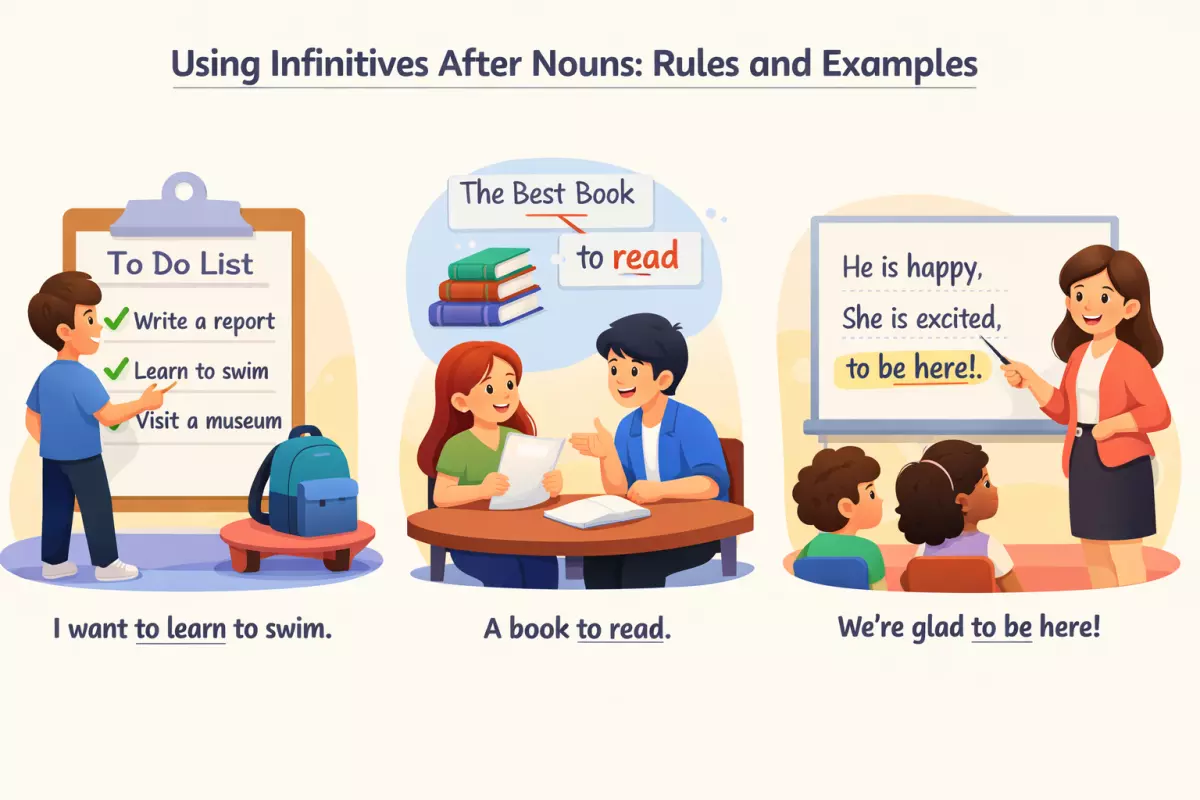 Learn why some English nouns are followed by an infinitive, the most common noun + to + verb patterns, and how they show purpose, intention, or possibility. Covers key nouns like decision, plan, and chance, sentence structure, common mistakes, and practice exercises.
- Why some English nouns are followed by an infinitive
- Common noun + infinitive patterns in everyday English
- How infinitives explain purpose, intention, or possibility after nouns
- Typical nouns that often take infinitives such as decision, plan, and chance
- Sentence structure with noun + to + verb combinations
- Frequent learner mistakes when using infinitives after nouns
- Practice exercises: build sentences using noun + infinitive patterns
Using an infinitive after a noun is a clear way to express purpose or what someone needs to do, and it appears often in everyday English. You hear it in phrases like a chance to talk, a plan to travel, or the time to decide, where the to verb points to the next step. This guide explains when the pattern sounds natural, when it feels awkward, and how to use it confidently in real conversations.
Why some English nouns are followed by an infinitive
Many nouns can be followed by to + verb because the infinitive works like a compact “purpose” or “next step” clause. Instead of adding a full relative clause (for example, “that we can use”), English often prefers an infinitive to show what something is for, what should happen, or what someone intends to do.
Common meanings the infinitive adds after a noun
- Purpose or function: the noun names a thing or role, and the infinitive explains what it is used for.
- Plan or intention: the noun refers to an idea (plan, decision), and the infinitive states the intended action.
- Need, requirement, or obligation: the noun signals necessity (need, requirement), and the infinitive names what must be done.
- Opportunity or possibility: the noun refers to a chance (opportunity, chance), and the infinitive gives the action that becomes possible.
- Instruction or task: the noun points to something assigned (task, job), and the infinitive specifies what the task is.
- Ability or readiness: the noun describes capability (ability, capacity), and the infinitive identifies the action someone can do.
- Reason to act: the noun expresses motivation (reason, incentive), and the infinitive states the action being motivated.
Usage patterns that explain the structure
In many cases, the infinitive after a noun is a reduced form of a longer clause. This is why it often feels natural and efficient in writing and speech.
- Reduced relative clause: “something to eat” = “something that you can eat.”
- Purpose phrase: “a tool to open the lid” = “a tool for opening the lid.”
- Planned action: “a decision to leave” = “a decision that we will leave.”
Noun groups that commonly take an infinitive (with examples)
- Plans and choices: a plan to expand; a decision to resign; a choice to wait; an intention to apologize
- Needs and requirements: a need to rest; a requirement to wear ID; a demand to explain; pressure to perform
- Opportunities: a chance to speak; an opportunity to learn; a moment to think; time to leave
- Tasks and roles: a job to do; a task to complete; a duty to report; a mission to protect
- Ability and readiness: the ability to focus; the capacity to adapt; the courage to ask; willingness to help
- Reasons and motives: a reason to worry; an excuse to leave; an incentive to improve; a motive to lie
- Things available or remaining: nothing to add; something to discuss; plenty to do; work to finish
- Documents and messages: an email to confirm; a form to sign; instructions to follow; a note to remind you
- Places and events (as “occasions”): a place to park; a party to attend; a meeting to join; a venue to host the event
- Tools and methods: a way to solve it; a method to measure growth; a device to track steps; a strategy to reduce risk
What to watch for
- Meaning differences vs. -ing: “a plan to meet” (intended future action) vs. “a plan for meeting” (the arrangement/process).
- Agent is often implied: “a book to read” usually implies “for someone (you/us) to read,” even if the subject is not stated.
- Not every noun works equally well: the pattern is most natural with nouns that already suggest an action, goal, or requirement.
- Common error: ❌ “a decision for leave” → ✅ “a decision to leave.”
Common noun + infinitive patterns in everyday English
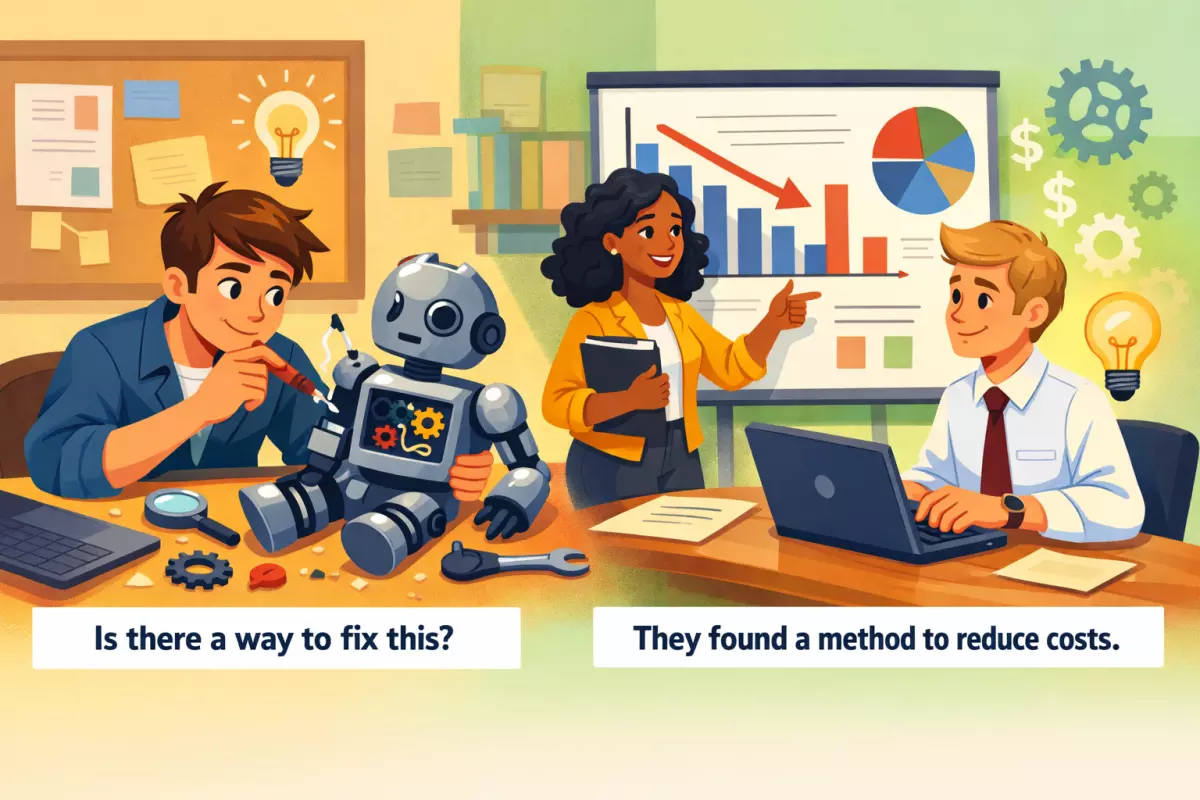
Many everyday noun phrases are naturally followed by an infinitive to explain purpose, intention, or what is needed next. In these patterns, the noun names an idea (a plan, a chance, a decision), and the infinitive adds the action connected to it.
1) Nouns that express purpose or function
Use the infinitive to show what something is for or what it is meant to do.
- way to + verb: Is there a way to fix this?
- method to + verb: They found a method to reduce costs.
- tool to + verb: This app is a tool to track spending.
- device to + verb: It’s a device to measure temperature.
- key to + verb: Practice is the key to improve quickly.
- strategy to + verb: We need a strategy to reach more customers.
- plan to + verb: My plan is to leave early.
- idea to + verb: That’s a good idea to try next.
2) Nouns about opportunity, time, and readiness
These nouns often introduce the next action someone can take.
- chance to + verb: I didn’t get a chance to call you.
- opportunity to + verb: This is an opportunity to learn.
- time to + verb: It’s time to go.
- moment to + verb: Give me a moment to think.
- turn to + verb: It’s your turn to choose.
- place to + verb: We need a place to park.
- room to + verb: There isn’t enough room to sit.
- way to + verb (common with travel/online tasks): Is this the right way to sign in?
3) Nouns that signal necessity or obligation
Use the infinitive after these nouns to state what must be done.
- need to + verb: There’s a need to update the file.
- requirement to + verb: It’s a requirement to wear a badge.
- duty to + verb: It’s your duty to report it.
- responsibility to + verb: She has a responsibility to help.
- rule to + verb: There’s a rule to keep the door closed.
- permission to + verb: Do you have permission to enter?
4) Nouns about decisions, requests, and promises
These nouns often pair with an infinitive to describe what someone decided, asked, or committed to do.
- decision to + verb: It was a hard decision to quit.
- choice to + verb: You have a choice to stay or leave.
- request to + verb: I got a request to send the report.
- invitation to + verb: Thanks for the invitation to join.
- promise to + verb: He made a promise to call.
- refusal to + verb: Her refusal to apologize surprised me.
5) Nouns that describe ability, effort, or willingness
Use the infinitive to show what someone can do, tries to do, or is prepared to do.
- ability to + verb: He has the ability to explain clearly.
- chance to + verb (ability/opportunity overlap): I finally had a chance to practice.
- effort to + verb: It took a lot of effort to finish.
- attempt to + verb: It was an attempt to solve the problem.
- refusal to + verb (attitude): His refusal to listen caused delays.
- willingness to + verb: I appreciate your willingness to help.
Quick accuracy notes
- Use the infinitive when the noun needs an action to complete its meaning: ✅ a plan to meet → the plan is incomplete without the action.
- Many of these nouns also work with of + -ing in some contexts, but the meaning can shift: ✅ a chance to win (opportunity) vs. a chance of winning (likelihood).
- When the noun is followed by a person, you may need an extra structure: ✅ a request for you to email me (noun + for + person + infinitive).
How infinitives explain purpose, intention, or possibility after nouns
After many nouns, an infinitive (to + base verb) adds a forward-looking meaning: what something is for, what someone plans, or what can happen. This structure is common in both formal and everyday English because it packs a lot of meaning into a short phrase.
Core patterns to use
- Noun + to-infinitive: the infinitive works like a reduced clause describing the noun.
- We need a strategy to reduce costs.
- She has a plan to move abroad.
- Noun + for + object + to-infinitive: highlights who the action is intended for or who is expected to act.
- This is the best time for you to call.
- They made arrangements for the team to travel early.
- Noun + to-infinitive with possibility/ability meanings: often follows nouns like chance, opportunity, ability, right, permission.
- He had a chance to explain.
- Do you have permission to park here?
Meaning types with practical examples
- Purpose (what something is used for): a tool, method, or resource followed by an infinitive.
- a device to measure blood pressure
- a key to open the storage room
- a guide to help new staff
- a way to improve accuracy
- a method to prevent errors
- Intention (what someone plans or aims to do): common after plan, decision, intention, promise, attempt.
- a decision to postpone the meeting
- an intention to apply next year
- a promise to return the documents
- an attempt to contact support
- a refusal to cooperate
- Possibility / opportunity (what can happen or become available): frequent with chance, opportunity, option, ability.
- an opportunity to learn on the job
- no option to cancel online
- the ability to concentrate under pressure
- a chance to see the results
- room to grow in the role
Common noun choices that naturally take an infinitive
- Plans and choices: plan, decision, intention, arrangement, proposal, promise, attempt, refusal
- Opportunities and limits: chance, opportunity, option, ability, right, permission, time, place, way, need
- Resources and solutions: tool, method, strategy, solution, approach, system, process
Accuracy notes (what to watch for)
- Use for + person + to-infinitive when the noun is followed by the person affected or expected to act: ✅ It’s a good idea for him to rest.
- Avoid using an -ing form when the meaning is “future/goal” after these nouns: ✅ a chance to win ❌ a chance winning.
- Keep the infinitive close to the noun it describes to prevent confusion: ✅ a plan to expand the team (clear) rather than separating the phrase too far.
Typical nouns that often take infinitives such as decision, plan, and chance

Many abstract nouns are commonly followed by an infinitive phrase (to + base verb) to explain what the noun is about. This pattern is especially frequent with nouns that express intentions, opportunities, obligations, or readiness. In most cases, the infinitive answers “to do what?” and works like a compact clause.
Core pattern
- noun + to-infinitive: → Her decision to leave surprised everyone.
- noun + to-infinitive + (optional details): → We made a plan to reduce costs over the next quarter.
- noun + to-infinitive after “the”: → He missed the chance to speak to the director.
Common nouns that take an infinitive
The nouns below regularly appear with an infinitive because they naturally introduce a future action, a goal, or a required step.
- decision: Their decision to postpone the launch was sensible.
- plan: The plan to expand into Asia was approved.
- chance: I didn’t get a chance to apologize.
- opportunity: This is a good opportunity to learn new skills.
- ability: She has the ability to explain complex ideas clearly.
- attempt: His attempt to fix the leak failed.
- effort: Their effort to improve service has helped.
- intention: I had no intention to interrupt.
- need: There’s no need to worry.
- desire: He expressed a desire to change departments.
- refusal: Her refusal to sign the contract delayed the deal.
- promise: The promise to call was not kept.
- agreement: We reached an agreement to share resources.
- permission: They gave permission to use the photos.
- request: I received a request to provide more details.
- invitation: Thank you for the invitation to attend.
- failure: The failure to respond caused confusion.
- readiness: Her readiness to help made a difference.
- reluctance: His reluctance to speak was obvious.
- right: You have the right to remain silent.
Usage notes and common pitfalls
- Use the infinitive to specify the content of the noun: “a decision” is incomplete without what the decision is about; “a decision to resign” completes the meaning.
- Don’t confuse noun + infinitive with verb patterns: “He decided to leave” (verb) vs. “His decision to leave” (noun).
- Mind article choice (“a/the”): “a chance to…” often means any opportunity; “the chance to…” often points to a specific one.
- Be careful with -ing alternatives: Some nouns can take either form with a meaning shift. Compare: “the need to finish” (a specific action) vs. “the need for finishing” (less natural and more abstract in most contexts).
- Common error: ❌ “the decision for leave” → ✅ “the decision to leave”
Sentence structure with noun + to + verb combinations
When a noun is followed by an infinitive, the infinitive usually explains the noun’s purpose, intended use, or what needs to happen next. This pattern is common after abstract nouns (like decision or plan) and after nouns that describe tasks, chances, or obligations.
Core pattern and meaning
The most common structure is:
- Noun + to + base verb: Her decision to leave surprised everyone.
- The infinitive often answers “what kind of noun?” or “which one?”: the ability to focus, a chance to win.
- It can also show purpose: a tool to open bottles, time to rest.
Common sentence frames you can reuse
- Subject + verb + noun + to-infinitive: They announced a plan to expand the office.
- There is/was + noun + to-infinitive: There is a lot to discuss.
- Have/need + noun + to-infinitive: I have work to finish.
- Adjective + noun + to-infinitive: It was a difficult choice to make.
- Determiner + noun + to-infinitive: This is the best way to solve it.
What the infinitive expresses after the noun
- Purpose or function: Do you have a key to unlock this door?
- Plan or intention: We made arrangements to meet on Friday.
- Requirement or obligation: He has a duty to report the incident.
- Possibility or opportunity: She got a chance to present her research.
- Decision or choice: It was his decision to resign.
- Ability or capacity: Her ability to adapt is impressive.
- Need or desire: I have a strong desire to improve.
High-utility nouns often followed by an infinitive (with examples)
- ability to learn
- attempt to fix the problem
- chance to speak
- choice to stay
- decision to move
- desire to help
- effort to reduce costs
- failure to respond
- need to rest
- opportunity to travel
- plan to redesign the website
- promise to call
- refusal to cooperate
- request to postpone the meeting
- right to know
- time to think
- way to solve it
- willingness to compromise
Common learner issues (and quick fixes)
- ✅ the decision to leave → infinitive explains the noun
❌ the decision leaving (usually incorrect in this meaning) - ✅ I have a report to write. (the report still needs writing)
❌ I have a report to be written. (possible, but changes the meaning and sounds unnatural in many contexts) - ✅ There are three emails to answer.
❌ There are three emails for answer. (wrong form) - ✅ a tool to cut glass
❌ a tool for cut glass (use for + -ing or to + verb, not for + base verb)
In most cases, choose the infinitive after a noun when you want a clear “next action” or “intended purpose” reading. If you want to describe general use, for + -ing is also common, but the infinitive tends to sound more goal-focused and specific.
Frequent learner mistakes when using infinitives after nouns
Errors with noun + infinitive often come from mixing up patterns (infinitive vs. preposition + -ing), choosing the wrong meaning, or attaching the infinitive to the wrong noun. The points below highlight common trouble spots and show how to fix them.
- Using a preposition + -ing when the noun normally takes an infinitive
❌ I have a decision of moving to London.
✅ I have a decision to move to London.
Many “plan/choice/decision/attempt” nouns naturally link to to + verb. - Using an infinitive after nouns that prefer a preposition pattern
❌ She has experience to work with children.
✅ She has experience working with children.
✅ She has experience in working with children.
Some nouns (experience, interest, skill, talent) often use -ing or in + -ing rather than an infinitive. - Confusing “purpose” vs. “content” meanings
❌ I read his message to complain about the delay. (sounds like the purpose of reading)
✅ I read his message complaining about the delay. (content of the message)
Use the infinitive for purpose (a reason/aim), but use a clause or -ing to describe what the noun contains or says. - Choosing the wrong noun: “opportunity,” “possibility,” and “ability” are not interchangeable
❌ I don’t have the possibility to come tomorrow. (often unnatural in everyday English)
✅ I don’t have the ability to come tomorrow. (if it’s about capability)
✅ I don’t have the chance / opportunity to come tomorrow. (if it’s about circumstances/time)
The infinitive may be correct, but the noun must match the intended meaning. - Forgetting the “for + person” phrase when the doer is not the same as the subject
❌ This is a good place to study for students. (awkward order/attachment)
✅ This is a good place for students to study.
When the infinitive has its own logical subject, “for + noun/pronoun” usually belongs right before the infinitive. - Misplacing the infinitive so it seems to modify the wrong noun
❌ She gave me a box of chocolates to eat on my birthday. (sounds like the chocolates are for eating, not the box; meaning may be unclear)
✅ She gave me a box of chocolates to eat on my birthday. (ok if that’s intended)
✅ For my birthday, she gave me a box of chocolates. (clearer if purpose is not important)
Keep the infinitive close to the noun it describes, and rewrite if the attachment is ambiguous. - Using “to” as a preposition and “to” as an infinitive marker interchangeably
❌ I’m looking forward to to meet you.
✅ I’m looking forward to meeting you.
Here “to” is a preposition, so it must be followed by a noun or -ing form, not an infinitive. - Overusing “the ability to…” where a simpler structure is more natural
❌ I have the ability to speak English well. (grammatical but heavy in casual writing)
✅ I can speak English well.
Noun + infinitive is correct, but sometimes a verb form (can, want, need) is the more typical choice. - Using an infinitive after “reason” without the usual “for”
❌ The reason to his absence is unclear.
✅ The reason for his absence is unclear.
✅ The reason he was absent is unclear.
“Reason” commonly takes for + noun or a clause; “reason to + verb” is possible, but it usually means a motive to do something. - Mixing “need to do” and “need doing” patterns
❌ There is a need fixing the printer.
✅ There is a need to fix the printer.
✅ The printer needs fixing. (different structure)
After the noun “need,” the infinitive is the common choice; “need + -ing” belongs to the verb “need,” not the noun phrase. - Adding “of” before the infinitive after certain nouns
❌ She made an attempt of to explain.
✅ She made an attempt to explain.
Some learners transfer “attempt at + noun/-ing” into an incorrect “attempt of to…” structure. - Using “to + verb” after “suggestion” and “advice” in contexts that require a clause
❌ My advice is to you to rest more.
✅ My advice is to rest more.
✅ My advice is that you (should) rest more.
With “advice/suggestion,” either use an infinitive (general recommendation) or a clause; avoid inserting an extra object in the middle. - Forgetting that some noun + infinitive combinations are fixed and common, while others sound forced
✅ a chance to win; a way to solve it; the right to vote; a plan to expand; an attempt to help
❌ an information to know; a knowledge to do (unnatural; use “information about…” / “knowledge of how to…”)
When the noun is not naturally followed by an infinitive, switch to “about/of/on” or use “how to” where appropriate. - Confusing “how to” with a plain infinitive after nouns like “way” and “method”
❌ They explained a way to you fix the error.
✅ They explained a way to fix the error.
✅ They explained how to fix the error.
Use “how to” when the focus is on instructions; use noun + infinitive when the noun itself names the solution. - Using an infinitive where a relative clause is needed for clarity
❌ I need a person to the report. (missing verb; unclear)
✅ I need a person to write the report.
✅ I need a person who can write the report. (emphasizes ability/selection)
If the idea is “a person who…,” a relative clause can be clearer than stacking noun + infinitive.
Quick check before you choose an infinitive
- Ask what the infinitive expresses: purpose, a planned action, or a requirement often fits noun + infinitive.
- If “to” is a preposition in the larger sentence (look forward to, object to, be used to), use -ing after it.
- If the noun describes content (a message, report, complaint), a clause or -ing is often more accurate than an infinitive.
- If the doer is different, consider “for + person + to + verb” to make the meaning explicit.
Practice exercises: build sentences using noun + infinitive patterns
Use these tasks to practice common structures where a noun is followed by an infinitive (to + base verb). Focus on meaning: the infinitive often explains the noun (purpose, plan, ability, decision, or something needed).
1) Complete the sentence with a suitable infinitive
- I don’t have the time ______ this report today.
- She made a decision ______ her job.
- Do you have any advice ______ with stress?
- They found a way ______ costs without cutting staff.
- He has the ability ______ clearly under pressure.
- We need a plan ______ the new software.
- There’s no reason ______ angry about it.
- Our goal is ______ customer wait times.
- I got permission ______ early.
- She took the opportunity ______ with the director.
Show answers
- to finish / to write
- to quit / to leave
- to deal / to cope
- to reduce / to cut
- to speak / to explain
- to implement / to roll out
- to get
- to reduce / to cut
- to leave
- to speak / to talk
2) Build sentences from prompts (noun + infinitive)
Turn each set of notes into one natural sentence. Keep the noun + infinitive structure.
- (need) / (to call) / the client
- (chance) / (to visit) / the museum
- (decision) / (to postpone) / the meeting
- (ability) / (to learn) / languages quickly
- (way) / (to solve) / the problem
- (permission) / (to park) / here
- (plan) / (to expand) / next year
- (refusal) / (to apologize) / surprised everyone
- (attempt) / (to fix) / the printer failed
- (invitation) / (to join) / the team
Show answers
- I have a need to call the client.
- I had a chance to visit the museum.
- We made a decision to postpone the meeting.
- She has the ability to learn languages quickly.
- They found a way to solve the problem.
- Do we have permission to park here?
- There’s a plan to expand next year.
- His refusal to apologize surprised everyone.
- My attempt to fix the printer failed.
- She received an invitation to join the team.
3) Choose the best option (to-infinitive vs. other forms)
Select the option that fits standard usage after the noun. Some nouns strongly prefer a to-infinitive; others commonly take a preposition + -ing (for example, advice on doing).
- He has no intention (to leave / of leaving) before noon.
- Could you give me advice (to prepare / on preparing) for the interview?
- We don’t have permission (to enter / for entering) this area.
- She made an attempt (to call / at calling) him again.
- There’s a possibility (to rain / of raining) later.
- I have a reason (to believe / for believing) this is true.
- They offered me an opportunity (to present / for presenting) my idea.
- He has a talent (to draw / for drawing) portraits.
- We reached an agreement (to share / for sharing) the costs.
- She expressed a desire (to improve / of improving) her writing.
Show answers
- of leaving
- on preparing
- to enter
- to call
- of raining
- to believe
- to present
- for drawing
- to share
- to improve
4) Fix the error (rewrite correctly)
Each sentence has a problem with the noun + infinitive pattern (wrong preposition, missing “to,” or an unnatural structure). Rewrite each one.
- ❌ I have a suggestion to improving the introduction.
- ❌ She gave me permission leaving early.
- ❌ There is no chance for finish on time.
- ❌ He made a decision of change careers.
- ❌ We have a plan for launch the product in May.
- ❌ They found a way for reduce expenses.
- ❌ I don’t have the time finish it now.
- ❌ She has the ability of speak confidently.
Show answers
- ✅ I have a suggestion for improving the introduction. / I have a suggestion to improve the introduction.
- ✅ She gave me permission to leave early.
- ✅ There is no chance to finish on time. / There is no chance of finishing on time.
- ✅ He made a decision to change careers.
- ✅ We have a plan to launch the product in May.
- ✅ They found a way to reduce expenses.
- ✅ I don’t have the time to finish it now.
- ✅ She has the ability to speak confidently.
5) Expand with your own details (controlled production)
Write one complete sentence for each noun. Add a realistic context (work, study, travel, daily life). Keep the noun immediately followed by the infinitive where possible.
- a plan to ______
- a decision to ______
- the ability to ______
- an opportunity to ______
- permission to ______
- an attempt to ______
- a way to ______
- a refusal to ______
- a promise to ______
- the time to ______