Infinitives After Question Words: How, What, Where, When

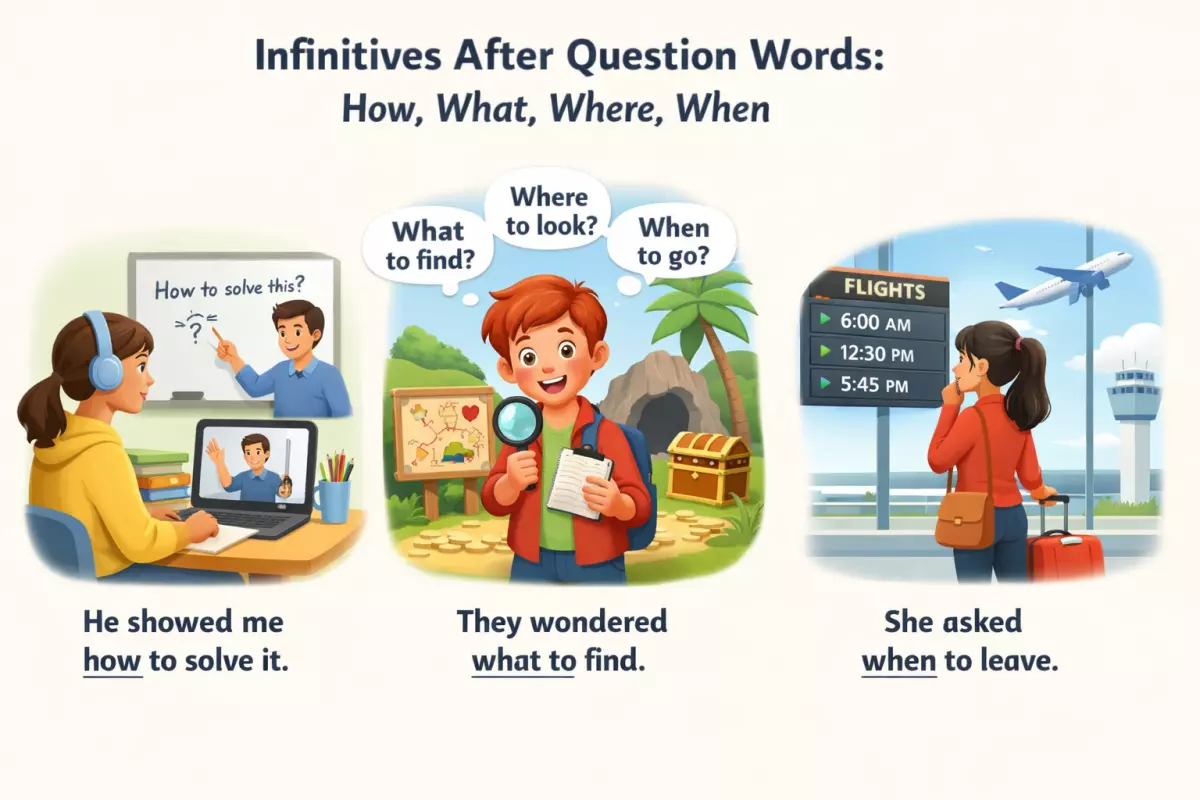 This article explains how question words combine with infinitives in English, with patterns like how to do, where to go, and what to say. It shows when they replace longer clauses, how they differ from direct questions, common learner errors, and ends with sentence-completion practice.
- How infinitives combine with question words in English
- Sentence patterns like how to do, where to go, and what to say
- When this structure replaces a longer clause in English
- Using question word + infinitive in instructions and explanations
- Differences between direct questions and question word + infinitive
- Typical learner errors with structures like how to use or what to choose
- Practice exercises: complete sentences with question word + infinitive
Ever freeze mid-sentence because you know the question word but not the next verb? In everyday English, we often follow how, what, where, or when with an infinitive to describe the right action or choice: how to fix a problem, where to park, what to say, when to leave. This simple pattern keeps your meaning clear and practical, especially when you’re explaining decisions or asking for help.
How infinitives combine with question words in English
English often uses a question word + infinitive to talk about an action in a general, indirect way. This structure is common after verbs like know, learn, decide, remember, and show, especially when the speaker is asking for information, giving instructions, or describing uncertainty.
Core pattern
- Question word + to + base verb: how to start, what to say, where to go, when to leave, who to call.
- This behaves like a noun phrase and can be the object of another verb: I know what to do.
- It is common in indirect questions and instructions: Can you show me how to use this?
Where the structure appears in a sentence
- After reporting/knowledge verbs: I don’t know where to park.
- After teaching/showing verbs: She showed us how to log in.
- After decision/planning verbs: We decided when to meet.
- After adjectives about certainty/difficulty: I’m not sure what to choose.
- As a subject (less common, more formal): How to respond is the real issue.
Meaning: indirect question vs. instruction
- Indirect question (information needed): I’m trying to figure out what to write.
- Instructional (steps or method): This guide explains how to install the app.
- Choice/problem-solving (best option): He can’t decide where to sit.
Common question words used with infinitives
- how + to (method): how to reset a password
- what + to (choice/thing): what to bring
- where + to (place/direction): where to turn
- when + to (timing): when to stop
- who + to (person to contact/choose): who to ask
- which + to (selection from a set): which one to buy
- whether + to (yes/no decision): whether to wait
Usage notes and frequent pitfalls
- Use “to” + base verb, not a conjugated verb: ✅ I know what to do. ❌ I know what do.
- Don’t use “to” after “why” in standard English: ✅ I don’t know why she left. (not why to leave in most contexts).
- Subject is often implied (usually “I/we/you” from context): Tell me where to put it. (= where I should put it).
- “Who to” is possible, but can sound formal; many speakers use a clause instead: I don’t know who to invite / I don’t know who I should invite.
- Whether to is common for decisions: They discussed whether to postpone the meeting.
Expanded example bank (useful patterns)
- Do you know how to pronounce this name?
- She learned how to drive in the city.
- I can’t remember where to save the file.
- We’re not sure when to start.
- He explained what to press first.
- Please tell me where to sign.
- They showed us how to check in online.
- I’m deciding what to wear.
- Ask your manager who to contact.
- She couldn’t choose which seat to take.
- Let me know when to call you.
- He forgot where to meet them.
- We discussed whether to take a taxi.
- I don’t know what to say right now.
- Can you advise me how to respond?
- They’re figuring out where to place the shelves.
Sentence patterns like how to do, where to go, and what to say
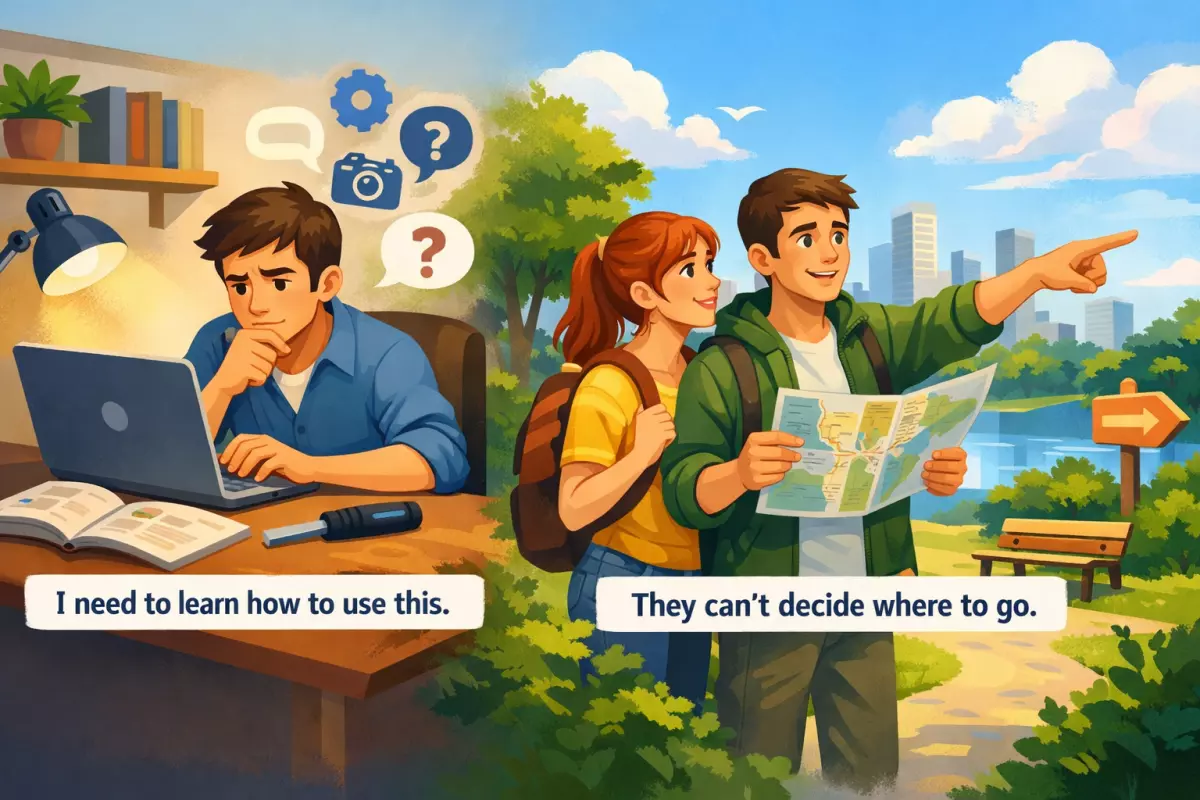
English often uses a question word + infinitive to talk about an action that is unknown, undecided, or needs instruction. This structure is common after verbs like know, learn, decide, remember, and show, especially when the speaker is focusing on the next step rather than asking a direct question.
Core pattern
- Question word + to + base verb: how to use, what to buy, where to park, when to call
- Often follows a main clause: Subject + verb + question word + to + verb
- Meaning: “the correct method / the right thing / the best place / the right time”
Common sentence frames (ready to use)
- I don’t know how to start.
- Do you know where to go?
- She explained what to do next.
- We’re deciding when to leave.
- He forgot where to put the keys.
- They taught me how to pronounce it.
- Please tell me what to bring.
- Can you show me how to log in?
- I’m not sure which to choose.
- She wondered whether to accept the offer.
- We discussed where to meet.
- He learned when to stop and listen.
- I can’t remember how to get there.
- Ask your teacher what to write.
- They figured out how to fix the problem.
- Let me check when to submit the form.
Usage notes and typical choices
- Use it to avoid a full clause: “I don’t know what I should do” → “I don’t know what to do.”
- “How to” is about method or process: how to install, how to respond, how to improve.
- “Where to” is about location or direction: where to sit, where to turn, where to apply.
- “What to” is about choice or action: what to say, what to wear, what to include.
- “When to” is about timing: when to start, when to stop, when to follow up.
- “Which to” is used when selecting from a limited set: which to pick, which to keep.
- “Whether to” is used for a yes/no decision: whether to wait, whether to call, whether to continue.
Common mistakes to avoid
- ❌ I don’t know how do it. ✅ I don’t know how to do it.
- ❌ She told me what should do. ✅ She told me what to do.
- ❌ We discussed where should meet. ✅ We discussed where to meet.
- ❌ He explained how to doing it. ✅ He explained how to do it.
This pattern is especially useful in instructions, advice, and planning because it keeps the focus on the action (the infinitive) while the question word signals the missing information (method, place, choice, or time).
When this structure replaces a longer clause in English
English often uses a question word + infinitive (for example, what to do, where to go, how to fix it) as a compact alternative to a full clause with a subject and verb. This structure is common after verbs that express knowing, learning, deciding, explaining, or discovering.
Core pattern and meaning
The shortened form usually stands for an embedded question such as “what I should do” or “where we can go.” The implied subject is typically the same as the subject of the main clause, and the meaning often involves advice, choice, method, or next steps.
- Question word + to + base verb (what/where/when/how/who + to do)
- Often corresponds to: question word + subject + should/can/will + verb
- Most natural when the main clause subject is also the “doer” of the infinitive action
Common replacements (full clause → question word + infinitive)
| Longer clause | Shorter structure |
|---|---|
| I don’t know what I should do next. | I don’t know what to do next. |
| She explained how we can reset the router. | She explained how to reset the router. |
| They couldn’t decide where they should park. | They couldn’t decide where to park. |
| Tell me when I should call you. | Tell me when to call you. |
| He learned how he could pronounce the sound. | He learned how to pronounce the sound. |
| We’re discussing what we should include in the report. | We’re discussing what to include in the report. |
| Do you remember where we have to sign? | Do you remember where to sign? |
| Show me how I can open the panel safely. | Show me how to open the panel safely. |
Where it works best (typical verb environments)
- After “knowing” verbs: know, learn, remember, forget, figure out
- After “decision” verbs: decide, choose, determine, plan, agree
- After “communication” verbs: explain, show, tell, teach, describe
- After “discovery/problem” verbs: find out, discover, work out, consider
Usage notes and limits
- Subject match is key: If the person who will do the action is the same as the main subject, the infinitive form is usually fine. If a different subject is required, a full clause is often clearer.
- Modal meaning is implied: The infinitive commonly carries the sense of “should” or “can,” depending on context (advice vs. ability/possibility).
- Not every question word behaves the same: “Why to…” is uncommon in modern English for this meaning. Prefer a full clause: ❌ “I don’t know why to leave.” ✅ “I don’t know why I should leave.”
- Choice vs. information: The compact form often suggests a practical choice or instruction (steps to take), not just a factual question.
Extra example set (compact, high-frequency)
- I’m not sure what to say.
- He showed us how to log in.
- Do you know where to buy tickets?
- Tell me when to stop.
- She couldn’t decide which one to choose.
- We need to figure out how to pay.
- I forgot where to put the key.
- They’re learning how to negotiate politely.
- Ask the receptionist who to contact.
- He’s considering what to study next year.
- Let me know when to send the file.
- She taught me how to pronounce his name.
- We discussed where to meet.
- He didn’t know what to expect.
- Can you suggest what to wear?
Using question word + infinitive in instructions and explanations
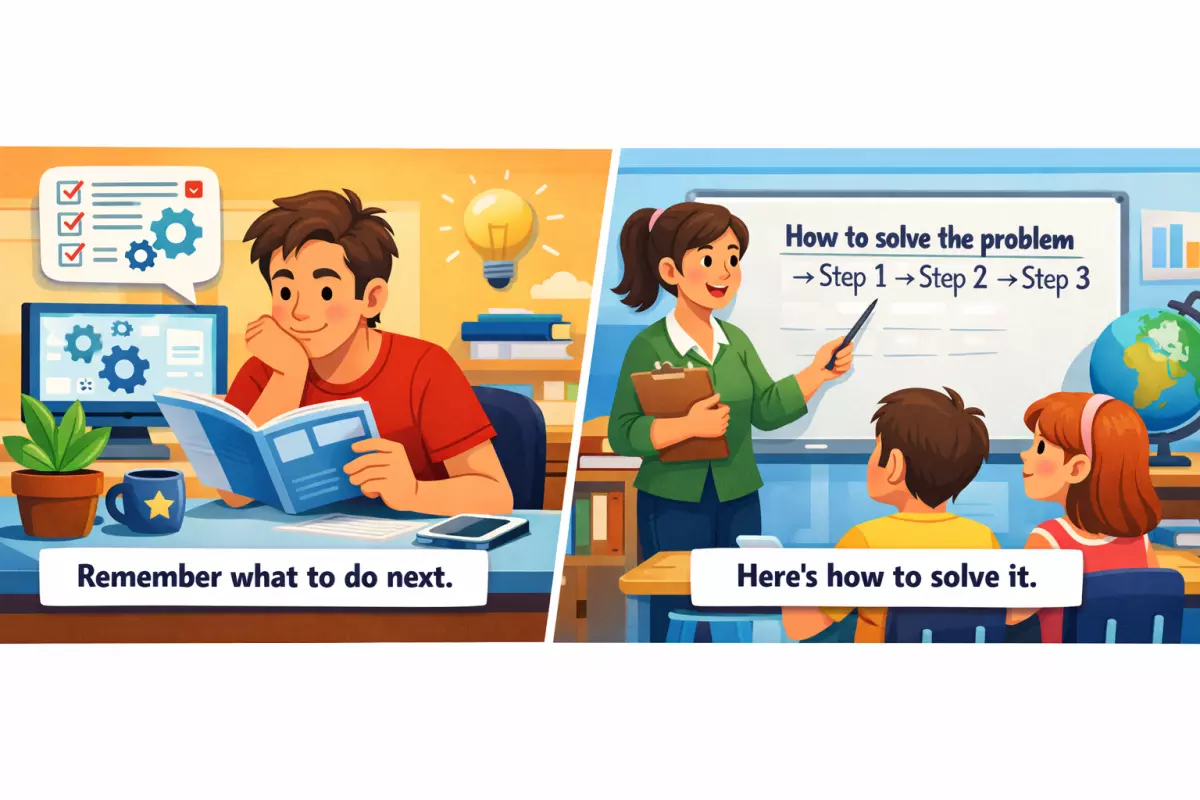
This structure is common in guides, manuals, and classroom explanations because it lets you name a task or problem in a compact way. Instead of writing a full clause (for example, “how you can install the app”), English often uses a question word followed by an infinitive (“how to install the app”) to introduce steps, options, or decisions.
Typical pattern and where it appears
The basic form is:
- question word + to + base verb (how/what/where/when + to do)
- Often used after verbs like: explain, show, tell, learn, decide, find out, know
- Also used as headings and labels in documentation: “How to reset your password”
Common instruction-style uses (with examples)
- How to + verb to introduce a procedure: “How to change the language settings.”
- Where to + verb to point to a location or destination: “Where to save the downloaded file.”
- When to + verb to explain timing: “When to restart the device after an update.”
- What to + verb to clarify the correct action: “What to do if the screen freezes.”
- What to + noun/verb for required items or actions: “What to bring to the appointment.”
- Which + noun + to + verb for choosing between options: “Which button to press to confirm.”
- Who to + verb for the right contact person: “Who to call if you can’t log in.”
- How + adjective/adverb + to + verb for degree or method: “How quickly to respond to customer emails.”
- How to + verb for troubleshooting: “How to check whether the cable is connected.”
- What to + verb for safety guidance: “What to do in case of a power outage.”
- Where to + verb for forms and submissions: “Where to upload your documents.”
- When to + verb for schedules and deadlines: “When to submit the report.”
- How to + verb for settings and configuration: “How to enable two-factor authentication.”
- What to + verb for error handling: “What to do if you see an ‘Access denied’ message.”
- Where to + verb for navigation: “Where to find the privacy controls.”
Meaning: implied subject and advice
In instructional writing, the subject is usually implied as “you” or “someone.” For example, “how to install the driver” means “how you should install the driver.” This makes the phrasing neutral and suitable for general directions.
Common grammar points and frequent mistakes
- Use to + base verb, not a conjugated verb: ✅ “how to reset” ❌ “how to resets”
- Don’t add an extra subject after the question word: ✅ “where to park” ❌ “where you to park”
- After “what,” the meaning often equals “the right thing to do”: “what to do next” (next step/solution).
- For direct questions, use a full clause instead: “Where should I park?” (question) vs. “where to park” (instruction/topic).
Differences between direct questions and question word + infinitive
Direct questions ask for information from a listener, while question word + infinitive structures (for example, what to do, how to get) package the question idea into a phrase that can act like a noun. This changes word order, grammar choices, and the kind of meaning you express.
| Direct question (finite verb) | Question word + infinitive (non-finite phrase) |
|---|---|
| Used to ask someone for an answer. | Used to talk about the answer/decision as a thing (an “issue” or “plan”). |
| Has question word order (often with auxiliary inversion): “Where do I park?” |
No inversion; uses to + base verb: “I don’t know where to park.” |
| Stands alone as a full question sentence. | Usually sits inside a larger sentence after verbs/adjectives/nouns: “Can you show me what to click?” |
| Time and tense are explicit: “When did she leave?” |
Tense is not marked on the infinitive; time comes from context: “I don’t know when to leave.” |
| Subject is typically stated: “What should I do?” |
Subject is often understood (usually the same as the main clause): “I don’t know what to do.” |
| Can include modals and question tags: “What should we do?” |
Uses the infinitive instead of a modal: “We discussed what to do.” |
Word order: inversion vs. infinitive phrase
In direct questions, English often uses an auxiliary (do, be, have) before the subject. With question word + infinitive, you keep normal order and attach an infinitive after the question word.
- ✅ “Where do we meet?” → “Let’s decide where to meet.”
- ✅ “How can I reset it?” → “He explained how to reset it.”
- ✅ “What should she wear?” → “She wasn’t sure what to wear.”
- ❌ “I don’t know where do we meet.” (keep inversion only in direct questions)
Meaning: asking vs. referring to a decision or instruction
The infinitive version often sounds like you are focusing on the solution, plan, or instruction rather than requesting an answer right now. It is common in advice, procedures, and problem-solving language.
- Direct question: “What do I do now?” (requesting immediate guidance)
- Infinitive phrase: “I don’t know what to do now.” (describing your uncertainty)
- Direct question: “How do we get there?” (asking for directions)
- Infinitive phrase: “She showed us how to get there.” (reporting instructions)
Common sentence frames that take question word + infinitive
These phrases frequently introduce a question word + infinitive clause. They help you embed the “question” inside a statement.
- “I don’t know what to say.”
- “Do you know where to go?”
- “He explained how to use the app.”
- “Can you tell me when to start?”
- “We need to decide which route to take.”
- “She forgot where to put the keys.”
- “They discussed what to do next.”
- “I’m not sure how to respond.”
- “It’s hard to know when to stop.”
- “Please advise what to include.”
- “He learned how to fix it.”
- “Show me where to click.”
- “Tell us who to contact.”
- “I can’t remember which button to press.”
- “We’re considering where to stay.”
When you cannot use the infinitive form
Question word + infinitive is not always possible. If you need a different subject, a clear tense, or a full clause with its own verb, a finite clause (often with should, can, or a normal embedded question) is usually better.
- Different subject needed: “I don’t know what he should do.” (not “what to do” if the subject must be explicit)
- Past time emphasis: “She remembered where she parked.” (more natural than “where to park” for a completed past action)
- Need for a full embedded clause: “Tell me what you want.” (not “what to want”)
- After some question words: “Why” rarely works with an infinitive in this pattern; prefer “why + clause” (“I don’t know why he left.”).
Typical learner errors with structures like how to use or what to choose
These question-word + infinitive patterns are compact and useful, but learners often mix them up with full questions, add extra subjects, or choose the wrong verb form. The points below show the most common problems and the cleanest fixes.
- Adding a subject after the question word
❌ I don’t know how I to start.
✅ I don’t know how to start.
Use question word + to + base verb when the subject is the same as in the main clause. - Using a full question word order inside the infinitive phrase
❌ She explained how do we install the app.
✅ She explained how to install the app.
✅ She explained how we should install the app. (full clause alternative) - Using
to
+ -ing
❌ Can you show me how to using this feature?
✅ Can you show me how to use this feature?
Afterto
, use the base form:to use
, notto using
. - Forgetting
to
❌ Tell me what do next.
✅ Tell me what to do next.
The infinitive marker is required in this structure. - Confusing
what to
withwhich to
❌ I can’t decide what to choose: the red one or the blue one. (two clear options)
✅ I can’t decide which to choose: the red one or the blue one.
Usewhich
when the choices are limited and known; usewhat
when the options are open or unclear. - Using
why to
(usually unnatural)
❌ I don’t know why to change my password.
✅ I don’t know why I should change my password.
✅ I don’t know the reason for changing my password. (noun phrase alternative)Why + infinitive
is rare; learners usually need a clause withshould
or a different structure. - Mixing two patterns: infinitive + clause
❌ She told me what to do that I should call support.
✅ She told me what to do: call support.
✅ She told me that I should call support.
Choose either the infinitive pattern or a that-clause, not both at once. - Using the infinitive pattern when the subjects are different
❌ I showed him how to fix it. (but he can’t fix it; I will fix it)
✅ I showed him how I would fix it.
The infinitive version usually implies the same “doer” (or that the listener is the doer). If the doer changes, a full clause is clearer. - Leaving out an object that the verb needs
❌ I don’t know what to put.
✅ I don’t know what to put in the form / on the label.
Some verbs sound incomplete without context; add the necessary object or place phrase. - Choosing the wrong question word
❌ Tell me where to choose. (selection, not location)
✅ Tell me what to choose.
✅ Tell me where to click. (location/action on a screen)
Match the word to the meaning:where
= place,when
= time,how
= method,what/which
= choice/thing. - Overusing
how to
when a simple infinitive is enough
❌ I need to know how to open the window. (very basic action in context)
✅ I need to open the window.
Use the question-word form when there is real uncertainty about method, choice, time, or place. - Confusing
what to do
(decision) withwhat to do
(instruction) without context
✅ I don’t know what to do. (I’m unsure; I need advice.)
✅ He showed me what to do. (He gave instructions.)
The grammar is the same; the meaning depends on the surrounding sentence. - Using a gerund after the question word instead of an infinitive
❌ She explained how installing the update works. (different meaning and structure)
✅ She explained how to install the update. (steps/method)
A gerund phrase can be grammatical in other structures, but it does not replacehow/what/where/when + to + verb
when you mean “the right method/choice/time/place.”
Quick self-check
- If the phrase answers “method/choice/place/time,” try: how/what/which/where/when + to + base verb.
- If you need a different subject or extra details (tense, modal, condition), switch to a full clause: how + subject + verb or what + subject + should/can + verb.
- If you see
do/does/did
inside the second part, it’s probably a full question pattern and should be rewritten.
Practice exercises: complete sentences with question word + infinitive
Complete each sentence by adding the correct question word + infinitive form (for example: what to do, where to go, how to fix, when to leave). Focus on the pattern: question word + to + base verb. In many items, you may need to adjust pronouns or add a short ending to make a full, natural sentence.
Exercise 1: Choose the best completion
- I don’t know ________ next, so I’ll wait for your advice. (what / where / when) + (to do / to go / to leave)
- Can you show me ________ the settings on my phone? (how / what / when) + (to change / to choose / to stop)
- We need to decide ________ the meeting because everyone is busy. (when / where / what) + (to schedule / to invite / to explain)
- She wasn’t sure ________ the email, so she saved it as a draft. (whether / how / where) + (to answer / to arrive / to share)
- Do you know ________ a good mechanic near here? (where / what / how) + (to find / to finish / to follow)
- He asked the receptionist ________ the form. (how / where / what) + (to fill out / to turn off / to bring)
- I can’t remember ________ the file, so I’ll search my downloads folder. (where / when / what) + (to save / to start / to speak)
- They discussed ________ the budget without cutting staff. (how / what / where) + (to reduce / to return / to remove)
- Please tell me ________ the package if I’m not home. (where / when / what) + (to leave / to listen / to learn)
- We haven’t agreed on ________ for lunch yet. (where / what / how) + (to meet / to mean / to move)
- He didn’t know ________ the joke, so he stayed quiet. (whether / when / where) + (to repeat / to repair / to relax)
- Could you explain ________ this word in English? (how / what / where) + (to say / to sit / to send)
Show answers
- what to do
- how to change
- when to schedule
- how to answer
- where to find
- how to fill out
- where to save
- how to reduce
- where to leave
- where to meet
- whether to repeat
- how to say
Exercise 2: Complete the sentence so it sounds natural
Add a question word + infinitive phrase and any extra words needed to finish the idea clearly.
- I’m not sure _______________________, so I’ll call you before I come. (arrive)
- She asked _______________________, because the instructions were unclear. (start)
- We need to figure out _______________________ without spending too much. (get there)
- He showed me _______________________ on the website in under a minute. (sign up)
- They couldn’t decide _______________________, so they made a pros-and-cons list. (choose)
- I don’t know _______________________, so I’ll keep it in my bag for now. (put this)
- Tell me _______________________ if the train is delayed. (do)
- She learned _______________________ by watching a short tutorial. (pronounce the name)
- We discussed _______________________ so nobody would be late. (meet)
- He wasn’t sure _______________________, so he reread the message. (reply)
- I can’t remember _______________________, but I know it’s written down somewhere. (log in)
- Please explain _______________________ in a polite way. (say no)
Show answers
- I’m not sure when to arrive, so I’ll call you before I come.
- She asked how to start, because the instructions were unclear.
- We need to figure out how to get there without spending too much.
- He showed me how to sign up on the website in under a minute.
- They couldn’t decide what to choose, so they made a pros-and-cons list.
- I don’t know where to put this, so I’ll keep it in my bag for now.
- Tell me what to do if the train is delayed.
- She learned how to pronounce the name by watching a short tutorial.
- We discussed when to meet so nobody would be late.
- He wasn’t sure how to reply, so he reread the message.
- I can’t remember how to log in, but I know it’s written down somewhere.
- Please explain how to say no in a polite way.
Exercise 3: Fix the error (question word + infinitive)
Each sentence has a problem with the structure. Rewrite it using question word + infinitive (not a full clause with a subject), unless a full clause is necessary.
- I don’t know what should I do.
- She explained me how can I reset my password.
- Do you know where do we park?
- He taught us how we use the new software.
- They can’t decide when will they leave.
- Please tell me what I to bring.
- I’m not sure where to going after class.
- We discussed how to can reduce costs.
- He asked what to do he next.
- I don’t know when to left.
Show answers
- I don’t know what to do.
- She explained to me how to reset my password.
- Do you know where to park?
- He taught us how to use the new software.
- They can’t decide when to leave.
- Please tell me what to bring.
- I’m not sure where to go after class.
- We discussed how to reduce costs.
- He asked what to do next.
- I don’t know when to leave.
- ✅ Use question word + to + verb: how to install, where to sit, when to stop, what to say.
- ❌ Avoid question word + auxiliary inversion in this structure: not what should I do after “I don’t know…”.
- If you need to show a specific subject, a full clause may be better: “I don’t know what I should do” (clause) vs. “I don’t know what to do” (infinitive).