Gerunds After Phrasal Verbs: Rules and Examples

 Explains why many phrasal verbs are followed by gerunds, lists common ones that require -ing, and shows the sentence structure. It also explains how meaning stays consistent, flags mistakes with give up, keep on, end up, and gives tips plus fill-in practice exercises.
- Why many phrasal verbs are followed by gerunds
- Common phrasal verbs that require a gerund after them
- Sentence structure with phrasal verb + gerund combinations
- How meaning stays consistent when gerunds follow phrasal verbs
- Mistakes learners make with phrasal verbs like give up, keep on, or end up
- Tips for recognizing phrasal verbs that take gerunds
- Practice exercises: complete sentences using phrasal verbs with gerunds
Many phrasal verbs take an -ing form right after them, and using this pattern makes your English sound more natural. In everyday speech we say give up smoking or look forward to meeting, not give up to smoke. When you learn which verb-and-particle combinations are followed by an activity, you can pick the correct form confidently and avoid common errors.
Why many phrasal verbs are followed by gerunds
Many common verb + particle combinations behave like single verbs that naturally take an -ing form as their complement. In practice, the particle (such as to, up, on, or with) often creates a pattern that prefers an activity noun (a gerund) rather than an infinitive.
1) The particle often acts like a preposition
In a lot of phrasal-verb structures, the second word functions prepositionally. When a verb is followed by a preposition, English typically uses a gerund to name the action that comes next.
- Insist on + gerund: She insisted on paying.
- Approve of + gerund: They don’t approve of smoking.
- Look forward to + gerund: I’m looking forward to meeting you.
- Get used to + gerund: You’ll get used to waking up early.
- Object to + gerund: He objected to being interrupted.
- Care about + gerund: She cares about doing the job well.
2) The -ing clause names an activity, not a future plan
After many phrasal verbs, the next idea is treated as an activity or experience (a “thing you do”), which fits the gerund well. This is especially common with verbs about stopping, continuing, avoiding, or spending time.
- Give up + gerund: He gave up drinking.
- Keep on + gerund: They kept on talking.
- Put off + gerund: We put off moving.
- End up + gerund: She ended up working late.
- Carry on + gerund: Please carry on reading.
- Cut down on + gerund: I’m cutting down on eating sugar.
3) Some combinations are fixed in everyday usage
Certain multi-word verbs are learned as set phrases, and their complement is conventionally a gerund. Learners usually do best by remembering these as chunks rather than trying to “calculate” the grammar each time.
- Feel like + gerund: I feel like staying in tonight.
- Can’t help + gerund: I can’t help laughing.
- Get around to + gerund: I finally got around to replying.
- Be (not) up to + gerund: I’m not up to arguing today.
- Be keen on + gerund: She’s keen on learning languages.
- Be responsible for + gerund: He’s responsible for training new staff.
4) A quick accuracy check: “to” is often not an infinitive marker
A frequent mistake is treating to as if it always introduces an infinitive. In many phrasal-verb patterns, to is part of the preposition phrase, so an -ing form follows.
- ✅ I’m looking forward to seeing you. → (to = preposition)
- ❌ I’m looking forward to see you.
- ✅ She objected to working overtime.
- ❌ She objected to work overtime.
When you notice that the particle behaves like a preposition, the gerund choice becomes more predictable. When the expression is simply fixed, learning it as a unit is the most reliable approach.
Common phrasal verbs that require a gerund after them

Many phrasal verbs are followed by an -ing form when the next word is an action. In these patterns, the gerund acts like a noun (the activity), so it can follow a preposition-like particle (such as to, of, on, with, in, for) or complete the meaning of the verb phrase.
Usage patterns to notice
- Particle as a preposition: when the second word functions like a preposition, the next verb is typically a gerund (e.g., insist on + -ing).
- Verb + particle + activity: some multi-word verbs regularly take an -ing activity as their complement (e.g., give up + -ing).
- Object in the middle: a noun/pronoun can often come between the verb and particle, but the -ing form stays after the phrasal verb phrase (e.g., put it off + -ing).
High-frequency phrasal verbs followed by a gerund
- give up + -ing: She gave up smoking.
- put off + -ing: They put off meeting until Friday.
- keep on + -ing: He kept on talking during the film.
- carry on + -ing: We carried on working despite the noise.
- end up + -ing: I ended up taking the earlier train.
- go on + -ing (continue): She went on explaining the rules.
- get on with + -ing: Please get on with writing the report.
- look forward to + -ing: I’m looking forward to seeing you.
- be used to + -ing: He’s used to working nights.
- get used to + -ing: You’ll get used to driving on the left.
- object to + -ing: They objected to paying extra fees.
- admit to + -ing: She admitted to breaking the vase.
- confess to + -ing: He confessed to cheating on the test.
- insist on + -ing: She insisted on speaking to the manager.
- count on + -ing: We’re counting on you helping us.
- depend on + -ing: It depends on getting approval first.
- think about + -ing: I’m thinking about moving closer to work.
- dream of + -ing: He dreams of starting his own business.
Common learner pitfalls
- “to” doesn’t always signal an infinitive: In look forward to, to is a preposition, so it takes a gerund. ✅ I look forward to meeting you. ❌ I look forward to meet you.
- Don’t confuse “be used to” with “used to”: ✅ I’m used to getting up early. (habit now) ✅ I used to get up early. (past habit)
- Word order with objects: ✅ She put off answering the email. ✅ She put it off answering the email. (pronoun between verb and particle)
Sentence structure with phrasal verb + gerund combinations
When a phrasal verb is followed by an activity, the next verb often appears in the -ing form. The most common pattern is: subject + phrasal verb + gerund. This section focuses on where the gerund sits in the clause, what can come between the parts of the phrasal verb, and how to add objects and complements without breaking the structure.
Core patterns you can reuse
- Subject + phrasal verb + gerund:
✅ We ended up waiting outside. - Subject + phrasal verb + object + gerund (when the phrasal verb can take an object):
✅ They talked me into joining the club. - Subject + phrasal verb + gerund + object (gerund takes its own object):
✅ She kept on asking questions. - Subject + phrasal verb + gerund + adverbial (time/place/manner):
✅ He gave up driving at night. - Subject + phrasal verb + gerund clause (longer -ing phrase):
✅ I look forward to meeting everyone who’s coming. - Question form (auxiliary + subject + phrasal verb + gerund):
✅ Did you end up taking the job? - Negative (do not / did not + phrasal verb + gerund):
✅ We didn’t feel like cooking. - Gerund with its own subject (possessive or object pronoun before -ing):
✅ I objected to his using my laptop.
✅ I objected to him using my laptop.
Placement rules: where the -ing form goes
- After prepositions inside phrasal verbs, use a gerund:
✅ We ran out of having enough time.
✅ She insisted on paying. - Do not insert an infinitive after these combinations:
❌ We ended up to wait outside. → ✅ We ended up waiting outside. - With separable phrasal verbs, the object can come between the verb and particle, but the gerund comes after the full phrasal verb meaning is completed:
✅ She put off the meeting by changing the agenda.
✅ She put the meeting off by changing the agenda. - With inseparable phrasal verbs, keep the particle next to the verb; place the gerund after the whole unit:
✅ I ran into seeing him again at the conference. (awkward but structurally possible)
More natural: ✅ I ended up seeing him again at the conference. - Don’t split “to” from its preposition role in “look forward to”:
❌ I look forward to meet you. → ✅ I look forward to meeting you.
High-utility sentence frames (mix and match)
- I feel like + gerund: ✅ I feel like staying in tonight.
- We ended up + gerund: ✅ We ended up taking a taxi.
- They kept on + gerund: ✅ They kept on interrupting.
- She gave up + gerund: ✅ She gave up drinking soda.
- He put off + gerund: ✅ He put off calling his parents.
- We talked them into + gerund: ✅ We talked them into trying it.
- She talked him out of + gerund: ✅ She talked him out of quitting.
- I look forward to + gerund: ✅ I look forward to hearing from you.
- They got used to + gerund: ✅ They got used to waking up early.
- He objected to + gerund: ✅ He objected to being recorded.
- We insisted on + gerund: ✅ We insisted on speaking to a manager.
- She apologized for + gerund: ✅ She apologized for arriving late.
- They complained about + gerund: ✅ They complained about waiting so long.
- I thought about + gerund: ✅ I thought about moving closer.
- He concentrated on + gerund: ✅ He concentrated on finishing the report.
- We worried about + gerund: ✅ We worried about missing the train.
Adding detail without changing the grammar
- Add an object after the gerund: ✅ She gave up eating sugar.
- Add a complement after the gerund: ✅ He ended up becoming the team lead.
- Add a reason clause: ✅ They put off meeting because the client was sick.
- Add a prepositional phrase: ✅ I look forward to working with you on this project.
- Use a passive gerund when the subject receives the action: ✅ She complained about being ignored.
How meaning stays consistent when gerunds follow phrasal verbs
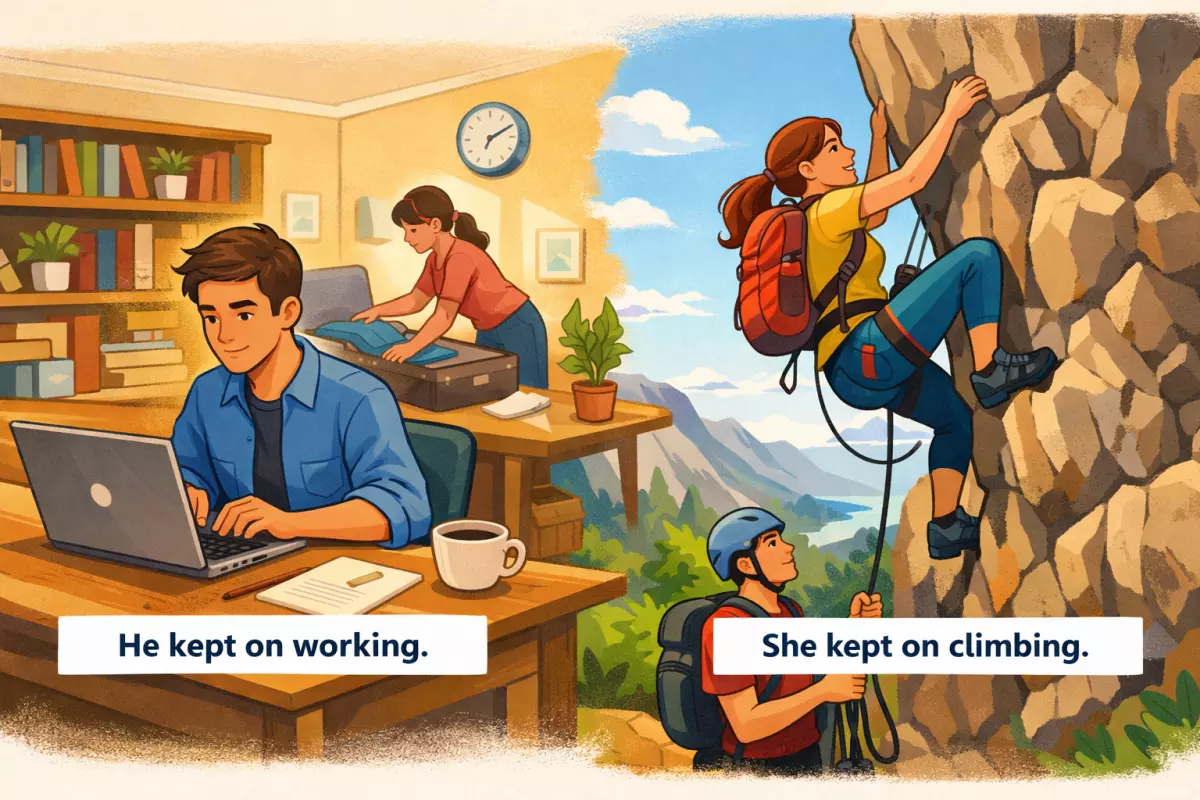
The core idea is that the phrasal verb keeps its idiomatic meaning, and the gerund simply names the action that becomes its object. In other words, you are not “changing the verb”; you are completing the phrasal verb’s pattern (verb + particle + object) with an -ing form.
Pattern to notice: the particle stays attached to the verb
When a gerund follows, treat the phrasal verb as one unit of meaning. The particle (up, off, out, in, on, etc.) signals the specific sense, and the -ing clause fills the “what?” slot.
- Structure: phrasal verb + gerund object → give up + smoking
- Meaning: the phrasal verb contributes the main meaning (quit, postpone, tolerate, continue), while the gerund names the activity (smoking, meeting, waiting).
- Result: the sentence reads as “quit what?” “postpone what?” “continue what?” rather than as two separate verbs.
Common meaning relationships (with examples)
Many phrasal verbs naturally take an activity as their object, so an -ing form fits smoothly. The meaning stays stable because the particle keeps the same role it has with noun objects.
- give up + gerund = quit an activity: ✅ She gave up drinking.
- put off + gerund = postpone: ✅ They put off meeting until Friday.
- keep on + gerund = continue (often despite difficulty): ✅ He kept on talking.
- carry on + gerund = continue: ✅ We carried on working after lunch.
- end up + gerund = finish by doing (unexpected result): ✅ I ended up taking the later train.
- look forward to + gerund = anticipate with pleasure (because to is a preposition here): ✅ She’s looking forward to traveling.
- get around to + gerund = finally do after delay: ✅ I finally got around to replying.
- go on + gerund = continue an activity: ✅ He went on explaining the rules.
- cut down on + gerund = reduce frequency/amount: ✅ She’s cutting down on eating sugar.
- talk about + gerund = discuss an activity: ✅ We talked about moving closer.
- insist on + gerund = demand: ✅ They insisted on paying.
- apologize for + gerund = express regret: ✅ He apologized for being late.
- complain about + gerund = express dissatisfaction: ✅ She complained about waiting so long.
- focus on + gerund = concentrate on an activity: ✅ Let’s focus on solving the problem.
- count on + gerund = rely on something happening: ✅ I’m counting on hearing from you soon.
- rule out + gerund = eliminate as an option: ✅ We ruled out driving at night.
Why this works: gerunds behave like nouns
In these patterns, the -ing form functions as a noun phrase, so it can follow prepositions and can serve as the object of the phrasal verb. This is why forms like look forward to meeting are natural: to is not an infinitive marker there; it introduces a prepositional phrase.
Quick “meaning check” to avoid mistakes
- Ask: “What activity is being named?” If the answer is an action, the gerund often fits: put off what? meeting.
- Keep the particle with the verb; don’t treat it as optional: ✅ They put off meeting. ❌ They put meeting off (possible with a noun, but awkward with a gerund clause in many contexts).
- Watch prepositions inside multi-word units: ✅ look forward to seeing you. ❌ look forward to see you.
- If the phrasal verb already has a clear noun-object meaning, the -ing form usually keeps the same sense: give up chocolate / give up eating chocolate.
Mistakes learners make with phrasal verbs like give up, keep on, or end up
The most common problems come from choosing the wrong verb form after a multi-word verb, mixing up meanings, or misplacing objects and pronouns. Because many of these expressions behave like single verbs, the grammar after them is often predictable once you learn the pattern.
Frequent errors and how to fix them
- ❌ Using an infinitive instead of a gerund after certain phrasal verbs: ❌ “He gave up to smoke.” → ✅ “He gave up smoking.”
- ❌ Switching forms mid-sentence: ❌ “She kept on to study and practicing.” → ✅ “She kept on studying and practicing.”
- ❌ Forgetting that end up is typically followed by a gerund (or a noun phrase): ❌ “We ended up to stay home.” → ✅ “We ended up staying home.”
- ❌ Confusing give up (stop doing) with give in (stop resisting): ❌ “I gave up arguing, so I agreed.” (This suggests you quit arguing, not that you surrendered.) → ✅ “I gave in and agreed.”
- ❌ Treating keep on as if it needs an object: ❌ “Keep on it doing.” → ✅ “Keep on doing it.”
- ❌ Putting the pronoun in the wrong place with separable phrasal verbs: ❌ “Put off the meeting it.” → ✅ “Put it off.”
- ❌ Using a noun when a gerund is needed to express an activity: ❌ “She gave up cigarettes” (only means the product) when you mean the habit. → ✅ “She gave up smoking.”
- ❌ Overusing “about” after think when the intended pattern is “think of” + gerund: ❌ “I’m thinking about to change jobs.” → ✅ “I’m thinking about changing jobs.” / “I’m thinking of changing jobs.”
- ❌ Missing the difference between stop + gerund vs. stop + infinitive (not a phrasal verb, but often confused in the same area): “He stopped smoking” (quit) vs. “He stopped to smoke” (paused in order to smoke).
- ❌ Using a base verb after be used to: ❌ “I’m used to wake up early.” → ✅ “I’m used to waking up early.”
- ❌ Confusing be used to (familiar with) with used to (past habit): ❌ “I used to working nights.” → ✅ “I used to work nights.”
- ❌ Adding “to” after phrasal verbs that already require a gerund: ❌ “They kept on to complain.” → ✅ “They kept on complaining.”
- ❌ Using the wrong preposition in a verb + preposition combination that behaves like a fixed unit: ❌ “I’m looking forward for meeting you.” → ✅ “I’m looking forward to meeting you.”
- ❌ Misreading to as an infinitive marker in “look forward to”: the to is a preposition, so it takes a gerund (or noun), not “to + verb.”
- ❌ Avoiding the gerund by forcing a clause that sounds unnatural: ❌ “He gave up because he didn’t want to continue to run.” → ✅ “He gave up running.”
Quick pattern reminders
- Many common multi-word verbs are followed by a gerund to describe an activity: “give up smoking,” “keep on talking,” “end up paying.”
- If the second word is a preposition (for example, “to” in “look forward to”), the next verb is usually in -ing form: “look forward to meeting,” “be interested in learning.”
- With separable phrasal verbs, pronouns typically go in the middle: “put it off,” “turn it down,” “figure it out.” This is separate from the gerund rule, but learners often mix the two issues in the same sentence.
Tips for recognizing phrasal verbs that take gerunds
Many multi-word verbs are followed by an -ing form because the particle + verb combination behaves like a single verb that normally takes an activity as its object. When you learn the common patterns, you can often predict when an -ing clause will sound natural.
- Look for “stop/quit” meanings. Phrasal verbs that express ending a habit or activity are frequently followed by a gerund:
✅ He gave up smoking. → (stopped the activity)
✅ She cut down on eating sugar. - Notice “avoid/escape” meanings. If the phrasal verb means avoiding something unpleasant, an -ing form often follows:
✅ They got out of paying the fine.
✅ I got around to writing the email. (focus on the action finally happening) - Watch for “continue/keep” meanings. Verbs that signal persistence commonly take an -ing complement:
✅ He kept on talking.
✅ She went on explaining the rules. - Check whether the object is an activity (not a thing). If what follows is clearly an action, the gerund is a strong candidate:
✅ We talked about moving abroad.
✅ They insisted on meeting in person. - Pay attention to prepositions inside the phrasal verb. When the second word is a preposition (on, about, to, of, for), it often introduces a noun/gerund phrase:
✅ She apologized for being late.
✅ He objected to changing the plan.
✅ We thought about taking a taxi. - Use the “noun test.” If you can replace the -ing form with a noun phrase, the structure is usually correct:
✅ He gave up smoking. → He gave up cigarettes.
✅ They insisted on meeting. → They insisted on a meeting. - Learn high-frequency combinations as chunks. These are commonly followed by gerunds in everyday usage:
- give up + -ing: give up scrolling, give up drinking
- put off + -ing: put off studying, put off calling
- keep on + -ing: keep on trying, keep on asking
- go on + -ing: go on working, go on talking
- get around to + -ing: get around to cleaning, get around to replying
- look forward to + -ing: look forward to seeing you, look forward to starting
- be used to + -ing: be used to waking up early, be used to driving
- insist on + -ing: insist on paying, insist on checking
- apologize for + -ing: apologize for interrupting, apologize for forgetting
- think about + -ing: think about moving, think about changing jobs
- talk about + -ing: talk about traveling, talk about saving money
- dream of + -ing: dream of living by the sea, dream of becoming a pilot
- complain about + -ing: complain about waiting, complain about working late
- prevent (someone) from + -ing: prevent him from leaving, prevent them from entering
- get out of + -ing: get out of doing chores, get out of paying
- Don’t confuse “to” as a preposition with “to” as an infinitive marker. In combinations like look forward to or be used to, to is a preposition, so it’s followed by a noun or gerund:
✅ I look forward to meeting you.
❌ I look forward to meet you. - Check whether the phrasal verb can take an object before the -ing form. Some patterns allow a noun/pronoun first, then the gerund phrase:
✅ They talked him into taking the job.
✅ She talked me out of buying it. - Use meaning to decide between -ing and other complements. A few multi-word verbs can be followed by different structures with a change in meaning. For example:
✅ He went on talking. (continued talking)
✅ He went on to explain the next step. (moved to a new action)
Quick self-check before you choose -ing
- Is the phrase after the verb an activity or process (something you do)? If yes, a gerund is likely.
- Does the phrasal verb end with a preposition (on/about/to/of/for/from)? If yes, expect a noun or -ing form next.
- Can you swap the -ing phrase for a noun without changing the grammar? If yes, the structure is probably correct.
Practice exercises: complete sentences using phrasal verbs with gerunds
Complete each sentence by adding the correct gerund form (-ing). Focus on the pattern phrasal verb + gerund (for example: give up + doing, look forward to + doing, carry on + doing).
Exercise 1: Add the gerund (-ing form)
- I finally gave up ________ (smoke) after ten years.
- She’s looking forward to ________ (meet) the new team.
- We carried on ________ (work) even when the internet went down.
- He put off ________ (call) the dentist until Friday.
- They ended up ________ (take) a taxi because the buses stopped.
- My parents don’t approve of me ________ (stay) out late on weekdays.
- I can’t help ________ (laugh) when I hear that story.
- Are you interested in ________ (join) the study group?
- She insisted on ________ (pay) for dinner herself.
- We talked about ________ (move) to a smaller apartment.
- He apologized for ________ (arrive) late to the meeting.
- I’m worried about ________ (lose) the file again.
Show answers
- smoking
- meeting
- working
- calling
- taking
- staying
- laughing
- joining
- paying
- moving
- arriving
- losing
Exercise 2: Choose the best completion
Select the option that correctly follows the phrasal verb and keeps the meaning natural.
- We’re thinking about ________ a car this year.
A) buy B) buying C) to buy - He kept on ________ even though everyone asked him to stop.
A) talk B) talking C) to talk - She’s not used to ________ up so early.
A) get B) getting C) to get - I’m tired of ________ the same mistake.
A) make B) making C) to make - They succeeded in ________ the deadline.
A) meet B) meeting C) to meet - He admitted to ________ the wrong file.
A) send B) sending C) to send - We ran out of ________ during the hike.
A) water B) to water C) watering - She complained about ________ ignored in the discussion.
A) be B) being C) to be - I’m looking forward to ________ from you soon.
A) hear B) hearing C) to hear - He’s responsible for ________ the final report.
A) write B) writing C) to write
Show answers
- B) buying
- B) talking
- B) getting
- B) making
- B) meeting
- B) sending
- A) water
- B) being
- B) hearing
- B) writing
Exercise 3: Rewrite using a phrasal verb + gerund
Rewrite each sentence so it includes a natural phrasal verb followed by a gerund. Keep the meaning as close as possible.
- I postponed calling my manager until Monday.
- She continued working despite the noise.
- He stopped trying to convince them.
- We discussed changing the schedule.
- They eventually stayed at home because of the storm.
- I’m excited about visiting your city.
- He said sorry for interrupting.
- She doesn’t like waiting in long lines.
Show answers
- I put off calling my manager until Monday.
- She carried on working despite the noise.
- He gave up trying to convince them.
- We talked about changing the schedule.
- They ended up staying at home because of the storm.
- I’m looking forward to visiting your city.
- He apologized for interrupting. (Already correct: apologize for + -ing.)
- She’s fed up with waiting in long lines.
Quick pattern reminders (for accuracy)
- After to in a phrasal verb, use a gerund: ✅ look forward to meeting ❌ look forward to meet.
- After a preposition, use a gerund: insist on paying, apologize for being, interested in learning.
- Common “continue” meanings often take a gerund: carry on working, keep on trying.
- Some items look like phrasal verbs but are fixed phrases with prepositions: be used to doing, be tired of doing, be responsible for doing.