What Is a Gerund in English? Definition and Examples

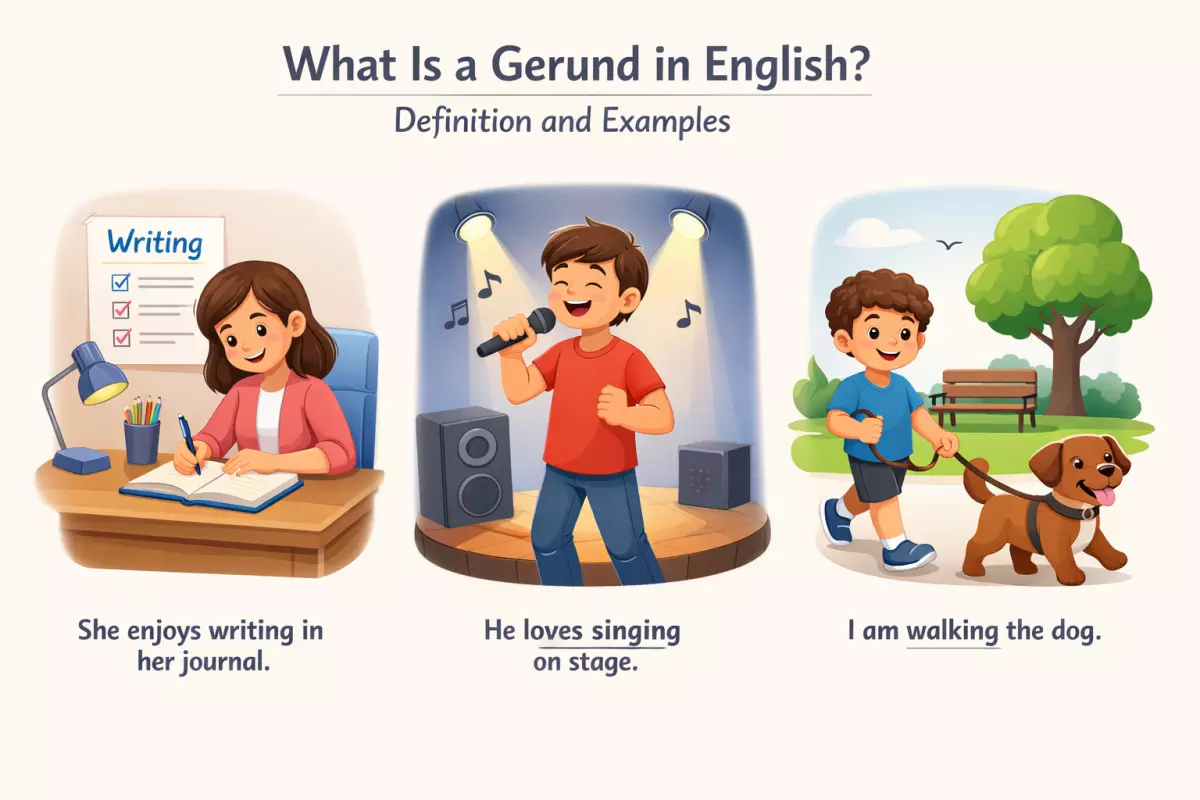 This article explains what a gerund is and why an -ing form can act as a noun, how to spot gerunds in real sentences, and the roles they play as subject, object, or complement. It also covers verbs and prepositions that trigger gerunds, common learner mistakes, and practice exercises.
- What a gerund is and why the -ing form can act as a noun
- How to identify gerunds in real English sentences
- The main sentence roles gerunds can have (subject, object, complement)
- Verbs that are typically followed by gerunds in English
- Why gerunds appear after prepositions in everyday speech
- Common mistakes learners make with gerunds
- Practice exercises: finding and using gerunds in sentences
In everyday English, a verb can act like a noun, and this form is called a gerund. It helps you talk about actions as things, so you can say you enjoy reading, avoid wasting time, or finish cleaning the kitchen. When you notice how the -ing form works in real sentences, it becomes easier to use it confidently and understand others.
What a gerund is and why the -ing form can act as a noun
A gerund is the -ing form of a verb used as a noun. It still comes from a verb (so it can keep verb-like features such as taking an object), but in the sentence it fills noun positions: subject, object, or complement. This is why you can often replace it with “the act of …” or “the activity of …” without changing the basic meaning.
Understanding the pattern is easier if you focus on job, not form: the same -ing word can function as a verb (part of a continuous tense), an adjective (a participle), or a noun (a gerund). A gerund is identified by how it behaves in the sentence.
How to recognize a gerund: the noun “slots” it fits into
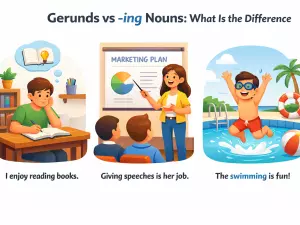
- Subject of a sentence: “Swimming relaxes me.”
- Direct object of a verb: “I enjoy reading.”
- Object of a preposition: “She left without saying goodbye.”
- Subject complement (after be): “My favorite hobby is cooking.”
- Object complement (after certain verbs): “They caught him cheating.” (Here “cheating” names the activity.)
- Part of a noun phrase: “His constant complaining was exhausting.”
Why the -ing form can behave like a noun
- English allows “verbal nouns”: the language can turn actions into things you can talk about, evaluate, or count as activities (e.g., “Running is hard”).
- It can take determiners like a noun: “The singing was beautiful.” / “Her singing was beautiful.”
- It can be modified like a noun: “Loud singing” / “Careful planning.”
- It can still keep verb-like structure: a gerund can take an object (“reading novels”), be negated (“not knowing”), or be modified by an adverb (“quickly finishing”).
- It can form longer “gerund phrases”: the whole phrase acts as a noun: “Learning a new language takes time.”
Common patterns you’ll see in real sentences
- Verb + gerund: “avoid driving,” “consider moving,” “finish writing,” “keep trying.”
- Preposition + gerund: “good at explaining,” “interested in learning,” “tired of waiting,” “before leaving.”
- Possessive + gerund (more formal): “I appreciate your helping.”
- Object form + gerund (very common in speech): “I appreciate you helping.”
- Negative gerund: “He apologized for not calling.”
- Gerund with an object: “She suggested taking the train.”
- Gerund with an adverb: “Quickly answering emails saves time.”
- Gerund after “no” for rules/signs: “No smoking.” “No parking.”
- Fixed expressions: “It’s no use arguing.” “There’s no point complaining.”
- Gerund as a general activity: “Cooking is fun.” (general) vs. “To cook tonight is my plan.” (specific plan, more “to-infinitive” style)
Gerund vs. continuous verb: a quick way to tell
- ✅ Gerund (noun role): “Running helps my mood.” (Running = the activity)
- ✅ Continuous verb (verb role): “I am running now.” (am running = the action in progress)
- ❌ Common confusion: “I am running helps my mood.” (This needs a noun-like subject, so “Running” is correct.)
How to identify gerunds in real English sentences
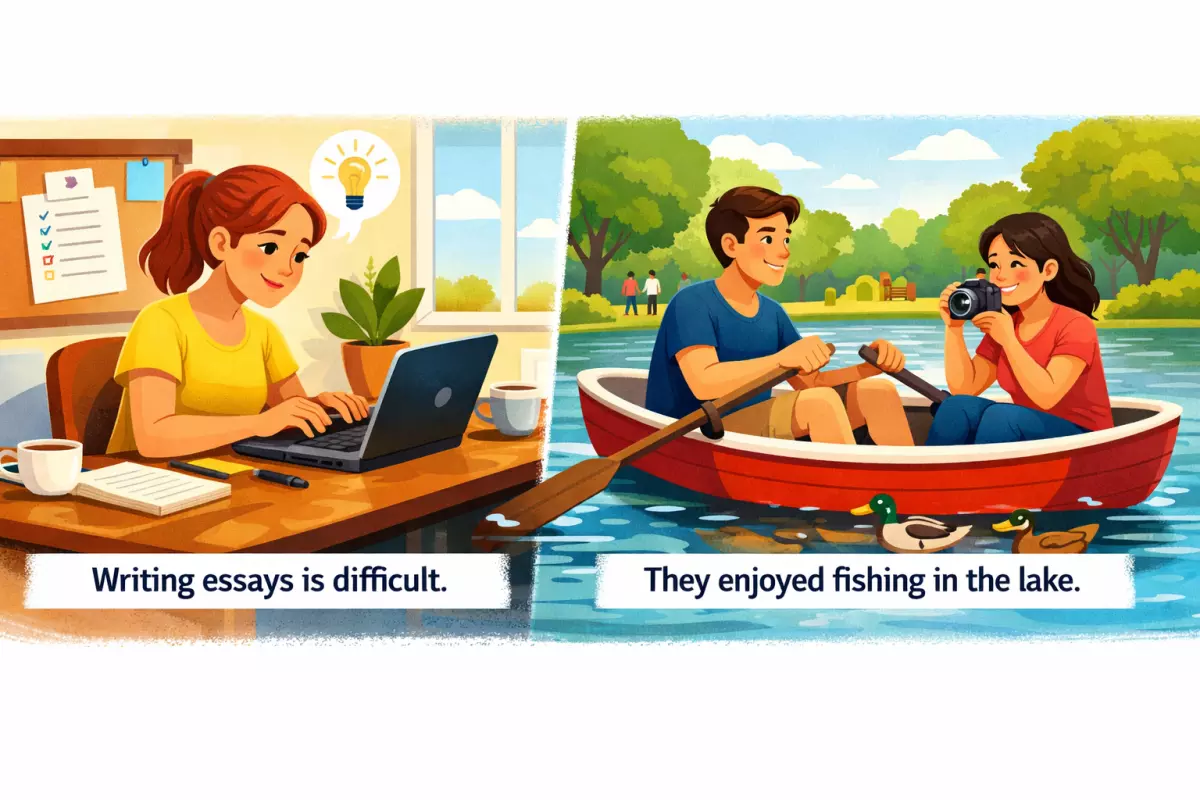
Spotting a gerund starts with form and then moves to function. A gerund looks like a verb ending in -ing, but it behaves like a noun in the sentence. The key is to check what job the -ing word is doing: naming an activity, acting as a subject/object, or following a preposition.
Step 1: Confirm it is an -ing form, then test its role
- Find the -ing word and ask: is it naming an action as a “thing” (an activity or idea), rather than describing a noun?
- Swap-test: replace the -ing word (or phrase) with it or a noun like this activity. If the sentence still works grammatically, it’s likely a gerund.
- “Swimming relaxes me.” → “It relaxes me.” (works)
- Question-test: if the word answers “What?” or “Which activity?” rather than “What kind?” it usually points to a noun function.
Common positions where gerunds appear
- As the subject of a sentence (the activity is the topic):
- “Reading before bed helps.”
- “Working late isn’t always productive.”
- “Traveling alone can be empowering.”
- As the object of a verb (the activity receives the action):
- “She enjoys cooking.”
- “They avoided talking about it.”
- “I considered moving closer.”
- “He kept interrupting.”
- After a preposition (a very reliable clue):
- “Thanks for helping.”
- “She’s interested in learning Korean.”
- “He left without saying goodbye.”
- “They succeeded by practicing daily.”
- “I’m tired of waiting.”
- As a subject complement (after be, identifying what something is):
- “Her hobby is painting.”
- “The hardest part was starting.”
- In fixed patterns with “go” (activity names):
- “Let’s go shopping.”
- “We went hiking last weekend.”
How to tell a gerund from a present participle
Both forms end in -ing, so the difference is the grammatical job. A present participle acts like a verb (part of a verb tense) or like an adjective (describing a noun). A gerund acts like a noun.
- Gerund (noun role): “Running is my favorite exercise.” (Running = the activity)
- Present participle in a verb phrase: “I am running now.” (running = part of the present continuous verb)
- Present participle as an adjective: “The running water was cold.” (running describes water)
- Quick check: if the -ing word directly modifies a noun (like an adjective), it is usually not a gerund.
Gerund phrases: look beyond the single word
A gerund can bring its own objects and modifiers, forming a gerund phrase that still functions as a noun.
- “Learning new vocabulary takes time.” (phrase = subject)
- “She apologized for arriving late.” (phrase after a preposition)
- “I remember meeting him at the conference.” (phrase = object)
- “Their goal is saving enough money for a deposit.” (phrase = complement)
Common pitfalls to watch for
- -ing after “to”: “to” can be a preposition or part of an infinitive. If it’s a preposition, it’s followed by a gerund.
- ✅ “I’m committed to improving.” (to = preposition)
- ❌ “I want to improving.” (want to + base verb)
- ✅ “I want to improve.”
- Possessives before gerunds (more formal, but still common): “I appreciated your helping.” / “I appreciated you helping.” Both appear in real usage; the possessive version treats the activity more like a “thing.”
- Don’t label every -ing word as a gerund: “The man standing by the door waved.” (standing describes “man,” so it’s participial, not a noun use).
The main sentence roles gerunds can have (subject, object, complement)
A gerund (the -ing form used as a noun) can sit in several core positions in a sentence. In each role, it behaves like a noun phrase: it can take modifiers, it can be expanded into a longer phrase, and it answers questions like “what?” or “which activity?”
-
1) Gerund as the subject
When the -ing form is the subject, it names the activity that performs the verb. This is common for general statements, habits, and rules.
- Pattern: Gerund + verb → “Swimming relaxes me.”
- With a longer phrase: “Driving at night requires extra attention.”
- With an object: “Learning languages opens doors.”
- With a modifier: “Careful planning prevents problems.”
- ✅ “Working from home saves commuting time.” ❌ “Work from home saves commuting time.” (when you mean the activity as a noun)
Tip: a gerund subject often sounds more natural when it is not too long. If the subject phrase becomes heavy, English often uses a different structure (for example, starting with “It…”), but the gerund-as-subject form is still grammatically correct.
-
2) Gerund as an object
Gerunds frequently appear after certain verbs and prepositions. In these positions, they function as the thing being done, enjoyed, avoided, finished, and so on.
- Direct object after a verb: “I enjoy cooking.”
- After a preposition: “She’s interested in coding.”
- After phrasal/prepositional verbs: “They talked about moving.”
- After “spend (time/money)”: “We spent the afternoon hiking.”
- After “be used to”: “I’m used to waking up early.”
Common verb + gerund patterns (a quick set to learn):
- avoid + gerund → “Avoid touching your face.”
- consider + gerund → “Consider taking a break.”
- finish + gerund → “Finish writing the email.”
- keep + gerund → “Keep practicing.”
- mind + gerund → “Do you mind waiting?”
- miss + gerund → “I miss seeing my friends.”
- recommend + gerund → “I recommend reading it.”
- risk + gerund → “You risk losing data.”
- suggest + gerund → “She suggested leaving early.”
- stop + gerund → “He stopped smoking.”
- admit + gerund → “They admitted making a mistake.”
- deny + gerund → “She denied breaking it.”
Note: some verbs can take either a gerund or an infinitive with a change in meaning (for example, “stop,” “remember,” “try”). That difference comes from the verb’s pattern, not from the -ing form itself.
-
3) Gerund as a complement
In complement positions, the gerund completes the meaning of the clause. The most common case is after the verb “be,” where it identifies what something is (or what someone’s role/activity is).
- Subject complement after “be”: “Her favorite hobby is painting.”
- Defining a job/role: “My main task is troubleshooting.”
- Explaining a problem: “The issue is getting accurate data.”
- Giving a goal/focus: “Our priority is improving safety.”
- With a longer phrase: “The hardest part was staying calm under pressure.”
This use is especially helpful when you want to label an activity as the key point: hobby, task, issue, priority, challenge, or goal.
Verbs that are typically followed by gerunds in English

Many common verbs take an -ing form as their direct object. In these patterns, the gerund works like a noun: it names an activity, habit, or experience. Learning the most frequent verb + gerund combinations helps you avoid mixing them up with infinitives (to + base verb).
Common verbs that take a gerund
- enjoy: I enjoy reading on the train.
- avoid: She avoids driving at night.
- consider: We’re considering moving closer to work.
- finish: He finished writing the report.
- keep: They kept talking during the movie.
- mind: Do you mind waiting a moment?
- miss: I miss seeing my cousins.
- practice: She practices speaking every day.
- suggest: He suggested taking a break.
- recommend: The doctor recommended resting for a few days.
- admit: She admitted making a mistake.
- deny: He denied taking the keys.
- risk: You risk losing your data without backups.
- postpone: They postponed meeting until Friday.
- delay: The airline delayed boarding the plane.
- quit: He quit smoking last year.
- give up: She gave up trying to fix it herself.
- can’t stand: I can’t stand waiting in long lines.
Usage notes and common pitfalls
- Gerund after prepositions: If a verb is followed by a preposition, the next verb is usually in -ing form. Example: They insisted on paying for dinner.
- “Suggest / recommend” patterns: These often take a gerund or a that-clause. ✅ She suggested leaving early. ✅ She suggested that we leave early. ❌ She suggested to leave early.
- “Mind” in questions: “Do you mind + -ing?” is a polite request. The expected answer focuses on whether it’s a problem: “No, not at all” (meaning it’s fine).
- Phrasal verbs: Some multi-word verbs commonly take a gerund (for example, give up, put off, keep on). Treat the whole phrase as the verb: They put off moving.
When you’re unsure, test whether the -ing phrase can be replaced by a noun. If it works (for example, “I enjoy reading” → “I enjoy books”), a gerund is often the natural choice.
Why gerunds appear after prepositions in everyday speech
In English, a preposition needs an object to complete its meaning. When that “object” is an action, English typically expresses the action as a noun-like form, which is why the -ing form (a gerund) is so common after prepositions. This pattern is especially noticeable in everyday conversation because people constantly talk about reasons, methods, timing, and reactions—ideas that are often introduced with prepositions like about, for, by, and after.
In practical terms, think of a preposition as a bridge word that points to a thing. If the “thing” you want to point to is an activity, you treat that activity like a noun: talked about + moving, interested in + learning, good at + explaining.
Core usage pattern
- Preposition + noun: “She’s interested in music.”
- Preposition + gerund: “She’s interested in learning.”
- ❌ Common mistake: “She’s interested in learn.”
- ❌ Common mistake: “She’s interested in to learn.” (after a preposition, this is usually not the standard structure)
Prepositions that frequently take gerunds
These are some of the most common “preposition + -ing” pairings you hear in daily speech. Each example shows the preposition introducing an activity as its object.
- about: “We talked about moving.”
- after: “After finishing work, I went home.”
- before: “Wash your hands before eating.”
- by: “You can improve by practicing.”
- for: “Thanks for helping.”
- from: “He stopped her from leaving.”
- in: “She succeeded in finding a solution.”
- on: “They’re working on updating the website.”
- of: “He’s capable of handling it.”
- with: “I’m fine with waiting.”
- without: “He left without saying goodbye.”
- at: “She’s good at explaining things.”
- instead of: “Instead of driving, we walked.”
- because of: “Because of missing the bus, I was late.”
- due to: “Due to having a meeting, I can’t come.”
Why this feels natural in conversation
- It keeps the sentence compact. “Thanks for helping” is shorter and smoother than rephrasing the idea with a full clause.
- It matches how English packages actions as “things.” After a preposition, speakers often need an object quickly, and a gerund fills that slot cleanly.
- It supports common “chunk” phrases. Expressions like “good at,” “interested in,” and “tired of” are often learned as fixed patterns, and the -ing form naturally follows.
- It avoids awkward infinitive structures. Many learners try “to + verb” after a preposition, but standard usage usually prefers the gerund in that position.
Everyday sentence frames to copy
- “I’m thinking about ___ing.”
- “Thanks for ___ing.”
- “I’m good at ___ing.”
- “I’m interested in ___ing.”
- “I’m tired of ___ing.”
- “I’m worried about ___ing.”
- “I apologized for ___ing.”
- “I succeeded in ___ing.”
- “I left without ___ing.”
- “I did it by ___ing.”
Common mistakes learners make with gerunds
Many errors with -ing forms come from mixing up when English needs a noun-like form (a gerund) versus a verb-like form (an infinitive or a present participle). The patterns below focus on the most common trouble spots and how to fix them.
- Using an infinitive after a verb that normally takes an -ing form
❌ I enjoy to swim. → ✅ I enjoy swimming.
Common verbs that are typically followed by an -ing form: enjoy, avoid, finish, consider, suggest, recommend, mind, practice, miss, quit. - Using an -ing form after a verb that normally takes the infinitive
❌ I decided going. → ✅ I decided to go.
Verbs that often take to + base verb: decide, plan, hope, want, need, promise, agree, refuse, learn. - Forgetting that some verbs change meaning depending on -ing vs. infinitive
✅ I stopped smoking. (I quit the habit.)
✅ I stopped to smoke. (I paused another activity in order to smoke.)
Other meaning-changing pairs: remember doing / remember to do, try doing / try to do, regret doing / regret to do (formal), go on doing / go on to do. - Confusing gerunds with present participles
A gerund acts like a noun: ✅ Swimming is relaxing. (subject)
A present participle acts like part of a verb or an adjective: ✅ She is swimming. / ✅ The swimming child waved. - Using the wrong form after prepositions
After a preposition, English typically uses an -ing form, not an infinitive.
❌ She’s good at to explain. → ✅ She’s good at explaining.
Common preposition patterns: interested in, tired of, afraid of, focused on, responsible for, before/after + -ing, without + -ing, instead of + -ing. - Misusing “to” when it is a preposition (not an infinitive marker)
In expressions like “look forward to,” “be used to,” and “object to,” to is a preposition, so it is followed by an -ing form.
❌ I look forward to meet you. → ✅ I look forward to meeting you.
❌ She’s used to work late. → ✅ She’s used to working late. - Leaving out the gerund as the object of an expression
Some fixed phrases require an -ing form to complete the meaning.
❌ It’s worth. → ✅ It’s worth trying.
❌ There’s no point. → ✅ There’s no point arguing. - Putting a full clause after a preposition instead of using an -ing clause
❌ After she arrived, we ate. → ✅ After arriving, she ate with us. (when the subject is clear)
Use this carefully: it works best when the subject of the -ing clause matches the subject of the main clause. - Creating a “dangling” -ing clause (unclear subject)
❌ Walking to the station, the rain started. (Who was walking?)
✅ Walking to the station, I got caught in the rain.
Make sure the doer of the -ing action is the subject of the main clause. - Using an object pronoun where a possessive is expected (formal writing)
In more formal English, a possessive can sound more natural before a gerund.
✅ I appreciate your helping me. (more formal)
✅ I appreciate you helping me. (common in speech)
Both appear in real usage; choose based on formality and clarity. - Forgetting the negative form
Negatives usually place not before the -ing form.
❌ He admitted to not telling the truth. (possible, but often awkward here)
✅ He admitted not telling the truth. - Mixing up “be used to” and “used to”
✅ I used to live here. (past habit; base verb)
✅ I’m used to living here. (accustomed; -ing form) - Using an -ing form after “help” in contexts where the base verb is more natural
✅ Can you help me carry this? (very common)
✅ Can you help me carrying this? (possible in some varieties, but less standard in many contexts)
If you’re aiming for broadly standard usage, prefer help + object + base verb. - Overusing -ing after “like/love/hate” without noticing the meaning
✅ I like swimming. (general enjoyment)
✅ I like to swim in the morning. (often sounds like a preference or habit; can feel more specific or intentional)
Both can be correct; the difference is usually subtle and context-dependent.
Quick pattern check
- After a preposition → use an -ing form (interested in learning, good at explaining).
- After certain verbs → memorize whether they take -ing (enjoy doing) or infinitive (decide to do).
- When the -ing word is the subject or object of the sentence → it’s functioning as a noun (Reading helps me focus).
- When the -ing word describes a noun or is part of a continuous tense → it’s a participle (a running joke; she is running).
Practice exercises: finding and using gerunds in sentences
Use the activities below to spot -ing forms that function as nouns and to choose the correct structure after common verbs, prepositions, and expressions. Pay attention to what the -ing word is doing in the sentence (subject, object, complement, or object of a preposition).
1) Identify the gerund(s)
In each sentence, find the gerund or gerund phrase. Ignore present participles used only for continuous tenses (e.g., “is running”) and adjectives (e.g., “a running joke”).
- Swimming in cold water wakes me up fast.
- She apologized for arriving late.
- His favorite hobby is building model planes.
- We discussed moving the meeting to Friday.
- They’re interested in learning Korean.
- Reading before bed helps me sleep.
- I’m tired of explaining the same rule.
- One benefit of cooking at home is saving money.
- He avoided answering the question directly.
- My parents insisted on paying for dinner.
- There’s no point in arguing about it now.
- She suggested taking a short break.
Show answers
- Swimming in cold water
- arriving
- building model planes
- moving the meeting to Friday
- learning Korean
- Reading before bed
- explaining the same rule
- cooking at home; saving money
- answering the question directly
- paying for dinner
- arguing about it now
- taking a short break
2) Choose gerund (-ing) or infinitive (to + base verb)
Complete each sentence with the correct form. Some items allow both forms, but choose the one that best fits the meaning.
- I can’t stand ________ (wait) in long lines.
- We decided ________ (leave) early because of the weather.
- He admitted ________ (break) the rules.
- She hopes ________ (study) abroad next year.
- They finished ________ (paint) the kitchen.
- Do you mind ________ (open) the window?
- I promised ________ (call) you after work.
- He kept ________ (ask) the same question.
- She offered ________ (help) with the report.
- We’re considering ________ (rent) a smaller apartment.
- I forgot ________ (lock) the door. (It didn’t happen.)
- I’ll never forget ________ (meet) her for the first time. (A memory.)
Show answers
- waiting
- to leave
- breaking
- to study
- painting
- opening
- to call
- asking
- to help
- renting
- to lock
- meeting
3) Fix the sentence (common pattern errors)
Rewrite each sentence so the structure is correct. Focus on these patterns: preposition + -ing, verb + -ing, and “it’s worth/no use + -ing.”
- ❌ She is good at to solve puzzles.
- ❌ I look forward to meet your team.
- ❌ They suggested to take the train.
- ❌ He avoided to talk about money.
- ❌ It’s no use to argue with him.
- ❌ Are you interested to join us?
- ❌ I’m tired of to hear that excuse.
- ❌ She insisted to pay for everything.
- ❌ He left without to say goodbye.
- ❌ This book is worth to read.
Show answers
- ✅ She is good at solving puzzles.
- ✅ I look forward to meeting your team.
- ✅ They suggested taking the train.
- ✅ He avoided talking about money.
- ✅ It’s no use arguing with him.
- ✅ Are you interested in joining us?
- ✅ I’m tired of hearing that excuse.
- ✅ She insisted on paying for everything.
- ✅ He left without saying goodbye.
- ✅ This book is worth reading.
4) Write your own (controlled production)
Create original sentences using the prompts. Each answer must include a gerund or gerund phrase.
- Write a sentence where the gerund phrase is the subject.
- Write a sentence where the gerund is the direct object after a verb (e.g., enjoy, avoid, consider).
- Write a sentence with a preposition + gerund (e.g., interested in, good at, before, after).
- Write a sentence using “There’s no point in …” + gerund.
- Write a sentence using “It’s worth …” + gerund.
- Write a sentence with a possessive before a gerund (e.g., “I appreciate your helping …”).
Show answers
- Example: Practicing every day improves your pronunciation.
- Example: I enjoy learning new idioms.
- Example: She’s good at explaining grammar clearly.
- Example: There’s no point in complaining if you won’t change anything.
- Example: This documentary is worth watching.
- Example: I appreciate your taking the time to review my draft.